Transcripts
1. Start Even If You Don’t Feel Ready : Sit down to create
and nothing moves. You feel stuck.
Maybe you even feel a little guilty
for not starting. The feeling is more
common than you think, especially if you're a
beginner who wants to draw, paint, design, write,
or try an AI tool, but keeps waiting
for the right mood. If that's you, take a
breath. You're not lazy. You're just overwhelmed. Here we're going to do
something very small. We're going to focus on
starting for 5 minutes only. Not an hour, not until
it's perfect, 5 minutes. I'm Paul, I help beginners
learn new skills in a clear and simple way so they can feel safe
trying something new. I had many days where
I wanted to create but kept opening and
closing my tools instead. Everything, except
actually begin. What changed things for me was lowering the starting line. I teach this because I know how heavy just start can sound. It feels big, it feels serious. So we're going to make it small. By the end of this, you will
know exactly when to begin. The answer is simple. You begin for 5 minutes only. This works on its own, and it also connects naturally with other simple habits
you might build later. If you're already someone who creates daily for
long stretches, this will feel basic. That's okay. You can
use it as a reset. But if you're new, overwhelm, or stuck in overthinking,
this is for you. You don't need special tools. Any creative tool
will work a pencil, a notebook, a painting app, an AI image generator,
even your phone. We'll go slowly.
First, we'll talk about what's really happening
when you feel stuck. Then we'll choose
one very small task. Then we'll set a
five minute timer. Finally, we'll
stop when it ends. Nothing dramatic, a
small, clear start. You don't need motivation. You just need 5 minutes. Let's begin gently.
2. Create Something for Five Minutes Only: When you feel blocked, it can feel silly to
make something tiny. You might think 5 minutes won't matter. I've
thought that, too. But here's what
we're going to do. You will create
one small piece of creative work for 5
minutes only. That's it. This is called 5 minutes start. It can be a sketch,
a short paragraph, a rough painting,
a simple design, or an AI generated image. You guide with a prompt. The only rule is that you
stop after 5 minutes. You build it slowly as we go. First, you'll choose
one very small task. Then you'll set a
five minute timer. Then you'll stop
when the timer ends. The primary material is simple. Any creative tool
you already have. If you draw, use your pencil. If you design, open
your design app. If you use AI tools, open one and type
a simple prompt. You can work along with
me, pause if you need to rewind if you want to
hear something again. At the end, you'll have one small piece
created in 5 minutes. It might look unfinished.
That's perfect. This is about starting,
not polishing. You are not trying
to impress anyone. You are practicing beginning. Even if your results
feels messy, you're doing the real thing. You're creating, and
that already counts. Let's look at what
makes starting feel so hard and
how to soften it.
3. Lower the Starting Line : When you feel stuck, it usually isn't because
you cannot create. It's because the starting
line feels too high. You might think you need to
create something good or something complete or
something worth sharing. That pressure freezes you. So here's the simple idea. Lower the starting line to
5 minutes only. That's it. 5 minutes is short enough that
your brain doesn't panic. It knows it can
handle 5 minutes. There are three
simple parts to this. First, choose one very
small thing to do. Not a full project,
just a small piece. Second, set a five minute timer, a real one on your
phone or computer. Third, stop when the timer ends. Even if you feel like continuing
why does this matter? Because when you tell yourself, I'll just do 5 minutes, you remove the weight
of a long session. You're not committing
to finishing. You're committing to beginning. For example, if you want
to draw a portrait, you don't say, I'll
finish the portrait. You say, I'll sketch the
outline for 5 minutes. If you want to write a story, you don't say, I'll
write the whole scene. You say, I'll write
for 5 minutes. If you want to
create an AI image, you don't say, I'll
build full series. You say, I'll try one
prompt for 5 minutes. The decision here is simple. Choose to begin for
5 minutes only. No more, not less. This works because action
reduces overthinking. When your hand moves,
your mind quiets. When you see
something forming on the page or screen,
the block weakens. So the flow is clear.
Choose one tiny task, set a five minute timer, stop when it ends. That's how you lower
the starting line. Now, let's actually do it.
4. Choose One Very Small Creative Task : You might feel tempted
to choose something big. Your brain wants
to make it count. But right now,
small is powerful. Let's use a simple example
so you can follow along. Project title 5 minutes Start, primary material, a pencil,
and a sheet of paper. First, take your paper and place it in front of you. Just that. Put it on the table. Next,
decide on one tiny task. No draw a full character. Instead, choose something like sketch the outline
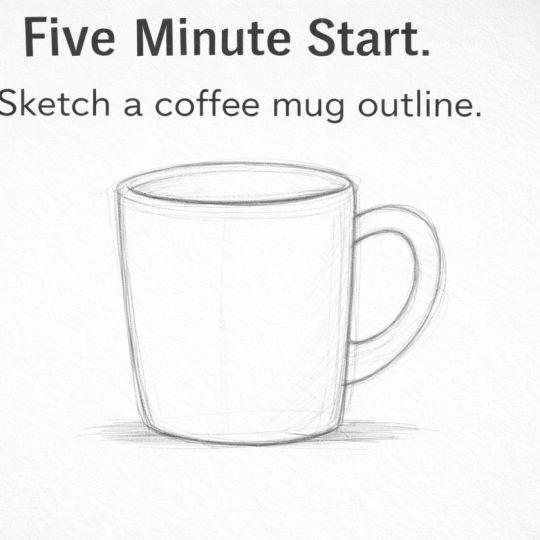
of a coffee mug. Then right at the top of
the page, 5 minutes start. Under that lightly right, sketch a coffee mug outline. That's your tiny task. Now look at the blank
space below it. The space is where your
5 minutes will go. Notice how small this feels. You are not committing to
shading, details or background. When I first try this method, I would accidentally choose tasks that were still too big. I'd say, I'll sketch
a full scene. Then I'd stall again. When I finally chose
something simple like one object, it
felt manageable. So pause for a moment
and ask yourself, is this task small enough
to finish in 5 minutes? If not, shrink it again. Maybe it becomes draw the top curve of a
mug. That's allowed. You've now chosen
your tiny task. That alone is a win. You moved from
stock to specific. That shift matters. In the next part,
we'll add the timer.
5. Set a Five Minute Timer and Begin : Even with a small task, you might still hesitate. You might think, maybe
I'll just scroll first. That's okay. Notice it. Then return to the plan. Open your phone or computer and set a timer for 5 minutes. No four, not ten, five. Place the timer where
you can hear it clearly. Now, look at your paper again. First, put your
pencil on the page. Just touch it to the paper. Next, draw a simple curve
line for the top of the mug. It doesn't have to be
perfect, just a curve. Then draw two lines
downward for the sides. Keep them light. After that, connect the bottom
with another curve. Finally, add a small
handle shape on one side. Keep going gently
until the timer ends. Maybe you adjust a line, maybe you redraw part
of it, that's fine. If you're using an AI tool, first type a simple prom like simple coffee mug
sketch, black and white. Minimal style.
Next, click Genre. Then adjust one word in
the prom if you want. Maybe change minimal
to hand drawn. Let the 5 minutes pass
while you explore lighting. When the time rings, stop
immediately. This is important. Even if you feel like you're
just getting into it, stop. Stopping builds trust. You told yourself 5 minutes,
you kept your word. That feels good. You
just created something. It might be simple, it might
be rough, but it exists. And that's different
from being stuck. In the next part, we'll practice stopping calmly and
noticing what changed.
6. Stop When the Timer Ends : Sometimes stopping is
harder than starting. You might think I should keep going now that I'm in the flow. But here we are practicing
something very gentle. We are practicing beginning
without pressure. So when the time rings, put your pencil down. Look at your coffee mug outline. First, take a slow breath. Next, notice one
small thing you like. Maybe the curve feels nice, maybe the handle looks balanced. Then resist the urge to fix it. Just leave it as it is. If you're on an AI tool,
stop adjusting prompts. Save the image as it is. Now look at what happened
before you were stuck. Now you have a visible result. A simple outline,
a simple image. It might not be impressive, but it is real. This is the calm
power of 5 minutes. You didn't wait for inspiration. You didn't argue with yourself. You just began. Overtime, these five
minute starts add up. Some days you will
stop and walk away. Other days, you might
choose to continue later, but the rule stays the same. The commitment is
5 minutes only. That reduces pressure. It makes starting safe. I remember one week where I did nothing but 5
minutes sketches. Some were messy,
some were awkward, but by the end of the week, I
had a small stack of pages. And more importantly, I
felt less afraid to begin. You just completed
the full process. You chose something tiny. You set a timer, you
stopped when it ended. That's it. You now know how
to lower the starting line.
7. Share Your Five Minute Start : Your project is simple. You created one small
piece in 5 minutes. Primary material, a pencil and paper or any creative
tool you chose. Project title 5 Minutes Start. Short project
description example, a quick coffee mug
outline created in 5 minutes to practice
starting without pressure. Here is the final example
from start to finish. At the top of the page,
it says 5 minutes start. Below, it says, sketch
a coffee mug outline. Under that is a simple
drawing of a coffee mug. It has a curve top,
two light side lines, a curved bottom, and a
small handle on the. The lines are slightly uneven. There's no shading, no
background, just the outline. That is the complete project. In the first part, you chose the small task and
wrote it down. In the second part, you set a five minute timer
and drew the outline. In the final part,
you stopped when the timer ended and
left it as it was. This works because it
proves you can begin. You don't need a long
session to make progress. You need a small start. To upload, take one clear photo or screenshot of
what you created. And the project title
5 Minutes Start, write one or two sentences
about what you made. It's best to upload soon after finishing while it's still
fresh. Keep it simple. Most people share small imperfect
work. That's the point. No one expects a
masterpiece here. This is practice
not performance. Once you uploaded, you've
completed everything.
8. What If I Still Feel Stuck Tomorrow : You finish the full
process that matters. Still, it's normal to
still have few questions. First question, what if 5 minutes feels too
short to matter? That makes sense.
It can feel tiny. But if you tell yourself,
it's only 5 minutes. Your mind relaxes. If you sketch one simple
object like a coffee mug, you are building the
habit of starting. The length is small, but the shift from stock to moving is big. Second question. What if I want to
continue after 5 minutes? That's a good sign. If you finish your mug
outline and feel energized, you can choose to
continue later. But the promise you
made was 5 minutes. Keeping that promise
builds trust. If you always extend it, it can quietly turn
back into pressure. Third question, what if my
5 minutes result looks bad? That's very normal. If your mug looks uneven, that's fine. The goal was not quality. It was beginning. If you focus on the
act of starting, the quality improves over time because you are
creating more often. Here's one small tip. If
you feel extra resistance, shrink the task even more. Instead of sketching
a full mug outline, draw just the top
curve for 5 minutes. The smaller it is, the
easier it is to begin. And one more mindset shift. Instead of asking, is this good, ask Did I begin? That question
changes everything.
9. Remember the Five Minute Rule : You did something
important here. You faced that stock feeling. You chose something small. You set a timer. You
stopped when it ended. If there's one thing I hope
you take with you, it's this. You don't need to
feel ready to begin. 5 minutes is enough. You are not someone
who can't start. You are someone who just
needed a lower starting line. Here's a simple shortcut
to remember it. Think of the word start. Small task, time is set, act gently, respect the
5 minutes, then stop. That's what you were
doing all along. It's simple, but simple works. I've noticed something
interesting over the years. The days I told myself, I needed to create something great where the
days I avoided it. The days I told myself just 5 minutes were the
days I actually showed up. Thank you for being
here and trying this. Please upload your 5
minutes start project. Even if it's just a simple
mug outline, it counts. And I would truly
appreciate it if you leave a review sharing
your experience because your review
helps me grow as a teacher and help other
beginners find this lesson. If you have questions, that's completely normal. Ask them. Be proud of yourself. You turn stuck into action. And the next time
you feel blocked, remember how small
this can be 5 minutes. That's enough to begin. Thank you for taking this class. I'll see you in the next lesson.
 Paul Nene, Helping beginners take action