Transcripts
1. Intro: Welcome to this goal setting and productivity workshop
where you'll learn how to prioritize your goals
and break them down into actionable steps and then create a visual calendar to manage your time and
reach your dreams. Do you have a lot
of things going on and you feel like
you're always working, but you feel unproductive. You have trouble sticking to schedules and a hard time
reaching your goals. My name is Mika and I'm a published author
and an illustrator, an artist, a mom, and
a business owner. If I had a dime, for
every time someone asked me how I managed to get so much done while staying
at home with the kids, I'd be ready to
retire this week. I have ADHD, and juggling,
multifaceted, small business, and staying at home
with three kids has taught me a few things about time management
and organization. I've created a visual
scheduling system that's helped me
become more productive and that helps create calm and peace in the chaos
that I call life. During this workshop, I'll share my mindset shifts and my
tips and techniques about time management and productivity so that you can set your goals and achieve them
without feeling like you've missed out on life
while trying to achieve them. We'll also talk about
how to stay motivated, how to overcome rejection
and manage distractions, and what to do when life
happens and gets in the way, and how blocking time
increases your productivity. For the class project, you'll be filling out a four
page workbook and then scheduling tasks into a visual calendar for about
three to six months time. It may sound like a lot, but once we get going and
you see how easy it is, we'll prioritize your goals and break them down into steps, and then you'll feel
organized and motivated to start knocking out those projects and
reaching your goal. Are you ready to balance your life and reach
your goals? Let's go.
2. Class Overview: I created this class
for other creatives and entrepreneurs who
might be feeling stuck and kind of
anxious in their life. So I personally learned about vision boards and goal setting
about five, six years ago. And while the elaborate
vision boards really did not feel
like my thing, figuring out my life
goals really did make a big change in how
I was moving forward. And for many, many years, I've tried to keep all
kinds of planners, but a lot of times I would
forget to write in them, and then I would have big gaps, and these kinds of
physical planners never really I wasn't able to see
kind of my whole schedule. All at the same time. And so that kind of gave me
a lot of anxiety. And so, about 1.5 years ago, I started scheduling
everything in kind of big chunks of time and with
multiple months at the time. And so that changed my
productivity again, and it gave me peace of mind, knowing that I'll be able
to fit everything into my calendar without
having to keep track of everything in
my head all the time. So this class has
kind of two projects. In the first half, we'll do a little
bit of goal setting and you'll prioritize your goals and figure
out what your kind of number one big life goal is. And then you'll spend
some time breaking that big life goal
into smaller steps. And then in the second half, we'll take those
steps and schedule them into a visual calendar
with blocks of time. So at the end of the class, you'll have figured out kind of what your number
one big goal is, and then you'll
have a schedule to follow to start working towards. Is a four page handout that
is part of this class. You can download and print that. And there's also a digital
perpetual calendar that you can use to
create your own calendar. I've also created a Procreate calendar brush that is available for $3 if you want a faster way to
schedule in the future, but it's not
necessary in any way for you to be able to
complete this class. Once you're done, I would love to hear your top,
you know, maybe two, three takeaways from this class, and I'd love to see your
completed calendars. You can post them in the project section under this video, and the downloads are
also under that same tab. I use Procreate on the iPad
in this class because it's an easy way for me to make my schedule and then
go back and change it. But you can totally use pencil
and paper and, you know, markers if you want, or you can use any other digital program that you might be working with. All right. So now
let's get to work.
3. Big Goals: Before we get into more
of the nitty gritty of the daily scheduling and
making our, you know, pretty calendars, these
are just my examples, I wanted to talk a little bit about your goals for the future. And so if you've ever taken
a vision board course, this part will be
kind of easy for you. If you haven't, then
I want you to take a few moments or it might be a good time for
soft reflection. It might take a
little bit longer. For you, but I want you to take some time and think about
what your big goals are, like your five year goals and your ten year goals and write those down and
kind of just do, like, a brainstorm
or a free write, write down all the things
that you can think of. And so for me, about six years ago, I wrote things down like having
a book published. I wanted to do fabric. I wanted to, you know, all the things that
I wanted to do. I wrote those down. And so take a few moments and
write them all down. Doesn't have to be
fancy, but I just want you to kind of
think big and think what some of the big goals
that you have for either your life or your
career are for the future. And then after
you're done kind of filling this side of
the piece of paper out, then after that, I want you
to move on to the next video.
4. Prioritizing Goals: So if you're like
me, you might have jotted down a good
number of things. These are things
that the past me about five or six years ago was thinking of doing
or wanted to do. So I've got things like publish a series of books
or picture books. I wanted to do fabric, license, teach classes, sell
online, wholesale. And whatnot. And so what
I want you to do now, which is going to be
kind of the hard part, is I want you to take a really hard look at this
and really prioritize. And so I want you to take
whatever you have on this side and move it into
this column over here, and I want you to
organize by priority. So you put your top goal, which back then, for
me and still is, was it was kind of a you know, this and this were
my two main goals, and, you know, this one kind
of nestles into over here. This was kind of my first goal before I even thought
about this one. And so I could do
published author. As you look at these,
some of these might be kind of some bigger
goals that might be on the five to
ten year track, and some of these might be
a little bit smaller goals or things that you're
already working towards. And so, for example,
five, six years ago, and currently, I still sell I was selling
on Etsy and online. I was really
thinking about doing more producing more kind of things to sell and
then doing a little bit more wholesale and doing trade shows and all
that kind of stuff. And I wanted to teach
classes, license artwork. So from here, I would say my second thing would
be to teach classes. My next one would probably be going to
put sell on. Let's see. And then from there, so I've
taken care of that one, then I could put license. So that's that. That's
kind of the same. And then let's see, fabric, the trade show, and
then wholesale. So these back then
would have been kind of some of my top things. So once you've gotten your
kind of top three goals down, you'll have all these
other goals that you're going to kind of
put off to the side. These are goals that you're not really going to be working on. You give yourself kind of permission to dream that
these will be, you know, things that you
don't discount or they're not going to be
things that you'll never do, but they are things that you're not going to be
working on right now. So your top priorities
is going to be whatever you put
on slot number one, and that's what you're going
to be working on the most. And then if you have some
extra time around that goal, then you can on
those other goals. And the reason why I
want you to have kind of your goals in
order of priority, and I want you to have kind
of one main goal that you're working towards is that it
gives you a life trajectory. It gives you a goal
to work towards. So the problem with not
having any goals in life is that you really don't have kind of a destination
to aim for. So without a goal, it's kind of like
getting into your car. And then having, you know, no destination in mind. If you have no destination in mind or you don't know
where you're going, you can't ask for directions, and you can drive around
for hours, days, years, months without getting
anywhere specific. And so it really is important to have some kind of a goal so that you know where you're
headed in life. If you look at my other
side of the paper, the opposite problem to have is to have too many goals.
And that was kind of me. I had this shiny
squirrel syndrome where I was trying
to do everything. In addition to actually
what I wrote over here, I was also trying to
do fine art and do galleries and art fairs and craft fairs and
stuff like that. And so, like, sell
not only online, but also sell in person. So it was actually a couple more things that
you see over here. And the thing with that is it's almost like if you were
trying to build a house, but instead of trying to
build one house and one city, I was trying to build you know, ten houses in ten
different cities. And instead of, you know, working on one house at a time, I would, you know, it's almost like you're
going to one city for one week and
build a little bit, and then you're going
to fly to another city and build a little bit, and then you're going
to go to another city and build a little bit. And so if you imagine trying to build ten houses
one week at a time, traveling to a different
city every other week, you can imagine how long it's going to build
those houses. And yeah, probably those houses will end up being
built eventually, but it's not a very efficient
way to build a house. And so much more efficient
would be to have one house in one city and
you build that house up, and then once that
house is done, then you start working
on the other houses. So as I was so the kind of epiphany I had at
this point was, I'm trying to do
too many things, and I'm not really
and while I'm working super duper hard and I'm
putting all the hours in, and I'm, you know, I was getting success in kind of
all these different areas. But because I was doing a little bit of this
and a little bit of that, I just wasn't even though
I was getting success, I really wasn't going anywhere
in each one of those, you know, career choices. And so, once I really
decided to buckle down and pick one goal that I
was going to put, you know, 90% of my effort into, that's when I really
started to notice huge kind of leaps and bounds starting to go forwards
and reaching that goal. And so that's the
reason why I want you to write down your
goals and figure out what your main goal is. And then the reason why I
want you to have, you know, one or two tops three kind of other goals that you have
on the side is that, you know, sometimes you are
kind of in a waiting time. So for picture books, you know, I would
be writing books, and sometimes I would
send something out, and then you're kind of waiting for replies back from people, from your critique partners. And you might have,
like, a day here or a couple of hours there
of some extra time. And then that would be the time when I would work on some
of these other goals. And so you know, going back to the
House illustration, it's not really that
you're trying to build multiple different
houses in different cities, but it's more like, you know, you've got your main house
that you're building, and then you've got a
little side project, like you're trying to
do a raised garden bed or a shed in the backyard. And so fully, if you can kind of figure things out and kind of slot things together, hopefully, whatever those two
things that you're working on are going
to be something that also helps you build up that main thing, whether
it be, you know, either the illustrations that
you're making or, you know, if you're working towards
some different career goals, Um, hopefully, you know, everything kind of
supports each other and helps build you up
towards that main goal. So now that we've gotten this first main
goal figured out, let's turn the page over
and then work on our why.
5. The Why: So for the next part, what I want you to do is I
want you to write down your number one goal
onto the top over here, and then we'll look at your why. And why I want you
to think about this for a moment is that, you know, this big
goal is going to be, you know, kind of
a long term goal. It's going to be five, ten
years, maybe even a lifetime. You don't want that thing to be something that you don't
care about, right? I don't know why you
would want to waste ten years of your life working towards something that
is not important to you. And so, you know, life is just too
precious to waste. It's also going to help keep
you motivated as you're working towards
this goal because it's something that
you deeply care about. And so, as you're
writing down your Ys, it usually kind of relates to a deeper belief or kind of
a core value that you have. Um, so for me, I would kind of
start with saying, I want to be a
well known picture book author and
illustrator because I want my books to reach the
widest possible amount of, you know, people, kids,
educators, parents. And then from there, I can ask, again, why and delve
a little bit deeper. From there, I can think about my I'm thinking about
my own experiences. I'm a mother of three
children myself. And we used to you know, well, we still read books with my youngest one
is six right now, but when my oldest
two were little, we read so many books. That was a favorite
pastime for everybody. We visited the
library all the time. And I just remember I treasure that time
that I had you know, that I spent with my kids, we sat together, and it was
such a bonding experience. You know, we read funny
books and sad books, and it just opened up
such a world for us, and it was such a bonding moment or kind of a bonding experience, and it was joy I created
so much joy in our lives that that's what I want to
create for other people. And so then if I
delve, you know, kind of deeper, another
reason is, you know, why I think books are
important is that I also feel that children are important and that
through books, children will end
up being, you know, children who are read to
end up being, you know, they end up doing better
in school and they end up being kind of smarter
later in life. So I feel books are important because they give children
a better start to life. And so, those are
all kind of like the things that are rolled into my core beliefs that
are rolled into why I want to be a well known picture book author
and an illustrator. And once you've taken up some time to figure
out the whys, you can move on to
the next video. And we'll talk about
zooming into your goals.
6. Zooming Into Your Goal: Once you have your number
one goal figured out, what I want you to do is
either turn the paper over or if you're using just
a blank sheet of paper, grab another sheet of paper. And what I want you to do is
take that main goal that you have and then break it down into smaller little
tasks that you could do. If you're just starting
in your field, some of the things that
you might want to think about is different things that you might have to
research and learn. You might not know
anything about. If it's illustration, you might not know anything about
illustration yet. So you want to do some research about what picture
book illustration is, what are some requirements
and so forth, and you want to do maybe some classes, go
to a conference. SCBWI is a great
organization to join. And so you can spend
some time kind of brainstorming things that
you would like to learn. Then some other things, you probably need to
practice some new skills. If you're an illustrator, this might be something
like, you know, you might need to learn
a digital program, how to do character design, how to draw backgrounds. If you're an author, it might
be something like pacing, plot structure, or
literary devices. And so whatever skills that
you might need to learn, in order to learn a skill, you need to put the hours into actually practicing
those skills. And so don't discount that time, make sure you're kind
of counting that into your whole big goal of getting into the industry
that you want to get in. Then kind of once you
kind of figure that out, you start thinking about, how are you going to get found? Do you have social media?
Do you have a website? You can do some research on where the people who are
in hiring positions, where they might
be, do you want to start connecting with
them on LinkedIn? Do you want to have
an Instagram account, beyond BluSky,
whatever it might be? You also probably want
to have a website of some sort and
beyond LinkedIn. And then lastly, you
also want to be found, and so on top of social media
and platforms like that, you might want to think
about having some sort of a portfolio or have some sort of a website online and creating and not only a
website or a portfolio online, but you also want to
have a portfolio of, you know, putting together
a good portfolio of work. And whether that be if
you're applying for a um literary for an agent, they want to see more
than just one story. So you want to have
more stories written if you're an author or if
you're an illustrator, then you want to have
a portfolio of work, whether it be for picture books or for surface pattern design, whatever it might be, you need to put together
that portfolio. And so when I'm working all these ideas
down onto the page, what I usually do is kind of
a mental map type of thing. So if I know that I need
to do some research, I'll do and then I might put
what I want to research, and I add all those
things over here. Then if I need to
do practice skills, which also relates to, you know, creating a portfolio or whatever
skill you're working on, then I would put, you know, create new work for a portfolio. Let's say, ten
pieces every month. It could be draw every night. It could be, let's see, how to get yourself found. So it could be my social media, setting those accounts up. It could be portfolio,
online portfolio. And then that could also be so all these tests
can also be broken down into smaller pieces. So this could be learn
how to do a website, and then it could
be write bio for it and write and a CV for it. One thing could be edit
pieces into collections. It could be format, photos,
and so on and so forth. And so I would go down, and I would just kind of start figuring out all the
different steps that you need to start working on in order to become whatever
your main goal is. So this video is kind
of a two step process. The first step is
going to be finishing up this section right here, the Zoom in section while
you are putting things down, start thinking about what are things that you can
do maybe this month. You know, where in
your general timeline are these different
steps going to be? Some of them are things
that you can do right away. Some of them might be
things that are going to be a little bit
further down the road. Um, what I want you to do
is grab the next page, which looks like this one. It's got these four
sections over here, right your goal on the top,
just so you don't forget it. And that way, it's
easy to reference. And then I want you
to start thinking, looking at different goals. And so think about what you would like to accomplish
in the next month. Think about what you might want to accomplish
in the next three months, six months, and then
in the next year. And then whatever
you have down here, start working those things
into these boxes over here. And then that way, we start kind of working our scheduling up and figuring out
what you want to happen in kind of
the near future. And if you're having trouble breaking any of
these steps down, you get stuck with how do I get myself found
on social media? Feel free to post your questions or wherever
you're stumped at, post them in the
discussion section below. I'll be happy to chime in, and other students in
this class can also weigh in and help you break down those steps
further for you. So I wanted to just add
a really quick kind of side note before we move
on to the next step. I wanted to just make you aware that some of the
steps that you might have put down in your zooming in might be things like
getting an agent or getting representation
or getting published and while those
are great goals to have, also be mindful of what you
can effect and what you can't what do you have control over and what you don't
have control over? So for example, you
can't make an agent represent you and you can't
make an editor publish you. Those aren't things
that you can force because those people make
the decisions themselves. But you can what you do have control over is how you are
trying to go about that. And so you can be the best
possible illustrator. You can be, you can have the
best possible portfolio. Or if you're an author, you might want to
continue writing stories because probably the
first illustration you make, the first story that you
write is probably not going to be the best one that you're going to be doing
in the first year. I encourage you to
just keep writing and keep illustrating
and then that way, you can build up those skills
until you're finally at the level where you're ready for representation
or for somebody. You have the best chances for those things that
you want to happen. And so it's really most
about what you can do as an author
or an illustrator or entrepreneur, whatever
you might be doing. How can you make
sure that you're at the right place at the right
time with the right product, and the right message
that's going to appeal to the person that you're
trying to attract. Before we move on
to the next video, hopefully you'll
have these two pages brainstormed and
all ready to go. And then the next video, let's talk about zooming out and thinking about
the industry as a whole.
7. Zooming Out From Your Goal: And so while we've looked
at a whole bunch of steps to kind of zoom in and
break everything down, I also want you to take a
moment and zoom out and think of the industry
that you're trying to get into as a whole. So I'm going to be if I want to be an author
or an illustrator, that would be the
publishing industry. And how does that
publishing industry work? Like, what does an editor do? What does an agent do?
What's their role? What are different
publishers out? You understand where you
fit in on a larger scale, that'll really help you be more objective about your own
work and where it fits into the industry and
where you need to improve to be able to compete at the same
level as your peers. So if you're able to be a
little bit more objective about your work and where you sit in the marketplace or
in your industry, then that also helps you troubleshoot any setbacks or rejections that you
might be getting. You might be able to figure out, if your drawing
skills are not at the same level as everybody
else who's pitching, or it might be that the
product that you're trying to sell is not sellable in the
current marketplace. Or do you have knowledge of what is currently being published and where your work sits
and fits within that, which is not the same
as following trends. Following trends,
you're kind of wishy washy and you're constantly trying to look for
the next thing. And so I want you to you know, clear in what you're doing
and have your own style. And if a trend happens
to come by that goes with what you're trying to do or what you like
to create, then, you know, by all means, follow that trend and make work
that fits that trend, but also be your own person,
your own illustrator. One of the issues
might be, if you weren't presenting yourself
professionally and came off wrong and understanding how you can improve on that,
if you're being objective, then you'll also be able to
kind of look at your website, able to get feedback
on your website and understand if your website is helping you or if
it's hindering you, if you have a whole bunch of
awful artwork over there, then art directors might be coming over
there and thinking, your portfolio is really only as good as your worst piece in it. It's important that you're always looking at
your portfolio and making sure that it's showcasing the best work that you have. Another issue might be that you pitch something
and it got rejected, but it might be with a little
bit more research that maybe your work didn't
fit that company at all, like the style that
they were producing. So so if you understand
those kinds of things, then you'll be able to do a
little bit more research and figure out the companies
that do sell work that you're creating and
that will be more likely to accept your work or look at your work when
you pitch it to them. So what I want you to
do in the same way as we brainstorm for
the previous section, I want you to brainstorm
over here and think about ways that you can learn
about the industry. So if you're in
publishing, one of the things could be join aCBWI. It could be to take
webinars that they offer or go to a conference. ACBWI, if you are trying
to get into publishing, they also have great
handbooks that explain a lot of things. It might be doing
research online. It might be getting a mentor. It might be getting critiques. And so the list that you make
on this page might not be quite as extensive as the list that you made for
the other page. But I want you to
spend a little bit of time on that and then grab, you know, whatever your
main things from here. You can put them into
kind of an organization over here that gives you which things you want to do first and which things
you might want to do later. And then I want you
to turn back to the page that you already
have listed some items, and then add some of the things that you
want to learn about the industry into your different goals for
the upcoming year. In the next video, I'll
talk about blocking your time and why I
think that's beneficial.
8. Benefits of Blocking: Okay, so now you should have some actionable steps lined
up in your sheet over here, and we can start about how we get Mm on into the calendar. And so I recommend starting with three months or if you
feel more confident, you could even do four, five, six months at a time. And to start working
on my calendar, what I usually do is I'll have my blank
calendar on one side, and then I'll brainstorm
everything that I need to do them in
the upcoming months. Sometimes, I can figure
it out month by month. Sometimes I'll just write
a list. In most cases. This year, I actually did it on a separate page and then scheduled it onto
a different sheet just because I wanted
to do all six months because there were some
things that I wanted to plan towards the end of
the year and make sure that I'm able to keep track or make time for
everything that were important priorities
for me for this year. When I figured out what
tasks that need to happen, either in the time frame
given or per month, however you want to
do it, I find it you can see how I block time for it. And so I don't
work on, you know, one thing one day,
something else the next day, something
else the next day. I like to work on one project for as long as it
takes for me to finish that project and then switch on to another project. So I find that blocking continuous time in
order to work and complete a project is the most efficient way
for me to use my time. I find that switching
my brain in between different tasks takes
a lot of effort, and it takes a lot of kind of brainpower
and especially if it's kind of tasks that
I don't feel like doing, it takes sometimes
it'll take me a day or two and between
switching tasks. To, you know, get my head
from, you know, let's say, I've been editing and
recording videos, and then I need to work on a picture book and I
need to do thumbnailing. And switching with
very different kinds of tasks takes me a long time. And usually I end up losing one or two days of just kind of procrastination and
not being able to get going. And so I always
schedule that time in. At this point, I know
how my brain works. So I schedule I know that it'll take me a
couple of days to get going, so I make sure I
schedule kind of those extra two days in
into that block of time. Um, but if I were to
be switching between, you know, different
tasks every other day, then I would never get anything done because
my brain just wouldn't be able to turn on to the next
task that I'm working on. And so the less time
I spend switching between tasks is less time than I waste switching mindsets. And so this blocking of
time or kind of batching, what I'm doing also works
within each block of time. So if I'm working
on illustrations, I need to do, um like, I might do sketching, and then I might do coloring, scanning, cleaning and, you know, whatnot
different tasks. And instead of doing, you know, page five and sketch
color scan in fix it, and then doing page
six and sketch color, I do all the sketching at once, all the coloring at once. And not only does that
make my workflows faster, but that also kind of
eliminates errors. I might be making in either when I'm scanning
in and page sizes, or if I'm coloring my prints
or my illustrations in, then if I have a very
specific color for, let's say, a sweater
for a character, then I can, you know, go in. I've printed all my
illustrations out or I have everything
is sketched, then I can mix my color and
then paint that sweater on every single illustration
instead of having to redo that every single time. I um I work on a
different illustration. So blocking my time also
within projects helps a lot. And then blocking my time also helps a lot
with my anxiety. I'll get if I have a lot of events coming up like
something like this, I'll get really anxious about the future when I
can't quite I like to kind of hold
things on the edge of my mind and make sure that I'm on top of
everything all the time. And when you have
three kids and they have hobbies and
doctor's appointments, and then you have
upcoming, you know, work events and their Zoom
seminars and whatever, I get really anxious
because I just know that I can't keep all those
thoughts and I can't keep everything
straight, and I drop balls. And so for me, it's really important
to be able to kind of block this time and be
aware of what's coming up. And then that
eliminates my anxiety for work where all I got to do is just
reference this calendar, and I know exactly what
I'm going to be working on this week and what I'll
be working on next week. And I don't have to
make that decision over and over and over again
and try to figure out, well, what am I
going to do today to work towards my goal or what
am I going to do next week? And so it just makes me feel better as a creative when I don't have to make
those decisions constantly. Alright, so I wanted to add a couple of more
notes over here. And while I don't have
a video for this, I hope you enjoy my
Procreate drawing video. In Video four, we talked
about prioritizing goals and having that number one goal and then putting those
extra goals aside. And so that keeps me
in check when I'm faced with shiny squirrels of the world and also
being envious of other people's successes or things that I see
on social media. And so I lump these
two things together, shiny squirrels and Envy
because I feel like they're both distractions
from my priorities. I have ADHD, and there's a lot of exciting things
out on the Internet, and I could be chasing
shiny squirrels all over the place and be pushed around by all kinds of whims. And the same goes with
my feelings of envy. And so when you're
on social media, you might see
somebody, you know, maybe a friend got a greeting
card line or they got picked up by a fabric
company for a fabric line. And those are things I've
wanted to do for a long time. When I see those and
it gets me down, I can remind myself about what my priorities are,
what my goals are. And I realize that, you know, getting a fabric line is not one of my
current priorities. It's not one of
my current goals. And so that kind of
reminds me that I'm on my own journey and working
towards my own goals, and I can be happy
and cheerful for other people because they are on a different
journey than what I am. And the reason why I like
prioritizing my goals is it gives me provision to
want other things in life. And that way, I
don't have to feel like I'm denying
myself of anything. And if there's something that I really want to do
that looks like fun, then, you know, I'll keep a list on my desktop or have a
Pinterest board for it. And I give myself permission to do that
sometime in the future. So once I finish one
of my top three goals, then I can work on something
else in the future. And then that way, I
feel like that way, I still feel like I'm allowed to want all the things and
chase all the shiny things, but it's just not a
priority for right now. Another reason why I like
to be productive with the time that I have is I feel like I have
so little of it. I'm the stay at home parent
basically for our three kids, and so whenever the
kids are at home, that means that I'm
not really working. And so I do have the
time now that they're a little bit older of the time
when they're at school, but then after they come home at school in the
early afternoon, then it's all about
taking care of the kids, making home cooked meals because making home cooked
meals is another, you know, kind of a core
belief or a value for me, keeping them healthy. And then we do their hobbies. And then after they go to sleep, I might put an extra, you know, hour or if I'm really
struggling to meet a goal, I might work for several hours
at the end of the night. That's why when I
do get to work, I try to be as productive
with my time as I can. Alright. And so those are
kind of my main big reasons why I love this so much and why this is
so helpful for me. And in the next video, let me just talk to
you a little bit more about how I go about doing this.
9. Scheduling: Yay, we get to the
scheduling part. This is my favorite part, and this is one of my
favorite things to do. It just gives me so
much satisfaction, planning my time ahead and knowing how I can be productive. And so I love going
to a coffee shop. I treat myself to tea,
and then I sit there. Without anybody interrupting me, I turn my phone off. And this is just one of
my favorite things to do about every three to six months or however many months
I'm doing at a time. And so the way that I start
is I'll have, let's say, I'll have three over here, I have four months that
I want to work on. And I always work in
procreate because it's just I can draw over here,
and it's really simple. And I usually have my
calendar on one and then my whatever I'm doing on a
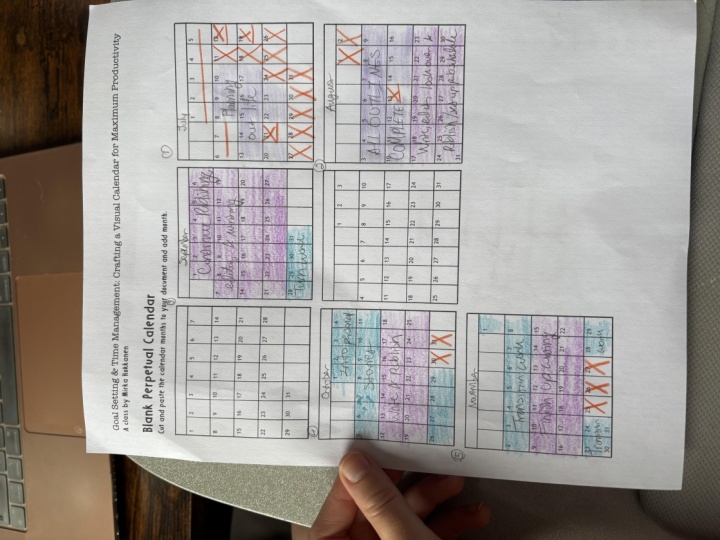
different layer underneath it. And for this class, I've actually I've given you a perpetual calendar
that you can use, and it's on a different
layer over here. And so if you want, you can just copy the months that you need. You can see that the
month the day is starting on a different
day on each one. And so you copy or the
calendar dates that you need, and just be aware
that over here, every calendar ends in 31. And so if it's a month that
has less than 31 days, just make sure to
delete the extra days from those calendar blocks. And so you can use
this calendar. A lot of times,
I'll just download some free calendar
that I find online. And I've also created
calendar brushes, and I can show you super
quick how these work. So there's a
calendar grid brush. For these ones, it's
easy if you have, like, a set for your calendars. And so I have the same set. So the way you set
these little knobs over here is you hold onto it, and then you see
there's a little plus, and when I hit the
plus, then it gives you a little thing that
it's easy to hit. And so since I don't
have that one. So we'll pick this one. And
so from here, I can tap this. I can pick which calendar month. And so this is the
way these are titled. It says calendar. First day is Sunday, first day is Monday. This is American calendar. So Sunday would be
one is over here. First day or first day
of the month is Monday. That would be here, first day of the week is Tuesday, and
that would be there. And so we can pick
this one. And then you tap the middle
of your calendar, and then you get your days. And then if you wanted to add Sunday through Monday or
Monday through Thursday, then you'd tap your calendar
again, and then um, you can depending
where you tap in here, it's going to change
where it adds it. But in this middle box, if you tap it towards
the top middle, that's when it usually
puts it in the right way. So that would be a good way to then make yourself
calendar blocks. And so I do have those brushes available that are on the you can purchase
those on the side. But let's get back
to our scheduling. And so I'll have my calendar months that
I want to work on, and then I get my
I like my pencil. And so what I would do is you have you obviously have
this sheet to work off of. And so whatever I want to work on whatever my goals are
for the next four months, I would write brainstorm all those things on
the side over here. Number two is I do
family calendar. And so the second step that
I do is the family calendar, and what that means is
I grab my phone out, and from my phone, I can tell I've
already marked down, you know, if there are
any days off from school. So let's say, you know, this day is a day
off from school. They have, let's say
spring break is over here. And then I know they
have this Friday and this Monday off school. And so I'll mark down
all the days when I know that my kids
are going to be home. Or some months we
might have visitors. And then if we
depending who it is, I might cross that week. Off, too, because
I'm home and so it's going to be expected that I
spend time with that visitor. And I might still
schedule something small for me for this week, but I like to just mark
down all the days when I know that I won't be
able to work full time. And so that's kind of the
second thing that I do before I start scheduling
everything over here. And then once I've gotten
these two main things done, then I start looking at my goals over here and
start scheduling things in. And usually I like to have
one where I write things, and then I like to
have another layer, and you can do this
however you want. This is kind of how
I like to do it. And so I have some colors over here already that I usually use, and you might pick
that, you know, red is going to be days
when you're illustrating and blue is going to be when
you do a different task. I usually don't
get that involved. I just want to make sure
that whatever colors don't look too similar to each other so that it's different enough that I know whenever my task is changing. So let's say I'm going to spend so let's say some of my
goals are going to be here, let me write some goals down. Okay, so these might be some proposed tasks
that somebody who's just starting in picture book illustration or writing, like what I would have
done a while ago. And so let's say, so I've got three new
pieces por portfolio. I want to work on
a YouTube video. I want to work on a new story. I have a conference
coming up and so anything so anything that's an actual event
that's coming up, like, let's say,
a conference and I know I have a paid
critique coming up, I would start with those first. So let's say I
have a conference, and that's coming
up this weekend, then I probably so
I fill that in. Oops. And so I fill that in. And then usually when you're
going to a conference, you need to work, you
know, you need to pack and get your portfolio ready. So depending how many days
you think you need for that, then I'll add that and then
I'll write conference. So I'll write that over there
and then cross that out. And then if I know I have
a paid critique coming up, I might do that with
a different color. Let's say my paid critique is coming up at the
end of February. So this is my critique. Or if I know that's
going to be 28 February, then I know if there's a due date when something
needs to be turned in, let's say the due date
is the week before, then I might schedule
a couple of days over here to work on my story. And then if the
critique is just, you know, a half an hour
an in person thing, I'm not going to spend a whole
day on it, but that way, I know that I'm
getting ready for it. Then let's say something
else I want to work on. So usually I just change the
colors kind of arbitrarily. So what is important over here, what I want to work on first? Some new pieces
for my portfolio. Maybe if I'm interested in
working with this person, I want to make sure
that things look good. So if I need to do three pieces, let's say, I'm thinking I need a day for
each illustration. So depending if you can
work on the weekends, you could schedule yourself for the weekend or if you don't
want to work on the weekends, then you could also
schedule some time. So maybe I'll schedule
these days over here. And I always write down
immediately so I don't forget. So this is portfolio. I want to work on my new story. I want to research agents. Also, before my critique, maybe I want my
website to look nice. So maybe over here, I'm
going to spend this time. Oops. I need a different color. I'm going to need this time, and I want to work
on my portfolio, make sure it looks good. And so over here, I've given
myself some sub tasks. And so I know that when
when I get to that part, I'll know to be working on that. And so that kind of covers up most of my January. Let's see. While I'm working on my website, I might also want to set up my newsletter 'cause that's
kind of adjacent to that. So, um, maybe I'll
I'll schedule. I I don't work on the weekends, I just like to color my weekends in even if I'm not
working on it. So maybe I'm I'm going to think scheduling or figuring out my newsletter is
going to be hard, so I'm going to
give myself let's say two days time to do that. And I don't need
to write it over here because it's
the same color. Then I know my kids are
off of school over here, and then let's see what
else can we start? So I've got a couple weeks before my next task,
my conference. What do I want to If I'm
going to a conference, I've got my online stuff ready. I've got my portfolio. Let's see. This one's taken
care of. Oh, critique group. So if you have a critique group, you want to make sure that
you set time aside for that. So in general, you're if it's a writing
critique group, for that, you usually have to as other people are looking
at your manuscript, it's your job to look at other
people's manuscripts, too. And usually it
takes me at least, it's usually about an
hour to two hour task per one if I'm doing any kind
of written critique. If it's if we're meeting in person and
we're talking in person, then I don't have to
do the written part. But it still takes me some time, so you might want to
spend a day to, you know, so let's say your critique
day is over here, then maybe this day
is going to be spent On critiques. And then if
there's kind of, like, an odd day like this, then I usually end up just
using it for something. So let's say I'm just going to use these two odd days
for my portfolio stuff. Actually, if I'm going
to a conference, I might want to I might want to order some
business cards for that. And so this is going to be design and order
business card or cards, whatever you want to hand
out at the conference. So I got to think
about that in time for me to actually send it and then be able to
get it in the mail. So that might actually depending where you live, might
not be enough time. So it might be possible that I want to stick
this somewhere else or switch put this over here and then put the newsletter over
here or something like that. And then I would just go down my list and keep
scheduling stuff in. And if you have extra
time at the end, then I would always recommend
that you do that to work on either new stories or new pieces or whatever work on those skills that you're
trying to improve. Or if you already kind of a proficient
author and Illustrator, then, um, instead of, you know, trying to
learn something new, but just upkeep
your skills because that takes time
too and, you know, make time to actually
make new work, which I'm actually, you know, personally really bad at just making work for fun and
making work for myself. I usually end up trying to
put it together and make some sort of a project of it instead of just
doing stuff for fun. But if you end up having extra
days somewhere in between, then those are great days to schedule time for learning and either taking an online class or rewatching a webinar that
missed or something like that. And if you have any
questions about how my mindset works when I'm working on this
or you get stuck, then feel free to post it in the discussion
section below, or you can post
your calendars in the projects and ask for
feedback if that looks good. And I'll say from experience that if you're
just starting out, you might not know how
long a task might take, or this might take
a lot of, like, you might schedule yourself once and make a
schedule like this, and then you realize that,
you know, oh my goodness, creating an online
portfolio takes twice as long as what I needed, and then you might have to end up kind of shuffling
things around. You know, as you're
learning about yourself and as you're learning
about the way you work, then little by little, you'll be able to
figure out how long it takes for you
for any given task. And so for myself,
it's fairly easy. I know how long it takes
for me to draw a dummy. I know how long it takes for me to do final illustrations
and so on and so forth. And so it's fairly easy for me at this point to schedule myself and be pretty
accurate with knowing how much time I need
for any given task. But sometimes life
gets in the way, and we run into some issues, and I'll talk about
that in the next video.
10. When Life Interferes: Alright, so as I said, as I mentioned earlier, I'm a mom and I stay at
home with three kids. We have a family,
husband, cat, and a dog, and so life gets
unexpected sometimes. It might be that I get a call from school that one
of the kids is sick or they come down
with something and I need to make a doctor's
appointment for the next day. And so you can't always
plan for the unexpected. I have all these things that
I have on my to do list, and some things are going to be more important to
finish than others. Like, if you have a
conference coming up, you need to get ready
for that conference. Or, you know, if there's a
firm deadline or, you know, your book is due,
then your book is due and you might not be able to change the deadline for that. And so I know which tasks are kind of the important
tasks which I can't drop or which are
important to finish. And so whenever
those things pop up where it's just I
end up losing days, like last week we had
multiple snowy we had three days of snow days and
another half day of school. And so I lost almost, you know, 3.5 days of work time. And then some things
just need to be dropped. And so, for example, last week, my goal was to work
on a newsletter and then two blog posts. But because the kids were
home, my husband was home. Everybody was home, and it was noisy and everybody was bored. You know, it was just
a blizzard outside. And so I needed to drop
one of those things. And so I ended up working on one blogpost and I mostly
wrote it at nighttime. And then another blog
post just never got done. It wasn't as important. I'll try to complete that at another time or make up
for it in some other way. They were blogs for my own blog, not for somebody else's blog. And then I was able to get the
newsletter done on Friday. And so you just kind
of figure out what are priorities and
what things can be dropped when those
kinds of things happen. And then when we talk about all those kinds of errands that we
have to do, like, we got to get groceries, and house needs to get cleaned or there's gonna
be a doctor's appointment, dentist appointment,
whatever it might be. So in the same way as I'm
trying to batch my work life, I try to batch my personal
life in the same way. So if I need so I usually only try to go to the grocery store
one time a week. And so for that one day when
I go to the grocery store, I try to run all
my other errands, like, go to the post office. I try to, you know, schedule, make sure that that's the same day that
I'm taking somebody to the doctor's office,
whatever it might be, I try to just
schedule, you know, if I have a phone
call or a meeting, whatever it might be, I just try to schedule
everything in one day. So instead of losing, you know, 2 hours here and
having to stop and start and do this and
that on any given day, I try to do all my errands on one day and then
have the rest of the week as open as possible to work on the tasks that
I need to be working on. And so hopefully that just eases your mind a little bit that
whatever you write over here, it doesn't need to be You
know, it's not set in stone. It's flexible and
sometimes things change, and you can take things off your schedule or you can
shuffle things around, and it's going to be okay because you have
your priorities, and you know which
things are okay to drop and then which things
you need to schedule for lad. In the next video, I'll talk a little bit about how to
keep yourself motivated.
11. Keeping Yourself Motivated: I wanted to go over
some reasons why this works for me and why this kind of scheduling
keeps me motivated. One reason why I feel
that this kind of visual scheduling
works really well is it gives me visual deadlines. So it's really easy
for me to tell. This is where I'm going. This
is where the deadlines are. And so I'm kind of
artificially creating my own deadlines for myself
because I don't have a boss. I do have projects that are due like a book illustrations might
be due on a specific day. And so I'll make sure that whenever I schedule
time over here that, you know, it's going to
be done by the due date. But then a lot of things
like when I need to just write a new book or when
I'm working on a new book, there's no there's no
deadline for that. If I'm working on a skill share class, you know, whatever, social media promotion, none of that really has deadlines. And so creating these deadlines for myself and then
being able to see them visually gives me a
lot of motivation to keep going and
hitting those deadlines. So another reason kind
of adjacent to that is, as you're scheduling,
I'm scheduling myself back to back over here. And if I miss one deadline, it pushes it's like
a domino effect. It pushes against all
those other deadlines. And so if I miss it, then I feel really scrunched on time, and then I'm going to
have to delete things. And usually, if I can
help it, you know, if it's just kind
of my laziness, but if I haven't gotten
myself around to getting something done in the time that I've
allotted for it, then that kind of squeezes
all my other deadlines, you know, further down the line. And so that's why
I want to try to keep my deadlines
because then it affects all my other deadlines and
it makes it stressful for me because I don't like
to take things off my calendar if I've already
kind of scheduled them. Nice thing is, I do
schedule because I have the three kids and you never
know what's going to happen. A lot of these kind of bigger blocks of
time, like over here, this yellow area is what I've made time for
myself to work on a new book project to be pitched further
in the future. I'll have, you know, some
wiggle room in there. So if I needed if all these other things
before it ended up you know, pushing and I lose a
couple of days over here. It's not the end of the world, but then I just have
less time to work on my next project
that hopefully one day I'm then going
to be paid for. And so I feel like there's always consequences if
I miss my deadline. So the other way
that I keep myself motivated is rewarding myself. And so whenever I
finish a project, especially if it's
something that I really didn't feel like doing. I don't particularly
love writing blog posts, but it's important for
where I want where my goal is kind of like what
I want to reach for my goal of being an author
and an Illustrator. I want that web presence, and then writing
blog posts helps. It's kind of like all
roads lead to Rome, whereas my blog posts point
people to my website, or it points people to my work or it points people
to my classes. And so I feel like
it's a great way, like an evergreen
way of once people, you know, that starts showing
up in Google results, that's a great way
for people to find me instead of social media. So while I'm putting some
things on social media, it's not I don't spend a lot of time on it and a lot
of time promoting on it. What I do spend more time on or want to spend more time on
is creating the blog post. And YouTube videos and things
like that that I feel are a little bit more evergreen than things that you
post on social media. And so back to my point
was that whenever I complete something that I don't like to do
as much as maybe, like, illustrating or I
love creating classes. So when I'm writing, and I have to get that
done, and usually, I only give myself one
day to write a blog post because if I give myself
two days or three days, then I just I just mull around and
don't get anything done. And so you should be able to write one blogpost
in one day, right? And so whenever I get
that blog post done, then I reward myself after, whether it be, you know, a piece of chocolate or I
don't really drink soda, but I'll reward
myself with soda or I'll take a trip to the thrift store or
whatever it might be. And those are different things
that I reward myself with. So it can be
something that I eat or something that I do or I'll I'll give myself extra time to read a book that night or whatever it might be. So going back to the idea that don't have to love
everything that you do. There's so many
different steps for you to reach your goal, and it's okay not to love every step as
much as the other. Like, I love all the
creative things. I love drawing. I love
creating classes. But things like maybe like I mentioned writing
a blog post or doing the first round of thumbnails or first draft of my manuscript
is always really hard. And so I always
show up for work, even on the days when I don't feel like doing the task that
I've scheduled for myself. And most of the time,
what happens is I'll show up and once you start working and once you
finally get going, then the inspiration kind
of comes after that. And so I know that about myself, and I know that that happens. And so some days it is
hard to go to work, and some days I don't feel
like doing what I like doing. And so I just get going
and I get it done, and the inspiration
usually comes, and then it's not so bad. And then that that thing is taken care of and I don't have to worry
about it anymore. And then it's time to
celebrate when you're done. So I also like some of the website that
give you analytics. Like, this is a screenshot from Pinterest or like
YouTube or Skillshare. They'll show you this kind of a graph, and you can
do it, you know, over three months
or you can do it, you know, nine months
or a yearly view. And I like it when I
can track and see, try to make that
graph go every year, it's rewarding for me, and I
find it kind of fascinating. It almost feels like a game where I'm trying to
figure out, Okay, this is what I did
this past month, and if I go up or
if I go down, like, whatever I posted or
whatever, you know, descriptions that
I've written or whatever it might be, you know, if that graph is going
up and down or the classes that I posted or
whatever it might be. And it feels almost like a game. And so I try to figure out what I should be doing and what's working and
what's not working. And so that makes it really
fun for me where I feel like, you know, it's a game
that I'm playing. But I do want to add
caution over there that while I'm actively working on trying to make my, you know, this is the Pent while
I'm trying to make my overall performance go up, I also don't take it personally, and I don't make
it myself worth, like if you're on
social media and you're looking at your
numbers on social media, um, don't equate that to your personal value
or your personal worth. It's really important
to make sure that those two things
are different. The amount of followers
that you have on Instagram, for example, does, you know, not equate to how good of an illustrator you are or how good of an
artist you are. And so I just wanted to make
the distinction between the two things of
where I'm doing it for work and where I'm
trying to figure out the system and what works and what doesn't versus thinking, you know, if it
goes down one day, like, Oh, I'm a failure, nobody likes my art,
you know, whatever, just make sure that you make the distinction
between the two. Earlier, we did
this exercise page where you wrote down your why. So when the days come
on your schedule where it's a task that you don't
particularly love doing, knowing your why and
knowing that you're working towards a higher goal or a bigger goal or a
longer term goal, rather than just completing this one thing
like a block post, it's building up and you're working towards
something bigger. That also really
helps me to keep going and keep working
towards that big goal. And I know I've already
talked a little bit about rejection in some of
the earlier videos, but I wanted to just do
a short little segment and talk about rejection a little bit more in
the next video.
12. Final Thoughts: Thank you so much for
joining me in this class. I'd love to hear your key
takeaways from it and see your goal sheets and your colorful calendars
that you've worked on. I look at all the projects
and the comments that are submitted in this class
and reply to all of them. If you feel confused or you have questions about any
part relating to this class, don't hesitate to
ask questions below, and also other students in
the class can then chime in. If you enjoyed the class, please leave a
positive review below. I look at all the reviews, and the feedback really helps me create my next
classes better, and the reviews also help other students find
the classes better. If you want to see more classes, you can go to my profile here on Skill Share and click Follow. And then that way,
you'll be notified when new classes come in. And you can also go to my
website at Mirca with hn.com, and I have all the classes
listed over there, as well. I can't wait to see
what you create, and I'll see you in
the next class. Bye.
 Mirka Hokkanen, Illustrator/Author/Printmaker/Educator