Transcripts
1. Introduction: Are you ready to start building a picture book illustration
portfolio that reflects your voice and attracts
agents and art directors? In this class, you'll
learn how to put together a children's book
illustration portfolio, and you'll walk away with a clear understanding
on what to include, why it matters, and how
to pull it all together. We'll also briefly touch
on what to do if you have multiple styles and where and how to present
your portfolio. If you ever tried
to put together your portfolio and felt
overwhelmed, you're not alone. It can be analysis paralysis, even for seasoned
illustrators to know what to include
in their portfolios. Thankfully, you don't need
dozens of complicated pieces, but rather a focused set
of illustrations that demonstrate your
storytelling skills and character consistency
in your style. This class is designed for beginning and intermediate
illustrators, beginning illustrators
who want to create pieces with the
portfolio in mind, for intermediate illustrators
who are ready to put their portfolio together
and start submissions. Hi. I'm Mika, and I'm a picture book author
and illustrator, and I worked with publishers of all different sizes in the last kind of
five to seven years. I've created both picture books and early reader graphic novels, and I'm really excited to
jump into this class with you and get your portfolio
ready for submissions. So if you are ready to set up your portfolio, let's jump in
2. Project Description: Welcome to the class.
I am excited to start building your picture book Illustration portfolio with you. So in this class, we have kind of ten key points on what to include
in your portfolio. We'll talk about
different aspects and different items to
including your portfolio. And for the class project, what I would like
for you to do is create a collection
or a portfolio of somewhere maybe
five to ten pieces and include them on one page
or in a gallery online, and then you can either take
a screenshot of it or save that page and then upload that into the project
gallery in this class. If you are in the earlier stages of working on a
portfolio and you don't have a range of
illustrations that are ready yet, what I would like for
you to do is take some time and reflect on that
list that we're going to be going through
in the class and think about what kind of illustrations would
work for you? What kind of books do
you want to work on? What kind of illustrations would work for you for a portfolio, and then make some
thumbnail sketches of the ideas that
you're thinking. What you can do is upload those thumbnails into
a project gallery. There's not really
one correct way to share your portfolio
in this class, and especially portfolios
are living breathing things. They're constantly changing. As you're creating
new illustrations, you're going to
add new things to your portfolio and then
take everything out. Consider this class as a
great stepping stone and a starting point on putting
that portfolio together and also if you have if
you are going through that analysis paralysis
and you can't figure out which pieces are the best ones
or which ones to take out, to have a more clear
and concise portfolio, then those kinds of things
are also great to post either in the discussion section or in the project gallery. You can post ten pieces and ask, which one do you think is the weakest piece
in this collection, and then people can
give their feedback. And that will also help you see the work through
other people's eyes and see which pieces are better to include in a portfolio
and which ones are weaker. We are going to get right into our ten main points
of what to include in a picture book
portfolio and we will get into that in the next
video. I'll see you there.
3. 10 Things To Include in Your Portfolio: Today, I wanted to talk
a little bit about if you are just wanting to
get into picture books, what you should consider
putting into your portfolio. And I'll give you kind
of ten points to think about and think of these ten points as
being like a Vn diagram. Your ten the ten points don't have to be
individual illustrations, but you can combine
different points into similar illustrations. And so point number one is include illustrations
with kids in them, and so have kids running around, jumping, doing all the fun
kid things that they do. Um, if you like doing people, then I recommend
that you can add other ages of people in
your portfolio as well. So have some adults, maybe some teenagers,
some older people, and then that way, you have a nice variety, but it's nice to have
most of the characters in your illustrations be kids of the age that you
want to illustrate too. My point number two kind of
verges on point number one is illustrate or your portfolio should show things that
you like to illustrate. And so if you don't like to illustrate cities or
cards or machinery, then don't include a whole bunch of that in your portfolio. Personally, for me, I really
like animals and nature. So almost all the pieces in my portfolio have some
kind of nature scene. Almost all of them have animals. Not very many of
them have people. I have some, but almost all of them feature
animals of some kind. So illustrate what you
want to do books about. Because the worst thing
that could happen is an editor or an art
director sees your piece, where you drew a truck
or something like that, and then they contact you to do a whole book that is all about trucks and cars
or something like that, and then you're
stuck illustrating something that you don't
care to illustrate. Point number three is include illustrations with some
common animals in them. And so this might
be pets, you know, cats and dogs, maybe bunny
rabbits or hamsters. They could be forest animals, like bears and foxes. They could be jungle
or farm animals, animals that you see in
picture books a lot, and having some examples of those is great to have
in your portfolio. Point number four,
you want to include different formats of
illustrations in your portfolio. So if you think about
opening up a book, and there might be one
illustration that's horizontal and that
goes a full spread. So you want to include some
horizontal illustrations with backgrounds
in your portfolio, and then some of your book illustrations
might just be one page and they
might be vertical. So you want to include some vertical illustrations
in your portfolio, and then also just some
spot illustrations or vignettes where you have a little bit of background
or no background at all, and you just see the character. And so including a variety of different kinds of
illustrations is really beneficial to
show that you can do all those different kinds of illustrations in your portfolio. Then point number five is try to include scenery that happens
in different locations. So you can include scenes that show interior scenes like in a kitchen or
in a living room. And that way you can
showcase how you would, um, design an
illustration like that, and then also include
scenes that happen outside. They can be in the
city or in a forest. And that way, you're
showing a range of different illustrations
that you can do. Point number six is show the same character in
multiple illustrations. And so this will be so this will be kind of
a series of illustrations, and you'll have
the same character in at least three
different illustrations, and that shows that you can draw a character
consistently, and you want to
have the character different pose in each one, make sure they're
somehow active. So maybe one is showing
them from straight on. Maybe in one of them,
they're climbing over, and you're showing
them from the side, and then maybe another one is a close up of them or
something like that. And then also make sure that your character is showing
different emotions. And then that way, you're really showcasing that you can
have a character and draw it consistently
moving and having different emotions in at least three different
illustrations. And that just showcases that you can complete a
full book and have your character be
consistent throughout the whole thing and have
your world building, have you know, all
your backgrounds look similar in all the
illustrations. Then for point number seven
is show different emotions. And I touched on this
a little bit earlier. Make sure you are showing
different emotions. So not every character in every illustration
that you have in your portfolio should be happy. You should show characters
that are sad that are upset, or you can have, you know, two different characters
in the illustration and one is sad and one is happy. And then that's immediately
telling some kind of a story. And so just make sure
that you're showing a range of emotions
in your portfolio. And then alongside that
for point number eight is show a lot of movement
in your illustrations. And so you don't want to just
show your characters with their arms hanging limply on
their side, standing still. You want to show them running, jumping, with, you
know, excited, think about how their
emotions can be shown through um
through their bodies. And so if somebody's running, are they running excitedly? Are they running angrily? Are they running afraid? How are they moving and
how are the emotions being shown in your characters
through their bodies? And so, again, show a lot of different movements and
emotions in your portfolio. And then point number nine is showing off your
storytelling capabilities. So, for example, when
you're working on that series of three illustrations with
the same character, what kind of a story can you tell between those
three illustrations? But then also think
about what kind of stories can your individual
illustrations tell? And so a lot of the movement and emotion will come
into play in that. So if you have a character that looks like they're
upset, and let's say, they're in the living
room and maybe, you know, it looks
like they just fell off the side of the couch
or something like that. And then think about what
other elements you can put in that illustration to really push
that storytelling. Could it be a different?
Like, what time of the day is it? What other kind of props
does your character have? You know, are they in, you
know, are their clothes dirty? Is their knee scuffed? Are they Is their outfit doesn't match what they
look you know, let's say, I don't know if it's a
girl climbing in a tree, but then they're
wearing, you know, a ball gown or a tutu
or something like that. You know, adding those
kinds of elements into your into your illustration will help with the storytelling, and it'll it'll
create this whole you can create a whole story with just one illustration when you pay attention to the
emotions and the props and the movement and
all those things and create really dynamite
single illustrations. And point number ten
is less is more. And so as you are working on creating new illustrations and adding them into your portfolio, always go through your portfolio and make sure you're cutting out weaker pieces because your portfolio is only as
good as the best piece in it. And so it's helpful to be in a critique group
and get feedback from peers, or you can get a critique from professional Illustrator or from art directors or agents
through SEBWI events, and like I do critiques or if you're in any kind of a community
or Kidlt 411, you could ask there's an Illustrator group over there that you can ask feedback for, and sometimes it's helpful for other people to
look at your work and let you know which pieces are the weaker, weakest ones. But it's good to develop
that eye for yourself, too. And if you can put critique
group together for yourself, then you start when you
critique other people's works, you start noticing different
things in your own work, and then it becomes
easier to figure out which pieces are stronger
and which pieces are weaker. In the next video, we'll
talk a little bit more about the Venn diagram and how one illustration can fit
under multiple categories.
4. Venn Diagram Illustrations: Okay, so I wanted to elaborate on the n diagram
idea really quickly. So on this side, I've added all the ten different things that you can include
in your portfolio, and this is just an example
of one of the pieces that I've recently included
in my portfolio. And so when you're
thinking about pieces to include and there can technically be if
you look online for things to include in
a picture book portfolio, you can find an endless
list of things. And instead of illustrating things all the
things separately, think of them how
they can go together. And so, you know, the way a venn
diagram works is if you have spheres and
they're overlapping, and so you'll have children, and then you'll have animals. Oh, let's say locations. And instead of one illustration,
only showing animals, but you can think about how can one Illustration hit multiple
things from your list? The part where
everything overlaps, this should be the sweet
spot for your illustration. Out of this list, what is
this illustration catching? So we have children. We don't have people
of different ages, but we are including children. Things that I like
to illustrate. Yes, I like to do children, and I like to do outdoor scenes. We have an animal over here. We don't have any
fish, but there's a little turtle over here. And then the different formats and locations, that
would be, you know, if you're comparing your
multiple multiple things. And for the location, when I looked at my portfolio, I realized I don't really
have any underwater scenes or scenes with a lot of water, which is why I
created this piece. I wanted to have
a mermaid piece. And then that way, I was able to include kind of kids in it, and then I was able to
include an underwater scene, and I intend to work in
the future to add a couple of more underwater scenes with maybe some fish and some
cute sea life in there, just to round out my portfolio with a little bit more of
a variety of work in it. Then it doesn't show the same character in multiple
different situations, but I could, for example, pick this character to
be my main character. And then what I could do is do a couple more illustrations showing this character
in different poses. And then that way, I could
include that one in there. Then showing different emotions. This characters kind of happy. This one's kind of happy, and this one's
kind of surprised, showing different movement. We've got this
character going this way and then this one
kind of reaching. And so they're all doing something a
little bit different. We were showing this
one in profile, and these ones more from kind of like a three quarter view. And then how am I
telling a story each? So if you're doing
series of pieces, those series of illustrations
can tell a story, but also always make sure that your individual
illustrations tell a story. And so how is this
illustration telling a story? We've got obviously
something going on with this little kid going
somewhere with a backpack, and it's got a
little turtle in it. We've got these two kids over
here kind of reaching out. And so there's obviously, you know, something going on. With this illustration, and then we're in an
underwater scene. And so you can kind of come
up with a plot and a story just looking at this one
single illustration alone. And then the point for the
less is more, obviously, that is for deleting your weak illustrations
from your portfolio, and so this one was just
a piece that I added. And when I add things, I usually flip
through my portfolio, look through it, and
then what I'll do is if I add one or
two new pieces, I'll see if there's
any pieces that are weaker and I will
remove those or just older and I'll remove those from my portfolio and only keep
the best ones in there. But every time you're
working on an illustration, try to hit as many of your
ten different things in it, and that way, you'll have
really strong pieces to add to your portfolio. The next video, we're going to talk about the tricky
question about including multiple styles
in your portfolio.
5. Multiple Styles: And the question of
including multiple styles in a portfolio seems to pop up a lot when talking about
putting portfolios together, especially with illustrators
who are still a little bit more kind of earlier
in their career. And I feel that you end up having a style the
more you work. Many years ago, I
felt that I had multiple styles because
I would look at illustrations or I would
look at picture books, and I'd be, Oh, I
can do that style. And they were still
my own illustrations. I wasn't copying
anything, but I could emulate a style
by looking at it. And it's easy to do one
off pieces like this. But when you actually have to do a full book and you're doing
30 illustrations for it. All of a sudden, it doesn't
it's not that easy to, you know, emulate
a different style. Your style kind of
develops naturally as you work in serial
kind of work like that. The more work you
do, the more of a style you end up
having because there's going to be there's going to be ways that you are comfortable in drawing
specific things. There's going to be ways that
you like to draw buildings, the ways that you
prefer to draw trees, characters, and you
develop kind of shortcuts and things
that are easy for you. And I feel like that's how
your style develops over time. And when you're working on a full complete book
and you have to have all the illustrations that
are all that all go together. They look like they're
from the same world. They all have to be drawn,
painted, colored consistently. And so, like I said, it's easy to make those one off pieces that look a
little bit different. But if you have not done so yet, think about putting together a whole picture book dummy and you can start with
just sketching it all out. You can take I talk about this
a lot in my other classes. You can take an existing story like Little Ren Riding
hood or Hansel and Gretel, and come up storyboard it, come up with thumbnail sketches and sketch that whole thing out. And you don't necessarily
it takes a lot of time to make full
final illustrations. And so you don't
necessarily have to do final illustrations for the whole book when you sketch all of those pages
out or spreads out, and then you do a couple of full illustrations, really soon, you're going to figure out
what you're comfortable with and what you're
not comfortable with. Are you the kind of an
illustrator who wants to have all the details all the time in every single
illustration, or are you the kind
of an illustrator who wants to have more
simpler backgrounds or flatter colors or are you doing rendering everything
very three dimensionally? And I feel like if you do
this exercise a couple of times and you make a couple
of picture book dummies, you will end up having a style. And I wanted to look at a
couple of different examples. And so we're going to
switch over to my screen. Okay. So first off, I'm going to share my own
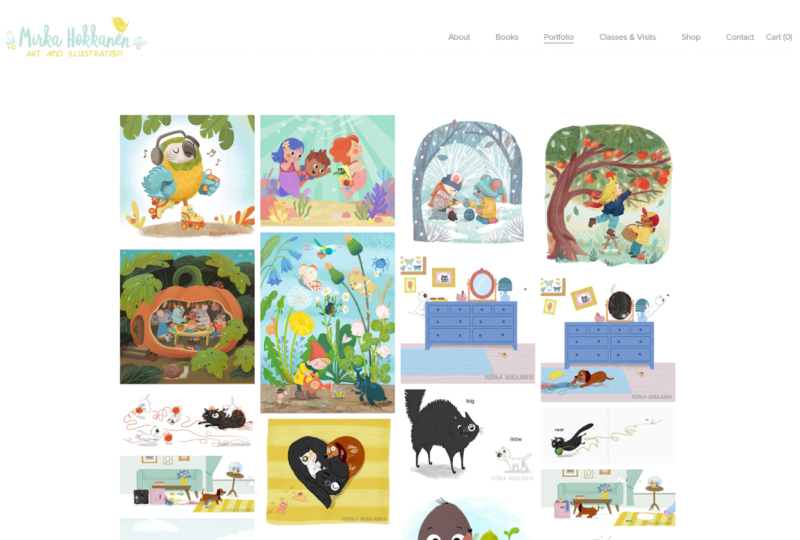
portfolio just to show you. And so I work in a couple
of different media, so I don't do
everything digital. And I also work in watercolor
and pencil and gouache. And so to have those two, I have those kind of as two different sections
on my website. And so this is the top part
is my digital illustration, which I think is
kind of stronger. It's more, I guess you
could say commercial. And you can see all the pieces through here
and you can see, I also have pieces that
are from my graphic novel. And then if you scroll down, you'll see that this
is my watercolor Illustration kind of
section in this portfolio. And these are all different watercolor
illustrations that I've done. And then if you
actually go down, I've also made one book that
is with printmaking Media, which was Wood engravings. And so I have a couple of examples of that book
down at the bottom. So technically, I have
three different sections. And you can see with this bottom section with the printmaking, it's kind of a different
style than my other ones. But I would not include these different sections in
your portfolio unless you have enough strong
work to put in each one to demonstrate that you can do that consistently
for a whole book. And so that's important.
But if you look between, so you can so I have
my watercolor pieces, and then I have my
digital pieces. And those things are
two different media, but they're not necessarily
two different styles. Like, yes, when I apply
my digital media, it's going to look different
than my watercolor media because that is just I'm working in two different media,
so they look different. But if you look at my color
choices and if you look at, the way that I
draw my characters and kind of lines and
things like that, there's a lot of
the same in both. And so you can still tell that it's done by
the same artist, even though I'm working
in different media. So it's not completely
two different styles. It's just the same illustrator working in two different media. And so I wanted to just
pull up a couple of other. I found I wanted to show
This is an illustrator, Hadley Hooper, and I wanted
to just show their style. And if you look over here, you can see, we have
this book at home, and it has so she uses these kind of printmaking
processes in her books. And with this book, you can see that there's some black outlines for
the characters, but a lot of the items
don't have outlines on it. But then if you look at
some of the other ones, you can see that they're all
not exactly the same style. For example, with this one, it looks a little bit
more kind of digital. There's a lot more lines, but it still looks, you know, like the same illustrator. The color palette is a little
bit different on this one. And so you can have
slightly, you know, different projects that you're working on and different sets of illustrations
in your portfolio. And so, see, this one looks
a little bit different. Again, this one looks like
it's a little bit more digital with the layering. With this one, it looks like
maybe there's some kind of watercolor elements
in it instead of all printmaking elements like this tree in the background looks like that was scanned in. Watercolor. And so
she's also using these different kind of media and she's combining
them digitally over here, but it all looks
kind of cohesive. And if you were to ask her to
illustrate a book for you, you could kind of expect as a publisher
what you get from her. And then she also
has a little bit of a different style down
at the bottom over here. So a couple of different
kind of things going on, but you can still
kind of expect know what you can get from
her if you hire her. And then just as a third
example over here, I have this is directly from
the Bright Agency website. Ben Mantle, his website was
down for whatever reason. And so we'll just look at some of his
illustrations over here. There's a couple of
illustration agencies, and there's some online places where you can look at a
bunch of illustrators and you can click over
to their portfolios and see the type of work that they have in their portfolio. And this is a great
way to look at what kinds of things you
could be including in yours. And so what I wanted to just
call your attention to in this portfolio is that you can see that there's some
of the pieces where, like, this one looks like it's a middle grade cover
that he's worked on. This one, Bunny's on the
Bus is a picture book. And so he's got a little bit of a variety of audiences
that he's worked for. So if you look at his character designs for the
middle grade book, they're going to be a
little bit different than the characters
for the picture books. But in general, you
can see it's still kind of same textures. The color palettes are
still they all kind of look like they go together.
There's a couple of other. This is a middle grade
cover over here, and there's another
one over here, and I wanted to show. So if you look at
a lot of these, they have this kind of digital really pretty painterly style. But then there's this one. I wish I could get it bigger. But with this one, you can see, it's a little bit of a flatter. It's not as painterly. There's outlines, and
then things are kind of flat in this
illustration over here. And so there's some variety in the techniques you could
say that he's using, but in general, it still all looks like the same
illustrator's work. And so if you are thinking that you just have too
many different styles, I would work on a couple of bigger projects where
you need to create multiple illustrations
for the projects and then see how your style starts
emerging from there. And then from there, figure out what kind of pieces to
highlight in your portfolio. In the next video,
we'll talk about how to gauge where your illustration fits in the market and how to see if it's good
enough to submit yet.
6. 9-Grid Exercise: A grid of nine is a little exercise that you
can do to kind of figure out where your work and your skill lies in comparison to other illustrators
that are already out. So for this exercise, what
I want you to do is I want you to find nine
other illustrators who work in a similar way then you who are already
publishing picture books, who are already creating
books for publishers. And so you can either
look at illustrators, maybe who you follow online. If you can't think of any, then what I would recommend
is going to the library and just flipping through books and seeing which illustrator's work kind of resonates with you, where you kind of think
that you could kind of be at the same level as them. And so to get to the point, what I want you to do is find eight other illustrators work. And then I want you
to take either snap a photo of it or if you can find their work on
portfolios online, get a digital image, and I want you to arrange it in a nine by nine grid with your
piece being in the middle, and then all these other
illustrators works being around. And then be objective
and compare your work to those nine illustrators
who are already working and see how your
work compares to theirs. I how's the color
palette looking? How's your character
sketch looking? How is your rendering looking? And do you think
that your work is at the same level as the illustrators who
are already working? If you feel like you're
kind of at the same level, then I would say
that you are ready to start submitting
your portfolio. If you feel like your work
is not quite up to par yet, you can also ask for friends or critique
group or critique partners if they can give you some feedback
and what they think. If you can figure out where
your work is kind of lacking, are your color palettes
not quite polished enough? Do you need to work on your character designs or is it just that
your work doesn't look as finished as
those other Illustrators works and kind of
try to pinpoint if it's not quite at
the same level yet, try to pinpoint where it is lacking and ask those critique
partners what they think, where you think could improve. And then really work and you can rework the illustrations
that you already have and rework that one kind
of aspect of that and try to work so that the
professional illustrators and your work is
at the same level, and then, you know, you're ready to submit your portfolios
when you get there. And here as an example, I've used one of my
illustrations in the middle of the mermaids
that I showed you earlier, and then I put eight other
illustrator's work around it, and you can see how I've been influenced by all these
different illustrators. I've looked at their
color palettes. I've looked at the way that
they render digitally. I've looked at their
character designs, and I've taken bits and
pieces and kind of made it my own style that I'm
comfortable drawing. And so I can place my piece in the middle and feel
fairly confident that, you know, my piece looks, you know, about
at the same level as everybody else's around me. And then that way, I can tell that I've done a good job
with this illustration. If you don't have a full
illustration to post yet, you can even post your nine grid as one of your class
projects for the gallery. And in the next video, we'll switch gears a little
bit and talk about how and where and who to
present your portfolio to.
7. How/Who/What to do with Your Portfolio: So in this video,
I wanted to talk about what to do
with your portfolio. You spent time. You've
curated your portfolio. It looks gorgeous.
It is ready to go. It's professional
and clean and neat. But now you need
somebody to send it to. And so let's talk
about a couple of different ways to present your portfolio and then
who to send it to. So the first thing to do with your portfolio is put it
online. Have a website. And there are different
places that you can do this. If you have an
Adobe subscription, you can have a
portfolio through them. There are websites like Behance, where you can
upload a portfolio. But I would recommend
anything where you can have your own domain
name attached to it. And so, personally, I have my website
through Squarespace, and I know a lot of other
illustrators do, too. And some people use WIC. Personally, I would not
recommend that one because I've just heard a lot of
people have issues with it. But I would try to
have some sort of a presence online where
it's not on social media, where this is your space, where you put up your portfolio, you have a little about page. You have your
contact information. And that way, if an art
director or editor or an agent, somebody is interested in you, they have a place to come and find information about you
and a way to contact you. So that's kind of
the first place. Then the second place
would be social media. I would not try to be on
every single social media. I would pick maybe one
or two of the ones that you feel more
comfortable working with Instagram is one that
a lot of illustrators are on and I've heard that a
lot of art directors will use Twitter or X used to be one, but I think a lot of people publishing has moved
away from Twitter or X, and I think Bluesky
might be another option. I know there's several
art directors there who are posting work and who are
looking for illustrators. And then other places
would be Behance or, you know, have your
Adobe portfolio. There's Cara, which is
very similar to Instagram. And you could even
have a portfolio or, you know, Illustrator
page on Facebook. And so there's a lot
of different places. Personally, I also pin
illustrations onto Pinterest. And so there's a lot of different places where you
can include illustrations. And then that way, it's
just easier to find you. And so on social media, there's an event called
Kidlet Art Postcard that was started by Gina
Perry a couple years ago, and it's gotten very big. It gets a lot of attention. And so it is a hash
tag that you use. And every first
Thursday of the month, picturebook
Illustrators will post their brand new picture
portfolio kind of a postcard, and it's just a single image
with your information on it. This is what mine looks like, and art directors can search for the hash tag and
then find you that way. And so I recommend just participating in that if
you are posting online. And then that way, also, I like posting the images with my information
on it because then your information
is always going to be attached to the image instead of just posting an illustration. And also I usually if I
do post illustrations, I also do include
usually my name as a watermark or
something in a corner somewhere so that if
somebody saves it onto their desktop or something that they can tell whose
illustration it is. So I recommend doing
that. Several years ago, people would actually
send physical postcards and some people still do create physical postcards that
they send to art directors. But with that, the
thing is they can be thrown out or they can be filed and never
looked at again. There's an expense to print
them and to ship them. So I don't know if that would be my first thing that
I would jump into, but it is an option if you feel that you want to grab somebody's
attention that way. In order to find
submission information, if you are a member of
SCBWI their website has a handbook that lists all publishers
of children's books, and there's addresses in there. And you can also go look
at books that you have, look at who the publisher is, and then go to the
publisher website. And on the bottom, it
will usually give you submission information
on who to email. They usually have
an email address that you send submissions to and directions on what
they in the submissions. And usually in
those submissions, if you're sending
an email somewhere, you just type up a short little email that
introduces yourself. Hi, my name is Mirka Hokkanen. I am a picture book Illustrator. And then you might want to say something a little
bit about yourself. Usually, I'll say, I like to illustrate nature and animals, and you can say
what media you use. So I work digitally, and then depending what the
submission guidelines are, sometimes you can
attach images to your submissions or sometimes
they just want a link. So make sure you look
at the submission information before
you submit anything. Um, and then this is where
your website portfolio comes into play where if you need to submit
a link to something, instead of sending an Instagram link or a social media link, you're linking directly to
your website portfolio. And if they do allow for
actual submission images, what I would do is just
size everything very, very small, maybe 100
and I would do 150 DPI, and maybe maximum
1,000 pixels wide, and you could either just send one illustration or you could
send a collage of maybe, you know, a couple of different illustrations on per page. And then that way, you're just sending a very
small attachment or an embedded image in your email submission
that isn't going to clog anybody's email inbox. And so that way you
can also directly send your portfolio to all
these different publishers. Many publishers oh, I
don't know the statistics, but I want to say at
least half publishers have open submission
policies where you can directly email them with your portfolio or
your portfolio links. And then the last
way to get in front of editors and agents would be through SCBWI events or
other I know highlights. And there's some other
people who do Kidlet events, and they will have editors
or agents as faculty, and then you usually have an open submission
policy afterwards, or you have an invitation
to send something. And a lot of times
during these events, there will be critique
opportunities that are usually
pretty affordable. The big SCBWI conference
that happens in New York, usually in kind of January, February timeframe, they actually have an in
person portfolio event because a lot of these
publishers are in New York and the conference
happens in New York. There's an opportunity to submit your actual
physical portfolio. And they put all the portfolios on these long tables in a room, and then all the
art directors from all the publishing houses and all the editors are invited. And many of them come, and
they will come and in person flip through portfolios
at the conference. And I know that several people it's not a magic bullet for everybody to get published, but I know of illustrators who
have gotten work that way. So that is yet another way to
get in front of publishers. And those are kind
of the best ways of getting your work in front and seen four publishers and then the other avenue to go and so that's kind
of going on your own. But if you're interested
in working with an agent, there are also
illustration agents and literary agents and illustration agents, the
difference between the two. Illustration agents only
work with illustrators, and a lot of times there
fees are going to be higher. They can be up to
50% compared to a literary agent who
also works with authors, but some agents will also
represent just illustrators, and agents usually take
around 15% or so of the fees. But what an agent will do for you is they do all
that shopping around. And so you can
still post online, and you can still
approach publishers. But now you have a person
who's in your corner and agents have direct relationships
with publishing houses, and they will directly
send your work. And so it takes a little bit of the
work off of your plate. And publishers will come
to agents with projects, especially if it's an
illustration agency, publishers will go directly to illustration agency and see and find illustrators
from there. And so you're able to
get some work coming your way through agencies. But I feel like
it's always good to be active yourself and have a good online presence
because a lot of times those publishers
and editors and agents, they will look at
your portfolio, your personal spaces and see what you put out and how
active you are and how you kind of engage online to kind of gauge if
you would be a good person, reliable, you know, nice person to work with
on a project together. And so for the next video, let's look at just
a few examples of illustration portfolios.
8. Examples: In this video, let's look at some picture book illustration
portfolio examples from professional Illustrators. I just wanted to
show a couple of different examples from
people who work in different styles
and different ways that people have put
up their portfolios. When we look at the
portfolios, think, are you seeing lots
of movement in there? Are you seeing lots
of emotions in there? Are you seeing characters in
different poses in there? Are you seeing animals
and people and different ages and
then aside from that, also analyze and kind
of think about how is each portfolio specific to
the person who has put it up? So, obviously, it's going
to be in their style. But also look at
most illustrators kind of have favorite color
palettes that they use. There's a lot of blues.
For example, for mine, I like a lot of
kind of aqua blues and yellows and greens. And so there's a lot of those
colors in my illustration. And then you can also kind of tell what that illustrator
likes drawing. Like, do they like drawing quirky animals or do they
like to draw people or, you know, are they drawing
very natural looking things, or are they doing kind of
very simplified drawings? And so when you're looking
at the portfolios, you can kind of really
break apart and see what that illustrator
is about and how that portfolio is pulled
together with the colors and the style and all
those other elements. And then try to kind of emulate all that in
your portfolios. And so first up over here, we have Mikaela God. And you can see she does
these kind of watercolor. She's done even a
Google front before, like the logo before. And you can see that she has this kind of a watercolor style, and you can see that she's got some picture books
in her portfolio. There are vertical pieces. There's this kind of
a circular piece. This is a spot illustration. And she's showing nature. She's showing different
ages of people. And so looking at all
the different things, she's showing people
doing different things. They are not stiff, everybody's kind of moving. People shown from
different places. And so I just wanted
to show this one as a first example of things that one person has
included in the illustration. And with this kind of Native American
heritage that she has, you can see that she's included other illustrations
that kind of fit into this portfolio in here, too, like this Raven
on Wood and some of these other illustrations
that she's added. And these could be like
this toxic plants could be commission or a licensed piece that she's done for another
company for something else, not necessarily picture
book illustration. And instead of putting all these different pieces in different categories
on her website, she's chosen to put
everything together. But if you look
at it as a whole, it all kind of goes
pretty well together, and it shows kind of a nice, cohesive style that she has. Then we have
Illustrator Emma Levy. And this is her
picture book gallery. And instead of having everything kind of
going down a page, she has chosen to do this kind of slideshow type of a
thing where you have to click on each image to view it. Personally, I don't know if I would recommend
this because it makes it cumbersome to look
through a portfolio. But I could see because
there's a lot of different types of
illustrations over here, there's some spots, verticals. Like this one was very very
kind of wide and horizontal, and sometimes illustrations
don't sit really well if they are all
those different sizes. And so in that sense, I could see that this
would make sense to have all these different
sized illustrations, sit nicely, and then an editor or an art director can kind of flip through here and
pick the pieces to see. Then the next illustrator I have up over here
is Abby Cushman, and you can see
she has a gallery, and everything is in
the shape of a square. And then when you click on it, you get the full illustration. So like this illustration
that I just clicked on is really horizontal
illustration, but you have to click
into the illustration to actually see the full piece. And you can get a good sense of her illustrations just by looking at this gallery
wall over here. So next we have Illustrator
Chris Chatterton. And so here are some of the books that he's worked
on at the very top. You can see the covers
of all the books. And if you click on
the book covers, and you can see a couple
of different styles. And so you can see
that these pieces that are these board
books on the top, they're for a younger audience. So character designs
are super cute. They're very kind
of easy to read. There's dark outlines, which makes it easy to
decipher the images. And there's not a lot
of kind of modeling. The colors are very flat. And then when you kind
of scroll down and these are his regular
illustrations, they're a little
bit more painterly and kind of not sketchy, but there's a little
bit more texture to them compared to these
pieces on the top. And if you click on one
of these book covers, it'll show the information for the book and a picture from
the inside of the book, and then it shows
a couple of it. And then when you
actually click, you can go back and then it takes you back to the gallery. If you don't click back, then
you can kind of go back to the gallery this
way. And go through. And I love the way this works, and it makes it fun to flip
through the portfolio. Honestly, I don't know how
to set this up myself. My is very much more of just a gallery similar
to Abby Cushmans. The way that he has it set up is it's all the covers
of his books. And you can obviously
tell that he has done a ton of books. And unless you've done this many and have all
this work to show, then you don't have to show
the covers of the books. Show or you can include the
covers in your portfolio, but also show individual
illustrations. But he's got so much stuff that he is just putting covers, and then you can click
on individual ones. But then he's done
other things as well. And so he's included, there's this mug over here
that he's designed. I think this is most likely
a birthday card over here. He's got some character designs. And so then once we scroll
past the actual books, then he has some kind of
simpler, smaller illustrations. There's even a sketch over here. And so you can kind of
get a bigger range. You can see Lord of
the Rings over here. And he's got Harry Potter things and things that are maybe more for a
middle grade audience. And so he's worked on a range
of illustration projects from it looks like from board books to
middle grade or so. And so that's just an example. And then just jumping over
to mine really quick. I wanted to add one
more footnote for this. And so when we looked at
my portfolio earlier, we looked at digital pieces, and then there's the
watercolor pieces. And then I showed these
pieces over here at the end, that were the inout or
the printmaking pieces. And I just wanted to say, because this is a
very different style than my regular
picture book style, this was one of the first
books that I ever did. And the way that we pitched this because it was
so different from picture book illustration is I actually do have a
background in printmaking, and I have a
printmaking portfolio. And so when we pitched
for the books, we pitched with a lot of
these prints that I've done. And so I had this
background in printmaking, and I had a whole portfolio to then back up
this book project. And they were able to trust
me that I would be able to complete a complete
picture book in that style because I did have a whole
printmaking portfolio. And then compared between the other portfolios that we just looked at compared to mine, one thing that I decided
that I wanted to do with my portfolio was show
the full illustrations. And so, instead of
mine being cropped and shown as a grid of squares, I wanted my illustrations to
show as full illustrations. And so if you look at here, you can immediately see
that some are vertical, some are spots, some
are horizontal spreads, and you don't have
to you can just scroll through my
whole portfolio and see all the illustrations, and you don't have to click
on each individual one to see the illustrations. And after we've looked at all
these different portfolios, and you can go
online and look up your favorite illustrators and see what their
portfolios look like. This is a personal
choice up to you. There is no right or
wrong way to do this. And I know at least with
Squarespace, it's a very easy. It's just you can
toggle a button and it'll switch which way. And so it's easy
to see if you like your illustration
portfolio to look this way or that way and then figure
out which one you want to do. In the next video, I'll
just go over your options and choices and some ideas
for your final project.
9. Class Project Thoughts: For your class project, I don't want you to
stress over it too much. It can be very simple. If you did the
exercise where you had the nine illustrators with
your piece in the middle, that would be a
great exercise to post in the project gallery. Or, like I said, if
you're just starting out, you can make sketches of ideas for illustrations
that you want to create. You could even include
a color palette that you want to work with.
If you already have pieces that you want to
include in a portfolio, you can put them up on a website or put them up in a grid
on a piece of paper, and then either save that or take a screenshot of it and post that in the
project gallery. And as always, if you ever
have questions about the class or if you have questions about your personal portfolio and
you want some feedback, feel free to post that in the project gallery in the
discussion section below, and other students and myself, we can weigh in
with our opinions. And let's jump into
the last video, and I'll share with you my final thoughts on the portfolios.
10. Final Thoughts: Putting a portfolio together
can feel pretty daunting, but I hope that
after this class, I've been able to put your mind at ease at least a little bit. When you incorporate those
ten kind of steps or points and the idea of the VN diagram into
your illustrations, you'll be able to create a really dynamic
portfolio that's going to capture the interests of our directors and
editors and agents. If you are brand
new to picturebook Illustration and
enjoyed this class, then I recommend
that you check out my other picture book
illustration classes as well. Um, I recommend starting with the reading for
a research class, which gives you the
tools to kind of break down picture books
that have already been published and then use the knowledge to make
your own work better. And then I have
several other classes about character illustration, anthropomorphic characters,
drawing consistently, picture book dummies
and things like that. And so I hope that you'll join me in some of
those classes as well. See all my classes, you can
click on my name that's above over here or go to my
website at ch.com. And if you enjoyed the class, I hope that you
would take just a few seconds to review it. It doesn't take long at all. The place to review
is just down below. You can give it stars. If you have time, you can
write a short sentence. It really doesn't take more
than a couple of seconds. Getting feedback is helpful for me to make future
classes better, and then also for
other students to see what others have thought about the class
who took it before. You again for taking this class. I really look forward
to seeing your posts in the project gallery,
seeing your portfolios, and maybe your nine grids, and I look forward to seeing
you in the next class. Bye.
 Mirka Hokkanen, Illustrator/Author/Printmaker/Educator