Transcripts
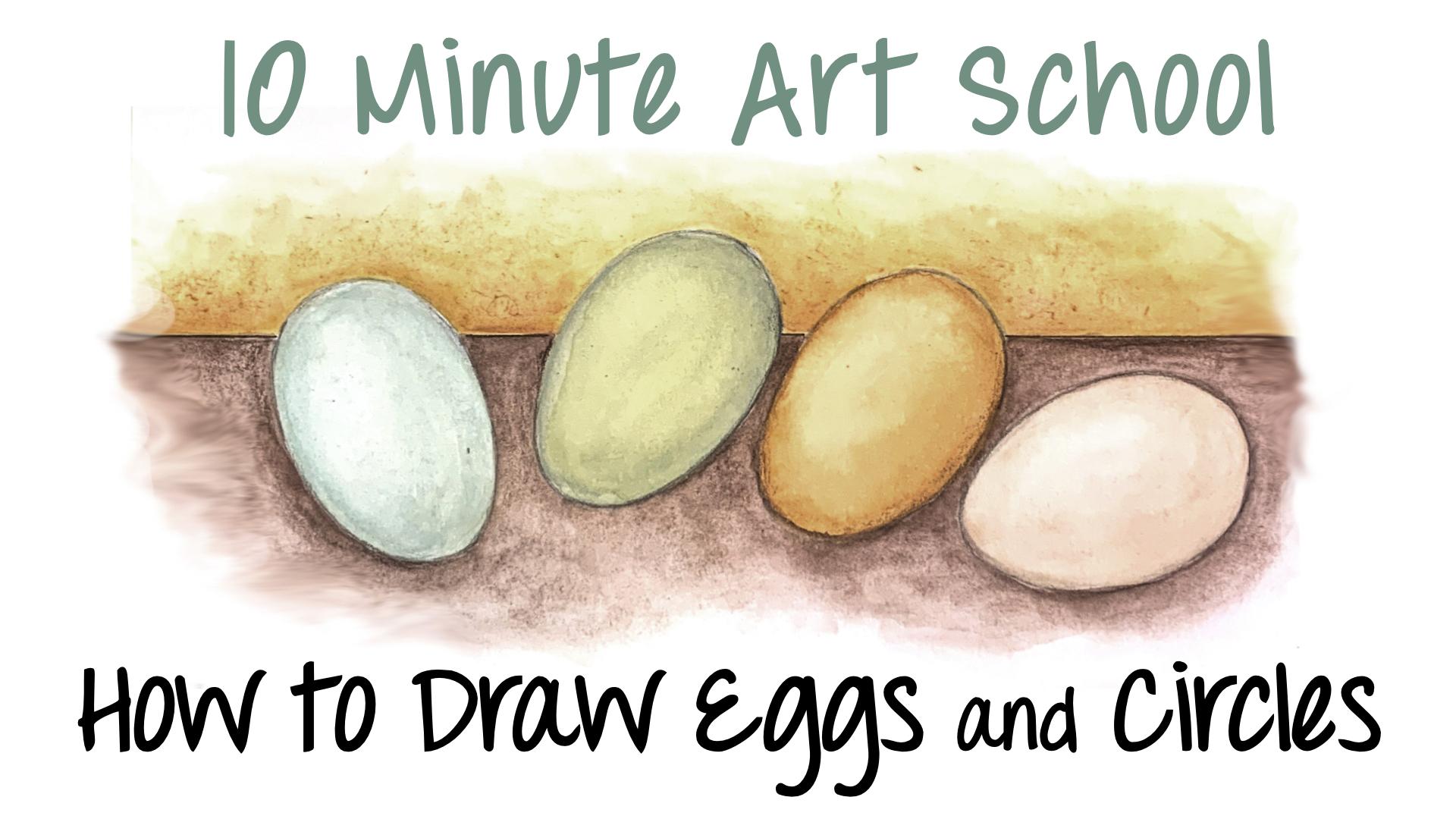
1. A Couple of Good Eggs Intro: Allow me to introduce you
to a couple of good eggs. If we look directly
at the end of an egg, we see it's a circle. From either end, a
bigger or larger circle. If we look at an egg
from any other angle, the really nice thing is that we've got the
same shape going on. The not so nice thing
is that it's not a shape that's that easy
to draw right off the bat. My name is Jessica, and
I'm here to teach you how to draw circles
and to draw eggs. Your project, obviously, will be to draw a
couple of eggs.
2. How to Draw a Circle: In order to draw an egg, you're going to have to be
able to draw a circle and a circle is not that
easy to draw perfectly. If you just reach down
and try to draw a circle, it's very likely to have flat sides and fat
sides, as I call them. We'll talk about
that in a minute. The best way to draw
a circle is to have a very loose hand in a
very small sketchy stroke. I'll show you what I mean, and also to understand that your sketchbook is not
glued to the table. And so you can turn it, and when you turn it, you're going to get the best circle. I'll show you what
I mean right here. So this is the tiny little
stroke I'm talking about. What you're doing here
is you're hunting for the correct line that makes the circle nice
and round and even. Your brain and your eyes, know what a circle is
supposed to look like. And so when you do this and allow your brain and your eye
to find that line for you, you're going to have
the best luck at having a symmetrical circle. You'll see as I'm
coming around here, I am going to be Of. See, where I was going
there. And I know it. I know that this circle has
to be coming back this way. You can make your little
marks in either direction. And when you get done, you get rid of anything
extraneous, like that. And you look at it, and you say is there a fat
place or a flat place. And yes, here is most of a
really wonderful circle. But right here is a
fat place because that wonderful circle
would finish itself out right there and not
all the way out here. Okay. So that is how to
freehand a really good circle. And once you have the line and you can see
that it's a correct line, you can strengthen that, even with by darkening your pencil and erase
the other lines. Okay. Now, I do not look
down on drawing tools. And so I have a
circle template here. And you can use it anytime that you want to if you're
in a hurry or whatever, but I encourage my
students to use it as a checking point
for their circle. Now, I'll show you what I mean. I'm choosing something Yeah, that is like that first circle. And when you put a
template over it, it's going to be really
obvious where it is flat. And this one doesn't have a fat, but it's going to be
obvious for you to see where that went
wrong with flatness. Here's another little
flat space up here. And then these, now that
we have the good line, that's a little fat space. But you can make
a judgment call. And every time you
are doing this, you're teaching your brain more about what a circle
is supposed to look like, so it can help you free
hand circles at any time.
3. How to Draw an Egg: I encourage you to draw a
number of circles until you're pretty comfortable that your circle is a nice round, not perfect, but
almost perfect circle. Then we can be ready
to draw an egg. I'm going to give you a formula
for drawing a great egg, and I want you to know
that you're going to go through all this architecture
every time you draw an egg. But when you do it
and think about it, do it again, think about it. What happens is that you
get it in your head, what an egg shape looks like. You can use a ruler, and to do this, or you can just draw a
line and measure it. But I want you to start with
a line that's 2 " long. Then find the spot and mark it that is at three quarters
of an inch from the top. And you're going to
make a line that is three quarters
in both directions. So I'm going three
quarters from here, three quarters from here. And we have this little cross. Then I'm going to turn the book, and I'm going to mark three
quarters this direction. What that's done has given us the starting
point for drawing a lovely circle that it
totals 1.5 " in diameter. Now, this circle certainly has a fat problem and
a flat problem. So I'm going to fix the fat
problem first that makes those three sides look
good and come over here and round out my flat. And I end up with a
pretty good circle, and it is diameter of
one and one half inches. Here is a measurement
of one half inch, and I am going to draw
a circle that big. And again, using
the sketchy method to get the roundest
circle I can. This is our architecture, and I want you to
notice that this is a three to one ratio. So whatever the diameter of
the top circle you make. The second circle you make
will be one third of that. So this is an inch
and a half in here, and this is one half
inch down here. And now, all we have to do is go from this spot with a little
sketchy line so we can get a nice curve going on
and come down and meet the bottom of that circle and do exactly the same thing
from the other side. Okay, that's your
plan to draw an egg. No, you're not going to go
through all this every time. But after you do this, a few times, you're going to get it about how an egg
is constructed. Now, the beauty of it is if this line is not straight
up and down doesn't matter, like if you wanted to draw an egg laying on
side, that is cool. The only two things
that matter in this exercise are that you have a line that is at right angles with your
originating line. That has to be true, and then that your large circle is three times the size
of your small circle. Now we're going to just
erase what doesn't belong to show you
that what you end up with here is a
very nice little egg. There you have an egg shape that nobody could
really complain about.
4. Egg Sketch Gallery: I thought I would
close this lesson by showing you some sketches
that I've done of eggs. Maybe you'll be inspired about going out and
drawing some eggs. When I encountered
farm fresh eggs, I was delighted to
see the colors. And some of them are so subtle, and I wanted to find out if I could actually get
those colors to happen. I just decided to do a sketch of eggs cooked
every which way. I had farm fresh
eggs in there, too. And boiled eggs, you
just draw your egg and then circle right
in the middle of it. And over here about how to tell whether an
egg is fresh or not. You put it in a glass of water, and if it floats,
you throw it away. Eggs are great for when
you're drawing recipes. And here's a quick pan for
tata that I love that is, you know, very low calorie
and pretty healthy. And we've got our
eggs drawn here. And then notice that grape tomatoes also
have that same shape. So if you can draw an egg, you can draw some
little tomatoes, too. Avocados. Share a
very similar shape. This is only partial avocado, but you can see right here that an avocado from the outside
is also an egg shape. So if you cut an avocado right in half
and try to draw the inside, you'd be doing the same
thing as a hard boiled egg. So go forth and draw eggs. And if you'd like to go a little further and
learning how to draw, look for my drawing from the ground up workshop
on skill share. And there's a lot that
you can learn to take these things further from
your ten minute art school. See you next time.
 Jessica Wesolek, Artist/Teacher