Transcripts
1. Class Intro: Hello. I'm Daniella Melon, an artist and author. Thanks for joining me for today's class on using simple marks or strokes to create abstract art. Today's class mark making abstract art prompt Number one uses my waves on the shore line technique to help you envision the various layers used in creating a successful abstract piece of art. Today's class uses a simple four step prompt to create compelling layers in artwork. You can use any media you prefer, such as watercolor or acrylic paints, or even combined media, like using collage and markers. Today's lesson is demonstrating using watercolors and markers, but could be used for most media. I encourage you to use what you have on hand and terrible a process to your own artistic voice. We'll start with a brief overview of the four elements of Mark making, then discuss a layering process. From there, we'll use various supplies to create a piece. This class is the first in a series of mark making classes, and I hope you enjoy it. Now Let's get started
2. 2 Class Supplies: for today's mark making class. We only the three handouts from Class one is just the mark making basics, and we'll go over this in a chapter very quickly, just explaining what the marks are that we're going to use and how to create our own repertoire of them and finding ones that are personal to us that we're interested in. The 2nd 1 is explaining our process today, and we're gonna be doing the waves on a shoreline model to create our images. And so this explains it in greater detail, and we'll go over all of this in class. And lastly, the last handout is just a mark making prompt. And this is the specific challenge for class today so that you can create your own project . You also need some other supplies. So now, for art supplies, how do we make our actual painting well, use whatever art supplies you like whatever, when you're comfortable with and feel free to cross media. So in today's class I'm gonna use watercolor and then some acrylic paint, maybe even some markers, and here I have just watercolor markers, permanent markers and acrylic paint markers I find with the acrylic paint markers. I really tend to only use white or black, but any colors will do that you like. It just doesn't have to be a big investment. I have my standard permanent markers, and then I have an assortment of acrylic paints. I have my craft pains, which are much cheaper, but they're very fluid. And then I have my more like artists, grade paints or professional paints. I have paintbrushes. I have a old toothbrush that I use as to mix batter controlled spatter. I have a small, just detailing brush here and then a permanent marker. That's not gonna bleed through, and this happens to be by Sharpie. You can also use stencils if you'd like, and you can use your brush. Or you can use just a little pad to use them. For any of these media in class, I'm going to use an eight by 10 piece of watercolor paper, but you could use canvas for still board. Whatever your media works with, feel free to use that in the next chapter, we'll go over creating and becoming familiar with our basic marks
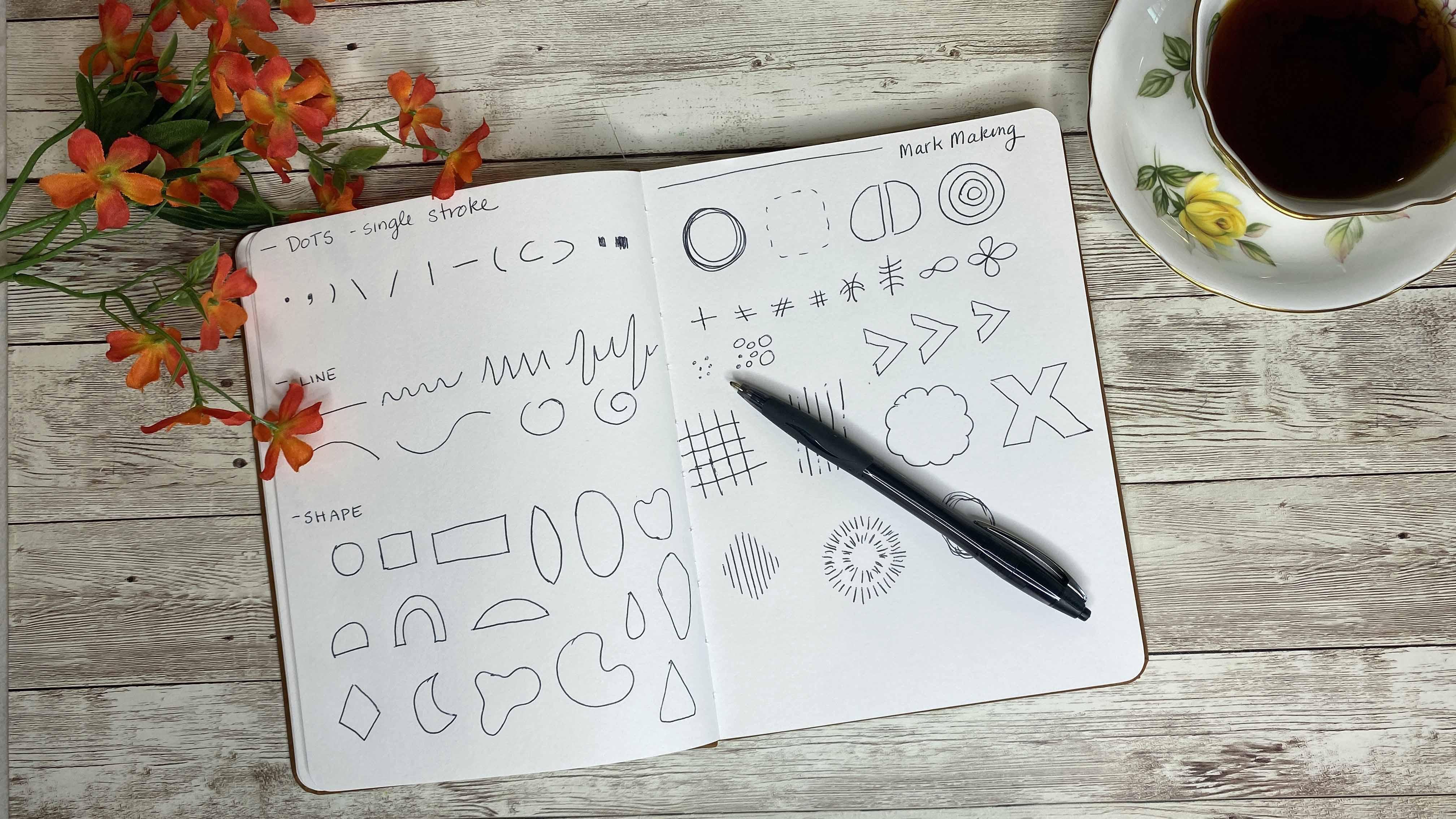
3. 3 Making Marks: to make my marks. I like to have a piece of paper or even a sketchbook filled with pages of just marks. And there nothing that's really elaborate. They're more just like strokes. And all these strokes can be expressive motive or just strokes. So with Mark making, the premise is, everything starts every creation that you draw. Paint write starts with a single dot OK, so we have just the dot and then from there, a dot can be a single stroke or it qualifies as a single stroke, so that could be a dash. It could be a comma. It could be a thicker line. It could be a teardrop shape, but it's just a single mark. Go any angle you want. So those are what I consider dots, even though we know that they encompass a few more things. It's just single stroke. The next thing is the dots turning tow lines, and so line is just taking a dog and elongating it. So obviously we all recognize a line, but it can also be different. Things like this thes things qualify his lines as well. And as you can see with just the three lines here we kind of created different moods. This one's flowing and soft kind of feminine. Maybe describe it as this one is full of anxiety and haphazard. So these air different ways that we turn a dot into a line and there are farm or both of these. The next thing we do is when we complete align, we make a shape. So for a shape weakened, obviously do a circle. We can do a square, a diamond, teardrop, anything like this we can do, Um, like a chevron, we can even do an organic shape. Anything that connects and closes becomes a shape. Lastly, we started with the dot We turn it into a line, it could become a shape if we want. And then if we repeat this, it becomes a pattern so we can combine them or just do them singularly. So if we have a bunch of circles just like this, we now have a pattern because it replicates three times. We've made a pattern. We can combine shapes, so we have a circle a dot in a circle, and once again we have a pattern. But as artists, we could take some liberties with this and so we can turn something that doesn't qualify the mathematical pattern into a visual pattern. And by that I mean, if I want to just make a bunch of circles, all different sizes, they have something in common. They're all circular and they're all solid. That becomes a quasi pattern. We can do this by the shape as well. So if I want to make a filled pattern as I call it, it doesn't mean that it's opaque. It means I'm taking a shape and creating it out of other shapes. So if I have a circle and I want to create it out of lines, I just draw it into this way. And so the here I have a circular shape made out of lines, and I refer to this as a filled shape. Another way to create a variation on our pattern is to combine our dots or our strokes so we can have a plus sign. We can have a hash mark, tick tack, toe board, whatever you want to call it. We can do a take on the infinity or they're not equals two. And so these are all variations. If you'd like, you can create a journal of just your variations and your dots, your lines in your shapes. And this way you can go back to it and refer to it. If you're ever at a point where you can't think of what to Dio, sometimes it's nice to create these shapes and decide Well, I'm gonna fill it in so I'll take my circle and we've already made it here with lines. We've made it here with various shapes, various sizes and scales of the circle, and then we can have a circle that we fill in. There are also other varieties. We could take the circle and just repeat it. Just like that, we can take the circle and overlap it. And here we have additional things created from our original dot and our original stroke. And so these are the basics of mark making, and there's plenty off ways you could go with this and express even further. But this is the basic, and we'll start with this today. I encourage you to come up with some shapes, strokes, dots, patterns that you like and keep a record of it. Somewhere in the next chapter, we'll go over today's process
4. 4 Waves on a Shoreline Technique: for today's process, We're gonna follow the vision of thinking about waves on a shoreline and what we see the all the different layers that we see from there. And then we're gonna relate this to our mark making process. So when we look at a shoreline because there's so many different layers, the water is transparent and you might have some spots of highlights from the sun that you can't see through. You might have some shadows that you're not familiar with, what are what's at the bottom. You might see some dry sand, some wet sand, some stone, maybe a sea creature buried in. And that's what we're trying to capture with our mark making abstract painting. So I'm just gonna use markers today only because they dry quickly just to give you a quick show. And then we'll go into our process using watercolors. So what I like to do is I think of it in terms of layers, and I like to start at the bottom layer. And so I want to start the bottom layer, and the bottom layer is the shape, the large shape. So if I create this and I show this is gonna be. My bottom layer will make four layers here, and this is just a rough sketch. I think about what's at the bottom, what I see furthest away from me. And so that would be the sandy floor. And like I said, we might see some partially buried stones, some shells, the sand, maybe some ripples from the waves that have caused the sand to create different shapes. So I'll just kind of create that here, and I'll just use a few colors. I'm not filling up my page, although I can if I want to, and I do have some overlap. Okay, The next layer, which when we create our painting will actually put onto our first layer is where we're gonna have some more patterns and shapes that overlap and go on top of our first layer. So here I might see a nangk ER or buried treasure chest, and so I'll put that on my piece. The next layer is where I want to start compressing and making my layers my shapes. My image is smaller on a much smaller scale, a little more thought to them. So here I know that on these two layers if I was to combine them, I'll have these shapes and then I'll have some white area. So to combine them, I will take a shape and build on top of it. And so, by doing that, I might make an open shape or a partially filled shape. So here's where I might combine my circle and put that my filled circle on top. Or I might make some hashtag like marks here and there. And then, lastly, the top layer will want closest to me is where I'll put my finest detail work. I might do some spatter, or I might do a series of dots, and as you can see as each one of these progressed, the layer got smaller and smaller. Now there are a few things to consider when working with these layers. There's color, there's composition, their spacing. And by spacing, I mean, we don't want everything to be compressed on our paper in one spot. Unless, of course, that's the look you're going for. But one thing will take. Keep in mind, aside from picking out colors is, well, train leaves space evenly around it or not evenly around it. But with a little bit of thought. As for choosing colors, we all know that there are certain colors, the psychology behind them. They're certain colors that make you feel one maybe calmer than others or some colors ever supposedly. They make you hungry. I think there's three ways to look at color in a nut show, and there's obviously far more ways overall. But I look at them in subtle colors, kind of like pastels or neutrals. I find those very calming and kind of sophisticated, depending on the look. Then there's brights and cheery colors, and so I think of those as blues and greens and yellows. And then there's my serious and bold colors, very passionate colors like blacks and reds and purples. So those air three extremes. But that's kind of how I divide up color, and from there I find it easy to incorporate emotion into those colors, calming, bold and passionate or bright and cheery. In the next chapter will start painting are layers
5. Abstract Art: Layer 1: So here we have our prompt. We're gonna make five shapes as a sketch as our first layer. Um, we can even just do four them on the first layer and then add a second shape, or maybe three of them in the first layer and then add to as a second shape. You can sketch out the first layer. If you like or not, it's up to you. But the three requirements, or the four requirements, are to use five shapes of varying sizes. So here you can use different shapes altogether, or the same one. Just different sizes overlap at least three shapes, so that's easy will make the shapes either touching, intersecting or actually overlapping completely inside, encased inside another. At least one shape should be partially filled, which is a shape composed of various dots, lines or shape, and then use additional layers on top of that. So we can do that so I'll just make my quick sketch here. I think I'm gonna reverse the sketch so I have my big shape here. Another one here, make a little here, maybe a 2nd 1 on top and then 1/3 shape here. So that's a rough sketch of what I'm gonna dio I did it lightly in pencil so I can erase it when I'm done. So now I'm gonna choose my colors And once again, I'm gonna either choose subtle colors, bright colors or bold colors Didn't take my colors And I'll start with a very subtle purple mix A little on my palate Takes in purple And I'll take some Prussian blue And I'm gonna take a little of this brilliant pink Just a soft pink We'll make it a little more opaque Little Adam, Another brush full of water to this And I'm gonna start my first big color here My big shape And I'm not gonna cup completely color it I'm going to go around the edge, create that outer shape that I want And I'm gonna leave the inner circle of it dry Not really a circle, but I'm gonna try and echo the shape that I created that I'm gonna pick up the pigment on my brush and go around creating that shape and revising it as I go. Add the pigment. If I see an edge is too sharp or too pointy. Two curved. I'll go in there and fix it up. Then I'll come back in. Just deposit more pigment around the edge because for this shape, I want there to be a nice sharper edge. Gonna rinse my brush so I brush is damp, Remove some of the water and I just want to make sure that the inner side here has a very subtle edge. Still has a very light center, but the interior is quite light. I gotta go back in at a little more purple, a little more Prussian blue to my pigment and then we just take some of that super pigment and deposited around the edge Still only one color per se. But it just gives a slight variation as well as adding more pigment I'm gonna rinse my brush and I'm gonna work on my shapes down here because it's water color I'm gonna let the shapes dry in between When I want to create an overlap Gonna take some cerulean blue and just a little Prussian blue I have the color that I like, uh, wet my brush and I'm gonna do the same thing that I did hear leaving the interior of this shape dry. Then I'll pick up my pigment and deposit that around the edge again. I'm creating two surrounded organic shape. I'll go in there with a damp brush, can always dry my brush some. Or if I want to pick up the pigment from the center and then I can go in there and deposit more pigment right on the edge and I'll let this layer completely dry.
6. Abstract Art: Layer 2: What I want to do now is create this next shape here, and I'm going to create a shape that isn't quite as solid as these two. So I'm gonna take some of this brilliant pink and just the tiniest amount of red. This is parallel in red, wet my brush and on the dry paper, I'm gonna take my brush that's soaked with pigment. And I'm gonna go over here, overlap my shape and go around here. I think I'm gonna change the shape from being so solid to having an area of white in center . And I'm just gonna slowly move my brush around following the shape. I just kind of created as well as the one that we put down first. And it's a very subtle color, so I'll go back in, makes a little more color into that, and then deposit that color right on top. And again, I'm not looking to fill in that image opaquely or solidly. And because I'm working on the dry paper, it will dry quicker and it will run on Lee in the areas where I put down that pigment. So when I go back in, really add some more pigment right to the edges. I like the way that looks. I like the variation this shape has created, and I'll let that layer dry. They'll come over here for this shape. I'm gonna take some more cerulean blue like we have in our palate will mix in a little more and a little deep green with that Give a little turquoise feel when I get the right shade that I'm looking for. And I'm gonna do a similar thing that I did up here, where I'm gonna create the shape with my damp brush, my wet brush with pigment on the paper. I'm gonna really make this shape a little more irregular than the one that it's gonna go on top of. I'm also gonna leave a lot more white on my paper and then I'll go back in and deposit that color. Now I'm gonna let this dry before I add our next layer. But there's a couple things that I want to do here. I think I want to change this size to me, it's too much identical to the size we already have. So I'll pick up more pigment and I'm gonna really make it larger But I still want white of the paper in between this pink shape and this green shape. So I'll bring it up, but not too much. And because the paint hasn't dried yet, I'm getting a nice blend where it doesn't look like I added to the shape. After the fact we'll go back in there, deposit more pigment like that. I think I'm gonna mix a little more pigment to get a little more intensity and deposit that in places again. This is more emotional painting, so I'm kind of just going with what I like, since I don't have an end result. Like, I'm not trying to paint a cat's face or, ah, specific thing or where you know, if I'm on the right track, I'm just going by what I feel and what works for me while I have some pigment on this brush . Speaking of that, I'm just gonna throw some pigment down, private in a spray just around here. I like doing that because it breaks up the white and it unifies by pulling those two colors together. I got a little bit of spray on the pink and that's okay, and then we'll come back in after this dries and work on one more background shape here. So this will be layer two of our project.
7. Abstract Art: Layer 3: So now for our next layer one that I sketched out in here, I want to put the layer on in a series of shapes to create the bigger shape, my filled shape as it were. So I'm gonna take some surly and blue on my palette, and I'm gonna mix it with some ultra marine blue. We'll give it a little more intensity because I want control this one. I'm gonna use my brush right on the dry paper. So I'm gonna create an organic looking shape and it's gonna be composed off a series of teardrops and the teardrop is the shape I have for my brush. So I want the bottom of the teardrop to be the base here because it will cause the I go down. And so I'm going to kind of start in the center here of my shape, and then I'll just build around it, creating that organic shape. I'm not looking to space it evenly, but right now I'm just looking to create a shape that is the right size for what I'm going for. And it's really nothing. I can explain. It's just I want it to look coordinated and balanced where it's not repeating the same shape I have, or at least necessarily the same size that I have already. So I like how this kind of starts to flow. So I'll go with that a little further, and I'll pull it up over here just a little more. Then I'll come back in and mix that color the cerulean blue and the ultra marine blue. You know, put another layer down right on my teardrops, sure to pick up enough pigment and deposited. So this point, just do a quick recap and make sure that I have the requirements for my challenge here for the prompt. So I need five shapes. 123451 has to be filled shape, which I have right here and then I have to overlap them. And so this one overlaps these three. So I already have three overlaps here, and these two overlap gonna put one more stroke right there and there. So now I'm gonna take a little bit of this pigment, and I'm just gonna splatter it over here. Not exactly up top here, but maybe just right over here. So whatever's on the brush, but it ruins my brush switched to my larger brush and make a very pale wash of water just right up top here, let it soak into the paper, and then I'm gonna take just a little bit of this pigment and brush it on with my brush. I'll blend it in so it just fades into the paper. And it's just a subtle bit of color that unites the purple. With that background, I can go in deposit a little more purple, just like that, and I want to do the same thing with a little bit of this. Blew right over here. What? The paper. Pick up a little cerulean blue, Put it down on my paper, and then I'm just gonna blend it out. This is an optional step, and it's just something so that my peace doesn't look like it's paint directly on a piece of paper that it has a little bit of blend little fading little haze in the distance. I'm gonna let this dry, and then we'll come back and at our top players very small scale patterns or shapes right on top of the image we have. And I can use my water color pigments if I want, or I can use a marker or in acrylic pen
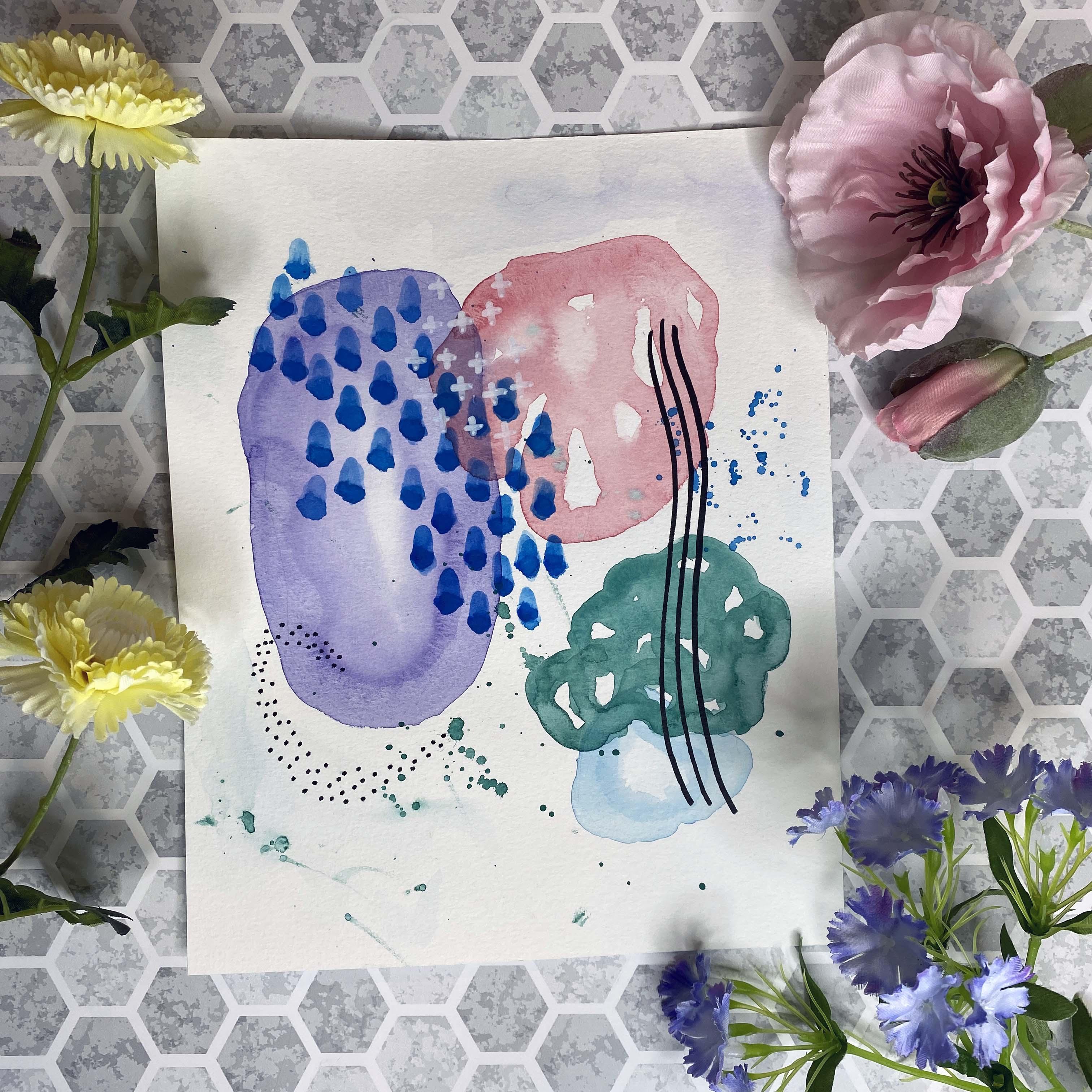
8. Abstract Art: Layer 4: So now I'm ready to add my top players. At this point, I want to take a look at my painting and see what I have going on. So I have a filled shape here with our blue teardrops. I have a couple of shapes that have the feathering or the white ground background showing through. I have a nice Grady in on these two shapes. I have a little spatter. Little hey is around here. So now I want to choose pieces to put on top of this that will add interest, draw the eye or unite the piece, or maybe even all three. At this point, I could take a stencil and see if I wanted to add maybe some of these lines here, and I could trace over them with Martin Marker or a different stencil. And I think I want to stay away from the rectangles and squares just because this is such a rounded shape. So that would eliminate thes. I think I would will add some of this these lines here. We kind of have the I going down this way. I think if I have a few lines going this way, it'll drag it together, force it together. But I'm not even sure I need a stencil for that. So I'll take my acrylic paint marker and I'll just make the some lines here. And I got to figure out, Do I want them stick straight? So I want them organic. Do I want a slight curve to them? So here I have this line and it goes down and it combines all three of our shapes here together. In addition to that, there's a lot of contrast because it's such a dark color compared to the colors we used. So I'm gonna repeat that shape, trying to stick close together and go parallel to it, and they will do it one more time. So there I have some shapes that I added in Think over here, I'm going to add additional, smaller shapes, and I'll kind of echo the shape here of a rounded bottom of this purple background shape. And I'm just gonna use little dots. I kind of made my curve like I liked, and then I'll come in here and add some more of those dots. And again I'm incorporating another shape, which is totally fine, as well as repeating a pattern on a very Saul scale, and it kind of blends around with the spatter we already created, and it echoes some of the shapes that were trying to pull from our image. I'm gonna pull this over here a little further, just like that, and I like the way that looks. Lastly, I'll take my white acrylic pen and you can use white paint. You can use gel pen if you want, and I'm going to see what else I want to add. I think it was gonna add a few pluses, just little shape pluses here and there in a cluster, and I'll go right over the drops that we have, as well as the big shapes in the background. It'll take a step back and look at my work. I like the way that looks. There's multiple shapes built up on top of each other. There's a lot of overlap, and then there's some contrast that just pops out at you. I'm pretty happy with this, and so there I have are completed image. The next chapter will wrap up the class, and I'll show some variations using different media. Besides watercolor
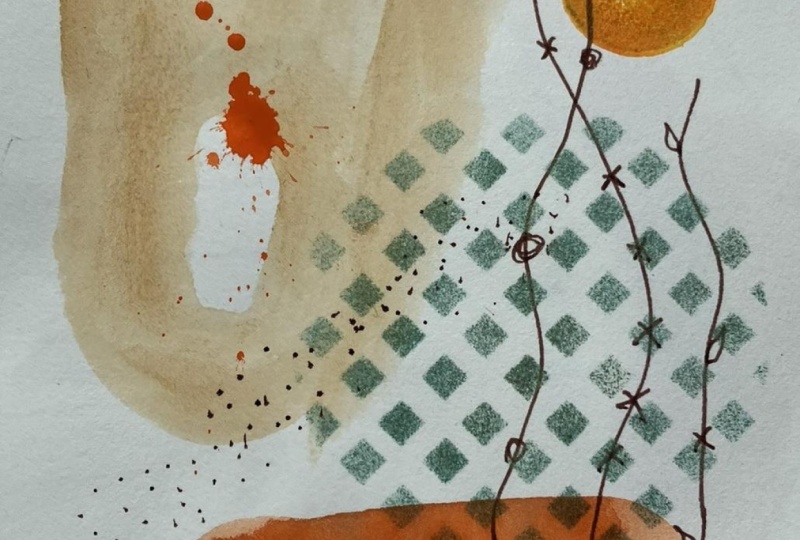
9. Class Wrap Up: So here we have our completed image from class. We met all the criteria of our challenge. All four prompts. We use five shapes of varying sizes. We overlapped at least three of the shapes we added one shape, at least that was partially filled in. And that was this shape here with our teardrops are blue teardrops. And then we used additional layers of lines and dots, which kind of pulled the piece together, unified it and picked up images from the background as well as followed the curves that we made throughout our peace. And this was done with watercolor and then we used in acrylic pen at the end toe. Add the white pluses, which are very subtle. The black lines, which are very country strong and a sharp contrast, as well as these black dots that again formed another curve. Here's another example of the same procedure with the same prompt. And instead of using watercolors, I used collage, some acrylic paint and then just a black marker on. This is just a permanent marker, so I collage my image of my major shapes. Then I added one shape here. If you can barely see it of these pink squares. And then I took some that pink and just faded into the background. Here is well, and on top of that, I added my top layer here of these black dots, all the shapes air similar their organic, but they're kind of overly shaped, and I like the way that looks. This used a lot of color to create this image. Lastly, I took this and I used totally different materials. This is acrylic paint, strictly acrylic paint. So I took my canvas and I painted it black instead of white. And then I created my shapes, and I did a process very similar to the watercolor where I put a couple of shapes down that didn't overlap. When they dried, I added more shapes, and then I went in. I added a stencil on top to create this shape. Lastly, for my top layer, I went in with some really contrast in color, this white and this yellow and I put some repeated pattern of the dots on top of that, and it got a totally different look using the same prompts. So with one set of prompts, you can use lots of materials. Anyone's that you have on hand, you can combine the medium that you have and you can create totally different results each time you create this project. Thank you for joining me today. Please be sure to follow me here on skill share to get notified of future classes. Please consider leaving a review and thank you for watching.
 Daniela Mellen, Artist & Author