Transcripts
1. Introduction : Welcome. This is the
very first video in a whole series about how to play the guitar and how
to play chords. Along with this course,
there's going to be an e book. You'll notice that the e book
is divided into two parts. Part one is all
about playing solo. That would be literally
playing the note of the song. But we're going to start
in this course with P two. Some chords are used in music
a lot more than others. You need to start with
the most common ones and then get progressively
more difficult. By the end, you
should be able to play something pretty cool. We're going to give you some
very well known songs which you can sing and then play
along with your guitar. You can either strum
or we can pick. Those are your two main
right hand techniques, and we're going to show you
both. Let's get started.
2. Lesson 1 (A and E - Go and tell Aunt Nancy): The two chords that we
start with are A and E. You need to know at least
two chords to play a song. It's very difficult to find
a song with only one chord. A looks like this, and you play it from
the fifth string down. Let me show you exactly
what A looks like. You put your ring finger in the second fret.
These are frets. Second fret, second string, you put your ring finger
and your middle finger, you put on the third
string in the same fret, and your index finger on the fourth string
in the same fret. They all have to
fit into that fret. And then you mustn't touch any other strings
with these fingers. If you touch the bottom string, see you're going to
have a weird sound. Your fingers must
stand up straight like soldiers because they mustn't
touch any other strings. So it's quite a tight
squeeze for them to all fit into that fret there. Try to get a clear sound, do it over and over from
the fifth string down. You don't play the string
because sounds wrong. E, we play all the
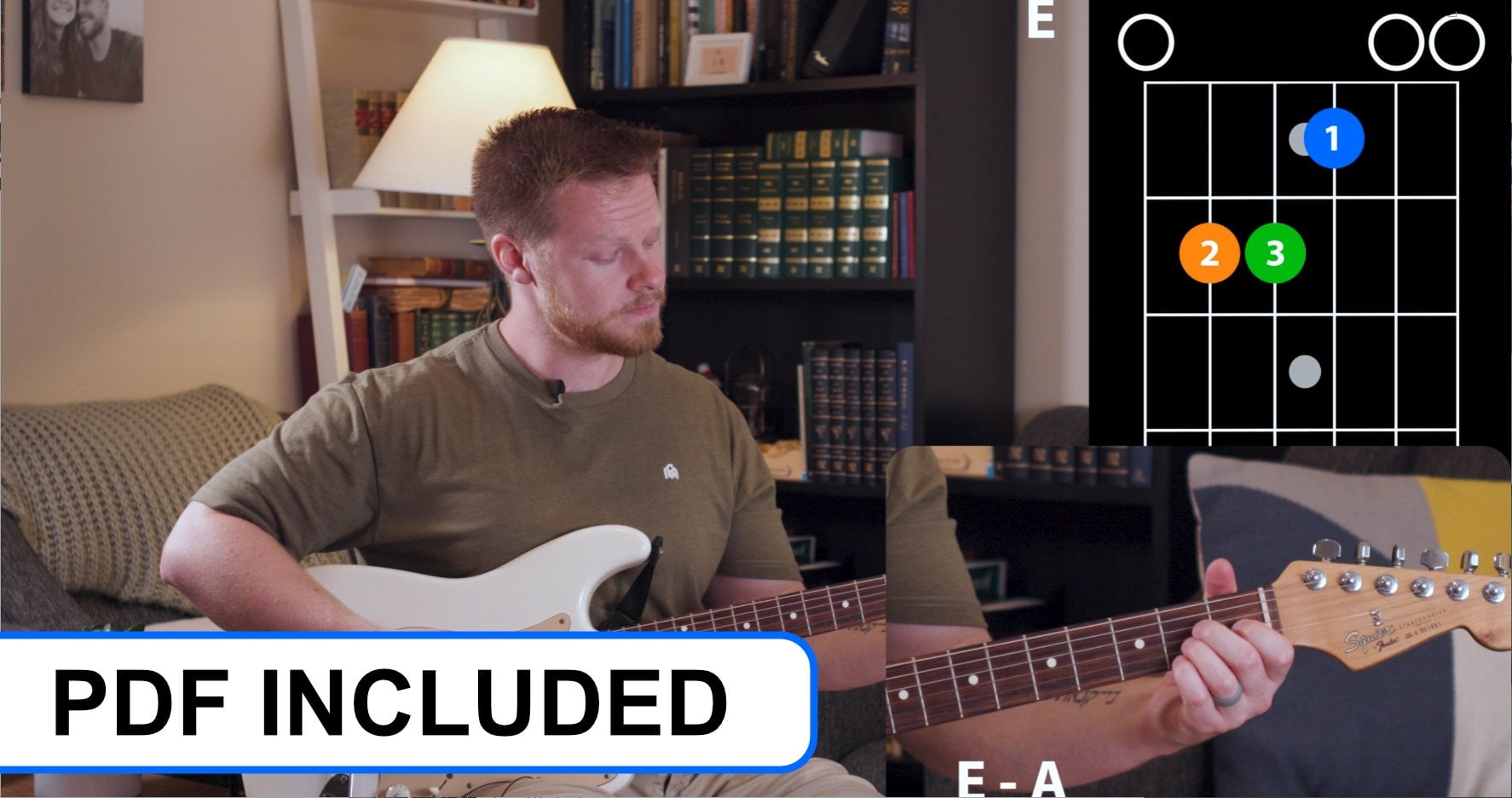
strings. Sounds very good. It's a full core. Show you exactly how to build E. In the first fret on
the third string, you put your index finger. And then middle finger
on the fifth string. Then that one between them gets pressed down
with a ring finger. These two they are friends. They do those two strings, and then make sure you
don't press anything on a string that's already pressed down because that
doesn't make any sense. It's in the first, the third st index finger. These two friends, they go together on the
fourth and fifth, and we play all the strings. Practice going
down all the time, smoothly get a nice sound. So when we play the first song, go and tell Aunt Nancy. With this hand, we're just
going to go one, two, three, four, one,
two, three, four. Remember the correct strings. A six for E, three, four, and only from
the fifth for A. One, two, three,
one, two, three. Do this a lot before
you start the song. H. H. H. The song is in A, which means it usually starts
with A and ends with A. In between, we're
going to have some es. I'm going to count 24, and then I'm going to start. Two, three, four. T g. Let's do it again. One, two, three, four, G. O on the old gray
3. Lesson 2 (London Bridge): So we have another song with A and E. It's called
London Bridge. You should know it. Same thing. We're going to count to four. One, two, three, four. London Bridge is falling down. Falling down falling down. London Bridge is falling down. I Lady. Let's do it again. One, two, three, four. London Bridge. He is falling down. Falling down, falling down. London Bridge is falling down. By fair lady.
4. Lesson 3 (Hansie Slim): Now we have a song
called Hansi Slim. It is Afrikaans.
It's like Dutch. The song is about a boy who wants to climb the mountain
and see the whole world, and he's got a stick and a hat, and it fits him well and
he's full of courage. But his mother's heart is sore because Hans is
not at home anymore. In his mid hears his mother's sigh and he
runs back home again. I think it's a German tune, so some of you
will recognize it. One, two, three, four, slum slum and stock Iot Pass on Hot is for fun Mardi art ferns and the iner we're now Martha Shall we do it again? One, two, three, four, slum and stock int past. Is fun A artful ser s and the nemere. Went mod I think if the song is too fast for you, you can put it on a slower
speed on your tablet or your computer or your phone so that it plays a song slowly that you can practice and
once you know it, you put a normal speed.
5. Lesson 4 (D - Brahms' Lullaby): I'm now teaching you how to play D. It looks like this
and it sounds like this. Let me show you exactly
how to build it. In the second fret,
these are frets. In the second fret,
your middle finger goes on the bottom string, and your index finger
goes on the third string. Now it's obvious you can
see that the ring finger in the next fret go in the
middle st, the second string. We don't play the
top two strings, we only play from the
fourth down. Like this. Do it over and over again
to get a smooth sound. If you don't press hard
enough and you don't press at the exact place, it will sound. You will hear it. It
won't be a clear sound. Usually, we try
to go just behind this little metal strip. We're not going to
play D like that. We rather shifted up as close as possible to the
end of the block. The song that we're going to
play is called Bros Lullaby. It starts in A, and
just now you'll see, we're going to use D, and we also go to use E. You just do nice down
strokes for this one. Down strums, like this. A. D. A. God, let's go. One, two, three, one, two on and go no. Go to bed down and sleep, tight, se your yes and start
to your Pleasant dreams until When the sun lods the sky, you will wake feelings pry. Start the day with a smile. Life is really w w. If that's a bit fast
for you to keep up. Remember, you can
make it slow on your phone or on your computer
while you're practicing. Make it a half speed or so, and then you can
just practice first. The second time round, I want to show you
the same song with a little bit of a fancy
strum on this side. In other words, you can hear
that the song goes one, two, three, one, two, three, so we're going to go the lower
string with two high ones, two times down here, down there. So let's do the lullaby
again, and you try that. One, two, three, one, two, and good night. Go to good night close
your eyes and start to your less and dreams until
When the sun lights the ski, you will wake feelings. Start the day with
the smile. Life is.
6. Lesson 5 (The First Noël): So far, all the songs have been in A and this one is also in A. It's called the First Nowhere. If you see two chords
above one word, that means that while
you're playing that word, you must play two
chords like this. The next no, you see the E above the second
part of the word, and the next d above the second part of
Noel and next one. Sometimes you'll see
two d above one word, or you see the chord above
the second part of the word, then you must do exactly
what it says like this. Oh, well. No or So it's possible that you
can change the chord at the beginning or the
middle or the end of a word. Let's try the first now. One, two, three, one, two, field keeping the shape on a cold winter snd snow No. No No Let's do it again. One, two, three, two now angels to C two sgeper, Penfield the sheep on a cold winters no blood No. No. No
7. Lesson 6 (B7 - This old man): I'm showing you now
how to do B seventh. Your index finger goes in the first fret on
the fourth string, and then we're going
to do a little waterfall skipping
string every time. You small fingers on
the bottom string, your ring fingers on
the third string, and your middle fingers
on the fifth string. You can see that this one is pressing down on
the fourth string, and these two are around it. When we play B seventh, we only play from the
fifth string down, so we skip the top string. And it goes together
with E and A. Maybe you could practice
E seven, e. 87. This old man is a song
that's also played in A. One, two, three, four. This old man. He played one. He played nicknck on my
drum with a nicknck. Maddy ck, give the dog a bon. The old man came on
That was a slow tempo, and remember you never
change your tempo. While you're busy with the song, it stays the same space
apart, the strums. Now, to make the song
more interesting, you can double it like this. One, two, three, four. The sold he played one He played nicknck on my
drum with a nicknck, baddy weapon give the dog a ball the s ma So in this song, you can see the second line. He played Nick knack on my
drum is the difficult part. It's got the new chord, and it's also got more chords
than the rest of the song. So what you do then
is you pick out just that line and you practice it over
and over like this. Played Nick on drum. P play Nick ack on my drum. P played Nick Na drum. Pick on drum until you
can do it smoothly. Then you know the whole song
is going to go smoothly. Otherwise, you're going to get stuck every time in that line, and it might discourage you. Hope you get that right.
It's not so easy, but if you do, you'll be very proud of yourself and
will be proud of you.
8. Lesson 7 (Yankee Doodle): The next song is going
to be challenging. But if you know B seven, which you already do, this one, then you'll be able to do it. You just need to go practice before you start Yankee Doodle, you need to practice
E seven, Ben, sn. There's a lot of
that in the song. Middle finger stays in place
and all the others change. If you could do that quite fast, then you can try Yankee doodle. We're going to do
it very slowly. One, two, three, four. Yankee Doodle went to town on. He stuck and called M Yankee Doodle, dress fine. Yankee And my the music
and the step and make yourself quite the I'm going to do yankee
doodle a bit faster so that when you know it well
and you've practiced a lot, then you can go
with me the speed. 14 Yankee doodle, when
two town riding on a bone He stuck a
feather in his cap and called it Mo Yankee doodle, dressed up fine
Yankee doodle Ddind the music and the step and
make yourself quite banding. Oh.
9. Lesson 8 (G - Home on the Range): I'm showing you now how to
play G. Sounds like this, and you play all the strings. Your ring finger is on the first string
in the third fret, and your index fingers on the fifth string
in the second fret, and your middle finger on the sixth string
in the third fret. It's a nice like E. The song that we're doing with G is
called Home on the range. I think range means
something like a farm. We've learned the new G now, but the song we're
doing starts in D. G is somewhere
else in the song. Thereby Buffalo,
you'll see the first G. This song is in D, but it also uses E A and G. Home on the range. One, two, 12 give
me where the bath where the t and
the g play Wheres clod Theca and the
skye are not cloudy And on the rain We the deep the g of There's heart. The sky g w. And the skies are blown We're going to
pick instead of strong. The bottom three fingers are just going to do
this all the time. They stay the same. The thumb is going to have to be clever. D uses the fourth string, you're going to go like this for D. A uses the fifth string. You're going to go
like this for A. E uses the top string, you're going to go
like this for E. And g, also the top string. You've got to remember
when you see the next ord, what is the base
node for that chord? One, two, three, one, two, give me where the
bf where the t and an play W for the sky and the skies are not cloud on the rain. Where the de round the
blade Where Sal is for the sky and the skies are not cloudy you'll see
above discouraging. The g is in the
middle of the word, so you change at coag.
You only change. Where the disco word. The chord is above the place in the word where
you must change.
10. Lesson 9 (C - Down in the Valley): Down in the Here the wind The chord I'm
showing you now is C, and you don't play
the top string. Sounds like this. In the first fret, you have your index finger on
the second string. In the second fret, you have your middle finger on
the fourth string, and in the third fret, you have your ring finger
on the fifth string. So just be careful. You don't play strings
three. You skips. String three. The right
hand plays five strings. You don't play the top string. Why don't you play the top
string? I'll let you listen. It sounds horrible. Can you
hear. Something's wrong. So see we play from
the fifth string down. The song we're doing
for this Cord, C is called down in the Valley. One, two, three,
one, two, three, down so Bale Here the wind blow Here the wind Oh. Here the wind blow. Down in the He the wind blow. All right. There's a nice
pick for this one as well. You must remember
your bass string, which is five for C. The
bottom three stay the same. They go. They pick twice all
the way through the song. S. G. So, this song's got only C and G. It's quite an
easy coord song. One, two, three, one, two, three, down in Valley. He wind blow Hear the wind blow. Here Here the windblow Down in the Here the windblow
11. Lesson 10 (Hush little baby): The next song we're
doing in C is h, little baby. One, two, four. Hash little baby. Don't say a word. Papa gonna by you making bird. If that making bird
Papas gona by you aiding Now I want to show
you a pum chuck pick. This is the pum, Your
base string is the pum, and the bottom three strings, which are always the
same is the chuck. Boom, chuck, boom, chuck chuck. Maybe you can practice
that before you start. C is fifth string,
G, six string. One, two, three,
four, little baby. Don't say a word. Papas gona buy you
a marking bird. And if that making
bird don't sing, Papask buy you a diamond ring.
12. Lesson 11 (F - Red River Valley): The next chord is called F, and it's a tricky chord
because this finger, the index finger must press down both those strings
in the first fret. Then in the next fret, the third string and then the next
fret, the fourth string. Let's say you're going from C
to F. It's a back and down. You have to press quite hard to press those two down
at the same time. When you play F, you only use four strings from
the fourth down. So the song we're doing
is Red River Valley, and there are only two Fs in it. So I suggest you also
practice a little bit of something like C F G. C F to get a lot of practice with F. Up to now we've been using our thumb
when we strum like this. Now I'd like to teach you
just to use a finger nail. We use the index finger and we just go down
with the nail. 123 from this a they say
you are going I shall miss your bright eyes and
sweet smile just because you are weary and tire You are changing your
range for a while. So come sit here
a while here you a Do not sten to be a ad No. Just remember the
red river valley and the cowboy who loves you so. The next round of
Red River Valley, I want to show you how
to use more nails. So we go to sort of
go top string bottom, top bottom, top bottom. Top bottom, toto to to
something like that. So I'm actually using most
of my of these four nails. O. Index finger to try and
hit the correct bay string, which is four for F six for g five for C. Shall we try that? One, two, three, *** al they say I shall mince your
bright and s Just entire And you are
change your age for So come here you leave Dating Just remember And the boy who loves you And
13. Lesson 12 (Twinkle, Twinkle Little Star): There's another song
that we can do with F, and that is Twinkle
Twinkle Little Star. There's a lot of changing
between the three chords, C F and G. I suggest before you start Twinkle Twinkle Little
Star that you just go C F F che C F F che, something like that, O C F G C, F C, F g as fast as you can until you
can do it quite quickly. And then you start with
Twinkle Twinkle Little So. One, two, three, four, Dkle twinkle How wonder what you are L a diamond in the sky. Tinkle tinto. Oh, I wonder what Oh,
let's do it again. Tin Tin so. Oh I wonder what A L P diamond the sky Twinkle twin. What I hope I haven't
been doing G like this. Let me just show you in case. G looks like this, but you
can also do it G seven. Can you hear it's
almost the same. The only difference
is this bottom note. So sometimes without thinking, I play G seven. H.
14. Lesson 13 (My Grandfather's clock): O Now, there's quite a long song called my grandfather's clock. It's quite a fun song, but there's also quite a lot of movement from one
or to the other. But I think once you master this one,
you'll be very happy. One, two, three, my grandfather's clock was
too large for the shelf. So it stood 90 on the floor. It was tall by half than
the old man himself. Though it weigh not a penny. It was put on the morn
of the day that he was born and was always
his treasure and pride. But it's not short, never to move again when the 90 years without lumbering tick talk ticks
life seconds numbering. Tick talk tick. But it stopped short. Never to move again when You can play the first part of the
song a bit louder. And then when it
comes to 90 years without slumbering,
you can go softer. It makes your music more professional when you use a bit of softer and louder. Let's now that you know
my grandfather's clock, we can try a very cool
little pick like this. The thumb must remember
the base note, which is C which is
five for C, four for F, and six for g. The other three fingers just pick the last the bottom
three strings all the time. So it's quite fast
on the right hand. One, two, three. My grandfather's clock was
too large for the shelf. So it stood 90 s on the floor. It was taller by half
than the old man himself. Though it weighed not a penny. Wait more It was
but on the morn of the day that he was born and was always his
treasure and pride. But it stopped short. Never to move again when the
old man 90 years without slumbering **** Doc
his life second slumbering **** Doc
tick it stopped short, never to move again when the You can see I not only went
louder and softer, but I also went half
pace, where it came to, but it stopped short, never to move again, I half the pace, instead of going,
it stopped short. Never to move again. I went, it stop
never to move again. T for that line, and then I went faster again. When the M. So I hope
you get that right. It's really fun, but also quite a challenge. All
the best with that.
15. Lesson 14 (Em - O Come, all ye Faithful): This is E minor. It
almost looks like, E is like this, you just
take away the index finger, and you use all the strings. A very nice minor note, a little bit more sad and
very useful in some songs. In this song, come you faithful. Unfortunately, minor only
appears in the last line. I only appears once. Maybe we'll find other songs
with more e minors in them. The song is in D. Okay. And I'm going to play it quite slowly because there
are places where there's a lot of
changing between A D. There's a lot. You should practice this
before you start A 123 Joyful two Come and be the angels That might have been
too fast still, so let us do it even slower. One, two, three, joyful C and be angels. Oh come
16. Lesson 15 (Am, Dm - We three kings of Orient are): So now we have another minor. We had E minor, now
we have a minor. A minor looks like this
and sounds like this. If you play A and you go
down with all of them, one down for each
string, you get a minor. I think you can play
all the strings, but I usually just
play from the fret. And another minor, the third one is D
minor. Looks like this. Index finger on the first
string in the first fret, middle finger on the third
string in the second fret, and ring finger on the second
string in the third fret. And you play from
the Fourth Stream. We travel so far Bild
Fountain Mountain. Do undertone. This is quite a
challenging song. It's got both our
new minor chords, A minor and D minor, and it's got E g, C and F. We have six
chords in this song. You'll have to have all
your bearings about you. 133 king of ing gifts. We travel so far and fret there's no Sn one. There's no of mine. Snow bright stills st Hi go. So you'll notice that I don't just go down, down, down, down. I sort of go more base, and then two lighter ones, like a more heavy, and then two lighter ones. Good. Let's try it again. 02, three. We three We travel so far He flows star of one of star Bu bright to I heard No
17. Lesson 16 (Skye Boat song): The next song is Sky boat song. It's in C. It uses
C and G and F, but also A minor and D minor. It's also quite challenging, but let's do it slowly. One, two, three, speed
boat like a b on the w on y la that's more be Oh See. Now the waves how the
waves sun D claps un F filled our fall stand by the shore fall they will speak on unable to
like a bird on the w s s You noticed where the words tell
me that there's a loud waves and
the thunderclaps, I sing a bit louder, that makes your music a
bit more professional. I'm going to show you
a boom chuk chuk pick. F A min D minus. You thumb must remember
the bas string. 02 set speed bonny boat
like a bird on the we. Ow the sa Berry the lad that's born to be O S Lu the waves the waves roll claps D f stand by the shot Oh fable to like a bird. A s s Sky is an island, right? Isle of sky.
18. How to tune your guitar - 3 WAYS: Hello, everyone. Welcome back. Today, I'm going to show you
how to tune your guitar. The ways to tune your guitar. First question we must ask is, why do I tune my guitar? Well, I'm going to demonstrate. My guitar is at the
moment out of tune, and I'm going to play
Twinkle Twinkle Little Star. Then I'm going to tune
it and play it again, and you listen to
the difference. Link Twinkle Little star. Oh, my wonder. L b. All right. Now I've tuned it. Listen to Twinkle, twinkle. Twinkle Twinkle test L twinkle. I think you will
agree with me that it sounds much better
when it's tuned. When you use a tuner
to tune your guitar, you have to know the
names of the strings. We have got a little
rhyme that you can use. Emma and Daniel go by X. E, ma A and D, Daniel, go by B x, E. And this is what you
must tune to on the tune. When you put the tune on
and you pluck a string. It must say E for that string. If it doesn't say E, you
have to turn until you find E. And then you start looking at the
three little lights. If the little light
is on the right, it means you loosen a bit. If the little light
is on the left, you tighten a bit. It looks like my E string
is a bit too tight I'll O. So now it's too loose. I must adjust until the
green light goes on. There we are. There. If there's a lot of noise around you
while you using a tune, it's not really going to work. If someone is screaming
or playing an instrument, you'll just have to
get it them quiet. You can also put the tune right up against
your guitar that helps to focus on
your instrument. And, Emma, this is A. Looks like A is pretty
close to right thing. It's fairly easy to
tune with a tune. You can also download an app on your cell phone
that's got a tune. We'll show you how that works. All right. You can go to
Apps and download an app to Tuna app, it's
the same thing. You have to know the
names of the strings, Emma and Daniel, go by sings. If you use the cell phone app, just make sure the little dial is right at the top when
you're plucking the string. And it's quite easy to use. Only thing necessary here is
for you to know the names of the strings. All right. Another way to tune is obviously to use a piano or a keyboard. Between methods,
I tune the guitar again just to show you
the next way to tune. You go to the piano and
use the same notes. Emma and Daniel, go by. You find an E. Remember
the first one is E. Find a E on your keyboard that sounds low like this. There we are. You try and listen
to that E and your E. And adjust E. All right? Then you find, A. Mine is too low. Then
you find Daniel, D. Go. G. By, B. Eggs. Can you see the top
and the bottom string? Two octaves apart. So a keyboard is quite easy to. If you don't have a tuner, or you don't have piano or any electrical or
device to help you. You just have yourself
and your guitar. I'm going to show
you how to do that. You go to fret number
five, one, two, three, five, and you put a
finger on the top string. Now the top string
and the one after it, six and five sound the same. You can hear that
the second string is a little bit too low. So I tighten it up there. Don't tighten the wrong one. Until they sound the same. Now my top string is fine. Now I go to the second string in the fifth threat and
I press down there. Now this string that
I'm pressing down and the one under it
must sound the same. Can you hear there's
a difference? Fourth string is too low. Turn the one that
you have a tuned. Only the underneath one. Now the fourth one. Until they sound the same to me. Then I go one down. Now the one that
I'm pressing down and the one underneath
it must sound the same. And I only change
the bottom one. For the third string, it's the only one that is different. He goes to Fret number four. In fret number, on the third
string, you press down. Now, that one and the one
underneath sound the same. Now I come back to Fred
five for the last one. Now I've tuned it by ear, and I test it. Play E. Sounds fine. That is how you tune by ear. It is the most difficult route, but it's very useful when
there's no other way to tune except your ear.
Try to practice that. We know now that each
string has a name. Make sure that all your strings are in the right position. Emma is first in line, and it must tighten
clockwise to the back. It tighten that way and loosen back that A is a second one, it must tighten that way. Daniel tighten that way. When you come to
the bottom three, go in that position,
by, B, eggs. Emma and Daniel go by eggs, and they must all tighten
in that direction. So you might need to
restring your strings, and put them all in
the right position. It would be very good for you to learn all these ways to tune your guitar because sometimes you want to use your cell phone, but it's the batteries flat. And then you're not near
a piano or a keyboard, and you can use your e. Thanks
for listening to everyone. I hope to see you the next es.
19. Advanced fingerpicking for inspiration :): Now we're going to pick out some of these songs as a bonus to you who've practiced so
hard with a special pick. The first one we're going
to do is the first no well, and we're going to use a pick
up and down pick like this. So you choose your base string and then you go base three, two, one, two, three. Let me do it slowly. That's A. D, E, H. Okay, let's dry slowly. One, two, three, one, two now angels did say step Thin fields in field keeping she H Cl Now. One is. You see there's E and A
on the first no well. You don't have time to
do the whole pattern on E. You just have time
for two fingers, and then you have to go to A. No. For this old man, we've got a nice
pick where you have one long note and
two short ones. Your base note is longer. D. D. Okay, let's try
it for this old man. One, two, three, four. The small man. He played one. He played Nickck on my drum with the nick Paddy
give the dog a fall. The sm came home. The small man He played one. He played Nick Neck on my drum with a nick N Daddy weep
Give the dog a ball. The Stoneman game rolling. So now you can also alternate your bass strings to make
it even more fun like this. What did you four? The solemn He played one. He played Nick one drum with
an body give the top board the man game rolling Tada. T
 Salome Cilliers, Academic literacy facilitator & musician