Sunflower Watercolor Bookmarks: Using Salt and Watercolor Pencils for Texture | Marisa Johnson | Skillshare

Playback Speed


1.0x


  • 0.5x
  • 0.75x
  • 1x (Normal)
  • 1.25x
  • 1.5x
  • 1.75x
  • 2x

Sunflower Watercolor Bookmarks: Using Salt and Watercolor Pencils for Texture

teacher avatar Marisa Johnson, Artist/Photographer

Watch this class and thousands more

Get unlimited access to every class
Taught by industry leaders & working professionals
Topics include illustration, design, photography, and more

Watch this class and thousands more

Get unlimited access to every class
Taught by industry leaders & working professionals
Topics include illustration, design, photography, and more

Lessons in This Class

    • 1.

      Hello and Welcome

      1:06

    • 2.

      Art Supplies

      3:00

    • 3.

      Washes and Techniques

      7:33

    • 4.

      Sketch The Flowers

      1:44

    • 5.

      Flowers

      10:16

    • 6.

      Leaves

      4:37

    • 7.

      Finishing Touches

      8:33

    • 8.

      Class Project and Thank you

      2:24

  • --
  • Beginner level
  • Intermediate level
  • Advanced level
  • All levels

Community Generated

The level is determined by a majority opinion of students who have reviewed this class. The teacher's recommendation is shown until at least 5 student responses are collected.

166

Students

4

Projects

About This Class

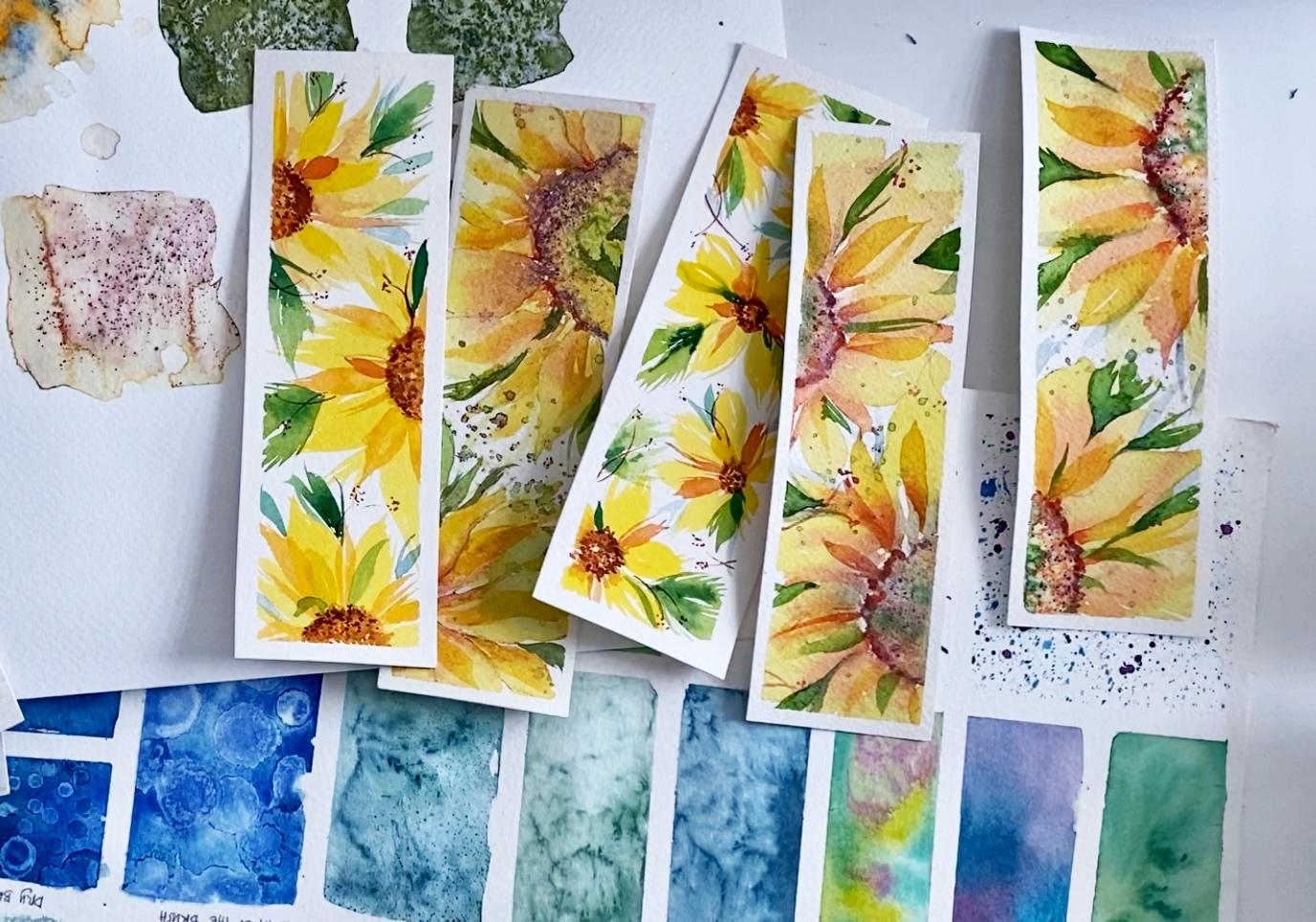
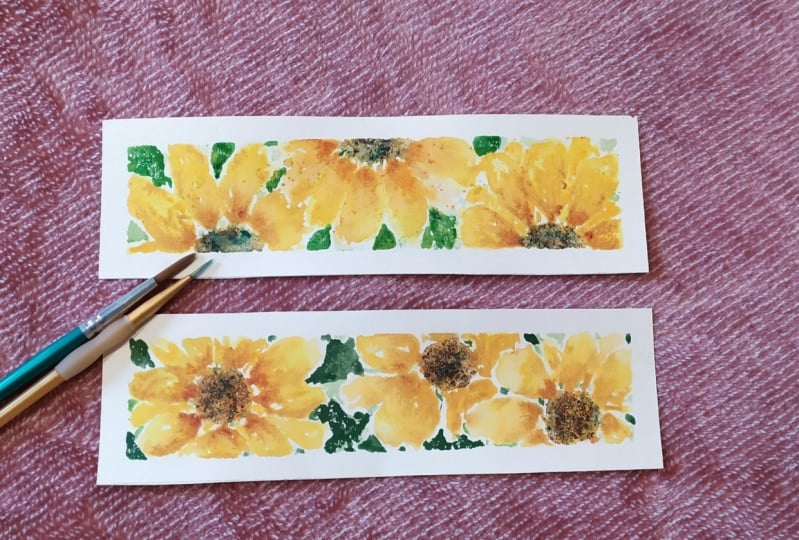
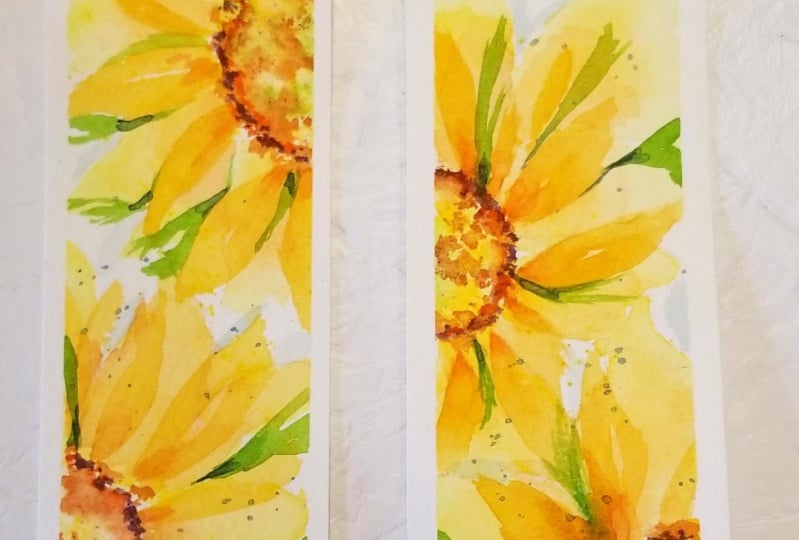
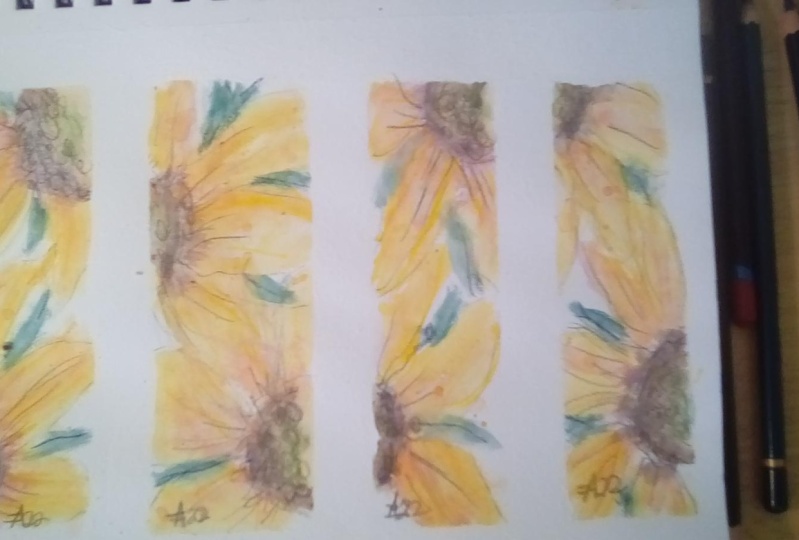
Hello!  I hope you are doing fantastic today.  We are going to paint a simple watercolor sunflower bookmarks.   Here you will learn to control the water and paint in order for you to achieve the transparency and opacity of watercolor also the control of your hands holding the brush.  You will learn and enjoy the use of salt and watercolor pencils to achieve textures.

Here is the guide for your class project:  

1. Prepare your paint, brushes, water and paper.  Try to paint using natural light or under a bright source of light.

2. For beginners, do some exercises first in creating petals and different washes and techniques. You can find the exercises under the Watercolor Washes and Techniques section.

3. Paint the flowers. This is not something too serious where we have to think about detailing and depth or dimensions.  This is more about being free and tapping into your intuition.  Just be creative and feel free to add your own style.

By the end of this class you will not only have bookmarks to be a part of your reading journey, but you will have inspiration and confidence to paint simple and easy loose sunflowers in watercolor.

Sharing your Artwork

I can't wait to see what you create.  Please show me your work in the project section and please do feel free to upload any of the following:

  • Your Watercolor Washes and Techniques
  • Your work-in-progress from any phases of the project
  • Your final Watercolor Painting

Don't forget to tag me on Instagram @habit_of_art and use the hashtag #letspaintandstayconnected to feature your work on my stories.  Please reach out to me if you have any questions or need an extra guidance.

https://www.instagram.com/habit_of_art/

https://www.facebook.com/makulaystudio

Feel free to share your work to our Facebook Private Group Page: Let's Paint and Stay Connected by Makulay Studio

https://www.facebook.com/groups/1024233775013094

Make today amazing!

Meet Your Teacher

Teacher Profile Image

Marisa Johnson

Artist/Photographer

Teacher

Marisa Johnson is an award-winning artist.  Has been honored with numerous awards for her artworks in the US Department of Army.  Has had several solo and group exhibitions and publications in Japan and South Korea.  She has done a lot of commission work sold internationally.  Have been teaching since 2007 serving the US military families in Japan and Korea.  Now being based in the Philippines, she is looking forward to share her artwork expertise to everyone interested in developing its creativity.

See full profile

Level: All Levels

Class Ratings

Expectations Met?
    Exceeded!
  • 0%
  • Yes
  • 0%
  • Somewhat
  • 0%
  • Not really
  • 0%

Why Join Skillshare?

Take award-winning Skillshare Original Classes

Each class has short lessons, hands-on projects

Your membership supports Skillshare teachers

Learn From Anywhere

Take classes on the go with the Skillshare app. Stream or download to watch on the plane, the subway, or wherever you learn best.

Transcripts

1. Hello and Welcome: Hello you beautiful creatives. I hope you are all doing excellent Today. I'm Marissa, an artist, photographer and a yoga instructor currently based in Manila. In this class, I am going to show you how to paint a simple watercolor sunflower bookmarks with using salt and watercolor pencils to add texture. This is not something to Syria where you have to think about serious detailing. This is more about being free, more like tapping into your intuition and just let your creativity flow. Have this watercolor bookmarks be a part of your reading tiny, or simply give them as a gift to your avid reader, family or friends, have fun painting and see you. The next lesson. 2. Art Supplies: Welcome back. Now let's do a quick rundown of the art supplies we need in this class. Watercolor paper. I like using Arches cold pressed, or making bookmarks. I prefer this size as it comes in handy and I can carry its every time I travel. Watercolor paints. In this class, I am going to use Holbein watercolor tubes, gamboge, Nova, lemon yellow, vermilion hue, mineral Violet, raw sienna, mars yellow. And I will probably use cobalt green. And then I'm going to use hookers, green, sap green, and indigo watercolor pencils. These are the shades of the watercolor pencils. I am going to use red, violet, purple, red, and dark indigo, but a simple dark purple color. We'll do the trick. This is totally optional. You can skip this process of using watercolor. Watercolor brushes. Since we are painting in a small surface, I'll just use russia's Number six, number four, and a script liner brush number for my favorite script liner brush number two. We are going to be meeting a nail file if you decided to use watercolor pencils. Of course. Glasses of water. One for rinsing the brush, and one for clean water. Paper towels, washcloths, a pencil to lightly sketch the subject. I normally do this intuitively without sketching, but for the sake of this class and for the beginners, I'd like to show you how I would simply lightly sketched flowers. Next thing we need a board to tape down to pay for, to avoid buckling of our watercolor paper. And we need a masking tape or washi tape to place around a pooper. When need an eraser, a see-saw or a table salt, and a palette. I like using a ceramic dish or a pallet to mix colors. 3. Washes and Techniques: Let's practice first washes and techniques that we're going to use for this project. We will begin aware that wet on dry and flat wash, wet-on-dry is basically a wet brush with paint on dry paper, which I am also applying and trying to achieve a flat wash. Over here. We want the color to be even know dark areas, no light areas. Next is wet on wet, meaning wet brush on wet paper. Here, I lay clean brush with clean water onto the paper. Here, as you can see, I am setting down the orange paint freely onto the wet paper. And I am going to combine blue to let the colors bleed into each other. You can also drop some water using that tip of the brush. This is the power of wet on wet technique. It allows us to create harmonious color to insertions. I'll let the paint do what it wants to do and let it surprise you. Next is salt effects. Salt is all about timing. So I am painting a wash of green here and I am going to wait a little bit to put salt on it when the paint becomes damp and not too wet. I am painting another one here to sprinkle sea salt right away onto the wet paint. We're going to wait until the assault soak up the paint. Meanwhile, we move on to splatter technique. There are few different ways to do spattering techniques using brush. For this lesson, I just simply use my index finger to tap the brush. Another kind of splattering technique that we will be doing is using watercolor pencils to splatter drops of powder onto the wet paint. Here, I grabbed my nail file and I simply scratch the watercolor pencil onto it and let the wet paint to catch the powdered pigment. Next to her is glazing. Glazing means painting over a dry paint. And since our first towards this dry already, I'll just go ahead and paint over it and meet together. This is the technique I use in creating petals and the leaves. Tip of the brush at the bottom. Then lay the body of the brush than tip of the brush again at the top and and repeat the process, the half size of the panel. And of course, yes, we can do just one stroke tip of the brush, then later buddy up the brush than a tip of the brush again, at the top end. 4. Sketch The Flowers: Hello and welcome back. Now let's put a tape around our watercolor paper on a study voids. As I have mentioned earlier, I have this size all the time with me. It always comes in handy every time I travel. So easy to use as bookmarks. I just put tape around it for borders. And there you go. I got myself to bookmark. But of course you can manually measure and cut your paper in science says that you prefer. Just lightly sketch the flower petals here. If you want a somewhat guide, I have uploaded the sketch of this bookmarks in the Resources folder for you to download. And as I have mentioned earlier, I do this for the sake of our lovely beginners here. If it was just me, I'd like to paint this loosely, intuitively without sketching. 5. Flowers: Let's paint our sunflowers. Keep in mind, this is more of a relaxing about having fun and exploring. We don't have to worry much of depth and details. You just mind that tonal value, the lightness and darkness of the colors. We start with wet on wet, wet, the middle part of the sunflowers with a brush of water only. I apologize, that process didn't record, but here's to show you how I did it with a second, the bookmark. Now without wet middle part, you can simply dab a little bit of yellow, a little bit of orange, and a little bit of green. The grab your watercolor pencil and nail file to start spattering. This will create a nice texture with assault, which we are going to add next. And time to sprinkle salt. And over here, I am repeating the same process. On the second week, Monday. Before I begin painting the flower petals, I grabbed a dry, clean brush here to brush away and clean off the powdered pigment from the watercolor pencil. Here, I am mixing lemon yellow and a gamboge Nova together. It's totally fine to use if you only have one shade of yellow. I am doing spattering here first with the mix of lemon yellow and a gamboge Nova. Then I will decide painting the petals. You seeing the wet on dry technique. I am just simply creating a flat wash hair and just filling in the petals that we just sketched. Just enjoy and have fun with the process of painting this bookmarks. Maybe you have the intention and meaning behind painting. This tried to focus on that. Creating art isn't always about the end result, but the intentions behind it. And while my first layer is still damp, I layer it with a darker shade of yellow. You can make some little bit of orange to your yellow if you want to achieve a little bit of a darker tone. My wash is still damp, and so I layer it with an orange shade, which is vermilion hue. Now, we will just wait for this wash to dry. Now that it's dry, as you can see, it becomes lighter. Watercolor tends to become lighter on paper when drinks. And so I decided to add more layers of petals using just gamboge Nova. And while that wash is still wet, I dab a little bit of vermilion hue using that tip of the brush. Let this dry and I will see you in the next class to paint the leaves. 6. Leaves: Painting the leaves is very easy. You just fill out the empty spaces between the petals, but try not to overdo it. I am using a sap green here for the lips. And you can see here, I grabbed my number to script liner brush and I just dab a little bit of a yellow onto the green. Just a tiny, tiny bit. And of course, you can also put some layers on top of the petals in flickering motion. While the green wash is still wet, I just dab a little bit of indigo to give it a little daft and not looking too flat. There goes our simple lives, and I will see you on the next lesson for some finishing touches. 7. Finishing Touches: For finishing touches, we're going to define the center of the sunflowers. I'm going to use a mineral, violet here. Using the number two round brush. I just dab a clean water just on the edge of the center of the flowers. And then I will just tub tiny bits of a duct of mineral Violet. And then I am going to add a bit of vermilion hue that I'm going to add more leaves where that using very light shade of indigo. In order to do that slight mix, you add more water content to the pigments and a few more spattering of the same mix and also spattering of watercolor pencil, powdered pigment. 8. Class Project and Thank you: As easy as that, you have now, two bookmarks, so enjoy for yourself or give it as a gift to your family or friends. Now let's remove the masking tape. Make sure that the appeal that tape away from the painting going outwards. I want to quickly show you is that you can protect your bookmark from pills in case you like to drink tea or coffee, like me who are reading it from us? Any fixative or watercolor varnish. Thank you so much for joining me and taking the time to relax together. I really hope that you did enjoy and that you took something away from this class would be great if you could share what you create. I cannot wait to see it. Please do share on the project section. And if you post it on social media, please tag me so that I can see it and share your work and cheer you on. If you have any questions, please feel free to ask them in the discussion section of this class. And I will get back to you as soon as I'm able. And if you find this class beneficial, it will be much appreciated if you leave a review to help other students and decide if they like to take this class until next time. And I wish you joy on your journey to painting. Bye.