Transcripts
1. Introduction: If you're beginning to brush
up on your Spanish skills, or maybe you just want to begin learning Spanish
for the first time. This class will teach
numerous ways to do this. Some that you may have
never heard of before. And the great thing
is you don't need any previous experience
to take this class. But if you know some Spanish, this will only help
you improve your game. Learning a foreign language
can be intimidating enough, but not knowing all the
ways you can learn it can make it difficult to
find what fits you best. Since each person learns
a little differently, this class will give you
several options, if not many, to make learning Spanish
not only more fun, but also more tailored to
how you prefer to learn. While the Spanish speakers in my families speak Latin
American Spanish. I took Castilian, Spain, Spanish from 7th
to 12th grades, and have 16 college
credits in it. From there, I started a business developing
curriculum for and taught Spanish programs to
two-year-olds to adults. From this experience
and training, I've learned that the more fun and diverse the
training styles are, the more engaged
the students are. That's why I wanted to share
what I've learned with you. I've picked the favorites
of my students, but also some of the methods
that help the most in acquisition and retention
of a foreign language. In this class, we're
going to cover six ways to learn Spanish. What's your preferred
learning style and how you want to
use each of them. Choosing bilingual and
or immersion programs. Sounding more like
a native speaker. Finding programs you can grow with, locating conversational
Spanish resources, And what might be
holding you back and what can propel you
forward to reach goals. We're also going to apply this knowledge to
our class project, which is a chart
that you'll fill out as we walk through
these lessons. This chart can serve as a
roadmap for how you can start and stay motivated
in learning Spanish. I'm excited that by
the end of this class, you'll have new ideas
on how to make learning Spanish more engaging
and fun for you. So let's get started.
2. Your Class Project: To learn Spanish, you could
choose an audio book, online program, course, app
or so many other things. How do you know which
one is right for you? We're going to cover
six different ways you can learn Spanish and
apply that knowledge to a chart where you can flesh out your thoughts and plans
to reach your goals. Instead of picking up the first
Spanish program you find, only to find out later that
it's not a good fit for you, you'll have this chart that you'll fill out along
the way and you'll discover what a Spanish
program should have for you. Please start by
opening the file in your project section
of this class that's titled "Spanish
for beginners, six ways to learn." You can either fill it out as a Word document that
will expand as you type. Or there's a PDF
version that has room in each row to
write what you want. The first column
lists the six ways to learn, that we'll be
covering in this class. After we go over
these ways to learn, we'll walk through
an example of how to fill out the second column. The second column lists
the things to consider and or work on for
that way to learn. There are also
questions in each row for the second column
to get you thinking. The third and last
column you can fill out is titled due date. This third column is optional, but if you work best by
having dates to aim for, so you keep moving forward, This is where you can
plan when you want to do each thing you've filled
out in the second column. By the end of this class, you'll end up with your class project chart
filled out with what is relevant to your learning of Spanish with a plan of
what to tackle first, should you want to
approach it that way. If you'd rather just
listen and absorb then this class will give
you ideas of what to look for as you
search for programs, classes or books that
will teach you Spanish. Let's start with the first
way to learn Spanish: Knowing what the
learning styles are and what your preferred
learning style is.
3. Use the 3 Learning Styles: Overview: We all acquire and retain a foreign language a
little differently. Some prefer to see the words,
they're visual learners. Some learn best by hearing
the language spoken. That's auditory learning. And others learn best by doing or moving while
learning Spanish. They'd be kinesthetic
or tactile learners. Regardless of which
learning style we favor, we all learn from each
of these three styles. As a side note, many say there
are four learning styles because they add reading and
writing as the fourth style. And beyond that, some even claim there are up
to eight learning styles. To keep it simple,
we'll focus on the three basic styles of visual, auditory,
and kinesthetic. It's important to first know which learning
style you favor and to choose foreign
language study programs that cater to that
learning style. Otherwise, you'll
have a harder time acquiring the language and won't have as much
fun as a result. So how do you figure out which
learning style you favor? There are a lot of professionally and
scientifically devised questionnaires that
will tell you. I'd suggest searching
online for learning style questionnaire and taking
a questionnaire or two. Once you've discovered what your preferred
learning style is, it's also important
to remember to use all learning
styles to some degree, because especially in foreign
language acquisition, seeing how the words are spelled and then
hearing how they're pronounced is, of course,
pretty darn important. They all work together to help you learn what
you're wanting to. Now, it's time to fill in the first thing on your
class project's chart. Once you've determined your
preferred learning style, write it down in the blank. Next, we'll look into how each learning style works when
learning another language.
4. Use the 3 Learning Styles: Visual: Let's start with the
visual learning style: What you can see. You can learn Spanish primarily by just
reading and writing it. As a side note, remember this is what
some breakout as a fourth learning style
in and of itself. But we're going to
lump these into visual. The visual learning
style is anything you can see, read, or write. Let's look at some examples. You could copy of
vocabulary words on flashcards that
have photos on them. Take notes during a class, and draw diagrams that help make sense of the concepts
you're learning. Read a Spanish textbook and look at a Spanish
speaking video. If this is your preferred
learning style, it's in your best interest to not take a Spanish class that relies exclusively on
reading words on paper. You'll likely do better
if you have some visuals mixed into the reading
portions of the course. Next up is the auditory
learning style.
5. Use the 3 Learning Styles: Auditory: The auditory learning style is all about what you can hear and say and talk about with
others through conversation. Here are some examples. You can listen to
a Spanish-speaking TV program or podcast. You can hear yourself repeat the vocabulary you're
learning from an audio book. You can listen to Spanish
music on the radio, and you can attend a conversational
Spanish class online or in-person. This last option, by the way, is the best option of
all in my opinion. That's because it requires
you to process what you're learning in a different and more complex way than the others, while also allowing you the
opportunity to get feedback. So if this is your preferred learning style, you're in luck. Foreign language learning lends itself very well to
auditory learners, especially in this digital age. You can use any of the
examples mentioned and more. Just make sure
you're not studying exclusively from a
text-only book in print. And you'll probably
do very well. And that's the auditory
learning style. Now we're on to the
kinesthetic learning style.
6. Use the 3 Learning Styles: Kinesthetic: The kinesthetic learning style is a little different and not a preferred learning style for the majority of the population. But that doesn't mean
it's not powerful. And it makes learning
a whole lot more fun. Because of that, I really
like to focus on it, especially for the
positive impact it can have on foreign
language learning. The kinesthetic or
tactile learning style is one where you use
your body to learn. You do, feel or experience
the learning with your body. It's very effective when you use a multi-sensory approach, meaning you use the
other two senses of visual and auditory learning with the kinesthetic to have the greatest impact on
your Spanish studies. Some examples of this are: you
could walk while listening to an audio book that pauses so you can repeat back
what's being said. Or while listening
to an online course, you could use magnetic
alphabet letters to spell the word
you're learning. You can also do this with
words printed on magnets and form those words into
sentences on a magnetic board. And yet another way, which is a popular method specifically for foreign language
acquisition, is one of my favorites. It's called total
physical response. It's worth taking a
deeper dive into. Total physical response, or TPR, is a very effective method that's backed by
research and it's associating a movement or kinesthetic way of learning with the language
being acquired. When I teach Spanish, I personally have chosen to use American Sign Language or ASL with my students
because you can learn two foreign languages
at one time. And all the Spanish
words you're learning already have a motion
associated with them. Let's look at an example. Thank you in Spanish is good gracias and here's
the sign for thank you, or gracias, in ASL. So whenever you say gracias, you use the sign. Now you try it. Gracias. It's that easy. If using specific signs for specific words
isn't your thing, then there's another
tactic you can use. Four of my five kids have gone
through speech therapy, and when they're having a
hard time saying a word, the speech therapists
have taught them to tap their chin for each syllable
they're pronouncing. And I like to switch hands
for each new word. Let's do an example
together to show you how. Say you're listening
to an audio book and it says, repeat after me: el cocodrilo es verde If you're not familiar
with Spanish, you might be thinking, say what?! But if you were, all at the same time, to use the visual learning
style to see the words. Then use the auditory
learning style of hearing someone say that sentence while tapping your chin while the
words are being said, let's see if that's easier to break down what's being said. el cocodrilo es verde I don't know about you, but
that's much easier to me. Now, let's add two more things. The English translation
of that sentence, and a visual, a picture
of the vocabulary word. Try saying and tapping
with me again. el cocodrilo es verde So much better, right? There's a third way I've used, and it's similar to
tapping the chin, but instead you clap
for each syllable. Let's try that with
another sentence. el canguro es rojo If you're brand new to Spanish, that might have sounded
like a jumble of sounds. Or maybe you can make
out a word or two if you took high school
Spanish decades ago. Let's try it while listening
to me say the words, while you read the words and the translation
on the screen, and look at the visual all while clapping for
each syllable. Here we go. el canguro es rojo One more time. el canguro es rojo If kinesthetic is your
preferred learning style, you can try any of
these movements mentioned while looking
at an online course. Or maybe you want to listen to a podcast while doing chores. Whatever the mix, you'll likely find better results
with your studies if you add some physical
movement while you're studying. Those are the three
different learning styles, visual, auditory,
and kinesthetic. By incorporating all of these learning styles when
you're studying Spanish, your learning will not
only be more interesting, but you'll retain it better. Now it's time to take out
your class project's chart. Please fill in which one or ones you'd like
to give a try. Noting any specific ideas you learned or thought
of on your own. And if it's helpful for you add a date to when you'd
like to try that out. When you're done
thinking that through, we're ready to cover the
second way to learn Spanish: Choosing bilingual or
immersion programs.
7. Choose Bilingual and/or Immersion: Congratulations on finishing the first and longest lessons on ways to learn Spanish. Now that you know what the
three learning styles are, it lays the foundation for learning about all
the other ways. And the remaining five ways
will go quicker because they're well-known and don't
need as much explanation. The second way to learn Spanish is to decide whether you'd like a bilingual or immersion
approach in the program you choose. Whether that program
be an audio book, a textbook in print, an online course,
or something else. Bilingual learning
is when you're being taught Spanish through
the English language. As you progress
through the program, Spanish could likely be used
more and more than English. Bilingual programs
will translate vocabulary words and conversational sentences
while you're learning. Immersion learning
is when you learn Spanish through the
Spanish language. One of the most common ways
this happens for adults is when they live in
a foreign country that's Spanish speaking. So they're forced in
a good way to acquire Spanish by just living
and or working every day. Another way is if you take a conversational Spanish class, where only Spanish is spoken. You listen and try to pick up
what's being communicated. I personally am not a fan of immersion when you're a
brand new Spanish learner. This is why. If I'm trying to teach you
Spanish and I ask you ¿cuándo vas a la tienda? How will you know what
those words mean? Now, if I show you the English translation
of that sentence, you not only understand
what you're saying, but can deduce several
things like the fact that three English
words are lumped into one word means that verbs may not be a word
for word exchange. And when you hear the word
la before another noun, you'll know that's likely
the word the in English. With that being said,
if you know enough Spanish to converse
at a basic level, immersion could
be a good option, especially when you're immersed
multiple times a week. And if you can mix bilingual learning with immersion learning,
that's even better. Do you want to try bilingual,
immersion, or both? Please write down
your thoughts and intentions on your chart, adding a date to when you want to find that kind of program. Now, let's talk
about how to repeat Spanish words and sound
more like a native speaker.
8. Sound More Like a Native Speaker: If you want to sound more
like a native speaker, I have a pronunciation
guide that you can download in the class
project tab of this class. The pronunciation guide will
tell you how each letter or combination of letters is
pronounced in Spanish. But first, a huge disclaimer to remember when
using this guide. Just like British and
American English have different pronunciations
of the same word you might hear a
Spanish word being pronounced differently
in Spain than in Mexico. So this pronunciation
guide is a guide, not an exhaustive
treatment of how each and every country pronounces
each and every sound. You can use the pronunciation
guide to study on your own or to brush up on
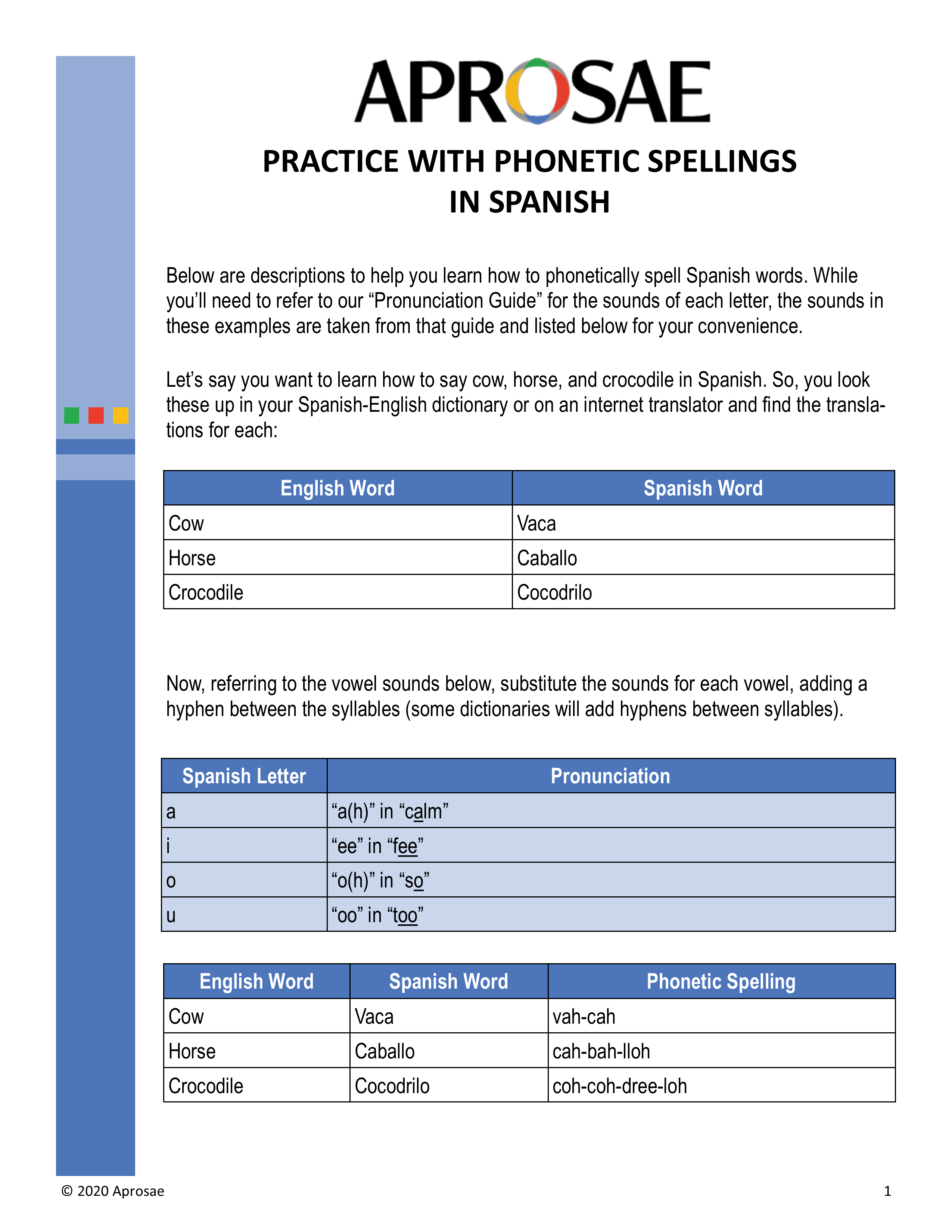
the sounds of Spanish. If you want to go further there's also a
downloadable worksheet in the class project's
section called practice with phonetic
spellings in Spanish. You can download that, follow the instructions
and learn how to better pronounce
any Spanish word. Depending on the instructional
program you choose. That program might focus on
how to pronounce Spanish. Others may just tell you to repeat the word after
they've modeled it. If you find you need more
instruction on how to pronounce Spanish than
your program provides, my favorite way is to
perform a Google search for how to say and then add the Spanish
words you want to say. Like here, we've
searched for how to say hola, which is hello. The search results will come
up with an audio file of the pronunciation for you to
listen and practice with. Yet, if that doesn't
fit your style, there's a plethora of
videos on sites like YouTube about all things related to Spanish
pronunciation. Or you could also search for articles online or
from the library. By using the
pronunciation guide, the three-page worksheet titled practice with phonetic
spellings in Spanish, or using any of the
other tips mentioned you can pretty quickly
go from saying things like Los Angeles to Los Angeles. If you need to start learning, or maybe just brush up on
Spanish pronunciation, please write down if you're
going to use the guide, the worksheets, search for further resources,
or something else. Think of when you'd
like to do this by and write that down as well. Next up is finding programs that teach Spanish that
you can grow with.
9. Find Programs You Can Grow With: A discouraging thing to
some Spanish learners is they invest in learning Spanish by taking a beginner course, and then there's not an intermediate
or advanced course. It can be especially frustrating if they
took time to find a program that fits their learning style and
it's worked well for them. That's why it's
important to think ahead when finding a program and find one that has other courses you can
graduate up into. That's also helpful
for motivation. To know you have another course to work towards as a goal. And most places that have intermediate and or advanced
courses will be sequential, meaning they'll build
upon what they've already taught and teach it in
a way you're used to. There are two main
places I've found most people go to find
Spanish programs. One is digitally, and
the other is this thing called the library. Digitally there are a lots of options. On online marketplaces
like Amazon they have bestseller
lists when you search for things like foreign
language instruction. This will show you
the top sellers from one of the largest
marketplaces online. In the Android or
Apple App Stores, you can find apps
that teach Spanish. You can search for things
like Spanish learning apps. And you can find
reviews from users, amount of downloads,
which indicate popularity and even
editors choices. Online you can find other
options like classes, games, e-books, websites,
software programs, and more. A good old Google search can help you find
more resources, than you
ever imagined. The nice thing about the
library is that you can lay hands on the programs you
think might work for you. And at no cost. I like to place holds on the
items I'm interested in, sit down and peruse each one before bringing
them home to use. Depending on the library,
you may have access to some of them was
popular programs in all formats that you
can find online. If there's a program you want, but your library
doesn't have it remember you can ask for
an inter-library loan and you might be able to
get it that way. I've actually done
that before and my library has
purchased the resource. So you might get
lucky that way also. Just keep in mind to match your learning style with
whatever program you choose. On your class project chart write down where
you plan on finding a program and note the date
you hope to do this by. And let's not forget that
community websites and the library may have conversational Spanish
opportunities. So let's dig deeper
into that topic next.
10. Conversational Spanish Resources: The fifth way to
learn Spanish is by participating in conversational
Spanish opportunities. These don't need to
be formal classes, but need to be where you
have the chance to talk back and forth in Spanish
with another human being. There are several
ways you can do this. You can attend a
Spanish-speaking Church service and talk to others afterwards. You can attend
special business or community events like a Cinco de Mayo or
May 5th festival. You can volunteer
for a non-profit where you're assisting people
who speak Spanish. You can eat at a locally
owned restaurant where the staff are
Spanish-speaking. And you can prepare to order
in Spanish before you go. You can join in a formal conversational
class that's hosted at a library, community center or a continuing education
program at a college. Or you can find a
native speaker who wants to learn English and
you want to learn Spanish. And you could instant
message each other. If none of these opportunities
exist in your area, you could find an opportunity
online or even create your own opportunity by finding a Spanish speaker at work and asking them to
meet for a coffee. Or you could meet
a fellow parent at your child's school
and ask them to join you and your child for
a play date at the park. Any live person to live person conversational Spanish
opportunities are the best way to participate
in conversational Spanish. But if that's not your thing, there's a way to
passively expose yourself to Spanish
conversations. You could turn on
the TV and listen to a Spanish series or movie, or turn on the radio and
listen to Spanish music. Though passive
learning opportunities don't engage your mind
and introduce you to aspects of the Spanish language that you'd get through
a live conversation they do hold firm value
if participating in conversational Spanish isn't
going to work for you. Another thing that's speaking to a native Spanish speaker will give you is that you'll be
exposed to their culture, which can expand your
world in so many ways. Think of how you'd
like to participate in conversational Spanish
opportunities and write down your thoughts on your
class project's chart. Next up is our sixth and last
way of learning Spanish: How to stay motivated so
you reach your goals.
11. Keep the Momentum Going: Have you ever just busted out
of the gate to do something new only to lose your
motivation along the way. If you have, you're not alone. Think of what goal you
have for learning Spanish. Do you want to be able to carry a basic conversation
with your friend? Do you want to be able
to order completely in Spanish from the Mexican
restaurant you go to every week? Maybe you want to
be able to talk to Spanish speakers at work. Or it could just be to
challenge your mind. As you use your Spanish skills, you might find it
opens new worlds to you and your goal
might grow as well. But for this lesson, keep your current goal in
the forefront of your mind. As you might have
experienced before, life can get in the
way of our goals. Think about what kinds of
obstacles you might encounter remembering that
obstacles can be internal of our own
creation or external, something outside of us
that we can't control but many times we
can work around. For example, let's say you
have a lot of kids at home. Family time is not only
essential but important. How can you add
learning Spanish, to your already full plate? Let's say your oldest child
is taking Spanish in school. One idea is that you could take an online class
while you're with them and then attend community events were Spanish
is spoken with that child. Another example might be
that you find yourself getting unmotivated
because you're not able to use the Spanish
skills you're acquiring. If that's the case, you can
use some of the ideas from the conversational Spanish
lesson in this class to make Spanish a skill
that you need in life. Regardless of what
obstacles you might face, There's one thing every
person needs to do to keep the momentum growing, and that's to set
yourself up for success. There are three main points that are important to do this. The first is positive thinking. When something is new, There's going to be a learning
curve and you might start thinking or even telling yourself that you
can't learn Spanish. That's simply not true. I remember decades ago, a commonly held belief of many was that new
neural pathways couldn't be developed well or at all as you hit certain ages. Recent research has
shown that we can build new neural
pathways at any age. Let yourself know this if or when you ever doubt
that you will speak, read, and write Spanish one day. The second thing is the more you put into learning Spanish, the more you're going
to get out of it, just like anything else. If you spend 15 minutes a day, every weekday
reviewing Spanish, like one day using flashcards. The next listening
to Spanish music, the next taking an
online course and so on, your skills are going
to advance so much quicker than if you do one
of those things once a week. Setting realistic
expectations is your friend. And the third thing is if you make a point to have fun
while learning, you're going to stick
with it so much longer. Focusing on your
preferred learning style will make Spanish more engaging, rewarding, and fun for you. Now, let's fill out the class project's
chart one last time. If you foresee any obstacles to learning Spanish, note those. Next, think about what motivates you to not only overcome
those obstacles, but also that goal you thought of at the
beginning of this lesson. You could note that as
a motivator you want to use to keep the momentum going. Congratulations,
felicitaciones You are done with your chart
and almost with this class. Last, let's look at
the last lesson to discover what you can do now
with what you've learned.
12. What's Next?: Now that you've learned six ways to learn Spanish and what your plan of attack is for
learning Spanish. What's next? Well, you have a
couple of options. First, I hope everyone posts
their class project's chart. I'd love to see what
you have planned. Also let me know if you have any questions and
I'll get back to you. Second, please follow us so you get word of when we
have new classes. One class we'll have uploaded, if it's not there
already, is titled take the mystery out
of learning Spanish. It covers the why of
the Spanish language so you can deduce what common threads
you're seeing and grow even faster in your ability to
understand and speak Spanish. Whatever you do with
learning Spanish, please remember, you can't do it all in a day, nor should you. It all starts with
that first step. So please make
sure that you take that first step you have on your chart and let
us know how it goes. Remember we're here to
help get you there. Please post your class project's chart so we can give you any
feedback you're seeking. And so you'll be one step
closer to where you want to be. Adios.
 Aprosae - Michelle West, Training / Consulting / Speaking