Transcripts
1. Introduction: Hi, I'm Emily. I'm an artist and a drawing
teacher from New Zealand. In this quick and
fun practice class, I'm going to take you
through some exercises to help you become more
comfortable with sketching. We'll be sketching these
cute origami animals and we'll be using
straight lines only. But we're not going to
be using any rulers. Instead, we'll focus on
judging angles by eye and on drawing loose natural sketch lines with
a relaxed hand. It might seem simple, but you'll be developing essential coordination
skills that will carry through into your
other drawing projects. You don't need any
special materials, just an HB pencil
and some paper, and there's absolutely no
pressure with this class. It's just a fun way to get
in some sketching practice.
2. The Project: The project for this class is simply to follow
along with me through the practice exercises and compose a page of
origami animal sketches. You can download the
resource handout showing the animal images, the line drawings, or you can draw from the
images on screen. And if you want to take
this project even further, you could have a go at drawing
the origami animals from the photo sheet and include some shading to help show
their three dimensional form. Upload your sketches to the project section once
you've finished. I really look forward
to seeing them.
3. Warm Up Exercise: Okay, let's go. Welcome to
today's fun little project. Now, if you've taken any of my courses or my classes before, you know that I am a big advocate for
drawing straight lines, even for curved objects. So I will give you
a curved object like a pear or an apple, and then I'll ask you to draw
it using straight lines. You might be sick of drawing straight lines, but
they're really, really useful because we can use them to measure
curves in a way. Now, today, we're going to
be drawing straight lines. We're not drawing
any curved objects, which you might be
really happy about because we're going to
be drawing origami. Now, these are some little
things that I made. It's quite fun making them. And if you want to make
some, I can link you the YouTube video down
below this video. We're not going to
be making Origami, but I've just made these, so we've got some
subjects to draw, and as you'll see, they all have straight lines. So we're going to be
practicing our straight lines, not applying them to curves, but just practicing
drawing angles, measuring angles by eye, and using nice, loose sketching
movement with our pencil. And we're going to
start by loosening up. Get all of these out of the way. You might want to use
two different pages, one for the loosening
up exercise, and then the second one
for our drawing project. So to loosen up, we're
just going to start sketching some
really basic shapes. You can work all over
your page if you want to. You might go to divide
your page in half, depending on how big
your sketchbook is, but this is, you know, like eight by 11 " around about, and we're going to use
up the whole page. And I'm just going to start
sketching some basic shapes, start with a triangle,
maybe a square, and try to use that nice loose rhythm where
you're not thinking too much about how straight the line is or how
perfect the line is, but you're moving your
hand in that direction. And you'll see I
fake the line first, so I will kind of
get a feel for it, maybe really, really lightly or not even touching the page. Before I put my pencil down. So I'm getting that rhythm
going with my hand first. And this is the way
you get good at sketching fast and also
just having nice light, relaxed and loose looking lines, which can be used in
your final drawing. You know, if you're doing
a finished drawing, you might want some of
these lines in there, but they're also really useful just for the first
sketch that you do, the first layer that
you do of your drawing. So we've got a few basic
shapes down there. Now we're going to
add on some shapes. So thinking about origami
there's a lot of triangles. There might be some squares
or rectangles, as well. There might be some
little triangles coming off the bigger triangles. And sometimes there's
like a head up here. So you can play around with creating weird sort of creatures with these,
if you want to. I mean, this could be if I put another square there
and another square there, maybe it's some kind of goose. Trying to think what that is. Some sort of weird weird bird, I think, because of this head. Maybe we could draw
something that is more of an animal face. You can copy what I'm doing or you can just
make up your own. So maybe this is sort of a
fox's head or a dog's head. See, everything is made
up of straight lines, a lot of triangles
in there as well. But we don't have to
always have triangles. We could have long rectangles. Origami sometimes symmetrical, so you could think about
making things symmetrical. I don't know what this one is
going to be, but we'll see. Maybe I'll put another few
sets of legs or something. Maybe it can be a bug.
Maybe it can be a scorpion. Or a fish or whatever
you see in it there. And you could also just do
something that is abstract, so don't worry if
you're not getting it to look like anything
in particular. I just keep on adding on
triangles and rectangles. Think about the
angles that I put in and how they might match
because in Origami, there's certain ways
of folding things. You don't often have kind of
just a random random angle. They'll often match the angles that you've
already got there. And also just thinking about how things might kind of
line up with each other, maybe this lines up with this. Maybe this lines up with this. Even though I'm
doing it randomly, I'm thinking about those
things as I do this. A parallelogram there, so this
one's getting pretty big. But it doesn't have to
be anything at all. It's quite fun to do these
ones that look like they are kind of folding folding
underneath each other. A square and then this triangle folds underneath it. Same
things happening here. So a square and then a
triangle that doesn't come all the way across
the length of that square, so we could do another one here. And maybe I'll do
one more over here. So all I'm doing is
starting with a shape, not thinking about
what it's going to be in the first place. You see how I corrected
that shape as well. So I did a triangle that
wasn't an equal triangle. I want it to be symmetrical on both sides. I'm
just correcting it. And if you're drawing
nice and loose and light, then that's really easy
to do those corrections. I haven't used an
eraser at all yet. Getting a little bit
looser with this one. I'm thinking, Ken,
I turn this into something probably not
a little bit strange. Could be some kind of weird
snake curled up on itself, maybe with a hat on. In which case, I'll bring
this out a little bit more. It's our practice.
I hope you got the feel for those nice
light and loose lines. Now, we're going to have a go
at sketching some of these. Now, it's kind of
hard to draw them just looking at the
origami itself because, you know, sometimes they sort
of bend in different ways. So I drawing them out for you in black and white line
drawing, and we'll use those. But I do have a
photograph of these. If you wanted to draw from
the actual photograph, you could download that and
draw from that, as well. I mean, that might give you some other interesting angles. So in the photograph, when I look on screen here, you see there an extra wing. You'd be looking at the three dimensional
form of it rather than just the two
dimensional form of it.
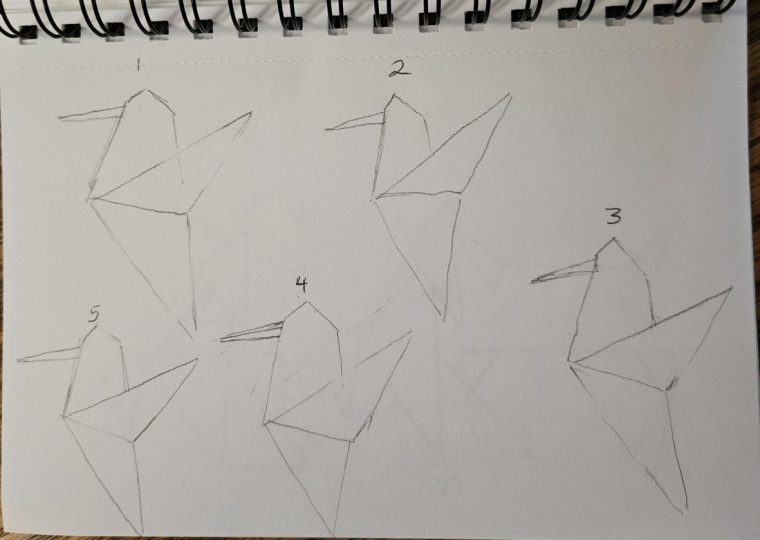
4. Hummingbird, Fish, Crab: Here's the first film
we're going to do. This one is a hummingbird, and you're going to
choose a shape to start with and then just
add on those shapes, but try to gauge the angle that you see in that picture there. You can work on screen, just drawing what you can see on the screen if your
screen is big enough. If it's a phone, then you might find it's
a little bit hard to see, and you might want to
download the sheet that I've got with all of the line
drawings of the animals, orogami animals, and
then you can put that on another screen so
you can blow it up as big or small
as you want to. But otherwise, we'll draw
from the screen here. I can make that a
little bit bigger. I'm going to fit maybe
five on my page. We won't do all of them. I'll leave some for you to
do for practice on your own, but just think about being
out to fit one, two, three, four, five, something like that on there. Not too big. I always say about tennis
ball size for your drawings. So choose a shape to start with and get a feel for that angle. So I'm looking at
this wing here, I started to go up a little bit. But when I really
look at it and try to match my direction
with that angle, it's something a
little bit like that. So keep these really
light to start with light and loose drawing that triangle
shape of the wing. And then I can add on
this triangle here. And as I add on this one, I'm looking at the
relationship between the two. Are they exactly the same? They look like they're
pretty much the same shape, so they'll be about
the same size. And then I'm going to put on this head and chest of the bird, looking at where the lines join up with the lines
that are already there. So the back of the bird here is about in line
with this line coming up. Maybe it's a little bit inside that and think about how
high up it comes as well. So all the time,
even though we're drawing something really simple, we are practicing
observation skills, we're practicing gauging angles, we're practicing
comparing angles, and where things line up
with each other as well. And we're comparing sizes within that drawing. So
there's the first one. If you keep your
lines nice and light, and you want to you
could go through and darken those lines out. I'm not making these lines
perfectly tidy or anything. My pencils a little bit blunt so that you
can see it clearly. It doesn't matter if yours is a little bit blunt, as well. We're just going for the angles and the
shapes we can see. Now, if you see that you've got something that is way out, maybe you do have this
wing coming up like this. So you put this wing in
here and you're like, Okay, no, I can see now
that that's incorrect. Just go ahead and draw over
top. Leave what's there. Draw your corrections
over top so you can see the difference
that you're making and then erase the lines. So you see you didn't
use the eraser at all. As I was drawing, I was working it out with
my pencil only. Let's move on to the next one. So let's have a go at
doing a fish this time. Choose one shape to start with. I'm going to use that triangle
at the front of the fish. And look at the type
of triangle it is. It's equal on both sides, but it's quite a sort
of a squat triangle. This length here is definitely longer than these two sides. Then we can add on
this shape here. Correcting my angles as I go. Trying to get a feel for them. Any of them you're
stuck on, take a look at the photograph
or the download, take a look at the screen
and move your hand and draw something so you
can see what you've got, and then you can compare
that to the subject. Looking at the height of
this compared with this. And I might not get these right. So if you see something that's not right in my
drawing, don't just copy me. You're going to
draw what you see. This angle here,
get a feel for it. How's it change from
this angle to this one? And this is where you could also be looking a little bit at negative spaces as we bring
in these other angles here. So negative spaces, the space between the shapes between
these two triangles here. So once I put that one in, if I look at that
space in there, I can see that this
angle isn't right. It should be more like this. And that means that
this angle should be a little bit more
tilted that way as well. When you're happy
with the shapes, erasing any the lines
you don't need, you can tidy things up a
little bit if you want to. Straighten some
lines up if they're a little bit to one side, leaning to one side, maybe
this one or this one. If they are a
little bit crooked, then you can just
straighten those up. So there's the
fish and the bird, and I'm going to add
in the crab over here. You start with the
biggest shape, getting a feel for the
height in the length. So keep things loose. I think mine needs
to be a little bit bigger that way and this way. Nice and loose. And
as you do this one, try to be aware of
what you're observing. What are you looking for?
What's your brain doing to try and find the correct
shape or the correct angle. So are you looking at the
spaces between things? Are you looking at the angle? Are you looking at
where things line up? So if I put in this arm here, thinking about how far
along it comes before I bring that arm
out on an angle, this space is bigger
than this space. Try to be conscious of
what you're looking for, or how your brain is working. You might not even be
consciously looking for it, but you're noticing something. It's a pretty quick one.
Not too many parts to that. You've got that nice big
man shape that everything else is coming off.
So we got two more. I'm gonna fit one
here and one here, and then you can keep practicing on your
own if you want to.
5. Dinosaur, Bird: Going to fit the
dinosaur just in here. Just before you place
it on the page, think about how much room
you're going to need. You need a bit of
room for that tail. If you started drawing here, then you're gonna
run out of room. So a good place to
start for this one might be maybe the long neck. Leave enough room for the head, but I'm going to put that in first just so that I
can work this way. Sometimes tricky to get those
longest straight lines. You think about the
length of that neck, maybe put on this line. The head. How is this angle
different to this angle? They're slightly different. There's this triangle shape here so we can break it up
into smaller shapes. It's an equal triangle
by the looks of it. You can even make little
marks if you want to to try and figure out where
you think things will go, just so you can
gauge that distance before you actually
put your line in. So I put a little
mark there where the other flipper
is going to go. And then I was able to
look at this line here and just see if it feels like the right length or
if it matches up with another length before I
actually put that flipper. I'm still drafting every
line first very lightly. And it may have made my body
just a little bit too tall, compared to the
neck, that's okay. It just means the tail
is going to come way out here so I can get
that same angle. Eras the lines you don't need. The other way to
tidy up your lines, if you want to is to draw darker lines over top
when you're happy, and then just as eras
over top of them. If you're pushing quite hard
with those darker lines, then it's all the other lines
around that darker line that are going to be erased. Yeah, just erase that. There we go. There's
my dinosaur. I'm going to do one more. And I'm gonna fit this
other bird in here. Now, this one was
facing this direction, although its wing was
going back this way, this one is facing
the other direction, its wings are going
back this way, you might find that
one or the other is easier to draw just because of the angles that you're drawing and what
direction you draw. And so for me, it's easier to go this way, 'cause
I'm left handed. All of the lines going that way will feel more natural for me. For you, it might
be more natural to go that way, if
you're right handed. It's something about
that movement, I think that outwards movement that feels a lot more
natural when you're drawing. So this one's got a square or a diamond shape square
right in the center of it. Just think about having
enough room on either side for the tail and that
wing coming up there, so I could put mine fairly low down and trying to draw a square that has equal sides and it's also sitting straight up on its corner like that
like a diamond. Let's move generally
from left to right, so I can put in a straight line here
straight up and down. Makes it easy, a
little bit here, and then look at that angle. And there's a little
equal triangle there. We've got a triangle with two equal sides here
and a longer base. And it's carrying on
from that line there. So it should be nice and
straight all the way from this edge of the
square along that triangle. And then we've got another
one that comes across here, and this one, the base of this larger triangle
is going to follow along with this
edge of the square. It's quite nice the
way this one folds. And everything kind of
matches up on the same angle. And here, we've
got a horizontal. And we've got another
horizontal down here. You know how far
across does has come? I think these two
actually line up. So that makes it nice and easy. You can look at the
negative space in there. But if I line that
one up with that one, and then I look for this angle, which is the same as this
angle and this angle. You need to erase
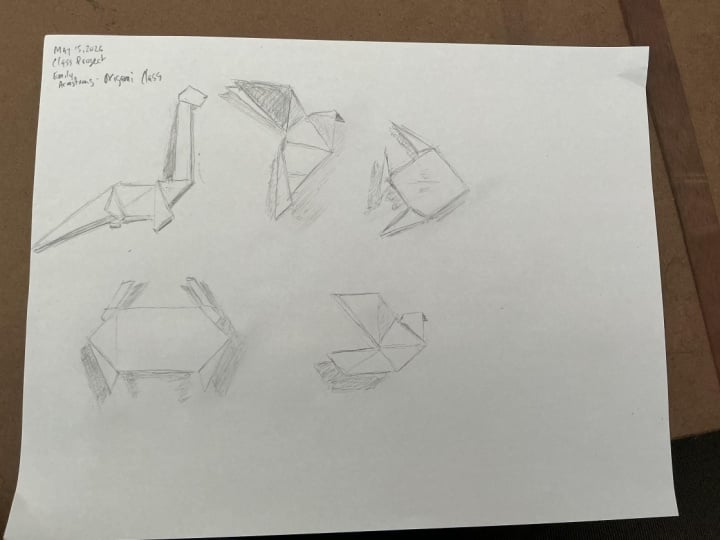
anything you don't need. So these are my five
origami animals drawn using only straight lines, but practicing a
couple of things, loose light sketching and faking your lines first or figuring
out your angles as you go, testing them first, moving
that hand along the page. And also using your
observation skills to look at negative spaces, to look at where things line up or where they occur across a line and how shapes compare
to each other, as well. So there's an element of proportion that we're
observing by eye, too. Now, there are a couple
more that you can do. There is this guy, which is a turtle, and this one here, which is a frog. There he goes. And, there's one
more bird, as well. So there's this bird, which you could do
if you wanted to. So if you enjoyed this practice, go ahead and draw these ones
from the line drawing sheet, that black and white drawing
of the different animals. If you want to take things
further and, you know, you're feeling pretty confident and you've been drawing
for a little while, then have a look at the
photographs of these and try and draw them with a
more sort of three D effect, so you might be able
to see, you know, where different parts
are sticking up, or you might be able
to see where there's one plane one edge or side that is a little bit darker or a little bit lighter
than another one, you could add a bit of
shading in there, too. That would be a really
good next project or next level project if this was really
comfortable for you.
 Emily Armstrong, The Pencil Room Online