Transcripts
1. Introduction: Hi, this is Michelle West
with Aprosae for your class, Real productivity: how to
reach your goals every time. Have you ever just busted out of the gate to do something new, only to lose your
motivation along the way? If you have, you're not alone. Having sustained
productivity is something anyone can get into the
habit of doing - anyone! It's just learning how to
plan and follow through, then applying that to what
goal you want to accomplish. I've been the head of
marketing departments for over two decades. For everything from a
non-profit organization to a for profit company, to a university where
I've had to manage teams of marketing professionals
to accomplish websites, social media, public relations, marketing, advertising,
branding publications, email, media relations, and so many other things
all at the same time. While having to make sure
that numerous people get an overwhelming amount
of projects done in a short amount of time
can be challenging, but with the planning
and follow through process we'll be
covering in this class, it's become a habit, even an instinct for me. And my hope is it will
be the same for you. We'll learn how to plan and
follow through by filling out the chart in the class
projects section titled my productivity plan. By the end of this class, you'll have a roadmap that
will guide you on how to reach your goal in the
time-frame you want to. And we won't just address the tasks necessary to
get this goal done. We'll also talk about the internal factors,
like procrastination, that need to be overcome
to increase productivity. I'm excited to see what goal you have and how you are
going to reach it. Even more exciting to me is that once you've
done this with one goal and then
another and another, is how it will change the productivity
level in your life. In every area of your life. You're just retraining
yourself with more productive
habits and mindset. So let's get started on
developing the habits So it'll become an instinct for you much sooner than later.
2. Class Project: Increasing the productivity in your life is very doable
and we're going to start addressing the thoughts
in your head and the tactical tasks you
need to get there. We're going to dive into the
different aspects of being productive and apply
that knowledge to our class project
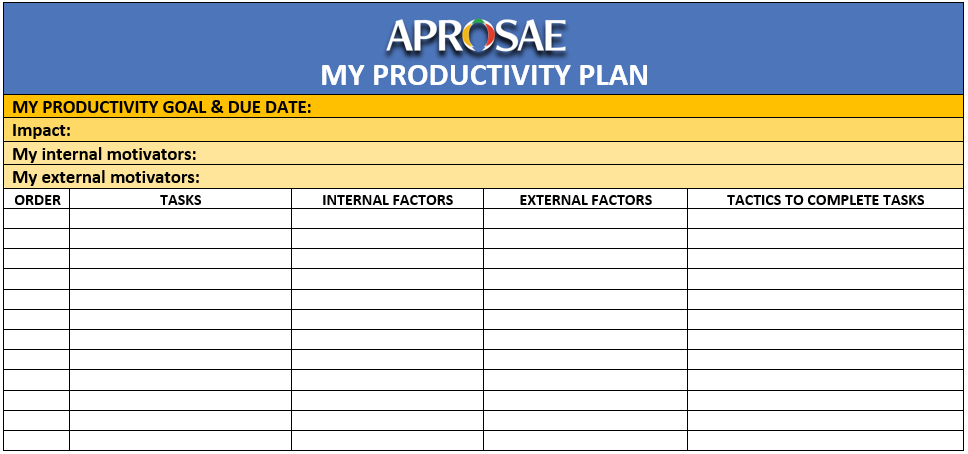
along the way,. Please start by opening the file titled my productivity plan. The top four rows under the title are your
guiding lights. They help anchor you to what and why you're being productive. We start with a goal
you want to reach, how it will benefit
you when you reach it, and why you want to do it. When times get tough, these things will
keep you going. Then there are five columns that you'll fill out
after each lesson. Those columns cover
the following: What tasks you need to take to reach your
productivity goal. What internal things
like procrastination and external things like
family and work responsibilities impact
you reaching this goal. How you're going to accomplish each task and
prioritizing the tasks So you know what
order to tackle each. As we go over these, we'll walk through examples
on how to fill them out. After you've completed
goals using this process, it will eventually become
a process that you intuitively do and your
productivity will flourish. By the end of this class, you'll end up with the
foundational knowledge of how to overcome the things that are holding your productivity back. So let's get started
with the first lesson, defining the goal
you want to reach.
3. Your Productivity Goal: When you saw this class
and thought, I need that. Why do you need to
be more productive? What do you not feel in
control in? Think through, write down or type your
thoughts. From those thoughts Do you see a common thread? Do you see something
in there that you really want and need to do? Let's look at a fictitious
couple, Sarah and Jim. They have kids, they both
work and they feel a little overwhelmed with the
responsibilities they have. They recently got a
warning from their Homeowner's Association or HOA, that their lawn is out of compliance and has
to be worked on. Then the oldest child's teacher emailed them and told them that their child's reading
level is below average and they need to meet to discuss
how they can help. And Sarah's job is
requiring her to increase her travel time so she can assist other plants in
their OSHA compliance. On top of this, Jim's dad who lives hours away, just got double knee surgery
and his parents are asking Jim to help out at their house
during his dad's recovery. These things are on top of the already long laundry list of driving kids to
their activities, trying to get their workouts in, maintaining their
homes and cars, cooking, cleaning,
you know, the rest. While Sarah and Jim might
need to do all these things, it's helpful to hone in on just one goal for their
productivity plan. Then when that goal's met, they can go through the plan
again for subsequent ones. By the time they get to
their third or fourth goal, this productivity plan will start to become second nature. So which goal do they choose? They could choose the
most pressing need, the one that just
can't be avoided, or very bad consequences
could occur. Or they could choose the
goal that is easiest and we'll give them encouragement
to move on to the next. Some people are
motivated by getting the thing off their
plate that keeps them up at night while others need some success
to rally behind So they want to work
on another goal After that. What about you? Look
at the thoughts, you listed out and think about what motivates you right now. By focusing on one goal, you'll not only end
this class with a roadmap to get that
goal accomplished, but you'll learn the process
to get other goals done. It's good to focus on
one goal at a time, especially one that you know, you can successfully accomplish or that you have to get done, or you're going to have some
very hurtful ramifications. When you do have success. That sets you up for future success with being
productive in your life Because emotionally your psyched
that you've got that done But you're also investing in the skill of being
more productive. If you can't choose
between multiple goals, you can complete two productivity plans
side-by-side as we go through the lessons. This can be beneficial because if you
choose an easy goal, you might not get why we're
going through each step. But if you choose a hard
one, you likely will. Doing two goals side-by-side can help you see the
various nuances of How to be more productive. But some may be overwhelmed
doing two at a time. So if you choose two goals
and feel overwhelmed, please drop one and
come back to it later. Sarah and Jim decided they had four new things that
need to be goals So they wrote those down. Fix the HOA lawn violations, remediate their child's
reading challenges, Delegate Sarah's
ongoing responsibilities with home and family while she's traveling, and create a plan to help Jim's parents
during his dad's recovery. Then they thought about what
will happen, the impact, if They don't accomplish each goal. For the goal of fixing
the HOA lawn violations, If they don't do that, the impact on them could
be that they have fines including or up to a
lein put on their house. For the goal of remediating their child's
reading challenges, There were several impacts
If they didn't do this. First, their child
would get further and further behind making
catch-up even harder. Secondly, their child's
mental health concerns, She feels dumb and
depressed right now, could continue and/or increase. And lastly, an
underlying condition such as their suspicions
about dyslexia, could avalanche into other challenges. For delegating Sarah's
ongoing responsibilities with home and family
while she's traveling Some negative impacts could be the pantry won't
have enough food. The house and clothes
will be dirty, and the kids won't get
to some activities. And the last goal Sarah and Jim could choose
from is to create a plan to help Jim's parents during their dad's recovering. If Sarah and Jim don't do this, some of the negative
impacts could be the dad will have challenges
with getting to the bathroom and
other essentials, and the mom will get stressed trying to
pick up the load from the dad's
responsibilities. Sarah and Jim then have to prioritize
who gets the help first. Their lawn number
one, their child number two, the logistics
of their home three, or Jim's parents four. This is a philosophical
question that each person, couple, or family has to
answer for themselves. All of these could be
helped by hiring people, but they don't have enough
disposable income right now. So they choose number three, how they can keep life going as normal while Sarah
has to travel. Once they get that plan to keep the basics in life continuing, they are going to then create a plan for the
other three goals So they have a timeline
to get them all done and communicate that plan
to those waiting on them. For your productivity plan, write down the potential
goals you could tackle. Then think of which one is the one that you
should tackle first. Is it so basic to living
you can't ignore it? Is it so crucial for a loved one that you
have to address it now? Or maybe you're just
tired of not getting it done and emotionally
ready to tackle it. Write down the goal you
chose in the first row of your productivity
plan and write the date You'd like to accomplish it by. Now that you've
decided your goal Write down why you
chose that goal. Another way to look at this is answering the question of what will you get out of
accomplishing this goal? The answers go down
in the impact row. For Sarah and Jim's goal, the impact will be that
everyone will have life go on as usual and
have the food, clothing, driving, and
support to do that. Now that you know
what goal you're going to use to increase your productivity
and what you're going to get from
accomplishing this goal Let's move on to what the internal and
external factors are that will keep us
motivated to be productive.
4. Productivity's Energy Source: You can have all the tips and tricks on how to become
more productive. But if you're not engaged, interested, or even care
about what you're doing. Why would you want to use
those tips and tricks? Simon Sinek says a great
point on this topic. He says, the work
world is tough. Wake up, go to work
doeal with the boss, or if you are the boss,
deal with everyone. Make money, come home,
manage personal life, go to bed, wake up, repeat. That's plenty to
deal with every day. Why get fancy and waste time By trying to also understand
why you do what you do. The answer to that question
isn't fancy, It's simple. Discovering the why injects
passion into our work. This is what I call
productivity's, energy source and
discovering why we want to be productive
is valuable for work, school, and home life. What motivates us
to be productive isn't the tips,
tricks or tactics, Those are the tools we
use to be productive. What motivates us is why we care about our
productivity goal. That's the key to finding the motivation to be
productive with our goal. Then we need the tips and
tricks to reach that goal. So what motivates you to
accomplish your goal? Usually there are
internal motivators and external motivators. Internal motivators are usually your feelings and
thoughts about your goal. They can be more negative
in nature like fear of failure or not wanting
to give up control. Or positive like you'll
gain favor with someone, or it will give you a
shot of endorphins. In Sarah and Jim's example, Sarah's motivation for providing the basics of life
for her family, such as cooking and driving
kids to activities, is that she has a
strong nurturing drive. And when she's able to
cook them a meal that they enjoy together while laughing and talking about their day Her heart fills up with joy
seeing her family connect. She's also made a
point every night at bedtime to ask each
person how their day went and provide
an opportunity to talk through any joys and
disappointments they had. This also fills her desire
to nurture and gives her tremendous joy because she feels needed and relied upon. So this is what she'd write down as her internal motivators. What are your
internal motivators? What do you emotionally
feel or mentally think that motivates
you to reach your goal. Write this down as your internal
motivator or motivators. External motivators
are those things that are outside your mind. Usually external motivators can be things that are tangible, physical, or
financial in nature. For Jim and Sarah's goal, Jim looks at things through
more of a tangible lens. He wants his family to be fed
clothed, and have shelter. Sarah does the shopping for food and prepares their
school lunches. The kids are starting to wash
and fold their own clothes, but Sarah still
picks up the slack. Jim's motivation is to
have the essentials. So their family has
their physical needs met. How about you? Think about your goal. What things outside your
mind, like tangible, physical, or financial benefits
motivate you to reach it? Put that in the external
motivators row. Once you have a clear idea
of what motivates you, that's when you know what will energize you to productivity. If or when procrastination sets in or roadblocks
come your way, you can look back at these
motivators and cling to them to get you through to
the next step of the process, then eventually to your goal.
5. Your Goal in Manageable Tasks: Have you ever set out to get something done only
to stop along the way because you dreaded the next
step or task of the process. Or maybe you didn't even
know what to do next. Procrastination and
roadblocks hit us all. But when we can see the tasks to get from where we're
at to where we want to be and realize the whole
process isn't blocked, is just getting past
one task of many In a process We can push through the dreaded one to
continue our productivity. For Sarah and Jim remember
this was what they wrote down when they were just writing
down their thoughts. Their goal was to delegate Sarah's ongoing
responsibilities with home and family while
she's traveling. So they could have the impacts of the pantry will
have food to eat, the house, and clothes
will be clean And the kids will get
to their activities. But now they need to think
through in more detail. Here's their goal. Delegates Sarah's
ongoing responsibilities with home and family
while she's traveling. Now they need to define what those ongoing responsibilities
are and who will do them. Jim starts by writing the list. Jim shops for food. Jim drives the kids
to and from school, Jim drives to
after-school activities, and Jim helps their oldest
child with homework. Sarah had these on
her list as well, but had four more. Jim
preps and cooks meals. Their oldest child
cleans the toilets. Their oldest child vacuums
and mop the floors. And Jim touches base with
each child at night. If your goal is one that
involves another person, like Sarah and Jim's, it's important to make sure each person weighs
in on the tasks. When they compared their
lists and discussed everything, they see that Jim has too much on his
already full plate. And Jim feels that
putting more chores on their oldest child while
that child is trying to read more every night to improve
her reading skills and has her mom's support from only
afar isn't a wise choice. So they go through each task one-by-one and make
modifications. For Jim's list of tasks They change it from Jim
shopping for groceries to Sarah ordering groceries online and having them delivered
to the house. Jim will still drive the
kids to and from school, but Jim will only drive the youngest to after-school
activities while Friends, will drive their oldest kid. And now grandpa and
grandma will help their oldest child with homework over a phone or video call. From Sarah's list, there
were additional changes. First, Jim is going to buy
ready-made meals and or order out for dinner instead
of making home-cooked meals. Sarah and Jim figure
the toilets can wait, but eating lunch can't. So their oldest is going to
pack lunches for the family. And the floors will also
survive without being cleaned. So they cross off the other
chore for their oldest child. And lastly, Sarah won't have a lot of responsibilities
for work at night. So she's going to
call to touch base with each child instead of Jim. Now they can put those as tasks in their
productivity plan. Think about your goal. What are the tasks you
need to do to get it done? Write them down on the chart in the second column titled tasks. In Word, you can change
these tasks easily, but if you're doing
this on paper, I suggest you use a pencil so you can change
things as needed. Because sometimes when you
get into doing these tasks, you might have an obstacle come up that you didn't expect, and it changes things. For now, Try to get the tasks in
chronological order and just know that it's okay if
that order changes later, since you have an order
column where you can put numbers for the
order the tasks go in. We'll do that in lesson nine after the chart is
completely filled out. Next up is figuring out
what internal factors are impacting your productivity
positively and negatively.
6. Internal Factors for Productivity: There are some things
you can control. These are internal factors
that impact your productivity. External factors are things you can't control coming your way, but you might be able to influence their impact
on your productivity. Internal and external factors can be positive or negative, meaning they can contribute
to your success in reaching your goal and
or detract from it. It's important to
recognize each. Let's look at the positive and negative internal factors first, so you can figure out what you can contribute to your success and what obstacles
are getting in the way of you reaching
your productivity goal. Examples of positive internal
factors that increase productivity are
being self-aware of your strengths
and weaknesses, believing in yourself and the importance of
what you're doing. Having a strong work ethic, aiming to have excellence in whatever you put your hand to, knowing how to ask for help when you don't have
a skill you need. And being flexible
and pivoting when a new approach is needed
to get the job done. Let's explore one of the
positive internal factors. Being self-aware
of your strengths - to understand why
they're important. One of the books that I've
found most helpful in understanding how I work
is StrengthsFinder 2.0. This book comes with
a quiz that will uncover what your top
five strengths are. Then you can look up those five things in the book to understand what each entails. For example, three of my five
top strengths are ideation, which is applying new
ways to doing things. Strategy, which is creatively
figuring out how to take disparate pieces
of the puzzle and making them whole
and futuristic, which is finding a way to
impact not only the goal, but other areas that
the goal touches. So during COVID lockdowns, when I had two preschoolers and one kindergartener
with attention spans the size of gnats
who I suddenly had to partially homeschool and partially make sure
they were paying attention to their
class times online. I learned very quickly that I was ill-equipped to teach
these grade levels. My strengths are
indicative of why. When I have a goal that's routine
and lacks creativity, like sticking to
the school schedule and following a
particular lesson plan, I often can't apply
the ideation or new ideas that auto populate
my mind like an avalanche. And strategy. There was no need for strategy, just forced upon routine and
scheduling. And futuristic. This ties into
creating strategy and seeing how each piece
impacts the other. The school schedule and
lesson plan didn't offer what I'm hardwired to do: to take a puzzle of disconnected pieces that needed to
strategically fit together in a new and creative
way that would create the required
impact on other areas and goals. For my role is
homeschooling mom It was pure execution and trying to teach little
ones how to pay attention long enough to maybe capture a fraction of
what was being taught. It's not that my combination
of top strengths or bad, or that the strengths needed for homeschooling little
ones are bad. It's that my top
strengths didn't match the strengths needed
in any way at all. Yet, since I had the self-awareness thanks
to StrengthsFinder 2.0, that this was going to be
the case from the get-go, I could set realistic
expectations. I could seek help
where I needed. I could ask the teachers if
I could teach a concept in a different way to satiate my
need to inject creativity So I'd be more
engaged in teaching. Being self-aware of my strengths
and weaknesses is what made this forced upon
situation much more palatable. That's why being self-aware of my strengths and weaknesses
has been great for me. It helps me embrace the things I need to be satisfied in my work. And I can incorporate
those things to increase my productivity because they're natural and exciting for me. Now, let's move on to negative internal factors
that decrease productivity. Some examples are
fear of failure, doubting your abilities, lacking
motivation or interest. Analysis paralysis
or indecision, lacking boundaries,
and procrastination. Again, Let's explore one of the negative internal factors to understand why
they're important. Let's take one we've
all probably done in our lives before:
procrastination. Think of a time you've
procrastinated on something. And if you can think of
one associated with your productivity
goal, even better. Next, discovering the reason or emotion behind the act of
procrastinating is what will help us
overcome the urge to procrastinate and freely
progress to productivity. Why do you think
you've procrastinated in the example you
have in your mind? Some common reasons are fear of failure, and lack of
interest or motivation. Let's take one of Jim's
added responsibilities while Sarah is traveling for
work: feeding the kids. Let's say he hates
having to do meal-plan, shop, prep, and cook food, but he obviously has
to feed his kids. So fast-food drive-throughs have been the menu for a whole week
and he is feeling guilty, but he's so drained after work that the
thought of planning, shopping, prepping,
and cooking is more than he's willing
to tackle right now. So he pushes off
or procrastinates the need to feed the
kids something healthy. One night while he's ordering another burger and fries
at a drive through, his oldest is telling
him how her tummy hurts and she hasn't been
able to go number two since they've been
eating like this. The guilt that he's been pushing down surfaces so quickly that his procrastination in finding healthier dinners ends because
he cancels his Order and goes to the grocery
store instead to buy a rotisserie chicken
and heats up some frozen veggies
to go with it. After that, He
determines to come up with a solution
to finding better but easy to fix meals that are healthier by asking
Sarah to give him some ideas before the
weekend when he has time to regroup and
plan for next week. Jim didn't change
the reality that he was overworked and
tired across the board, but accepted that he couldn't change his situation right now. And he let the warranted
Guilt motivate him to reach his goal of caring properly for his kids nutritional needs. Like Jim, when each of us
faces procrastination, we have to face the reasons and emotions that are keeping us from completing our goal and consciously push through them Focusing on the elated feeling that when we reach our goal. As you've processed
these two lists of positive and negative
internal factors, do any feel like what you're experiencing as you work
toward your productivity goal? Look at your productivity
plan and note any positive internal
factors that you'll use to increase
your productivity, or negative ones
that you'll manage or eliminate to
ensure your success. Now, you can probably
guess what's next. Let's move on to external factors that
impact your productivity. The things you can't
control but can influence.
7. External Factors for Productivity: External factors
related to reaching your productivity goals are things that are
outside your control, but you might be able to
influence their impact. Just like internal factors, external factors can be
positive or negative. So they can either add to
your productivity and or take away from it. By recognizing both, we have a greater chance at reaching
our productivity goal. Now, let's explore the positive and negative
external factors that you might be facing. Examples of positive external factors
that increase productivity are having financial and or work-related
help from others. Being given work that
gives you purpose. Having a workspace that's conducive to you
doing your best work. Being emotionally
supported by others, and having accountability
with others. Some negative external
factors that decrease productivity are having
an impractical workload, receiving a lack
of communication, not being given enough time to complete a task or project. Having people who aren't
respecting your boundaries and not being able to rely on others who are needed to
complete the job. Taking advantage of positive
external factors is easy. But discovering how to adapt to external causes you can't
control can be challenging. And there are mental and
emotional adaptations we need to manage the influence those external
factors have on us. For example, at one
of my employers, I had an impractical workload. Not in the sense of too
much work for me to do, but I noticed there was
a pattern of being given a goal that would take one
to two months to complete. But then after two
weeks on average, our department was put on a
new project with new goals. Remember StrengthsFinder
2.0 from the last lesson? Well, number four of my
five strengths is achiever. I do my best work when I'm productive and with my futuristic
and strategic leanings That productivity needs to
make sense by meeting a goal, strategic, and be
impactful for the future. The achiever and me would work relentlessly to
get the goal done, only to have our
department taken off the project before we
could reach the goal. I felt trapped like I
was in Groundhog Day. So I reviewed our team
meeting notes to make sure my impression
was grounded in reality And unfortunately, it
was. For three months This had been the pattern. If I was just looking
for a paycheck, I'd have been okay with it. But I need purpose and I need to have my work make an impact. Yet, I couldn't control the
external factor that our department's workload
kept changing to where we couldn't
complete projects. I could control though, how I influenced and or
managed this. There are three main ways we can
influence change on an external factor that
affects the progress we have toward meeting our goal. Those three ways are action,
advocate and acceptance. Let's look at each one. Take an entrepreneur
who sells his hand carved sculptures at outdoor
markets during the summer, he's noticed potential customers aren't standing around
his booth like others. He thinks it might be because those other booths have
canopy tents over them, giving the customers a break
from the scorching heat. He borrows a canopy tent
to test his theory and notices an uptick in people looking at his
sculptures and buying. So he purchases his
own canopy tent with signage printed on all four sides so people know what he's all about
even from afar. If you have an
external factor that you can just act upon to change, think about the real problem. The sculptor couldn't
change the sun's heat. But he could create
an environment that welcomed and comforted
his customers. By testing his theory, he didn't have to invest any money until he
found it was correct. And that the purchase
of the canopy tent had the return on investment that he needed to make it
worth purchasing. It's important to note that
the external factors that just need our
action to turn them from negative to non-existent, Neutral or even
positive factors are usually ones that aren't
other people's decisions who have some sort of decision-making authority
on what we're doing. The second way to
influence change on external factors is to advocate. Advocating is attempting to get support from
others by expressing your views and desires with the hopes that you get
what you're seeking, whether it be to uphold the
rights that are due you, to remove obstacles or to
help you achieve your goal. Advocating can be
hard for some because there's usually an
element of confrontation Which some shy away from or
downright get anxiety from. If confrontation is
something you don't like, you can reframe the
feeling that advocating is confrontational and see it more as a conversation
about ideas. Even if this is hard for you, developing the skill
to advocate has immeasurable benefits
that will be useful in every part of
life and is worth overcoming the discomfort
to develop the skill. Try to determine why advocating for your
needs or wants is uncomfortable and
address that reason so you can move forward. Some common reasons
people give up on advocating for themselves is
fear of losing something, They are people pleasers, or they grew up being
reprimanded for speaking up. Advocating is how I chose to influence change
on the example I gave earlier about our
department's boss changing our goals every
two weeks on average. I met with my boss, approached him in the way that I thought would best
influence him, being direct with him, but not saying things
that could put him on the defensive, and asked him for a
chance to complete a project of his choosing. I could have given
him the proof that he changed our goals
as often as he did, but I felt that would
have put him on the defensive and shut
down any negotiations. The last way to influence change on an external factor
is acceptance. Sometimes what we want
isn't in the cards for us. For example, in the 1970s, pet rocks were sold. They were successfully
sold it that. But if the inventor of
these rocks dreamt of having pet rocks in every
home as long as he lived He'd be sorely mistaken that his business idea
had that longevity. Having a short-term
burst of success was in the cards for him, grandiose,
long-term success was not. At other times,
there are factors we don't know about and if we did, we'd realize why those we report to or those were seeking
financial help from, aren't on board with our vision
for what needs to happen. If you've been a boss
before or even a parent, you might be able to relate
to the fact that there are moving pieces you can't
share with everyone. But many have opinions on how things need to be
done and you have to direct their work or life to another path, to their
discouragement. Whatever the reason for your external factor
getting in your way Sometimes we're just left
with having to accept that we have to move in another
direction than we want Because our boss says so,
because our customers don't want what we have to
offer, or something else. In my example, I advocated but it didn't
influence change. Maybe it wasn't my
boss's decision to change our department's goals
every two weeks on average. Maybe he was frustrated too, but couldn't divulge that. Or maybe he was entrusted with the
department's progress and changing goals often was the vision and strategy
he thought was best. Whatever the case was, I never knew and chose to accept that reality until I could move to a different
department, which I did. When all you're left
with is acceptance It's important to
make sure you're not accepting a deal
breaker for yourself. For example, in one workplace you might be bullied
or harassed. Those should be deal breakers
and never okay to accept. But if you're treated
with respect and there's just a lot of red
tape to get anything done, then you could find some
legitimate workarounds or reframe your situation by identifying the
positive aspects of your work that make it
worth staying the course. Remember back to
literature class, there are six types
of conflicts. Man or human versus self. Man versus man, man
versus society. Man versus nature, man
versus technology, and man versus fate
or the supernatural. These types of
conflicts can also exist with internal
and external factors As we've seen in some of the
examples in our lessons And maybe you've experienced in your own life. By capitalizing on the positive internal
and external factors or impacting change
upon the negative ones You can progress toward reaching your productivity goal and take that growth to other
parts of your life Not to mention all future
productivity goals. As you've processed
these two lists of positive and negative
external factors, do any feel like what you're experiencing as you work
toward your productivity goal? Look at your productivity
plan and note any positive external factors you'll use to increase
your productivity, or negative ones that you'll manage or eliminate to
ensure your success. Now, let's move on
to specific ways or tactics that can increase
your productivity. These are tools you can
use to reach your goal.
8. Tactics to Increase Your Productivity: There are two main
types of tactics or tools to increase
your productivity. The first type of tactics
fall under time management. The second type is
attention management. Let's look at what each of
these types of tactics are. We all know there's
only so much time. So we have to manage
the amount of time we have in a
day, week or month. The practice or discipline
of time management Is how we plan and
organize the division of our time between
our responsibilities. Time management focuses on what you're doing
with your work, like scheduling and prioritizing
the activities we do. It's less strategic
and more tactical. It's taking control of what
you put your time into. Then there's
attention management. This is how you identify
and control distractions. How you deliberately focused
only on the task at hand, and how you find
what puts you in the creative flow that
produces your best work. Attention management is very
intentional, not reactive. It's taking control of what you deem as a
priority instead of going on cruise
control and letting life's twists and
turns direct you. With this understanding of
the two types of tactics, time-management and
attention management, let's look at examples of specific tactics or
tools that we can use and match each tactic to their type to make sure the
differences are understood. The first example is that
dreaded email inbox. At one place I worked, I got so many e-mails
that not only did I get tired of not knowing
what was in my inbox, I was sick of the
fear that I was missing deadlines
or not getting back to people in
a timely manner. Then a co-worker told me
about her One Touch rule. She only touched
an email once and then it was out of
her inbox for good. I adopted this
rule and have made it a habit for the
last 12 years Though it took me about
six months to find my version of the One Touch rule. At work, I'd close my door, and put a post-it note on it that I'd
be available in 30 minutes, then go into my email
inbox to read the emails, respond right then, and put any responsibilities or
follow-up items in my calendar. Then I had different
categories of folders in my inbox and put the email
in the folder it belonged to, so I could reference it
later if I needed to. I did this once in the morning, once in the afternoon, and once before the end of day. Let's look at what tactic is time management versus
attention management. By putting the
responsibilities from the email into my calendar, I'm creating a to-do list. That tactic is time management, but by closing my door and putting a note on it to
reduce distractions So my attention
could be solely on triaging and
responding to emails. That tactic is
attention management. A second example is
say you have your kids asking you for things while they're
unpacking from school, while you're cooking dinner, and while you take a
call from your spouse reminding you to schedule a
car maintenance appointment. Because this
multitasking situation isn't uncommon for you. You've created the habit of
writing notes to yourself on your phone's calendar
to remind you to do things like schedule the car
maintenance appointment. So you ask your kids to give you a second
to take a break. You step away from cooking and right then while
you're on the phone, you put a note in
your calendar for tomorrow to schedule the car
maintenance appointment. That's so you don't forget. Would this be time management
for attention management? It has both types. It would be time management
because it's a tactic of scheduling your
responsibilities, stopping your kids
from talking to you, and stopping the cooking
while you're scheduling is
attention management. The tactic is focusing
on one task at a time. Let's briefly list
out other tactics for each type by looking at Sarah
and Jim's productivity goal, which was how they
can keep life going as normal while Sarah
has to travel for work. Using time management tactics, Jim and Sarah planned that goal. Next, they prioritize their
goals and responsibilities. Then they broke that
goal into tasks. And then they've delegated which person would
take on each task. Now, both Sarah and Jim
could take those tasks and apply time management
tactics to each. For example, they could
create a to-do list, then schedule when
they need to start each responsibility
on their calendars, and if applicable, set a deadline for when they
want to complete each task. Additional tactics
could be that Sarah and Jim want to touch
base with each other daily on how things are going so they can address
obstacles when they happen and collaborate on how to pivot or strategize anew. If that happens, then they could look at how
they're organizing their workload and come up with solutions such as streamlining the activities of their day. Now, applying attention
management to Jim and Sarah's goal could have any
of the following tactics. When the kids and
work get demanding, Jim could reduce
the distractions in his life so he can not get overwhelmed by the
exhaustive to-do list and just focus on
one task at a time. Sarah can control technology like turning off her
notifications on her phone while she's at work and turning them back
on during breaks, lunch and at night. Jim can control his environment like forcing himself
to take a break, to eat without
demands from kids, by eating on the back
porch after they've eaten. Sarah has become aware of an unproductive
behavior she has, which is looking
at her phone while she's in training during
her business trip. She then finds herself
daydreaming about all she has to do and
her work trip is over. She can redirect that day
dreaming by setting aside time to focus on solutions
for how she's going to address those
backlogs at work And home. Jim has some co-workers who
are coming by his office every day around lunchtime to talk about their personal lives. It's stressing him out
because he was going to use his lunchtime to take care of some of his added
responsibilities. So he decides to set
boundaries on the amount of time he listens and then manages his overall stress load
by waking up a little early each day to practice
yoga and mindfulness. As you can see from
these lists of tactics, time management is what
you're doing with your work. And attention management is how you engage with your work. The time management tactics
will give you the tools to complete the tasks you need
to reach a productivity goal. While the attention
management tactics will set your mind up to use
those tools with success and consistency
by controlling your mind and environment
to develop new habits. You might have examples of
your own that are coming to mind that hold you back
from being productive. If so, think through what time and attention
management tactics could help you overcome the obstacles
that kind of situation brings. Now, look at the
list of tactics. Which ones do you want
to try out so you reach the goal on your
productivity plan? Write down at least
one tactic for each task on your my
productivity plan chart. Now you have all you need
to move to the last lesson, which is how to bring your
productivity plan to life.
9. Implementing Your Productivity Plan: Now you're ready to complete filling out your productivity planned by numbering the first column
that's titled order. Since you have the full picture of everything else
being filled out Think of which task needs
to be accomplished first. And put the number one in the order column
next to that task. Continue until you've ordered all the tasks you have
from one to the last task. If you have some tasks that need to happen simultaneously, then you can put the same number
in front of those tasks, like the number five tasks here in our example
of Sarah and Jim's. Implementing any plan to become more productive
doesn't just involve completing tasks by using the
tactics you've described. It also involves having
a productive space, being committed, and having fun while
aiming high for that goal. Let's talk about having a
space for productivity. Being productive involves
finding how you do your work best and creating an
environment that fits that. Just like if you were
trying to go to sleep, you would not turn on flashing lights in your bedroom all
playing heavy metal music. Figure out where
you can focus best and when you'll have the
least interruptions So you don't have to
switch gears constantly. Now, how do you stay
committed to the end? You have a plan for yourself, but this plan isn't
etched in stone. Obstacles may surface. Sometimes they open new doors that are even better
than the original plan. So stay flexible, but stay the course so you reach
your productivity goal. And remember that there's negative and positive
procrastination. Negative procrastination is what
we usually think of. It's when we put things off indefinitely because we
don't want to do it. But positive procrastination is when you notice that
your original plan doesn't strategically mesh with what reality has presented. So you change the order
of your tasks and or you even change a task
to reach the goal better. This is positive
procrastination and is still staying the course to reach
your productivity goal. And the last thing
that will help you implement your
productivity plan to the end is to have fun while
aiming high for that goal. One study from the
University of Washington found that mice, when deprived of the naturally occurring motivation
chemical dopamine, took significantly longer
to perform a simple task. The more they persisted in
that task without dopamine, the worst there times got. On the other hand, mice that
had a little pick me up of dopamine at any
point in the process, cut their performance
time roughly in half. Now, we're not mice, yet some of us are
treating ourselves like a rodent in
a maze doomed to repeat the same lack
of productivity over and over again
with no joy in sight. To combat this, inject
a little fun and a little celebration into
each task you complete, remembering the reason
you're reaching this goal. Now, we're ready to finish
this class by looking at the conclusion
lesson to discover what you can do now with
what you've learned.
10. What's Next?: Congratulations! In this class you have set your productivity
goal with a date you'd like to accomplish it by, determined the impact that
goal will have on your life. Evaluated what motivates you
internally and externally. Detailed what tasks are needed, as well as what internal and
external factors impact you. Established how you're
going to accomplish each task which will
set a course for your success, and prioritize the tasks so that you
have a plan of attack. Now that you have a
greater understanding of how to increase
your productivity and have a specific plan on how to do that with
a specific goal What's next? Well, you
have a couple of options. First, I hope everyone posts their chart titled my
productivity plan. I'd love to give feedback So please let me
know if you have any questions and
I'll get back to you. After using this productivity
plan chart two or three times, it will become more and more intuitive to where
you'll start thinking in a productive way and using
the skills instinctively. And your life won't be
bogged down with things to do and worries about what
you're not getting done. You'll go into
cruise control and be more productive than ever. Second, we, Aprosae, are
producing new videos on a variety of topics from marketing and business
to the creative arts. So please follow us. That way you'll be the first
to know when they're out. Whatever your
productivity goal is, please remember, you can't do it all in a day
nor should you. So congratulations on taking your first step to increasing
your productivity. Remember, we're here
to help get you there. So please post your
productivity plan so we can give you feedback And so you'll be one step
closer to where you want to be.
 Aprosae - Michelle West, Training / Consulting / Speaking