Transcripts
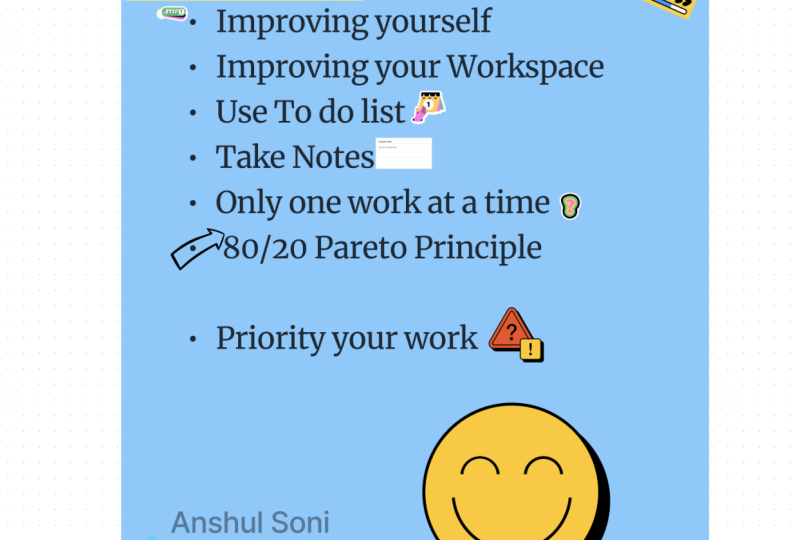
1. Introduction: Productivity class habits and tools to increase
your productivity. Maybe for many of you, being productive means a lot of work in a short
amount of time. But I consider that being
productive means, first of all, knowing the direction
you want to go in the place where
you want to be. In a word clarity. That's why you need to
put your life in order. Hi, my name is o video. I am a graphic designer
and entrepreneur. And in this course I want to help you become a
better version of yourself and be more productive
in everything you do. We will start with
the first-class. Improve yourself. Thanks for watching and I'll
see you in the next class.
2. Improve yourself: Improve yourself, take care of your body because
it is the place where you will live
all your life. You cannot be productive if you are sick or without energy. This is the first
step you need to take to prepare the ground
for what is to come. I'm not saying you have to
be a world fitness champion, but being careful about what you eat and exercising a few times a week can have a huge impact on your self
confidence and energy. That's why I advise
you, first of all, to take care of your
body because it is the place where you will
live all your life. Like the physical side, the mental side plays
a very important role. Give up negative thoughts, read and surround yourself with happy and positive people. View or the average
of the five people you spend the most time with. So be careful what
friends you make because bad friendships
spoil good habits. Go to bed early
and wake up early. I always say that the day begins with the night before it. If you do not rest well, the next day you will feel tired and therefore
unproductive. If you go to bed late, you will not rest properly. And on the other hand,
you will wake up late and you will lose a
few hours of that day. If you work at the office, take a ten-minute
break after each hour. Also, each month, you go on a vacation in which you can completely disconnect
from your work. Don't bring your work
on vacation because you won't be able
to work or relax. In the next class, we will talk about improving the workplace. Thanks for watching and I'll
see you in the next class.
3. Improve your workspace: Improve your workspace. Workspace is very important
in determining productivity. You have to feel good in
the place where you work. Bad smells, noise,
office clutter, do nothing that distract
you from your work. That is why it is very important to be
clean in the office. On the desk, you have nothing but absolutely
necessary objects. The more minimalist it is, the better you will
be able to work. If you have files that
you need in your work, organized them in such a way that you can easily
find what you need. In this way, you won't waste much time
searching through them. Also, your digital files need to be organized to easily
find what you need. While working your phone
can be a huge distraction. Turn off your notifications and do not enter social networks. You don't even realize how
time passes and you wake up doing something
completely different and wasting a lot of time. A very good method is to take
the phone away from you, possibly to another room to completely eliminate the
temptation to use it. In the next class, we will talk about to-do list. Thanks for watching and I'll
see you in the next class.
4. To do list: To Do list. In the evening
before going to bed, prepare your tasks
for the next day. Create a To Do list with all the tasks you want to
accomplish the next day. Start with the most
difficult ones in the first part
of the day when you have the most energy and at the end leave the
least difficult ones. You can use both a pencil with a sheet or a notebook
and a phone or laptop. I like to use the
physical format. It gives me a lot more
satisfaction to write by hand, but that works for me. You can choose your own way
to create a to-do list. It is important to create
it in the evening and the next day to keep it as
close to you as possible, to check it constantly. In the next class we will
talk about taking notes. Thanks for watching and I'll
see you in the next class.
5. Take notes: Take notes. It is very
important to take notes, even if we are no longer
college students. If we don't use some
information often, we simply forget about it. That's how our brains work. Information such as
passwords, license keys, business ideas, data about different places and much more. We can store them
organized on the phone, laptop, or even on a
physical notebook. You don't have to struggle
to remember everything. You don't have to
know everything. In order not to get
lost in information. It is necessary that
they are well-organized by creating categories
and subcategories. I use Notion. It is a very powerful tool and can be used on both laptop and phone. Basically, you have it
with you everywhere. You can also use Evernote, Apple Notes and more. In the next class, we will talk about why multitasking is killing
our productivity. Thanks for watching and I'll
see you in the next class.
6. Stop multitasking: Stop multitasking. It often seems that
multitasking is a very necessary skill to reach your goals
and be successful. But not many people say
that multitasking makes you very tired and destroys your
ability to concentrate. When you switch from
one task to another, productivity decreases
by about 40% and the stress level increases. You need to stop doing that. Focus on one task at a time and give it
your full attention. Multi-tasking distracts you,
destroys your attention. You may not be able to concentrate when you have
a more difficult task. How can you give
up multitasking? Turn off notifications
for applications on your smartphone as well
as those on your computer. Do not open more than three tabs at a time in the browser and pay 100% attention to a task
for at least 30 minutes. Work in a clean and tidy space. Prioritize the most
important tasks. In the next class, we will talk about
Pareto principle. Thanks for watching, and I'll
see you in the next class.
7. Pareto principle: Pareto Principle AT 20th. The Pareto Principle
says that 80% of the results come from
20% of the actions. This principle is very popular and can be
applied in any field. Whatever field you work in, taking this principle into account will save
you time and energy. Knowing that 20% of actions
lead to 80% of results, we can pay more attention to those 20% of actions
and we can delegate, replace, or optimize the rest. We should not ignore
the 80% either, but our focus should
be on the 20%. In the next class we will talk about why as
good to say, no. Thanks for watching and I'll
see you in the next class.
8. Learn to say no: Learn to say no. It is impossible to say yes to all the requirements
and needs of others. And at the same time
finish your projects. You must learn to
say no to those who interfere with the smooth
running of your work. It doesn't mean you have
to say no all the time. You can give help to those
who asked for it after you finish your tasks are
when you have free time. When someone asks
you for a favor, you don't have time
for, politely refuse.
9. Conclusions: Thank you for following
me here and I hope the information I have provided you will be useful to you. You don't have to implement
them all at once. Start with one, to take
them one at a time, test them and see which
ones are right for you. If you have any
advice or questions, if you like something or
if you did not like it, please leave a message
in the comments section. Thank you and see you
in the next course.
 Ovidiu Timplaru, Illustrator | Graphic Designer