Transcripts
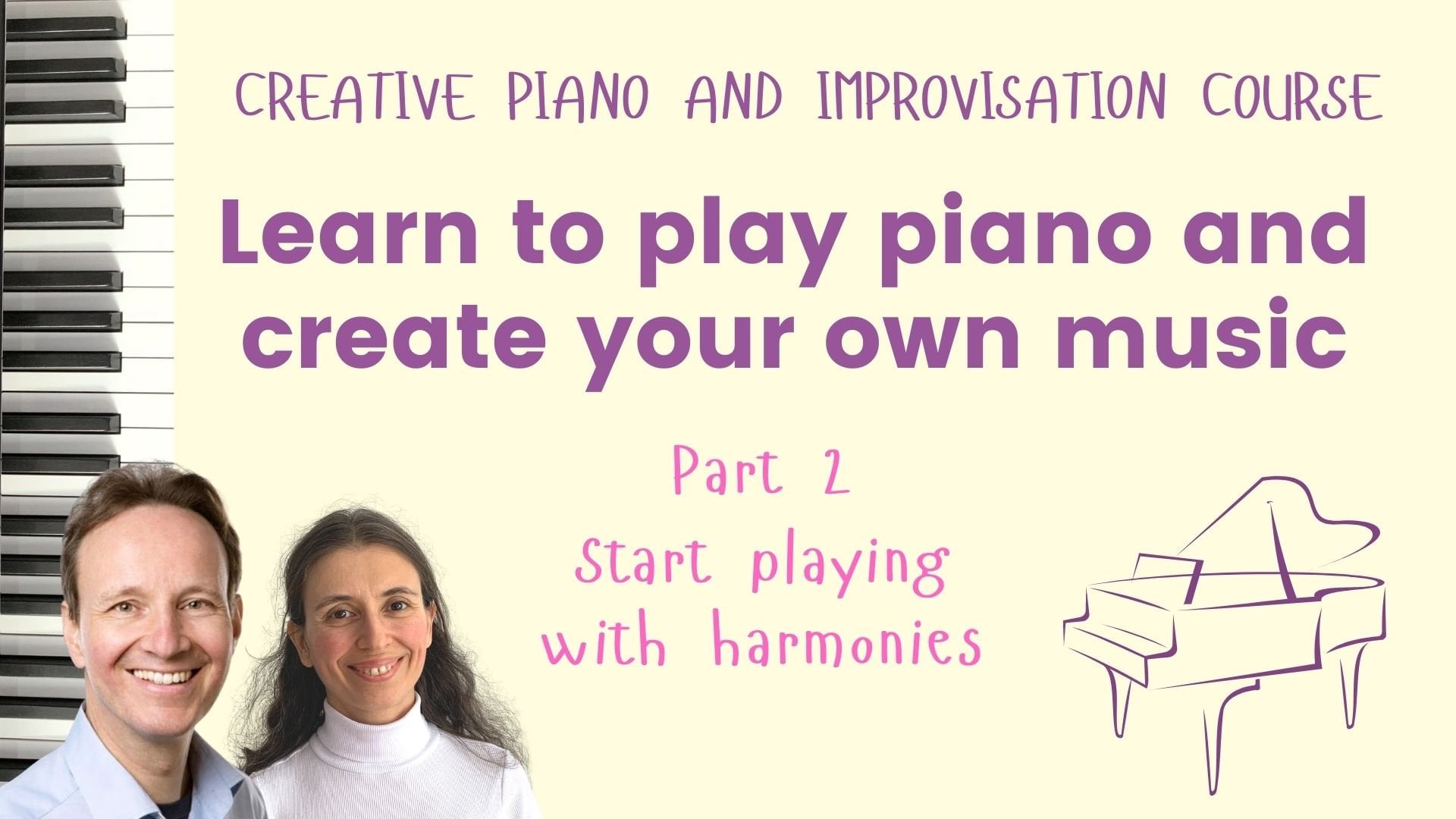
1. Presentation: Welcome to our creative piano
and improvisation course. In this series of classes, you will learn step-by-step
to play piano, to improvise, and to
compose your own music. This first class
shows how to develop good basic piano skills, and
how to play several charming, melodious piano compositions. Beginners can easily learn these pieces without
having to know the staff music notation. At the same time, you will discover in a happy, creative way the steps to melodic piano improvisation
and composition. At the end of this class, you will be able to
improvise and compose your own melodies .To sit at the piano and play music
that comes from your heart. This class is designed
for beginners. No knowledge of playing
piano is required. We demonstrate playing the music of this class in an easy way. Our hands are filmed from
the top on the keyboard. And we also show the letter names and the
rhythms of the tones. In addition, you will receive several easy piano pieces
that we wrote for this class. You will be shown how
to play them and how to create similar
melodies on your own. If you have already skills
in playing piano, you can skip the first
videos and proceed immediately to the second
half of the class. There will follow more classes
in this series that will guide you on your way to learn piano in a creative way and to master
piano improvisation. Hello, I am Martin and I am Stella. Martin, can you tell
us more about yourself. I studied at the
universities of music in Vienna and the Mozarteum
in Salzburg. I received a Master degree in organ and degrees in piano, piano pedagogy, and
orchestral conducting. And what about you?
Concerning music I have two master degrees, one in musicology and
one in music education. But presently, I focus
more on developing art activities as art teacher and surface pattern designer. But I always love playing
different musical instruments, such as piano, organ, harp, and even accordion. But you know, Martin, I really fell in love with your method of teaching
piano through improvisation and creativity. Can you tell us more about the music you compose
and improvise yourself. I often perform improvised
music in concerts, church services,
silent movies and other events. I improvise in
many different styles. It could be in classical or popular style, or crossover
between various styles. I also composed and recorded several albums of
music for relaxation, meditative piano music, and music that creates a calm
and loving ambience. Many of my recordings are on YouTube and can be
found over my websites. sounds-of-rising-spirit.com
and martinanderle.net. I know you have many
students that learn with you piano improvisation
and composition. How do they make it? Is it hard to accomplish? Piano improvisation
is not difficult. Just enjoy every step of the
process and with the time. you will surprise yourself with what
you are able to do. Many of my piano students
achieved great success in piano improvisation and
compose beautiful piano music. By practicing, you can reach
a level that listeners will believe, that your music is written by a great composer. It is much easier to achieve
then many people believe. Great. I can't wait to see
what you will teach us. Let's go inside of the class.
2. Materials: Martin, before we start: do we need something
special for this class? You will
need a keyboard or a piano. Any keyboard works? You can start out with
any keyboard. But for continued progress, it is helpful to
have a keyboard, or a digital piano with sensitive, dynamic piano touch
and a pedal. Acoustical pianos of cause
are always great. Thank you, Martin. That's all we need
for this course. Please notice that we also prepare some additional
resources for you and you can
download them from the project and resource
section of this class. You will find a button just
below this video player. See you in the next video.
3. Class Project: The project of this class
will be to play one of your own melodies using what you have learned
in this class. You can record yourself and
upload the recording on YouTube or another platform
you're familiar with, then share your link in the project section
of this course. We will be happy to provide feedback and to answer
your questions.
4. Hand Position: A good finger position is
essential for playing. piano. Fingers should be curved as if you hold an
apple in your hand. A very good exercise is to imagine that you take an apple from a
branch of a tree, hold that apple, and then let
the hands fall down unto the keyboard. The fingers will then be
naturally in a good position. Always relax your hands. If playing with curved fingers is not easy in the beginning, then just be patient and correct your finger position from
time to time. We can train our fingers. by playing one tone after another up and down, using first three fingers, then four and then
all five fingers In doing this, we can
use different places of the keyboard And we should do it first with the right hand and then with the left hand. Each finger is
given a number. The thumb is finger number 1. That means the
left hand has from left to right the
finger numbers 5 4 3 2 1. The right hand from
left to right, 1 2 3 4 5.
5. Name of the Tones: The piano keyboard has
white and black keys. In this first class, we will use only the white keys. Each white key has a letter name from
the musical alphabet, A, B, C, D, E, F and G. You will find the name
of the tones on this chart, which is on the PDF that you can download under the resource
section of this class. The seven notes repeat
regularly along the keyboard. The distance between
one note, for example C, and the next note
bearing the same name - the next C that is
either higher or lower, is called an octave. You see the tone C is the white key left of the
group of two black keys. The tone F is the key left of the group
of three black keys. Let's do a similar exercise
as in the previous video, but this time, be conscious
of the name of the notes. Place the right hand thumb on
the key of C and play C, D, E, F, and G with the five
fingers of the right hand. We can do that at different
positions of the piano. Now let us take the left hand and place the little
finger on the C, playing C, D, E, F, and G.
6. Create Your First Melodies: Now let us play your first own melodies using
the tones from C to G in an order that
you will enjoy. Start out with the tone C, and end with C.
It will be beautiful to create melodies that include
bigger intervals, C - E, C - F, D - G. and even C - G. Let's start with the right hand. If you want at the beginning you can imitate my example. But then, I recommend
you to create your own, playing
something different. Put your video on pause
and play your own melody. Now we can make
the same practice. with the left hand. I will play another example that
is different from the ones before.
7. Note Values: Naturally melodies are formed with longer
and shorter tones. For this purpose,
we need to learn different time values.
On this chart, which is also in your
resource documents, you see different note symbols. The first one is a whole note. For a whole note, we count four regular
beats, 1 2 3 4. The second one is a
dotted half note, which has the value of
three regular beats. Notice that the dot is always on the right
side of the note. We count 1 2 3. Then you find the half note. For a half note, we
count two regular beats. 1, 2. For a quarter note, we count only one beat. The eighth notes are just
half of a beat long. That means two eighth notes
receive one beat.
8. Measures and the 4/4 Time: Music is grouped into measures. Bar lines show where a new
measure starts and ends. Measures have a certain
number of beats. One piece usually has
the same number of beats in each measure throughout
the entire composition. The 4/4 time indicates that we have four beats
in each measure. In written music, you find the time signature at the
beginning of each piece. Let us take the example with
the 4/4 time signature. The upper four indicates that there are four beats
in each measure. The lower four indicates that the quarter note
is equal one beat. You can count the four beats playing different
rhythmic patterns. 1 2 3 4, 1 2 3 4, 1 2 3 4 In this way, we get a natural feeling for the
different note values. You can imitate my examples and then play your own
rhythmic patterns.
9. Creating Melodies Using Various Time Values: Now let us form melodies
with different rhythms We use quater notes, half notes, dotted half notes
and whole notes. You can mix the different
note values as well you can mix different notes. And now let us start out
with any tone you want. Just end with the tone C. Again, take your
time to practice this exercise and see what
kind of melodies you can find. Let us do it first
with one hand and then with the other. Trie to combine all tones smoothly.
When you are comfortable doing this
we can include the eighth notes. Do you remember the eighth notes have just the value
of half of a beat. That means two eighth
notes form one beat. Now as next steps, we form melodies where we use
both right and left hand in one melody. I will play several examples. Try to create and play many
different melodies. The more you practice it, the easier it will be. You notice, I played some of my
examples in a faster speed. For a beginner, this
needs time of practicing to accomplish. For practicing. we start out in a slow tempo. We take for example the following melody. I play it first in a slow tempo. After few days of practicing you will be a little faster. Then even faster.
10. The 2/4 and 3/4 Time: Beside the 4/4 time, there exist other
time signatures. Now, let us look
at music that has, three beats in each measure. We call this the 3/4 time. Here you see an example. We find dotted half notes that have the value
of three beats, half notes, quarter
notes, and eighth notes. But all the measures, have three beats regardless how the notes with different time
length are combined. We will play a melody using this rhythmic pattern
and we will count. The next example is in 2/4 time. The 2/4 time has just two
beats in each measure.
11. Strong and Weak Beats: Measures have beats that are
stronger and beats that are weaker. Depending on the
style of the music, the difference between
strong and weak beats can be done more or
less noticeable. Dances emphasize the
strong beats more. And have the
weak beats played much lighter In other music. there is often only a small
dynamic difference between strong
medium and weak beats. In the 4/4 time The first beat is strong, the second beat is weak. The third one medium. And the fourth one
is again week. In 3/4 time, the
first beat is strong. The second and the
third beats are weak. In 2/4, the first beat is strong. The second beat is weak.
12. Creating Melodies in 2/4 and 3/4 Time: Now let us create
melodies in 3/4 and 2/4 time. I start out with an
example in 3/4. Now I played one 2/4. I invite you to create
your own melodies, playing something different
from what I do. As an example, I play
2 more melodies. One in 3/4 time. And the second in 2/4.
13. Practicing Advice: Martin, I have noticed that you played the
last melody in a faster tempo. But how to play fast
without making it messy, especially when we begin. A good way of practising
is: Start out always practising
in a slow tempo. Try to memorize what
you are playing. Practise for several days slow. And then, when you are
secure in a slow speed, increase the tempo gradually
until you finally reach a speed, which you would
like to have in a timely correct, and secure way. We touched this aspect in a video before, where I
demonstrated it. Try to be patient with yourself. Never force a fast
speed upon yourself. The more you practice
and train your fingers, the easier it will be to
play in a faster tempo. Yes, it makes sense. But I have another
question for you. When you were a little boy, did you always start out
practising slowly? O no, when I was a little boy, I wouldn't do that. I always played fast and my piano teacher was
really upset about me. I remember when I
was six years old, I played the piece
"The Motorists". And I played it always
as fast as possible. It's funny, but
I understand this. From my experience, I
have noticed that it is also very important to enjoy every step of the process. So don't worry too much. Just do your best and
put all your heart in your little melodies and be sure that they will
flourish in the future.
14. The Use of Imitation in Music: Martin, I have noticed that in your
previous examples, you imitate motifs between
your right and left hand. Is that ? Yes, Imitation is an element that has been used a lot in music. We can learn to incorporate imitation into our
improvisation, That does not mean that we
have to do this all the time. But, it is an interesting option. Naturally, the left and right-hand
can imitate each other. It means one hand starts out with the melodic fragment and the other plays
something similar. Sometimes it can be
exactly the same. Let us start out with an example. I play three tones
in the right hand. Then I pay the same three
tones an octave lower in the left hand. Other times we can start
imitation with the same notes, but then continue differently. I will play another example. You will hear only the first
four notes are the same, the others are different. In this example, the right hand ended on E, while the left hand, ended on C. The ending on
E is an open ending. This suggests that
the music will continue while the ending on C, gives the feeling of a
musical conclusion, O, that gives already some ideas. Do you have some other
options for imitations? Other possibilities would
be that imitation uses the same intervals but starts
out with a different tone. The right hand played
the tones C D E C D. While the left hand
played D E F D E. Right and left hand started
out from different tones, yet played the same
melodic motif. Or we play different tones, but the same rhythm. It means only the length
of the notes are the same. Right and left hand play the same note values, but different up and
downs of the tones. We have seen four different
kinds of imitations. In your first example, you used the same tones that can be repeated one or several
octaves higher or lower. In your second example, you used the same
beginning but a different ending
of the musical motif. In your third example, you used the same intervals, but starting the motif from
different tones and in your fourth example, you played the
same rhythmic patterns, but with different tones
and different intervals. Can you play for us some more examples using these different kinds of imitations
and maybe mixing them. O yes, of course.
15. Rests: Music has not only
times where we play, but also times where we have
to pause and no tone sounds. We call these rests. Exactly as the note values, rests have signs that indicate how many beats
we have a silence. The whole rest indicates
four beats of silence, or a whole measure of silence. The half rest is two beats long. The quarter rest has
the value of one beat. And we have also
the eighth rest. Only as long as an eighth-note. Notice that for the
three quarter rest, we don't have a specific sign. But the three quarter rest
can be written either as a dotted half rest or a half
rest plus a quarter rest. I play for you an example of
a melody including rests. Then, I invite you to go
ahead and play your own melodies with rests
16. Creating Melodies Using Different Hand Positions: Until now, we used melodies
into position from C to G. Let us now create melodies in a different position on
the keyboard using G, A, B, C, D, in both right and left hand. I play an example.. And now let us change again
using another position A, B, C, D, E. Please, go ahead creating and playing your own melodies in different
positions on the keyboard.
17. The Dotted Quarter Note: In order to play
more dynamic music, it is helpful to introduce
the dotted quarter note. This note has the
value of 1.5 quarters. Usually after a
dotted quarter note follows an eighth note to
finish the first two beats. Let us first see how we include the dotted quarter
note into your melody. And now let's count. We will add "and" for the eighth notes in order to help us to be exactly in rhythm. 1 2 and 3 1 2 3 1 2 and 3 1 2 and 3 1 2 3 1 2 3 1 2 and 3 1 2 3. Now try it out and form melodies with a
dotted quarter yourself.
18. Shifting Between Hand Positions: We don't want to
limit our melodies always to a
five-note position. For this, we need to learn
how to shift hand positions. The distance between the thumb and the second finger is naturally bigger. Therefore, we can easily play an interval more than a step between the thumb and the second finger. We try this by creating
a melody with the tones C E F G A, and in the
left hand C D E F A. We can also extend the
thumb to bigger intervals. Or we can make a stretch
between other fingers. Let us form a melody with the tones C, F, G, A and the next higher C, using the five fingers
from one to five.. I would like to show you,
that you can create melodies combining two
different positions. Next you see and
hear such a melody. Please go ahead and form now your own melodies.
After having practised this, we can create and play melodies using several
different positions. You hear now an example, where the melody shifts
through many positions. A good idea is to practice more often the spots,
where the hand shifts. You could go back and
forth between two hand positions, until you are very secure
with the move. When you have mastered shifting hand positions, you can create an play
many different melodies. You can use several different
rhythmic patterns and also repeating notes. You can again include
the element of imitation. Or you could form
music where the left and right hand communicate
with each other. It is like one hand asks a question and the
other hand answers. I show another example.
19. Pickup Notes: So far, we started all our melodies with the first
strong beat of a measure. But you could also play notes before the first beat
of measure number one. We call these notes, pickup. The formal name is anacrusis. When we give numbers
to the measures, we don't give a measure
number to the pickup. Measure number one is the
first complete measure. There are a lot of possibilities
for creating a pickup. The anacrusis could be one beat long with a quarter
note, or two eighth notes. Or it could be a pickup
of 3 eighth notes, or one of two quarters, or even three quarters. A pickup of just one eighth
note is also an option. Martin, can you show us some
examples using pickups? Yes, I will play three
different examples. The first one has a
pickup of a quarter note. The melody is
in 3/4 time. The next example has a
pickup of two eighth notes, You will hear, that the
pickup notes are on a lighter time. We play them less strong, than the beat one of
the first complete measure. In this way, you hear, that they are actually pickup notes. In this example, the first
strong beat of measure number one was on C. The
two pickup notes, lead to the tone C. In this class, most examples
are in the key of C Major. As C Major uses only white keys. The tone C is the
keynote of C Major. It serves as a
focus for that key. Usually we end the melodies
that are in the key of C major on the tone C. The melody you just heard ended on the middle C, while the first
strong beat of measure number one, had the treble C.
It is one of many possibilities. You could also form melodies where the first strong beat
of measure number one is not a C. This will shape
your melody in another way. The first strong beat of
measure number one in the first example was
on the tone G. Now you hear another melody with an anacrusis that
leads to the tone C. The pick up contains
3 eighth notes. I use the rhythmic patterns, of the 3 eighth notes
throughout the entire melody. Just the second last measure had a different rhythmic pattern
that gives some variety. In this melody, right and left-hand don't
imitate each other, but are complementary
to each other in playing one melodic phrase. When I played this melody, I went with the left-hand into the range where we usually
play with the right hand. You can also experiment
with your own melodies. where the hands play one
complementary phrase. In case you want to
play exactly my melody, then please observe that the simplified letter
notation of the tones does not indicate whether a
tone is played in a higher or lower
range on the keyboard. It's time to go ahead and create your own
melodies with pickups. The more you experiment
with your own ideas, the better you will be in improvising,
and composing melodies. Take your time and write down the tones and the note
values of your melodies. Then play them again and see if you want
to make some changes. Sometimes it requires
several tryouts before you are really happy
with a melodic composition.
20. More about Shifting Hand Positions: In this video, I will explain two options for moving the
hand into another position. The first possibility
can be used when the same note repeats
at least twice. Then you can play
the repeating note the second time with
a different finger. This will move your hand
into another position. I demonstrate it with an example. The second option is to
stretch and contract your hand. Also here, I show you how to do it. You will see and hear now three examples for moving through
different hand positions, using these two options. Explore these two options
for changing hand positions until you feel confident in moving with ease on the keyboard. Again, I invite you to
create your own melodies.
21. Legato and Staccato Notes: Besides smoothly
connected notes, we can also play detached notes. In this video, we will learn how to alternate notes that are well connected with notes that are shortened and not
connected to the next one. When the notes are smoothly
connected to each other, we call this Legato. This is what we have done
most of the time until now. When we play detached notes, we call this staccato, I will
play for you an example. You have heard that
in this example, the staccato notes
were sharply detached, but they don't have to be
always so sharply detached. You can also play
them not so short. I will demonstrate it for you. Now, let us experiment. Let's play first
the notes C, D E, F G, F E, D, C first smoothly
connected legato. And now we play the same
notes, detached or staccato. In notated music,
staccato is indicated by a dot under or
on top of a note. Notice the difference
between the dot behind the note
making it half value longer and the dot on top or under the note making it
detached by shortening it. Here are some more examples. First, let us alternate
four legato notes with four staccato notes. And now, we alternate two legato
notes with two staccato notes. We invite you to
form melodies, including staccato
notes, and legato notes I play for you one more example.
22. Crossing the Thumb: Another option to shift positions is to cross
with the thumb under the hand. For exercise with
the right hand, we use the tones CDEF with
the fingers 1231. The thumb moves under the
hand and plays the key F. In order to develop
a good piano technique, it is important to keep the
hand as still as possible. Do not turn the wrist. The crossing
movement should be done by the thumb alone. By crossing under the thumb, we can play the tones C, D, E, F, G, A, B, C. Using the fingers
in the order 12312345. We call this, the C major scale, When going back down again, we cross with the hand
over the thumb. Thus, we play the
tones C, B, A, G, F, E, D, C with the fingers, 54321321. Let us do the same
with the left hand. Notice that in the
left hand we cross with the hand over
the thumb on the way upward
and with the thumb under the hand
on the way down. Make the effort to play the tones in an equal slow speed. For beginners, it might need several days of practice
until one achieves smooth transitions using
the crossing of the thumb. We can not only cross the
thumb after the third finger. It is also possible
after the second or or fourth finger. And on the other way, the hand can move over the thumb with either the second, the third or fourth finger. Here you see and hear two examples.
23. Melodies Using the Crossing of the Thumb : In this video, we will
create melodies using the crossing of the thumb. We will play first a simple melody It is a good idea to start out with very
easy melodies. After this you can take the next step and create
more complex melodies, as you have learned now, a lot of techniques and ways to express your musical ideas. I wrote two melodies that you might be interested in playing. The first one I called
"On a Mountain Meadow". It is a lyrical melody. The right-hand starts the main musical motif. It is
taken up by the left hand. Right and left hand from the musical conclusion,
complementary. You can download
the notation of this melody as well
as a second one, "Song of the Little Creek"
from the resource section of the course. For those who
already read music. We included the staff
music notation. We also wrote the letter
names under the notes. In this way,
you learn the melodies, even if you are not yet familiar with this staff music notation. If you learn the melodies
from the letter names, we suggest that you also watch my playing on
the video in order to see whether a note
should be played in a higher or lower range
on the piano keyboard. You'll find numbers for the
fingering in the notated music. These numbers
indicate which finger we should use for
a certain note. We have not yet spoken about
staffs and music notation. We will do this in
Part 2 of our series. For many people, playing
is actually much easier than the reading of
the notes on the staff. Learning improvisation
will help you to express your musical
ideas directly. But sometimes it's also
good to play and practice, what someone else wrote. This can help you in your
own creative process. A second melody, "Song of the Little Creek" is built on a dialogue between
left and right hand. Try now by yourself
with more complex melodies, using the crossing of the thumb.
24. A-Minor: Beside the C major scale, there is another scale that
uses only the white keys. It is the A minor natural scale. Martin will demonstrate
it for you. He plays the tones A, B, C, D, E, F, G, and A with the fingers, 1 2 3 1 2 3 4 5. Now let us create melodies in A minor.
Melodies in A minor usually end on the tone A. We show you our example. We call these melody
"The Silver Birch". If you want to learn it,
you can download it from the resource
section of this class. Again, we wrote the letter names of the tones under the notes. Please observe that the melody
uses the middle C and D, as well as the treble C and D. To use the printed
fingering will be helpful. In the notation of this melody, you find what we call a tie. A tie is the curved
line connecting two notes having
exactly the same pitch. The tie indicates that
you hold the note for the total number of beats
of both note values. In this example, the
tone is held five beats. After having learned
to play the melody "The Little Silver Birch", you can go ahead and create your own
melodies in A minor. Remember to end your melody
on A. In this way, one hears and feels that your melody is actually in A
minor and not in C major.
25. Structure Your Melodies Using the Ternary Form: Most of the time music has a certain form. The form is the structure
of a musical composition. There exist different
kinds of musical forms. The one we will discover today is A B A. This form is called a ternary form, because it has three parts. Section B is usually
contrasting to Section A. The final section is the repeat
of the original section A, but it can be also different. Then we call it A1, B, A2. Often the A2
section starts with the same melody as
the first section A1, but it evolves in
a different way. In order to create
melodies with this form, it is necessary to
memorize well enough, at least the beginning of the first part in order
to be able to repeat it. Martin will play for you
an example which you can also find downloadable in the resource section
of this course. This is the melody called
"Children's Happy Time". The parts A1 and
A2 are in C major, while the B section
is in A minor. In this example, the different character
of part B is brought only by the change of the key
from C major to A minor. You can hear and
see that the B part starts with the tone A and
focuses around the tone A. When you learn this melody, it will be helpful to practise more often the spots where
the hand changes positions until
you arrive to play the whole piece in
one equal tempo. For example, you can
repeat one or two measures several times until you
feel secure with that spot. You can discover more melodies in ternary form in
the next video.
26. More About Composing Melodies: Now is the time to apply
everything we have learned in this course, in our
improvisation and compositions. We share with you three
different melodies. They are all in ternary form. And you can find them again in the resource section
of this course. Martin would you like to
present us the first one? The first melody, "Sweet Memories" has a lyrical character. Tones are smoothly connected. Remember, we call this legato. The up and downs of the
melody line require often, that we move on the keyboard by stretching and sometimes
contracting our hands. But we also moved
by changing fingers on repeating notes
and thumb crossing. This melody is in 4/4 time and it starts with a pickup
of 3 eighth notes, All parts are in C Major. Right and left hand
contribute together in building one melodic phrase. The second composition
is "Little Joke". It uses often detached
and staccato notes. You find also rests. The music is in 4/4 time and
starts on the strong beat. The piece is in C Major with
the middle part in A minor. Right and left hand
often imitate each other. Notice that it has a
specific rhythmic motive. An eighth note followed
by a quarter note, and then again, an eighth note. We call this a syncopation. The syncopation gives to
the melody it's bouncy joking character. The third melodic composition "Slavonic Song" I
is in 3/4 time. The notes are played legato. Part A is in C major. The middle part in A minor. It starts and ends with the tone A. You can hear, that the A minor
contributes to the more nostalgic character
of this part, compared to the brighter
character of C major in part A. The hands are again complimentary to each other
in building the melody. For practicing, it
can be good to learn these melodies. But then go ahead and do your
own compositions. We will be happy to see
what you will create.
27. Final Thoughts: Congratulations! You have completed this class. You learned how to develop
a good piano technique. You improvised, composed, and
played your first melodies. We encourage you to
practice all you have learned until you feel at ease and happy with playing
your melodies. In case you are a
complete beginner, don't be discouraged,
if you need to go several times over
certain steps, it is normal in the beginning. Don't hesitate to reach out to us in case you have questions. You can also record some of your melodies and upload them
on a platform like YouTube. If you don't want to
make them public, you can save them
as unlisted and share a link in the project
section of the class. We'll be happy to
provide a feedback. In part two of this series, you will learn about chords, how to accompany your
melodies with harmonies and play with both hands
together at the same time. You will also discover
the staff music notation. If you want to be
informed, when we release a new class,
click the follow button. If you want to discover more
of Martin's composition, you can visit his website, sounds-of-rising-spirit.com We also offer individual
music coaching for those who would like to have one-on-one online lessons. We hope you have enjoyed this
class and we will be happy to see you in some of our
music and art classes.
 Stella and Martin Anderle, Artist and Musician,