Transcripts
1. Stickmen Intro: Hey, what's up, guys? It's me. Um, somebody that you haven't maybe seen before or
haven't seen in a while. My name's Ed Foichuk
and I'm one of the lead instructor instructors at how to draw comics.net. And, um, this is my first
foray into the Academy. Um, so bear with me because
it might be a little clunky. Usually, I do not
do a lot of lives. Um, but I am pretty well
known for winging it. So I think we'll be doing
we'll be having fun. Um, yeah, I'm sure those that have
hung around how to draw comics and stuff has seen
my face maybe too much. And you've definitely
probably seen my courses on offer and
stuff like that, right? I specialize. Let's
go with that. With anatomy, muscular
anatomy, especially. And weirdly, that's not what I'm gonna
touch on today, though. Instead, what we're
going to focus on today is the
simplified skeleton. Stickman. We're gonna have
some fun with some Stickman. So what I'm hoping
is whoever joins this during the live
stream or after, you pull out a drawing pad and just start doodling away.
You know what I mean? Like, just accompany me. If I'm going too slow for you, sketch off to the side, if
I'm going too fast for you. Well, I'm not too
fast for anybody. Um, yeah, no, I
won't be too fast. And this is not a
complicated lesson. I wanted I picked Stickman and simplified
skeleton because I knew it would be easy for me and easy for you guys to get
used to me and stuff. During this live, feel
free to ask questions, and we're gonna interact a lot. Hopefully joke around. I'm kind of notorious for dumbass dad jokes
and stuff, right? So I'll probably be
dropping some of those. Uh, I just got off of a
massive recording for those of you who entered into
our cover a cover contest. Um, just roll through that. Me and another fellow
instructor were giving critiques on those. So
that was tons of fun. So don't mind if I take a sip once in a while
to lubricate things. And here's my sponsorship
Do of the night. This is Pepsi Electric. Zero. Um, kind of tastes like
Mountain Dew. I don't know. I'm kind of digging this stuff. Okay, so Clayton is hanging
out and watching me perform, and he's gonna
enlarge my screen and shrink my face 'cause
I've got a giant head, and I don't need to be taking up all the real estate on
this screen, right? Um, yeah, we're
gonna get into this. Hey, Giovanni, what's up?
2. Stickmen Rule Of 8: Okay, guys, so we're going to start with a simplified skeleton and see where we
can go from there. What I I'm kind of
presuming that actually, I'm not gonna presume
it I'll stop there. I'm going to start
from basics and just roll with it and see
how everybody feels with it, according to just some
basics and stuff. And then we'll add to it, okay? If this is really too
elementary for you, M. Have fun with it. Joke around. Make fun of me in the
comments or something, right? Okay, let's see. I'm going to just
take a blue line. And I'm just I'm starting
in the corner of my page, and I'm just going
to draw a simple top to bottom line, right? And what I'm doing is I'm
going to teach or review, depending on the rule of eight and my
interpretation of it. I've seen a few different ones rolling around and
stuff like that, but this is my approach to it, so maybe you'll have yours. Maybe it's similar
to mine. What I do is I draw a straight line, and then I kind of
sometimes use my hand. Shrink. Right? I can use it actually
on the screen and just tick and find
the center, right? Like, it's just like I'm
not squishing your head. I'm more trying to find the center between these two points. So here's my top, here's my
bottom, here's my middle. I'm going to do the same again. I'm going to cut it in
half, right about there. Gonna cut that in half
right about there, cut that in half,
right about there. So this top half, I've
divided by four so far. And the bottom half I
could also divide by four, but I won't because I'm
lazy and that's what I do. So I'm going to just
cut it in half once, if I really wanted
to, I could tick, tick and do my four. But these last two down here, I'm not I don't really use them. There's no point for me
for what I'm about to do. Okay, now that I've
got this rolling, I've got it divided
by the rule of four. What this rule of
eight, rather, right? What it is is eight heads,
eight head high, right? Now, this is more comic
book superhero proportions than the average individual. Some people will be eight heads high if they
have a very small head. But most people are
about six to seven, the average human, right? But when we're drawing
them, we like proportions. We like a little bit of drama, and that's why I'm doing
this voice, right? So what I'm going to do is
just rough in actually, you can kind of see I'm going to roughen these heads, right? This would be my eight heads. Did I measure them perfectly? Hell, no. Am I going to? Hell, no, I don't
care that much. That's not what I'm
here for today. I'm just here to play. Okay? So what I'm gonna do with this is just
roughen that top head, and that's my ugly
circular oval head, right? So that's the first
block, right? The first quarter
or eighth, right? I'm gonna come down
to the fourth one, and I'm also going
to draw a circle, but I'm going to draw maybe a little more circular
than ovals, right? And I'm hoping you guys are
kind of following along. Yeah, I don't think I'm gonna
lose anybody at this point, right? This is
pretty easy, right? So I've got the head
and I've got the hips. This is my hip so far, right? In between the head and the hips is the majority of the
torso, the rib cage. Now, some people will
draw a rib cage, something like this, right? Because that's kind of
actually how it looks. But because in the back, we've got a scapula, that
comes back like that. I actually end up roughing
it in more like a chevron. You don't have to because the actual rib cage is
more oval like this. But like I said, if you look at the anatomy
from the back end, I'm not going to flex today. The scapula wings out
a little bit, right? So the chevron works for
me in its simplified form. Okay? And attached
to the Chevron, then I'll put the shoulders, the deltoids to be
specific, right? And this is kind of what
I have for the torso and. There's my skinny
*** neck, right? Okay, so so far, we've got kind of a really
easy upper torso, right? And everything
gets proportional. I find that this being the crotch, like,
so here's my hip, and I'll put little little
Superman is on this dude. I'm going to make it a
dude right now, right? If the crotch touches
this halfway mark, okay? So I'm not going to draw
any details in that, but if roughly the
crotch touches that, then that also means the wrist is going to roughly
touch that mark, okay? So what I do is I draw circles down here and just
kind of connect, connect. That is my skinny little arms. So like I said, the wrist will break
at around the crotch. Everything's individualized. I've trained with guys that
have a massive dead lift, and the reason they had
that was because they had those long ***
monkey arms, right? So I'm just kind of giving
you ballparks of things, and then we can
adjust from there. And we will play with it later. I'm giving you an overall
guideline right now, and then we'll roll
off of that, okay? Alright, halfway roughly
halfway in the arm, and we could wiggle
it a little bit, but those are going
to be the elbows. Pretty damn simple, right? Like, This is such
an easy articulate, articulable figure that we're going to be able to do so much, but you have to have this down. You have to be able to draw
this really easy, right? Now, the next thing I do is because we're not just
a floating torso, I've got to add legs
in here somewhere. Okay? Where do I put them? Well, what I'm going to what
most people do will draw like a little triangle
for the feet, and then they'll draw it down. I like longer legs, not only on the ladies I date, but on the figures I draw. It's a 90s thing, I think. So what I do is actually, I
put the ankle at this point, and I draw my little
ugly simplified feet, and I draw straight
down and straight down. And then that halfway
mark, that's the knee. And so I draw the kind of like the hip comes
out, the hip joint, how upper skeletal system
attaches into the hips, right? Just a little bit
of junction bends. I don't want to
get too much into the skeletal system
itself because it gets really complicated. A
lot of bones in the body. But this simplified this
simplified skeleton is so simple, so easy that I feel that anybody right now after watching
how long was that? A couple of minutes,
right? After watching that couple minutes, you
should be able to draw it. If you can't if you're watching it after when This
isn't live, stop. Rewind and do it again. Do you know what I
mean? Do it a few times so you can have it. So it really should
be like, bam, bam, bam, bam, bam, bam, bam, bam. Ooh. That's it. Ten second sketch, okay? Like, really, I want
you to be able to be so comfortable with drawing this simplified
skeleton that it takes you nothing to be able to draw it out
like that, okay, guys? So, hey, James,
welcome to the chat. I'm Ed. Kind of the
weird guest star.
3. Stickmen Side and Twist: Okay, so we've got
that from the front. We've hit the major points
of articulation, right? Everything from the
shoulders, elbows, wrists, knees, ankles, all that
kind of stuff, right? Let me take a drink. I didn't tell Clayton
that I was gonna be drinking during this
live, so it's a surprise. Now, why don't we turn? Let's rotate this. So I'm
gonna do the same thing. You know, I could
make it a little bit better and draw it straight across or
whatever, right? And you can see how lazy I
am being with these lines. Like, I'm not using the ruler function or
anything like that. So if you're drawing at home,
it really I'm not expecting you to us not everybody has a tablet where they can perfectly rule lines and
stuff like that, right? Um, oh, Michael just asked, should the limbs be curved for the simplified skeleton?
Not necessarily. No. When you look at the way that certain legs
bow, you know what I mean? Like, you could have a little bit of curving in
there and stuff like that. But for right now, just
keep them straight, okay? Just I'm really going
so simple here, and there's a point to it,
why I'm doing it that way. So what we're going to do
is we're going to rotate the skeleton so that we're
looking at it from the side. Okay? So we've
still got the hips, still got the head,
but, you know, our head has side
profile to it this time. Okay. We've still got our torso,
but it's from the side, so it's a little bit different. So the rib cage is more here
and it comes like this. Actually, usually, now, this is where it
gets a little bit. There's a little bit depending on how much duct butt you got, but you've got an
anterior pelvic tilt, so it'll tilt this
way and the back will tilt this way, depending. I'm not going to nudge
it too far here, okay? I'm just going to kind
of draw it straight. But as we start to
customize a little bit, you'll start to see the flow changes just a little bit, okay? So once again, from this point, leg comes down and down into
the foot. Here's the knee. Now, we can kind of start to bend things around a bit
with the flow of the muscles. Don't want to do that yet. I'm going to put this hand here, this shoulder here as
we're carrying it over and connect that to the hand
halfway, there's the elbow. So again, what I'm hoping for is that you guys are able to one, draw this simplified stick
figure when you're sleeping. Or when you're awake.
But really, like, at any point, you should
be able to, like, Whoosh, draw a line, divide it and break it down
into its sections, okay? If you do not feel
comfortable with this, if you're like, practice,
practice, practice, practice, practice so many times because we're going to
venture into moving, twisting, pushing, pulling,
all this kind of stuff. So getting it at its it's chorus foundation is what I really
want from you, okay? This is really,
really important that you guys feel so
comfortable with this. Just I don't know if you can, in the comments, give
me a little bit. Like, are you saying, Yeah, I think I got the simplified rule Vate for front and back or front and
side, at least, right? B. Looks the same until we
add musculature, right? Does everybody think that they're kind of doing
okay with that? And what's interesting about
this is I was stuck on this. This took like, my proportion
sucked until Clayton, how long ago did you put
out your proportions class? Because that was
the first lesson I ever took online
of any art course, and it blew my mind. When I took that and then
made it a little bit my own, everything was just
unlocked, right? So what I'm hoping
ten to 15 years ago, that's about right, actually. Yeah, that sounds about right. I'm hoping that this either unlocks
something for you guys? Or just makes it a hell
of a lot easier, okay? Because, really, that's
what it's about. Okay. Okay, so we're feeling
kind of okay with this. If I'm looking at
some of the comments, we're feeling kind of okay. Okay. So I'm going
to keep going on, keep on going on, right? I'm just going to carry
this line over, right? Do the same thing, and
divide it in half, divide, divide, divide, divide. Yeah, like I said, I
don't I don't need that division down in the lower section so much
or anything like that. I'm going to go back
to straight on. But this time, I'm
going to straight on. What I want to do is turn the torso a little bit this way and turn the bottom
just a little bit this way. So normally, what I do, for example, if I'm drawing
the Chevron and everything, and I'm going to see if
this makes sense to you, with this underwear and the rib cage and all that kind of stuff, what I normally do is here's the center line and here's
the center line, right? We can see these dudes are
looking straight at us, right? The center lines are straight on because these are
straight on shots, right? Um, but that's not what
I want to do here. I want to turn some
things around. I want to twist
some things around. So what we don't really
pivot at the crotch. I may have tried on occasion. Thus, my hernias, I don't know. We pivot more between the rib cage and the
hips themselves, right? So the actual pivot that we're going to be doing
will be at this joint. So what's going to
happen is I want to have this one pivoted this way and
this one pivoted this way. And you can see, it's not a
huge it's not a huge twist. Right? Um, I'm not
totally turning. We'll get into really big
twists in just a bit, but I just want a little
bit of a twist here, okay? So my underwear line's
going to stay the same, but it's going to wrap around
this ball just slightly. And the rib cage is going
to slightly go there. So that means this
shoulder will come, doing a little bit, you know, this shoulder will be more
visible for the viewer, and this shoulder will
be a little less. So it would be a little bit
behind and, do, do, do, do. Like that. Right? Okay.
So what does that mean? If I'm drawing these down, maybe my little booties
will be more like this. And I'm going to do something
with the arms in a minute. But you can see how now I've pivoted the hips
just a little bit, and I've pivoted the
torso just a little bit. And if I want to, I could do something similar
with the head even, and I could start
to turn it, right? So you can see how
you start to get this nice flowy
movement instead of just straight on static I'm
just standing here, right? Staring at you with eagles, calling in the background
and my blue steel Instead, now I'm turning, giving
the side eye, right? There's a lot of a lot of
ways of approaching this. But as Clayton just mentioned, I am really trying
to simplify this, really trying to make it
so that you could doodle this out and rough
this out, you know, when you're plotting,
when you're making your thumbnails and
stuff like that, so that it takes you seconds seconds to be
able to do this, okay? So that's what
we're going on for. So hopefully, if you guys
are following along, you've done this little turn
and twist, right? Okay. Now, one thing that I want to talk about in
articulation and stuff like that. Let's see if I've got
enough room here. Let's see where
am I going to go? I remember I said that roughly the wrists would break around the
crotch level, right? Okay. Okay, what does that mean? That means that if I
was to raise this arm, it would roughly follow a circle around
these pivot joints. Those are not boobs. That's just a pivot joint
inside the shoulder, right? So, you know, if the arm is
here or here or here or here, and of course, I'm roughing
this badly, right? And we'll have a certain
range of motion that it'll break and it won't be able to rotate all the way over, right? But that's what I want
you to be able to do is understand that you can
move it within this range, and this arm can move
within this separate range. Let's see. As I go off the
screen a little bit, right? So I can break, break, break, break, that
type of thing, right? And so when we look
at these points of articulation, change. We know that that's
exactly what it means that we're able
to move those joints. Yeah.
4. Stickmen Proportions: Eric just dropped a question,
so let's get into it. I might be Bit Hein.
So this strategy is regardless of size
of the character also. I mean, let's say if you
have a character like the Hulk, She Hulk, et cetera. Let's do that right now, man. I think that's perfect timing. Jump me back to the screen. Okay, remember when we were
talking about proportions, right? We had this
rule of eight. We had this rule of
Eight saying, Well, it's got to look
like this and that, right? What if I shift? What if I do the hips down here? Put the torso like this. Well, what did I
just draw? Right? That's a quite hawkish
looking figure. So I can, I just
wing that, right? But if I'm looking
then I got one, two, three, four, I kind of did the top relatively
in proportion. But this is kind of a
six head high figure with it being very, very top heavy, right? I put it all into the torso, I can blow out the shoulders
and stuff like that. I blew out these hands. They're monstrous
gorilla hands, right? And if anything, if I really
feel like messing around. I can make the head
even smaller, right? I I really want to
do that, right? So that's one way to
approach it, right? Another way is like, let's say, I can bump the torso
smaller and I just divide, let's say this is
my halfway point. So this is I'll put my hip here and then my knees, my feet. I'm starting to play around
a little bit, right? So here's my Now, does this work as a character? I don't know. Maybe
I would have, like, instead of
what I did here, I think instead, I might have if I'm going to
lengthen those limbs, I might as well, lengthen
these limbs, too. Do a nice little
halfway point, right? So there's more of this
is kind of hulkish. This is kind of slender
mannish. You know what I mean? Like, you could really elongate things, right, stretch them out, and play around
with proportions. But what's cool
about this is we've all we're still back to our points of
articulation, right? Like, it all still
works very similar. We've got these points
of articulation that fundamentally
carry over, right? You know, like, these are all the same little points that we've been using and we
can play around with. So when I go to draw this
slender man or Hulk, right? Like, let's see.
Let's draw this hulk. Okay, so I'm going to do
this with a small head. I'm going to draw the hips here. Big torso, big shoulders. I'm going to put his head
kind of like this, right? Okay? And there's the hips. So my central line is going
to be kind of like this. And let's He's got these
monstrous shoulders, right? That's what I kind of
got going on here. I actually made
his head too big. Let's make this smaller. Okay. So maybe what I
might do is, like, put these up here and then they carry back
to these giant hands, and he's going for,
like, a big hulk smash. He's flying through the air.
Oh, he's got small legs. Right. A and there we go. And you know what? I think I
don't necessarily love it, but what I would do you could see here's the center
lines and stuff, right? That kind
of thing, right? So what I would do is
probably even push it further because right now he's just kind of leaping,
like, a bit of a gorilla, but it just works so
easy that once you understand these basic
simplified skeleton and point of articulation, all you need to do then is draw an action line,
a line of action. However, we're
going to and we're going to do that on
the next page here, and fill it the **** in, you know what I mean? And
just have fun with it. Okay. So any questions before? Right now, we've got the rule Vate we've got so I'm going
to highlight that rule Vate. We've got twisting,
and then we've got proportions changing around the different proportions
from slender man. So you can bump it wider. You can bump it narrower,
you can do whatever, right? Next one, I want to
do a line of action, but I just want to make sure
that everybody's Sorry. Geez. Everybody's kind of caught up and feeling kind of
comfortable where we're at. So I'm just going to
again, read through this. Yeah, skeleton gets
warped to some extent. It depends how much you
want to play with it. You know what I mean? Like, I just it's like putty, you just stretch and pull
and stuff like that. You could really play around if you're wanting to push
those proportions. Like, if you're making the hulk, make it
look like the hulk. This is where we get
into character design and that's another section, being able to look at
the difference from one character to another
just in their silhouettes, right in their proportional silhouettes and stuff
like that, right? So, play with proportions, like, stretch limbs and
see how that works. And then when you're designing your characters, make
it recognizable. Distinguishable and
then consistent. So if you're always drawing
the hulk that's six heads high and four of
those heads are torso, who then stay that way. You know what I mean? Now you know when you're
going from page to page, panel to panel, that's how you
draw the Hulk, you, right? You've chosen that you've
cared because it gets really confusing when all
of a sudden it starts bouncing around, right? And whether it's slender man, Hulk's the easiest because he gets very bulbous and Billowy and all that
kind of stuff, right? And he's fun to play with
and everything, right? But the tick would be a
very similar thing, being, you know, Dorito Oh, whatever. You know, like the Dido shape, big uptop small
down in the bottom. That's what makes these
characters stand out. Right? Or that's one of the things that can make
a character stand out. So really play with
proportion, guys. Get the rule of eight down, get the twist down,
play with proportions. Okay? We're at the
45 minute mark. I think we're doing okay. So far, reading the comments, I think I'm doing okay here. I've only sworn a few times, and Clayton hasn't
booted me yet, and so I'm good. And like I said, um, this episode has been brought
to you by Pepsi Electric. Actually, that's really
what it's called. Zest citrus. This **** is good, like for zero calories. Like, it's like, legit
taste like Mountain Dew. Clean's gonna give me
so much **** for this. Okay, I want to switch
into a new page. Oops, didn't need to do that. Here's my new page. There we go. Oh, note on. Eric just ask. So if I draw skeletons for
a character transforming, I kind of play more
and more with drama dramatizing dramatizing
the skeleton, yeah? Yeah, like, okay, if the
character's transforming, like, from Bruce Banner
to the Hulk, ****, yeah. Like, that's the
point of it, right? If it's just proportionally Bruce Banner to proportionally
Bruce Banner bigger, it's just bigger banner, right? It doesn't really
do much, right? Like, M, M, ma, ma, right? You want to see goes from Bruce Banner and
even the posture. Like, that's something
else, you know, like, just that's where, like, Christopher reaved really
well as Superman, right? Being able to,
like, have himself kind of brought in a little bit, a little bit smaller, you
know, kind of hunched in. And then standing up
and bigger, right? And that's just one human actor. We can push it further. We've got these or pencils or whatever the
**** you got, right? Were kind of amazing that way. So we could really push
that proportion, right? And yes, Christopher Reeves
is he's the superman, right? Like, he just his
transformation sold it. And so lucky for us, we don't even have to do that. Like, we can really it's
putty in our hands. We can literally push and pull proportions and play with it. Do you see all these peas
that I'm talking about? Okay, I want to do
line of action. And, uh, there's two
things I want to cover, and maybe you guys can remind me before I'm done with
the lesson for today. Line of action, actually, three. Line of action, weight
distribution, and fun.
5. Stickmen Figure References: A quick break to show
you something behind me. Uh, let's see. Who do I got? I'll grab this wolverine. When I was growing up,
action figures sucked. They were this high and just
robot up and down arms. The new ones have tons of
points of articulation, right? We could see the
knees, the hips. There's a lot of external,
internal rotation. We can see this and if you're
gonna buy an action figure, look at the chest hinging. It's kind of hard cause the light's blowing it out
a little bit, right? But this chest, he could fold it in and he could fold it way out. So there's actually, like a
hinging a butterfly hinge going on in that peck
area and stuff, right? So as a side note, when you're playing around
with simplified skeletons and you're doing
all these things, if you're struggling even a bit, and if you're looking excuse
to buy toys, even a bit. Look for action figures. But when you're looking
for action figures, look for as many points of articulation as are workable and applicable
to what you're going for. I'm trying to think
of, do I have somebody that's not really
good for articulation? Yeah, so this she hulk has no butterfly hinging in the
peck or anything like that. So it can go up as
stiff as hell, right? It can go down and it kind of got this and it goes forward. Whoo. Actually, it
goes forward and back. Back in the days, you
couldn't even do this. This was new, right? It just action figures would
just go like this, right? So this is kind of cool, but you can do better, right? You can get something
with better articulation, like I pointed out,
this wolverine. I find for some reason,
Wolverine and Spider Man. I know what it is
about those ones. They're great on their points of articulation and
stuff like that. I think because
they're and Hulk, too, I think it's Marvel's,
like, throwing itself into its main
characters and stuff, right? Okay, guys, so this was a little break showing you
guys about action figures, but we can see how if I
was to rotate this around, how it follows the principles of what I was talking about, that circular range in
the shoulder, right? Let's go back to the
drawing for a second. Okay.
6. Stickmen Line Of Action: Let's see if I can do this.
Okay, line of action. I'm going to pull
up this new page. And I'm going to draw a line. Now, let's say
this is my person. And obviously, I'm kind of
moving forward here, right? Like, we're moving forward. This is an action line. He's going forward here, right? So once again, if
I really want to, actually, I'll make this
flat on the ground, I guess. I'm just eyeballing this, right? Here might be the hips. Here's the torso,
here's the head, right? This is where I'm going to have him running. Okay?
So let's do that. He's going to be
looking straight ahead. This arm is going to go up. The opposite arm shoulder
is going to come back. Maybe I'll have this leg. And remember, I'm
kind of eyeballing, roughing to say, Okay, the
knee would be about here. And I'm just going to put this back leg
back to about here. Okay, so this is the line of
action for this character. He is running. And if I can do a little toe hinge there or whatever, which my spotty has. And that's a reasonable
character running, right? Like, it looks to me, it looks like the
character's running. This character is not just is not standing because they
would fall over, right? So we know this
characters running. The motion, the pieces of the
body are all signifying it. Let's push it further, okay? So I'm going to see how
far I could push this. And I like pushing things. I like pushing
limits a little bit. And, believe me,
just so you know, when you push hold on. One, two, three, four. Yeah. When you push, y'all
can **** it up. Like, seriously, you push
a lot and you break it. And that's kind of cool, maybe I'll push I'll try that today. But, like, really,
you want to push the line of action so
far that it snaps, then you take a half step back, and that's the
money shot, right? Okay. So, what have I
got? I got my hips here. I've got my torso
from the side here, and I've got my head here. So I'm going to I'm gonna have my dude my dude looking forward. Shoulders, I'm just doing this
from a straight on angle, straight from the
side just to simplify things or whatever, right? So let's see. Put
this hand here. And I've pushed this, here's the knee down to
this knee. There we go. That's pushed a lot, right? That's almost Looney Tunes
cartoonish a little bit. Like, the way he's running
there and stuff like that is kind of
ridiculous, right? But it still works. The
anatomy is still there. It checks and
everything like that. And boy, is he
ever going, right? Like, he's the
motoring and stuff. Do I love it? I think that's probably as far
as I was to push it. If I was to do one more, it would almost be like he's falling on his *** or falling on his face
a little bit, right? But I think how that works, how I've got it, it
still kind of works. So, whether it's Spider
Man and a funky pose, whether it's the flash
running forward, you know, if I was to do
that with a figure, pose it, and then from the
side, honestly, it's kind I did it for anatomy's sake and stuff
like that for drawing it. But from the side, it kind
of reads a little boring. But when how many times do
we see that cover the flash? Covers plural of the flash
running towards you, right, like hands up and just like, and everything's,
like, bent and, you know, the fore shortening
and stuff like that. If I was to pivot this camera and put it
head on facing him. Well, now I got a
bad *** shot, right? Now I got the money shot, right? But it's still I've pushed it. I've been pushing
this pose, right? So that's what you
want to kind of do is push that line of action and see how far you can push it
until it becomes ridiculous. And even if it is ridiculous, you just stepped into
Looney Tunes world, and that's not the worst
thing in the world, right? I think that still works. So, this then leads me into, I was gonna do balancing, but I want to do play first. So we'll do line of action. Um Balance and play. Just to remind myself,
'cause I don't feel like you guys are
gonna remind me. Okay.
7. Stickmen Balance: Okay, so balance. And this is related to balance
because right now, if this person that we're
looking at up here, they're not balanced. They're
falling forward, right? Luckily, their momentum
keeps them rolling. I don't know if you guys
have ever tried to run down a hill. But you look ridiculous. But you stay up because
you keep moving forward, right, until you don't? So if I'm looking at balance, I'm looking at the
weight distribution of how things pan out against, in this case, gravity. There's other forces
that play on occasion, but for right now, we're just going to talk
about gravity. So like I said, if I have
this character, all right? And my character is
just standing here. They are decently
balanced, right? We can kind of agree that
my character will be kind of balanced standing there. Although my feet are not the
most balanced in the world, I think you guys get
it. This is the ground. This is the middle
weight of the character. It's all balanced. Okay, what happens if my character
likes yoga, Woops. And I try to hit a yoga pose. So I'm going to
put swing this up. And I'm gonna put
the pose like that. That's a yoga pose,
right? Well, no, hold on. I'll get all yoga on your ***
and call me the yogi today. I'm gonna put these
down here. There we go. Okay, so, how's my
character doing? Is my character in a yoga pose? Yeah. But there's a lot of
weight on this side. There's a lot of weight
happening on this side, right? So with this knee
being out here, this shifts the
weight distribution, and there is a very good chance my character is going
to topple over. Okay. So how would I change that if I was to do
this over again? Hmm. I might have the head
here, but I might have to shift the hip this
way, just a little bit. I might have to shift it so that this leg is
coming from this side. Do you see how the body's
trying to correct? It's trying to find its balance without being
pitched over, okay? Balance is really important, in a standing pose, especially. Now, we'll go back to this line of action thing.
There is no balance here. There is momentum. So the momentum is carrying
the balance forward, right? That's what's happening with
the running one, right? So if I I'm trying to
think of a cool pose. Somebody was submitted some
artwork to me the other day, and it was a trooper
that was running. So I'm trying to remember
what the pose was. But fundamentally, You know, I mean, it was a half half
step pose or whatever. I can't remember what
it was. They had a gun or something,
right? I don't know. So sometimes I draw what
it's supposed to be. And then there I go up into
a shoulder or whatever. And so I'm looking at where just this line of action
has him tipping forward. But I'm going to put the
balance more forward. So he's on this foot, this knee, the weight carries it down
here. You see what I'm saying? So this weight of the center line, I've
moved that forward. This has shifted. This one
is not on the center line. Here's my center
line. This one's off, so he's going to fall over here. But this center line, this center line of the
weight lands a lot on this. Plus, there's a little
bit of momentum. Okay. It's a little tough without I should have pulled up a lot of references for you
guys and stuff, but I just wanted to wing it and just totally do it
with stick figures. But you can see how having just a little bit of momentum with a little bit of an eye for balance will help you make a more believable pose in
your stick figures, right?
8. Stickmen Fun and Review: Hey, the last one first line of action, balance, now, play. What I like to do, and
this works out perfect. We're at about an
hour now, right? What I like to do is goof
around in some of my warm ups. So I will and it's
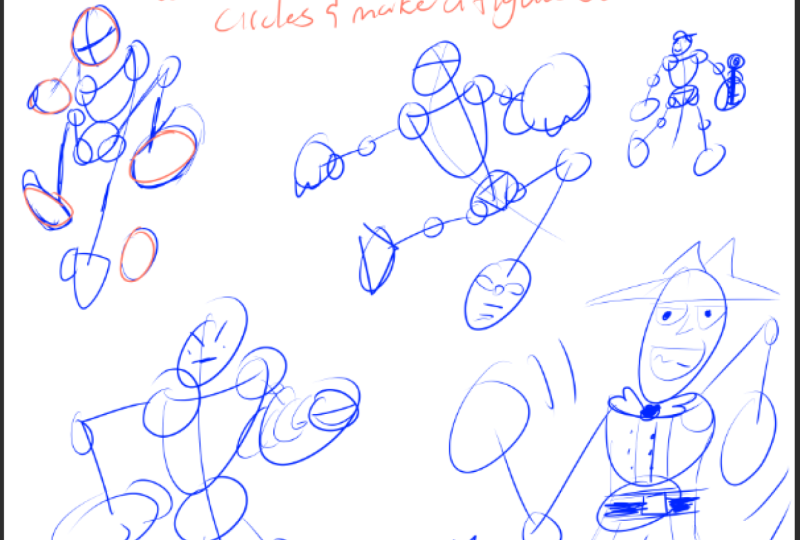
harder than you expect. Like legit. It's fun, but it's actually kind of hard. So what I'll do is I'll I'll draw some circles randomly,
and I'll be like, Okay, how am I going to take these random circles and
make them into a figure. So my random circles are
usually head, hands, feet. So I'm going to let's
say I make this a foot and this a foot, my ugly *** bean feet,
go to make this a head. Hmm. Okay, so how
can I do this now? Well, kind of roughing in here maybe maybe my torso
could be here. No, I'm thing I'm going
to drop it down because I want this to connect to this. Here's a hand and
I'm going to do a little spidy hand
or whatever, right? Um, this will go
back to an elbow. This will come here
for another hand. This will come up here and
then come down into this, and this will come up maybe somewhere here and
then down into that. So how ugly is this? But here's 1 ft,
here's another foot. Here's this. Here's this. All right? It comes
up into a knee here. This is coming back here. We've got our and this is just an exercise
in ridiculousness. Like, don't get it twisted. This is just fun, but it's
a fun little warm up. So you can really play around with just throwing
circles everywhere. So that's kind of, like,
either the first thing you want to do when you're playing with warming up with torsos or
something like that, or kind of last thing is, like, just see if you can place a
bunch of circles and say, Okay, well, how do I make
a figure out of this? Like it I'm just looking at it. I'm like, What the hell? What am I going to
do here? Okay, so, what I can do is kind of throw
a line of action in here. And let's say this is a head. Okay. Well, then maybe a
torso here and hips here. So I can put a foot here. Up to a knee, down to a foot. And you can see how I'm just like, I'm
guessing here, guys. Like, I have no clue before I drew this what I
was going to draw, right? Okay? So this is coming
from the hip joint, up to the foot. That's a little and I can push the size of that
if I want, right? Maybe I'll come
here to a knee down to a foot down here, right? Maybe this could be like
I like Spidey because, you know, he could
be holding on to webbing or something
like that, right? And he could be reaching down
in this one or something. And that's how ridiculous. Yeah, it makes it into a game. Like, it's a weird, weird exercise that I do, but it really challenges
your brain to say, how how can I do this? How can I connect
these dots, right? And so that was kind of like
the last thing I wanted to throw at you as a bit
of an exercise, right? Just to kind of play around. Okay, so we're going
to review, guys. Ooh. Did I go upside
down somehow? Yeah. Okay, so the first one, and maybe
I'll write this in. Purple. I just rule
the rule of weight, getting proportions down, right? Nice static proportions. Then my twists, earning to twist a little bit
around the pivot points of articulation and also being able to do it with a little bit of a bend
and stuff, right? Not breaking being aware word, aware of that 90 degrees, okay? And then we get down
into proportions. Pushing and pulling the
length of the limbs, the width of things
and stuff like that, to really have fun
with it, okay? I love creating
characters this way, and I love also recognizing, like, what ****** me
off a little bit, because I go to a comic and people are like,
You look like Wolverine. I'm like, No, I don't. Wolverine's five foot three and 260 or something like that. Like Wolverine should
look different. I love Hugh Jackman
and stuff like that, and he's a great in the
role and everything. But Wolverine looks
different than cyclops. Cyclops looks different
than the Beast. The Beast looks
different than Colossus. Kitty Pride looks you understand
what I'm saying here? So push and pull
proportions and really, really understand why certain characters might
look a certain way. Then we get into
the line of action, seeing how far you can
push it until it gets into Looney Tunes territory and
having fun with that, right? Balance, understanding how, um, you can still have a bit of a line of action and
a bit of movement, but you have to have it
a little bit grounded. Okay? So looking for, are you grounding
yourself correctly? Does it make sense, okay? And then have some fun. Just play around, have
some fun with it, be goofy, make it
a bit of a game. Don't stress yourselves. But really just I found, even just doing it live, I don't think I've
ever done that live. It's a little
challenging. I'm like, what the hell am I going
to do here, right? Like, this is not as easy
as It looks you'll be like, Hi I can do that.
Do it. Let's see. Do it. Like, have fun with it. I want to see what
you guys come with. And if you have another 20, 30, $40, go get some
action figures. Get some ones with some very
cool articulation points. Look at how Spidey here, too. He's got that butterfly hinge
in the peck there, right? He's also got the
to articulation? Yes, Spidey is a bom. I think this is Mafex actually, is the maker of this one. Guys, that's going to be it for my first class in the How
to draw Comics Academy. I want to thank you for
hanging out with me. I'm glad that I got to hang out with you guys to look through some questions
and stuff like that, to bounce them back and
forth a little bit. And I very much appreciate
Clayton welcoming me in. Normally, like I said before, I'm a little bit of I'm more focused on muscular
anatomy and stuff. And also, I'm a
kick *** colorist. But simplified skeleton. I think if you can
get this down, if you can just draw a line, break it, twist it, bend it. Sounds like one of those
bop it games, right? If you could bop it,
you're gonna kill it. You're gonna do so, so well. This is going to be so
easy for you guys, okay? So I know that afterwards, there's in later days, there's some joint sessions
and stuff like that. Hopefully, I'm going to
be able to jump in on that a little bit
busy this week, but I love hanging with you guys. You've
been really cool. Um, Matt, Eric, Joshua,
Clayton, all y'all. Thanks so much for
hanging out with me. And for those who
are watching it at a later date, hope
you dig it, too. And that's the cool
thing. You can pause, rewind and watch it
again and stuff and see if I talked way
too fast for you. And just to be
clear, this episode of How to Draw Comics
Academy was brought to you by Pepsi Electric. That's it. Have a good night, guys.
 Ed Foychuk, Making Learning Simple