Transcripts
1. Etsy for Artists: The 10-Minute Niche Test to Find What Sells: I'm Carrie Cantwell. I'm an Illustrator
surface designer, and my artwork has been licensed by companies
like Target, World Market and Pottery Barn. But long before my
art licensing deals, I was just an artist trying to figure out one big question. How do I make art that
people actually want to buy? And the biggest mistake
that I see artists make when they start selling
their art online is this. They open a shop first and then figure out
what to sell later. Today, I'm going to show you a quick exercise I call
the ten minute niche test, which will help you
identify a direction for your art that
has a real audience. In this short, easily
digestible class, you'll learn how to find a niche for your art that
isn't just creative, it's sellable, which
is perfect for Etsy. Using the ten minute niche test, you'll discover how to identify patterns already
present in your work, define a clear audience and validate your ideas using
real marketplace insights. Instead of guessing
what might sell, you'll walk away with a simple, repeatable process for finding a direction that connects
with buyers on Etsy. If you've ever felt unsure
about what to focus on as an artist or you've worried that your art
is too random to sell, this class will help you turn your instincts into a
niche that feels natural, specific, and ready for the real world.
Let's get started.
2. Stop Guessing: The 3 Clues Your Art Is Already Leaving Behind: Before we jump into this lesson, let's anchor it in
Etsy specifically. Etsy isn't a place where random
ideas magically take off. It's a marketplace
powered by search. People show up on Etsy already
looking for something, typing in phrases like funny Catmug or vintage
botanical print. Your job as an artist on Etsy
isn't to reinvent yourself. It's to recognize what
you already create and translate that into something people are
actively searching for. This next step is where that
clarity starts to form. Instead of trying to invent
something totally new, start by looking for patterns
in what you already create. Ask yourself three questions. What subjects do I draw
over and over again? Like animals, food, plants, architecture, funny
quotes, et cetera. What style naturally
shows up in my work? Is it playful, elegant,
vintage, bold, minimal? What emotional vibe does
my work give people? Is it cozy? Is it funny? Is it calming, nostalgic? Most artists already have
a direction forming. They just haven't stepped
back to notice it. Your niche usually lives right at the intersection of
those three things. A niche isn't just what you
make, it's who it's for. Let's say you draw cats. That's not a niche yet. But these are, for instance, funny cat illustrations
for introverts, elegant black and white
cat art for modern homes, whimsical cat art
for book lovers. The moment you add a
specific audience, your art becomes much easier to sell because people
don't just buy art. They buy art that feels
like it was made for them. Once you've answered
these three questions, you're not just describing
your art anymore. You're starting to
shape something Etsy can understand and
surface in search. Think of this as building
the DNA of your niche. These patterns
become the keywords, product ideas, and visual identity that help
the right buyers find you. Now we're going to take
that idea out of your head and into the real
Etsy marketplace to see how it holds up.
3. From Art To Audience: Who Is This Actually For?: Now that you have a
rough niche direction, we're going to do
something incredibly simple and incredibly powerful. We're going to
validate it using Etsy itself because Etsy isn't
just where you sell. It's also one of the best
research tools you have. It shows you in real time
what people are buying, what's saturated, and where
there's room for your art. Now we are going
to test the idea. Open Etsy and search
for your concept. For example, funny cat art. Look at three things. Are people already selling
something similar? That means there is demand. Do you see shops with
lots of reviews? That means buyers exist. Where could your
style stand out? You're not trying to copy. You're trying to
find a lane where your work can be
recognizable and different. Once you have a clear niche, everything else becomes easier. Like what products
you want to make, how you describe your art, and how buyers will find you. Your niche isn't about
limiting your creativity. It's about making it easier for the right people to find the art that you
already love creating. What you're looking for
here isn't perfection. You're looking for proof. If people are already selling
it, that's a good sign. If shops have
reviews, even better, that means real customers are already spending
money in this space. Now your role becomes
much more focused. You're not guessing
what might sell. You're refining how your
version stands out. This is where your
style, your voice, and your perspective turn a
general idea into something recognizable and ownable. And
4. Real Time Niche Test: I Try It So You Can See What Works: So let's do a little
Etsy research together. So you may know that the kind of art that I
create is kind of funny, cute, whimsical,
humorous cat art, and I want to validate my niche. So my niche isn't just cats. It's like cats and puns and cat humor
and stuff like that. So if I wanted to validate this niche that
I've kind of come up with, which is, you know, the intersection of cats
and humor for book lovers, I'm going to do a
quick Etsy search and do a little niche test. So let's search for let's try
funny a cat pun wall art. And let's just see,
like what comes up. So when I search on Etsy, you're going to see a lot
of ads for, you know, that Etsy sellers use to
advertise their work, which is, you know,
totally normal. One of the things that
you can do on Etsy and I do this all the time
because I validate my niches, even though I already
have them all the time. When you do a search, if you go to where it
says Show filters, you can go over
here on the left, and if you see where it says
Etsy best, click on that. And then you can choose
Etsy Etsy's picks. So star seller means
someone who makes a lot of sales. You
can also do that. That would basically
tell you, Okay, this person makes a lot of sales and does really well and
has repeat customers. And then Etsy that is
going to tell you, these are the shops that Etsy specifically is going
to show you before other shops because
Etsy considers these to be really popular
sellers with obviously, you know, art that does
well or, you know, products that do well
that people want to buy. So I'm actually going to
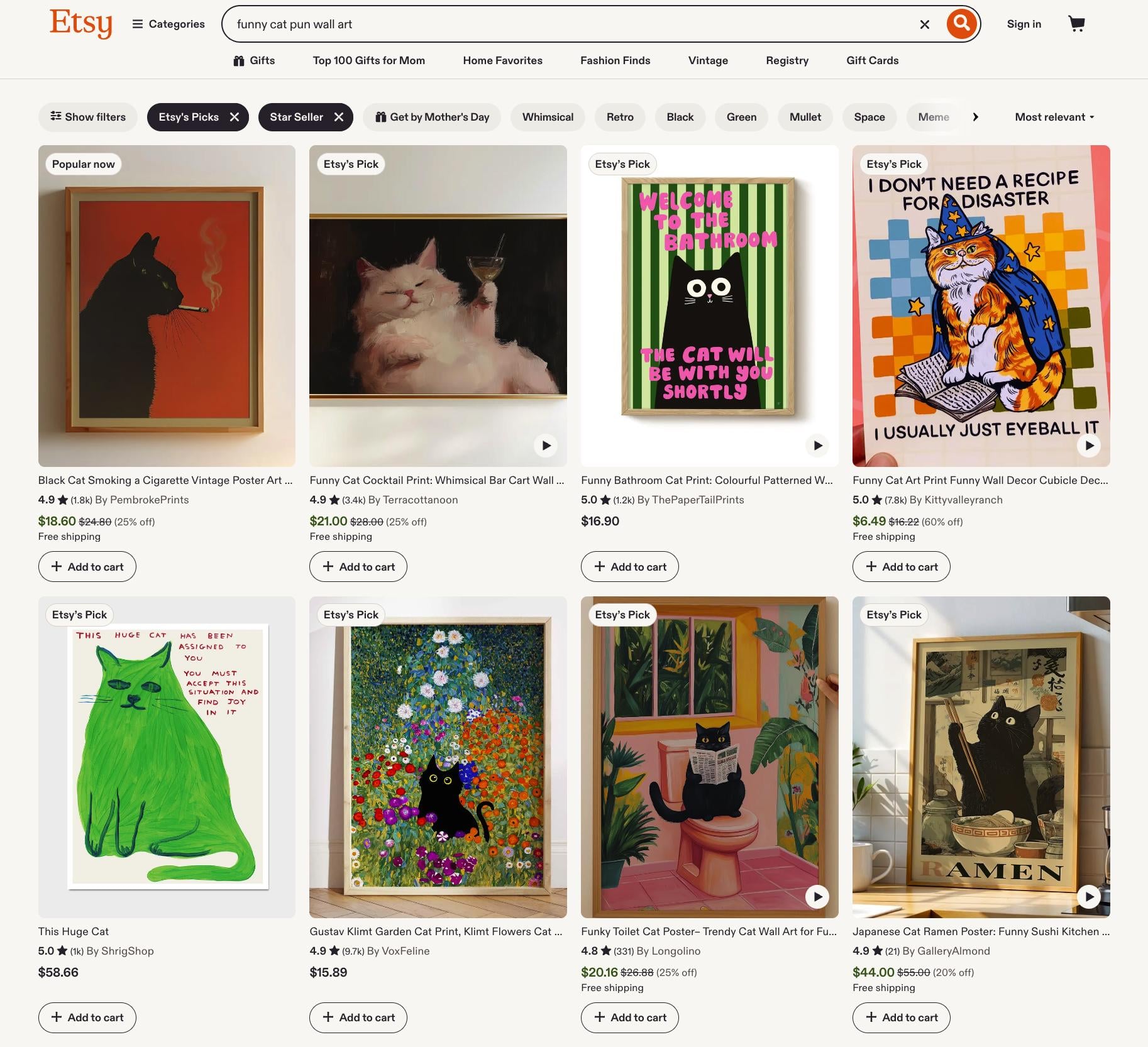
check both of those boxes. And now if I look, I can see I'm finding funny cat wall art that has kind of puns
or, you know, whatever. Like, here is okay, so here's a piece of art. It's showing me a video now, but this is a piece of wall art that has,
like, some text on it. It's obviously an illustration. The cat will be
with you shortly. Welcome to the bathroom. Very funny, very
cute. I love it. But then there's also,
you don't have to have illustrations with
hand on typography. You can also have painting. So there's a painting. There is an illustration. It's a poster. This
is another poster. But, yeah, so you can
just kind of scroll down, and this is going to give
you a really good idea. Of, you know, what's
out there on Etsy what Etsy considers Etsy,
see these here. You'll see where it says Etsy. You'll see that these
people are star sellers. So if you look below
the item name, see where this little
star is and it has 4.8. That means this person
has an average out of five stars of 4.8 stars. This person has five.
This person has 4.9. So they're all really
good. They get a lot of really good reviews. And also, if you look at this, look at this number
here, 9.7331. 1.2 thousand, one point that's how many sales
this shop has made. And then that's the shop name. So it's telling you, even if you hover over
it, who designed it, what the shop name, you know, or who owns the shop, how long they've been on Etsy. So you can see this person has only been on
Etsy for four years. They've made almost 2000 sales. They have really, really good, you know, Etsy feedback. Etsy chose them as an Etsy
and they have Cat pun wart. So if your niche is, I want to make wallart
that it's funny, that's cats that has, humor that only cat people would get, whether you're a painter or
an illustrator, you know, you now have pretty much proof that this stuff
sells. It's popular. People who are on Etsy are doing well selling
stuff in that niche. So then you just have to
think about, okay, well, how can I replicate this
for myself without just stealing their ideas and copying them? Because you
don't want to do that. So if you like drawing
cats and you like humor, maybe think about, okay, what can I do to combine
cats and something funny? Like this joke here, you know, welcome
to the bathroom. The cat will be
with you shortly. That's a joke that only
cat people would get. Well, think about what
are some other jokes that only cat people would get? You know, something
about, you know, cats being curious or
cats getting in boxes. Everybody who has cats knows, they love to get in boxes. So you could maybe do
a drawing of a cat in a box and give it,
like, some funny text, or you could do
something maybe more artistic or, you know, that looks more like
a fine art print, but it's still kind
of funny and cute. You know, the ideas are endless, but you're basically you're
kind of just looking for validation of your
ideas to see if, you know, this is
something that would even do well on Etsy
your niche idea. And if you can find a way to fit yourself in among
these other people, so you can then become just like these other people
on here that make a lot of sales and
are picks by Etsy. Look at this one. Here's
a direct pun. I loaf you. You know how cats
make, you know, the posture that looks
like a loaf of bread. So this is a funny, cute cat on piece of wall art. So that right there, and
that's really using, you know, a play on words, which is something
that I use a lot. So, you know, there are 1
million ways to do this. But think about how you can fit. How would you imagine yourself sitting among all these people? Because now you have proof
that this niche is valid. And that is really all you
need when you're trying to discover your niche and figure out once you've
narrowed it down, what you want to focus on and what you want to sell on Etsy.
5. Your Niche Locked In: Validate Your Idea With The Class Project: So now you've seen how to start identifying a
niche for your art. Now it's your turn to
define your niche. For your class project, I want you to share something that captures your direction. Share a screenshot
from Etsy search or a few Etsy best selling products that
validate your niche. And as a bonus, share one or more pieces of your art that
encapsulates your niche. This could be a single image, a collage of your work, or even a short written artist's statement
describing your niche. If you already have a piece that perfectly represents what
you want to be known for, you can share that, too. The goal here isn't
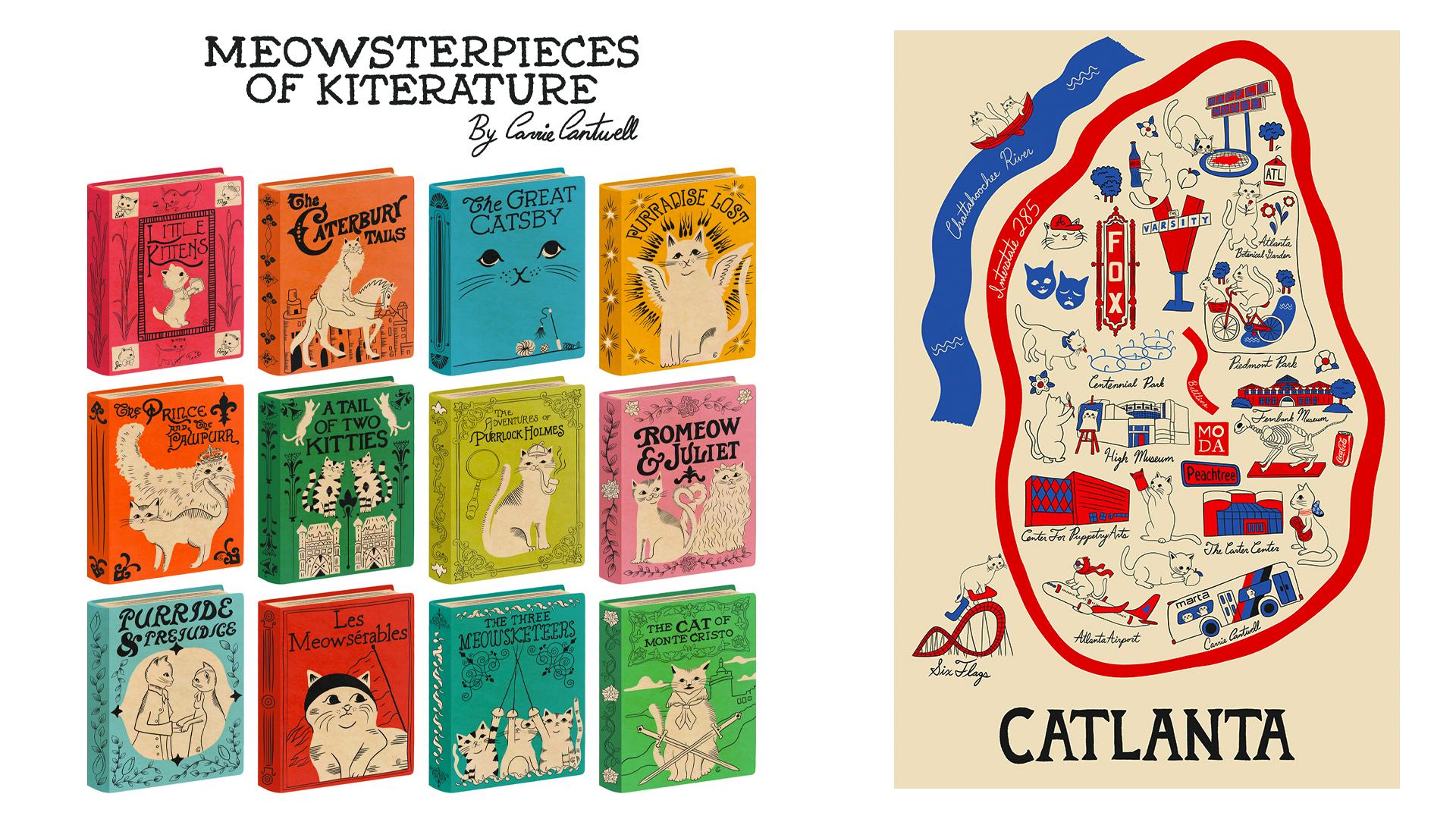
perfection. It's clarity. I'm sharing an
example of my own, including two pieces
from my artwork. One is from my cat
pun literary series, and one is from my
City kitties maps. So you can see how a niche can show up across
different products, but still feel cohesive. Think of this as
planting a flag. This is the direction
you're choosing to explore, test, and build on. And once you have that, you're
no longer just making art. You're building
something people can actually find and buy on Etsy. Congratulations on
finishing the class. If you enjoyed this class, I would also really appreciate it if you left a quick review. Reviews help other
students find the class and help keep me creating
more classes for artists. Thank you so much for
taking the class, and I cannot wait to see your Etsy shop visions
in the project gallery. See you next time. Bye.
 Carrie Cantwell, Illustrator | Surface Designer | Teacher