Transcripts
1. Introduction: [MUSIC] Let me start
by saying this. This is not a class on how
to draw a pretty picture. In this class, I will
teach you how to draw images that are imbued
with meaning for you. Throughout this class,
I will teach you simple join techniques and
mark-making techniques. But most importantly, I will teach you how to
see like an artist. I am Moon Maxwell, an artist and writer. I held my first solo art
exhibition when I was 13. I have been painting
abstracts and experimenting with
mediums since. I'm currently a graduate student at the University of Oxford. But when I'm not with my books, writing, or drawing, I can usually be found
admiring and filming the beauty of the more than
human world around me. To look at the
natural world from an artist's gaze means more than just paying attention to proportion and aiming
for accurate shapes. To see like an artist, you need to start
thinking like one. In this class, I want
you to ask yourself, what attracts you to a scene? What makes you want to draw it? To help you think
through these questions, I will introduce
you to the life, art, and art practices
of Vincent Van Gogh. The big lesson here is not how to best replicate
Vincent's works, but how to think like Vincent by learning
how to draw like him. For this reason, this class
is for anybody wanting to start their art practice of bring a new perspective
to their art. Think about your
drawing skills as the grammar and vocabulary
of your art practice. Without them, it would be impossible to express
yourself fully and currently. By the end of this class, you will not only
be able to draw, but you will be able to create your own unique
landscape drawing as a part of the class project. All you really need
to follow along with this class is an ink
pen and some paper. Let's get started. [MUSIC]
2. Before we Begin: [MUSIC] Before we begin, I want to clarify a couple
of things about this class. First, it is common knowledge that
Vincent Manago always signed his paintings with his
first name because he dreaded people
mispronouncing his last name. Throughout this class, I will call him by his
first name, Vincent. Second, I believe
this class is a fit for anybody no matter
what the strength of the artistic ability because the structure
of this class is informed as much by Vincent's art as
it is by his life. He began his art
career very late in his life with no
formal training. Throughout his short career, he kept going back to learning
the basics of drawing. Even if you walk on whims
that you can not draw, I hope Vincent's career can
convince you that you can. Keep watching to learn more
about our class project.
3. Class Project: [MUSIC] For this class, your
project is to create a landscape drawing
from a photograph or life by focusing on
those aspects of the landscape that are
most attractive to you. To get started, I would suggest
watching all the videos. The lessons are designed
so that you can build your landscape
design step-by-step. Once you have watched
all the videos, you can choose the subject of your drawing or use
my reference photo to follow along in the final
lesson joined from life. After you've completed
your landscape drawing, please make sure to upload
it to the project gallery. That way your classmates and I can see and engage
with your work. I can't wait to
see what you draw. Keep watching to learn about the materials required
for this class.
4. Materials Required: [MUSIC] I prefer using the Stillman and
Birn sketchbooks for my daily art
practice because you can use them with a
variety of mediums. For ink pens, I recommend
the Micron pens, the Pentel pocket brush pen, and then finally the
Copic multiliners. If you want to use
ink and brushes, I recommend the Winsor
and Newton Black Indian ink with the Pentel
watercolor brushes. For our first drawing
practice in this class, I will be using a blank
postcard to introduce you to how Vincent used his letters
to share his drawings. But you can use
your sketchbook or any paper that you have on hand. Finally, your class handbook, which is available
for you to download from the project and
resources section, is a fantastic resource. The handbook has
practice exercises and details step-by-step
advice on each lesson. Watch the next lesson to learn about Vincent's
drawings and life.
5. Vincent's Drawings: [MUSIC] On a cold, wet day from his
studio in Hague, Vincent wrote to
his brother Theo saying, "What is drawing? How does one get there? It's working one's way through
an invisible iron wall that seems to stand between what one feels and what one can do. How can one get
through that wall? Since hammering on it
doesn't help at all. In my view, one must undermine the wall and grind through
it slowly and patiently." Before beginning his
journey as an artist, Vincent had tried and failed to be successful as an art dealer, teacher, bookseller,
and preacher. When at the age of 27, following the advice of Theo, he committed himself to
a life as an artist. Vincent was determined
to prove himself, no matter the cost. For Vincent, drawing is at
the root of everything. He did not dare pick
up a brush until he gained confidence
in his draftsmanship. He writes to his brother
with frustration about early-career artists who neglect improving their drawing skills. "When I see several
painters I know here, struggle with watercolor
and painting, unable to find the answer, I sometimes think, friend, your drawing is where
the trouble is." Apart from his
conception of drawing as the cornerstone of any
worthy artist's work, Vincent also worked
endlessly to improve his skills because he thought he would
become an illustrator. His drawing practice didn't
just evolve with reference to the art he collected
and museums he visited, but also books and
periodicals he read. His ambition to become
an illustrator also meant that he made drawings that often looked like prints. Consider his early drawings. Notice the defined outlines
and control line work. There's a certain stiffness
in the composition, a detectable air
of practice that even suggests lack
of confidence. Nevertheless, even in
these early sketches, there's evidence of
Vincent's genius, a determination to
make his emotions and thoughts visible to
the rest of the world. Notice the posture
of this nude figure, the stress and tension
of her muscles, the matte appearance
of her hair, the posture of her body. Everything about this nude
woman expresses her despair. The frozen rigidity of
the background also indicates the harsh circumstances
the woman has endured. The mood of the
drawing is further underscored by its
title, Sorrow. Vincent was very proud
of this composition. He sent the drawing to
his brother saying, "The enclosed is, I think, the best figure I've drawn yet. That's why I thought
I'd send it to you." However, this was
a rare episode. Vincent was hardly ever content with his ability
to draw human figures. He instead turned to picture
the landscape to depict and express the plight and suffering of humankind
symbolically. Not long after composing Sorrow, Vincent sent Theo
another drawing, a landscape called The Roots. In his letter, he compared Sorrow and The Roots, writing, "I wanted to express
something of life's struggle, both in that white, slender female figure and in those gnarled black
roots with their knots." The last painting
Vincent would ever make, Tree Roots in 1890, deals with the same
subject of gnarled, bulbous roots as his
early drawing, The Roots. Observe the differences
between the two. Of course, it's an
unfair comparison in many ways because of the
difference in mediums. But still, notice the remarkable difference in how Vincent approaches
the two works. Consider the abstract and graphic quality of the painting, the lack of shadows
in the scene, the feeling of movement
in the composition, all set the painting
apart from the drawing. So how and why did Vincent's artistic style
change in eight years? When Vincent moved to be with his brother in Paris in 1886, he befriended many
impressionist artists. He became acquainted with their innovative style
and approach to art. At that time in Paris, there was a growing
awareness amongst artists regarding
the potential of photography and a
sentiment that art must do more than represent the
exactness of figures. Vincent was also very
fascinated with the work of Japanese artists and began
to study them carefully. These influences altered
Vincent's approach to drawing. Look at these
drawings by Vincent. He has drawn the same
scene repeatedly to see how different
mark-making techniques could change the
effect of the scene. His linework has an
innovative spirit, he constantly adapts and changes his mark-making techniques
to create different works. Consider the drawing in the middle and its
vertical format. It was rare when this
drawing was made, for landscape drawings to be
made in the vertical format. But Vincent was so fascinated by Japanese woodblock
prints that he didn't hesitate to give his drawing
paper a quarter turn. The artistic style Vincent
adopts in these drawings, influenced his painting styles. These paintings he made during
the last three years of his life became his
most famous works. In this class, we will learn the mark-making techniques
Vincent used in his later drawings
and think about how we can create our
own unique landscapes. [MUSIC] Keep watching to
start your art journey.
6. Drawing Basics: [MUSIC] Welcome to our first
drawing lesson. We will start with the most basic of basic
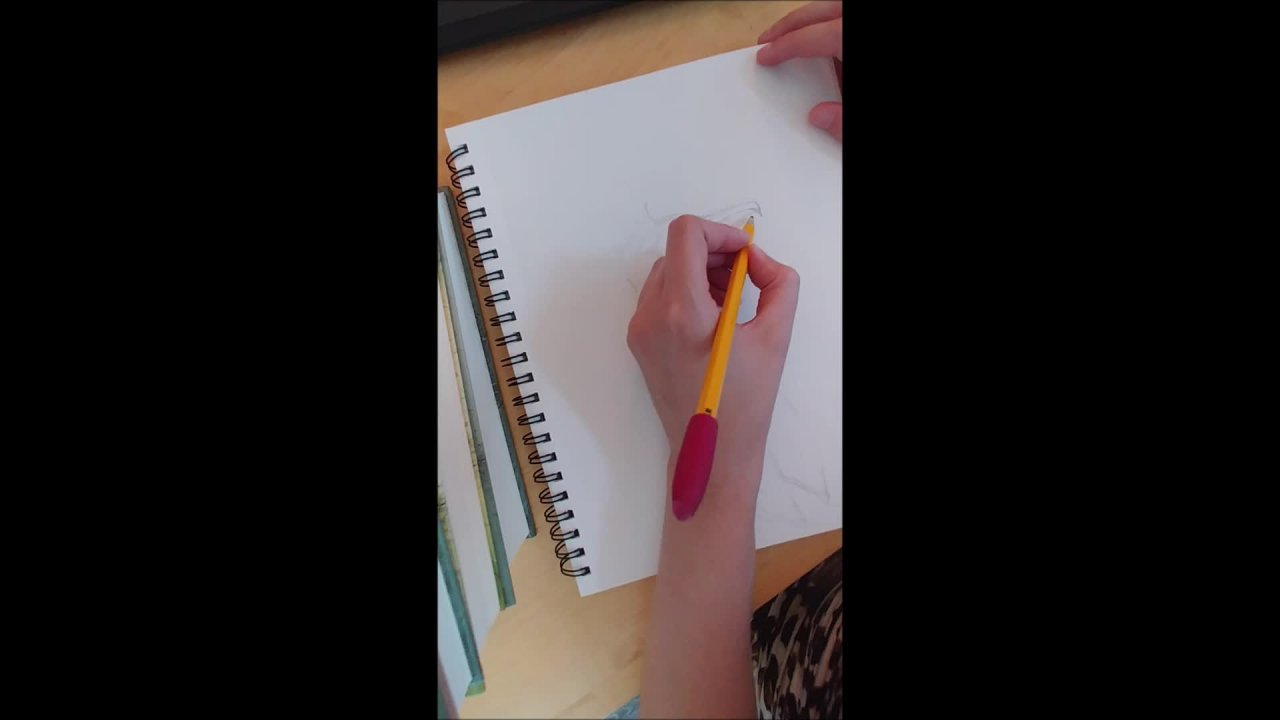
drawing techniques. I want you to take your
pencil and draw a circle on the page with one
continuous line. Don't lift your
pencil from the page, but try to be as
accurate as possible. The result of drawing this
way is an imprecise shape. The circle I have drawn
looks lumpy and bumpy. Let's try drawing
a circle again. But this time using several
short, sketchy lines. Aim for keeping your lines
as light as possible. Drawing this way will
allow you to keep adjusting your sketch to
make more accurate shapes. Now let's do the same
exercise with a triangle. Again, draw the triangle in one continuous line without
lifting your pencil. As you can see, my triangle
is not in the best shape. I'm going to draw the triangle again using short sketchy lines. There is no comparison
between the two. The triangle on the
right-hand side, which I drew using short sketchy lines is
definitely more accurate. If we repeat this exercise
to draw the shape of a leaf, we get a similar result. The leaf on the right-hand
side is much more proportionate than
the one on the left. Drawing in short light lines
keeping your hand loose is a much more effective way than drawing in stiff, solid lines. Continue practicing this
drawing technique with the exercise in your class
handbook labeled Task One. [MUSIC] Keep watching to learn simple and effective
mark-making techniques.
7. Mark-Making Techniques I: In this lesson, I
will introduce you to five types of
mark-making techniques. We will learn about
hatching, cross-hatching, contour-hatching,
stippling, and scribbling. These techniques will
help you bring textures, depth, and richness
to your drawings. Follow along as we learn the first mark-making
technique, hatching. Hatching is drawing parallel
lines in the same direction. You can draw lines
from left to right, or you can decide
to draw them in any other direction
that suits you. Hatching is a particularly useful mark-making
technique when you want to give an object a
clean and simple structure. For example, you can use this technique to depict
all distinct trees, grassy grounds of wheat fields. If we take hatching a step further and draw
parallel lines in an opposite direction
over our first set of parallel lines, we
get cross-hatching. Depending on your preference, you can even overlay
the lines with lines in a different direction
a third, or fourth time. Cross-hatching is very effective to show rough or
highly dense areas. The last hatching
technique I want to show you is contour hatching. For contour hatching, your hatch marks go around
the shape of an object. This is an excellent
technique to indicate movement and highlight your object's
three-dimensionality. For example, you can
use this technique to define the curvature
of a tree branch. Our following mark-making
technique is stippling. Stippling is using a cluster
of dots to define an object. The denser the
cluster of your dots, the more dense that area
of your object will look. For example, if you use stippling to define
a soft ground, you can use denser cluster of dots to define darker
areas of the ground. In the circle I have
drawn on the left, you can see that I have
varied the density and lightness of my strokes to
create a different look. The last technique we're
going to learn is scribbling. Scribbling means just
that, scribbling. All you want to
do for scribbling is to take your pencil and let loose drawing loops or
any other random shapes. This one technique is a great way to define
subjects that are too far or areas that are not the primary focus
of your drawing. For example, you could
use scribbling to define bushes,
foliage, or flowers. Now we have covered all the necessary mark-making
techniques for this class. I've given you a few
examples of how to use them, but feel free to get creative. Continue practicing
these techniques with the exercise in your class
handbook labeled task 2. [MUSIC] Continue watching to learn more about mark-making
techniques.
8. 8 Mark Making Techniques II: [MUSIC] In this lesson, I want to introduce you to how you can use the mark making techniques we learned in the previous lesson to
create landscape drawings. First, I want you to
examine this drawing and identify the mark
making techniques used. As you can see, hatching has been used to show tall distinct trees and
features on the ground. At the same time, scribbling and
contour hatching have also been used to
define distinct trees. Stippling and cross
hatching have been used for the grounds
in different areas, creating various
textures in the join. Let us repeat the
exercise to see if we can identify the various mark
making techniques again. In this drawing, the elegant
and clean hatching marks are immediately striking. Stippling has been used
to define the sky, which gives the impression
of a sunny, cloudless day. Scribbling has been used on
the left-hand side corner of the drawing to define
some bushes or foliage. By focusing on how Vincent has rendered different areas
and subjects in his work, you can build your own
mark making skills. You can refer to our
class handbook for additional sources on
Vincent's drawings. Once you've practiced identifying
mark making techniques, the next step is to learn how to apply what you have learned. Here is my study of one of Vincent's most famous
paintings, Starry Night. As you can see, I have used various hatching techniques
to define the sky, mountains, and houses. I've used contour
hatching to define the trees and greenery
on the bottom right. I've also used a
scribbling to define trees between the houses
and the mountains. This is another drawing I've made of the Vincent's painting, cypresses with two
female figures. Notice how I have made
small circles to define the flowers and use contour hatching to
define the clouds. Learning how to draw is defined
by learning how to see. So I recommend that you browse through
Vincent's drawings and paintings to become adept at identifying the various
techniques he uses. You can also refer to Task
3 in your class handbook to fine tune your ability to identify mark making techniques. In the following videos, we will learn how to
draw what we see.
9. Let's Draw: [MUSIC] Let us recap what we have learned so far. We have learned to sketch in short light lines so that we can keep
adjusting our sketch. Drawing in light
lines has also proved helpful so that we can
erase and edit our sketch. We have learned five mark-making
techniques: hatching, cross-hatching, contour-hatching,
stippling, and scribbling. By identifying the
mark-making techniques used by Vincent, we have also learned
how we can use mark-making techniques to draw different features
of a landscape. Now we can start drawing. For our practice drawing, we are going to be making Vincent's "A Wheatfield
with Cypresses". I will draw on a postcard to introduce you to
how Vincent wrote poignant letters to express his emotions and give
meaning to his art. But you only need your ink pens and sketchbook to follow along. Keep watching to start
your drawing practice.
10. Begin: [MUSIC] I'm starting my sketch by drawing the
tall cypress tree. Notice how I'm not outlining
the tree in bold lines. I'm using short, sketchy lines to define
the tree's shape, while also paying attention to the movement and
dynamism of the tree. [MUSIC] For the ground, I'm paying attention to the undulation of the
foliage in the painting. It is important to
remember to draw in short, light lines so that you
can always go back, and erase, and edit. [MUSIC] For the short tree, I'm again focusing on
drawing its shape using short pencil strokes
and not bold outlines. [MUSIC] For the mountains
in the background, I will use the same
technique I use to sketch the foliage at the
bottom of the cypress trees. [MUSIC] In Vincent's painting, the clouds are
defined with colors. I will give the clouds their
shape by using curved, wispy lines to convey
the same feeling of lightness that is
there in the painting. [MUSIC] I've gone ahead and filled the drawing with various
mark-making techniques. I have defined the
wheat field using the technique of
hatching and stippling. I've used contour
hatching for the foliage, the mountains, and the clouds. If you would like, you can
pause the video here and use my drawing as a reference
to make your marks. Make sure to keep your marks light because in the
following videos, we will learn how to
edit our drawings. [MUSIC] Keep watching to learn techniques of
measuring proportion.
11. Proportion: [MUSIC] As you can see, there's not enough space
left at the bottom of this card for depicting the
foliage in the painting. The wheat field also lacks
the required height. Even the hills in
the background at the side of the card are hidden. To make a composition
more accurate, we need to measure proportion. Proportion refers to how a part of an object
relates to the whole. To measure proportion,
find a feature in your landscape to measure
against other features. For our drawing, I will show you how to measure the
short cypress tree, and then estimate
how many times that measurement fits inside the tall cypress
tree and the ground. I want you to hold
your pencil in your hand and stretch
your arm forward. Make sure to keep
your elbows straight. Then align the tip
of your pencil with the top of the head
of your object. After that, move your
thumb along the side of the pencil and align your
thumb with the object space. This section of your pencil
is now your measurement, and you can use it to measure other features in the landscape. For example, I measured about two-inch short cypress
trees in the tall tree, and about one inch
in the ground. Using this technique, I have redrawn some
aspects of my drawing. You can notice that by paying attention to the
proportion of the trees, I have been able to give more space to the foliage
and the wheat field. I've also been able to draw
the mountains that were earlier hidden behind the
short tree at the corner. In the following video, I will show you how to
make your composition more accurate by paying attention
to the negative space. [MUSIC] Keep watching to
learn how to make more accurate shapes by paying attention
to negative space.
12. Accuracy: [MUSIC] For this lesson, I will be focusing on the top right-hand side
corner of the painting. Specifically, the negative
space between the clouds. Negative space refers to
the shape around an object. Paying attention to
negative space means paying attention to the space
where your object is not. I will pay attention to
drawing the blue sky, the negative space
between the clouds, to bring greater accuracy
to the shape of the clouds. When I'm looking at my drawing alongside the reference photo, I can make out that the space between the clouds
needs to be deeper. You can use this
technique to edit other areas between clouds or any other area
in your drawing. [MUSIC] Keep watching to learn how to add ink to your pencil sketch.
13. Adding Ink: [MUSIC] I'm first using my
pentel pocket brush pen to draw the cypruss trees. I decided to use the pentel pocket brush
pen for the trees because you can make bold yet
spontaneous lines with it. If you want to highlight
any area of your drawing, use bold strokes or
darker lines to cover it. I will not be very
particular about drawing over my pencil marks
because that can hinder the flow of my
pen work but feel free to follow your pencil sketch
as closely as you like. I'm using the Copic Multiliner 0.25 to define the foliage
and the mountain range. I apologize for repeatedly covering one side of my
drawing with my hand. When I draw, I like to
control the paper I'm drawing on just like I
control the pen I draw with, so I will keep pausing to make it easier for you
to follow along. For the details of the foliage, I'm using the Micron 005. Again using the Copic
Multiliner 0.25, I'm drawing the
details at the bottom. For the clouds, I'm going
to be using my micron pen. I'm not connecting
the lines so that I can avoid creating
a solid shape. Here, I want to allude to the shape and
movement of clouds. For steepening, I'm using
my copic pen again. Now I'm going to erase
the pencil marks. Make sure your ink is absolutely
dry before doing this. Once you've erased
the pencil marks, there may be areas as
you want to touch up. Go ahead and add the
finishing touches. Now that you've completed
your practice drawing, feel free to share
it with the class by uploading it to the
class project page. If you're going to share
your work on social media, don't forget to
tag me and to use the hashtag ink with Vincent, so that we can all see
what you're working on. Keep watching to learn more about Vincent's letters. [MUSIC]
14. Vincent’s Letters: For the artists wanting to learn how to draw like Vincent. Vincent's Letters
are for much more than just anecdotes
from his life. His letters offers students
the chance to train themselves to see
the world as he did. Consider this passage from a letter Vincent wrote
to Theo from Hague. ''At the moment, a
wonderful effect can be seen from the
window of my studio. The city, with its
towers and roofs and smoking chimneys
stands out as dark, somber silhouette against
the horizon of light. The light, though, is only a broad strip; above it hangs a heavy shower, more concentrated below,
above torn by the autumn winds into great tuffs and
clumps that float off. But that strip of light
makes the wet roofs glisten here and there in the
somber mass of the city." In this short passage alone, you can see how
Vincent is looking at the whole world around
him as an artist. He's studying the view from
his window as if it were a painting and thinking
about colors and textures. That is what I
encourage you to do. Look at the landscape
in front of you or the photograph of a
landscape and describe it. Aim for a thick description. Describe the context,
the actress, the movement,
everything you notice. When you sit down
and try to express with words what you
see in front of you. You will begin to pay attention
to the small details. The shadows, the
shapes, the light. When you begin to describe
something in words, you immediately begin to picture it through your thoughts
and frame of mind. This exercise will
help you enormously in conceiving and composing a
unique and original landscape. But most importantly, it will help you give meaning
to your join. Keep watching to learn more about choosing the
right subject.
15. Choosing A Subject: [MUSIC] If I were to explain this lesson's
purpose in one line, it would be this:
I want you to find pieces of yourself in the
landscape in front of you. For some, relating to what
they see and projecting their emotions
onto the landscape may come more naturally
than to others. But with this exercise, I hope I can make it easier for you to connect with
the natural world. To start this exercise, I want you to look
at this drawing made by Vincent and think about what aspects of the landscape he focuses
on in his drawing. Without referring to
the museum catalog or the drawing's title, just see the drawing
in and off itself. Vincent's inventive play
offline is striking. There's a screen of
cypress trees at the back defined with
close hatching marks. There's also an illusion to some blue structures
in the background. Varied hatching techniques
define the ground, but no feature is as
dominant as the sun. If the drawing is
studied independently, it appears that Vincent's
primary subject was the sun and its
brilliant light. The two trees at the forefront and the
bold lines separating the ground from
the field seem to exist just to frame the sun. Stippling is used here for the sky and the
ground in the front, giving the impression that the sun's blinding light
baits the ground completely. Contrast this with
this painting. Here, the cloudless,
light-filled sky takes up almost
half of the space. But other features
notably catch our eyes, the shadows of the trees. Whereas in this drawing, the shadows are not defined, what interests
Vincent while putting this composition together
is the sun and its light. The lack of definition
to the shadows of the trees doesn't mean that
the shadows weren't there, it is Vincent's choice to give them lesser importance
than the sun. That is what I want
you to do while you are designing
your composition. Make choices that
reflect your interests and not necessarily the
exactness of your subject. To start creating
original landscapes, think about the following
questions while looking at the landscape
in front of you. I would recommend writing your answers down so
that you can make your initial sketch
with reference to the notes alongside the
picture of your landscape. What features of the
landscape stand out to you? Try to be specific when
answering this question. Is there a tree that
stands out to you? Then try to be specific and
think about the tree's shape. Is it round? Is it irregular? Next, try to think about how the features you like in a landscape relate
to each other. For example, perhaps the trees and the flowing river
stand out to you the most. Then think about how these two features
relate to each other. How do the features that
you have noted complement or contrast each other? Think about soft ground juxtaposed with the
hard pebbled floor. After observing the
landscape features, think about the
weather and seasons. Perhaps the sunny sky and large cumulus cloud
stand out to you, make a note of them. Finally, think about your mood. It is possible that
even though you admire the trees and
the flowing river, you like the clouds best. The clouds relate most to your
cheerful and radiant mood. Sometimes there's no reason why one thing stands out to us. Still, to make a
composition original and expressive of our
emotions and thoughts, we must be cognizant
of the features and aspects of a landscape
that attract us to it, that make us want to draw it. Since the features
that stand out to you, like clouds, may be fleeting, I suggest always taking a photograph of the
landscape as a whole and individual photographs
of the specific features in the landscape that
stand out to you. For our next class exercise, I have taken a photograph of the landscape I want to draw. What stood out to me
about this scene was how the light and shadows
fell on the walking path. The irregular shape of the trees and the curvy and rounded look of the foliage also
drew me to the scene. Most importantly,
the walking paths symbolically
represented my desire to find and discover
new things about the natural world and
this specific tree trail. You can download this
reference photo from this class' project
and resources section. A link to this photograph is available in your
class handbook. If you want to recap or think through these questions
on your own time, you can refer to Task 5
in your class handbook. [MUSIC] Keep watching to learn more about
drawing from life.
16. Drawing from Life: [MUSIC] In very broad strokes, I have gone ahead and defined the walking path and the
foliage of the trees. I've kept my pencil marks
very light and barely added any detail because I want to jump right in with my ink pens. For me, the frozen
skyward movement of the tree branches
is very striking. I'm going to note
that in my join by keeping my strokes varied
and moving upwards. In defining the roundness
and waviness of the foliage, I'm inspired by my
previous drawings made after [inaudible]
paintings. Like I did in our
practice exercise, I will use thick
and bold lines to highlight those aspects that
really stand out to me. The foliage of two identical
trees can look and feel different depending
on your perspective. From where I was standing, the tree on my right
which was closer to me seemed to have a
more bristly texture. I will use a finer pen to
define the foliage here. I will define the foliage on the ground using a variety
of hatching techniques. In the scene V, we defined the foliage in our
practice exercise. I'm going to draw over the
foliage I've sketched with a fine pen with thick lines to give
the effect of shadows. For the shadows on the ground, I want to keep my
strokes loose and bold. I'm inspired by
Vincent's painting, olive trees with the yellow sky. I need to join this and
this painting and I remember drawing the shadow
in those loose bold lines. I'm going to repeat that here. I'm going to outline the
shadowy areas by using short final lines to
create a contrast. To show the downward
curve of the hills, I'm going to draw a
wavy lines moving from the top left to the bottom
right of the sketch. I've defined the areas
where the sunlight falls on the path with a fine
ink pen to meet short, the area looks light, and contrast the shadowy areas. While drawing from life, you may constantly feel the pressure to
recreate what you see, but I encourage you to take on perhaps an even more
difficult task and that is to draw aspects of the elements of a landscape
that stand out to you. I've made sure that
light and shadow move along and according to the
downward slope of the hills. It is crucial to resist adding details and overcrowding
your sketch. Since I have added
the last details, I think when necessary, I will call it a day. I hope you enjoyed
following along. I would love to see what
you are working on. So please share your sketch
on the class project page. If you share your
drawing on social media, don't forget to tag me
and use the hashtag inkwithvincent so we can
all appreciate your work.
17. Final Thoughts: [MUSIC] Thank you so much
for taking the time to watch this class
till the end. I would love to see your work. Please don't forget to upload your class project to
the project gallery. If you share your
work on social media, don't forget to tag me and use the hashtag 'Ink with Vincent.' I would appreciate
it if you leave feedback for this class, so that prospective students can hear from you first hand and learn how the class can make a tangible difference
in their art journey. If you are inspired by Vincent's appetite for
the natural world, checkout my YouTube channel, where among other things, I share my insights from
the more than human world. Thanks again for joining
me. Happy drawing.
 Moon Maxwell, Artist and Writer in Eternal Gratitude