Transcripts
1. Welcome to Creative Flow: Do you ever feel stuck
in the creative process? Do you struggled to come up
with new ideas for your art and the little time that you actually do have to make art, you just have absolutely
no idea what to make. If so, you are not alone. Basically what you have
is creative inertia. You're coming in cold
without a lot of ideas, hoping that you're
creative muse will reign beauty and creativity
into your brain. That will not happen
about 95% of the time. In most cases, you
have to warm up your creativity in order
to get it flowing. And in good news, there
are creative techniques and strategies that
you can use to overcome your
creative inertia and get back into the
flow of creativity. And that's why I
created this class, creative flow techniques to overcome creative block
and spark inspiration. A class that's centered around warm-up exercises to get your brain bursting
with ideas and inspiration will demonstrate
what those techniques are and why they're so effective
for our creative brains. What's really great
about these exercises? You only need a few materials, paper, pen, and
maybe some markers. That's it. So whether you're
a seasoned artists are just starting out, this class is designed to
help you break through your creative blocks and tap
into your inner creativity, will explore a range
of techniques and exercises to help you overcome
the fear of perfection. Find the time to be creative and generate new and
exciting ideas for your art with quick
and easy exercises that you can do immediately. This class isn't for just
experienced creatives. If you're someone who
wants to introduce creativity back
into their lives, but isn't sure really
where to start with that or how to overcome
those creative blocks. This class is for you to, by the end of this class, you'll have the toolkit
of techniques and strategies to help you
overcome your art blocks, spark your inspiration and unleash your creativity and
in case you don't know me. Hello, my name is Amanda. I am an acrylic artist and I love to teach people
how to open up their own creativity and let out their inner artists and
absolutely loved the process. So if you're ready to open
up the creative floodgates, join me in this class
and let's dive in.
2. What You'll Need: Hey, welcome to this class. I'm really glad you're able
to join in order to open up the creative floodgates really
only need a few materials. What you'll need is some paper. You can use multimedia paper or even just printer paper is fine, as well as a marker and a pen
and a fast coloring medium. This includes markers
and colored pencils. We're not really going
to touch anything with acrylics or watercolors or oil paints because
they take way too long and they are
big time investment. The point of these
exercises is to get you in and out quickly and get
your brain buzzing, warmed up and ready to
tackle on bigger projects. Now if you want to follow along with me on the exercises with the same picture that I
am using as a reference, I will include that
in the class notes. So be sure to take a look at that and download it
for yourself as well. So now that you've gathered
all your materials, Let's hit onto the next lesson.
3. Prepping for Creative Flow: Mindset: So you finally have the
time to be creative. You sit down at your
desk or getting ready to create something
spectacular bend, you have absolutely
no idea what to make. Unfortunately, this
happens to everybody. So creative well runs dry and there has to be some way to warm up your brain with
some simple exercises when it comes to prepping
for your creative flow, it's important to
first think about your mindset throughout
this entire practice. Because really a big
origin of why we have creative blocks
comes from the fact that we want utter perfection. Not knowing where to
actually start with a piece kinda feeling mentally
bogged down from other life, things that are
happening around you, or even just being inside
our own heads a lot. And especially with
creative people, the more you're in your head, the harder it can feel to actually be creative and
put something out there. So throughout this entire class, as well as, as you take these exercises with
you into the future. I want you to remember
a few things. You are not required to
make anything beautiful, aesthetically pleasing,
or even something that's going to be
seen by other people. These exercises are specifically tailored and made for you and for your brain to kinda
get you warmed up and going. And so the very idea of making something that's beautiful, aesthetically pleasing,
and perfect does not exist with these exercises. Although oftentimes you will get something that will
pleasantly surprised you. And because he's exercises are fairly quick and easy to do, my recommendation
is to set aside about five to 10
min every day to do these exercises
just to help keep your brain in that
constant creative flow. Because as you well know, ideas tend to come when
we're not thinking about it. And that is where we
find inspiration. And most important of all, it's actually doing the thing, It's doing the exercises. So at the end of every lesson, I have an assignment
that goes along with that lesson so
that you can follow along and do your own
mental brainstorming and actually learn
what it feels like. And I encourage you to
do every single exercise and see what exercises
work best for you. And the last thing
before we dive in is knowing that
you will not fail. This is a pure safe space
for your creativity. So you can go as crazy as you want to with these exercises. Honestly, the crazier you go, the better the results. So with that all in mind, let's head over to
the next lesson.
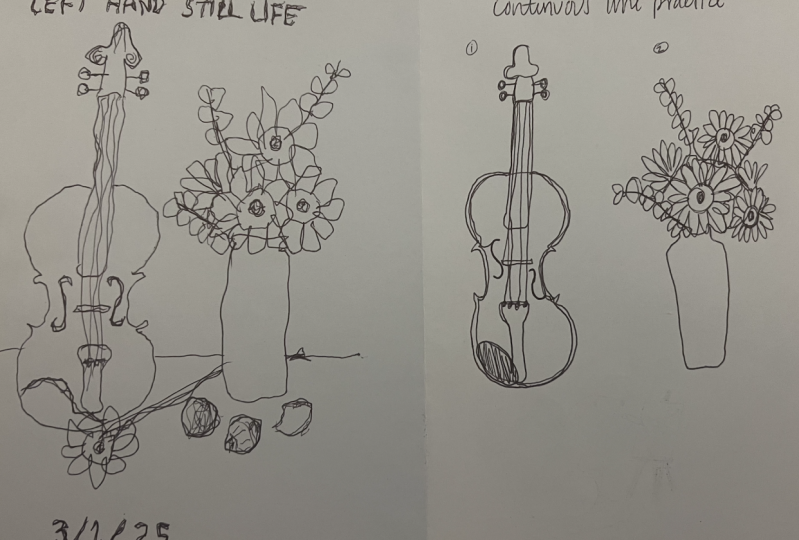
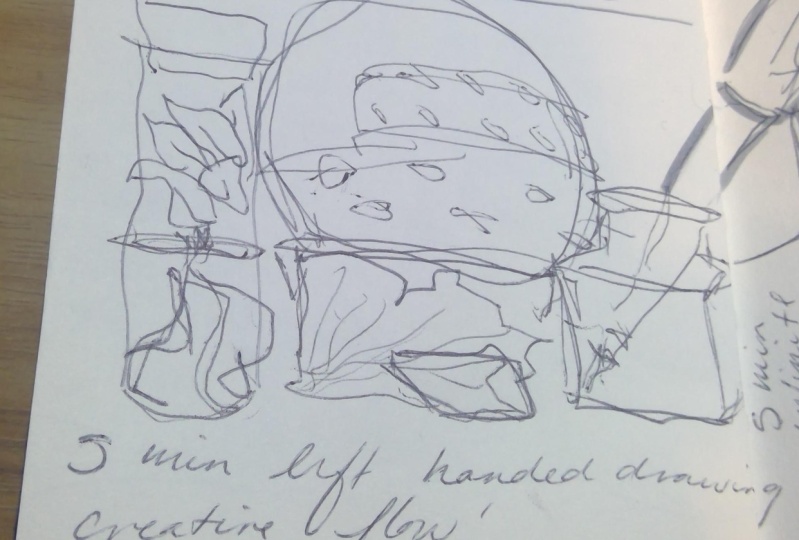
4. Exercise 1: Opposites Baby!: Welcome to the first lesson on how to open up your
creative flow. The first exercise
we're going to be doing is drawing with your opposite hand and
you're going to use your pen in your
non-dominant hand. So the only thing you're
going to need for this exercise is
a piece of paper, a black pen or marker, and a reference
picture of some sort. You can use the one that's
included in this class, which is a still life
scene with a violin, a vase of flowers, as well as a few other
accoutrements on the table. And you can choose whichever
parts of focus on. For this quick exercise, you will take your pen
and your marker and transfer it to your
non-dominant hand, and that is the hand you
will be drawing with. So in my case, I usually
draw with my right hand. And for this exercise I
will draw with my left. It's a simple trick to make life a little
more interesting and challenges your body and your brain in a whole new way. And it's really amazing
to see how clumsy and awkward you can get at
such a simple task. And it really forces us to think our brains like our bodies get weaker if we don't push them. And it's also been
shown that the use of your non-dominant hand also
increases the amount by which the non-dominant
brain hemisphere is activated much more so than
using the dominant hand. So if you primarily always use your right hand and you switch
over to your left hand, you are going to then activate your left
brain hemisphere. And this is actually
strongly correlated with improved levels of
creativity, intuition, and ability to feel your class project
is to take any scene following the reference
picture or one of your own drawing that
scene with your left hand. Don't take too long on this. I probably took
about five to 10 min to do this whole
entire exercise. It could be shorter.
It could be longer however way you want. And once you have
your completed piece, be sure to share it in the
class project section.
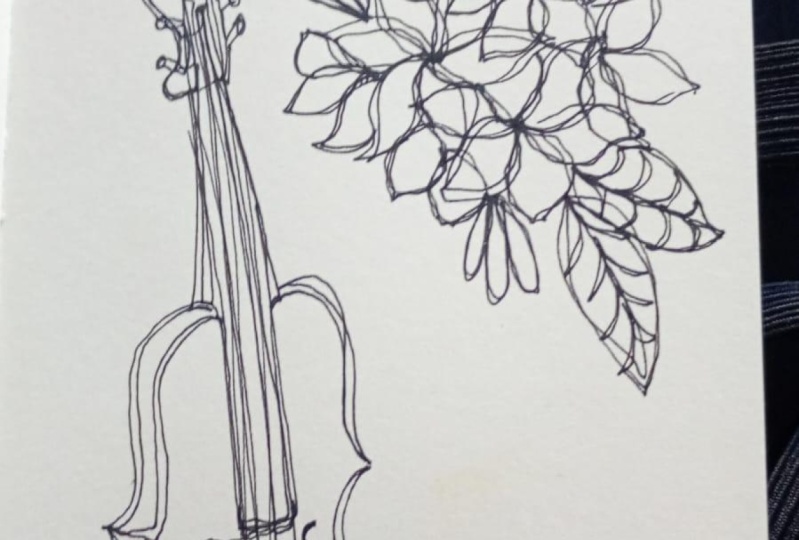
5. Exercise 2: The Infinite Line: Hey there and welcome to
exercise to the infinite line. Now this exercise
is extremely fun. You need to draw whatever it
is that you're going to draw without lifting your pen
or marker off the page. And you essentially are
going to make a scene using one continuous line. So all you're going to
need for this exercise is a piece of paper, a pen, or marker, and a reference picture. Again, you can use the
one that we have in this class without
lifting your pen, draw out the scene. Now in this case, I just went ahead and did separate pieces. I did the violin as well as the bouquet of
flowers next to it. Just to kinda play around with this concept and get
my brain warmed up. Now the reason why this
is so important for our creative flow is
because oftentimes we get too much into our heads and
we tend to over-complicate our lines are our paint
strokes with lots of tiny, tiny little lines and making
it super, super complicated. By doing this exercise, you're actually learning
to improvise on the spot. So in my case, I actually
ended up doing the violin a couple of times because
as I did the first time, I knew I could do it better. So when I did it
the second time, I figured out different ways to make my lines and
make them continuous. So I got a piece that was more representative of a violin. And the more I was
able to do that, the more spontaneous and
lose the drawings became. And that was a really
beautiful looking effect. And it's actually
inspired me to want to do much more looser
interpretations of my subject pieces
for later paintings, your class project is to
take parts of the scene or even do the whole
scene using one line. And once you're done with
that, be sure to post it in the project
section of this class. Have fun.
6. Exercise 3: The Beyond: Hey there, welcome to exercise
three, though beyond. Now this exercise is a really
interesting and fun one. You're going to draw a bunch of random squiggles and
lines on your paper. And then you're going to
try to take those lines and turn them into
something recognizable. So all you're going to
need for this exercise is a piece of paper, a pen, and maybe a
marker or highlighter. You're going to
first take your pen and do a bunch of
random squiggles. You can even close
your eyes and just randomly make marks
on your paper. So then what you're gonna do is look at your squiggles and try to identify something
recognizable inside of it. And then with your
marker or highlighter, you're going to draw within those lines and make whatever
you see come to life. When I did this exercise, I immediately saw aggressive
looking bumblebee holding up It's fist, like it's about to box. No rhyme or reason. I just made that tend to push this exercise a little further. You can use markers
instead of pens to make your marks and
your random squiggles. I went ahead and took like
three colors of markers, squiggle them and
did all sorts of random mark-making on my page. And then took my black marker
or a Sharpie and try to identify picture or a face or something within
those random shapes. And the results are always
very fun and interesting. Now this is a great exercise for your creative
fluid because it helps your brain improvise and see beyond what is actually there. And not only that, it really
helps to relax your brain, and it has been shown that
creativity thrives on a relaxed mindset and even going deeper into why
this works so well, doing this exercise helps you turn off your sympathetic
nervous system, which is your fight
or flight response, and just relax and tap
into your creative flow. Of course, there is
no wrong answer. You can look at one thing
one day and see one thing and the next Stacey, something
completely different. It's simply you and your paper and your creativity at work. So now your class project
is to make random marks, either using a marker or
set of colorful markers, and then discover
and draw a scene or an object within
those random marks into something
that's recognizable. And when you're done,
be sure to post what you've made into the
class project section. I can't wait to
see what you got.
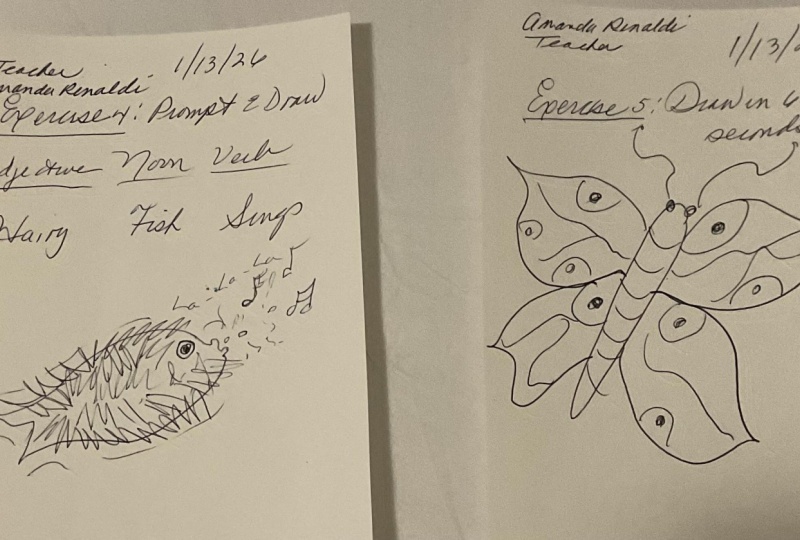
7. Exercise 4: Prompt & Draw: Alright, welcome
to exercise four, which is the random
prompt and draw exercise. I know you're gonna need for this exercise is
a piece of paper, a pen, and a list
of prompts that you can download
within this class. So the exercise
is pretty simple. All you need to do is
pick one adjective, one noun, and one verb. Put that together
into a phrase and doodle what that
phrase means to you. I had the phrase
pretty banana eats. I drew a banana that was
dressed in a bikini, that was eating a pizza. And she has the phrase,
I like them gooey, it's silly, it's dumb, and it made me giggle. This is just a really
fun and creative way to just let loose, have a laugh and also to
represent a core idea. It's something that's
so simple as a doodle. You get the ability to
think on your feet and improvise without
getting bogged down, with starting completely
from scratch. So having the idea given to you, instead of having to come
up with it on your own. This teaches you
to have fun and to loosely put together ideas that can eventually turn into
more ideas in the future. And most importantly, a warms up our hands and our
minds with something that isn't totally normal
or routine for our brains. So now your class project is to put together a random phrases in the prompt list and just dueling out what that phrase
means to you. Once you are done,
be sure to share it in the project
section of this class.
8. Exercise 5: Draw in 60: Okay, welcome to exercise file, the file exercise of this class. And most probably one of
my favorites draw in 60 s, you are to draw
something, a phrase, a scene of reference,
a landscape, whatever it is that
you want in 60 s. And all you're gonna need for this as
a piece of paper, a pen, a reference picture, and, or a prompt that you
would like to use, and also a timer set to 60 s with all your
materials at the ready, Turn your timer on and
you're off to the races, started doodling and
getting out any ideas or any concepts that you want
out as quickly as possible. In my case, I decided to use a reference picture
from this class, which is the still
life of the violin and sunflower seen it. I challenged myself to do
this entire piece in 60 s. With my first try, I was able to do just the
violin and 60 s. And then I challenged myself again to
do the entire scene is 60 s. And by the third
trial was able to get most of that scene done, learning with each iteration what it is that I had to
do to get it done faster. Now this exercise is amazing for your creative flow
because it helps develop your ability to convey core ideas in a very
short amount of time, allowing you to pinpoint
what makes that sketch unique to that topic. Plus it's a really fun game to play with your friends too. So if you ever wanted to
have a creative flow party, throw out this exercise. It's a fun, fun time. Your class project is to
take a scene or a prompt and draw it out in exactly 60 s. Feel free to do this as
many times as you like, just to challenge
yourself to get better. And once you're done,
please be sure to post your finished sketch in the project section
of this class. Have fun.
9. What to do Next: So now that you've learned
the five exercises, you now have the capabilities and tools to help you open up your creative floodgates
and really get into the flow of your
inspiration and art-making. My suggestion for you is to use a combination of these
exercises whenever you're feeling stuck or unable to
get past a creative block. And in my case, I actually
like doing these exercises before I start a new painting
or a new art project, just to kinda help me
get the jitters out. Think of it like you're
about to go for a run. You wouldn't
necessarily step out of your house and
just start running. You would do some exercises
just to kind of get your muscles warmed up
before you take off and run. Making art is very
much the same process. You need to be warmed up
and ready to go before you can go off to the races and
create your next masterpiece. Just because you
don't feel creative or our creative all the time, it doesn't mean that
you're a failure. Everyone has their
sticking points. Everyone has their
days, weeks, months, years, where they do feel
creatively dried up. What matters is understanding
that our creativity is a muscle that needs to be
exercised and warmed up. But what you can
do for yourself to help your creativity
work with you, is warm it up with these
exercises to get you flow in and go in and having a wonderful time in
your art process. If you enjoyed this class, I would love for you
to give me a review so that I get a better
understanding of how I can serve you in the future
with more classes and content that helps you become
the better creative artist. I wish you all the best in
your creative endeavors. Have fun and always
have fun with your art. See you later.
 Amanda Rinaldi, Teaching you to Art with Confidence