Transcripts
1. Class Introduction: Ever scrolled past an
ad on social media. And the next thing you know, you're topping Shop Now or learn more without
even thinking twice. That, my friend, is the quiet magic of
excellent copywriting. Hey, there, I'm Christine. And over the years, I've learned how to write copy that
doesn't just look. They get real results. Copy that catch your
eye mid scroll, make you feel
something and nudge you gently but powerfully
to take action. The truth is most copy
are easy to ignore, but yours, it
doesn't have to be. Whether you're growing
your own brand working in marketing or helping clients
stand out through words, you can confidently
write a copy that gets eyeballs and actually does the heavy lifting in
marketing for you. In this class, I'm walking you through the exact process I use to create a copy that connects deeply and
actually converts. Here's what we'll
cover together, what copywriting actually is and why it's not like writing
essays in school. How to tell the
difference between copywriting and content
writing they're not the same, and when to use each one, how to turn boring
product features into benefits your
audience can't resist. Three proven copywriting
formulas, Ida, pass, and four piece that
will help you stop guessing and start
writing with confidence. By the end of this class, you'll know how to craft clear, compelling copy that
sounds like you, not some pushy
Internet marketer. You'll have plug and play templates to make things easier. And a simple but powerful
copywriting workbook to help you apply
everything right away. This is for you if you're a
marketer ready to level up, a business owner
who wants to share how your products or
services can help, or a content creator who needs your words
to actually work. Let's turn that blinking cursor
into copy that connects. You ready? Let's dive in.
2. Class Project: When I first dip my
toes into copywriting, I was totally overwhelmed. I'd sit in front of a
blank screen for hours, overthink every single word, and end up with something
that felt, well, boring. No clicks, no connection,
just crickets. If that sounds familiar,
you're not alone. We've all been there, but here's what changed
everything for me. Understanding that copy isn't just about being
clever with words. You don't even have
to be a writer. It's about being clear and speaking straight to what your audience truly cares about. It's psychology,
empathy, marketing, and a whole lot of practice through many client
projects, and yes, a bunch of trial and error, I discovered a step by step
framework that removes the guesswork from writing persuasive copy and I'm
handing it all over to you. For your class project, you'll be creating
three pieces of high converting copy using the exact frameworks we
will learn together. Here's how download
the copywriting workbook from the
resources section. Pick a product or service. This can be your own business, a client you're helping or just something you
genuinely love. Apply the Ida pass and four piece frameworks
to create your copy. Upload your work to the
class project gallery. I personally review each one and share feedback
to help you grow. Pro tip, choose something
meaningful to you. When you care about the offer, your copy becomes so much more powerful and the
learning sticks. As we work through
each framework, you'll get clear on
who you're talking to. Pinpoint the real problems
your audience is facing, highlight what makes
your offer irresistible. And craft a clear call to
action they can scroll past. Remember, your first draft
will probably be rough, and that's perfectly fine. Even top copywriters don't nail their copy
on the first try. The goal is to apply what you're learning, progress
over perfection. Work alongside me
during the lessons or tackle the project afterward when you have more
time to focus. Either way, the
copywriting workbook will guide you
through each step. I can't wait to see
what you create.
3. What Copywriting is: Copywriting is the
art and science of writing persuasive
and compelling text, often referred to as copy. Its primary goal is to motivate the reader or viewer to
take a specific action. I'd like to give emphasis to the words persuasive
and motivating. It's because people
hate being sold too. They don't want to feel like
they're being forced to buy something or do
a specific action. You see, people buy with their
emotions and they need to feel that their
purchase decision is the best thing to do. That is where copywriting helps. Now, the primary goal
of copywriting is to let the readers or customers
take a specific action. Such as making a purchase, signing up for a newsletter, clicking a link or sharing
content on social media. Copywriting is like an
enchanting dance of words that makes audiences
click like Engage. It's the power to turn a simple message into a
compelling call to action. You might wonder, where
can I use copywriting? Well, everywhere. Copywriting comes
in different forms, whether long or short form, copy is part of our
everyday lives. It's in the advertisements
we read or watch in the brochures we picked up
from a stande at a local shop. In the web pages we visit online in the
social media posts, it's even in the company
tagline we just read and more. If you own a business, you'd need copywriting to deliver the right message
about your product or service to compel customers to buy or check
out what you offer. Now, you might wonder why copywriting is important
in digital marketing. Here are some reasons why. Number one, first
impressions matter. When a potential customer
lands on your website, opens your email or sees
your social media post, the first thing they
notice is your copy. Effective copy can
grab their attention instantly and entice
them to explore further. Number two, copywriting
conveys your brand message. Your copy is the voice
of your brand it tells your story,
values, and personality. It sets the tone for how
your audience perceives you. Whether you want to
appear professional, casual or innovative, it's all expressed through
your choice of words. Number three, copywriting
drives conversions. The ultimate goal of digital marketing is to convert
visitors into customers. Copywriting is the tool that guides this
conversion process. Compelling copy can turn a casual browser into
a paying customer. Number four, for engagement
and social sharing. Copywriting extends to
social media where it plays a vital role in encouraging
likes, shares and comments. Engaging copy can
make your content go viral and reach
a larger audience. Number five, copywriting
educates and informs. Sometimes your customers need more information to make
informed decisions. Copywriting in the
form of blogs, articles and guides can educate your agents and position your brand as an
industry authority. Now, copywriting has a
lot of forms and uses, and we'll deep dive into all of that in the upcoming lessons.
4. Copywriting vs Content Marketing: You might confuse copywriting
and content writing. Did you know that
these two work hand in hand to deliver
the right message? Yet these two are completely
different disciplines. By the end of this lesson, you will be able to
differentiate between copywriting and
content writing and understand when and how to use each type of writing in
your marketing efforts. Are you ready?
Let's die right in. Now imagine copywriting as the magician at a
grand stage show. Its main job is to persuade
the audience to take a specific action like buying
a ticket to the next show. Copywriting is all about
making things happen, and it does this with
short and snappy words. Content writing,
on the other hand, is like the storyteller in your family who gathers
everyone around the campfire. It's here to educate,
entertain, and inform. Content writing
focuses on sharing valuable information and
building trust over time. Here are some examples. The first example
for copywriting is buy now and get 50% off. So this is copywriting
in an online store, trying to make you
click and purchase now. Next example is sign up for our newsletter and
never miss a deal. This is another example
of copywriting, and it's all about encouraging
you to share your email. Next, let's discuss the
examples for content writing. The first one is cake
baking one oh one, an easy step by step guide. This is a blog post that explains how to bake
a cake step by step. So that is an example
of content writing. Another example is
when you see an in depth article about
the history of cinema. Copywriting aims to
make the ogens take immediate action like making
a purchase or signing up. It often uses persuasive, urgent and action
oriented language. Its length is typically
short and concise. On the other hand, content
writing aims to provide valuable information and
engage the audience over time. It has a more informative
and educational tone and may be longer
and more in depth. Now I have these two
pieces of writing. Can you help me
determine which one is copywriting and which
one is content writing? To participate in this activity, go to the Assignment tab
and submit your answers.
5. Features vs Benefits: In this lesson, we
will break down an important aspect of copywriting, features
and benefits. By the end of this lesson, my goal is for you to easily distinguish between
features and benefits. This skill will
supercharge your ability to write persuasively in
your marketing efforts. Plus, get ready for an engaging activity at the end of this lesson. So stay tuned. Now, what is a feature features are what a product or
service has or does. They are the specific
characteristics or functionalities of
a product or service. They are usually
factual and tangible. It can be the color, the size, specification, or
basically what it does. For example, a feature
of a smartphone is high resolution
24 megapixel camera. On the other hand, benefits tell us what those features
mean for the customer. Benefits are the
positive outcomes or advantages that a customer gains from using the
product or service. They explain how the
features fulfill the customer's needs or
solve their problems. Benefits are more emotional
and customer centric. Going back to our example, the benefit of the high
resolution 24 megapixel camera captures clear
and crisp photos that make your
memories come to life. Looking at these
examples for Pink Sugar, New York, the first feature
is, we offer customization. You can choose from
our signature cakes or a custom cake design. Now, this is a
feature because it just tells us what the
product is all about. So when you choose Pink Sugar, New York as your cake
supplier for your event, you can either choose from their signature cake designs or ask them to create a
custom cake for you. Now ask, so what or what's
in it for your customers. This is where the
benefits come in. Now, the benefit
is so you can plan the perfect party according
to your taste and budget. This statement gives the
customers the power to choose from the two options based
on their taste and budget. This benefit statement
explains how the feature we mentioned earlier fulfills
the customer's needs or solves a problem. Benefits are customer centric. Another great example for the features versus
benefits is this. The feature is our cakes are made from the
finest ingredients. Wow, it's amazing, but it's not that attractive
to customers yet. We ask what's in it for them? Then the benefit comes in. You can enjoy high quality
and best tasting cakes for your celebration. Now, benefits often focus on targeting the
customer's emotion, so they are compelled to make a purchase or take an action. Let's have a look at
another example for Rose, our online course creator,
teaching product photography. Here are some sample features
versus benefits statements. The first feature is learn
key principles in exposure, composition, lighting, and equipment in a structured
learning environment. So now we turn that into
a benefit statement, so you can learn all
the foundations of product photography
and confidently apply them to your work. Nice. Next feature is the course consists of
short pre recorded videos. So it just tells us
what the course has, which is short pre
recorded videos. So now let's turn that
into benefit statement. So you can learn
at your own pace and on a schedule
that suits you. Wow, that's valuable for your target students
or customers. Next feature is, we believe
in learning by doing. The course is packed with practical exercises
and assignments. The feature here is the practical exercises
and assignments. The benefit is so
you'll be able to apply your newfound knowledge
in real world situations, hone your skills, and boost your confidence
in photography. So that's nice. Always ask what's in it for your customers. Finally, the last feature is
one of the best features of this course is direct access to Rose and a supportive
community of photographers. Let's turn that feature
into a benefit. So you can ask questions, get feedback on your work, build your portfolio, and
speed up your progress. It's a nurturing environment that's here to help you succeed. That is a nice benefit statement and it answers what's
in it for them. Copywriting can be your marketing superpower
when done right. Customers buy with their
emotions with the help of the benefits and justify their purchase
decisions with logic, focusing on the features. To write the perfect copy, combine the features
with the benefits. Here are some steps. First, identify the features
of your products or service. Then convert those features into benefits by asking the
questions, so what? What's in it for them? Or why should they care? If you're still
adjusting, that's okay. Refer to our examples earlier. Finally, combine the
features with the benefits. For example, take
advantage of our in house cake delivery
service so you can make sure your cake arrives
perfectly and in one piece. Amazing. Combining features and benefits can create a powerful
statement for your copy. Let's put these into action. In the next video,
I will discuss the assignment and help
you get immersed in telling which ones are the features and which
ones are the benefits as seen in the
marketing materials of one of today's
successful brands.
6. Assignment - Features vs Benefits: Welcome. In this assignment, we are going to help you
sharpen your skills in determining which ones are the features and which
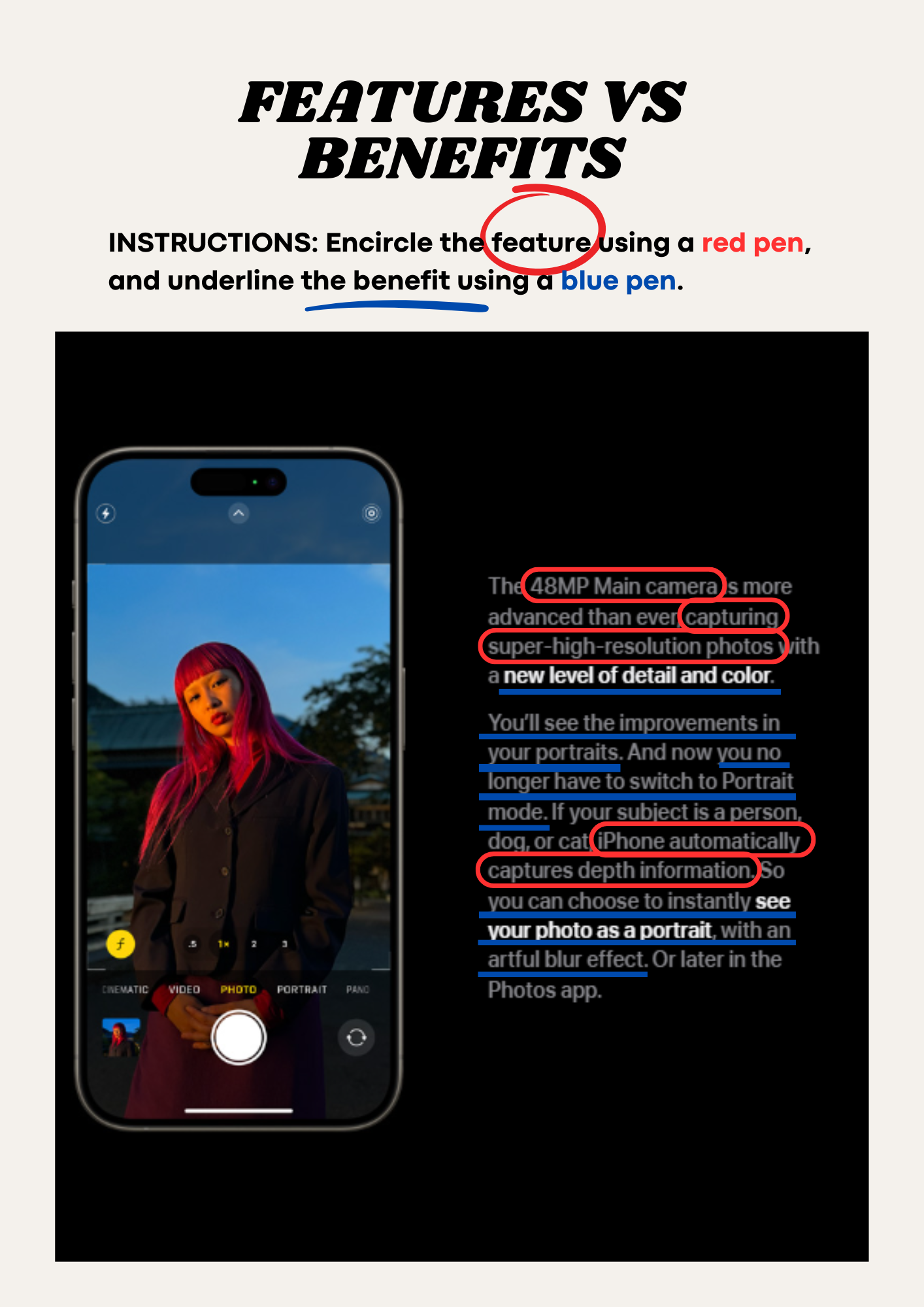
ones are the benefit. It's okay to be messy at first. Practice makes perfect. We have here a sales copy of the latest iPhone 15 P
from Apple's website, circle the feature using a red pen and underline the
benefit using a blue pen. You can either print this or answer this using your
laptop or computer. Access this at the
assignment tab. In the next lesson, we will discuss the
powerful and battle tested copywriting frameworks and how you can use them for your copy. We'll get immersed in each
framework equipping you to craft the best copy for your
business or your clients. I'll catch you in
the next lesson.
7. AIDA Framework: In the world of copywriting, the IDA formula is a time tested approach to creating persuasive
and effective content. IDA stands for attention, interest, desire, and action. The IDA formula
is like a ladder. You start by grabbing
the reader's attention. Then you climb up by
peuing their interest, building up their desire, and finally guiding
them to take action. The IDA formula is great
for landing pages, product descriptions, and
even social media posts. Let's break down each stage, understand its benefits,
and explore some examples. First, in the IDA
formula is attention. The goal is to capture the reader's attention
immediately. It helps readers get
engaged from the start, reducing the risk of
them clicking away. It essentially grabs their
focus and makes them curious. Now, how can you grab
your reader's attention? You can include urgency, encourage curiosity,
highlight your offers, or show relevance to
your target readers. Now, for our example, the target readers are
people who are interested in productivity and are tired
of overwhelming tasks. Let's dive right in. In
this example for attention, we are calling in those who are tired of never
ending to do lists. I'm sure a lot of people
can relate to this. Remember, the goal is to
capture the attention of those whom you want to target and
make them curious instantly. In this statement, you are pre qualifying those who
struggle with this problem. Next in the Ida
formula is interest. The goal is to boost interest and keep
the reader engaged. It encouraged readers
to explore further and show the contents relevance
to the reader's needs. What you can do to
win the stage is to incorporate
storytelling in your copy. You can also mention the
reader's pain points, add facts, or even include humor to
continue our example earlier. Again, our target readers are people who are interested in productivity and are tired
of overwhelming tasks. Now, for our interest statement, discover the secrets to
efficient time management. In this example for interest, we are building interest
by mentioning that we have the secrets to efficient
time management that could solve their problems. You can also build interest
by listing down the product features that might be beneficial
to your target readers. Now, moving further down the
Ida model, we have desire. The goal is to stimulate desire for the
product or solution. Desire statement appeals
to the readers wants and needs and creates
a strong desire for what you are offering. Always answer the question, what's in it for your
target customer? The desire stage adds
detail to the interest, but creates a deeper
emotional connection. To continue with our example earlier for our target readers, people who are interested
in productivity and are tired of
overwhelming tasks. Let's see. For our
desire statement, we have imagine a life with more free time
and less stress. Wow, sounds amazing, right? In this example for desire, you are giving an aspirational
picture of what you can help achieve through the product or service
you are offering. Finally, we move on to action. In this stage, the
goal is just simple. To encourage the reader to take a specific action. That's it. This drives the reader to make a decision and tells the
reader what to do next. To ace this stage, focus on short call to action
lines to avoid confusion. To continue our example earlier. So our target readers are
people who are interested in productivity and are
tired of overwhelming tasks. For the call to
action or action, we have clicked the BNw button to start your journey today. Make sure you are
directing them to a specific action like By now, subscribe to our email list, download a copy, visit us today, find us at, and more. You can reel them in by
promoting a limited time offer, making the call to action
or CtA button stand out and just focusing on
one action at a time. And there you have
it the IDA model. Remember to tailor each stage to your specific
audience and product. The IDA formula is a
powerful tool to make your content more
persuasive and effective. In the next lesson, we will discuss another
copywriting framework that you can use the pass model.
8. Assignment - AIDA Framework: Before we move on
to the past model, now it's your time to practice. Use this copywriting
workbook to create an IDA statement for your
business or your client. If you can think of an example, you can use our
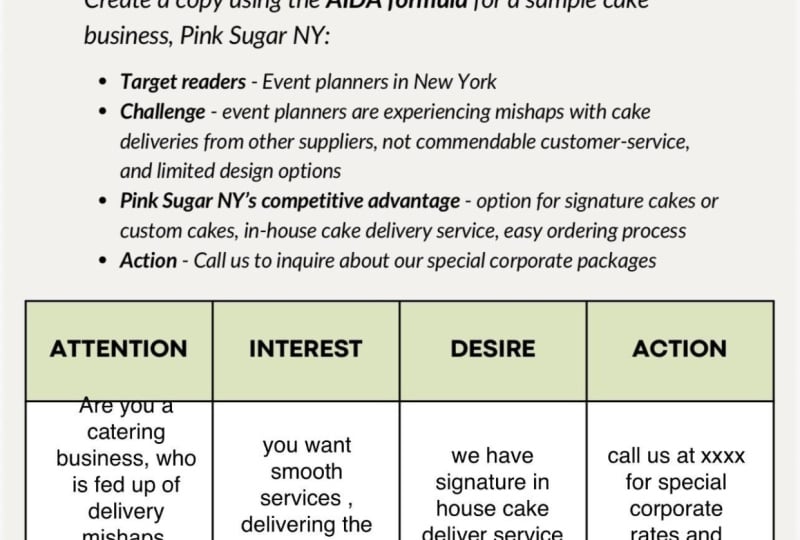
sample cake business, Pink Sugar, New York, create an IDA
statement for this. So our target readers are
event planners in New York. And the challenge they
are experiencing is this event planners
are experiencing mishaps with cake deliveries
from other suppliers, not commendable customer service and limited design options. Now, Pink Sugar, New York's
competitive advantage is the option for signature
cakes or custom cakes, in house delivery service, and easy ordering process. So the action that we are
trying to achieve is to call us to inquire about our
special corporate package. Access the workbook in the
resources tab of this section. This activity requires
a lot of thinking. So before continuing
with the next lesson, I encourage you to
take a break and come back when you're
feeling more refreshed. When you're ready, I'll see
you in the next lesson.
9. PAS Framework: Welcome back. In this lesson, we will discuss another
copywriting weapon, the Pass model. Pass stands for problem
agitate solution. It's designed to address the reader's pinpoints and provide solutions in
a compelling way. Now, the pass formula is like
a problem solving journey. You start by highlighting a problem that resonates
with your audience. Then you make that problem feel more pressing and finally, you present your product or service as the
ultimate solution. The pass model is great for short form copies like
social media content. Let's explore each stage its
benefits and some examples. First is problem. The goal is to
identify and present a problem that the
reader can relate to. You can do this by highlighting a common issue among
your audience. This makes the reader
feel understood and in the need of a
solution. Here's an example. So Let's say your target
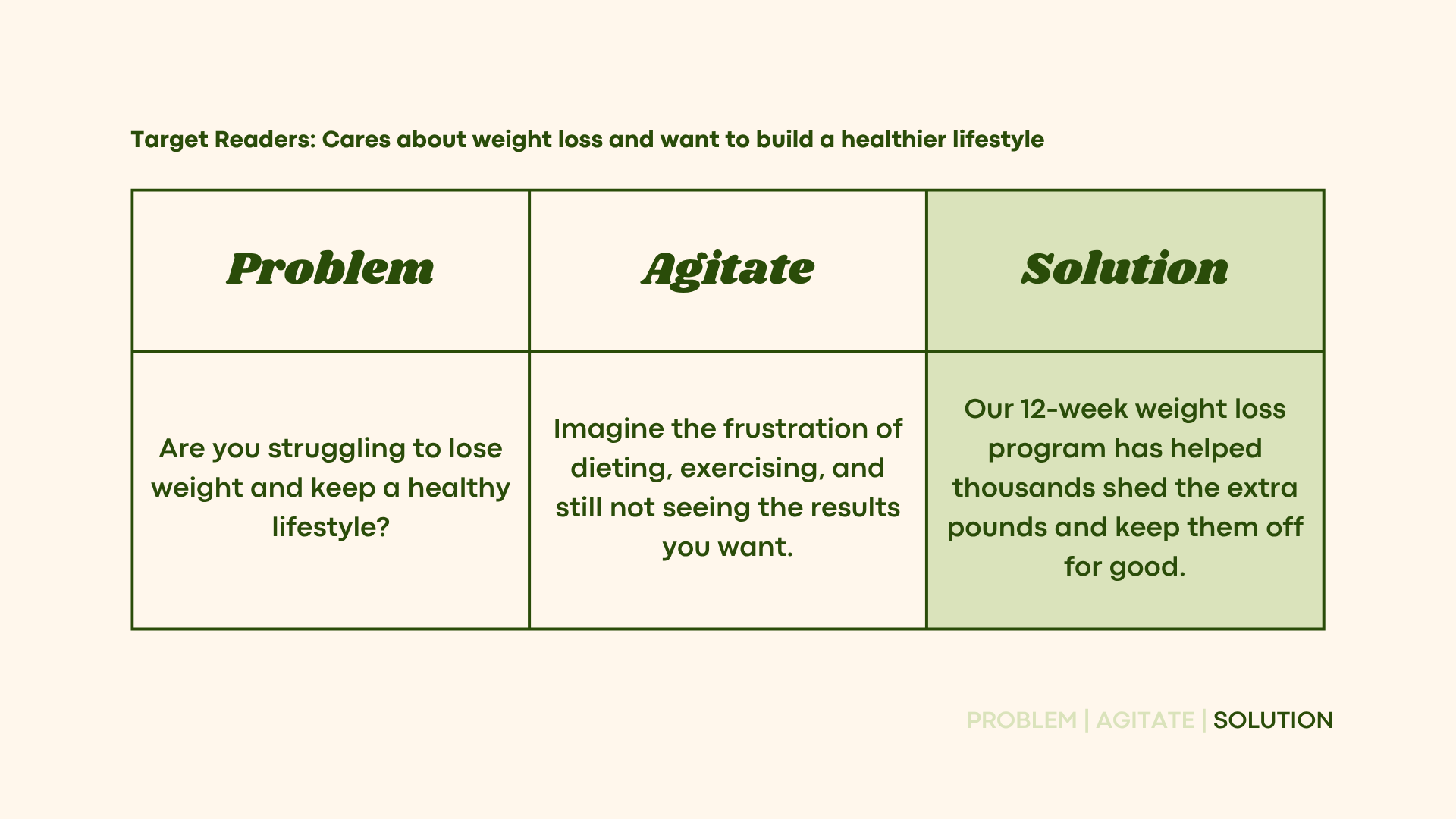
readers care about weight loss and want to build a healthier lifestyle. Let's di. Or the problem statement, are you struggling to lose weight and keep a
healthy lifestyle? In this example, it's
straight to the point and directly talks about your
target reader's challenges. Next is agitate. At this stage, the goal is to stir
up the problem, making it feel more
intense and painful. Ouch. It deepens the reader's
emotional involvement with the problem and compels the reader to seek
a solution quickly. Let's continue with our example. For the agitate
statement, let's say, imagine the frustration
of dieting, exercising, and still not
seeing the result you want. At this point, give them
a picture of what could go wrong if they don't act
on their problems fast. Add an emotional trigger or
connection to as this stage. In our example, we use
the words imagine, frustration and not seeing the results you want
to paint a picture. Finally, the solution. The goal is to introduce the
solution to the problem, which is your
product or service. This offers a way
out of the problem and it demonstrates the
value of the solution. At this point, you, meaning your
products or service, provide the relief or the solution to your
reader's problems. Let's continue with our example. For our solution statement, our 12 week weight loss
program has helped thousands shed the extra pounds and keep them off for good. This solution
sentence is powerful. It's like saying that you have the long term solution to
your reader's problems. At this stage, you show
an achievable solution. It's saying that in 12 weeks, your readers will have a long term solution
to their problems. Now, I feel like we're
missing something in the past model to make
it more powerful. It's the call to action or CTA. Just like the call to
action in the IDA model, choose only one CtA, make it concise and encourage
some type of urgency. CTAs like sign up to
our program today, subscribe or buy now. In summary, the past model includes identifying a
problem in the problem stage. Stirring it up in
the agitate stage, and finally offering a solution
in the solution stage. When using the past formula, it's crucial to empathize with your audience and be
authentic in your approach. Address real problems and
provide genuine solutions. This formula is a compelling way to connect with your readers, build trust, and guide
them toward your offering. In the next video, we will discuss your
assignment so you can practice using the past
model. I'll see you there.
10. Assignment - PAS Framework: Now it's time to practice
using the pass model. For your assignment, use
the copywriting workbook to create a pass statement for
your business or your client. If you can think of an
example, let's use Rose, our online course creator
teaching product photography. Create a pass statement for this so that target readers
are business owners, and their challenge is
this struggling to take beautiful product photos
that are enticing to their customers and no time
to attend scheduled classes. This is Rose's
competitive advantage. Students can learn product
photography anytime and anywhere with no pressure because videos are
available on demand. And finally, students can also use their smartphones
to take photos. And now the action that we want is to watch the demo videos. Access the workbook in the
resources tab of this section. Again, this activity is exciting and requires
a lot of thinking. So before continuing
with the next lesson, I encourage you to
take a break and come back when you're
feeling more refreshed. In the next lesson, we will discuss another
exciting copywriting framework, which is the four piece. If you are ready to uncover the next copywriting
framework and get your hands dirty
with another activity, I'll see you in the next lesson.
11. 4P's Framework: Welcome back. As an
effective digital marketer, our goal is to equip you with more copywriting tricks
up your sleeves. In this lesson,
we will teach you the four piece model
and how you can effectively use this
in your copywriting. This model helps you create compelling content by
addressing four key aspects. Promise, picture,
proof, and push. You begin by making a
compelling promise, create a mental picture
of the benefits, back it up with proof, and then push the
reader to take action. The four piece model is a great way to showcase
the results that you've helped achieve using the products or
services you offer, AKA, your social proof. The goal is to help your
target readers take action. Let's explore each stage its
benefits in some examples. First is promise. The goal is to make a clear and enticing promise
to your readers. You can address an existing pain or create an
aspirational future. This captures the
reader's attention with a strong commitment and sets a clear expectation for what the reader will gain. Say your product is a
hair care collection, let's explore how you can write your four piece statement. For the promise statement, revitalize your hair with our ultimate hair care solution. Here we are stating the promise, which is to
revitalize your hair. If you are trying to address
an existing problem or pain, you can say, say
goodbye to your dull, frizzy hair with our
complete hair care solution. Next is picture. At this stage, we are painting a
vivid mental image of the benefits your
product or service offers. Sensory language
uses vivid words and phrases that entice
the five senses, which is the sight, sound, taste, touch, and scent. It can help transform
your writing, crafting immersive and
unforgettable descriptions that captivate your readers. This helps the reader imagine the positive changes they'll experience and
evokes feelings of satisfaction,
happiness, or relief. And going back to our
previous lessons, we talked about people
buying with their emotions. So let's have a look
at our example. For the picture statement, we have imagined the
feeling of silky, smooth strands flowing
through your fingers. Now, we are creating a
mental image for the reader, helping them visualize
the positive change they can experience with
our hair care product. Next is proof. The goal is to provide evidence that your
promise is achievable. Asked the question,
how can they trust us? This demonstrates
that your claims are backed by real results. It also builds trust
with a reader showing that others have benefited
from your product or service. Let's continue with our example. Now for our proof statement, we have with over 90% of
users reporting stronger, shinier hair in just two weeks, our product is tried and tested. Here we provide proof
that our promise is achievable by highlighting real results and
user testimonials. You can include
facts, statistics, customer testimonials, and
even the number of units sold. Let's move on to the final
stage which is push. The goal is to encourage
the reader to take action. It motivates the reader to make a decision and take
a step forward. To as this step, you must have a clear call to action guiding the reader
on what to do next. Let's go back to our example and see how we can add
the final push. Now for the push statement, we have take the first step to healthier, more
beautiful hair. Click Order Now and
transform your hair today. In the final stage, we encourage the reader to take action by clicking
the Order Now button. This clear call to action
guides them on what to do next, and there you have it
the four piece model in copywriting. When using the four
piece in copywriting, remember to be honest and deliver on the
promises you make. This formula can be
a powerful tool to guide your readers from
interest to action, helping them realize
the benefits your products or
service can provide. In the next video, we will discuss
your assignment so you can practice using
the four piece model.
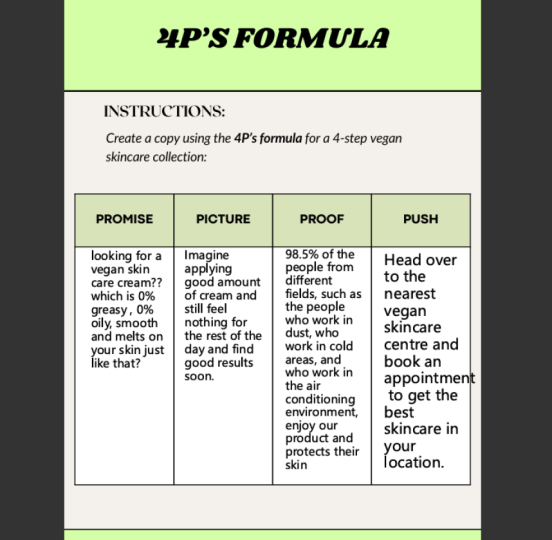
12. Assignment - 4P's Framework: Hi there. Now it's time to practice using the
four piece model. For your assignment, use
the copywriting workbook to create a four piece statement for your business or client. If you can't think
of an example, how about a four step
vegan skincare collection? Access the workbook in the
resources tab of this section. You can use this workbook when doing copywriting
for your business, your clients or
just to practice. Remember that it's
okay to be messy at first and continuous
practice is key.
13. Final Thoughts: You did it. I'm proud of you for completing this
copywriting class. I know life gets busy and
finishing a course like this, takes time, focus, and
a whole lot of heart. Really, well done to you. When you first started, maybe you thought copywriting
was all about being clever with words or
sounding extra polished. I hope you're walking away
with a complete mindset shift. The real secret to excellent copy isn't
just what you say. It's understanding
your audience so well. That your words feel like
you're reading their mind. The frameworks
we've covered, Ida, Pass, and four piece aren't
just fancy acronyms. They're your go to tools
anytime you need to turn boring messaging into
magnetic, meaningful copy. Whether you're writing
an Instagram caption, a sales page, or an email, you've now got a
toolkit that works. If you haven't already, I'd love to see your work in
the class project gallery. It's such a great way to lock in everything
you've learned. I personally go through the submissions to give
helpful, encouraging feedback. Plus, it inspires others in the community to
take action too. Before we go, here's a fun and super effective way to keep on learning copywriting. Start building a Swipe file. It's basically a
collection of copy that makes you pause and convinces
you to take action. Analyze them using the
frameworks we've discussed. What problems are they solving? How do they spark
desire or urgency? Which framework
might they be using? This personal Swipe
file will become an invaluable resource
for your future projects. You'll also start
to see patterns, and soon writing persuasive copy will become second
nature to you. If this class help you feel more confident in
writing a copy, it would mean a lot to me if
you leave a quick review. Not only does it help other
students discover this class, but it also gives me insight into what you'd
love to learn next. Don't forget to hit that follow button so you
don't miss upcoming classes. I've got more in the works
on digital marketing, productivity with notion, and creative content strategies
to help you grow. And, hey, if you're
proud of what you wrote, tag me on Instagram at Christine Socials
and at Skillshare. I love seeing how these lessons come to
life in your world. This is just the beginning. You now have the tools. Now go right and
share your message. I'm so excited to see where
these skills take you next.
 Kristine Sacdalan, Digital Marketer & Course Creator