Transcripts
1. Introduction: The Hi, I'm Elisabeth and welcome to my Ellen Gallagher inspired
Artist Series class. I'm a professional
artist and art educator, as well as a published
author and I've been teaching here on
Skillshare since 2021, sharing my love of art making, creative approaches, and in
the artist series classes, we are getting
inspired by the art of a variety of artists
from the past and present. I share a little bit
about their life and their art making approach. We look at the different
ways that they are exploring various
aspects of art, and then we get inspired by that to create art
of our very own. In this class, we're looking at the work of Ellen Gallagher. Ellen is an artist who
has been creating artwork inspired by her
history, her heritage, the region that she grew up in, her various time exploring
different aspects of the sea through various jobs that she had and
racial identity. She is looking to
her heritage and the past to get inspired by those things and explore them
in her art making. Using a variety of
art approaches. She's very much a mixed
media artist who has created her own visual vocabulary
and visual library to draw from as she works through her different
artistic process. This pass, we're
going to be looking at some of the different
imagery that Ellen explores both from her
sea inspired pieces, as well as cultural identity and the ways that we can weave those into our own art
making practice. Ellen uses a wide range of materials in her
mixed media works. You can really lean into any art supply that
you want to work with. But I'll be showing you the
mixed media approach that I'm exploring as I look into Ellen's work and get inspired
to make some of my own. Let's head over to
our next lesson to talk more about our class
project. I'll see you there.
2. Class Project: For our class project,
I'm going to show you some different ways that I'm exploring various
aspects of Ellen's work. I'm going to lean into some of the geometric simplified
grid work that she does, as well as the
biomorphic imagery, looking at the different shapes of sea creatures and getting inspired by those lines and those shapes and the way we can play with those
in our art making, as well as the creative
play that Ellen embraces in the different
art processes that she explores throughout
her history as an artist. And the work that
she is creating now. For a class project,
you can lean into any art supplies that you
have on hand or that you prefer or you can
follow along on the mixed media journey that I'm going to share for
my demonstration. Let's send it over
to our next lesson and I'll talk some
more about some of the materials that I'm
going to have on hand for my class project.
I'll see you there.
3. Materials: For Ellen Gallagher
Inspired Art project, you can use any art
supplies that you like. I want to lean into a little
bit of what I love to do, which is collage Mixed
Media and I want to play around with some of her art
approaches and techniques. She was doing drying and
watercolor and painting. I might get out
some watercolors. I'm not sure, but I want to go more the route that she
was going with collage. I want to play around with some different collage papers
that I already have and use those as a starting
point to get inspired by for some biomorphic
exploration. Also want to play
with the grid work that she was doing and leaning into some of these found papers for collaging that have some
grid elements to them. Security envelopes are fantastic because the inside of the envelope has this
wonderful pattern to them. Sometimes the pattern
is a little more geometric, sometimes it's not. You have to dig through
and find those. You could also create your own collage paper
that mimics this. You could also take this as a starting point and add on
to the design to make it more geometric or whatever
suits your interest in exploring an Ellen
Gallagher inspired art I really love
these patterns. I'm going to cut them up to create some blocking grid work as the background, I think, and then I want to draw and
paint and collage into that to bring out some
biomorphic inspired pieces. Biomorphic imagery is imagery
that is inspired by nature. Biological organisms,
be that everything from microscopic organisms up through to creatures that we
can see and ourselves. I want to play a lot with
mixed media and using unconventional materials
or using materials in unconventional ways to explore biomorphic imagery and
mixed media art making. That way, it's really
pushing me to go outside of my comfort zone for mixed media collage and kind of try some things in
some different ways, as well as weaving in some of the different sea
creature imagery that Allen was playing with and maybe even some
of my own heritage. I'm not sure. I do want to make sure that for my class project, I am not recreating
a piece that was specific to Allen's heritage because we don't have
the same heritage. I want to make sure
that I am being respectful personal
narrative that she was exploring in
her pieces and that I don't appropriate that
in my own art making. But this is the material
foundation I'm going to start with and then I'm going to see where
it goes from there. On the projects and
resources section of class, I'm going to list all
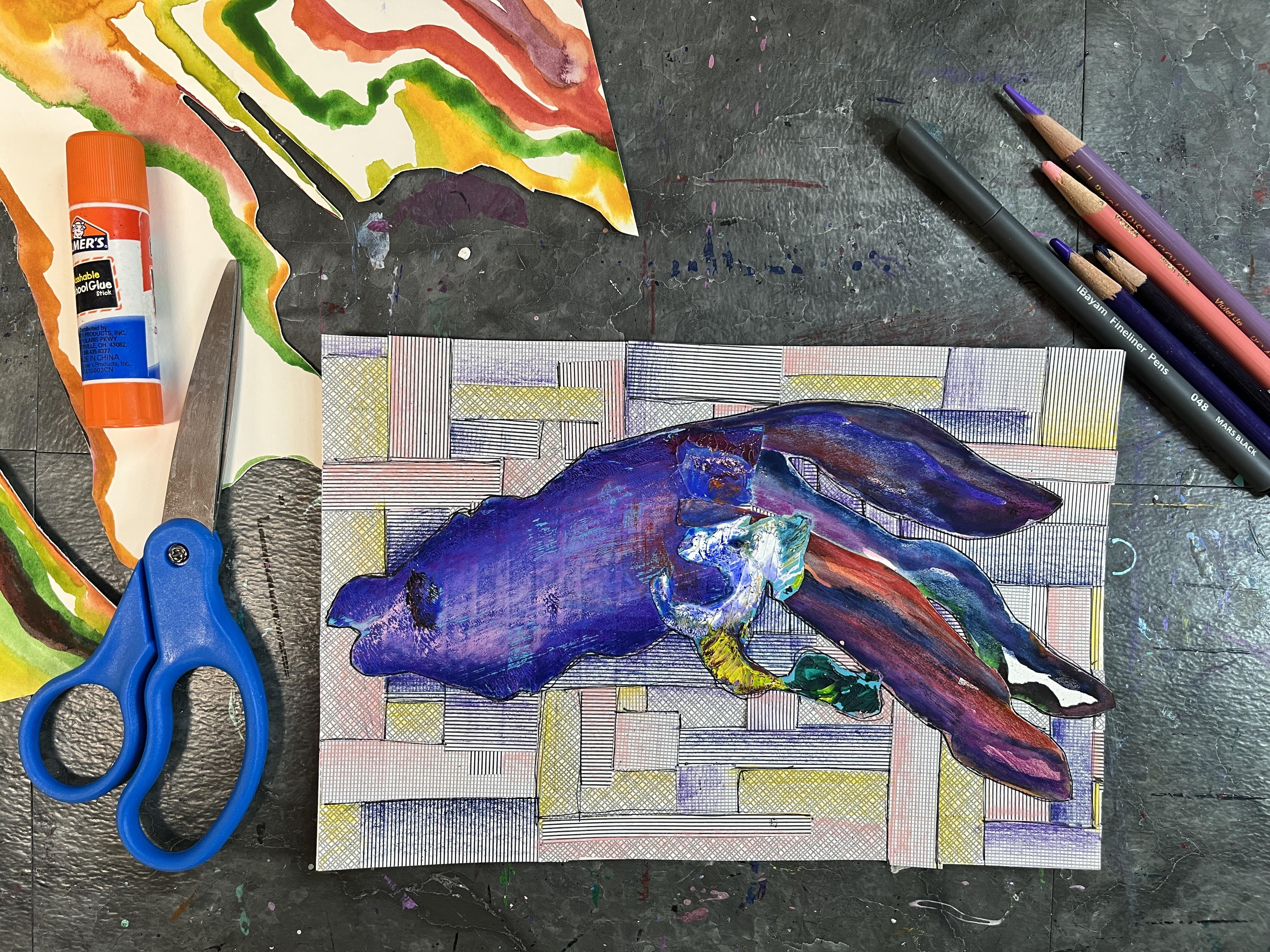
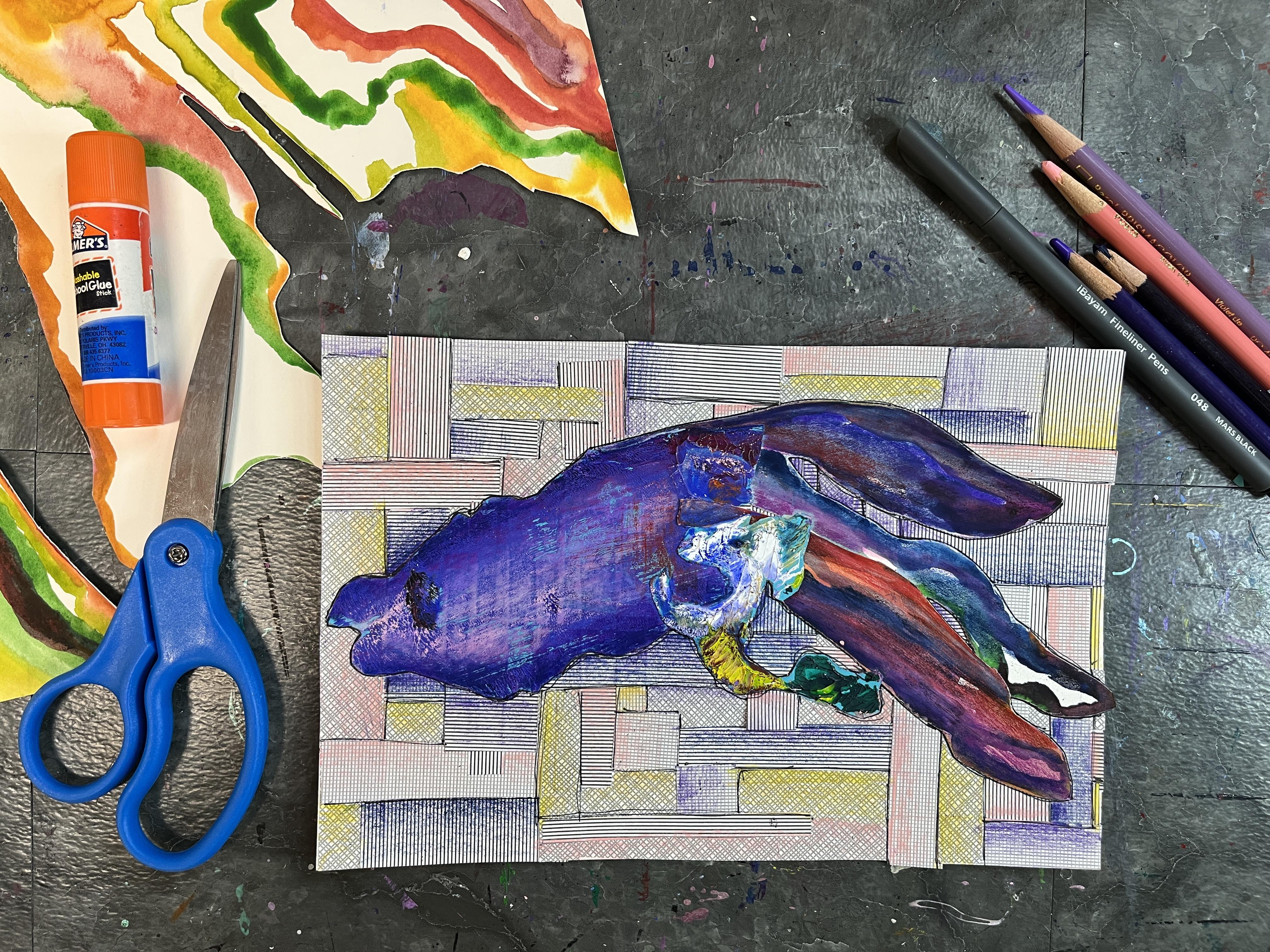
of these materials. I've got my collage papers. I've got some base
paper to collage onto. I've got some colored pencils, a fine liner and a sharpie, and then to glue
down my collages, I've got scissors and this
is fairly straightforward, but please know that you can take any route you
would like to for your art materials for your Ellen Gallagher
Inspired artwork. So let's it over to
the next lesson, and I'm going to
start building up the collage foundation that I want to then draw
and paint into. So take some time to gather
up your art supplies, and then I will see you in the
next lesson to get started making our Ellen
Gallagher Inspired artworks. See you soon.
4. About Ellen Gallagher: Ellen Gallagher was born in 1965 in Providence Rhode Island. Ellen is really
fascinating because she has a mix of amazing heritage. Her mother is Irish American and her father was
African American. She weaves a lot of
those aspects into her art and the imagery that she's exploring and the
story that she's telling. She's also leaning a lot into her upbringing
and where she grew up. Providence Rhode Island,
at the time that Ellen was growing was known as a whaling community and the sea has been a very
important part of her life. Prior to starting college, she had several
different adventures at sea in different careers
that she was pursuing, both on the Atlantic
Ocean and in the Pacific Ocean, as
well as the Caribbean. All of those things resurfaced later on when she decided to pursue a career as an artist. Started school and did the general studies and then she went and got an art
degree later on and she came at art
making organically and just was driven to find ways to create and express the
different ideas that she had. She's drawing on
literary references from the repetitive writings of Gertrude Stein and the
text of Moby ****, as well as other
artists such as Solow and African American culture
and heritage and history. She has a really unique way of exploring a time
in history that is complex and challenging and a darker side of history
and cultural identity, but she does it in really
profound intellectual ways and she's leaning into
inspiration that she's drawing from her community and her upbringing
and her heritage and African American background and all of these
wonderful resources. Thing from 1950s
beauty magazines to 1960 sci fi movies to literary periods that
are inspiring her. She was also heavily influenced by the artist Agnes Martin. Agnes Martin is another one that came to art later in life. She started as a teacher
and when she turned 30, she transitioned to
a full time artist. Her work is known for these
simplified grids, primarily. That's the foundation
of Agnes Martin's work. We can see that
grid work play out through Ellen's interpretation
of that in her own piece. This was really
going for wanting the viewer to feel
a sense of calm and peace when they
looked at her pieces and much can be said
the same for Ellen's, even though she's working on
and through and exploring many topics that are
complex and challenging, and she does so in
such insightful ways. We're going to be
looking at a lot of different aspects of
Ellen's work as we get inspired to create our own Ellen Gallagher
inspired artwork. Let's head over to
our next lesson, and I will start sharing with you how I am exploring a lot of the motifs in Ellen's
work through the lens of my own personal art aesthetic.
I'll see you there.
5. Grid Collage: I really was drawn to Ellen Gallagher's work with
grids and with found papers. I love that in some of her collage pieces and
mixed media pieces. She's using line
paper that I have nostalgia for from my own
childhood in elementary school. So I have been seeing
artists that are local to me using the inside patterns
from security envelopes. And I haven't had a lot of
chance to play with it myself, but I've been collecting
those envelopes and just really loving
those patterns. So I grabbed a couple that were more linear and more grid like, and I cut them up into various sized rectangles,
so short and long. And then I kind of wanted to do this sort of patchwork feel. So I'm gradually building up a geometric gridded patchwork abstraction for my background. This is very similar to
a lot of the grid work that Ellen does in her
mixed media pieces, where the background is
gritted with very light paper. And then on top of that, she puts other elements. So she's painting onto it, she's collaging onto it. She's drawing onto it, or a combination of
many different things. So this is really
all about for me, creating a surface that is prepped for what I'm
going to do on top of it. When I get to the next lesson, I do really want to lean into the biomorphic aspect
of Ellen's work because I also really
like biomorphic imagery. I like looking at the shapes
of natural creatures and plants and whether that be things we can see
with the visible eye or things that are
more microscopic, I just really love the
organic shapes in nature, particularly in
living creatures. So that's kind of also a
fun play that I want to do. I kind of want to
see if I can find some biomorphic imagery in
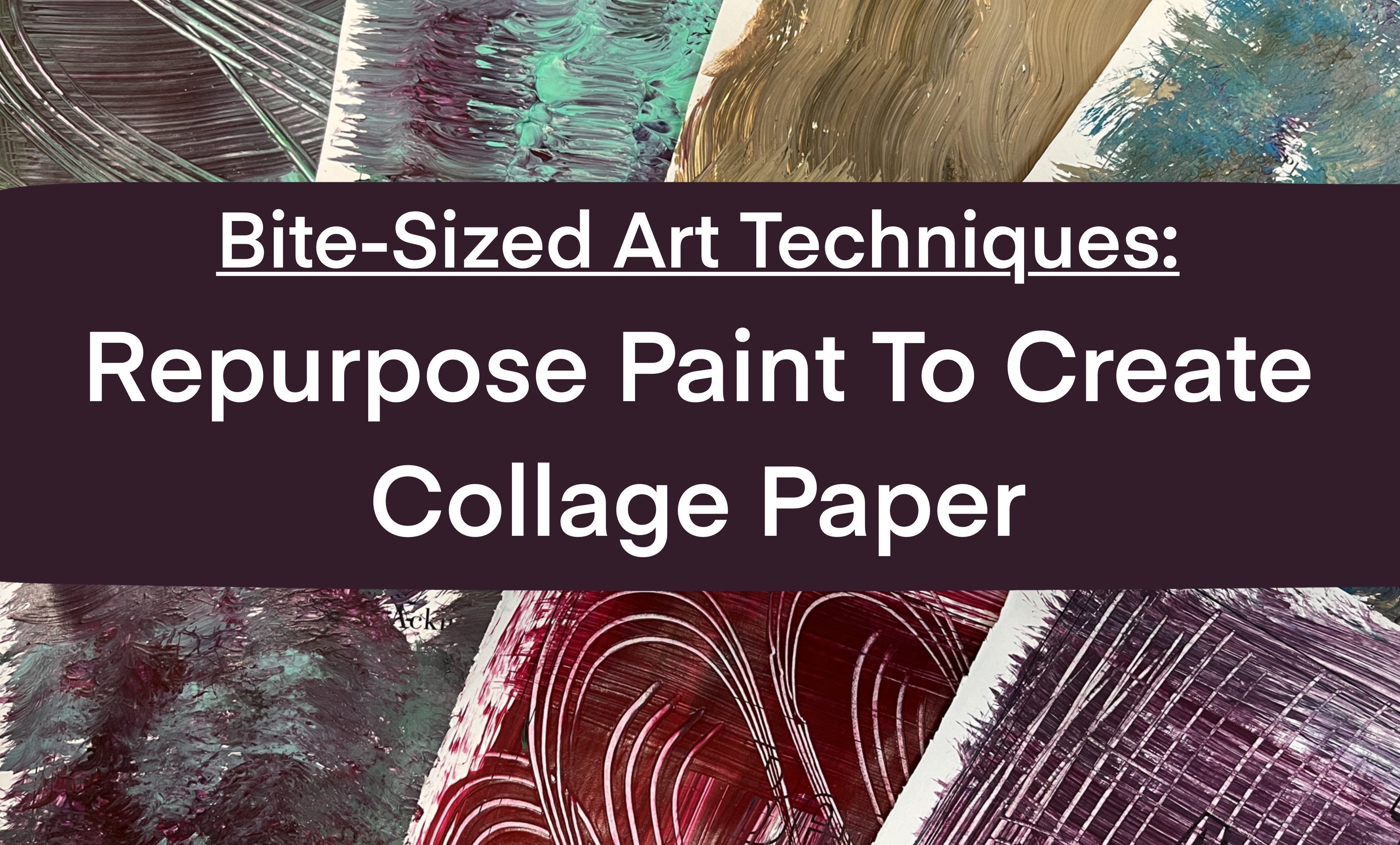
some other collage papers. So on the upper left corner, you'll see a stack of
different painted papers. They're either papers there
where I was kind of using up extra paint from acrylic pieces or they're
abstract watercolors, where I was just
kind of playing. Going to lean into what
biomorphic elements can I pull from those for the
second layer of my collage. But for this one,
I'm really just prepping my canvas, basically. I'm taking all of these
different pattern papers. They're all black
and white patterns, and they're all linear. There's three different patterns that I'm working with here, because it's just like
pen and ink work, right, where the way the marks the black lines are put together creates
different values. So I also have some
very subtle shifts to the papers that
I'm putting down. Kind of building it up
as I go and kind of figuring out where
do I want to vary the pattern of the paper and what size rectangle or square
do I want to put in there. So I'm just going
to keep doing this until my whole
background is filled.
6. Biomorphic Mixed Media Collage: As I was digging through different collage papers
that I have on hand, I started to see possibilities for
biomorphic imagery in them. So I pulled out a couple that
were especially inspiring, and now I'm going to cut
out the painted parts of those so that I can kind of build up and construct
a biomorphic creature. So this paper right here
is construction paper, and a lot of times when I'm finishing and acrylic painting, I have leftover paint
on my palette so I'll kind of slap that
down in some way onto another piece
of paper and turn that leftover paint into
a new collage paper. So that's what I'm doing
with this piece here. It's a little tricky
because it's really thick, but I think it's
going to make for some really neat elements, and I've got, like,
the parts where the purple and the
blue play together. There are a couple
of other blobby patches with the white
yellow and green, so I kind of decided
to just cut out the shapes that I was
finding in the paint, and then I would figure
out the rest of it later. I really love
working intuitively, so this was really great
for that because I like to kind of see what
happens and how my imagination and my creativity view things in unusual
ways as my you know, wheels get turning
and I'm kind of leaning toward different art aspects
and concepts in my work. You could do this much
the same way with any pattern paper that you
have if you wanted to, or you could kind of make
some paper and just kind of see what imagery you
can find out of it. It's a lot like looking for
pictures in the clouds, you know, trying to
find the possibilities in the paint, if you will. So I'm just kind of taking out the negative space where the paint didn't
cover the paper. For this watercolor sheet, it was where the watercolor is. I kind of started seeing
the possibilities of a fish like creature. So I'm just kind of playing with those pieces and kind of, like, a puzzle, putting it together and kind
of figuring it out. Really didn't want to
overthink it much, so I decided to dive right in and just commit to
it and glue it down. If you're working with
a thicker paper or a paper that has
thicker paint on it, you're going to really
want to put a lot, a lot of glue, and then
do a lot of burnishing. So burnishing is where
you're applying pressure and rubbing to really
get a strong adhesion. I do this a couple
of different ways. I do this by flipping the paper over and burnishing
on the backside, or I do it by putting a sheet of paper on top of it and
then burnishing over that. It's just kind of a nice way to really make sure that your
collage elements stick. This is also a great
time to kind of use my extra envelopes that I hadn't cut up yet to kind of just be another surface
to kind of help with. So this is a part of the process where
you could do collage also or something similar
with papers that you have. You could draw out your main imagery or
you could paint it. You could do it
right on the paper. You could do it on a separate
paper and then collage it. You could just lean
into other elements of Alan Gallagher's work
that you find inspiring. I really love collage
and I really love mixed media and putting
those two together. So I wanted to kind of
see how I could play with art materials and art
processes that get me excited, but really kind of
open that up by ways and things that I really
love about Ellen's work. And I also really love doing, you know, sea and
water creatures, too. So this kind of fits into that, but in a much more loose
way than drawing out a very specific ocean
or sea creature and then painting it
or whatever else. It's a matter of how
many more elements do I need until something
feels complete? Then what I find is if you do collage on painted papers
or with painted papers, it tends to be very flat, and I like to really
bring things to life by adding in drawn
mixed media details. So I'll often go in
with colored pencils, brush pens, paint
pens, fine liners, sharpies, whatever
I need to kind of really unify the papers
that I'm working with. And in this case, I'm
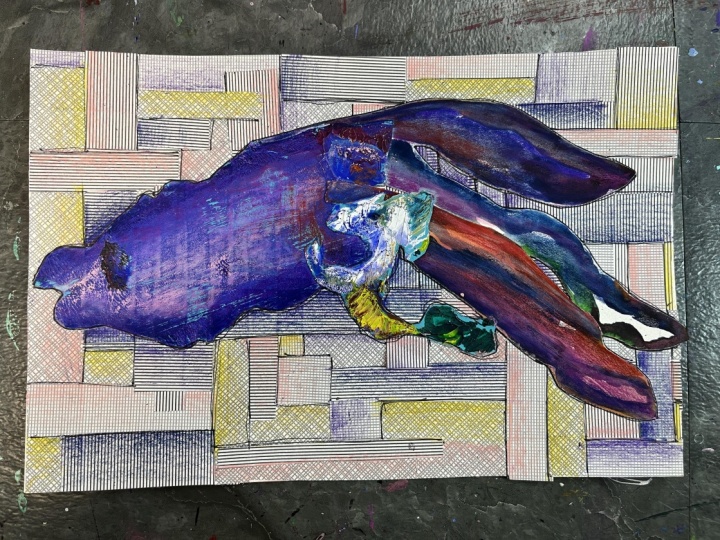
creating a creature, you know, a biomorphic creature. So I really wanted to use colored pencils and kind
of create a roundness and a depth and really kind of create some volume to a
very flat collage piece. That also really
kind of helps to have my creature stand out
against my background. It already does between all of the color in the painted papers and the black and
white background, also the organic shapes of
the creature in contrast to the geometric structure and gritting that I've done
in the background, too. Like, there's lots of contrast
happening in this piece. But I still found that I needed to define
my creature more. That's not necessarily
something you would need to do, and that's not something
that Allen always does. Some of her pieces,
the biomorphic aspects are much more abstracted. She's leaning more into
shapes and colors and textures and not worrying
about it being unidentifiable, anything. And sometimes it is. Sometimes it's very clear what her biomorphic or sea
inspired pieces are about. Wanted to kind of play a
little bit with both of them. I wanted to kind of help
clarify what I was creating, but also still lean into the bizarre nature of the
structure of this creature. So I'm just kind of layering
basic value systems. So dark fading to light
on all the edges, and then I'm playing
up different colors that I'm pulling from the tail. And then bringing that over to the main body and vice versa, just to kind of
help bring all of these wild acrylic papers and watercolor papers into unity to become a more
collected image. I will say it is very hard in some instances to do colored
pencil over acrylic paint. The acrylic paint papers, especially where I have
the white, the yellow, and the green, the paint is
really thick, really thick. So there's a lot
of texture there, and the color pencil
doesn't like to go over it. But so those
elements, I couldn't really draw into them as much, but I just kind of
let that be you know, its own thing and unified the rest of it and
was happy with it. Continue to push
my values and to refine and define my creature. Then I got to a stage where my biomorphic
creature was done, I felt like it was finished, and I felt like there needed to be a little
bit more unity between this colorful creature and the black and
white background. I'm not sure if I love how
this effect turned out, but it's where my
intuitive go for it, art making practice led me. So what I did was I pulled different colors from
the biomorphic creature, and then where the papers
overlapped in the background, I created just very
subtle value scales of those colors fading out. So I've got yellows, purples, just different colors that I had used above
with colored pencil, and then I'm just
adding these just really kind of
subtle value scales. The reason why I'm
not sure if I like this is because
before I did this, the background had a
really lovely unity to it. And I think I want
to do the background again and just let it
be the bull piece, not make it a
background to something else or to draw into it. This was kind of a fun
play on how I could create a structure in the
background and then how I could add to it. I do love what I learned
from this process, and I do think it works
for the piece, ultimately. But I also really loved the grid work that
I created in the back. So I'm kind of sad that I
disrupted it with the colors. But at the same time, it was something I'd
never done before. It was a new approach.
The whole point of this whole series is to get you to try new things and explore new things and
kind of see what happens. And then some of
those things are going to weave themselves into your continual art tool kit and things that you can
draw on and lean back into, and other ones you're
going to say, Well, that was a neat experience. I'm glad I tried
it, but, you know, maybe it wasn't really
for me or it just wasn't what I feel like
continuing to do right now. Like anything we try in life. I learned a lot from doing it. I had fun doing it. It was new. It was an idea I just ran with. And I think in
different contexts, I could really play that up. Had a ton of fun
creating this piece. It is a piece that
I never would have made if I hadn't looked
at Ellen's work and gotten inspired by
various elements of what she does
as an artist and kind of thought about
how I could then put those through my own lens and kind of see what
came out of it. I cannot wait to see
what you create. So let's head it
over to the last lesson to wrap up the class. I'll see you soon. Oh
7. Final Thoughts: The Thank you so much for joining
me in this artist inspired series class where we look to the work of Ellen Gallagher. I hope you had so much fun considering the different
elements of Ellen's work, be that her color scheme, her layering of
textural mixed media, her unconventional
mixed media approaches, the biomorphic
organic sea elements and creatures that she was
looking to for inspiration, her approach to how
she's working through different concepts of American history and
different things that are very meaningful to her own background and
ways that you can apply that to your own
art making as you explore your own cultural
identity through your art. That when you finish
your art project, you pop on over to
the projects and resources section of class and you post it to
the student gallery. It's really wonderful
to see how everyone approaches a project for
any of these classes. And it's a really fun way to
celebrate the work of each other and celebrate the work of ourselves as we share
our work with others. I'd also really appreciate it if you took the time
to leave a review. That is a great
way to share with others your experience
taking the class, how you processing
some of these ideas and artistic approaches in
your own art making practice. I appreciate that as
a teacher to give me insights as I
develop future classes. I know that as a student
of Skillshare my love checking out the reviews to find out from the
student perspective what they thought about a class before I dive in and
check it out myself. I would love to stay connected. If we aren't ready, please click the follow
button below so you get notified about
all the new classes that are coming
up in the future. Then I'd also love to stay
connected off the platform. You can find me over on
Instagram and YouTube, where I share lots of different things
that I'm working on, exciting updates for the future, art adventures I take and what's happening
in the art studio. Thanks again for
taking this class. I hope you are feeling
inspired and ready to put some fresh new perspective
on your art making and I hope to see you in class
real soon till next time.
 Elisabeth Wellfare, Artist, Art Educator