Transcripts
1. Hello Autumn!: There's something magical
about autumn, the crisp air, soft golden light, and the way the leaves turn the world
into a warm glowing palette. It's a season full of
color and texture, perfect for inspiring your next watercolor
painting. Hello, everyone. I'm Ahura, a software engineer, a watercolour artist,
and an art educator. I have always loved
how watercolor captures the soft
beauty of the seasons, and autumn with its rich reds, oranges and golds, is
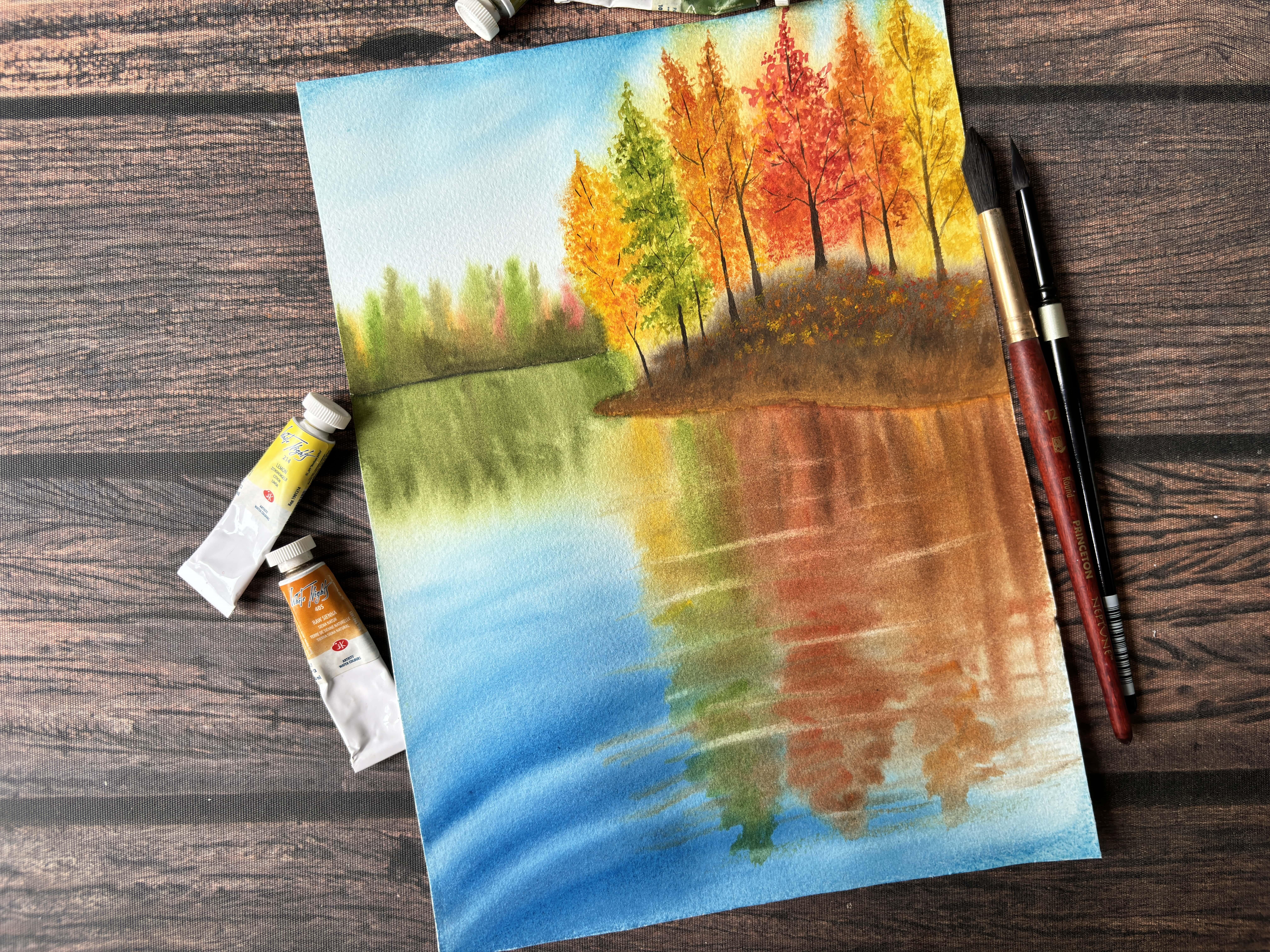
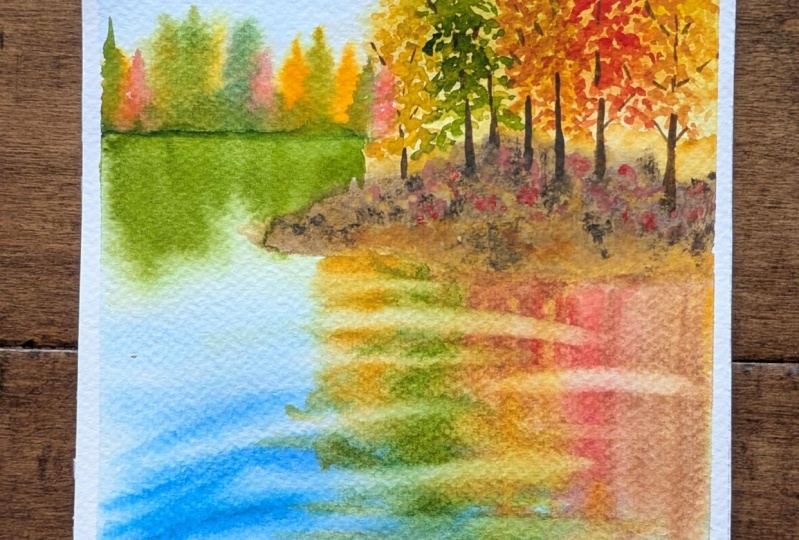
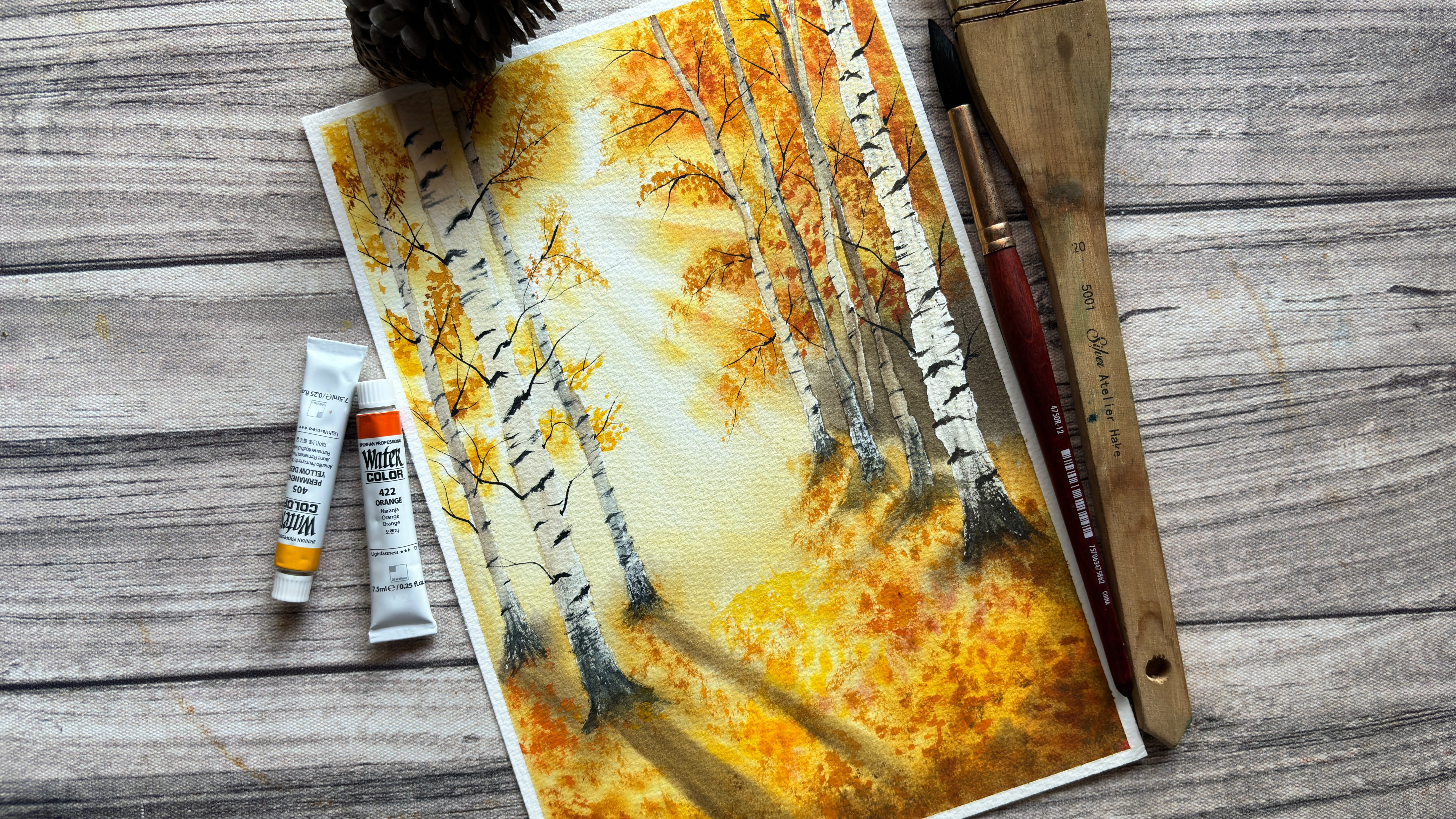
perfect for exploration. In this class, we will paint vibrant autumn trees
and reflections. You will also learn essential
watercolor techniques like wet-on-wet wet-on-dry
and dry brush while discovering how to build depth and bring your
colors to life. Whether you're just starting
out or refining your skills, this class is beginner friendly
and designed to help you paint confidently while
celebrating false beauty. Grab your brushes, your
favorite warm drink, and let's paint autumn together.
2. Art Supplies: All right, so let
us take a look at the art supplies that you will need for this
particular class. First is the paper. I'm using the paper from the brand
Saunders water food. It is coal pressed, 100%
cotton watercolor paper, and it is 300 GSM
140 B thickness. You can go with any brand
of watercolor paper. Just make sure to choose 100%
cotton watercolor paper. Alright. Let us
quickly take a look at the brushes that you will. So these are the basic
brushes that you will need. So first is a wash brush. So you can go with quill brush, mop brush, or even a
larger sized flat brush. This is just to apply a plain coat of water
onto the entire paper, basically to wet the paper. Next, you will need
three basic brushes. These are the brushes
from silver black velvet, size 12, six and eight. Then you will need a synthetic
brush size number four. This is to add the
dry brush techniques, and that's it for the brushes. Then you will need pencil and an eraser to make
the pencil sketch, a masking tape to tape
down your paper onto the you will need a board
or you can grab a hard book or a magazine
card or a table, and then you will need
two jars of water, and you will need a cloth. And finally, you will
also need colors, and to know what all
colors I have used, I have prepared a
separate video on this, so you can just go
watch that class, prepare your colors,
prepare your art supplies, and let's get started.
3. Autumn Colour Palette: All right, so let's
take a look at the color palette that you will need for this
particular class. So first, let us
start with the sky. So for painting the sky, I will be going with
my bright blue. This is a beautiful color from white knights and I love to
use this in my landscapes. And the same color we are going to use for
painting the water. Go with any blue
from your palette. Next up, we will
use cadmium yellow. This is another
nice opaque shade. So you can go with cadmium yellow or any other
yellow from your palate. So basic yellow that's
present in the palette, that would also do good. Next, we will go
with Indian yellow. This is a nice
transparent shade, and I love to use this
for my autumn paintings because this has a nice
golden yellow shade, and it is perfect for autumn. Okay? The next one
is Indian gold. Again, this is a beautiful
golden shade for painting those beautiful
autumn foliage, okay? So next shade is cadmium orange. So you can go with any opaque
orange from your palette. It could be deep
orange or any other, but I think basic orange from your palette is
the cadmium orange. So you can go ahead with that, or else you can go with
bright orange as well, okay? Next, we are going to go
with cadmium red or you can go with vermilion or any other red that you
have in your palate. The next up we have is carmine. This is a beautiful shade. So you can go with
carmine or crimson or any other quinacdron
rose, any shade. Okay. So next, we are going
to go with olive green. We need a nice shade of
olive green. All right. The next shade is sap green. So if you don't have sap green, you can take your
dark green and add a little bit of paints gray
if it is not too dark. Okay. So next, you will need some
amount of burnt umber. Then you will also need
some burnt sienna, and you will also
need vindic brown. Sorry, that was not burnt umber. I think it was
brown Venice brown. And then I swatched
out the burnt sienna. Then now I swatched sepia. So lastly, you'll also need a little
bit of Prussian blue. This is basically to add
the depth in the water. So these are pretty
much the colors. I know there are
too many colors, but these are all
the basic colors that are present
in your palette. So go get your color
palette ready, and I'll see you soon
in the next section.
4. Pencil Sketch: All right, so let us start
with the pencil sketch. The pencil sketch is
pretty much simple. We're going to sketch
the horizon line. That is the line which separates
your sky from the lake, and then we're going to sketch some trees on the
right hand side. So I'm just using my
normal mechanical pencil, and you can also go with
any pencil of your choice. But just make sure that the pencil sketch
that you are going to add is going to be very light and it must be
only visible to you, right, so that if you go
with a darker pencil sketch, it is going to stand out when
you finish your painting, and we do want that to happen. So the pencil sketch should
act only as a reference line, and it should just give you an idea of where the
paint needs to be added. So as you can see, first, I have defined the horizon line, and now I'm going to create a bunch of trees on
the right hand side. So at this moment,
you may not be clear with what I'm exactly
trying to depict here. So I suggest for you
to just wait and watch the pencil sketch
that I am creating here. And once I finish
the pencil sketch, you can pause the video, take a screenshot, have a
look at the pencil sketch, and then you can do
it for yourself. That way, you will not end
up erasing the paper and, you know, you'll not spoil the paper by erasing it
multiple times. All right. So yeah, you can just keep
on watching and then you can pause the video and prepare the pencil
sketch for yourself. So as you can see now, I have already defined the horizon line now I'm going to create
a bunch of trees, and it's going to be
really very random. It's not like the
one that is there in the reference picture that I used for this
particular painting. And obviously, you can always go with your
own intuitions. It's not necessary that
you always follow whatever is present exactly in
the reference picture. We don't want that
to be happening. We just want to let
our inner creativity flow onto our paper. Okay? So you can just go ahead and do it in any
manner that you want. Also, when you're creating the pencil sketch for yourself, it's not necessary
that you exactly do the same way as I
am sketching it out. Each one of us is
very unique and very beautiful and very
creative in our own ways, so we can do it in our own ways. All right, so yeah. All right. So I have almost finished adding
the pencil sketch. So you can see, I have just
added a simple horizon line. And then on the right hand side, I defined a small patch of the forest area
where I'm trying to depict some autumn trees
that are present over there. And you can also see that the trees are of
different sizes, different shape, and even
their length is different. Alright. So we need to
maintain this because if you are going to add trees of all the same size and shape, it's going to look really flat. So before you start
the painting, please make adjustments
to your pencil sketch so that once
you start painting, it will be very easy for you to follow along the sketches
that you have added. All right. So I think
this is pretty much it. I know you will not be able to see the pencil sketch as of now, so here is a closer look. Now at this moment, I think
it's much more visible. You can just pause the
video and take a photo, take a screenshot, and create the pencil
sketch for yourself. All right, so get this done and I'll see you soon in
the next section.
5. Background - Part 1: Alright, so let us start
with our painting. So first, we are going to
wet the entire top region, that is the area above
the horizon line, including the patch of trees that you have added onto
the right hand side. So for this purpose, I am going with my larger
sized quill brush. I basically like
to use this brush, since it is larger in size, and it also covers a larger area in a
shorter period of time. So you can go with any of your flat brush that
you have got or any other brush basically to go ahead and wet the entire region. All right, so make
sure you wet the paper nicely so that it remains wet for a longer
duration of time, allowing you to paint on
the wet on wet background. All right. So yeah, so take your own sweet
time to wet the paper. And I always suggest you to go ahead with 100% cotton paper, which is at least of minimum
300 GSM and 140 B thickness. Okay, so the main aim of using 100% cotton
watercolor paper is, it remains wet for a
longer duration of time. It holds good amount of water. Without rupturing your paper and allowing you
to paint freely. Okay, so it looks like the
background is nicely wet, and we're all set to
start the painting. Okay, so if there is
any excess amount of water that's collected at
the edges of your painting, please take a cloth or tissue and get rid of
that excess water. All right. So first, we're going to start painting the sky, and if you have been
following me for a while now, you must be knowing
that Cerleneblue or this blue that I'm
using from white knights. I think it's the bright blue. I don't know why I
always mix up between serle blue and bright blue. But anyway, so I love this bright blue
from white Knights to use it in my landscapes. It just it's a very
subtle kind of blue. And if you use it in a very lighter tonal
value, it's very subtle. But if you just try to
increase the tonal value, it becomes the bright blue as it is called by white nights. Okay, so you can go ahead with any blue that you have got, basically any light blue. Okay. And you can
see the tonal value. It is very light. This is a
very subtle kind of painting. It's a soft autumn scene that we're going
to try to paint. And the main focus of this painting are those
autumn bright trees. So those are the main heroes or the highlight
of this painting. Everything else in
the background, including the reflections,
everything is going to be really
soft and subtle. Okay, so I'm just painting
the entire sky region, leaving the right hand side of the paper because there we
are going to paint the trees. Okay, so you can just go ahead and paint the sky for yourself, and then I'll explain
the next process. Alright, so now that
the sky is ready, while the paper is still wet, we are going to add few
more background elements. So starting on the
left hand side, I'm going with my olive green, and you can mix a little bit of sap green as well to get a
little bit of darker shade. So make sure you're going
with a smaller sized brush. I have switched to my
size number eight brush or you can even go with
the size number six brush, whichever is
comfortable with you. And, you know, start
with the bottom area. Do not directly go in the center because that will be creating
a lot of blooms. Okay. So now you can see, we're
going to try to create some far away
background autumn trees or autumn bushes, you can say. So try to add different
types of colors over there. It need not be detailed at all, since it is wet on wet, we're just going to try
to create a bunch of autumn bushes there
back in the background. Okay? So you can just wait
for me to paint this, and then you can get an idea of what exactly
needs to be done. So you can see that first I started with Indian
yellow and Indian gold. Then I added a little
bit of cadmium orange, and I'm just adding
it in random places because I don't want anything
to be detailed here. It's just that I want
to show there are some autumn trees out
there in the background. Okay, so first, we
started with the green. You can go with
any kind of green. Okay. And then we went
with the yellows. Then we took out our oranges, and then we also
added some amount of and I'm going to
continue this process, and, you know, till I get a nice bushy area on
the left hand side, I'm just going to repeat
the same process. So you can see it is just that I am mixing some
paint on my palette, taking it on my brush, and I'm just dabbing it in the random manner to create some bushes or some
pine tree like structure. Okay. And make sure your
brush shouldn't have a lot of water because this
is a wet on wet technique. There's a lot of amount of water already present
on the paper. The only thing you need to make sure is take a nice amount of paint with a little water and then go ahead and
drop it on your paper. Alright, so you can watch me
and then do it for yourself. All right, so this is how the background bushes are looking. So if you want to
define any shapes, you can do that right away because now the
paper is still wet. So while the paper is still wet, we are going to shift
towards the right hand side, and we'll be adding a background layer for
the autumn trees. But I'll be covering that in the next section,
so I'll see you.
6. Background - Part 2: Alright, so now that we have added the paint on
the left hand side, now we are going to paint the autumn trees on
the right hand side. So we are first going to add a background wash for
these autumn trees. And in the later stages, we will be adding more
details onto these trees. So if you feel like your
paper has slightly dried, take your brush and
add a little bit of water and just try to
rewet the entire region. Okay, so now you can see
that my paper is still wet, and I'm just going to quickly start by mixing Indian yellow. So for the first tree, we are going to add a little
bit of indian yellow, and it's again going
to be very random. We're just going to create a
background layer, as I said, and then we will be
going and defining a detailed foliage onto
these background trees. Okay, so these trees
are in the foreground now compared to the ones
that we added earlier. So these trees are going
to be more detailed. So first, we'll be adding
the background washes. Then after drying, we will
be adding the foliages. Now for the next tree, we will be going ahead
with olive green. And if you don't
have olive green, you can take a little
bit of green and mix it with yellow and try to
create a similar shade. So no need to worry about it. So you can see I'm just going ahead and randomly dropping it, but I'm dropping
it following with the pencil sketch
that I have added. So I can see the lines
of the pencil sketch, and taking that
as the guideline, I'm just going ahead and
adding these three patterns. Okay. So the next
shade is Indian gold. So if you don't
have Indian gold, you can go with any of your bright yellow
that you have got, or you can mix a
little bit of yellow with your orange to
create a similar shade. Okay, so there's no
hard and fast rule to go ahead with
the same shades. Just try to mix and
match the colors on your palette and just
add it on your paper. This is autumn guys. So try to be as
colorful as possible, and you can go ahead and choose any colors of your choice. Okay? So, yeah. Now adding more deeper tones. I am going with a little
bit of cadmium orange now. This is a bright orange. So you can go with
any orange again from your palette and while
the paper is still wet, continue adding these patterns, and just don't worry about how your trees are
looking at this moment. All you need to do is
trust the process, and everything else will unfold automatically
and magically. Okay, so now you can see I'm adding more and
more deeper layers, and I have mixed a little bit of Indian gold with burn Siena, or you can go with
burnt umber as well, and you can just go ahead and continue
with the same process. Okay, so it's barely
the repetitive process. All you have to do is
choose 34 colors of your choice depending upon how many number of
trees you have added, choose 34 colors and just mix them on the palette
and go ahead and drop it. Now you can see, again, I'm going with a mix of Indian
yellow and Indian gold. Again, I'm trying to add this to the last tree on
the right hand side. Okay. So this is how
it's currently looking, and I am pretty sure that
you must be wondering, what are we exactly doing? I mean, where is this
painting even going? I know there are all those
thoughts running in your head, but trust me, the end result is going to be just beautiful. Okay, so yeah, now we are going to add a little
bit of sepia onto the bottom region because
there we are going to define the tree trunks for these autumn trees that we have added. So if you don't have sepia, you can go with vendi k brown mixed with a little
bit of pains gray, or you can directly go with any of the brown that you
have got in your palette. Basically, we are trying
to create a patch of land so that these
autumn trees look rooted and they don't look
like they're just flying in the I hope you're trying to get what I'm
trying to talk about. Okay? So when you
add the tree trunk, it should not look
as though it is just stuck outside the ground. It should be rooted
and grounded, and that's the reason
we are trying to create a patch of land for these trees. Alright, so now you can
see that I am just trying to define the shape of the patch of land
that we have added. So picking up more of my sepia, or in case you have
Bandike brown, you can go ahead with that
and just try to darken this because once the
watercolor is going to dry, you know, it's going to
dry one shade lighter. So just go with a
brighter tonal value. All right, so now we are going to go ahead with yellow ochre. So I'm going to pick up some
yellow ochre and add it onto the bottom of the brown or the sepia that we
have already added. I know right now
you're not able to see my entire palette because I just wanted to fully
focus on the painting, and that's why I did not cover the palette in my
camera, but that's fine. I will be just explaining
which colors I'm going to use, and you can follow
along with me. So we added one Dike brown, or you can go ahead with sepia, and following that, we added a little bit
of yellow ochre. Now, I'm going to blend
out these two colors really well and try to
create a land over there. Okay, so right now,
this is background, so it's going to look
a little bit weird. Once you define
the autumn trees, the tree trunks and once the
entire painting is finished, you will have a better picture of what you have
exactly painted. Okay. So now I'm taking
a little bit of paints gray and mixing it
with sepia and, you know, trying to
define it more and more, making it a little
more darker because I know this is going to
dry really very light, and that's the reason
I'm just going to make use of the wet
time on my paper, and I'll just go ahead
and define the shapes. So this is the time
if you want to do any subtle adjustments
to your background, you can just go
ahead and do that. But if your paper
is already dried, then you can stop and
wait for the next steps. Alright, so this
is the background. So let us wait for
the background to get dried completely, and once it is dried, let us go ahead with
the next section. Okay? So I'll see you
soon in the next section.
7. Autumn Foliage Part 1: All right. So now that the background layer
has completely dried, let us go ahead and add some autumn foliage on the
trees on the right hand side. So first, let us start with a little amount
of Indian yellow, and we'll start
adding the foliage. It is very simple process. So if it feels like intimidating for you
at the beginning, what you can do is
take a scrap piece of paper and just practice the
techniques onto the paper. That is you can try adding few autumn foliages and once
you get hang of the process, once your hand gets comfortable with the process
and the brush strokes, you can come back to
your main painting and add the foliage. It is a very simple process. We are not going to follow any particular direction or any particular way to do this. It is just that you are
trying to move your hand in various directions and creating some dotted patterns
like this. Okay? So you can see, I am just taking my size number six brush. This is, again, from the
brand silver black velvet. I'm picking some of that Indian yellow mixed with a little bit
of Indian gold, and then I'm trying to create these dotted patterns
onto the paper. And there is no much
water on my brush. It is simply wet paint, and it is just wet on dry. The surface has to be completely dried before you begin
adding the foliage. Now, we'll move on
to the second tree, so you can see I
have already started adding the foliage
onto the second tree, and I have taken the
shade olive green, and I'm continuing to
adding the dotted patterns. And I'm adding this
in a random way, but I'm also following
the shape of the tree. So I'm creating a pine
tree kind of shape. If you want to go
with any other shape that you have sketched
out for yourself, you can always do that because autumn trees are of
different sizes, different shapes, and, you know, of different Length as well. Okay? So trees might
be tall enough, some trees are broad, et cetera. So you can just go ahead and just define the trees
the way you like. Okay? So now you can see, so beautifully the foliage is being created onto the paper, and this is a dry
brush technique, okay? So if you're not comfortable
by using round size brush, you will get some another brush. I'm not sure what's the name of that brush, but, you know, it's very easy to create the
patterns using that brush. I think it is the fan brush, but I was not able to
find my fan brush, and hence I went ahead
with the round brush. So for those of you who do not have those dedicated brushes, you can simply choose
your round size brush, and if you are more comfortable
with synthetic brush, you could also go ahead
with that because synthetic brush does
not hold lot of water. It gives a good dry brush
pattern onto your paper. So now you can see
I have picked up sap green and I have mixed
that with olive green. Again, I'm trying to go over those previously added
dotted patterns, and I'm going to create a
beautiful foliage over there. So now it's going to be
entirely a repetitive process. So you can just sit back, relax, and watch me. All right. So yeah. All right, so now let us
move on to the next tree. Again, the process is
going to be the same. So let's start with
some Indian gold and make sure you're using different autumn colors
from your palette because we don't
want all the trees to be of the same color. Otherwise, it's going
to look really flat. Okay. So now taking some
Indian gold, again, you can see I have
started adding the dotted patterns randomly onto the background
shape of the tree. So it is very necessary for you to have that pencil
sketch in place. Otherwise, you will
be stuck as in where to add the foliage and in
what shape or what direction. Okay? So the pencil sketch is acting like a
blueprint over here, which allows us to add
the paint flawlessly, and it makes our job
much more easier. Okay? So yeah, now you can see, I have tried to split the trees into two
different shapes here, so it's up to get creative
as much as you can and just, you know, let the paint flow
and let it create the magic. So you can see, again,
I have started creating some foliages with the
same Indian gold shade, and you can just go ahead and try to vary the tonal values. So at some part of the tree, you can make the foliage to
be appearing a little darker, and at some other places you can make it a little
more lighter. And in this way, you will have a beautiful tree at the
end of the painting, okay so since we have the sunlight hitting
from the left hand side, you can see the sky is a little
bit white from the left. So we are going to have the sunlight hitting the trees
onto the left hand side, and hence that portion
will be lighter. And as we move towards the right hand side,
top right corner, all those trees will be having
a little bit of shadow, and hence that side of the tree will be appearing
a little darker. Alright, so now you
can see, again, I'm mixing a little bit
of Indian gold with my cadmium red to create
a sort of darker, orangish red shade, okay? So try to go and mix
the colors instead of directly using a darker
shade from your palette. This way, you know, you
will create a nice, organic, realistic look and
feel for your painting. Always try to mix and match the colors first
in your palette, and then you can go
ahead and add it. So now on top of the Indian gold that we have added earlier, now you can see, I'm
going ahead with this mix of Indian
gold and cadmium red. I'm trying to define few
shadow areas to the tree. So it is again
random completely. As I said, keep the
rule of perspective in the mind and add these shadows. All right, first
you can watch me how I'm doing this and later, you can paint it for yourself. You can see I started with the top and then I came down
onto the right hand side. And I'm not focusing much on the left hand side
because there there is light hitting or falling on the tree and on the right
hand side, there's a shadow. I'm focusing much on
the right hand side. Alright, so the technique
is very simple, do not get confused or do not make it much
more complicated. You can just wait
for me to finish, and then you can continue
with your tree foliages. All right. So now that we have
painted a couple of trees, let us continue adding
the rest of the trees. So starting with carmine now, Carmine is kind of a
reddish pink kind of shade, so it will be available in
almost all the palettes. So you can go ahead
and start adding this. Again, you can see I'm following the shape
of the pencil sketch, and I'm trying to create
a pine tree in structure, adding random foliage with
the help of dotted pattern. I know this process is a
little time consuming. You need a lot of patients, and some of you might get
bored to add the foliages, but it is very necessary to take short breaks in between so
that you can rest your eyes, rest your hands and shoulders
and neck, everything. So go have a cup of tea or just have a walk and then come
back, sit back, relax, have a podcast on or some
music on in the background, and just patiently and calmly
just enjoy the process. Okay. So don't rush this process because if you do not add
the foliage in a proper way, then it might look really flat and the main aim
of this painting is to bring that depth in those autumn trees or
the autumn foliage. Since they are the main
real hero of this painting, we are going to focus more
on adding these foliage. If you feel bored, please take a short break and then
get back. All right. So you can see now, again, I am keeping the left hand side of this tree a
little lighter and trying to add the darker shadows onto the
right hand side. So it's again, really
the repetitive process. Okay, looks like everything
is good and fine, and let us continue adding the foliage for the rest of the trees in
the next section.
8. Autumn Foliage Part 2: All right, so let us go ahead and paint the rest of the trees. So for this one, I'm
picking my cadmium orange. You can go with any
orange you have got. It could be bright orange. So if you have the
bright orange, you can add a little bit
of cadmium yellow to it to create a nice,
yellowish orange shade. Alright. Again, it's going
to be the same process. So please keep up that patience
and trust the process, and the end result is going
to be really stunning. Alright, so again, you can
see I am following the pencil sketch and trying to create
the pine shape trees, and I'm just creating
the dotted patterns by pressing the brush
against the paper, and this is going to be
completely a dry brush technique. Alright, so you can see
that I'm just randomly going all over the
place and trying to create some
beautiful foliage. Again, we are going to follow the same process
that we did earlier. So on the left hand side, we're going to keep the foliage lighter and on the right hand
side to depict the shadow, we are going to add
some darker regions. Okay? So this way, the tree is not going
to look very even. It's going to look more
natural and more realistic. Again, the process is
going to be similar. You can just wait
for me to complete, and then you can continue
adding or you can just paint along with
me, right. So yeah. Okay. All right, so now
you can see that I have switched to
my synthetic brush, and using the Indian gold
shade from white knights, I'm just picking up this dry
paint and trying to create some dry brush strokes on the tree just to create
the effect of foliage. Okay? So you can see this
makes the tree more defined, and you could directly go with this brush
if you have that. That is the reason I told
you in the first place, you can go with round brush or you can go with a
synthetic brush. Okay. So yeah. I mean, a natural brush
or a synthetic brush. Okay, and just try to define
the dry brush pattern. So it's looking so
beautiful and so defined. So in the beginning, you might feel that everything
is going out of the place, but once you start
defining your trees and once you take a step back and take a look
at your painting, you will get to know where
exactly the painting is going. Okay. So yeah, as I said, just trust the process, keep the patience and
wait for the end result. So I'm just going to keep
dabbing my brush onto the paper and make
sure you're not going to overdo this
because if you overdo, then whatever background layer that is being added earlier, that is just going to fade away. Okay. And we don't want that. We want the background
also to be visible. So next coming to the last tree, we're going to go
with cadmium yellow, or you can go with
Indian gold as well. That is up to you, but I'm going with cadmium yellow first, and then we will add more
details onto the tree. Again, the process is
going to be the same, so you can just watch me and
then paint along with me. Right, so now you can see that I am again picking my
synthetic brush and trying to define the details on the cadmim yellow that
we added earlier. Now I'm going with a mix of Indian gold and a little
bit of Indian yellow, and I'm trying to create
some deeper tones and trying to blend in with the cadmium yellow
that we added earlier. Again, I'm not doing
this all over the place. It is just at random places. Okay? So still, you can see the underlying cadmim
yellow is still visible. Okay? So do not overdo if you're already happy
with your foliage, then I request you to
wait for your painting to dry before we go ahead and
paint the next Alright, so I'll see you soon
in the next section.
9. Painting Tree Trunks: All right. So now that we
have added the foliage, we can go ahead and
paint the tree trunks for all of these autumn
trees that we have added. So the tree trunks are going to be really simple and they're going to be very delicate and it's not going
to be too thick, since the trees are far
away in the background, the trunks also appear
to be very thin, okay? So let us quickly go
ahead and paint it. So to paint the tree trunks, I will be going with my sepia. But if you don't have sepia, you can go with Wanda ke brown, or you can go with
any shade of brown. And if it is lighter, you
can just add a little bit of paints gray to it and make
it a little bit bold. Alright, so now you can see how I'm adding
the tree trunks. It is super thin, super delicate, and
super light, okay? So that is the proportion that you will be
going ahead with. So if you're going to add
very bold tree trunks, you are going to lose the
perspective of the painting, and that is not what we
are looking forward to. Okay, so just go ahead with very thin and
delicate tree trunks, and we are going to not
only add the tree trunks, but we are also going
to create few branches, and these branches are also going to be
thin and delicate. Right now, because of my hand, you may not be able to see it, but allow me to complete this, and then you may go ahead
and paint it for yourself. So it's really simple. There's nothing rocket
science over here. Okay? So you can see
how beautifully and delicately I have
created that tree trunk. So similarly, take
your own time and add the tree trunks for all
of these autumn trees. Alright, so I hope
you're familiar with the technique to
add the tree trunks. It is super simple, isn't it? So you have seen so
beautifully I've gone ahead and painted
all those tree trunks. Now you can see the
proportionate right, so it is looking really
realistic and natural. All these tree trunks
are of different shapes, and they are of
different sizes, also. They're not very thick
and they're not too thin, so it depends upon the tree
that you have created. So for the middle tree, since it is a little huge, the tree trunk is also
a little thicker, and that is how
you have to judge your painting and then go
ahead and take the decisions. Okay? So now there two
more trees left and I will be quickly going ahead and painting these
tree trunks as well. There's nothing really
to explain more over here because the process
remains more or less the same. It's all about
adding those teeny tiny details and
use a nice brush, pointed tip one,
and do not go with a very thicker brush or
a larger sized brush. Otherwise, you're
not going to get these thin delicate tree trunks. Earlier when we just
added the foliage, it was really looking flat and it was not appearing
like trees for me. So I was a little confused whether to proceed
with this painting or not. But when I added
the tree trunks, when I trusted in the process, and when I completed
the entire painting, it gave me a lot of confidence, and I was so happy
to see the results. So all I would ask
you guys to do is at any point of time when you are painting today or in future, if you feel like initially
something is not going correct or it is not in the floor or the painting is
all over the place, then do not feel bad. Just pause for the day, come back the next day and
start with a fresh mindset, and definitely you are going
to love the end result. So this is what I wanted to
convey through this painting. Okay, so a lot of lessons I have learned thought to share some
of these lessons with you. So with that, having said, we have painted all
the tree trunks. Now it is your turn. Go ahead, do it, and then I'll see you
soon in the next section.
10. Let's paint the ground: All right, so now let us
start painting the ground. We're not going to do
anything much over here, but we are just going to add
few details onto the ground. So first, let us start
by adding or defining the dry grass patterns
onto the ground. For that, I'm mixing yellow ochre with a little
bit of white guash. I know it's not visible here. The palette is not visible, but I'm going to explain you
how I created this shade. So take a little bit
of yellow ochre, take a little bit
of white gauche, and, you know, create
that mixture, Sona, why White gauche Because I want those dry grass patterns to look a little bold and
they must stand out. So if you directly
add yellow ochre on top of the sepia that
is already present, it might not be visible. That's the reason I wanted
a kind of opaque shade, and that's the reason I went ahead with a little
bit of white gouache. My yellow ochre mix. Okay. So now you can see I'm just defining a grassy pattern. Nothing is going to
be detailed here. It is just that we want to have some textures
onto the ground. So picking up more white gouache into the yellow ochre mix, and now you can see how those dry grass blades
are standing out. Okay? So continue to
add this all along. Till the right hand side. So you can see now it's looking a little
bit more defined. Earlier, the ground was
really looking flat and just by adding
a little texture, you can see how the painting
is taking its shape. Okay? So let's keep adding
these grass patterns. So you can also go ahead and
create your yellow ochre and white gouache mix and create this grassy pattern for
your painting. Okay? Okay. All right. So the next step is to add some foliage
onto the ground. So the foliage can be
anything in any random way. Let us first start
with cadmium orange. So using my synthetic
brush from Princeton, this is the round size
number four brush. I'm just picking
up some dry paint. So you can first go ahead
with cadmium orange, then with some
cadmium then you can go with carmine and a
little bit of green. So basically, whatever trees
you have painted earlier, the leaves from those trees
are fallen on the ground, and we want to depict the same. Just go around the tree trunks and try to add these foliage. All you have to do is
just take a dry paint on the brush and try to dab
this paint onto the paper, creating some leafy
patterns onto the ground. And this is completely random. You need not add at
a particular place. You can just go around
all over the place and just randomly create
it because we don't want it to be in
a specific order or in a specific area or
a particular line. No, that's not the idea. Idea used to create the
fallen leaf pattern. So you must have seen
those roads where the leaves have randomly
fallen on the road, and it looks just beautiful
and organic, right? Just the way like
that, we want to create a similar kind
of pattern over here. So this is, again,
a simple process. There's nothing much
to explain over here. So you can just
watch the process, enjoy and paint it for yourself. Right. So now that we have
added some leafy patterns, the entire structure
of the painting is slowly changing and
taking its shape, right? Now, let's go ahead and define
some grassy blades again. For this purpose, I'm
going to use sepia now, and I'm going ahead
with the same brush, and I'm creating again, some kind of grassy patterns. These are small ones, not the larger ones that
we painted earlier. So you can see, I'm just adding this grassy pattern
randomly again. It's not at the same place. Randomly, I'm just trying to add these dark patches
using the sepia. If you don't have sepia,
you can go ahead with your brown mixed with a
little bit of paints. So you can see the ground
earlier was looking so flat and now that we
defined some grassy patterns, some foliages, some
fallen leaves. And again, we are adding
more and more textures. So it is just looking beautiful, organic, and so
realistic, right? So this is what we are going
to learn in this painting. So we are trying to add some
textures, some patterns, and some details to
make our painting look more realistic and more
natural and more organic. That's the whole idea
of this painting. There are some paintings
where we just go with one wash and we just add
few trees and we end it. We never really focus
on the details. But in this painting, I
really wanted to slow down, bring out all the details and try to explain all
those techniques, those tips, and tricks to really make your
painting standard. All right, so let us continue
to add few more foliage. I felt like the foliages that we added earlier were minimalistic. So I just wanted to go ahead
and fill the ground region, not completely, but some. So again, going up
with cadmium yellow, then cadmium orange,
then some carmine, and, you know, I'm
trying to take all those opaque shades out because I want those leaves
to be standing out. After all, this
is autumn season, and I want to create the magic
using those maple leaves. Okay? So I am totally
enjoying the process so far. I know it takes a lot of
patients to get there, but Autumn is about
slowing down. It also tests your patients and it's the magic of the
colors the season creates. All right, I'm happy
with the way it has turned out and we have
added enough foliages, so quickly go ahead and finish yours and I'll see you
soon in the next section.
11. Painting the water and reflection: All right. So now that we have painted the background region, now it is time to finally
paint the water and add the reflection of the
trees onto the water. Okay. So first, let us start
by wetting the paper nicely. We need to work on wet on wet for a longer duration
of time and hence it is very essential for us to keep the paper wet for a
longer duration of time. For that reason, I am
using my flat brush. This is the hake brush
from silver black velvet. You can go ahead with
any larger sized brush. If you do not have a flat brush, you can go with your mop brush or any larger size round brush. Make sure you take your
own sweet time and apply multiple layers of washes and try to wet the paper evenly. Okay and make sure once
you wet the paper, just wait for a couple of
minutes and then again, go ahead and re wet the paper. This will ensure that the fibers of the paper have
been soaked nicely, and it helps to retain
moisture on the paper, which will be very useful for keeping the paper wet for
a longer duration of time. All right, so Looks like
the paper is nicely wet. Now we can go ahead and start
our painting. All right. So let us begin the painting. So first, we are going to
paint the reflections for those background trees
that we painted earlier. Okay. So the background trees
are of different colors. However, olive green is the
major color in those trees. And for this purpose, I am
going to start by adding the reflections using
a little bit of olive green mixed with
a little bit of sepia. Okay, so you can see I have started to add
the reflections. It has to be exactly below where we have added
those background trees. Okay. So make sure this is
going to take a lot of time, and that is the reason
I told you we want the paper to remain wet for
a longer duration of time. So starting with
olive green mixture, and I'm going around
the horizon line. Make sure you do not disturb the layers that
have already dried. Carefully go around and start
defining the reflections. So reflections are nothing but uh trees that we
painted earlier, they were from downward
to upward strokes. Now we are going to create
some downward strokes. It should be a replica of
what we added earlier. Only thing the reflections
have to be painted inverted. Okay? So we're just going
to add the reflections now. You can see. How I'm
adding those reflections. It is again, very random. The reflections appear
to be a little bit larger compared to the
trees that you have added. Okay? So when you see
any object in the water, usually the reflections
appear to be a little distorted and they appear to be a little bit larger in size. And this is the rule
of perspective that we need to keep in mind while
painting the reflections. Okay. Now, again, mixing
a little bit of sepia, and this time I'm going
with a darker version of the same mix because
the reflections have to be a little bit darker
because they mix with the blue color or the
blue shade in the water, and they tend to
be tend to appear a little bit darker
than the usual trees. Alright, so let us continue
to add these reflections. Now, again, going with a
darker mix, you can see, I've added more sepia to
the olive green mixture and I'm trying to create a darker
shade of this olive green. So instead of directly going and using dark green
from your palette, it is best to mix out some
colors on the palette and make it a little bit earthy and then add it onto your painting. So if you go I mean, if you go directly with
the colors that are present in your your painting
will look really flat, and it will not bring
out those natural colors that we find in the nature. But instead, if you try to
mix your own colors and create the own shade of green or browns or
for that matter, any kind of shade, then it sort of brings that depth
into your painting. It tries to create that natural, realistic looking
painting. Okay. So now you can see,
I'm trying to increase the intensity of the green that we added earlier.
It is nothing. It is just the same process
with the help of your brush, you're going to pull some
strokes from down to I mean, you're going to create some
downward strokes here. Sorry, not upward, but
downward strokes. All right. So now that we have
added the reflections, let us quickly go ahead
and paint the water. So if you feel like your
paper has started to dry, please go ahead and take your larger size brush and
rewet the paper gently and do it multiple number
of times to ensure that your paper stays wet for
a longer duration of time. So I noticed that my paper
had started to dried, and that's when I took my brush and gently
rewetted the paper. So at this point of time, if you want to adjust
the reflections of the background trees that you have added earlier,
now is the time. You can go ahead
and try to adjust the shape of these already
added reflections. But if you're already satisfied with the way it has turned out, then please do not
disturb the added layers. Okay. So now, let us start
by painting the water. Painting the water,
I'm going with my size number eight brush, and I'm going with bright blue because I used bright
blue for painting my sky. I would suggest whatever color that you have used for
painting your sky, please go ahead and use the
same color for painting the water because the sky
is reflecting in the water, and we want to depict that. Okay? So I started with a very gentle tonal value
of this bright blue, and slowly, I'm trying to
increase the tonal value. So with bright blue, I'm also mixing a little bit
of Prussian blue to bring that brighter tonal value
of the blue into the water. And as I go upwards, I'm making the strokes
a little bit lighter, and also I'm trying to
re wet the paper gently. You see, I'm not painting
only in one particular place. I'm going all over the paper, and this is to ensure that while you're working on
one side of the paper, the other side of the paper
usually tends to dry. So it's very important
to go all over the place and try to
keep your paper wet. Okay, so now you can see, I'm trying to create
some wavy patterns, some wave like structures
onto the water. Continuing with
the same process, first we went with bright blue. Then I added a little bit of
Prussian blue to increase the intensity of the paint
and continue to add this. And if you feel like your
paper is drying in between, please clean your brush
and with plain water, just go ahead and gently re wet. Okay. Now again, picking up some good amount
of tritian blue, mixing it with bright blue and directly adding
this onto my paper. And this time, I'm not
creating a flat wash, but I'm just trying
to create a wave like pattern onto the already
existing bright blue. It is very important to
start with a base layer and then go on adding the layers and create
the wavy patterns. Now you can see when I
created those wavy patterns, the already existing
base layer is giving a nice contrast to the waves
that we have added now. So we are not going
to define the waves. We are not going to
paint water over here. The autumn is the hero
of this painting. This is just to create
the reflection, we are going to add the water. So try not to keep
it more detailed, and we want to have a
very minimalistic water. It's just a simple lake that we are going
to try to create. Alright, so you can just watch me and then paint
it for yourself. All right. I'm really loving how those waves have turned out. So if you feel like your
paper is still wet and if you want to increase the
tonal value of these waves, NA is the right time to do that. Please make sure your
paper is still wet. If your paper has already started to dry
even a little bit, do not do this process. Otherwise, you're going to get
dry patches on your paper, and it is going to
ruin your painting. Okay, I'm happy with the
way it has turned out, and we are going to add
a few more reflections, but I'll be covering
that in the Part two, so I'll see you soon in
the next section. Okay.
12. Reflection Part 2: All right, so while the
paper is still wet, we are going to continue
to add the reflections. So make sure if your
paper has already dried, then I suggest you to wait and then re wet
the entire paper, and then you can start
adding these reflections. But my paper is still wet, so I'm going to continue
to add the reflections. So again, these reflections are similar to the ones that
we added previously. So you have to just
follow the shades of the color that is
already present on top. So first, we started
with Indian yellow, then cadmium yellow, then we added a little bit
of cadmium orange. Then now we are going to add
some darker tonal value. So for that, I went with my cadmium red
along with carmine. So you need not worry about in which order
you need to add. You need to follow the colors
that are already present on the top and exactly same shades you're going to
add at the bottom. I know there was a green tree, but we haven't added the green, but we'll go ahead and add. So it's not like
whatever you see on top, all of that is
reflected in the water. Obviously, everything is
reflected in the water, but sometimes you will
not be able to see everything clearly
into the reflection. I hope you have
seen that, right? So this is the base
shade that I created now quickly working on because I know that my paper
is going to dry, so you have to be a
little bit quicker. And that's the
reason I told you, wetting the paper is
really important. And also the quality
of the paper matters. Now you can see I picked
up some green and trying to create that particular
reflection over there. Again, going ahead with the
same set of colors and trying to adjust the size of
these reflections. Once you have added
these reflections, we're going to try to create some wavy pattern onto
these reflections. Basically, when you
see a reflection, it is not always straight and it does not have a
particular shape, right? It just appears to be a little
bit wavy and curvy, right? So that is what we
want to create. But before that, let us
create the base layer. You can just watch me and
then paint it for yourself. All right. So now that we
have added the base layer, now you can see
I'm just creating some wavy patterns for these reflections with the
same brush and the same color. All you have to do
is pull that paint down and just create
left to right strokes. Similarly, for
this tree as well, I'm just trying to
create the wavy pattern. Now, here, what you
have to do is do not take any pressure of how the
reflection is going to look. Reflections are totally random, they are totally organic. They do not have a
particular shape. So just let go of all the pressure that you
have in your mind and just let your brush create the magic and
the water on the paper. Okay, so having a wet surface is really important
to create this. So slowly, I'm trying to define the shape of those reflections, and you have to be a little
gentle and be patient. I know this is looking a
little bit weird right now, but please trust in the process and the end result is going
to be really beautiful. So keep adding these, and I'll explain to you
what needs to be done next. All right, so now
let us keep adding the colors and let us
intensify the tonal values. So you can see, I'm
going ahead with the same colors and trying
to create those reflections. It is totally random. You need to follow
the same procedure. So why am increasing the tonal value of these
reflections is because we want the reflections to appear darker because they are going to mix with the water and they're going to appear
slightly darker. And when your painting
is going to dry, we do want the reflections
to be faded away. So that's the reason while
the paper is still wet, we're going to go with
darker intensity. Okay. So let us
keep adding this. And if you have already
finished adding, then you can just wait and adjust whatever
you want to adjust, else, you can just
follow along with me. Okay? So I'm going to
quickly go ahead and define these reflections and we can go ahead with the next part. All right. Now that we have
added the reflections for the first two trees, we are going to create
the same wavy pattern for the rest of the trees. So again, taking that paint and trying to move my brush
from left to right. So I'm almost picking up the shade that is
there in my palette. It is a mix of cadmium yellow, then we have orange, then we have a little
bit of burnt umber. So it's basically that mix. Okay? So we want a darker shade and we try to create
that exact shade, okay? So you can go with
the mix of any of these three colors and try
to create the reflection. There's no particular shade. It's just whatever is
present on my palette. I'm just going ahead with that. Okay, now that you have
added the reflections, we are going to create some patterns onto
these reflections. So you might have seen whenever
there is a reflection, there's a little bit of water that's in between
these reflections. So exactly we are
trying to create that. All you have to do is you
want to have a clean brush. And you want to lift off the
paint from left to right, and each time you
lift off the paint, you need to wipe it on a clean paper towel and then
again, repeat the process. Make sure every time you lift
the color from the paper, you need to dip your
brush in the water and then clean it with the help of a paper towel and
repeat this process. Okay? So this process
is really important, as it will bring the
depth into your painting, and this also can be done
only when your paper is wet. If your paper has
already started to dry, then it'll be
slightly difficult to lift the paint from the paper. And also, please do not try this when your paper
has already dried. Otherwise, it's going to create some cracks and it's going to make your painting
look patchy. So that's the reason I said the timing is really important. The wetness of the paper
is really important. So basically, all the
parameters are really important for the painting
to look really beautiful. As I said you in the beginning, it's very important to
have a lot of patients when we're going ahead with
such a detailed painting. Alright, so I have lifted
off the colors from certain places and giving
some final touches to my painting and making use
of the wet paper because I know my paper is still
wet and I would like to lift off colors from
a few other places. If you've already finished that, then step back and take
a look at your painting. So, guys, we did it. This is the final look
of your painting, and I really enjoyed
the process. It was so beautiful. I taught me so many things. Most importantly,
it taught me to be patient and hope you
enjoyed the process. I really can't wait to
unveil the final painting, and I will do that once the
paper has completely dried, and I'll show you the final
painting in the next section.
13. Thank You!: Okay, so this is the final
painting. Have a look at it. I am so in love
with this painting, and I'm pretty
much sure that you are in love with your
painting, as well. Thank you so much for
joining me in this class, and I hope you had fun painting your own autumn landscape and exploring the magic
of this season. Remember, the beauty
of watercolor is in experimenting and letting
your creativity flow. Every brush stroke is a step towards building your
skills and your confidence. I would love to see
your finished artwork, so please post your projects in the class project section, and it is always
inspiring to see everyone's unique and
beautiful creations. Keep practicing, keep exploring
and most importantly, keep enjoying the process, wishing you a colorful, cozy autumn and happy painting.
 Aishwarya Shetty, my__paint___story | Watercolour Artist