Transcripts
1. Hello, Welcome Back!: As the days get
quieter and the world wraps itself in
winter's soft chill, this class is your
invitation to slow down, breathe deeply, and create
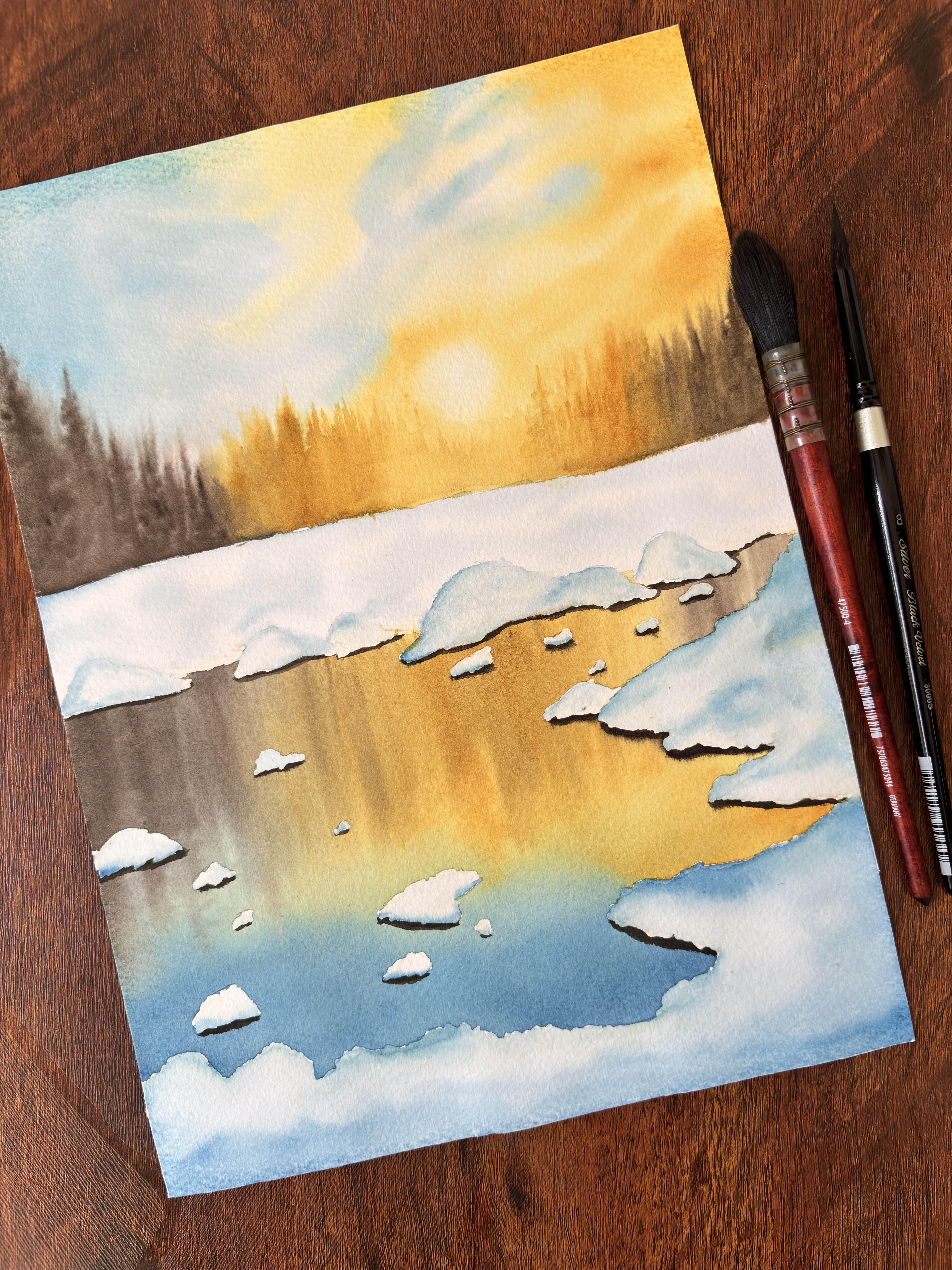
something beautiful. Hello, everyone. I'm sharia, an engineer and a atico artist, and I'm so happy you are here. In this class, we'll explore gentle atmospheric
techniques perfect for a cozy winter scene. You'll also learn how to paint the snowy rocks by
preserving the paper white. Whether you're a beginner or you have been
creating for years, this is a space for you
to experiment and to reconnect with the joy of
making art just for yourself. So light a candle, pull on your softest
sweater and setlen. I can't wait to guide you through this cozy,
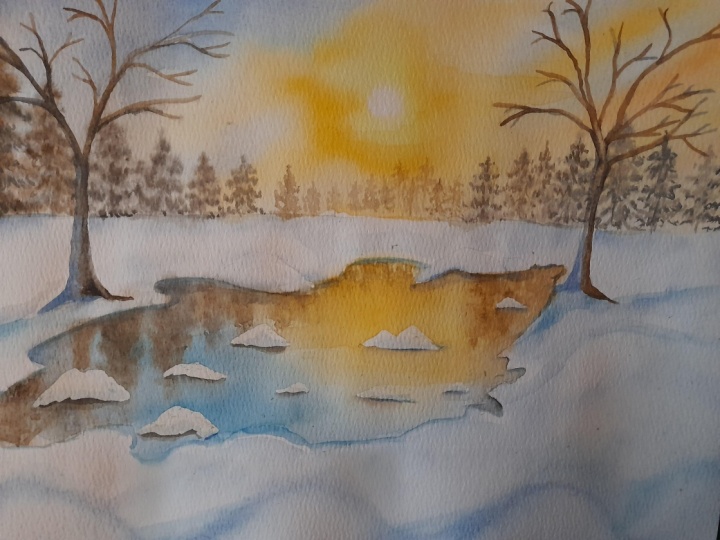
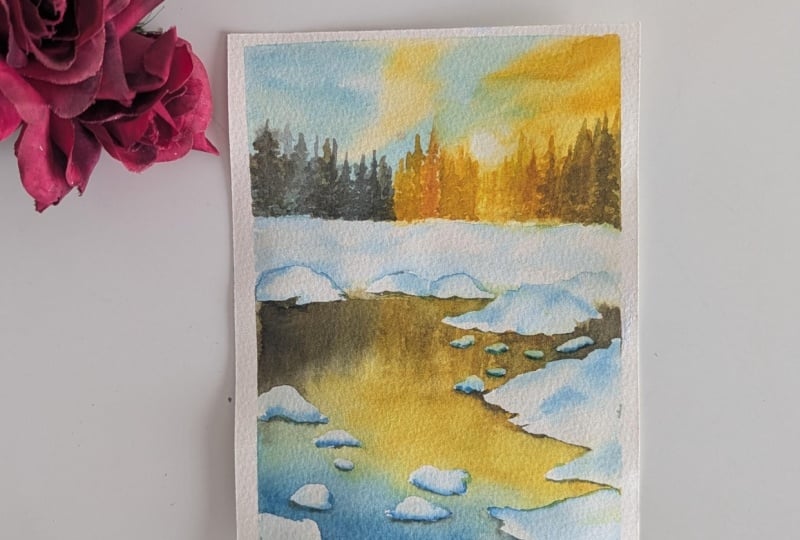
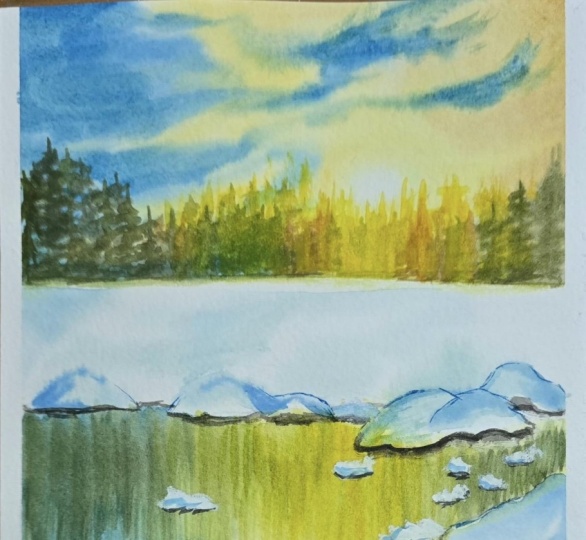
creative journey, and I'm even more excited to see the magical winter lakes
you bring to life. Let's make something warm together right in the
heart of the winter. See you in the class.
2. Art Supplies: All right, so let
us take a look at the art supplies.
First is the paper. So I'm going to be using the paper from the brand
Saunders Water food, which is 100% cotton, 300 GSM, and it is cold
pressed watercolor paper. So I love the texture
of this paper. So you can go with
any other brand, but ensure that it
is 100% cotton, and the minimum thickness
should be 300 GSM. Next up, let us take a look at the brushes that you will need
for this particular class. So all the brushes
that I am going to be using are from the brand
silver black velvet, but you can go with any
other natural hair brush. All right. So you will need a size number round 12 brush for
the larger washes. Then you will need size number
eight and size number six for adding the smaller washes
and the smaller details. And then finally, you will need a larger sized quill brush or a mob brush or even
a flat brush to, you know, just wet
the entire paper. So these are the basic
brushes that you will need. Next up, let's take a look at the color palette
that you will need. So basically, all
the colors I will be using for this particular class is from the brand white knights, and I'm going to be using my
palette for this purpose. So if you want to know the
detailed list of colors, you can watch the colors section of this particular class. Next, you will need
a board to fix the paper firmly
onto the surface. Then you will also
need a pencil and an eraser for adding
the pencil sketch. Then you will need
a masking tape to tape down your paper
firmly onto the board, and then you will
need a masking fluid. This is from Winsor and Newton, and then you will need
two jars of water. One has to always stay clean
to pick up fresh paint, and the other is to wash off the dirty paint from the brush. And finally, you
will need a cloth or a tissue to wipe off the
excess amount of paint. That's it for the art supplies. Go grab them, and
I'll see you soon.
3. Let's take a look at the Colour Palette: All right, so let
us take a look at the colors that you will need
for this particular class. So we will require very few colors for this
particular painting, and let's quickly look at them. So the first color that you
will need is Indian yellow. Basically, we are going to use Indian yellow for
painting the sunrise. And it's a gorgeous, transparent yellow shade, and I love this to use in my sunset
and sunrise paintings. So it gives a nice warmth
touch to your painting. The next color that you will
require is Indian gold. So this is another
warm, beautiful shade. And don't worry if you don't have Indian yellow
and Indian gold. Basically, you can go
with any of your yellows and oranges from your
watercolor palette. Alright. So these were the
two colors for the sunrise. Next, you can go ahead
with bright blue and this is for
painting the sky. All right. So the next color that you will need
is prescient blue. So we are going to use
prescient blue to add the darker tonal values
onto the snow region, basically to add the shadows
onto the snowy areas. Okay. So I hope
prescient blue is a common color that's present
in all the watercolor sets. And if you don't have
prescient blue, that's fine. You can go with the normal
sky blue that you have. Just go with a darker
tonal value, right. So the next color that
you will need is sepia, and this is basically used for adding those pine trees in
the background. All right. And if you don't have sepia, the alternate color
is you can go with brown mixed with a little
bit of paints gray. So these are pretty much the
colors that you will need. These are very few
basic minimal colors. So go get your colors ready, and I will see you soon
in the next section.
4. Let's add the pencil sketch: All right, so let us begin
with the pencil sketch. So the pencil sketch is
going to be really simple, and we're just going to define few things before we
start our painting. So first and the
foremost thing is, like we do in all our
landscape paintings, we decide where the horizon
is going to be so that we get an idea of where
the sky is going to be and where the rest of the
painting is going to be. Okay? So I have defined
the horizon line. Now, I am going to
create some snow blobs or some snow kind of rocks or
patches on the winter lake. I know that the pencil sketch
is right now not clearly visible because I am
marking it very light, but do not worry. Wait for me to finish the
entire pencil sketch. And once I have finished
creating my pencil sketch, I will pause and show you the entire pencil sketch up close so that you
can pause the video, take a screenshot of
the pencil sketch, and then you can go and take your own sweet time and create the pencil
sketch for yourself. So right now, it is
not at all visible, and I am doing this for a
reason because if you go ahead and draw the pencil
sketch in a very dark manner, then after you finish
your painting, the pencil sketch
marks are going to be visible through your painting,
and we don't want that. So when you are making the
pencil sketch for yourself, you need to take care
of these points. Always, the pencil sketch
should be as light as possible and it should
only be visible to you. Okay? So yeah, now, let me go ahead, quickly
finish the pencil sketch. And once it's done, I will show it to you up
close and you can go ahead, pause the video and create the pencil sketch for
yourself. All right. All right, so it took
me a while to add the pencil sketch because I want those snow patches to be, you know, looking good. And in terms of
perspective also, it should be looking right. Okay? So I have added these
snow patches or snow rocks, whatever you want to call them. They should be of
different sizes, different irregular shapes, and it should look
organic and natural. And that's what I try to
prepare the pencil sketch here. And yeah, a lot of
erasing was involved, and I don't want that
to happen to you. So that's the reason
I asked you to wait for me to finish
the pencil sketch. And now is that
time where you can go and prepare the pencil
sketch for yourself. So I will just show you the up close picture
of the pencil sketch, and you can just
pause the video, or you can just take
a screenshot and you can go ahead and prepare the
pencil sketch for yourself. All right, then. So I'll see you soon in the next section.
5. Wetting the Paper: All right, guys, so
we're just going to go ahead and wet the
paper over here, basically the sky region. And also, another
thing I want to point out here is I went ahead and masked all those snowy rocks that we added earlier
using the pencil. So this is so that we can preserve the paper white
to depict the snow, and this will look
natural and realistic. Okay, so just go ahead and, you know, mask all those areas, and then next step,
you have to go ahead and wet your sky region. So to wet the sky region, you can see I'm using a
larger sized mop brush, and I love using this brush
because it just covers the entire surface area of the paper in just a few minutes. Okay. So although you have
to do it multiple times because you want your paper to stay wet for a longer
duration of time. So I suggest you can
go with mob brush. If you don't have more brush, you can go with your flat brush, and if you don't
have flat brush, you can go with your
larger sized round brush. So there are a lot of options. You need not limit
yourself with anything, all right. So yeah. So wetting the paper
is very important, and it acts as a foundation for any of your wet on wet
watercolor painting. I highly recommend you to take
your own sweet time to wet the paper nicely so that your fibers of the
paper are soaking wet. And in this way, it allows you to paint for a longer duration of time and your paper stays wet
for a longer time. Okay? So I know this process
is a little time consuming. You might feel lazy in the middle or you
may even get bored. But please ensure that your
paper stays wet nicely. Okay? So yeah, I am just going to
go ahead and wet the paper. You can also start prepping
your paper in the background. Okay. So yeah. All right, so my
paper is nicely wet, and I hope you took your own sweet time to
nicely wet your paper. Okay? So having said that, I'll see you soon in
the next section.
6. Sky - First Wash: Alright, guys, now that
our paper is nicely wet, let us quickly jump
right into our painting. So first, I'm going to
start by painting the sun. So you can see I am using my size number
eight round brush. This is from silver
black velvet, and I am using this
to create my sun. I have defined a
nice circular shape using my Indian yellow
and Indian gold. These are the two
colors that I will be using for creating
my winter sun. But if you don't have
these two colors, then you can go ahead with any of your yellow
from your palette. It could be cadmium yellow, it could be lemon
yellow or anything, but I love this Indian gold
and Indian yellow because it gives a nice glow
and warmth to the sun. Okay, so now you can see, I have left the center portion
of the sun as to be white, and around it, I'm
going ahead and blending out and smudging
these colors. Okay? So do not allow
any of your paint to bleed into the center
portion of the sun because we want to preserve
that paper white for the middle portion of the sun. Okay, so it's very simple. We created the sun
and we are now smudging out the colors
onto the background. And if you see any of your paint bleeding onto
the center portion, then just dip your brush
into the clean water. Dab it on the tissue
paper and just, you know, lift off any paint or any
excess amount of water. And while I was
painting the sun, I could see some areas of my paper were slightly
started to dry, so I just went ahead
and rewetted the paper. Okay? So the goal here is when you start working on a
particular area of the paper, do not continue to
work on the same area. You need to move your brush
into the different areas of the paper so that
the paper stays wet for a longer
duration of time. Okay? Now you can see
with the same mix of Indian yellow
and Indian gold, I am trying to create
some shades in the sky, some cloudy kind of
structure onto the sky. Basically, our sky is
divided into two colors. One is cerlan blue and
one is yellow and orange. Not exactly orange,
but I would use Indian gold over here to define the darker
regions of the sky. We want a soft and a
subtle looking sky, but yet it is going to
have that winter glow. That is the region
we are introducing yellow onto our sky. Now you can see when
I am adding the blue, I'm not going ahead directly
with a darker tonal value. Why? Because when you mix
blue and yellow together, you are going to create a green into your sky, and
we don't want that. And that's the reason
I'm going with very light amount of
blue in the beginning. And once I establish
that light base shade, I'm going to go ahead and create a deeper tonal
value for the blue. Okay? So we want a softer, subtle looking, and yet
that warmth in the sky. So carefully go ahead
and add your paints, place the blues, place
the yellows and make sure you're not smudging
both of these paints. You're not blending them, you're just placing them. If you're not sure yet, then pause yourself,
take a break. Let me finish first, and then you can go ahead and
paint it for yourself. I'll just keep adding
the colors onto the sky and you can just
watch me doing that. All right. Now that the
sky is being defined, now we are going to go ahead and add some pine trees
in the background. These trees are not going
to be very detailed. Since it is wet on wet, it is going to be
blurry and it is going to be back
in the background. We're not going to
focus on the details. We just want some trees
to be present there. So now you can see I am
going with my sap green. Sorry, it's not sap green, it's sepia and you can go with any brown mix your brown or paints gray and you
can create the shade. The color really doesn't matter. You can see I added a stem. For this particular tree. And then on the either side, I'm adding the piney
branches onto the tree. It's very simple and there's
nothing complicated here. So I am doing this while
my paper is still wet. Okay? I want that soft looking
blurry background trees. And you can see
the trees are not very tall and they
are not too short. So the perspective has
to be maintained right. On to the very left edge, the tree is a little taller, and as we come
towards the center, the height of the trees reduces. And this is how I want to maintain the perspective
for my painting. Okay? So also, you can
see another thing is, as we move closer to the sun, we want the trees to
appear a little lighter because the direct rays of the sun are falling
onto the tree, and that's the
region reason that even though the trees are
brown or dark brown in color, but when the sun rays fall onto the leaves of the pine trees, then it appears to be yellow because of the reflection, okay? So keep this rule of
perspective in the mind. And in this way, we
are going to make our painting look more
natural and more realistic. So at this point of time, it may be looking
a little messier, but we are going to fix
everything as we move ahead. So please have that patience, please have that faith
and most importantly, trust the process,
enjoy the process, and the end results are going to be beautiful and fabulous. Okay. So as we created the
trees onto the left hand side, the similar thing,
you're going to replicate on the
right hand side. So closer to the sun, the trees are going to
be yellowish orange, and as you move further
away from the sun, the trees are going to
be a little bit darker. Okay, so adding the
trees is very simple. You can just practice
it on a piece of paper, and then you can come back
onto your painting and add it, but make sure your paper is wet and while the paper is wet, you are going to add the trees. Okay, so you can just watch me and then you can paint
it for yourself. All right, so you
can see, I have added some pine trees
onto the right hand side, just like the way we did
on the left hand side. So closer to the sun, your trees are going
to be lighter because the rays of the sun are
falling onto your trees. And as you move further
away from the sun, the trees are going
to appear darker. Okay. And now you will ask me that my paper has
already started to dry and you can see already the dry edges forming on
the paper. That's fine. I'm going to go ahead and
finish off the first layer, and I'm going to
show you exactly how you can fix this in
the upcoming lesson. So if your paper also
has dried, do not worry. Continue to add those trees
and make sure it is a little lighter because we don't want dry looking trees. Okay? So just take care of that point. And the paper dried
because I filmed this class in the afternoon and the sun was a little harsh. And because of that, my paper dried a little bit
faster, but that's fine. Let's embrace this process. Let's trust the process, and there's always a fix. And this fix, I will be showing you in the upcoming
lessons. So yeah,
7. Sky - Second Wash: All right. So now you can see that the first layer
has completely dried and you can see the things have appeared a little lighter,
but that's fine. We have added the base layer, and the base layer has
always remain lighter. Now, you are going to take your round brush and
slightly go ahead slowly, and you're going to apply a clean layer of
water onto the paper. You're not going to disturb
the underlying colors. You can see that carefully. I'm just going in just one
direction from left to right. If you're going
from right to left, that is also completely fine, but make sure you're not moving your brush back and forth. You're just going to go ahead in one single direction
and just carefully. Just like feather touch, you're going to move
your brush onto the paper and apply a
clean layer of water. Why we are doing this gently is because we don't want to disturb
the underlying layers of the paint that we already
added in the first wash. Just take utmost care of this particular point when
you're re wetting the paper. Okay? Now, when you're
wetting the paper, you have to wet the
entire region of the sky. There should not be any
area left that is dry. Okay? So just make sure
that your paper is nicely rewetted and just
take your own sweet time. Don't hurry in this
particular stage. Okay? And if you have that fear that paint is going
to get disturbed, your underlying colors
are going to spread, then do not worry because I have told you that once the first
layer has completely dried, only then you're going
to perform this step. If your paper is not dried
and if you try to rewet it, your colors are going to flow. Make sure you give enough
time for your paper to dry and then you're going to
start rewetting your paper. Okay? So my paper has completely dried and I came back and I re wetted the
paper now gently, and now paper is nicely wet, and now I can go ahead with the second wash. For
the second wash, it is again, very simple. This time, you need not worry about where I have
to place the trees, what colors I'm going to use, nothing because you
already know you did it in the first wash, right? Exactly, you're going
to use the same colors, you're going to go ahead on
top of those trees again, and you're going to
intensify the colors. You see, I added the pine
tree on the left hand side. This time I went with a
slightly darker tonal value compared to the first wash.
And in the similar manner, I'm going to go ahead and add
all of these trees again. And at this particular point, if you felt like the
sky that you added in the first wash did not
look a little better, you can add it now and you can correct now because now
your paper is rewetted, and, you know, you can
fix things over here. That's how you can fix
your watercolor painting. So if your paper is
dried, let it dry. Wait for it to completely dry. Re wet the paper gently without disturbing the
underlying layers, and then you can go ahead
and lay your second wash. Okay. So like I told you, there's a fix for every problem. So do not worry. Trust the process and see
the magic unfolding. Okay. So now I really don't
need to explain anything much over here because it's just
the same process. And you can just
watch or you can paint along with me and
finish the second layer. Okay. So yeah. Okay, now you can see
the left hand side is looking so beautiful
in the first wash. It was looking a
little bit messier. But as I told you, if
you trust the process and if you really
believe in the process, you are going to see
the magic unfolding. And in our case, the magic
is already unfolding. So I hope you are also
enjoying this process, and you can see now
we have achieved that soft looking background
trees on the left hand side, and we're going to
go ahead and do the same thing on
the right hand side. So again, carefully, just go
ahead and re wet the paper. So if you feel like,
again, the paper is dry, then just only wet the right
handside very gently and you can go ahead and place the trees like you did
it in the first wash. Okay? So you can just watch me, and then you can paint
it for yourself, or if you're already
comfortable, then you can paint
along with me. Okay. So yeah. All right. So now that we have created those background trees, it is looking much
more nicer and softer. And if you want to fix anything, you can do it in this
particular stage. But now, again, if your
paper has already dried, then I kindly request you to stop and just wait
for everything to dry and let us go ahead
and paint the lake region. Okay, so far, I'm so happy, and I hope you are also
happy with your painting, and I'll see you soon
in the next section.
8. Painting the Lake and Reflection - Part 1: All right. So now that we have painted the upper
pulsion that is the sky, let us quickly start by adding some reflections
onto our painting. Okay, so you can
see that already the ice areas have been
covered with masking fluid, so I need not worry about water or bleeding onto those areas. So if you have not already
masked those areas, please go ahead and mask it first before you
begin your painting. Okay? Now you can see I'm
using my size number eight, or you can go with any
larger sized brush again because you have to wet
the entire bottom region. That is your reflections
are going to appear. Again, just like we did
for the sky region, we are going to wet the paper nicely for the reflections
region because again, we are going to work on the
wet on wet technique and we want a nice smooth,
soft reflection. Please take your own
sweet time to do that. So my paper is clearly wet now and it is
nicely soaking water. So I can quickly go ahead
and start adding my paint. So first, I am going to add Indian yellow and
Indian gold mix that we used to create the
sunshine at the top. So what we are going
to try to depict here is whatever colors you
have used in your sky, the same colors you have to add it to create the reflection. So basically, it is the
replica of the sky. Okay? So towards the
right hand side, you can see there
is the sunshine. So that is where we
are going to add the Indian yellow
and Indian gold. Basically, I'm going to mix
these two colors because I have used these two
colors in my sky region. Okay. Now, once you add that, again, on the left hand side, we added the blue, so you can add bright
blue or Cerlean blue, whichever blue you
use for your sky, the same thing you
can go ahead and add. And I'm going to add a little darker
tonal value because this is how it was in
the reference image. And yeah, so slowly, I'm going to add these colors, but make sure you're not
going with two dark colors in the beginning because when yellow and blue is
going to blend, it is going to create a green in the middle, and
we do want that. So just go with low tonal
values in the beginning, and as you go ahead, you can build the layers. Okay? So you can
just keep watching me and then I'll explain
you the further steps. All right. So now that we
have added the base colors, let us go ahead and quickly
add the reflections for the pine trees that we
added onto the sky region. Okay. So now, again, for adding the pine trees, I'm going with the same colors, that is the sepia I used. So we are going to go with the lower tonal value
in the beginning, and as we move ahead, we are going to increase
the tonal value. You can see these are
just downward strokes. Taking you're just
adding some paint, and then you're pulling
the paint downwards. So you can see my hand
movement and the brush moving. So it is just creating that
back and forth movement, but you're just pulling the
paint vertically downwards. Okay, so you have to keep in mind the
rule of perspection. So if your trees are longer, the reflections also
have to be taller, and if it is shorter, it has to be shorter in the
reflections as well. So we are going to try creating the same
replica of the sky. Okay. So now you can see on the left and the
right, we have sepia. So we went ahead with sepia
and added the reflections. And in the middle, we
have Indian gold and Indian yellow pine trees because the sun rays are falling
onto those trees. Basically, the sun is
present in the center, and that's why we
want our trees in the center to appear in Indian
yellow and Indian gold. Okay. And that is what I'm
trying to depict here. So it is very simple. Again, it is a
repetitive process, so you can just continue
to add along with me. Oh All right, so we have created a nice base
layer for our reflections. So if you want, you can add
a little bit of sepia in the middle and try to
intensify the reflection. Not too much, but
a little. Okay? So this is how it is
looking at the moment. And after drying, this is
going to look very light. So in the next section, we are going to go ahead and add another layer it's nothing, but we're going to
re wet the paper and just lay down the colors that we did in this
particular section. The techniques and the colors, everything is going
to remain same. We're just going to apply a second wash in
the next section. I'll see you soon in
the next section.
9. Painting the Lake and Reflection - Part 2: All right. So now that the first layer has
completely dried, let us go ahead and
start re wetting the layer again so as
to add the second wash. So I'm using my size
number 12 round brush from silver black velvet, and I'm going to go ahead and
carefully and very gently. When I say this, I
really mean this because we don't want to
disturb the underlying layers. So by feather touch, you're just going to go ahead. And in just one
particular direction, you're going to gently
apply even coat of water onto the entire
reflection region. Okay? So take your own
sweet time and just go ahead with two to
three rounds so that the paper stays wet for a
longer duration of time. Now, I want to intensify the
blue that we added earlier. So I'm going to go ahead
with Prussian blue. You can go ahead
with the same blue that you used earlier, but make sure you're going
with a brighter tonal value. Slightly increase the
tonal value as compared to your first wash. You can see I have intensified it
using Pristian blue, and we want to
achieve a soft blend. So I'm just cleaning
my brush and smudging this paint onto
the rest of the background. So I want to create a nice
blend between the yellow, that is the Indian gold
and the Indian yellow. And I want a nice
blue at the bottom. So we don't want any green here, so we have to take ultimate care of that particular point. Okay. So now my blue is
looking nice and bright. I'm going to go ahead with Indian gold and
Indian yellow now, and I want to intensify
this as well. So picking up a nice
amount of Indian yellow, and I'm adding it onto the right handside towards the center where
the sun is present. So it's really very simple. Do not worry about the
underlying colors getting disturbed because
that's not going to happen because
it's already dried. Okay, now I'm going to go
ahead with Indian gold. Again, I'm going to add that color carefully
onto my paper. And you can see I'm
leaving certain gap, certain amount of gap
between the blue and the yellow because that's
where I want it to be, you know, a soft blend. So every time I am a rubbing the brush
onto my tissue paper and cleaning that
particular portion and trying to create
a soft natural blend. Okay. So yeah. Now it is looking good. Let's go ahead and do all the adjustments at this particular time because
once the paper is dried, you will not be able to
make these adjustments. You have to again, wait, rewet and do the
same process again. Okay? So that's the reason
when you're rewetting, do it nicely so that your paper stays wet for a longer
duration of time. Okay, now I am happy about how the colors
are looking here, especially the blue because when you look at
the reflections, the reflections appear much more darker than the actual image. If you might have seen,
you will be knowing that. Okay. So yeah. Now, again, all those pine trees are looking a little lighter, so I think we are going ahead and intensifying
those as well. So again, picking up a
nice amount of that sepia, and I'm going to
go ahead and add the pine tree reflections just like the way
we did it earlier. Okay. So you can see
that I'm picking up sepia and I'm
adding the reflection. So similarly, I'm going
to continue doing that on either side as well. So you can just watch me
and paint along with me. All right, so we have added the reflections now onto
those snow patches, basically where those
snow rocks are present, exactly below the rock, we're going to add the
reflections for the rock as well. So it is natural that whenever
you have any stone or any rock on the
water or any lake, you will see the reflection of the stone or
the rock as well. So we are trying to
depict that over here. So now you can see that when we take care of these
small little details, it really makes our
painting stand out and it also makes our painting look more realistic and more natural. So that is why in
all of my classes, I pay a lot of attention to these details, very
minute details. So I tell you that the rule of perspection
is very important. The size of the trees that
you add is very important. And when you're adding
reflections, again, it should exactly
reflect the way it is in the sky and all of
these tiny details, they are going to
make your painting look more natural
and more realistic. So I'm going to go
ahead and add all of these reflections
for the snowy patches. You can continue to
paint along with me. All right, so I have added the reflections on
the snowy rocks. I hope you have added
the reflections for your painting as well. So it was a really
simple process. We just went ahead
with sepia and added the thin line
around these stones, basically at the bottom of the stones to create
the reflections. All right, so let
us allow this to dry and I'll see you soon
in the next section.
10. Painting Snow - Part 1: F All right. Now we can start painting
the snowy areas. So let us start
by nicely wetting the upper portion of the snow, basically the area that is
closer towards the horizon. Okay? So we are just going to go ahead carefully and
wet the entire region, and you have to be super
careful while doing this step because we don't want to disturb the horizon line, and we don't want
the water creeping in towards the horizon line. Okay, so just take a
little bit extra care when you are applying the water. So again, this is going to
be a wet on wet technique. So just make sure you
apply nice coat of water multiple times so that
once you start the painting, it will be very easy for you. Okay, so for painting the snow, I am going to go
with Prussian blue. So since Prussian blue is
already a darkest color, we are not going to go with
the darkest tonal value. We're going to go
with subtle tints of that particular shade. So you can see the intensity of the color that I'm
adding right now. It's super light. It should not be very light also because once
the watercolor rise, you all know that it's
going to fade out. So make sure you're going
with a medium tone value. You can see I am not adding
this particular shade in a single wash or I am not creating a blended
wash over here. I'm just adding a
few drops or blobs, you can say, so as to depict the shadow
areas of the snow. It is very random, very uneven and very organic. So you need not bother about where and how
you're adding this. Just make sure to drop paints of this prussian blue shade
into certain areas. Okay? All right. Now in the similar manner, we are going to
go ahead and fill out the rest of the snowy blobs. Okay? So now for this
blob on the left edge, I am going to wet the
surface area first. Then I'm going to take
my Prussian blue and I'm going to add it onto this
particular snow blob. So the process is really simple. First, you're going to wet the surface where you
want to add the paint. Then you're going to choose
a medium tonal value of the Prussian blue and
then you're going to go ahead and drop it
into random places. Now for these particular blobs, which are in that rock shape, we are going to make sure
that we are not going to cover the entire surface
area with Prussian blue, but we are going to make certain tonal values,
towards the edges, we are going to have darker tonal values and we are going to just blend that color into
the rest of the area, and some parts of the snow blob, we are going to preserve
the paper white. This is the idea behind
painting all those snow blobs. Again, for this second blob, I'll explain and
repeat the process. First step, go ahead
with clean water, you're going to wet
the surface area of that particular snow blob. Okay. And once you
have done that, you will pick up a
medium tonal value of that Prussian blue and you're going to
define certain areas, certain darker areas,
certain lighter areas, and some parts will be
remaining as paper white. Okay? So the process is going
to barely remain the same. It is again a
repetitive process, so I'm not going
to explain more. You can just watch me and
then paint along with me. All right, so now you can see how the painting is
taking its shape. Now that we have added
the three snowblobs, you can actually see how it
is exactly popping out and it is looking three dimensional as though
it is, you know, real. So this is the intention
behind focusing on the smaller perspectives and the teeny tiny details
in your painting, which will eventually make your painting look more
natural and more realistic. Having said that,
let us go ahead and paint the rest of the snow
blobs in the similar manner. So now you can see this
blob in the middle. It is the larger one, and I want to make it a
little bit stand out. So I want to, you know, add extra amount of paint onto
this particular snow blob. So you can see I
wetted the surface. I added a good amount
of Prussian blue onto the left edge of this
particular snow blob. And now with a clean damp brush, I am trying to blend this paint into the
rest of the areas. But I'm making sure at
the same time that it is not covering the entire
surface area of the blob. What I mean by that is, I am not adding a
thick solid paint on the entire surface, but I'm just creating a
shadow on either side of the snowblob and the rest of the portion is going
to remain paper white. This way, it is going to make your snow blob look more
natural and realistic, and that paper white is
going to really stand out. So you can understand that once the entire
painting is complete. And if you're not confident yet to do this
particular process, first, you can try it on
a scrap piece of paper. Once you're confident,
you can come back and try it on
your main paper. Okay, so the rest of the process is going
to remain the same. You can watch and
paint along with me. All right. So we have painted all the snow blobs
that were on the top. Now in the next section, I will be going ahead
and painting the rest of the snowy blobs that are
present at the bottom region, and the process is going
to remain the same. So I have divided the video
into two parts so that it becomes a lot more easier for you to
follow along with me. All right. See you in
the next section. I
11. Painting Snow - Part 2: All right. So now
we will be going ahead and painting the
rest of the snowy region. The process is exactly the same, so I'm going to repeat the steps again for those of you
who missed it earlier. Okay. So now we are going
to paint the bottom region, again, that is the right
hand side of the paper. So we are going to wet this nice large area of the
snowy patch that you can see, and we are going to
go slow this time. Okay? So we are not going
to rush anything over here. So take your own sweet
time and try to wet this right hand side portion
of the snowy region, okay? Now, again, while
applying the water, you're going to take
extra care that the water is not
going to bleed into the lake region or any other portion of the paper
that is already painted. Okay. Now I'm picking up my
good amount of Prussian blue, basically a medium tone. And what I see in the
reference images, there are some darker regions and there are some
lighter regions. So I'm going to quickly
go ahead and place the colors like I see
in the reference image, and I encourage you to
just pause for a while, take a look at how
I'm adding the paint. Then you can go ahead and paint it for
yourself. All right. Yes. Mm. All right. Now the last portion is left. And then after painting this, we will be left with only a few smaller
blobs in the lake. Okay. So now, again, the process is going
to remain the same. I'm going to quickly
go ahead and nicely wet this larger portion at
the bottom that you see. And I'm going to
do this carefully. So I'm using my size
number eight brush, but if you're not
comfortable with this size, you can go with size
number six brush. Okay. Just make sure you're going with a
brush which is having a nice pointed tip so that you'll have a good control
of water and paint. And, you know, you can go over those tiny areas in between and paint without any
frustration. Okay. So again, you can see, I am
adding few darker areas. Basically, these are the shadows that are being
present on the snow, and I'm trying to depict those. Okay. So adding a nice layer of this particular
Prussian blue onto the edge of the snowy blob. Then I'm going to clean
my brush and just blend this paint or pull this paint into
the inner surface. Always, when you want
to do this step, make sure you have a good
clean brush and then smudge the paint into the
background. So yeah. I'm quickly going
to go ahead and finish off this
particular portion, and you can also go ahead and paint because
it's going to be the repetitive process
and the process is going to exactly
remain the same, right. So yeah. All right. So now that we have
added the base layer, now I want to intensify the look for this
particular snowy blob. So we don't want to have our paintings
looking to be flat. We want to make them
look natural and realistic and we want to bring the depth and realmism
in our painting. How can we do that by adding different tonal values by adding some deeper tonal values
into our painting? This time, I'm going to go ahead again with
the Prussian blue, but I'm going to increase
the tonal values lighter so that it's going to look more natural
and more realistic. So you can see on either
side of the edges, I added dark Prussian blue. It's not very dark,
but one shade lighter than the previous tonal value
that we went ahead with. And now everything is looking so beautiful and so natural. So now that we have completed
the rest of the areas, there is one last
step remaining and that we will be covering
in the next section. So basically, we are
going to paint those teeny tiny snow blobs
that you can see in the middle of the lake and we are going to
quickly go ahead and finish those in the
rest of the section. Okay. So I'll see you
soon in the next section.
12. Painting Snow - Part 3: But All right, so we are into the final
stage of our painting. So let us quickly go ahead
and finish this part. So you can see a snow blob present right in the
middle of the lake. I'm going to go ahead
and first quickly, nicely wet this
particular snow blob. Now, this particular snow blob is a little flat at this moment, but I want to give it a nice, three dimensional look or
three dimensional effect. How can you do that
by defining shadows? How can you define the shadows with the help of Prussian blue? So I'm going to take a nice
layer of the Prussian blue, and I'm going to define it
along the bottom edge of this particular snow b
Note that you're not going to add the Prussian
blue all over the snow blob, but you're only going
to paint it towards the bottom edge and towards the right hand
side of the edge. So you may not understand this particular point at
this particular moment, but let me first
finish painting this, and then you'll get
a clear picture of what I was trying
to explain to you. All right, so just watch me and then you can paint
it for yourself. All right, so now
you can see how I painted those three
tiny little blobs. They are not completely
covered with Prussian blue. We are just defining the
edges or the shadows, and the rest of it is coming
from the paper white. Similarly, I'm going to go
ahead with the next snow blob. Again, I'm going
to wet my paper, and I'm going to define
the shadow region using a medium tonal value of this
particular Prussian blue. You can see I am
clearly defining the bottom edge and
the paint is not spreading too fast
because I do not have much water or much
paint on my brush, and I'm taking utmost care
of that particular point. So you can see I'm smudging
out the paint. And, yes. So overall, the painting is
taking a very good shape. And like I told you, in the middle, things might
seem a little messier. Things may feel like
it is falling out, and it's all over the place. But like I have always told
you, give it some time, take some drake, and then come back and then resume
with your painting. And at the end,
you will see that everything is going to just turn out beautiful and magical, just like this painting. So yeah, having said that, let us quickly go ahead and paint the rest of
the snowy blobs. Alright, guys, we
are towards the end, and I'm so excited, but let us first go
ahead and finish those teeny, tiny
leftover snowblobs. And after this, I'm
going to go ahead and wait for my paper
to dry completely. And later, I'm going to
peel off the masking tape. So I can't wait to show
you the final painting, so I'll see you soon
in the next section.
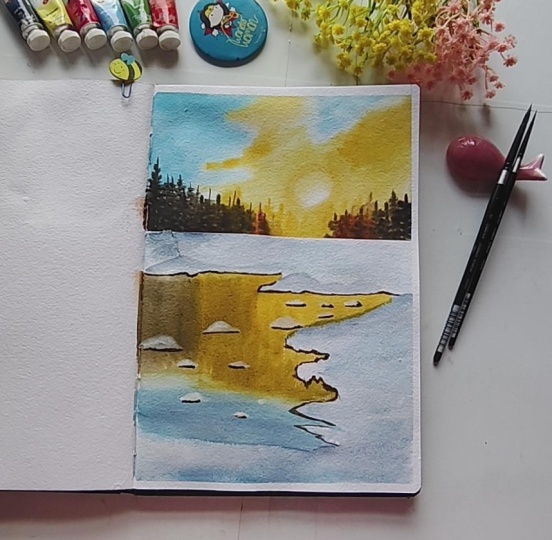
13. Thank You "SNOW" Much!: Alright, so this is the beautiful painting
that we painted so far. Just look at the
warmth from the sun, the calmness and
the coziness from the sky and the snowy areas. Everything about this painting
is so cozy and so magical. I hope you had a wonderful
time painting along with me, and I would like to thank each one of you for
making till the end. Having said that, I
would encourage you to go ahead and post
your class projects in the class project section
so that I can review your wonderful unique creations and I would personally give you the feedback that will be useful for your
future paintings. Having said that this is it
for this particular class, and I will be coming up with more such beautiful classes in the future until then have a happy winter and
happy painting.
 Aishwarya Shetty, my__paint___story | Watercolour Artist