Transcripts
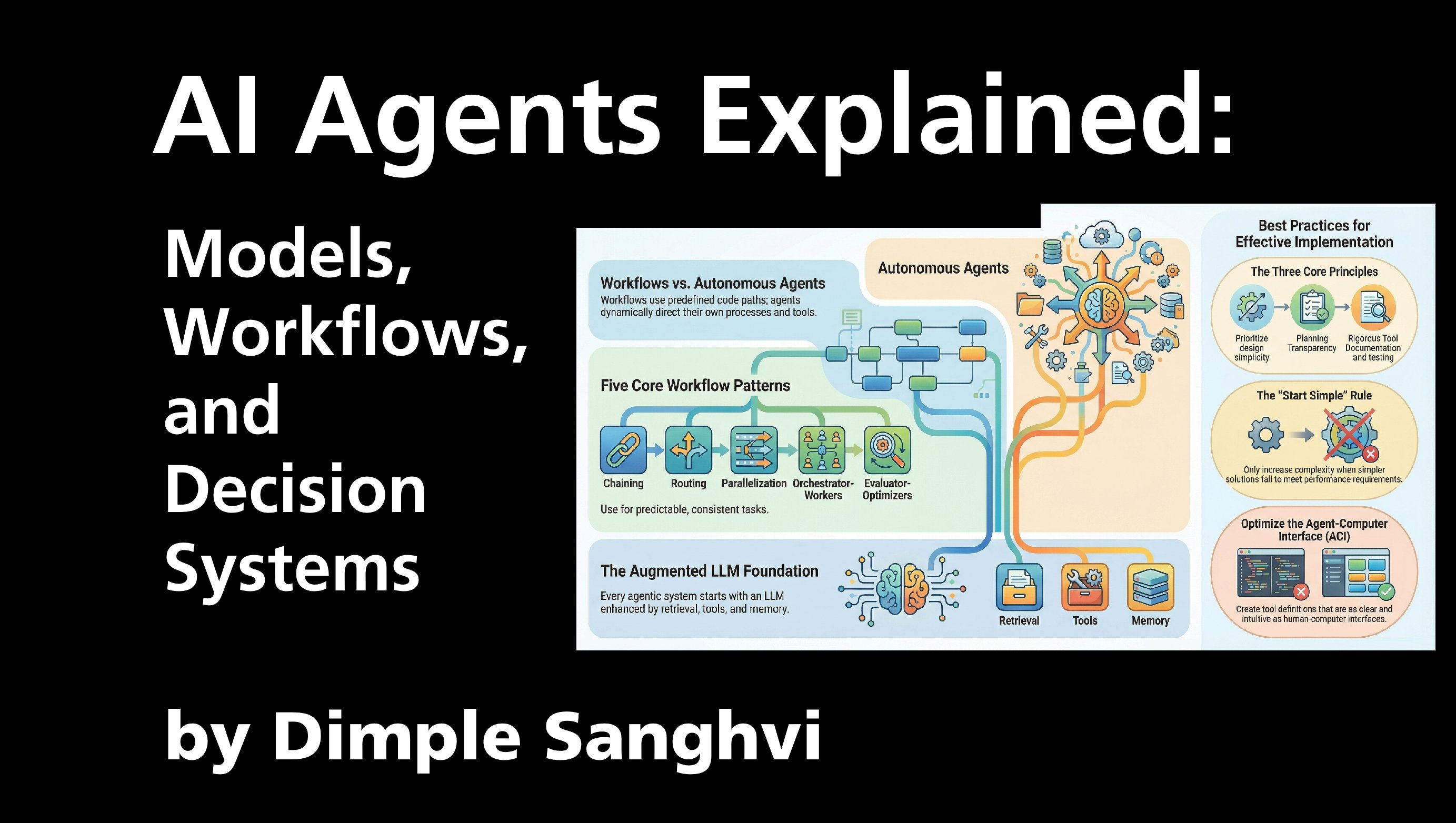
1. Introduction to Agentic AI Model: Let us understand
different AI models or a genetic frameworks. We have LLM, which is
by itself really smart. You can ask question,
it can answer. But just like the way
intern can't open files, can't look up the latest rules, can't remember what you
told them yesterday. That's limitation. An augmented
LLM is like upgrading that intern into a
knowledgeable worker or into a knowledge worker
with three extra superpowers, retrieval tools and memory. Let's break down the
powers retrieval, access to external knowledge, like giving intern access to your company's file
cabinet and Google search. This is a similar capability that the augmented LLM
retrieval part has. Let's think about a
healthcare example. Prior authorization agents pull the latest payer rules
before filing a request. Mortgage example loan
setup agents retrieve updated interest rate rules before drafting the documents. Lent, remove waste
of manual lookups, reduce rework when
outdated rules are used. The second is tools, ability to act inside systems. Instead of just
reading policies, the intern can now log into
portals and execute task. Agent logs onto a payer portal, submits the pre automatically. Agents call the Credit Bureau
API to fetch credit scores. So that is augmented LLM. We want to reduce human handoff so that the
cycle time becomes faster. The third important
power is memory, ability to remember
context over time. The intern keeps a notebook
to keep everything from past meetings and doesn't ask you for the same question twice. Let's take an example
from healthcare. Patient Experience
board remembers your last billing query
and continues smoothly. Loan assistant recalls that the borrower's income proof was missing from
the last meeting. Improve first pass yield. The objective is to reduce
errors due to missing context. When you combine retrieval
plus tools plus memory, you don't just get a chatbot. You have an agent that
can look up, act, and adopt fewer
handoffs, less waiting, and less rework, or leading to faster cycle time
and higher accuracy. Today, a nurse handling
denial spends 20 minutes. She looks up the payer
rules, retrieves it, logs into three system tools, and remembers the past denial
cases from the memory. Now, imagine an augmented
LLM doing that in seconds. That's the leap from
AI as a helper. AI is a team member. A plane LLM can take inputs
and give you the output. That's useful, but it's limited. It forgets the context. You can't always access
the latest data, and it isn't designed
to use external tools. Whereas an augmented
LLM fixes that by connecting the model to
three key extensions, retrieval tools, and memory. Retrieval is about
access to knowledge. LLM can query external database, knowledge systems, or documents to fetch facts in real time. Healthcare, pulling up
the patient history before drafting the summary. Mortgage retrieving the
updated credit scores and policies before res scoring. Tools have the ability to act. LLM can call APIs, trigger workflows
and run calculators. Invoke a fraud detection tool, trigger an RPA board
to reset the password. That is the capability. Memory is continuity over time. The LLM can remember
prior interactions, preferences, and past actions. Remembering brand tones across
multiple press releases. Recall a student's
learning progress to tailor the lessons. Together, these
augmentations turn the LLM business
grade collaborator, one that can recall history, pull facts, and take actions, not just generate text. Think of a plain LLM
as a bright intern. It can answer questions but forgets everything
after the meeting. An augmented LM is like giving the intern access tools and memory that can ensure that it's becoming more valuable
and enterprise ready.
2. Leaders Thinking with AI: If AI is a co pilot
in every tool, then we need to train the
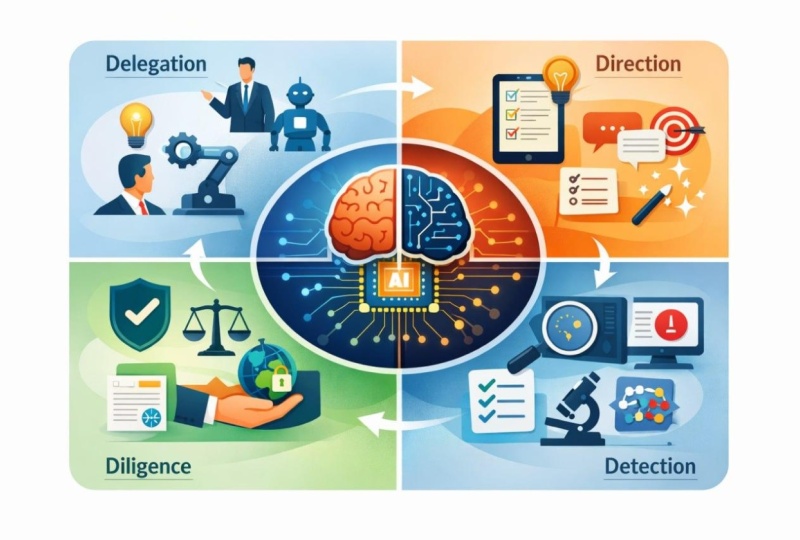
pilots, not the passengers. Hence, we are all here. The four Ds of AI
Capability Framework. This framework is designed to answer critical
questions for leader. How do we build AI
fluency at scale, not just AI usage. The four Ds provide a leadership
oriented capability map. The first one is delegation. Not everything must
be handed over to AI. Leaders must define what remains inherently
human judgments, values, relationships, versus what can be codified
and scaled with AI. This decision is strategic,
not operational. Misplaced delegation
leads to risk. Thoughtful delegation
creates leverage. The second D is direction. AI is only as effective as the clarity of the
problem it's asked to solve. Many failed AI pilots stem
not from weak algorithms, but from the poor articulation
of the business needs. For example, in the
finance services, if the ask is framed as
reduce fraud, AI struggles. But if it is framed as detect
anomalous transactions, above $10,000 within 5
minutes, the system thrives. Eaders must insist on precision
in framing the question. The third D is detection. AI will give you answers, but leaders must build the
muscle to interrogate them. Not everything that is
possible is correct. This is where the senior teams bring a critical evaluation. Cross checking AI's output
against the domain knowledge, compliance, and
business outcomes. Finally, diligence. Deploying AI without
responsibility is dangerous. Ethical guard rates,
data governance, and regulatory foresights
are not back office items. They are the
boardroom priorities. For transformation leaders,
diligence is the line between scaling responsibily and creating systematic risk. This framework is less
about how to use a tool. It is more about
how to lead it with responsibility in an
AI driven enterprise. Now that we have
explored the four Ds, let's connect them to
our organization design. How leaders can embed these
capabilities into teams, governance structure,
and culture. We know how to use AI, but more importantly, you will
know how to think with AI. This statement is at the heart
of why we are here today. Most organizations are
teaching people how to use AI, how to prompt, how
to run a model, how to automate a task. That's useful, but it's
not transformative. For leaders, the
real differentiator is learning to think with AI. That means shifting from
seeing AI as a tool in the corner to making it a thought partner in how
problems are framed, decisions are made and
opportunities are spotted. Consider this. Using AI is like asking E to create a
summary of a market report. Tinking with AI is asking, what pattern does
it reveal about customer behavior and what business models would
emerge from it? The first is tactical. The second one is strategic. In transformation programs,
this distinction separates a short term efficiency play from an enterprise
wide reinvention. L eaders who only know how to use AI will get
productivity gains. Leaders who know
how to think with AI will reimagine the industry. So as you reflect on
your role, ask yourself, am I treating AI as a calculator
or as a co strategist. That mindset is what will shape competitive advantage
in the next decade. Let's now look at how this mindset translates
into capabilities. The specific fluency
leaders must build in their teams to move from
using AI to thinking with AI.
3. What is Delegation: Dedication is the first and the most crucial competency
in AI Capability Framework. For transformation leaders, the real question isn't
whether AI can do something. It's whether it should do it. Let's bring this to life with two domains where many of
you have a direct oversight, customer service department
and claim processing. In customer service, AI
can handle initial triage, routing queries,
recognizing VIP status, pulling up customer histories. That works best delegated. They are repetitive, rule based, and prone to human
error if done manually. But when it comes to handling
emotional escalations, retaining a high value client or making a goodwill exception,
that's human territory. Delegating that to
AI would undermine trust and relationship
by our human clients. In claims processing, AI
excels in validating forms, checking policy coverage, and flagging
anomalies for fraud. Delegating these steps reduces the cycle time dramatically. But final settlement
discussions, dispute resolution, and policy exceptions
still require human oversight because they blend judgment,
empathy, and risk. The competency of delegation
is about drawing the line. Where does AI give
us speed, accuracy, and scale, where does human intervention
preserve trust, nuances, and responsibility? Leaders who get this wrong
either waste human capacity on low value work or expose the enterprise to reputational
and compliance risk. Let me clarify what AI
Capability Framework is all about and what it isn't. This is not about memorizing
the top ten prompts or chasing the latest hack
on Chat GPT or copilot. Those tricks became
outdated in weeks. What last is the
capability, the habit, the skills, the judgment you bring to every
AI interaction. Think of it in the way that you think about N or six Sigma. Tools evolve, but the mindset
and the discipline remains.
4. Delegation: Problem Awareness: Delegation and
problem awareness. Before we talk about AI,
let's talk about us. The cornerstone of a good
delegation isn't technology. It is clarity. Success starts by knowing exactly what
we are trying to achieve. Too often, teams rush to apply AI without
defining the real goal. The result faster outputs that don't actually solve
the business problem. So before involving AI, pause and ask four simple
but powerful questions. What exactly am I
trying to accomplish? Do I want to reduce
the claim cycle time, improve the first
call resolution in my customer
service department? What exactly am I looking at? What does success look like? It is shorter turnaround time, fewer errors, higher NPS, or lower cost to serve. We need the clarity for it. What kind of work is required? Is it simple but time consuming, like summarizing
a 20 page policy? Is it uncertain and exploratory, like finding a new
fraud patterns, or is it judgment intensive, like handling an
unhappy VIP customers? Where is AI best place? Where must human stay in charge? AI can draft and
summarize and classify. Human can decide, interpret,
and take accountability. Delegation is not
about offloading work. It is about breaking
down complex workflows into parts and assigning each
part to the right partner. Human or AI. When we start with clear goals, delegation becomes strategic. That's where efficiency and
effectiveness comes together. Thank you. I will see
you in the next lesson.
5. Delegation : Platform Awareness: Delegation and
platform awareness. Now, once we are clear
about our problem, the next capability is
platform awareness. Not all AI platforms are
built in the same way. Some are lightning
fast but shallow, some are slow, but
better at reasoning. Others are tuned for creativity, crafting marketing copies
and generating image, and some are optimized
for data accuracy, better at handling
structured content like invoices or claims. This matter because choosing the wrong platform is like
giving a hammer to a searcher. The tool itself isn't bad, but it's the wrong
fit for the job. For example, if you
need speed and scale, like scanning thousands of customer emails for sentiments, you might choose a lightweight
classification model. If you need judgment and reasoning like analyzing
a fraud claim, you need a reasoning model
that can explain its logic. If you are in a creative
problem solving, like rethinking your
customer's self service flow, you may want a generative model that can brainstorm with you. And here's the important part. Don't lock your team
into just one platform. The field is moving too fast. Encourage experimentation. Give your analyst
and Ops managers the chance to try two or
three platforms side by side. Transformation leaders
learn this lesson with RPA, BPM, and lean tools. The strength isn't in
a single platform. It is about knowing which
platform fits the problem. So here's the mindset shift. Delegation isn't just what
task do I give to AI? It is also about which platform is best suited for this task. That's how you combine
problem awareness with platform awareness to make AI a strategic partner
instead of a blank box. Thank you. I will see
you in the next lesson.
6. Delegation : Task Distribution: Delegation and
task distribution. Once you are clear about your goal and the AI
platforms available, the real art begins deciding how to distribute the task
between human and AI. This isn't about replacing
people. It's about balance. Think of three buckets, automation, task AI can
handle safely and repeatedly. These are the routine
rule based steps where scale matters
more than judgment. Auto extracting claim
numbers from the PDF form, tagging support tickets by
category before routing it. Augmentation is about task where the human and
AI work side by side. Here, AI helps to speed things
up and expand the option, but the human stay in control. A policy analyst asking AI to draft variation
in the clause, then refining the one that fits. A customer service leader co developing email
templates with AI, then tailoring the tone
for sensitive cases. Human only judgment, the task that should
never be delegated. These are the decisions that
demand human awareness, context, accountability,
and nuances. Deciding whether to deny a
borderline insurance claim. Or making a compliance
interpretation that carries regulatory risk. And then there's a fourth
category worth highlighting, low value repetitive work, the things no experts
should spend their time on. These are perfect
candidates for AI agents. Things like generating
meeting notes, preparing the first
draft of reports or consolidating
routine metrics. So the guiding question for you as transformation
leaders are, which part of your process are
ready for safe automation? Where can augmentation create more value by enhancing
human performance? Which area must remain human led to protect
judgment and trust? And what repetitive work can we confidently hand
off to AI agents? Getting this balance right is
what separates organization that simply use AI from those who truly
create value with AI. Thank you. I will see
you in the next lesson.
7. Second D: Direction: The second D of the AI capability
framework is direction. Let's dig a little deeper into this
competency of direction. Think about how you can
brief a new team member. You don't just say
fix the SLA issue. You provide the context what
the SLA is, why it matters, what tools are available, what exceptions
to watch out for, and what the final
deliverable should look like. That's direction. Now, replace that team member
with an AI system. The principle doesn't change. If you skip context and clarity, the AI drives vague
or incorrect results and the blame shifts
unfairly to technology. When in reality, it was
a communication failure. Direction is about how
you communicate with AI. It sits at the heart of almost every human
AI interaction. Clear direction transforms AI from a black box into a partner. Poor direction reduces
it to a noise. Let's make this real with
an example across domains. If you're thinking about a
healthcare provider service, instead of asking AI, summarize the patient node, direct it in a way, it's telling that summarize
the last three visits, highlight the medication
changes and upcoming test. Let's take an example from
claim settlement process. Don't say review this claim. Instead, check this
motor claim for fraud risk by comparing repair cost against
historical patterns, and flag anomaly is over 20%. Let's take an example
from mortgage. Don't say process
of application, but say extract the income
and employment details, flag the missing documents, estimate the
approval probability based on the underwriting rules. If I think about media or
communication department, instead of saying
draft a press release, you can be more specific in your direction by saying draft a 400 word release for a B to B audience with
a confident tone, highlighting regulatory
and compliance benefits. The competency of direction ensures AI delivers
work that is effective, efficient, ethical, and safe. The very outcome
transformation leaders care about when you
master direction. AI stops being a guesser and it becomes a
true contributor.
8. Direction: On isn't about clever
wording or tricky prompts. Think of it like writing an
SOP or a process document. You are translating
the business logic into AI readable instruction. Just as when you
onboard a new analyst, you don't just say
figure it out. You tell them what the
outcome should look like, what approach they should use, and what tone should
be maintained. Poor direction
results in rework. If AI delivers a wrong tone, wrong format, or missed logic, someone has to fix it. That kills adoption. Every bad output chips
away the user's trust. Consistency comes only when
the direction is strong. Direction is also
about governance. It's how you keep
AI aligned with business rules without
writing new code. In every transformation
program that you have led, you have already done this. You have defined what
success looks like. You decide the approach
or the method, and you align the tone
and the behavior. So these becomes your three important
pillars of direction. So now, simply applying the same rigor is when you
are interacting with AI. Let's start with the first
dimension of direction. That is product direction. Think about how often
AI disappoints you, not because the model is weak, but because we didn't tell
it exactly what we wanted. AI is not a mind reader. If you leave it guessing, the output is often
missed the mark. Product direction
means answering four simple yet powerful
questions up front. What's the context
for this work? Exactly, what should the AI do? What format should
the output take? Who is the audience and
what style is appropriate? Let's make this real with some HR examples across
some of the subprocesses. Talent acquisition team. Instead of giving a direction, telling the review the resume, give a clear product direction. Summarize this resume
in three bullet points. The section should
include relevant skills, relevant experience, and
evidence based strengths. Avoid inferring personalities
or demographic traits. Here, the AI now knows what
to include and what to avoid. Let's take an example from performance management,
instead of saying, write feedback for
this employee, give a product direction, draft behavior based
performance feedback. Structure it into an
achievement and strengths, development areas
and next steps. Use a neutral supportive tone which is suitable
for a mid review. There is no guessing the
AI has a blueprint now. Let's think about the
policy communication. Instead of asking
the AI to explain the new leave policy,
give product direction. Write 150 word employee
communication, explaining the new leave policy. Use simple language,
avoid HR jargons, and end with two
clear action steps. The audience is all the
employees of our organization. You can give the name of the
organization if you want. This ensures clarity, tone, and structure that matches the HR communication standards. We will take one more example from employee relationship team. Instead of asking the AI, summarize this complaint, give
a clear product direction. Summarize the
employee's complaint into factual
chronological format, include dates, action taken
and involved parties. Please do not interpret
emotions or assign blames. This keeps the output compliant
and investigation ready. So why is product
direction important? It is because when you provide
a clear product direction, AI has a blueprint. You are not leaving it to guess. You are setting explicit
requirement so that the output aligns with your goal and your standards and
your audience, once you are clear on
the product direction, the what, the next step
is to guide the how. That's where the process
direction comes in. I'll cover that
in my next class.
9. Process Direction: Now let's look at the second
dimension of the direction. Process direction, the how. In complex or regulated
environments, methods matter as
much as the outcome. Think about your own team. Sometimes you don't just care
about the job getting done. You also care about how
it is getting done. The same applies in EI. With process direction, you
are guiding AI's approach. The results are not just fast
but reliable and compliant. There are several
ways to do this. General guidance, like
handling someone's manual, step by step instruction
like giving a recipe, worked examples showing,
here's how I do it. This matters because AI
already has a broad training, but it doesn't know your
context unless you explain it. So you want to answer questions like what data source
should it draw on? Which issues must be
addressed and in what order? What workflow or analysis
style should be used? Let's ground this with
example from your domains. Healthcare providers services. Instead of summarizing
patient notes, say, summarize the last three visits
in a chronological order, highlight the
medication changes, and then flag any upcoming test. When you give process direction, you are not micromanaging. You are shaping the AIs method to reflect your business rules. That's how you prevent errors, reduce rework, and
ensure compliance. Thank you. I will see you
in the next lesson. A
10. Performance Direction: Performance Direction. If there is one takeaway from
this module, it is this. AI is not a database. It is not a vending machine. It does not simply store facts or spit out
a fixed answer. AI is an interactive system, or just like people, its behavior changes based
on how you guide it. That's where performance
direction comes in. Performance Direction is about shaping how you want
the AI to think, respond and present itself. It's not about what AI produces. That's product direction. It's not about how AI
should execute the steps. That is process direction. Performance Direction is about the personality and the
behavior of the output. Before you start
working with AI, ask yourself four questions. Do I need an assistant
that narrows towards one correct answer or a partner that explores
multiple possibilities? Do I want the AI to challenge assumptions or simply follow
my instruction precisely? Should the output
be detailed and rich or concise
and to the point? Do I want the reasoning step by step or just the final
polished answers? These choices
dramatically influence the quality and the
usefulness of the results. Let's make this real within HR. Performance Direction, let's
look at some examples. Instead of saying draft a response to an
employee complaint, the performance
direction gives you options like write a calm, neutral policy aligned response, which is suitable for
formal communication. Or you might give a direction telling,
write a supportive, empathetic, two
sentences acknowledgment before HR investigation begins. Same task, completely different
performance expectation. Let's take one more example from the talent
acquisition team. Instead of saying AI,
write interview feedback, you set the direction, write a structured feedback
in competency based format. Avoid personality judgment. Or you can say write a short manager ready summary
highlighting strengths, risk, and hiring recommendation. Performance Direction
ensures fairness and clarity in hiring
communication. Let's take an example
from the LND department. Instead of saying
explain this policy, you can specify the behavior. Explain this policy in simple and learner
friendly language as if teaching the new hires, or explain this policy in a detailed manager
level language with examples and implications. This changes the
tone, the depth, and the level of complexity
in the output that comes out. Performance management,
instead of saying, summarize this appraisal, you can guide how AI should behave. Summarize the appraisal using action oriented language and
avoid generic adjectives. Summarize with
coaching focus tones, prioritizing growth amendation. Performance Direction
shapes whether AI sounds like a coach or
a policy administrator. Why is this an important
skill that you need to know? Because without it, AI
behaves in a generic way. With it, AI becomes a precision tool that
adapts to your audience, whether they are
employees, managers, HR, leadership,
or the new hires. It understands the
purpose of communication. Is it a feedback, communication, coaching or documentation? It understands the tone, should it be empathetic, firm, neutral, or formal? The output can be
defined in a brief, structured R detailed style. So when you combine
product direction, what you want,
process direction, how to do it, and
performance direction, how it should behave, AI is just not an assistant. It becomes a thinking
partner that produces HR outputs that match
your exact standards. That's when AI begins to
deliver true business value. Now that you understand how
to guide AI with direction, the next step would
be detection, developing the discipline of evaluating AI
outputs critically, so you never accept an
answer at its face value. We will cover that
in the next video.
11. Preparing for Process Direction: Now let's look at the second
dimension of direction, Process Direction, the how. In HR, how work gets done is just as important
as the final output. Think about your own HR team. It's not enough that
the task is completed. It must be done accurately, fairly and in compliance
with the policy. The same applies when
working with EI. Process Direction
guides the AI methods so that the results
are not just fast, they are reliable,
structured, and safe. There are several ways to
give process direction. General guidance is like handing
over someone a playbook. Step by step instruction is like giving a procedure
or an SOP manual. You can also give
some worked examples like showing how the
HR usually does this. This process of
process direction is very important because
AI has broad training, but it doesn't know your HR
context unless you tell it. So with process direction, you clarify what data
should it use first? What must be checked
in sequence? What analysis style is
appropriate for HR? Which steps are mandatory
for compliance? Let's ground this with
examples from HR subprocesses. For a talent acquisition team, instead of just saying
screen this resume, you have to give a
process direction. First, extract the
job relevant skills, then map them to the
job requirement, then identify evidence
based trends, and finally list missing
or unclear information for the recruiter to follow up. As you can see,
this shapes how AI evaluates candidate fairly
and systematically. If I have to take
about complaints and investigation from employee
relationship process, instead of saying
summarize this complaint, we give a process direction. List the events in a
chronological order, highlight documented facts only, then identify areas that require additional
clarification. Do not interpret emotions
or assign blames. This prevents
inaccurate assumptions. The next example from performance management
team could be that instead of draft performance feedback,
give process direction. Start by identifying
measurable achievements, then link behavior
to competency, then outline
development areas using neutral language and end with the next steps aligned with the performance framework. You can see that we have given
very detailed instruction, the process that
it has to follow. This enforces fairness
and consistency. Moving to the policy
communication, instead of saying
explain this policy, if we are giving a
process direction, we will say, break it
down into three parts. What the policy means
in simple terms. When does this policy apply? Where it doesn't work? What employees need to do next, avoid any legal jargon
unless necessary. This ensures clarity
and accessibility. Create a training summary. Instead of this, I can give
a clear process direction, extract the key
learning objectives, then summarize employee
feedback into themes, then flag any recurring skill
gaps that need follow up. This improves
insight generation. So you might have understood why process direction
is important. When you give process direction, you are not micromanaging AI. You are shaping the method it follows to match
the HR standards, policies, and
compliance expectation. This is how you prevent errors, reduce rework, and
maintain fairness. This also helps in improving consistency, ensure
policy alignment. Process Direction is
what turns AI from a fast tool into a
reliable HR partner. I will see you in
the next dimension.
12. Weak Direction: A weak direction would be like, write a customer
email about delay. The AI output would be like, dear customer, your
product is delayed. We apologize. A strong direction would cover product
process and performance. So you will say, write
a three line email to a VIP customer who has experienced a three day
delay in the delivery. Mention the reason that
as vendor issue and offer a 10% discount coupon and keep the tone warm
but professional. The AI output will
be very different. It will say, Dear Mr. Ramesh, we are sorry for
a three day delay caused by a vendor issue. As a token of apology, here's a 10% discount for your next order and thank
you for your patience. Same AI model, same technology. The only difference
was the direction. And hence, it's an
important skill to build. If someone says it's just prompting or it's just prompt engineering,
the answer is no. Direction is about
operational clarity. Just like RPA fail when we
automate with wrong steps, AI fails without
clear direction. This discipline prevents misuse and it helps in
building the trust. In your last few
transformation projects, how often did you
miscommunicate creating rework, delay, and cost overrun? AI is no different. The cost of poor
direction is same. Rework, frustration
and lost confidence. The payoff of a good
direction is same too, faster cycle time, higher
quality and reliable adoption.
13. Third D: Detection: Now that we have
covered direction, let's move to the
counterpart detection. If direction is about clearly communicating
what you want, detection is about
quality control, evaluating whether what the AI produced is actually fit for HRuse this is one of the most critical
competency as leaders, because no matter how
advanced the model is, AI can and will make
reasoning errors, misinterpret your context, produce biased or non
compliant freezing. It can overlook
important evidence or generate responses
you didn't expect. Detection requires you to pause and ask three
questions every time. Is this output valuable
or problematic? Does it show the strength of
AI or expose its limitation? Is it ready to use
or does it need refinement before it reaches
employees or managers? Doing detection well
requires two things. Your HR domain expertise, your ability to judge
quality in HR context. So let's take an example. You can instantly
recognize if AI has misinterpreted a skill or inferred something
discriminatory. You can see whether
the feedback is behavior based or
personality based. You can tell if the complaint
summary is factual, neutral, and
investigation ready. For compensation and
benefits department, you know if AI misunderstood
eligibility criteria and miscalculated
salary components. We need to understand
the limitations of EI, knowing where AI
typically falls short. EI sometimes fabricates details that were never in the document. You may write feedback
that sounds confident but violates HR policy
or fairness standard. AI can misinterpret tones becoming too harsh
or too casual. AI may overlook
handwritten notes and H cases or exceptions. Let's look at an example. AI drafts an announcement
about a new leave policy, but the wording unintentionally
sounds provocative. Detection tells
you that the tone will damage the
trust if published.
14. Agentic AI Activity: Let us understand how you can have your personal
AI fluency plan. I'm going to give you
some activities which can help you assess your
current skills and how you can build your
competency around the FOD AI capability framework. So the step one is to assess your current skills
with examples. So let's say you want to rate yourself on the FOD competency. You might say that I'm a novice person doesn't
have much idea about it. You might say I'm still
developing skills to get there, or I'm a confident
user of the framework. So the template is very simple. You have the competency
in the first column. You rate yourself. It's a self assessment. What are the strengths you feel that you have
in this space, and what is the gap that
you want to fulfill? So for example, you
are a nos user. What do you feel are the gaps
and you want to fill it up? So let's take some examples
that I have filled up. So one of my friend
was working in the HR domain for the
talent acquisition team. So we rated down all
the four competency in the first column
that is delegation, description, detection
and diligence. So for the first competency of delegated her as developing, it is a self assessment
that she had rated. I'm just helping you understand how the table has
to be filled up. So delegation, which
is about developing, the strength that
she has is that she can tell AI to
summarize the SVS. And the gaps that she fell
is that she's not good at deciding when AI should
not screen a candidate. So as you can see on the screen, this is the template
that has been filled up by her, right? So it becomes easy for you to understand that for each of the Ds in the
competency framework, you are going to do
yourself rating, identify those strengths,
and fill the gaps. The second one is description. So she has marked
herself as developing. She's good with writing
some basic prompts, but she struggles to give
examples and she's having difficulty in getting the
correct tone and constraints. Detection is the third D of
the AI capability framework. She rates herself as nos and
can spot obvious mistakes, but it's hard to
identify the bias in the AI generated
candidate summaries. Diligence. She marked
herself as developing score. She's aware of the
data privacy rules, but not sure how to decide what candidate data
is safe to upload. Now let's take one more example from the loan underwriting team. So again, the competency, rating, strength, and the gaps. So this is the other friend
of mine who has rated it. So Diligence marked
it as developing good at asking AI to extract
key financial data, but unsure when to let AI recommend versus only summarize. Description,
confident in managing the description part
because can give clear instruction
on tone and format. Need to work on multi
step prompting. The third stage is detection. It is at a developing stage, good and can check numbers, but need to detect hallucination
of financial ratios. The loan underwriting
officer for the Diligence part mentioned
or scored herself as novas, aware of compliance risk, but not confident about the
data governance requirement. So let's go to the
next example that we have about the healthcare
provider service. So again, force Ds are listed,
delegation description, detection and Diligence,
and they have scored for each of
the competency. They have rated down the
strengths for each of the competency and the gaps
that need to be filled up. So as you can see, it's
important for us to fill up these competency
self assessment scoring. This can help us in understanding what
we need to learn more. The step two would be reflecting on the three
modes of AI interaction. Do you remember the three modes? Yes, it's automation,
augmentation and agency. You have to mention what
is your comfort level. So the template is
again, very simple, as you can see on the screen, that is the modes are listed, automation, augmentation
and agency. What is the comfort level? It is high, medium or
low, and your commentary. So let's understand with
help of an example. So from HR in an LND team, the person has rated
that automation, the comfort is very high, uses AI to generate MCQ
questions and summaries. Augmentation, the
comfort level is medium. They have tried to use it for co creating learning journeys. Agency, it is low, haven't used AI agents for auto
generated reports, so hence not comfortable with this part of mode of
interaction with AI. Now let's move to
the next example of identifying priority
areas, right? So again, here, competency, I can prioritize first. First, assessing my skills
in the four D competency, that is delegation description, detection and diligence, I will focus on description
and detection. So you are setting a
priority wherever you feel you want to first learn
this competency in detail. These two competencies will
have a highest impact on my professional
performance because I frequently work with AI
for writing summaries, drafting HR content,
analyzing documents, and supporting the decisions. The second question is why
these competencies matter? I need a detailed explanation. So here, why does
description matter? Why is that as a priority of learning these
competencies first? I have noticed that when
my prompts lack detail, hit outputs that
are too generic, mismatched in tone, incomplete or misaligned
with what I want. Clear instruction,
high quality output, but vague instructions give me random inconsistent results. Description is my
biggest bott neck. How I will benefit, HR processes will become more consistent. Example, interview
guides, JD creation. Banking style
summarization tasks will become more accurate. Example, policy summarization. A healthcare provider
service agent might say that the healthcare
administrative tasks like as summaries will avoid
jargons and errors. If the example from
media content will be finally match the
tone requirement of internal communication
and newsletter. What I must stop doing? I should stop writing one line prompts,
not giving examples, not defining tone or audience, not specifying what
not to include, expecting AI to magically
understand the context. So these are the things
I should stop doing. Now, mooing, why did I take
the priority of detection as my second priority
that I want to work with. AI often produces
fabricated details, incorrect reasoning, over confident claims,
and biased language. Detection helps me
evaluate output critically instead of
believing everything AI sees. How I will benefit in HR, I will prevent bias
to resume summaries. In banking, I will verify numbers instead of trusting
the hallucinated data. For a healthcare
provider service, I will benefit by saying that I will avoid accidental
clinical interpretation. From a media point of view, you might see that I
will prevent AI from generating unverified
claims or stats. What I must stop doing accepting the first
draft as final, assuming numbers are accurate, forgetting to ask AI for
the confidence score. Letting AI infer
demographic details like A, gender, et cetera, not cross checking against
source document. The third step would be the most valuable skill to
build within each competency. You have to be deep, specific and domain relevant. So priority number
one was description. So this is the skill to build. This is the first skill, giving multi layered instruction. That is one skill that I want
to build in description. Let's take an example. Instead of saying
summarize this resume, I would write
summarize this resume, focusing only on the skills and the experience
relevant to the job. Do not infer age, gender, personality, or
educational qualities. Provide three strengths, one development areas and justify everything
with evidence. Specified tone and audience.
Media communication. The example is write 200 words investor update in
confident data back tone. Avoid objectives like
amazing and revolutionary. Use short sentences. The skill three is that I want to be context
rich prompting. Example, could we summarize this patient case for
administrative documentation only. Do not diagnose, recommend treatments
or interpret systems. Giving examples and constraints, create assessment
summary that follows each format or this format
and excludes assumption. I want to focus my second priority on the
description skill set. So the skill one that I want to build is giving multi
layered instruction. A good HR prompt tells
AI what to focus on, what to avoid, and what
structures to follow. So instead of saying
summarize this resume, a strong HR prompt is
summarize this resume, focusing only on job relevant
skills and experience, provide three strengths with
evidence from the resume. One development
area, also evidence based rules do not infer a, gender, personality,
or attitude. This avoids bias and gives
AI a clear direction. The skill tool is to
specify tone and audience. Different HR tasks
require different tones, managerial, empathetic,
neutral, or corrective. So the example here could be rewrite this policy
update in a clear, simple tone for employees. Avoid technical HR jargons. Use short sentences and
give a message supportive. Tone direction prevents
miscommunication. The skill three I want to build is about context
rich prompting. AI becomes far more accurate when you provide HR
specific context. Summarize this employee
complaint in HR investigation, include only factual
events, dates, and actions. Do not assign blame, interpret emotions
or offer solutions. Adding context prevents AI from making unsafe assumptions. Skill four is about giving
examples and constraints. Showing AI what good looks like helps it to match
your expectation. Example, create a
performance review using the same structure as this
example, key achievements, strengths, development
areas, such as next task, and keep the tone neutral and
avoid unsupported claims. This example and
constraint keeps the output consistent
and unbiased. Now, detection, right? Again, I'm taking some
HR only examples. So if detection is the skill
that you want to build, detection in HR means evaluating AI output carefully,
critically and safely. So you never rely on assumption, bias or unsupported statements. The scale one would be about asking for reasoning
and verifying steps. AI sometimes reaches
conclusion that looks logical but are not grounded in the
source material. So when you're
screening a resume, instead of accepting
the output blindly, request transparency. You prompt should be show
exactly what resume lines, support each strength
you have identified. If something is not directly supported by the resume,
please highlight it. Why does this matter? Because it prevents AI from inventing skills or inferring
personality traits. The skill too could be about identifying bias and
harmful assumptions. Bias can only easily appear in HR outputs
if not monitored. Let's think about a
performance review writing. If AI writes, John
seems unmotivated. Ask the AI, what evidence from the document
behavior supports this? None exist, instruct, rewrite only behavior based
factual observation. Remove all personality
interpretation. It ensures feedback
remains fair, defensible, and compliant. Checking
domain accuracy. AI can misunderstand
HR policies, frameworks, and
legal boundaries. If I think about a
policy interpretation, ask rate your confidence
in each HR term you need, example, constructive
feedback, misconduct or PIP. Highlight anything
below 80% confidence. Then manually verify everything or anything that you
feel is uncertain. Incorrect HR terminologies can create legal and ethical risk. Contrasting outputs for tone, clarity, and appropriateness. Sometimes you need to identify different
styles to choose. Example, from employee
communication would be ask EI to
generate three versions. One conservative, which is using a formal
minimal emotions. Second, a term
supportive version, empathetic and bomb tone, and the third one
could be a neutral, that is a concise version,
straightforward facts. Then evaluate which
fits the situation. For example, announcing
a new policy versus addressing a grievance. Different HR scenarios
require different tones, and contrasting version helps you choose the safest and
the most effective tone. Which AI interaction
mode I will prioritize. The primary mode to
improve is augmentation.
15. Thank you for Choosing AI Agents class: As we come to the
end of this class, I want to pause for
a moment and say something simple and
sincere. Thank you. Thank you for being my students. And thank you so much for taking out time and completing
this course with me. You didn't just
watch the lesson. You engaged with
complex ideas from foundational language and models to fully autonomous
agent system. You explore what makes an agent different
from the workflow. You learned how augmented
LLMs combine retrieval, tools, and memory and reasoning. You examine real
architecture patterns like prompt chaining, routing, optimizer,
parallelization, and orchestration. Most importantly, you now
understand something powerful. Agentic AI is not about
adding complexity. It's about adding
the right level of autonomy at the right time
for the right problem. By completing this lesson, you now have a
practical framework for designing reliable, transparent and
maintainable AI systems. Whether you go on to
build autonomous agent, task planners or tool
enabler workflows, you are no longer just using AI, you are architecting it. And that matters.
Continuous improvement, whether in AI operations
or leadership, always begin with people
who choose to learn. People like you. Let me share
a little bit about myself. Who am I beyond this class. I'm Dimple Sangui,
instructional designer, AI capability builder,
corporate trainer, and a founder of
AvisA Learning App. Over the years, I
have worked with professionals and organization
across industries, helping them build systems
that are efficient, intelligent, and future ready. My goal has always been clear to make complex
concept practical, to make powerful
tools accessible, and to help individuals build capabilities that
truly create impact. This class is just one
part of that mission. But your journey
does not end here, and I would love for
us to stay connected. You can connect
with me on Linden, where I regularly share
insights on AI systems, continuous improvement,
productivity, and leadership. You can also join my WhatsApp community for
quick micro lessons and some practical tools and real world examples and
instructor led programs, which are most of the
time available for free. If you want structured
deeper learning, explore the Aviza Learning app where you will find
additional courses, templates,
certification program, and guided learning challenges. Keep building, keep learning, keep experimenting, keep designing systems that think better and work smarter. Most importantly, keep
investing in yourself. Thank you once again for being my students and being part
of this learning journey. I will see you in the
next class. Thank you.
 Dimple Sanghvi, AI Consultant, Lean Six Sigma Master Black Belt