Transcripts
1. INTRODUCTION - Watercolor Doodle Creatures - Practicing Drawing Skills - INTRODUCTION: Welcome back, Skill Share. Welcome all you new students to the eye. Pink reaches skill share classes. And today, this class is all about creating watercolor doodle creatures while practicing your drawing skills and leveling up your fun them. And so what I'm going to show you here today is how I come up with these fantastical little cool little creatures all original from my imagination. And in the process of creating these cool doodle creatures, I applaud all the drawing skills, even me as a very advanced drawer and doing it for a long time, I need practice every once in a while and every day to do my thing. And so I'm going to show you Sheep language, perspective, ellipses, axises, aiming lines, arches, contour in all of the above. So I'll see you in the next video, number two, peaks.
2. DRAWING SKILLS - FUN - Damentals - 002 - Watercolor Doodle Creatures: Alright, welcome to video number two in this class about creating water cuddled dude on creatures while practicing your drawing skills and leveling up your fundamentals. So right now I'm using a Tambo mono 4B. Just want to let you know that's my favorite pencil for sketching. If I'm using a traditional pencil and not the mechanical pencil and what I'm doing right now, I want you to draw along with me right now. I'm just doing shape language practice. I'm drawing squares and triangles and circles, all different sizes. And then I moved into ovals and I'm doing perspective drawing and I just did the minor axis. I'm finding the minor access so you can see how you could make a lot of limbs and legs and tongues. Now I'm doing aiming Amy lines where you make a bunch of points on the page and then you practice using your whole arm and you connect all those Amy lines you aim. And now I am showing an example of Amy line to make a shape. And I'm actually doing a creature head right here. So I'm showing how you can just do these point and then aim your lines and then you can practice. I'm practicing contour lines right there. Now I'm doing the Aimee lines, but I'm doing them more and perspective, right? One-point perspective now I'm doing them with the ellipses again and finding the minor axis, which like I said, we'll build limbs and all kinds of creature parts, right? So once again, I'm doing kinda loose perspective and drawing lines and just getting used to being really aware of that. We're applying all these skills while we're sketching. And here I'm doing a lot of arches. There's a parallel line. So you can practice parallel lines and you can keep using the Aimee Miami technique where you put dots all over the page and consciously place them so you get your arches. And in the next video, we will be doing the exercise, which is a base and eyeball creature. So it shows that how I used aiming lines and the little dots and make a lot of the Arts, Arts and ovals, ovals or some of the most powerful shape language you can use it in your drawings and specially cool doodle creatures. And the reason I chose doodle creatures, right, because it's my base philosophy of how I teach. And I believe every time you draw or paint your leveling up, even if you're just having fun, even if you're just a hobbyist, you're leveling up every time you draw and paint. But if you're not successful in the sense that at the end you have an art, I fact that beautiful piece of art that you created that first of all, you should please yourself like look at it and go, wow, yeah, that's cool. You know. I believe you have to have the success to keep returning, to keep improving and keep leveling up your, your kind of Crossman skill. You know. And I do constantly, so I wanted to share this technique. So right now I'm showing how you're applying all the sheep language perspective, ellipses, arcs, minor axis, all the technical terms, and they're kinda integrated now and you can see how, how am warmed up and doing the parallel lines right there. I did my Shake language on top of that. The my parallel lines again, give them a little hat. There's a lot of arches with parallel lines. Parallel lines. And I can't stress enough. You can practice parallel lines all day long. But the coolest way is the way I'm showing you, right? Like let's draw some cool little phone creatures. And then I throw in a bonus video at the very end. And that's where I show you where you could actually apply these creatures either in your social life, family life, or if you're doing a business that's very graphic oriented or you need to promote, you've got these cool little creatures and once again, you were successful. Venture. So little more parallel lines, practicing a little perspective and the length of the lines. A little more shape language of top, showing you how you can start combining sheets using parallel lines right there, little bit of an art. And you can see at the top left I got a tongue going on. So it shows you how you can apply the parallel lines with an arch. So all the stuff is pretty, you know, technical, scientific varies a fundamental at the base of it, which makes your drawings cool. And most of all does what I do with most of my work, which is every time I've drawn them communicating because I'm a storyteller. So It's very important to have a lot of the recognisable shapes in the appealing shape. So here I do a creature that shows how, you know, I don't need the Aimee lines anymore. I'm just in the zone, right. But I'm very conscious that I'm practicing my drawing skills and applying them. So they're not only practicing and you're getting practical use. So up next, we're going to get into outlining, detailing and getting it ready for water code. So I'll see you in the next video. The, the, the, the, the
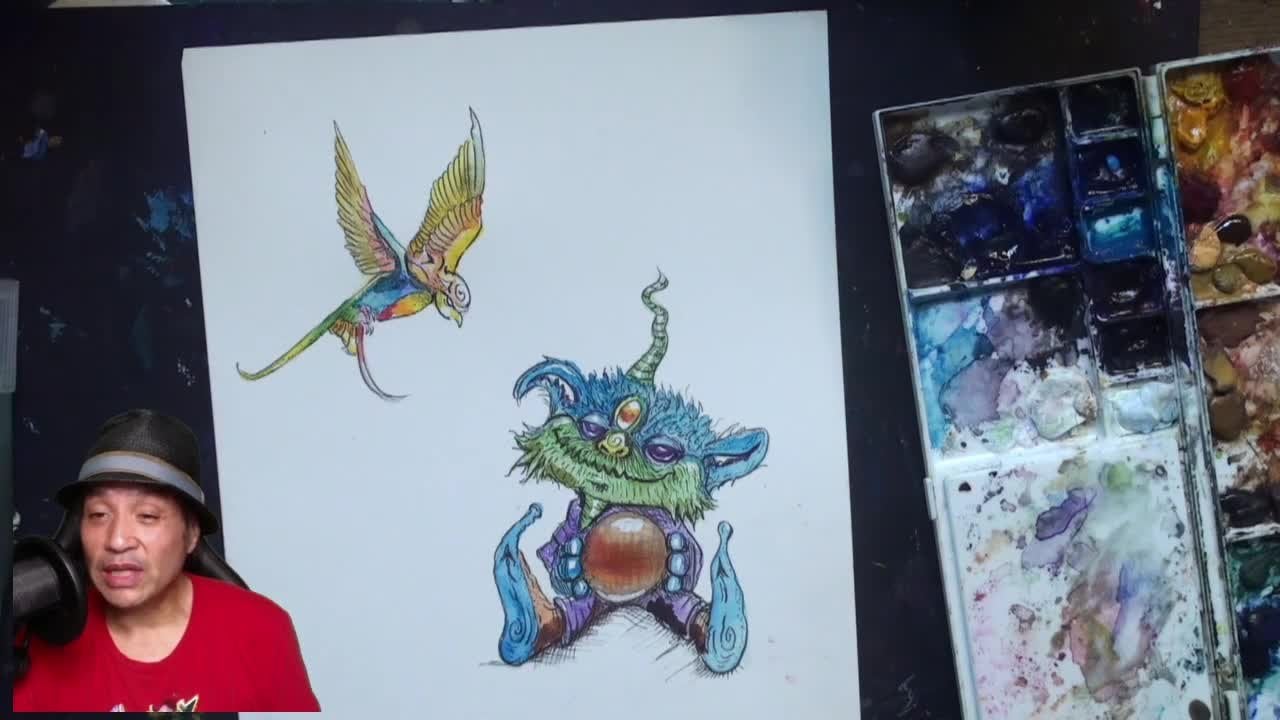
3. Outlining - implementing drawing skills - 003 - Watercolor Doodle Creatures: And welcome to video number three. And this is the part where we get into outlining. And we do the exercise. Provided this creature I'm working on right now. And his name is called wide open. If it is a he. And I included my sketch, drawing of wide-open the eyeball creatures so you can draw along with me. And so basically what I'm doing right here as I showed you in the previous video, how to work with your shape language, get warmed up, work with perspective lines and contour lines and draw ellipses and, and get your axises defined minor axises. And use Amy lines, a jaw, arches and contour lines and parallel lines. And so what's happening right now with wide open is I provided him for you. You can come up with your own creature or you can use this as a reference and draw them. And you see here is that the aiming line points on it. And they kind of become a feature of them too, right? They're kind of cool so they put the minds and then I practice my whole arm drawing right, by connecting the Aimee Lyons and I'm doing contour lines which are in the shape, right? And I'm doing a lot of the arches, right? So you can see, first of all, we're employing or shape language, right? Doing those ovals, we've got, they're not particularly circles or ovals, right? And then you see a lot even connecting lines on his horn, on top of his head and then his feet. And of course the IPC type right there. You see all that. We're doing a lot of arches and we're doing a lot of parallel lines. And we're also practicing a lot of our converges, right? And so now here I'm just going and showing you how I outline and pretty much defined the form of all these creatures. So when we get in the water color, we can practice our watercolor fundamentals, right? So I'm using a curator TO mechanical pencil and there are kind of a special brand. I'm using the roulette version and they come from Japan. And could a toga is the brand caught or Togo? How do you see why it's sit-in incredible penciled be using like this is because in the tip of it has a mechanism that sharpens as you drop. And so you kinda gotta get in the method of drawing where you live up here, your, your pencil a lot. So the mechanism, we'll turn it and will sharpen the lead. Also, I chose to use graphite in this lesson here on skill share, because graphite and watercolor really get along really well. And usually what I would do in this method was used ink. So I'd be doing thinking right now and really defining all the forms and lines. And so they are these cool creatures, right? And are the dimension and apply in my drawing skills right there. So I decided to use graphite, where I will use the new ink. So we've kinda doing inking but basically call it outlining. And I'll use the graphite to define, like I said, love the form and structure. But you see throughout this whole drawn, I'm applying all those drawing skills that you can just practice intuitively like do the first lesson of the last video we did, right? And, and do that if you need to do that, I don't really need to do that anymore. I just go straight into my sketchbook and start drawing, but I'm conscious of the shape language and doing can turn perspective lines are parallel lines and always defining where my minor axis is. And then also doing a lot of those oval perspective drawings where you draw the larger herbal and then gets smaller and smaller and we find the minor axis, which is the center of it. And then you can create all kinds of perspective and curves and it's good for arms. And of course, I showed the example in the last video that Tom, the creature I'm working on right now. But yeah, basically this right here is applying all your drawing skills. So I hope you broad along with us and you've got your creatures and you're applying your drawing skills. And I will see you in the next video. We're going to get, see the watercolor in how we practice our watercolor is skills. See you in the next video.
4. Coloring - Fun-damentals of watercolor 004 - Watercolor Doodle Creaturs : Alright, welcome to the water cola section of this course. And we are creating watercolor due to creatures. We're practicing our drawing and watercolors skills and leveling up in all our fundamentals. So right here, I'm taking wide open creature from the exercise and you can participate right now to start applying your watercolour is skills. And of course, you can apply all your watercolors skills. And one of the reasons I brought the watercolor in the end to this course is because when you do all that line work and you play all those Drawing Fundamentals and skills. You pretty much had defined all the form and the details, and mainly the form. And so now you can go directly in painting without worrying about the formless thing and edges, because using the pencil to outline, we created those really sharp edges. So we have the cool little creatures and they are very appealing and legible. And so in watercolor, where you can practice your fundamentals on practicing right now is I'm using a penta aqua brush and I used a large one. And I recommend the large one because it has an incredible snappy nylon brush tip that gets very, very fine and it gets as fine as the fine 0.1. And so you don't switch branches and you can get a big solution, brushstrokes and get the fine, fine, fine details. And so I'm used to, OK, we'll brush in. And one of the fundamentals that you guys can all practice is how much water, how most water compared to how much paint and how much pigment. And so that's a constant process. And, and I don't think you really can learn that from anyone because everyone kind of does it their own way. And so you gotta kind of practice. And it's the difference between using a water brush and using a normal brush too. So you might want to experiment with that. And then another thing I'm doing right now is I'm doing layering and a little bit of blending so you can practice layering and blending. And now what I'm doing, of course, is a watercolor fundamentalists called lifting. All right? And so lifting, lifting is removing the pigment, right? So I can get the proper values so I can make sure my highlights up at the top and that little center of the eyeball retina wherever it's called, right, I get null 3D. Same with the letters I'm shading on the side and I'm layering right now. But I think one of the biggest skills you can definitely get out of. Doing this exercise and making incredible little creatures right at a water color and graphite is a plane with your watercolor paintings, I don't know how many of you are real serious watercolors. But I fell in love with watercolor one and I was a kid. And being an artist my whole life in love, doing visual storytelling and painting for storybooks and animation in movies, right? I really fell in love watercolor and then coming online and getting supporters and fans real fortunate to be able to get all the real fancy watercolors. And I learned all about the top grade watercolors. And so I'm working with Daniel Smith. I have some Winsor Newton in there, and I have some Holbein and some other hybrid watercolor brands. And UCAS pretty much spend a lifetime on like, first of all, collecting them, which I don't really advised, right, because I really pretty much work in the CMYK palette these days. Rise will generate all the colors, but you can click on these wild colors. But the thing is, when you start getting out of the primary colors, if you're working in CMYK RGB, right? The primaries, we'll get the secondaries right? So like examples like yellow mixing into LU gives you a green and greens a secondary. Alright? So if you get into some of these secondary colors that like damming of Smith has amazing, like the amazing kinda off-brand that they mix themself right? Off colors often primaries. You spend a lot of time figuring out what colors work with each other. And so with these creatures that were colorizing and making all cool, you can start to learn what colors blend to each other. And then like this creature right here is a perfect example of I've learned my palate enough that I want to include all these kind of like almost opposite colors, not primaries, you know, like that, that's an orange. And if I mixed that born with that blue, I'm going to get a real muddy colored and that's not what I want then. That's an ascii. And so right there I'm showing an example. There's a cool blend that I know how to do. And I'm kinda living example because you see my watercolor palette right there. And you know, when you get really advanced in watercolor, if you really use the mixing trees to kind of create your own realm appellate, can you start to get all these off colors that were great? And another reason I wanted to share this tutorial and creating these fantastical fun doodle creatures is because I love doing fine art and grew up doing tons of fine art and still do it today. Love doing Nature Journaling and loves doing caricatures and portrait features. But kinda in that game, you can't, can't use all of the watercolor colors. I got. Some of them are just too out there. But in a drawing in pain from the imagination, you know, there's some fundamental rules to move, but overall, you can use every color that you back. So that's another big fundamental and water calling for sure in learning your palettes, how to build your palace, what pallets you use for what? And that's why I, I specialize in pain creatures is because I just love color. Probably the number one fundamental that I didn't really mention here that you can learn. It is color theory, right? Like I know my co-editor Well, because I've been doing it a long time and I practice every day. But thank you all for watching communist the bonus video. And I think you guys going to really like that kind of show how you can apply all this doodle creature magic to your real life and make it happen. Thank you for watching and leave some comments below lives creating interaction. Let's start interacting because I'm going to start putting up lots of videos, lots of tutorials right here in the scales here, and thanks, Skill Share, and see you in the bonus video. Okay. Okay. Can we
5. Bonus - What Can I Do With My Doodle Creatures - 005 Watercolor Doodle Creatures: All right, welcome to the bonus video. So what I do right now is I just bring all of those watercolor creatures, doodle creatures in the computer. And I'm using one of my favorite apps on my MacBook Pro, which is infinity Affinity Designer. And then I print them out either onto vinyl paper or read. We're glossing sticker paper on my Epson printer. And then just to create a little jump up job with my scissors. I got cool. Watercolors, do creatures, the stick, although the house on my skateboard, mom bike. Any possible a specify youth, a violent. So there's the tip. Rather odd. Thank you for watching. See you guys. I'll soon tune back in and leaves them comment. Down below, I paint creatures outwards.
 Ipaintcreatures . poet painter illustrator and storyteller, drawing and painting from the poetic imagination