Transcripts
1. 1 Introduction: Welcome to another IP
and creatures class, drawing and painting
from your imagination. Today, I thought I'd take
you into a little bit of the background process of
how I prepare game assets, which also my world are also storybook assets and
doing a bunch of prompts for book that I have
available on the internet. And it's called where it's at. And it's my rendition
of kind of bringing back a fantastical story
like Cat in the Hat, but it's all updated
in my world, the MTSU. And basically what's going to happen is I'm going to take
you to the drawing process of you and take you
through the base fundamental skills
it takes to draw what I call the
inker painter caps. And these are anchor
pane or caps. And to remind you on
a visual storyteller. And so a lot of my illustration, painting and drawing
and venture of being a professional
artist and illustrator, painter, animator and director, storyteller, is
basically rendering all I do to tell the story to convey something
from my imagination, some different fantastical
realm or world. So these ink or paint or
caps come from that world. And so basically I will go to the first drawing process
and the inking process, and then the watercolors. And I'm using pretty much
all your products on this. So I'll go into the depth
of the highs and lows, the watercolor, the pros
and cons, tips and tricks. And most of all, I will talk a lot
about my process of drawing and painting
from the ad imagination and how I come up with
all this stuff and how I stay driven and how I apply all the fundamental
drawing and painting and coloring skills through it all to make it
all come to life. And why do certain things
to get them prepped for, like I said, for assets, for games, or in my
world storybooks, I use them as props
in my story books. So I will see you over
in the first video, which is the drawing video. We will go to all
the fundamentals and the key elements you
use in the art of drawing and the science
of drawing to create these fantastical
hats and gets you going along with
that Second video. We'll do the inking
there, do the color, and the exercise will, I will include some of my
sketches of inker painter cats. So I'll see you
folks over there.
2. 2Drawing Exercise: All right, Welcome to the
drawing exercise of this course that is basically making
game and storybook assets. C2, E2 products and features
at your color brush pens. But right here I
thought I'd go through a little joint exercise
so you could draw along. The first fundamental
we will use is ovals. So just draw a whole bunch
of ovals and I always use my full hand
when I'm drawing the ovals and use my
arm and my myself and practice and just
warm up and then I do parallel lines, parallel lines. I also do a lot of
ovals and half ovals. Parallel lines use angles,
start using angles. Straight parallel lines,
different distances. Just warm up and really get it. And once again, I'm
using a ballpoint pen. I love ballpoint
pens for sketching because it's different to
me than using graphite. Because graphite you can erase and I'm really
wanted to just draw. And then I do these things. So tangles, which are like parallel lines
and angles, right? But we do a lot of draw
through and loop de, loops and underneath,
right, overlap drawing. Practice your draw through in your overlaps
because you use all these to make these
ink or paint or caps are like little
assets and props. Like even if you are
drawn like tea cups, you use all this or
tea pots or sunglasses you use a lot of these
are bases, are candles. So he's done a lot of stuff. And so now I'm going
to show you how I go into the hats and I use ovals, angles, and squares. In triangles. I use the power of
the center points and times and I
use contour lines. And so I'm going
to show examples while I draw up with two hats, I'm just doing these
on my imagination. You can look at some references, but I usually don't like
to look at them when I'm drawing because I want to
draw them like I've drawn. The magic of illustrating
a story or just draws so you recognize
somewhat what it is and it communicates
that kind of vibe. So you've got the cooks hat, got the little pork
pie that's in Top Hat, gets the doors, got a
little baseball cap. Put my little style
on them, right, and then draw just the
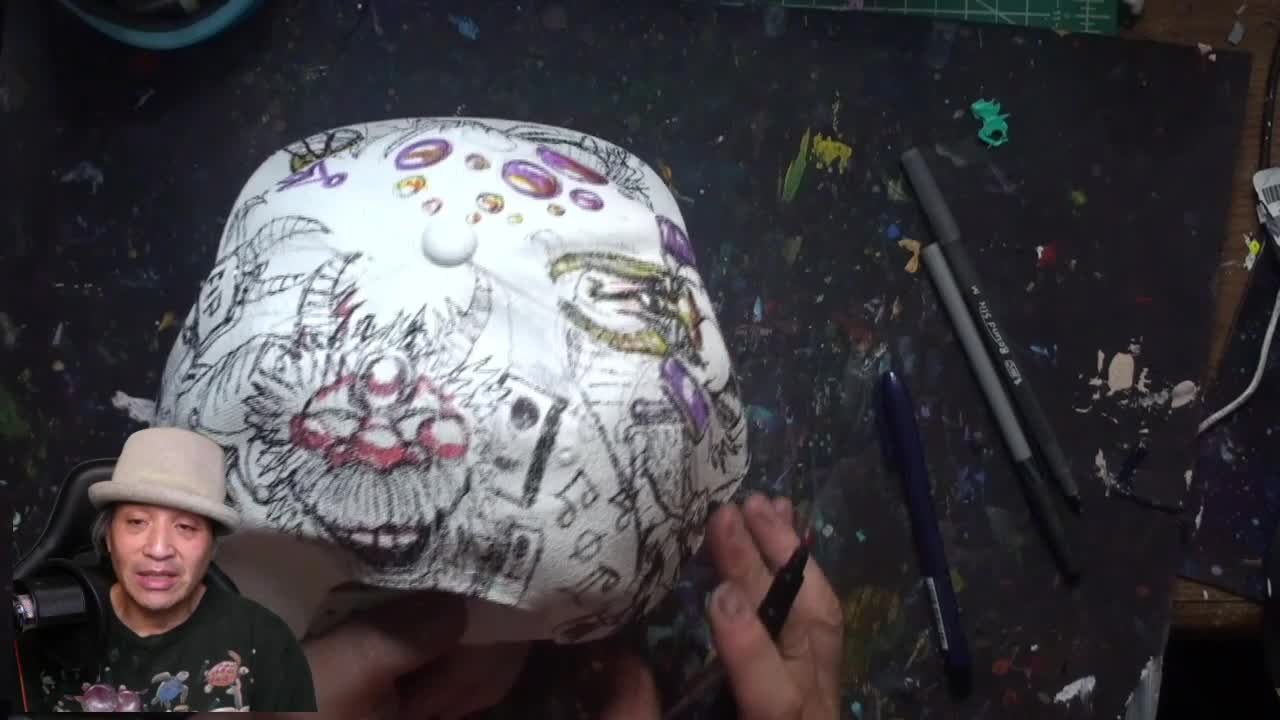
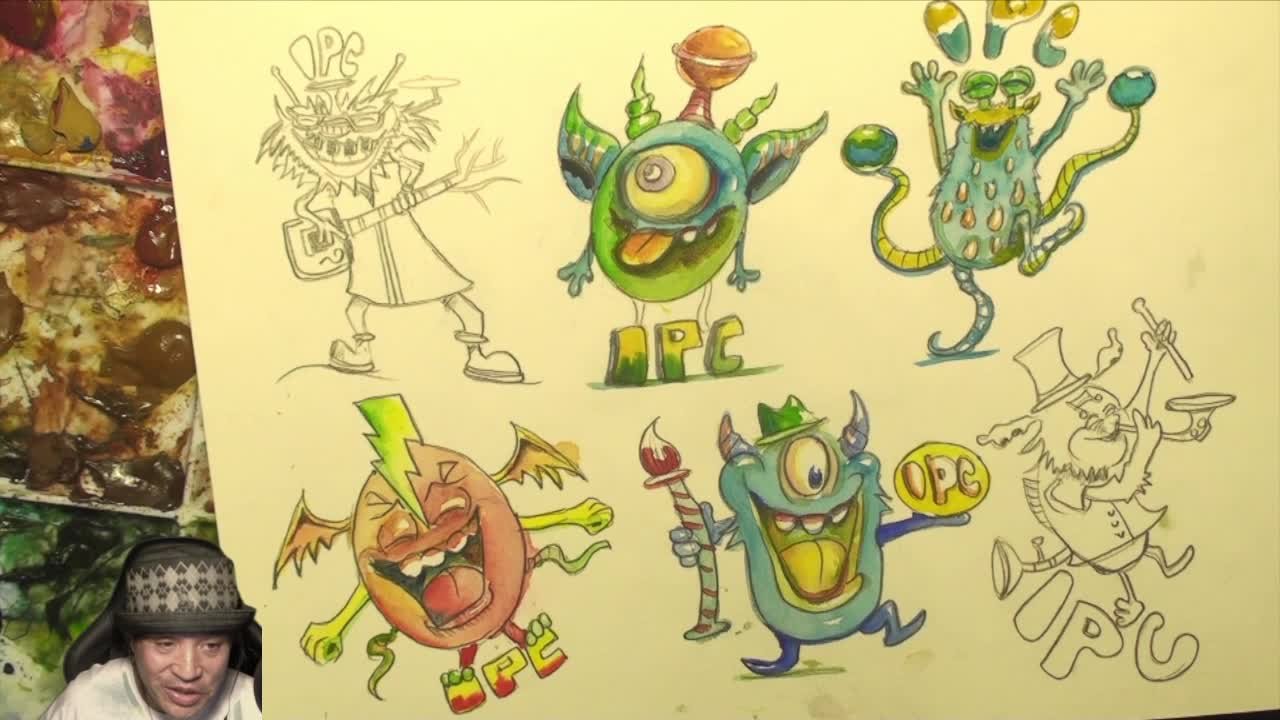
standard inker painter cap, which I think has some type of aching device and a
paintbrush coming out of it. So there's a lot
of parallel lines and angles and you just got to learn a lot of the shapes
and draw the shapes of the recognizable and draw
it in your style. The way you like to
communicate how that will be. A lot of story ideas. And once again, that's why
I like the ballpoint pen C, I can start to shade
real quick and get a real result of lake water cooler like
put my drips down, put a little highlight and make my little mechanics
of how the anchor, my inker brush or a painter or ink pen might work and then put my little logo IPC on there. All different types
of lettering. And I like to work really
quick in this stage. I do have it sped up
a couple of times, but I do work really
quick and conceptual. Usually a center point
right here, this, how do you do my
little Ferris wheel and my little wheel
invention on top? You'll see when
we get an inking, I got some that have little
inventions like wheels on top and then a lot of pipes using all that
draw through again, make a little saxophone coming off that is, it
exhausts saxophone. So just imagination is the limit to really
get comfortable with all those basic drawing
skills of angles and curves and most of all parallel lines
like I was saying, and ovals and contour
lines like I did right there on the candy
canes and you can see it. Alright, if you just keep looking at a lot
of parallel lines, I'm using the center line
again on the front there to measure where that's coming off. So it has a three-dimensional
quality and I understand like kind of disappearing points and vanishing points when
I'm drawing on there. And I do it again There I here. So I'm using the center point. I figured out where the center point is
on that object and then I can draw something
projecting out of it. And I put a paintbrush
out there, right? And that's again, there's I can get real
sketchy with a ballpoint pen, but also definitely
started flying a lot of shading to give it form and know what it's
going to look like. And if I have a lot of funds, so that's kinda like
a little beanie baseball type strains
cap, cap, right? But you know what it
is and that's the key, the story art, right? So this one, like the one I just did stuff out of the way a little bit light gray
right next to me here. It has a little
water tank on it. So of course, a lot of
watercolor and water brush right up there and
flowing a little tank, put a little fishing. Have a little bit of
science and make sense of how the water might flow down out of the tank into the ink or paint or cab
and drip into the thing. But the whole concept is very imaginative and
what I encourage, encouraged more as we get into the next video is that you
just got to have a great story in really be imaginative and do a lot of process of that thinking before
you start drawing. The basis of this
drawing exercise video is to see a show like
this parallel lines. All of the things
I mentioned are the fundamentals, contour lines, center points,
triangles, squares, ovals are very important. Then the sky's the limit. And then if you're
new to drawing, just spend a lot of time
looking at a spray paint can and figure out where all the parallel
lines are and ovals. And then figure out just
to have fun sitting there sketching it and
figure out how you draw it. I'll see you over there
in the inking portion.
3. 3 Inking and Outlining: Welcome to the outline in
inking portion of this class. And we're featuring game
assets and stored Burke acids, featuring the S, your
brush pen collection, color brush pen collection. But I'm using also
some other tools. And so I'm starting with
the black ink set by Asher and they basically
have re-imagined the hole and incredible
contemporary inking kit. Good for illustration,
comic books, Mung, prepping for watercolor, all sorts of every application
and I'm using them today. I'm using a 0.05
to start off with. They go all the way down
to 001 micro micro point. But this one allows me with the use of pressure to
get thick and thin lines. I'm not too concerned with giving too many inking
shading effects, more just outlining and
getting the detail. And once again, I'm illustrator that specializes
in visual storytelling. So a lot of my illustrations
are all about communicating the fantastical and
imaginable concepts that are coming across either in games for a younger audience or
for storing books. And these, once again are
called inker painter caps. And so the whole concept is that basically creative
people have all kinds of amazing things going
on up in their domes, up in their skulls
and their brains. And basically where they store all the great ideas and how they get into the world. And the concept is an
inker painted cab. And this was
specifically done for some game assets
and for storybook. And so like there's wheels, there's paint brushes
demonstrated in the drawing exercise
that just using a lot of parallel lines on the
angles, lot of ovals. All right? A lot of
shapes and use the power of the center line
to make things like wheels and make things in three-dimensional
coming off the hat. There's other accessories I didn't really show
in the drawing, but once again, the drawing
exercise, but once again, they're using those
fundamentals of angles and curves and contour lines and center points and most
of l parallel lines. And always thinking in
perspective and proportions. And drawing and painting
from the imagination is, in visual storytelling is more believability
enough to communicate. Really concentrate on the base
principles of expression. First of all, and second
of all communications. So somewhat tell what
the concepts are. But a lot of storytelling
and fantastical. Contemporary animation films,
storytelling storybooks, to me all about doing
what the master did. Dr. Seuss and Shell Silverstein opening people's imagination. Lot of it is just getting you, your fantastical ideas across. So the more that you
have more story in mind when you start to approach, really rendering your assets and your props and
illustrations for your stories that basically you kinda know what you
want to communicate. So that also translates very well to all the
different things that you're drawing
your illustrated in your painting and you're
representing two, communicate your story concepts. So once again, on the
technical inking side, I haven't switched up the pen. I usually stay with one
like this or I'll go up a little bit into the 0.05 and they have what are called the
synthetic brush tips, which are not individually
little hairs, but it's a little
nibs that you can flick and give pressured to and bend it a little
bit on the page and it gives you power over
getting a thicker line. And always remember an inking. A thicker line is where the
shadow is and the thinner line or the removal of a line is where the
light is coming. And so I don't really
think of a lot of light source if you've
heard that before. When I'm doing all
this mortgage, it's once again, it's story art, so just wanted to
communicate as best possible kinda what
it is on the hat. So it opened your imagination to wander more how it functions and if it does really
function and more, the goal is right to decent fantastical art and opened up the curiosity
of the viewer, the listener, or the audience. Once again, going back to
fundamentals, if you see, if you really look at it looks really complex and
it can be like, I don't draw it like that. Lot of it is why I do the drawing lessons
is just to show you. They're just based fundamentals that you just need to practice. Go over and over again, which are basically ratios, proportions, perspective, angles, right? And curves and
then basic shapes. And then just doing something you really love
and are interested in. So you continue to keep doodling and drawing and shows you a few, a couple of other
things in the drawing, which are those tangles, which are a good exercise for doodling and remembering things like dropped and
completion of shape. But the basic shape language
is always composed a very, very basic shapes like triangles
and circles and ovals. Then at that point is more how much you enjoy
what you're doing. So you will spend more
time doing it and finding that very particular ways
of how you draw the shapes. I'm not really a
precision person. I really liked the energy of the hand-drawn and that
you can tell that someone spent the time to
illustrate that and tell the story and he is kinda more
authentic, genuine field. Put it in a time when
they've been with all the tools and
the digital tools, you could definitely
get it to a point where it is pretty polished. So that's all just a lot
of techniques to do. Get that down. But
the main thing is the base fundamentals
of drawing. And then there's lot of confidence that I believe
to in your imagination. So the more you do it and
the more you see results in, the more you can share the art. Even on a commercial
level or just the first, on a hobby level within
your circle of people. And we live in a
great time where you just don't particularly
after work for a company or anything
you do that you can get on the wagon and
just get your skills. So remember one fundamental is always to have fun and keep you interested and be successful. So as I finished inking and lot of these Aussie,
you can see, I'll do come time
but hesitation, but that's more observation. Observing more. And I might switch a pen out here and there I will go
a little bit thicker. Just the process is a little quicker if I want to add
a lot of the shadows. And at this point, I'm really warmed up. And so I'm looking at
some of the hats and I'm looking at where you got to really punch in the shadow
because there's a lot going on and I'm a real fantastical
Illustrator like that. Sometimes the design
can get out of hand, but that's just part of
the storytelling and the layers I loved to do
and just flow with it. But once again,
returning back to the fundamentals is very
basic fundamentals. And the drawing here
to deliver what I imagined that was
inking and outline it. And I'll see you for
the final video. We're going to color this
with some mixed media, some watercolor ends
of color brush pens.
4. 4 Coloring: Alright, welcome to the
final video of the ink or paint or caps from
your imagination, game assets and
storybook assets, basically prompts in
visual storytelling kinda, you know, theatre
and publishing. And what we got
going on here is, I'm using the Escher
color brush pens and they work very much
like a lot of techniques. Used watercolor, where you lay down a
lot of the first layer, kinda like a wash
and it's pretty, it's not very thin
with markers because it punches very, very saturated. But that's what you do.
And a lot of it is, is these brush pens
are really nice to tip, is really incredible. They're made by the
Australian based company at, at your ET CHR and beautiful
set of 16 color brush pens, all different colors but with the same consistency of that
color and their pigment ink. So they're
professional ink pens. So that means that basically
the color won't fade. And you can see I pretty much use a very
painterly technique. The inking. I really paid attention, like I was saying in the
inky video to a lot of the shadows and the places where I needed to punch things. So a lot of the
really thin details will pop forward like that. It's kinda like a brush. We'll brush color
wheel on there. It has a bunch of
little creatures on their little
painting features. But you can see the
coloring process is pretty basic and I'm preserving
a lot of the highlights. Have a lot of really vibrant almost on the fluorescence side, some of these color brush pens. And you'll see in the end I just saturate a little bit more and add a little more blending a little more variety
of shaded tone. I will break out the S,
your watercolor set, which is a really nice set to a good tip about Escher products is they kinda came a little
later in the game. And they're an
international inner, Internet-based company,
has art supplies. Basically. Have really seems like I
don t know for a fact, but it seems like
they've been analyzed. A lot of art companies that have been art
supply companies that have been out a long time. And they really put together some nice sets that me as a
professional illustrator, visual storyteller
really appreciate. And all the sets have everything that I've got used to in
a lot of other products with I used to have
to mix and match with a pretty complete when you get this shifting color brush set or the black
color Inking set. And then watercolors over a nice perfect amount of colors. But you can do
some great blends. They are water-based. So you see how if you
work pretty fast. I got that pretty nice. Orangey, orangey red to the
yellow sunset fiery blend. Same with this one. Going for the gold feel a
thing called green here. So once again, just
being really conscious of preserving the highlights. A little more complex
one up there, the one with the wings on it, the wheel with wings, that you definitely
have to spend a little more time
with a reference and seeing what you gotta get kinda geometrically
perfect for the wings too. Be satisfactory
way you want them. So you don't have to go through the trials of I don't
know There's draw and all that because it wasn't going
to draw since you got to pay attention to the ratios
and certain things, especially that's why it goes
back to store yard again, you got to get it to the point where you're satisfied
that you're communicating. People are going
that that looks like a diesel truck and it's actually a little color
wheel or something. Imagine, especially
if you're doing a lot of magic stuff
and fantastical stuff. I do that where it didn't
exist in the world. So gotta kinda sell it
a little bit sometimes. But once again, these
are like assets, right? So these are like props. So lot of the story explains somewhat what's
going on right there. A lot of it is just to have fun drawing and
painting like I do and come up with a
little creatures and being an express
my imagination. Because I imagine all of you
that are creative like that. That's a very valued point
to do stuff like this. But the world needs more
stories, more wonder. So you can see some of these. I definitely have color
themes I'm in mind, and that's what we're working with pencil like
these are really cool because the limit of what
you can do with your color, but then it keeps it
in the sweetest thing, especially when you're
once again doing story arc like this one's
really have to kind of pay attention to that
one because it's got that weird pencils winding around with a paintbrush
kinda like wind around and O, and a lot of times why I do
a lot of parallel lines, even when a paintbrush in real life is like
a straight line because I'm just
showing interest. And I think that
comes a lot from my background and
illustration background. Fantastical illustration.
Illustration. Just give me more
interests as long as you can tell it's a
paintbrush and what it's doing. The twist things and bend. It. It's not a hard
fundamental skill like it goes right back
to parallel lines, is just practicing parallel
lines and curves and angles. Yeah, so most brush pen
sets work for this, so you don't necessarily
need the extra set. One of the really popular ones is Tombow and I use those a lot. But the SUR1 is super
powerful and I would recommend it because if you're
doing professional work, they are light fast. And a lot of marker sets
are not light fast, including the
powerful, cool beaks. Lot of alcohol based
ones are not light fast. So Escher is really
powerful because they are pigment based inks. I'd like to thank you
all for coming along for the journey and getting
creative, get inspired drawing, painting from your
imagination and adding the drawing videos hopefully brings up a level and
get you all inspire. But ultimately you got
to do something that you love to do and tell your story. And the rest is just the
enjoyment of the art adventure. And remember to always do things that you really
haven't interests and excite you to do so you'll continue to do them and improve your skills so you don't have to stress
about the end product. The end product will just communicate and be an expression
of what you want to do. So stay inspires, keep
painting and drawing, and come back and of course, leave feedback down below. But what you'd like to
see or added or anything, actually keep improving
what I do here. So thank you very, very much from I think teachers and I'll see
you folks, you'll see.
 Ipaintcreatures . poet painter illustrator and storyteller, drawing and painting from the poetic imagination