Transcripts
1. Intro: Golden Retriever: Hello and welcome.
My name is Emily. I'm an artist and owner of
Emily Marie watercolors. In today's class, I
will teach you how to paint protein, The
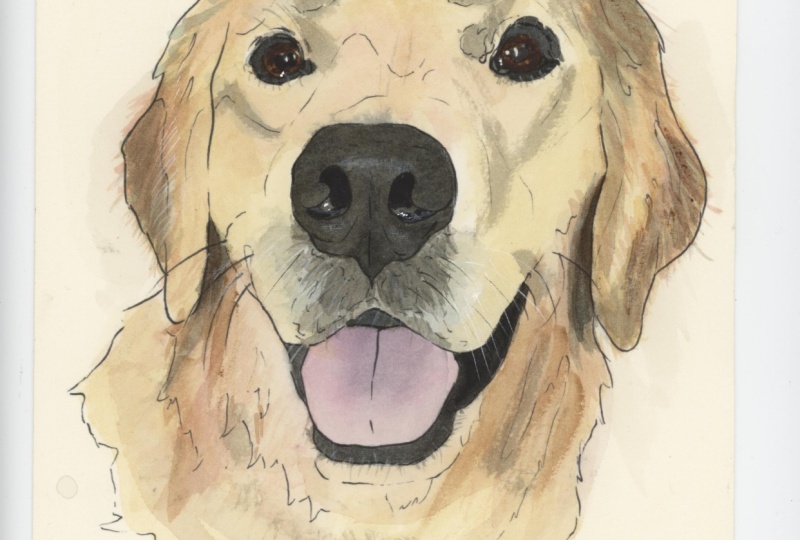
Golden Retriever. Using watercolors. Golden retrievers are
super playful pups. And so in this tutorial, we will look at how to paint
a dog with an open mouth. Smile. As a watercolor artist, I have found a passion for
painting pet portraits. You already know the basics
of watercolor painting. Pet portraits can be
a great way to turn your hobby into a part-time
or even full-time career. I have found success with my art business all thanks
to custom Pet Portraits. My style is characterized by adding details to
the mouth, nose, and eyes, but not
getting caught up in painting every
single hair or curl. In this tutorial, we'll start by talking through
the supplies needed. I'll share with you
the supplies that I use to create my
professional portraits, as well as the special
color palette I found gives me the best results. Then we'll dive into tracing
your pet and preparing your paper using masking
fluid and painter's tape. If you'd like to trace using
a light box or a window. I have also included a black and white traceable
outline for you to use. Next, we'll begin
painting layer by layer. I'll show you a combination of real-time video
with time lapses. So you can see the whole
process from start to finish. We'll end with adding a
colorful slash behind our dogs and finishing our piece
using a black micron pen. You are welcome to use the same reference photo I used for the painting of proxy. It's located in the projects and resources tab just
under this video. Or you can use your own photo of your
own golden retriever and use the tips and techniques
that I teach you in this Skillshare class
to paint your own dog. Either way, I'd love to
see your final projects. And I'm also here to help answer any questions
along the way. So let's get started.
2. Supplies Needed: Alright, let's start
by talking about supplies and studio setup. The one thing that I
love about painting with watercolors is that it doesn't require a whole lot of space. As you can see, my studio consists of a student's eyes desk in the
corner of a spare bedroom. We'll go over all the supplies needed and then
we'll get started. All right. Let's talk supplies. You can find a detailed list of all the supplies that
we talk about during this segment in the projects and resources tab just
under this video. Let's start by
talking about paper. For this class, I'm going to be using an eight by
ten sized paper. The watercolor paper that
I choose to use with my Pet Portraits is the
brand called arches. It's a £140 paper, and I prefer a hot
pressed paper. I'm working with Pet Portraits. A hot press paper
tends to be smoother. It doesn't have as any
rigid bumps on the paper. However, there are some
artists who are not big fans of hot press paper. If you are one of those people, feel free to try this
with cold pressed. The one suggestion I do
have is whatever paper you are using trying to
get a 100% cotton. This is just going to
allow your watercolors to correctly seep into the paper
instead of sitting on top. You'll notice that this is
a nine by 12 pad of paper. So I did have to cut
this paper down. Next, let's talk
about our paints. The palette that I'm using has a few different wells in
order for mixing colors. And of course I am going to be using a very limited
color palette. Most of the paints that
I use are Daniel Smith. Let's talk about the
specific colors. For the majority of
my pet portraits, I use a combination
of these 14 colors. I say 14 because although I
use art philosophy is maple, you can switch it out with Daniel Smith's
quinacridone, burnt orange. A printable copy of
this color palette can be found in the resources
tab below this video. I personally love to use granulating colors
when painting pets. I find that the separating
of pigments nicely mimics for which is a
great benefit when we don't want to paint
every single hair. That is why I always use a
combination of either shadow, violet, or moon glow and lunar
black in my pet portraits. Alright, let's move on to the rest of the supplies
that we'll need. You'll need some masking tape in order to tape your paper
down to the table. I will be using
some masking fluid. This is to keep the white of the whiskers and the white of
the eye is clean of paint. In order to apply
my masking fluid, I use an old small brush. This is a size 0 brush. And I also use a pen that
has a small nib on it. This pen I use mostly while solely for applying
masking fluid. For the whisker areas. I find that it
allows for a finer, thinner line of masking fluid as compared to my brush that tends to be a
little bit thicker. For the brushes that I'm
using for this project. I tend to not use a
different brush for details, but you are more than welcome
to use a different brush. The brush that I use for the
entirety of my piece is a silver limited black
velvet, round size six. I find that this brush gives me, it holds enough water for
some of my larger layers. And it also has a
fine enough point that I can use for details. For the color splash
in the background. I need a brush that can hold
a little bit more water. I'm using this brush
by Paulina bright. She's another Instagram artist. It is a size 0, but you
can use any brush that has a higher capacity
of holding water. Will also of course, need a pencil and a kneaded eraser to
sketch out our, our pet. At the very end
of today's class, I'm going to be using a Micron Pigma black pen size 03 in order to add a few
details around my pet portrait. I like adding this black to my watercolor
paintings because I feel that it adds crispiness
to some of my edges. If you are a watercolor purists that likes to only use
watercolor, feel free. There's no need to add
this black pen at the end. I always use a, an old towel when I'm painting in order to tap my brush on it, if I need to lift any colors. And I have gotten
in the habit of using two glasses of water. The reason being is
that at the end, when I add my color splash, I always need to use fresh clean water so that
I don't dirty up my color. And I usually use one cup of water while I'm painting
the actual dog itself. I detailed list of all the
watercolor supplies that I use can be found at my website,
Emily Marie watercolors.com. You can scroll through
all the supplies that I use according to category, and also click on
any of the links. When you click on a
purchase here link, it'll bring you to an affiliate link through
**** Blick Art supplies. Now that we have our
supplies together, we're ready to paint.
3. Tracing and Prepping your Watercolor Paper: After you get your supplies
together for this tutorial, the next step is to trace your dog and prep your
paper for painting. You can find a full color
reference photo of property, The Golden Retriever in the Resources tab
under this video. You can also find a black and white outline
of the golden retriever in case you decide
to use a light box or window in order to
trace the outline. Personally, I choose to use
an app called Da Vinci I, that I downloaded onto
my phone that helps me trace my reference photos
onto my watercolor paper. You can see that
I am looking into my phone as it's held
on my phone clip. And I can see my
watercolor paper as I'm looking at
my reference photo. When I start to size my reference photo on my eight
by ten watercolor paper. I'm looking at the distance between the head and the
outside of the paper. I want it to be around
two inches so that I have space for my colorful
splash behind. I'm going to start by tracing
the outline of the head. I'm not going to focus on
adding every single hair. I'm going to edit it as I trace. So that means that I'm
going to only trace the larger hairs that are
shown in the reference photo. I'm going to speed up
this video slightly, but I still wanted to show you my thought process
behind which details I like to add when I'm tracing which details
I will leave out. I'm going to edit the
amount of white hairs, then I'm going to cover
with masking fluid. You'll notice a lot of white
hairs here under the nose. I'm not actually going
to sketch those out. The reason being is that
I find when I do add what masking fluid to those
little hairs under the mouth, it tends to look a
little too busy. I am going to leave
those out the same with the little
hairs under the chin. I'm going to leave those
hairs out as well. The only Harris I'm going to use masking fluid to preserve the whiteness are about
three or four hairs in the corner of the mouth. As I start sketching
out the eye area, I'm going to sketch out some of the shadows that
are around the eye, some of these darker fur colors. I'm also going to trace the
outline of the highlight of the eye so I can use masking
fluid there as well. My client decided
that she didn't want the bandanna in the final
watercolor portrait. So choosing where to end the neck for is a difficult
decision to make. I decided to mimic
the circular shape of the face and come down
on the left-hand side, mimicking the curve of the face as well as
on the right side. I'm also mimicking the curve
of the face and I'm leaving that little center section open because that
is the lightest, brightest part of the fur. You'll notice in my
final piece that I also have this circular
motion to my painting. I am not painting the for to continue all the
way down the paper. I do like to leave some of that white outline of the paper. Now that I have my
sketch complete, I'm going to use some
Winsor and Newton masking fluid and an old brush to paint the highlights of the eyes so that I can preserve the
whiteness of the paper. You'll want to make sure to
use an old brush for this as masking fluid tends
to ruin brushes. I noticed two highlights
in the center of the eye as well as a highlight
in the corner of the eye, the inner corner of the eye. So I'm going to use a
data of masking fluid to keep that white
of the paper white. I'll use a calligraphy pen with a small nib to paint
the masking fluid, draw the masking fluid onto
the white of the whiskers. This technique is a little
challenging at first, so I do recommend
that you try this out on a scrap piece
of paper first. You do need to remove the
excess of the masking fluid from the tip of your
pen before you make, before you draw these lines. My next step is to use a
Blue painter's tape to tape around all four sides of my eight by ten
sheet of paper. And now I'm ready to paint.
4. Painting the Lightest Layers First: The next step is painting
the lightest colors. First, I like to
start with the iris, the tongue, and the
first layer of the nose. The colors I'm using
from Daniel Smith, RPM and tight genuine
quinacridone, magenta and moon glow. And from Art Philosophy,
I'm using Maple. I'm going to start with
painting the eyes, the iris or the colored
part of the eye. I'm using PM and tight genuine. And now I'm going
to just drop in a little bit more
concentrated maple into the areas of the eye that I see a little bit more brown. So that's usually the
underside of the eye. I'm going to clean my brush and I'm going to lift out any of the color from the area where I got it a
little bit too dark. Now I'm going to
mix up a little bit of quinacridone
magenta with water. And I'm going to paint the very first layer
of the tongue. The reason why I'm doing
the color of the eye, the tongue and the
first layer of the nose first is so that
these areas can dry. Before I do the
first layer of fur. Obviously, we don't want our brown of our firm
to touch against any of the blacks of the nose
or the colors of the iris. So doing these areas first is
going to allow them to dry. Before I start with the fur, I'm doing one solid layer of
wet on dry for the tongue. And now I'm drying off my
brush and I'm going to lift any of the highlights
that I see in the tongue. I noticed some highlights
along the base of the tongue and along the sides. So I'm going to
continuously clean my brush and lift
those highlights. Now for the base
layer of the nose, I'm going to mix a little moon glow from
Daniel Smith with water. If you don't have moon glow, you can mix your own by
first mixing a black. You can use indigo and dark
brown than adding some blue. And lastly, some purple. Moon glow is a really
nice neutral tint that has more purple and
blue undertones to it. And I find that it adds a little bit of color
to my pet portraits. And those colors do tend to shine through in the very end. What I'm doing now is I'm
adding my first layer, but I'm going to try to conserve a little bit of the highlight
at the top of the nose. And now I am dotting
around that highlight. Most noses that you see do have a little bit of some
indents in those noses. Almost looks like
sandpaper, if you will. And so I sometimes will dot my, my watercolor paint brush on the paper to create
these little dots, to make it look a little
bit more realistic. Since the base of the
nose and right underneath the nostrils is a
little bit lighter. I'm also leaving a little bit of a highlight under
those nostrils. And now I'm adding a little bit more dense,
concentrated moon glow. The very base of the nose. Lift some of the paint from those highlights
under the nostrils. Just so that I remember
that they're there and that highlight is a
little bit more pronounced. Remember that you can only lift paint off of damp surfaces, which is why I tend to stay
fairly wet while I paint. If it dries, it becomes more
difficult to lift the color.
5. The First Layer of Fur, Part 1: Now I'm ready to start with
the first layer of fur. For the majority
of this section, I'm going to be painting
first wet on dry and then adding in some
colors wet on wet. The base layer will
be art philosophy, SASA frass, and maypole. I'm using a little bit of
Winsor and Newtons raw umber and darkening it up with Daniel Smith PM
and tight genuine. So right now I'm mixing up some art philosophy, SASA frass, and adding in just a little bit of the Romberg by Winsor and Newton just to tone down those brighter yellow
colors a little bit. And I'm adding in a
lot of water because I want my first layer
to be very transparent. This first layer, I'm going
to start with the ear. I always, usually start
with the left ear that way, I'm not going to be
worried about ruining my painting because my hand is resting over a part
that I just painted. I'm not really going to worry
about any sort of hairs, individual hairs at this point. I'm going to fill in
whatever I see you with a solid coat of wet on dry. I'm going to dry off my brush
and you need to clean up first and I'm going to
lift some of that color, the inside part of the ear. If you notice in my
reference photo, that part of the ear that's closest to the eyes is
actually the lightest. So I'm just lifting a little
bit of color from there. Now I'm going to grab some
art philosophy maple. And well, the ear is still wet. I'm going to drop in a little
bit of that maple color, only in that triangle of darker browns that I
see on the outside. Remember, I'm not doing any sort of brushstrokes that mimic
the firm at this point. I'm just wanting to get
those base colors down. Alright, up until this point, I had been using a
round size six brush, and I decided to switch to a slightly larger capacity brush for the rest of the face. So right now I'm using a
polynom bright size 0. Even though it's a size 0, it is a larger capacity brush, which means that I can paint
slightly larger of a surface without having to consistently add more color to my brush. I'm going to start painting the areas of
the firm that I see. I am trying to leave
a little bit of white area just around the face that it's where
it's the lightest. I do need to work fairly quickly here because I want
the paint to stay wet, my paper to stay wet
so that I can one, lift some colors up and then drop in some more dense colors
before the paint dries. Alright, I will
dry off my brush. And now with a dry brush, I am blending those
edges that are coming up to the nose and
to the edge of the mouth. My colors are gradually fading when I look at
the reference photo. And so lifting and blending
that color from the edge is going to just help with
that gradual gradation. And every once in awhile, if I notice a highlight, I might dry off
my brush and lift some of the color
from that highlight. Most dogs do tend to
have these kind of eyebrow looking features
over their eyes. And the eyebrow feature
is usually darker and above that eyebrow and below that eyebrow is a
little bit lighter. So you can tell if
you look closely at the reference photo where
these eyebrows are. And so I'm just dotting a little bit more water and color in the eyebrows section. And lifting that weight off from above and
below the eyebrow. Now I'm going to use some art philosophy Maple
with a little bit of water. And I'm going to look
at the areas that are a little bit darker
in my reference photo. If you can tell, I am painting wet on wet. My paper is still damp. This is the hardest
part of doing this first layer is
working quickly. While the first color that
you lay down is still damp. If it starts to
dry out too much. My suggestion is to take
this face layer in sections. So maybe do the first half, drop in your color and then paint your second half
and dropping the color. Because I've been doing these
pet portraits for awhile. I tend to work a little
faster than beginners. And so my paper is still
wet enough for me to work. And adding these darker
colors that I see. I'm not painting
individual hair, but I am painting in the same direction that
the hairs are going. Now, if I have a section
that's gets a little too dark, I simply dry off my
brush and I lift some of that color up and
blend in the edges. So right now I'm blending some of those harder
edges with a dry brush. When I say dry brush, It's not completely dry. I I just dry it off with my towel that I'm holding
on to sit still damp. It's not completely dry. So I'm going to speed up the
video just a little bit. I'm doing the exact
same thing on this right side where
I'm using Maple and a combination of PM and tight genuine to add some of
these darker shadows. I'm focusing on the eyebrow area or that area right
above the eyes. And I'm also focusing on
the bridge of the nose and just adding in some darker
colors where I see them. Alright, I'm switching
back to my smaller, round size six brush. In order to paint the right ear. I don't need that
big of a brush and I need some finer detail
for the point of the ear. So that's why I switched back to my black velvet size six brush. Once again, I'm doing the
first coat of Art Philosophy, SASA frass mixed with
a little raw umber. And then I'm going to go
back and drop in some of the darker maple and some of the darker PM
and tight genuine, which is that darker brown.
6. The First Layer of Fur, Part 2: Alright, up until now, we haven't had to actually paint specific for brushstrokes. So we're going to use
a separate sheet of paper and practice some
brushstrokes right now, when I am painting the neck
of this golden retriever, I am going to be using some for unrelated brush strokes
to show the neck line. So as I start, I'm going to fill in
right below the neck. And then I'm going to use the liquid that's
already on the paper to pull some brushstrokes outwards
before your layer dries. Practice dropping
in a little bit of darker, more
concentrated pigment. I'm using my art
philosophy, maypole. I'm going to drop in that
darker pigment to the areas that are presumably a
little bit more shadowed. But this step has to happen
while my paper is still wet. You can also take
this time to try and do an upward and
downward brushstroke. If you notice, I'm painting
both up and down strokes. And that's creating this for look on both the upper
edge and the lower edge. And while it's still wet, I'm going to add in a
little bit darker pigment. Lastly, it takes
some time to paint some far brush strokes that
are separate from the neck. With these that I just painted, I have the downward brushstroke. Now I'm working on the
upward brush stroke. Then I'm also going
to play around with connecting these
two spots of fur. I'm not going to connect
it in all areas. If you notice, I'm just connecting on this
right-hand side. You can continue
to practice these upward and downward brushstrokes until you feel
ready and confident to start the neck of
the golden retriever. Feel free to fast forward this video a little
bit just to see what the end result will look like so that you can
practice accordingly. This is going to take time
and effort to really master. So please take your time
and practice often. Once I've practiced enough
now I'm ready to add the neck for details to my
golden retriever portrait. I'm using the same first layer of paint that I
used on the head. That is the art
philosophy is SASA Fraass mixed with a little bit of
Winsor and Newton raw umber. I also dilute this
with quite a bit of water because as my first layer, I want it to be
quite transparent. I'm going to start by
wetting the area underneath, painting a wet on dry, and the area
underneath the neck. And then I'm using
the same technique and brush strokes
that we practiced earlier to start painting
this edge of the neck. I'm working in small sections so that I can drop in some of that darker maple color gradually before
my section dries. So the reference photo
that I have of privacy, she's wearing a bandanna
in the picture, and the client does not want the bandanna in her portrait. So I'm going to be making
up the fur around the neck. I'm making it up based off of the same shape as her mouth. So that diagonal and triangle down of the mouth is what I'm trying to mimic
with my firm. So every once in awhile I'm
going to clean my brush off and I'm going
to use a clean, damp brush to blend these edges. Remember that we can
blend with a damp brush, but we should never be
blending with a wet brush. Alright, by this point
you might be tired of watching me paint the
fur around the neck. So I'm going to speed up this section a
little bit faster. Alright, the last layer
that we need to paint before getting into
the darker colors is this area
underneath the nose. I mixed a moon glow and
added quite a bit of water. It's about the same transparency that I used for the nose, the first layer of the nose. And now I'm going to be dotting all underneath
the nose and gradually lightening my dots
as I move further away. So once again, closer
to the center of the nose is where I'm going to have the
most concentration. And towards the
edge of the nose, it's getting lighter
and lighter. If this gradual lightness
is hard for you to achieve, I suggest to tap your brush on a piece of paper towel
as you move further out, That's going to
take a little bit of that liquid off of your brush so that you don't have quite as much Going on to the paper. It's also worth mentioning
that I am using a, the edge of my brush and not the point to
make these dots. So they're not exactly
circular dots. There are more lines that I'm, that I'm painting that
are running vertically. We don't want to have horizontal lines in this
area because that's not how the hair follicles
are in this part of our dogs. I'm also going to
paint a layer of the same moon glow in the
uppermost part of the tongue. So I'm starting to create that line between the
nose and the tongue. Even though in my
reference photo, I can see quite a lot of little
white hairs on this line. I'm not actually going to paint
those little white hairs. I've found that when I
tried to leave spaces open for those white hairs and ends up looking way too busy. I'm using the same
water down moon glow to paint a line down the
center of the tongue. And I'm also painting some of the shadows that I
see on the tongue.
7. The First Layer of Paint on the Eyes and Mouth: Okay, Now that we have all of our lightest layers down first, now we're going to work on
a slightly darker layer. And that's going to
be the first layer for the eyes and mouth. I have this as a
separate video because the moon glow color
that I mixed, I added a little
bit less water to my mixture of moon glow so
that it's a little bit darker. Since the mouth area and around the eyes are extremely dark. I'm going to start with
that darker color first, instead of build two
to three layers. I'll also use the same
mixture of moon glow to paint the slightly darker shadow just at the tip of the
mouth, at the top here. Alright, now I'm going
to start painting the darkest areas
of the left eye. Just so that you have a
comparison for the right eye, I am going to zoom in so you can see this process
a little closer. I'm going to start outlining
the top part of the eyelid. That is always going to be
the darkest area of the eye. Then I'm going to come around to the bottom and start
filling in the pupil. Since I'm using the
moon glow, It's, this isn't going to
be the darkest layer. So I'm going to fill in the
whole pupil with moon glow. You'll notice that
occasionally I will dry my brush off
and blend the edges, especially around
the bottom eyelid. Because I don't want
as harsh of a line. I'll dab my brush on my paper
towel to have a little less liquid to paint the
inside of the IFR, the little hairs
that you see there, as well as some little
furs above the eye. I'm using my reference
photo to make sure that the hair is going
in the right direction. So above the eye, I want to continue making this arched shape with the
fur on the inside of the eye. I can see that it's a
little bit more vertical. But I'm always looking back
at my reference photo to make sure that the hair is
going in the right direction. Alright, so now we have a
close-up view of painting the right eye using this
moon glow as my first layer. I started painting around the upper eyelid and then
continued to the lower eyelid. Now I'm filling in the
pupil and I'm going to then work on the upper
eyelid a little more with a few hair strands that are going in the same
direction as the eyelid. Remember that a
good way to reduce the opacity of your moon glow is to dab it on a paper towels every time you see
my hand flashing down and out of the picture
site is because I'm actually tapping it
on my paper towel to get some liquid off
of the tip of the brush. When I don't have as
much liquid on my brush, of course, I'm going to make lines that are more transparent. So I tend to not add more
water to my moon glow. I actually will just
vary the amount of water that I am holding on my brush by tapping it
on the paper towel. I'm going to use
the same density of moon glow that I just used
for the eyes and the mouth. To paint a second
layer on the nose. I'll start by outlining
the edge of the nose and then move into
painting the nostrils. Most dogs have
this vertical line through the center of the nose. That's always the darkest. And it starts at the very
top of the nostrils, sometimes in the middle
of the nostrils, and runs all the
way down the nose, even if you cannot see it
in your reference photo, I do suggest adding
it to your painting. When I move to paint towards
the top of the nose, I'm going to include a
stippling technique. Since dogs noses sometimes look bumpy even
though they're not, we can replicate that texture by using a stippling technique. Once again, don't
forget to touch your brush to your
paper towel to get off any excess paint and
liquid that's on your brush so that you
can blend those edges. So as you're watching
me paint the nose, I'm sure you are wondering
how exactly I'm figuring out where to add my darkest shadows and
where to leave highlights. Of course, I am looking
at the reference photo and there are lots
and lots of details. I'm trying my best to look at the largest
of those details, although I do often get focused on adding lots of detail is probably more
than I should at times. For the nose area, the things that you definitely
should look out for is the highlight on the
very tip of the nose. Also the darkest shadows
of the nostrils. The darkest shadow of that
center line of the nose. And then there's
also going to be highlights underneath
the nostrils. So it's a boomerang shape
highlight under each nostril. For this painting of privacy, there is also a highlight on
the inside of the nostril. I did include that, but only because I
decided I wanted to take a long time on the nose. That's not something
that I normally add in my other pet
portrait paintings. Sometimes when I paint, I record my painting
using a time-lapse so that I have to force myself
to paint a little bit faster. And sometimes it helps me
to not focus so much on those little tiny details
and to really focus on the larger overall
shadows and highlights. Okay, now that I'm done with the second layer of
moon glow on the nose. Finally, I'm going
to add a few extra, extra dark hair follicles
underneath the nose. Those darkest hair follicles
are always towards the center and they lighten
as you move outwards. So make sure to concentrate the darkest shadows
near that center line.
8. Painting the Darker Shadows of the Fur: Okay, while we're waiting for the moon glow from the nose, mouth, and eyes to dry. Let's do a second
layer of brown on the fur and paint
some darker shadows. The color I'll use for the shadows is a
combination of Maple by art philosophy and a little bit of piano and tight genuine
from Daniel Smith. Because we are
using watercolors, we do want to add water. This layer should
still be transparent. This is the stage in our
painting where we can focus on painting
individual hair strands. I'm not going to paint every single hair strand that I see in my
reference photo. Instead I'm going to
look for where are the darkest strands
and then paint those. You'll also notice that
the largest shadow, so that's that triangular
shadow to the left of the ear. I will fill in with this
darker color of paint and only leave out a few
strands of hair as highlights. Now some artists will
paint that entire section using a brushstroke that
will mimic the hairs. I have found that
when I do that and I tried to paint every
single individual hair, my paintings look too busy. And when they look too busy, your eye doesn't
know where to look. So instead of your eye focusing on all the
individual hairs, I would rather that the
viewer focus on the eyes, the nose, and the mouth. So any of the areas that are completely in shadow like
this left section of the ear. I will not paint
individual hairs. For adding some hair
details to the neck line. We will use the same
brush strokes that we practiced for the
first layer of hair. If you need some time
practicing those brushstrokes, please feel free to pause
the video and practice now. Now since the bandana
is in the way, I am going to use
what I know about golden retrievers
to paint the hair follicles about the same length as a normal golden retriever. So instead of painting
these hair follicles, the full length of
the first layer, I'm going to divide it into two. The way that I divide this
segment into two layers of hair is by painting the
shadows along the center. So at the very tip of the ear, you'll notice I'm painting a layer of shadow
running from that center of the ear all the way down
to the tip of the tongue. That shadow is going to
separate the two layers of fur. As we start to paint the
shadows of the face, let's remind ourselves
how to blend. First, paint the darker section. Before that section
dries tap your brush on your paper towel to
release some of that liquid. Then blend the edge. Remember that you cannot blend with a brush
full of water. If you try to blend with
a brush full of water, you'll create unwanted
backwash and blooms. When I compare my reference
photo to my painting, I noticed that
there are sections under the eyes that are
darker than my painting. There's a diagonal
line under each eye. So I'll paint that
section first, then tap my brush
and blend the edges. I'll do the same
in the corners of the eyes and also along
the top of the head, as well as the eyebrows. Now starting on the second ear, I'm going to use the
same techniques of only painting a few strands
of hair that I see. These darker strands, the
rest of the shadowed areas, I'm going to just keep as a shadow instead of
painting individual hairs. I'm speeding up this section so that I don't bore you to
death with my explanation. But feel free to
pause it at anytime and take a look at where the
majority of the shadows are.
9. Adding Depth with Black Details: The very last step before we
add the splash of color in the background is to add some
depth with black details. I'm using a lunar black. It's a color by Daniel Smith. It is a granulating color. That means that the granules of pigment will separate slightly. To give you a little bit
more of a pixelated look. I like that look because it mimics naturally occurring for, which for is not going to be
completely solid and black, and then it allows some of the browns behind it
to shine through. However, if you're not a
fan of granulating colors, you can feel free to use a
different black for this step. Or you can mix your own black. You can mix your
own black by using a combination of
sepia and indigo. I'll start by adding some of the darkest shadows to the eye. I am not covering all of the moon glow
that I painted earlier. I am letting some of that
moon glow shine through, especially on the edges. I'm going to try my
best to add a very, very fine line of black to separate the
ear from the face. Then I'll damp off my brush on my paper towel
and blend that edge. Here you can see a slightly closer up view of
adding that darkest black. I'll start with
the upper eyelid. And remember that I need
to follow the curve of the eye for any of the
hairs that stick out. I will add just a little bit of black around the
bottom of the island. But it's going to be a
very thin line here. I'm not going to
extend that dark, dark black to the bottom shadow. In my experience with
painting the pupils, the darkest shadow of the pupil is usually towards the
base of the pupil. And as it curves upwards, it is slightly lighter. So that's what I'm going
to do for this pupil. I'm going to add some darker
and lunar black at the base. But then I'm going
to allow that moon, moon glow to shine
through at the top. All right, Now onto
the infamous nose. So since I spent so much time on that second layer of moon glow, I'm only going to add my lunar black to the
darkest areas. So the darkest
shadows and the nose, of course, are going
to be the nostril. But I'll also use
some of that lunar black to trace the outline, at least around the edges, not necessarily around the top. I'll also use the lunar
black in that center line, running vertically
down the nose. So why don't we speed up this
second half of the nose, since you've already
watched me for countless minutes
painting the nose. Remember to focus on the
darkest areas and to use a stippling technique
on the top of the nose. Now it's time to add
a little darker of depth to the hair
underneath the nose. Remember, as you move outwards, the hairs get lighter. So tap your brush on your
paper to release some of that liquid and make your strokes a
little bit lighter.
10. Optional: A Splash of Color: Alright, this next step is actually an optional
step for you. It is adding a splash
of color behind your pet portrait and then potentially adding some blooms. You are welcome to choose whatever color you'd like
as the background color. I'm mixing a phthalo turquoise along with just a little bit
of PM and tight genuine. We'll start with
wedding or background. For that you need clean water and a
larger capacity brush. Now remember that wherever
you paint your water, your pigment will go. So this is not a step that
you wanna do quickly. Reminder to you that I
did speed this video up. So I do not paint that
fast in real life, although I wish I did. But I don't. After you wet the
area completely, you can drop in your pigment. And after you drop
your pigment in, I usually go back to the
edges and make sure that the pigment is completely touching the edges
that I'd like. Once I drop in my pigment, I'm going to dry
my brush and then I will blend the edges out so I don't add my pigment all the way to
the edge of the wet area. I actually let the pigment
spread on its own. And then I blend out that
end with a dry brush. Once I blend the edge, I'll go back and drop in a little bit more opaque
pigment closer to the fur. And now I'll work on
the next section. So I need to wet it first in order to drop in my
pigment afterwards. This is a wet on wet technique. Remember that wherever
you wet your paper, the pigment will run. So if you accidentally
paint over a hair, my best suggestion to you
is to use a dry paper, dry and clean paper towel
to damp off that spot, make sure that it
is nice and dry and then re-wet the area that
you'd like to paint. To add some blooms. Make sure to clean
your brush and use some of your clean water and tap some of your water into the already wet areas
of your color splash. Now, it's kind of tricky
to really time this well, because your paint
cannot be dry, but it also cannot be too wet. It has to be in that
in-between drying time. This could be something
that you might want to practice on a
separate sheet of paper so that you can control
the size of your Bloom.
11. The Final Details: You've made it to the very
last video of this tutorial. The final details. You'll want to wait until
your painting is 100% dry. That usually means leaving
it to dry overnight. Then you can peel
the tape off and start with our next step. I'm using a kneaded
eraser to erase all of the masking fluid that you used to preserve the highlights. You can see after we take
off the masking fluid, that there are certain parts
that need a little work, such as the highlights
in the eyes, the nose, and the whiskers. Let's look at how we can
solve these tiny problems. I'm going to mix a
little bit of moon glow. And now I'll start working on the highlights and the eyes. Most highlights of
eyes, animal eyes, will only have one
very strong highlight that should be 100% white. The rest of the highlights, I tend to dim a little
bit with some moon glow. You'll want to keep
the same highlight in each eye as the bright
white highlight. So I'm preserving this center
highlight in both eyes. So for the nose, after my painting dried, I decided that I didn't
like how busy the nose was. The paint dried, almost
speckles near the nostrils. So I'm re-wetting my brush and
using a damp brush to lift some of that color
just from the edges of the nostrils and the
top of the nose. I'm also going to use a
damp brush to lift a little bit brighter of a highlight
on the inside of the nostril. You'll find that watercolor
paints are pretty resilient in the sense that even
after it's dried for a day, you can still go back, re-wet and even lift. Now it's time to look
at the whiskers. The little whisker
hairs are a little too bright white
for my preference. So I'm going to wet my
brush and clean water. I'll dab off just
a little bit of that water and
with a damp brush, I'll blend all
around the area of the whiskers just to tone down that white
color a little bit. The last little addition
of paint that I sometimes add is another
layer of color to the eyes. When I look back at
the reference photo, protease eyes are a little
bit darker of a brown. So I'm using my piano and tight, genuine to add one more
layer to the iris. To help my pet portraits
pop from the background, I like to add a very
light micron pen outline. You'll notice that I'm not outlining the
entirety of the head. I am leaving certain areas open. The areas that I'm leaving open are those areas that are
just slightly lighter. So if you notice under neat
the little flecks of hair, I'm not outlining that. I also won't outline any of the hairs along the
lower edge of the neck. I also like to add some
micron pen to crisp up the details of the black of
the mouth, nose, and eyes. I always do be careful though, to not overuse my micron pen. So I am using my
reference photo to judge where are
the darkest areas and those are the only areas. I will use my micron pen for.
12. Congrats! Last Thoughts: Congratulations, you've finished painting
a golden retriever. I hope that you found
this class helpful wherever you are in your
watercolor journey. And once again, if
you feel comfortable, I'd love to see your final
projects from this class. You can upload a
picture or scan of your work to the project
gallery located below. If you have any questions, make sure to leave me a comment
in the discussions tab. And I will make sure personally to answer any
questions that I can. Make sure to follow me as an
artist and teacher here on Skillshare by clicking the green Follow button
above this video. You can also find more of my
pet portrait paintings and some of my botanical
watercolor art by visiting my website. That's Emily Marie
watercolors.com. Make sure to leave
me a comment below. If there's a certain breed of dog that you'd like
to learn about next, and we'll see you in the
next Skillshare class.
 Emily Marie Watercolors, Watercolor Artist and Dog Lover