Transcripts
1. Class Trailer: I bet you know the feeling. New Year's resolutions, all the best intentions, good ideas. And then life gets in the way
and it feels impossible to find time for your side
project or more in general, it is challenging
to juggle work life and find extra time for your
personal creative projects. I think passion projects are particularly hard because
they're personal. And this means that the rest of life and work easily come in-between
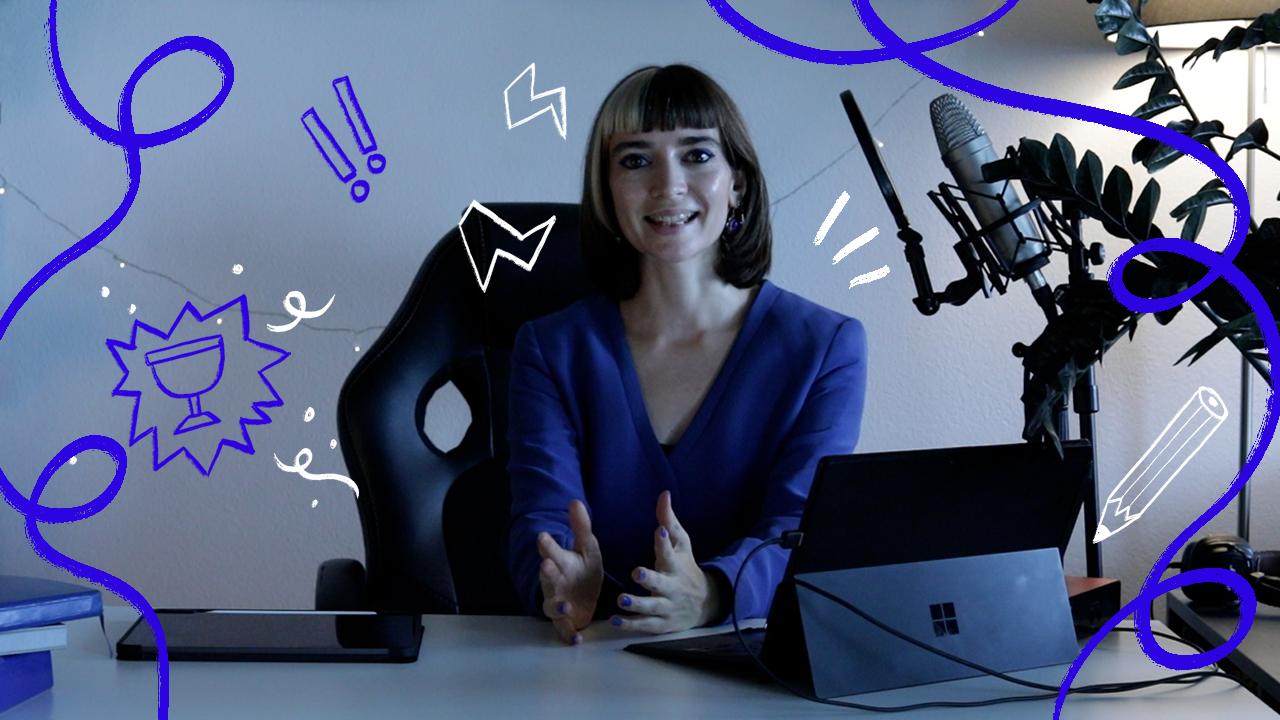
with their priorities. Hi, my name is Julia. I'm an animator,
illustrator, and director. As a freelance artist, I tried to balance plan
commissioned with personal work. And I soon realized how hard
it is to stick to them. The plan, especially when
it comes to side projects. In this class, I
want to share with you all the tips and
tricks I collected so far in order to accomplish my personal projects
alongside client commissions, I managed to make a
short animated film, self-publish scenes, result printed experiments, animated stickers and other small or bigger
personal projects. Personal projects are good to keep playing, try new things, collaborating with friends, but can also lead to
new opportunities. Attracting a new type of client, or maybe allowing you to
discover new passion, whether it's to
carve time to write, or you want to
develop a short film, or you want to illustrate
a book or make a podcast, whatever your side project is, this class might
be useful for you. You don't need special
materials to follow this class. I will provide you
with worksheets that you can fill out
digitally or print. The workbook will guide you through every step
of the process. This is also an evergreen tool you can refer back
to over the months. To find inspiration,
motivation, or guidance. You'll be able to
use it over and over for future
projects as well. Planning can be scary,
but through this class, I hope you learn how
to have fun with it, to be forgiving with yourself, and to practice flexibility.
2. Define Your Project: Welcome to the class. Let's first define what is the personal project
you want to develop. You might have 100
ideas or maybe you just know you want to do
something creative but you don't know
exactly what it is. It could be that you have
a big personal projects on the back burner or maybe
a couple of smaller ones. I usually have way
too many ideas popping up in the most
inappropriate moments. E.g. while working on
a big client project. For this reason, I have
dumped list to write those down in order not to be distracted from the
current project. I then go back to my
list later when I have the chance and the time to
start a new side project. Let's start here and let's go to the resource section to download the workbook
we're going to use. I'm going to fill the workbook together with you as we go. So maybe you have already
some very clear goal in mind. Maybe you have too many, or maybe you just know that
you would like to deal with a certain topic or
use a certain technique. All works in this phase. We are here to brainstorm
and brings out all the ideas and inputs that
you got in my list, e.g. I'm going to have some
more clear ideas, but also some more
general topics that I know I want to work with. I'm going to fill my
worksheets digitally, but you can totally print them out and do it on
paper if you prefer. And here we go. We start with the big
messy project dump. I'm just going to go
ahead and write down all the ideas and inputs, really without
thinking too much, just writing down what comes
into my mind and what I know as being a side project
in my head for a long time. Maybe it could be defined, maybe could be
just star keyword. Doesn't matter at this 0.1
thing I want to write. And I always wanted to make animated stickers
for social media. You know, those animated
stickers that you can use on Instagram
stories and so on. Then I thought if I'm
making any media stickers, then why not making
real stickers? And real seekers could actually become very
nice temporary tattoo. I always wanted to make
some temporary tattoos. Then I'm passionate
about recipes. I like cocaine. I like to exploring new recipes, in particular plant-based ones. I would really like to
do something with it. I always wanted to
make a coloring book. At some point I will. I love houseplants. I don't know if you can tell. And I thought that I could do a plant journal and house plant journal to keep track of your
plans and so on. In general and very much passionate about
environmental topics. So I'm going to write out
Environment and Sustainability. Because I know for sure
that I want to use my free time to do some
projects on these topics. I want to do a new
Skillshare class, ops and making it. Maybe you want to create
your own newsletter. I need to make a new intro
video for my patron. That's a side project I've
been postponing forever. I would like to make
an illustrated book. And I also want to try making
some illustrated notepads. I think they're fun and useful and I would
be nice, I think, to try a new product and
to have something new to sell on my online
shop or markets. Alright, Those are
my messy nodes. All of the ideas
that come into mind, it is a mess, but that's
just the first step. Now we're going on. The next step would be to put a little bit of
order in this list. And what I'm gonna do is
to grab a different color. Or I'm going to highlight two different things
in this list. I'm going to find out the what, which is the topic, the teams that I'm
passionate about, the actual content and the how, the how is going to
be the technique or the format or the product. So now I'm going to
explain what I mean. A technique or a format
or a product is e.g. a class, or a
newsletter, or a video. Or an illustrated book or
notepads or a journal, another book or stickers,
animated stickers. Those are all house. And the what, which are the
topics that I wrote down, the topics that are dear to me, the topics that I
want to develop, our recipes, plant-based,
environment, sustainability, ABC, intro, and houseplants. This is already helping me to understand what is what
and what is our how. Because it happens to
me very often that I write down my ideas
and I realize that some of them are about the content and some others
are about the technique or the tool or the format that I
want to explore or dry out. So e.g. I. Do want to
make animated seekers. I really want to learn how to implement them in my
Instagram stories. But I didn't think about the
topic of those stickers, but I know I want to try now
to make animated stickers. So the next step
would be to connect elements from this
massive list, e.g. yes, I want to make animated
stickers, but about what? I'm passionate about
sustainability and environment. So why not making some
stickers about that? Or yes, I want to make illustrated note pads
because I think they're fun. And I never made this product. I would like to try it out. It's gonna be about
recipes. Why not? I'm thinking I could make two different types of notepads, one for the recipe itself and
one for the grocery list. And then illustrated book. Again, I could
illustrate recipe, so it could be an
illustrated cookbook. Finally, some specific
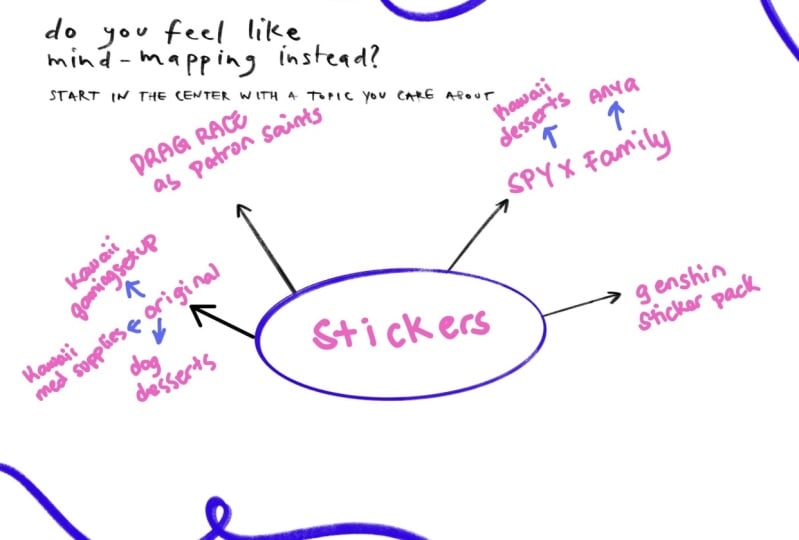
projects start to take shape. If you prefer to mind-map
for the brainstorming phase. The second page is for you. Of course, you can go back and
forth between these pages. It's up to you. Whatever works. In this case, I'm going
to use it to brainstorm even further about some
topics that are dear to me. I'm gonna give you an example. But in general, this mind-mapping technique
is good to come up with keywords or for more connections between ideas or between words. I'm going to brainstorm about the topic of environment
because I realize this is something that is
dear to me and I would like my side project to
be about this topic. Environment for me
means Sustainability. I'm also thinking
about awareness. Global warming. Really, any word that
comes into mind at this point is useful
to just write it down. Plant-based plants. Next, what I'm gonna do is
to try to connect elements. Some connections are
already in place. Recipes come out here again. If this is useful for you
and your brainstorming, use this mind-map technique. Otherwise, the big messy
project dam could be enough. And next, we're going to make
a little bit of order in our Messi list and
name the project or projects depending on how
many you came up with. This is a way to
clearly see them better to visualize the
project and give it a name. We're going to describe
the project in this table, describing the how, the what, and finally also defining
the effort for it. And you should be specific
like in this phase, we're going to
describe the projects. So the more specific
you are, the better. I'm going to show
you what I mean. A series of, let's say, six animated stickers
for Instagram stories. What about the environment? And I could be even more
specific and write about global warming about the effort we're going to talk later. So I'm going on
describing enlisting my projects is a set of
two illustrated notepads. One about recipes and the
other one grocery list. So finally, I want to make an illustrated cookbook of my favorite 24
plant-based recipes. So I'm trying to be specific. Not only an hour, I want to
make an illustrated cookbook, but I know it's gonna be about my favorite 24
plant-based recipes. So go ahead and write your
own projects in this table. It could be something like this, but it could also look
completely different. Maybe your project is a novel that you always
wanted to write. Maybe it's a podcast, maybe it's a series
of paintings. The next step is to
define the effort. So how much time consuming, energy consuming is a project of vigorous one-star is going to be an easy project to stars, medium effort and three stars, a big challenge, a big project. In my case, I think I'm the first project
animated stickers. One is quite easy
and straightforward. I've done GEFS before. They are all digital. I think this project is
going to have one star, which is simple to stars for the grocery and
recipe notepads. Because I've never done that. And it's a little bit
of a longer process, I think, because it includes printing and a physical product. And finally, the cookbook for me is a big challenge
and a big project. Lastly, it's time to pick the projects that
we want to make. Of course we cannot do all the projects
are the same time. And that's why we could
actually should pick 12 or three projects depending on our time
and energy consuming. They are. So I am always quite optimistic and I think I'm going to be able to
make all three of them. Of course, I left
something aside, e.g. their house plants journal
or the Skillshare class I'm actually doing right
now. So here we are. I defined three projects I
want to do in the next year. They have different weights as the animated stickers can
be done quite quickly. The note pads are a
medium effort for me and the recipe book
is the big challenge. You might have only one project, which is totally fine, or multiple small ones. Just try to keep
it realistic when thinking about the
time and effort. In the next lesson, we'll go into details to start breaking down the steps
to reach our goals.
3. Breaking Down: Now that we know what kind of final project we want to make, let's start breaking down the to-do list to get
to the final result. Those are the steps to
accomplish one of your project. Of course, if you have
multiple projects, you will want to make a
to-do list for each project. So let me first explain you why are we doing a to-do list? There are actually multiple
good reasons too often it's easy to underestimate the work that goes into a
creative project. This means we can
get discouraged when we encounter
some obstacles. Breaking down and
defining each step, we need to get their
alphas to realize the effective work which is required to accomplish
a certain goal. In fact, often you don't realize all the steps until you go through them and you name them. Secondly, breaking it
down into smaller, more digestible steps makes it more approachable
and less scary. We all have big and good ideas, but then it looks
like a huge endeavor and we all get scared
and not knowing where to start tackling the
problem one step at a time makes the
whole process more digestible and easier to start. So for each project
you want to do, you're going to have to write
a different to-do list, of course, but I'm
going to do now is to duplicate this
layer three times. Because I don't wanna do it
for the animated stickers, for the notepad and
for the cookbook. So let's start with
the animated stickers. This to-do list is
quite straightforward, but I'm gonna go through
it very quickly. For sure. The first thing I have to do
is to sketch some stickers, ideas and then select
seeks that I like. Then I'm gonna have to
pick a color palette. Finally, I have to animate them. Then to save them as GEFS and upload them
to Giphy my case. Then once I uploaded
on GIF here, I have to choose an hashtag
which is going to be useful to find my stickers. And that's it. Then I'm going to have to share and use them. So this is quite
straightforward and of course, you can also start from the
goal if it's useful for you. Sometimes were bigger
projects is better or easier to start from
the final result we want to achieve and break it down backwards to see
how to get there. But let's move to the next one, which is going to
be the note pads. For the note pads, I want to do first and I'm
going to add it into my list, is to brainstorm and research a little bit because I
never done such a project. Maybe it's worth
scheduling some time for research or mood boarding. Then I'm going to
sketch the elements. In fact, I'm thinking that I'm going to
reuse some elements, some illustrations,
and move them around in the
different notepads. Reuse. Finally, I'm going to design
the notepads and work on the composition or layout. And then I'm going to do
a print test to check the colors and the size of the text and adjust when needed. Then I'm going to find
the best print service. I'm gonna write
down even finding the best print service because this is going
to take some time. So I should as well
scheduled this. And finally, I'm going to
prepare the files and order. And after it is all
the marketing phase, but that's another list. Lastly, I'm going
to share with you the to-do list for the cookbook, which is the biggest and
most challenging project. Here again, I want to schedule some research
brainstorming, mood board to visualize better the result
I want to achieve. Then I'm going to
learn in design. I realized that I don't
know how to use InDesign. I never opened it. So I'm going to need to
schedule some extra time to learn a software that's going to help me to achieve this project. At first, I didn't
think about it. But then while
making this project, I realized it was
actually crucial to schedule some time to
learn something new. And then I'm going to write
the copy, the recipes. And actually, now
that I'm writing, I realize there's
another step in between, which is choose the 24 recipes. So after I selected
the 24 recipes, I'm going to write the
copy for the book. Then I'm going to
make flat plan or basically a layout to see where the coffee and the image go on the page
counting and so on. Then I'm going to sketch and
design the illustrations. I'm going to decide the font
and finalize composition. Finally, I'm going to prep the files and then
upload an order. And in this case, with such a big project, it would make sense to
start from the goal. And so asking ourselves, e.g. do we want it to be
an e-book or do we want a paperback or both? Then going back. So what do we need? We need like digital files. But for print or not, etc. Start thinking
about how much time you need for each step. Be realistic. Compare this with the
previous estimation you made. This could help redefine how
difficult the project is.
4. Priorities & Non-Negotiables: First, let's define our
priorities and non-negotiables to find out how much
time we can free in our typical week or month. So here's the phase where we
define our priorities and non-negotiables and
how much time we actually have in our daily life. Everyone's priorities
and non-negotiables list is going to be different. Of course, we're all different people
with different lives and different responsibilities
and different jobs. So I'm just going to give
you some ideas here, filling my own list. But of course, your lists
could be completely different. E.g. in my case, one very important
priority for me is to have my 8 h of
sleep every night. So I'm going to write
this down because for me, 8 h of sleep are necessary
and I would never wake up, let's say at 05:00 A.M. to do my passion project, I'm
going to write it down. Then, as I mentioned before, each one of us might have
different responsibilities. If you have a child or you
are working for a charity. And those are
non-negotiables for you. This is something you want
to write down because those have priority
in your schedule. Of course, I'm
going to write down quality time with loved ones. In this phase, you also
find out if there is any time you could free
up or use better, e.g. commuting, screen time,
social media, et cetera. And so in this
phase, I ask myself, is there any current
endeavor I can avoid? Can I free up some
space if he has where? Maybe I could use
the commuting time. If it's only 1 h in the
evening or the full, we can just write it down. Sometimes I tend to give
priority to decline job because it's a client job and because usually
it brings money in. But I'm not going to write it
down in my list now because that's usually my problem when trying to make a
personal project, I tend to always give
priority to any client work. While sometimes I
could just say no to as well client commission and work on my passion
project instead. Another thing we
could do is to use this graph on the right in order to have a more visual
representation of our time. This pie chart is about
your typical week, but of course you can do your typical day or month or or whatever
works best for you. I'm going to allocate
around us time of my week to work
on commission work, sometime for family
and quality time and some meantime workout. I keep some space for other, for some any kind of
unexpected things. And finally, I'm going
to have some extra time, which is for my side project. This is a further exercise
that could help you define your priorities together
with the previous page. So while we have here
is a graph dividing tasks or projects based on
the urgency or important. With this graph, we
understand better which project is more
urgent or important. E.g. in my case, I know I want to make the
animated stickers as soon as possible because I want to use them in my Instagram stories. So they're going to
be quite urgent. Not super important. So maybe I'm going to
put them in the middle. On the other hand, the recipe book and
the recipe pads, they're not so urgent because my goal is to have
a product for Christmas. So I have our earlier
in front of me. So I'm not so urgent,
but still important. So there's going to be
in the lower right box. Both of them. But I think the pads are more
urgent than the cookbook. What is in this corner of your graph as
priority number one. And then this is gonna be
the second one, et cetera. This is probably the least
important or urgent. For sure going to work on
animators seekers first, and then move to the recipe pads and
Cookbook along the year. So grab your calendar
in the next lesson, we're going to start looking
at timing and scheduling.
5. Grab Your Calendar: This is the time
to have a look at the months ahead and see how we can fit our
personal creative projects into our busy lives. When I look at my calendar and start imagining where
I could free up some space or where
I already have some space to work
on my side projects. So e.g. maybe I decided as a freelancer that I'm
going to dedicate one day per week to
my side project, which is maybe your day off in my case is
going to be Wednesday. And the rest of the week is
going to be client work. And then there are the weekends. In the weekends, maybe I'm
going to have some friends and family or
hiking, road trips. Maybe you think
you could dedicate Alpha day of each week
and do your project. So there could be something, maybe you do have a general month schedule,
maybe you don't. So you could totally
skip this phase. But maybe I know that
every last week of the month I'm full of
deadlines for deliveries. So maybe it's always
busy and hectic. I'm not going to add
some work there. And the same thing
goes for the year. Maybe you already know when
you're going on holiday. Let's say August. It's holiday, Easter holiday,
Christmas holiday. Or maybe, you know,
you're going to have a big client between
February and March. So I'm not going to schedule
passion projects there. That's already something
we're going to dig into those calendars deeply
in the next slide. Now I'm going to
think in detail about my ideal week or
typical ideal week. I said Mondays and Tuesdays are going to be for client work. Wednesday is my
passion project day. Sunday is family and friends. Then here at this point, we can add more. Maybe I know that every
Tuesday night I'm going to work out, going to the gym. Maybe you know that
mostly Friday or Saturday nights there
is some kind of party. Can be a birthday party, could be hanging
out with friends. So maybe you could
write this down. In this way. We find out e.g. if we add some extra
hours urine there, e.g. in the evenings, maybe
we want to dedicate 1 h every Thursday evening
and every Monday evening. Or maybe you know that you are commuting a lot
and maybe you can have 1 h every day in the
train or something like that. So this already looks like we know a little better
in our weekly, ideal weekly plan where we
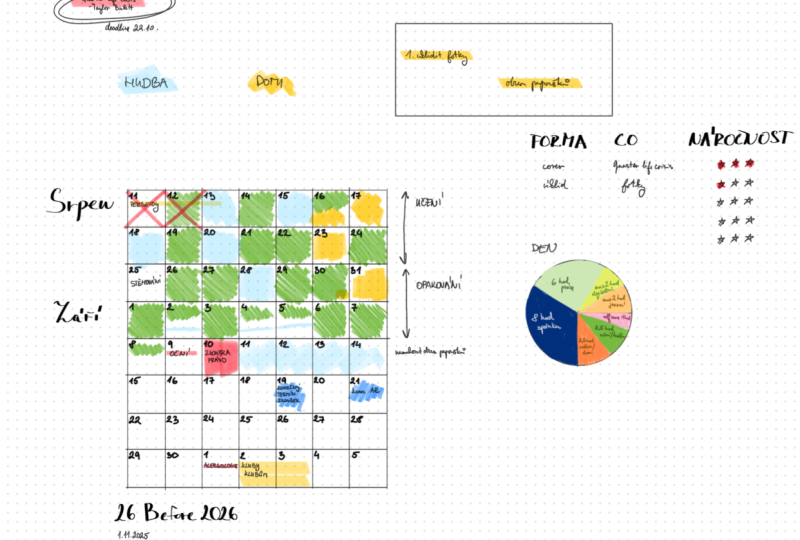
could feed our side project. Next, we move to the month. First, I'm going to
write down which month and I'm gonna put
down the dates. This is the month of April. Maybe I already know. I'm going to have some events going on that are going
to change a little bit. My planning, e.g. I have a birthday, I have to attend. Or maybe I have a
road trip planned, or maybe a family lunch. Or maybe you also have a Dr. appointment and maybe
even a big deadline. After we have written down all the things we know
we're going to have to do. We're going to find out if
and where our project fits. So we said to ourselves, every Wednesday is going to be dedicated to our
personal projects. So here we can work on
our project. But e.g. the day that I'm going
to the Dr. appointment, probably it's not going
to be the full day. So it's gonna be a
part of it or e.g. the 23rd year because it's
so close to a deadline. Maybe I'm not gonna be
able to work on it. Maybe I'm going
to be very tired. So I will not work on my side
project during my free day. Maybe I'm going to catch up with work in order to
meet a deadline, maybe I'm going to rest. So probably not
working on my project. And then we also said that we could work on our
project on Saturday. So as you can see, maybe we could work on these
first three Saturdays, but not on the one where we're going to
be on the road trip. Then we also said
Monday evening. So here there could
be some space for our work Thursday evening. So here we have a
plan to work on our project in the
month of April. And I would do this
at the beginning of the month or like planning
for the next month. And of course, you
will have to adjust and revise this
calendar as you go. Now we move to the yearly
calendar year, of course, again, it's gonna
be hard to predict all the unexpected events
they are going to pop up. But we can start
with what we know. So I know that
February and March, I'm gonna have this big client. I'm going to write it down. And I know that in May, I'm going for a trip maybe a couple of days
that I know that in August I'm gonna
go on holiday. Maybe not the whole month, but still it's going to disrupt
a little bit our rhythm. So let's keep it in mind. Then. I know that the risk
Christmas in December, which is both a holiday, so I'm probably going to
spend time with family. But also, there are
Christmas markets. And Christmas markets
are important for me because they represent a
deadline for my products. Because I want to have
my projects ready and done in order to sell the
products at the market. So now I'm going to
start thinking where I can fit my three
projects that I picked. And I'm thinking the
animated stickers are fast. I want to make them quickly in order to use
them as soon as possible. I'm going to make
them in January and a month should be more than enough to
complete this project. Then I think I'm going
to start work on my note pads in April and in
June or fully print them. And then I'm going to schedule the recipe book work until mid-November because
usually Christmas markets are also in November. This is how the
general plan looks like when I finished to
complete my yearly calendar. And let's move on. In the next lesson,
we're going to talk about scheduling
and checkpoints.
6. Schedule a Checkpoint: It is important and necessary
to check along the way how you are doing and how is
your project progressing. When you reach a Check Point, a milestone or a deadline? Don't see it like a scary test, but rather as a chance to
learn about your process, see how your creative
year is going. And if you needed to adjust, as we said, it is totally
fine to tweak your plan. You will learn more about yourself and you will
reschedule as you go. Especially for bigger projects, it is important to have checkpoints or
milestones in order to check out the work
in progress is doing to keep track
of the schedule. Otherwise, a big project
can be quite overwhelming. This is the case for
my cookbook project, which sounds like
a huge endeavor. And it's easier if
it's broken down into small deadlines were achievements
throughout the year. Check if you're progressing
on your to-do list, schedule some reviews or feedback on the
work in progress. Of course, you can
proceed on the plan only if the checkpoints
are reached. This could also be the
opportunity to realize that we over planned or field
our plate too much, or on the contrary, that we are faster than
we expected at any point, you can reconsider
your schedule, work on it again and
polish it to your needs. Maybe your life work
schedule changed. Maybe your project is going smoothly and you want
to add some small beat. Or maybe you need to trim
it down and simplify it. Always remember to stay flexible and forgiving
with yourself. For my cookbook project, I actually have to be
very much flexible and readjust the schedule along
the way multiple times. In my personal experience, the cookbook plan was
very overwhelming. In fact, it is a big
project and it was a much bigger effort than I
imagined on the first place. If it was at the beginning, at 24 illustrated
recipe collection, it became than smaller. And actually towards
the end of the year, I even decided to simplify it to recipe cards
rather than a book in order to have a product
for the market and postponing the actual book and printing for the next year. So now we're going to
go ahead and schedule checkpoints in our calendar in order to keep track
of our progress, I'm going to schedule checkpoints
on the yearly calendar. Because most of my projects, the notepad and the cookbook, they are spread across the year. I'm going to work in
a yearly calendar to set some milestones. Then after I'm going to
go into January month in order to schedule
some milestones for the stickers project. Okay. So I'm gonna start
with the note pads. I'm going to put a
milestone at the end of April for my notepads. It's going to be
style and layout. Then at the end of May, it's going to be design. And then at the end of
June is going to be none. For the cookbook I actually
already wrote before. I want to work in July
on the plan and copy. So by the end of
the month to have the copy ready and
an overall plan. Then by the end of September
of all the designs, by the end of October,
all the layout. And of course, by
mid-November must be done. So I'm gonna write
15th November. You see now I'm
realizing that if i in order to
receive the copies, I have to order by
the end of October. So probably send to print. By the end of October. Yes. Now I'm gonna go in the month of April to put some deadlines
for the stickers. So let's pretend this is
my months of January. And my side project for the month of January is going to be the animated stickers. So now I'm going to
set some milestones in order to complete
this project in a month. I read from my to-do list that I need first to sketch some ideas, then pick a color palette, then finally animate
the stickers and export them as a GIF. The biggest chunk of my work is going to
be the animation. I'm going to dedicate the
first week to the design. So by the end of the week, I want to have the design, the ideas, and the
colors decided. The second week. And probably the third is going to be dedicated
to the animation, which is the biggest chunk. So by the end of the third week, I'm going to have a milestone
for completed animation. And actually, because I know
how the animation processes, I'm going to keep the 21st
free for any kind of retake. It's actually very small
considering is just to an hour, but we're going to
keep that as retake. I'm going to set Then
the 30th of the month as a final deadline, which means that I'm
still going to have more than one day in order
to export all of them. Upload down g fees
at the hashtags. So gives me still a little
bit of retake time. Actually, you're going
to write it down. Yeah, I think this is a good plan for my
animated stickers. And it's also an example
of a shorter project, while the other ones
are a little longer. So of course, you could
also get into details in this way for the
big project, e.g. for my cookbook, I would
also then getting into the monthly plan and try to
break it down even further. For instance, if there
is a Month dedicated to the illustrations
of my cookbook, I would then go ahead and
divide each week in order to, let's say, illustrate two
or three recipes per week. The next lesson is all about motivation and how to boost it.
7. Motivation Booster: During the process,
you might find yourself losing
motivation or focus. It is totally normal, especially if the project is diluted in a long
period of time. And if you're doing
it on your own, you might experience
times of confusion and despair, discouragement,
destruction, etc. This is a lesson you
may want to rewatch for a motivational
boost in order to remind yourself why you
started this project in the first place and to
find new fresh energy. This motivational
worksheets are also a good section to go back
to along the process. Lastly, make it easy to start. Setup your material in space
so that it's always ready. Remember, starting
is the hardest part. Let's get to the worksheets. So here we have our
motivation worksheets. If you're working on
multiple projects, of course you're going
to do this process multiple times for each project. I'm going to start with
a cookbook project. And here there are a couple
of questions we could answer. Those questions are
supposed to help you realize and then
later remind you, what are your core reasons? What are the reasons why you're doing this
project in order for you to find new motivation and refresh it when you need it. So why did you
pick this project? In my case, for the
illustrated cookbook, I'm going to write, I feel I need to work on a side project that is
meaningful and useful. And I believe it's important to switch to a more
plant-based diet. Plus those recipes are delicious and the world needs to try them. Or e.g. I. Could also write,
I would like to challenge myself and try to work on a printed product
because I never did it before, like a whole illustrated book. So that could be
a nice challenge. Just ask yourself,
what are your reasons? And you don't have to show
this to anybody else. If you don't feel comfortable, you don't have to share this
in the project section, but ask yourself why? Really? What are the reasons why you want to do this project? The second question is, what is it going to change
once you complete the project? Once you complete it? What is this project
allowing you to do? This question, L2 to project yourself to the
end of the project to visualize what are
the benefits that you will get once the
project is completed. And this helps for sure for the motivation and to keep
going for me for sure, I will be able to have a physical product
to sell in markets. And also, I would for
sure learned a lot along the process because it's the first time that I'm working
on an illustrated book. Other examples could be that
you are going to enrich an, a larger portfolio, try out new techniques and
get better at those. Or it could be to share finally, with the world that story
that you always add in mind. And the last question
is about success. Asking you what does
success mean to you? This question also helps
to manage expectations, to understand what is the sign or what will
be the sign that we actually succeeded and did a good job isn't just
to finish the project, is to get one person
excited about it, or is it to become the
best seller in the world? So in my case, it's probably mainly just to get some good feedback
that will be enough, even if just one person
will be affected by it. I think that will be
already a huge success. So I'm going to write, I'll be satisfied to see
this project completed, printed, and to receive
some positive feedback. Even just one person
telling me that the recipe is delicious or like a deletion. Deletion discovery would make my day and make this
project work team. Okay, so now that we
completed this first part, I should go ahead and feel the same motivation page
also for the other projects. But this one is the biggest
project for me, sorry, It's the one that needs more motivation to keep
going for many months. The next page is about writing a letter to yourself
or to your future self. And I'm going to go
ahead and do that. You can do it like
this on a piece of paper or maybe on your notebook. But another thing you could do is to write an actual e-mail to yourself that it's gone to
reach you in the future. There is a service
online doing this. It's called Future me. Probably there are
also others doing it. Sometimes I do receive
e-mails from the past me and I find it
fascinating and fun. So I'm going to
do this right now for my illustrated cookbook. The following page is
about social commitment. You can find and create
social commitment in real life online, e.g. telling your
friends, colleagues, or family about your project or sharing your progress
on social media. The people in your life
are going to hold you accountable actively if you ask them to passively
because you feel the responsibility to do what
you said you wanted to do. In my case, I create
social commitment online on social media
with my patrons, sharing my plans and progress, but also with the subscribers of my newsletter and with
family and friends. Ultimately, the hardest part of a personal side project is the fact that we are
usually alone doing it. The people in your
life can help you stay motivated and engaged, checking if you're on track
and holding you accountable. Another trick to
stay inspired is to surround yourself
by creative people. Following some artists on
patriot and listen to podcasts, or even make your own moodboard for this particular project. Last but not least, keeping an achievement log can help with motivation as well. You can and should write down
every smaller achievement, such as reached Milestone, a solved problem,
a nice feedback, or simply a good feeling
about your project. We will talk about the
importance of celebration later and how this is connected
with your motivation. Up next is a less than about flexibility
and rescheduling.
8. Flexibility & Rescheduling: Of course, despite
our best efforts, sometimes our plants
have to change. Life happens and
we cannot expect the plan to go exactly
as we imagined. That will be ideal, but often it doesn't work. So this means that
checkpoints and milestones not always
are going to be met. Actually, most of the time things don't go
according to the plan. There is a quote that says, life happens while you're busy
making other plans, right? Yeah. I think it's pretty
accurate and that's a fact. So let's just be aware of
this fact and embrace it. I'm going to show you
some personal example. I'm going to share the delay that I had with some projects and how I manage to shift
it in the timeline, readjusting,
resizing, et cetera. I'm going to share this
so-called failure, even if I don't want
to call it failure because that's how
the process go. And this is what happened
with the cookbook. So here I'm going to show
you some examples for rescheduling and for readjusting the calendar when
something doesn't work. In my January month, the plan to make my
animation stickers. I'm going to go ahead now and
try to fix some problems. So let's pretend this
the 19th of demand. And we didn't reach our milestone to
complete the animation. Or in this case, I was already good in the
planning phase because I did calculate to have some retakes
before the final deadline. In any case, what I would do
is to postpone the deadline. Maybe I'm gonna put
it on the 28th. So this is the new deadline
for finalize on emission. So that in this way I still manage to hit the
deadline on the 30th. If not, it's also fine to go on the next month and
postponing even more. But now I know in my planned
the following month, I have this big client. So probably I'm
going to try to keep it in the month of January
on a larger scale. I'm going to show you
how I postpone or readjust my planning
in the year e.g. and in particular, now
I'm going to share with you some real facts about my own planning and
particularly about the cookbook I did plan
to make this year, but but things didn't
go as planned. So I had to readjust
my schedule. So what happened is that
I didn't manage to get the plan and copy
ready for June. Actually, the copy
was not ready, so I postponed the coffee together with the design in
the fall when milestone, which was copy and
design at this point. But then what happened is
that this was for real, a big, big project. I totally underestimated
the amount of work that was
necessary to complete it. So what I ended up doing
and that's why I want to, um, to share with you. Not only I try to reschedule and to give myself more time, but then what I ended up doing, I think in September, was to realize that I
actually didn't have the time to complete all these tasks before
the Christmas market. So before the end of the year. So I decided to change my
plan to re-size the project. And what I did was to, instead of making a cookbook. And that point, I decided
to make some recipe cards. So I already had some copy
and already had some designs. Instead of publishing
a whole book, I decided to print
separate recipe cards so that I could still have some products to
sell at the market. But at least it
would have not been such a huge project and
efforts such as a cookbook. So now it became
recipe cards project. And also from the 24 recipes that I scheduled
at the beginning, I decided to cut it down and go to 12 and to make just
six recipe cards. So that was more doable, more realistic for
time available. And I decided to postpone to the following
year the actual cookbook. I still want to do
the cookbook project, but it's going to be
postponed a little bit. And actually making the
recipe cards ended up being a good choice because
I actually learned a lot about InDesign anyway, and layout and composition. I printed them, so I did manage to check the
colors in print. And also, it was a
great test to see how my audience is reacting
with this kind of product. These are, by the way, the recipe cards
I'm talking about. It is like a page
in the cookbook, but they're all separate. And this allows me to
still make my project but in a more doable size. So why planning
if it's not going to work exactly as we imagined? You might ask, That's
a good question, but I think I have a
good answer as well. Even if I know the plan will
most likely change a little, planning gives me confidence
and helps me to start. I feel like I have a plan. I got it. I can
tackle this project. I'm allowed to start. The plan needs to have
a built-in resilience, which accounts for
uncertain events. The plan is malleable, implies that we are flexible, that you can adjust
and forgive yourself. And this also means less
pressure on the planning. I think that planning
is a matter of projecting ourselves
into action. Planning is in fact the first
step to start a project. It allows us to consider all the variables and come
up also with a plan B and C. And accepting advanced effect that it
might work differently. Flexibility is
crucial and that's why I dedicated a
whole lesson about it. Some people think
that the plan fails the moment it doesn't
go exactly as written? I don't think so.
Shifting, rescheduling, resizing, postponing. These are all
possibilities and they are part of the process and will
help you to reach your goal. So let's embrace the
imperfection of our plans and say flexible
rescheduling is fine. And in this part of the process, in the next lesson,
we're going to start.
9. Start!: This is a lesson
to remind you and myself that planning is great. But the next most important step is to start working
on your project, define your start
date and go for it. Don't get into the
procrastination loop of planning. Yes, it is a thing.
And I've been there. Once. You will get to
the end of this class, you will be ready to
tackle your projects. You get this. This was a short lesson and
there are no worksheets here. In fact, it's all about
action, not planning anymore. In the next lesson, we're going to talk about dopamine kick.
10. Dopamine Kick: This class is about not forgetting to celebrate
your success. It is important for your motivation and
your reward system. If you met a
milestone and you are one step closer to
the final deadline, this is worth celebrating. Let's just acknowledge
the power of the tick. How good does it feel to
take something off list? It feels amazing, right? And this is the dopamine party going on in your
brain and giving you energy and motivation to keep
going on these worksheets, you can track your success and remind yourself to celebrate. Milestones check also helps
you realize at which stage of the process you are and what percentage of the
whole project is done. You can see how the
celebration and motivation here go hand in hand. And some parts also in the
worksheets do overlap. So don't hesitate to
go back and forth in your worksheets to check
your milestone lists, to check your achievement list, and to keep your motivation
and celebration going. In fact, the moment
you feel good about your project and yourself, you feel energized to go on. Even planning for a celebration is going to boost
your motivation. You will protect yourself
into that pleasant situation, and this will give you fresh energies in
order to reach it. The reward can be a
treat you give yourself, but it can also be organizing
and hosting a party. In my case, I always tend to celebrate both online
and in real life. And I try to involve
all the people that follow my process and
kept me accountable. Write down the ways
you're going to celebrate a certain
achievement or goal. In this way, you're
going to visualize the reward and boosts your
motivation even further. The perfect place to celebrate your achievement is in the
project section down below, where we can support
each other and celebrate small or
bigger victories. Remember, celebration is an
important step of the plan. So don't skip it.
11. Bonus: So let's say running is
that this class is about planning and learning how to
be flexible with your plan. At the moment, I'm very upset because the weather is really cloudy and very bad for
lighting of this class. And I guess all I have to do right now is just
put into practice what I'm preaching and
be flexible with my plan and readjust it and
make it work anyway. So on another node, here are the results
of my side projects. For the purpose of this class, I recreated in front
of the camera for you the planning I made for
myself for the year 2022. I showed you step-by-step how I preceded and edited
my plan as I went. These are my animated
stickers that you can find a news on
Instagram stories. Here is my set of
notepads that I already printed twice because they've been a great success. And finally, here are
the recipe cards and the working progress of the cookbook that I
shifted for the next year. All in all, I did not manage
to complete the recipe book, but I learned a lot
from the process. On the other hand,
I managed to make the plan journal and
to Skillshare classes.
12. Wrap Up: Congratulations, You made it
to the end of the class and now you have a plan to
tackle your side project. Here's a little recap of what
we learned in this class. We define what is the project
that you really want to do. And also define the time
that you actually have and which ones are your
priorities are non-negotiables. Then we worked our way
through the calendar to find the actual spot where we could dedicate time
for this project. And we learned all about motivation and
tips and tricks to keep us engaged and
committed to the project. Scheduling milestones and
check points will help you to keep track of your
progress and to motivate yourself even further. Most importantly, don't forget
to celebrate your success. So I'm going to start
now celebrating you for finishing this class. And I hope that
not only you have now the tools to rock
your side project, but you also have a more comfortable relationship
with planning in general, remember that the worksheets
are there for you, not only for this project, but also for future ones. You can come back
to this structure whenever you have to
tackle a new planning. And we are going to support each other and keep each other accountable in the project
section of this class. So be sure to upload
a work in progress. In the project section, we can track each
other's progress and motivate each other. So let's share what we've made. This will also encourage
one another and help put the motivation
booster We all need. If you have any
question along the way, please ask down below. Not only you will get
personal feedback from me, but hopefully this might be
useful for others as well. Lastly, if you
share anything from this class on Instagram
or other social media, please use the hashtag
time management class. In this way, I can follow your progress and be
proud of my students. I wish you all the best with
your creative projects. By the way, if you're looking
for a creative challenge, I have another Skillshare class about animated morphine loops. So that may be, could be
your next side project. If you could leave a
review for this class, this would mean a lot. It helps other students finding the class and he helps
me to understand what you loved about
the class so that I can improve and make
better new ones. I really appreciate
your support. Follow me on Skillshare
and on social media and check out my website if you want to learn more about me. Thank you for taking this
class and see you soon.
 Giulia Martinelli, Animation Director / Illustrator