Transcripts
1. Intro: If you're struggling to make progress on things that matter, a habit, a project, a skill, your health, I get it. My name is Rich Armstrong. I'm an artist, author, and a content creator. I've procrastinated, I
felt overwhelmed and jump between ideas like a
monkey chasing a banana bird. But I've also moved
countries, changed careers, written books, built apps, and created over
40 online courses. So what's the difference
between what I finish and what ends up half
done or never started? I boiled it down into
a simple structure I call the 28 Day
Project method. You pick one focus. Work on it every
day for four weeks, even just for 5 minutes a day and review every seven days. It's flexible, repeatable,
and it fits inside your life. It even works for procrastinators
and perfectionists. Students have used it
to finish projects, create habits, and
learn new skills, and you can use the method
to make progress on whatever is meaningful to
you time and time again. In this course, you'll
learn the method, understand why it works, choose your next 28 day project, be guided through the
weekly checkpoints and learn how to
repeat it monthly. With this method,
you stop waiting for someday and start today. If you're ready to
make progress on what matters, then
let's do this.
2. The 28 Day Project Structure: How does a 28 Day Project
work? It's really simple. It's a four week
project cycle where you touch your
project every day. We kick off on the first
Monday of every month, same start day, same end day, easy rhythm, easy planning. Then at the end of every week, we reflect, review, and
adjust course, if necessary. I'll take you through
each of these checkpoints in more detail later
on in the course. And that's the
simple, repeatable structure of a 28 day project. It's predictable
enough to be calming, flexible enough to be livable. Now, two important caveats. Caveat number one, that sometimes a month
will have five weeks. When this happens, you
have three options. Take a rest week, do a seven
day pala cleanser project, or extend to a 35 day project. Caveat number two is what if you want to get started
on a 28 day project now, today, but it's in the
middle of the month. No problem. Do a shorter project now then sync with everyone
in the next cycle. Now, in the next
lesson, I'll cover why 28 day projects work so
well, so I'll see there.
3. Why 28 Day Projects Work: So why 28 days? Why this method? Why not 100 day project or a 365 day challenge or just doing life the
way you always have. Here's the thing. The 28 Day
Project helps you finally make progress on the things
that actually matter to you. The things you keep saying
you'll get to one day, the things you start and stop, the things that sit
quietly at the back of your mind whispering,
Hey, remember me. It's for those things. Now, there are probably tons of reasons the 28 Day Project
method works so well, but I've got seven to go
through in this lesson. Number one, it's the
right amount of time. 28 days is long enough
to make real progress, but short enough that your
brain doesn't freak out. As Goldilocks would
say, just right. It's not a huge mountain. It's not a forever marathon. It's just four weeks of focus. And the time you spend each
day is totally flexible. 5 minutes, 30 minutes, 2 hours, you decide you bend
it to fit your life, your energy, your season. Two, the structure is simple. Which means it's hard to
mess up or break or forget. It's modular, it's predictable, and it fits into weeks
and months and seasons, which is how we already
think about time. You get 12 shots a year to focus on something that matters, and it has these built in
checkpoints every seven days. That rhythm helps you reflect, adjust and keep momentum going. Reason number three is
that it creates focus. You can't do everything,
and that's the point. You get one focus per month. That forces clarity. You start saying
yes to one thing and automatically
no to the noise, no to everything else. Over time, that focus crystallizes what
you actually want, not what you think
you should want. Four, it builds daily action. This isn't about finishing
something huge in one go. It's about showing up every day, even for 5 minutes. That small daily act tells
your brain, I'm doing this. No, I'll start when
I have the time. That's how you beat
procrastination, perfectionism, and overwhelm. Consistency over
intensity. Good days, bad days, they all count. You'll see that
progress adds up, that consistency breeds quality, and that self judgment slowly
turns into self trust. Reason number five is
that it builds habits. When you do something
every day for four weeks, it starts to stick. You're wiring a new
default in your brain. And if you anchor
it to something you already do like drinking coffee, brushing your teeth,
sitting at your desk, it almost runs on autopilot. Repetition leads to motivation.
Not the other way around. Reason six, you
upgrade yourself. Each project cycle changes you. You gather new data, new
confidence, new self knowledge. You learn what energizes you, what drains you, and
what actually matters. You build momentum
and start seeing yourself as the kind of
person who follows through. And that's huge. Every 28 days, you level. And reason seven, you learn
a ton about yourself, your craft, your
patterns, and life. Some lessons hit early, some sneak in on day 26, and some only make
sense months later. But the point is, you learn by doing by showing up again
and again and again. That repetition
unlocks the magic. So, yeah, that's why the
28 Day Project works. It's doable, it's flexible,
it's transformational. It turns someday into today, and I should do this thing
into I did this thing. In the next lesson, I'll help
you choose a project for your next 28 Day Project
cycle. I'll see there.
4. Your Next 28 Day Project: Alright. Now it's time to choose something to work on
for the next 28 days. My 28 day projects are
typically important things. My brain things I can
only work on when I have large amounts
of uninterrupted time. But this is just my brain
being a perfectionist. You can work on
meaningful things in small amounts
of time each day. So, write down all the
things you want to do, especially the things
you rarely want to do, but haven't made progress on. Planning that once in
a lifetime holiday, learning a new skill or piece of software, updating
your portfolio, getting a new job,
practicing yoga, meditating, making your garden look nice, finishing your
write it all down. Then pick one you want to focus on for the next 28
days. Don't overthink it. Remember, in 28 days, you'll choose a new project or recommit to this one.
Quick interlude. If you have a vigilian
project ideas and cannot simply pick one, or you feel like
you have no ideas, skip this lesson and watch the choosing a Project
exercise lesson. There, I'll help you surface all your ideas and
then filter them. Also, have a look at
the project ideas PDF. You'll find a bunch of
great ideas that may spark ideas for your
own 28 Day Project. Okay, into Lou Dutton. Now that you've got a project, let's set expectations and
prime your brain for action. We can do this with
two questions. Firstly, how much
time does your brain realistically feel
comfortable with spending on your
project every day? Look at your calendar and tailor what's possible
to the month ahead. Go as low as you need to so that your brain's
not freaking out. You want this to be
a game your brain believes it can win. Secondly, where and at what time of day are you going
to work on your project, and will you anchor it
to an existing habit, which is always going
to make this easier? Be as specific as
possible 9:00 A.M. While drinking my coffee
at the breakfast table, when I sat down at
my desk to start working during my lunch
break in the park. Okay, you've got your project. Now there's just a
few more things to do that'll help you pitch up
daily and make progress. Number one, print
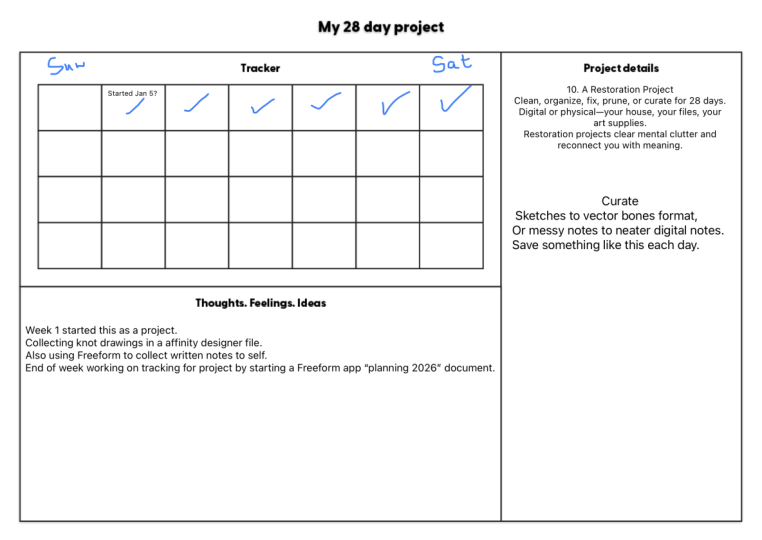
out the tracker, fill in your project details and strike off the
days you pitch up. Sometimes maintaining
your streak is the only thing that gets
you to pitch up each day. And that's great.
If you can trick yourself into spending
time on your project, eventually the
intrinsic motivation will kick in and motivate you. Two, a daily block in your calendar and
set a daily alarm. This reminds you to do your
project visually and audibly, and it prevents
other people from hijacking your project time. Three, tell at
least one person or a community what you plan
to do for the next 28 days. This provides some
light accountability. Also, when people close to you know what you're
doing every day, they won't innocently
sabotage your efforts. They may even help you like, Hey, do you mean to be
writing your book now? Alright. With those things done, on the first Monday
of the month, start your new 28 Day Project. In the next lesson, I cover
some exercises to help you brainstorm project ideas and
narrow down your choices. If you've already got a project, skip that lesson
and head over to the checkpoint videos.
Alright. See you soon.
5. Choosing a Project Exercises: If you're struggling to
come up with a project, either because you have a lot of ideas or because you
don't have any ideas, I've got some exercises
that are going to help. They'll help you
surface buried ideas, filter out the noise, and create a concrete project. There's also a project Ideas PDF you can look at to spark some ideas
for your own projects. The first exercise we're
going to do is a brain dump. We do this so our brain can stop storing and managing
and start creating, start ideating,
start connecting. So grab a big page or open up your Notes
app and dump it all, like, get everything out. Use a mind map or
columns or post its, whatever works best for you. Here's a few prompts
to get you going. One, what's been on
your list forever? Two, what do you want
to get better at? Three, what are
you curious about? Four, what are your
wildest dreams? Five, what do you love? Six, how do you rest? Seven, how can you
improve your health, both physical and mental? Eight, what are you struggling
to make progress on? And nine, what opportunities
are open this month? Exercise two, project ideas. For the second exercise, look at your brain dump and
circle items that excite you. Then combine with
other items to create interesting projects so that they go from vague to concrete. We'll get to the finer
details later on, but here are some examples
of projects that combine multiple items from the
brain dump exercise. Example number one, cook
healthy vegan lunches. So you might be curious
about a non meat diet. You love cooking, and you want to improve your
family's health. Example two, draw friends dogs. You love drawing, want
to get better at it, and you'll also spend time with your friends
and their dogs, and you decide to gift the drawings to your
friends when you're done. Seriously, this works
on so many levels, like just checks boxes
all over the place. Example, number three, meditate and manifest in the morning, which is a lovely alliteration. But let's say that you
want mental clarity, reduced anxiety, and you're curious about manifesting
what you want. Like, how does that
actually work? So, write your project ideas
down on a separate page, and then in the next exercise, you'll filter out project ideas. Do Exercise three, the filter. In this exercise, for each of the project ideas you've
got written down, fill in the blanks
of this sentence. I really, want to put your project idea in there for 28 days because and
then put your reason. This will sink some
project ideas, which is fine, but it will also bring others
to the surface. If the reason is thin or
icky, just cross it out. And if it lights you up or clearly solves a real
pain, then keep it. If none of the project ideas make it through this
filter, that's okay. Just ask yourself,
what do I really, really want to do for
28 days? And why? Then come up with that
list. That's the good list. In the next exercise, we'll take a look at what's
going on in your life next month so that we can plan a project that actually
fits into your life. Bob. Exercise four fit it in. Now that you've got
some project options, have a look at your calendar. Be honest. What can you fit in? What can you do this month? Do you have a busy
month coming up? What season is it?
Are you traveling? Are your kids home on holiday? Or do you have an
empty schedule? Don't over promise here. You want a game you can win. So start coming up with some project ideas to fit your calendar, to
fit your next month. In the next exercise, we'll
get into the details. Oh. Exercise five. The rules. Okay, you've
got some project ideas and a rough idea of what kind of a month you need to
fit your project into. Now you're going to
make some rules. Rule number one is time. How much time are you going to spend on your project every day? What's your daily minimum and is there a maximum amount of time that you're
going to spend? Two. When and where. So when and where are you
going to do your project? This could be a time and a
place or anchor to a habit like while drinking coffee before bed after sitting
down at your desk. And then rule number
three are constraints. Constraints boost
creativity and make it fun. So what constraints are
you going to put in place? How can you limit your tools, your subject, and your format? Now, write down your
projects in full. Here's a rough template
I like to use. Every day for 28 days, I will do X, your project for Min
to Max time when, where, using tools, constraints. Like, that's really specific. So here are some examples. Every day for 28 days, I will draw my friends dogs for 30 minutes around 9:00 A.M. After we walk the dogs using charcoals and
an A three pad. Or every day for 28 days, I will meditate and manifest at the breakfast table for 20 to 40 minutes after
drinking my coffee. Now you've got some
concrete project options with details that
fit into your month. If you've got more
than one project on your list and there
isn't a clear winner, choose the one that best
suits you right now for this next month or the one that you're
most excited for. And if you really can't choose, just go for the one at
the top of the list. Next month, you can go for
number two on the list. Okay, you've got your project. Now, there's just a
few more things to do that'll help you pitch
up daily and make progress. Number one, print
out the tracker, fill in your project details and strike off the
days you pitch up. Sometimes maintaining
your streak is the only thing that gets
you to pitch up each day. And seriously, that's great. If you can trick yourself into spending time
in your project, eventually the intrinsic
motivation will kick in. Two, put a daily block in your calendar and
set a daily alarm. This reminds you to
do your project, both visually and audibly, and it prevents other people from hijacking
your project time. Three, tell at
least one person or the community what you plan
to do for the next 28 days. This provides some
light accountability. Also, when people close to you know what you're
doing every day, they won't innocently
sabotage your efforts. They may even help
you like, Hey, aren't you meant to
be writing your book or aren't you meant to be
doing your meditations now? Okay, with those things done, on the first Monday
of the next month, start your new 28 Day Project. In the next few
lessons, I'll cover what to do at each of
the four checkpoints. I'll see you there.
6. End of Week 1 Checkpoint: Okay, one week down. Yeah. Now it's time for
a super quick check in. Ask yourself the
following questions. One, is your project working? If not, what's not right? Maybe the time of day is wrong? Maybe you're trying
to do too much every day, maybe something else. Number two, what have you learned or noticed so
far about yourself, your theme or working with
the 28 Day Project method? Maybe you discovered that
waking up at 5:00 A.M. Makes you far more productive
during the rest of the day or maybe that once you started
working on your project, it was really hard to
stop. Things like that. Number three, what could
you tweak in week two? Maybe you want to try doing
your project after dinner. Maybe you want to
spend more time on it. Maybe you want to
make it more playful. Write it all down and try
out your tweaks in week two. These are golden byproducts of the 28 Day Project
method, seriously. And then if you're up for it, post a mini reflection or
a photo in the community. You'll inspire someone else, and that often feeds
your own fire.
7. End of Week 2 Checkpoint: Whoa, yeah, halfway done
already. Pretty well, right? Now pause for a second and feel that momentum.
Let it sink in. Then ask, how has week two
been different from week one? Maybe it's felt like there is some kind of muscle
memory after two weeks. Maybe it's got boring. Maybe you hit the
dip in motivation. Question two, ask yourself, What have I learned
or noticed this week? Maybe something finally
made sense in an app you're learning or you wrote without
judging yourself as much. Three, what adjustment would make the next two weeks smooth? You need to leave
out your supplies or leave yourself
notes of where you got to the day before or maybe decrease the amount of
time you spend each day. Write it all down and try out your adjustments
in the third week. And optionally, share a nugget or process picture
in the community. Sometimes a little bit of
connection can recharge.
8. End of Week 3 Checkpoint: Right, three weeks in the
finish line is close. Now it's reflection
and transision mode. Ask yourself, one, how
has my project evolved? Maybe it's less about the tools and more about the content. Maybe the struggle has changed
from pitching up every day to saying something different each day
on social media. Two, how would you like
to finish this project? Ponder this even
if you intend to carry the project on
during the next cycle. Maybe you write about
it on Substack. Maybe you complete
a set of tutorials. Maybe you release
your song on YouTube and then get on to the rest of your songs in the next month. Three, how do I feel about
ending this project? Are you ready? Sad?
Maybe you're excited. Does it feel good? Does it feel like you're just
getting started, maybe? And number four,
what are you looking forward to when this
28 day cycle ends? Write it all down, and remember, it's all a byproduct of
the 28 Day Project method. Now, in this final
week, gather insights, tie up loose ends, and start sketching ideas for your
next 28 day project. Even if you are doing something similar or the same project, what are you going to change
about your next cycle?
9. End of Week 4 Checkpoint: Alright, you did it 28 days
of intentional action. That's huge, seriously. Before you celebrate, though, grab the loot the learnings, the good stuff, the gems, the jewels that you can take forward into your next cycle. Ask yourself, one, did my
project meet my expectations? Why or why not? Two, what's the difference between
now and on day one? Maybe you feel far more
relaxed, more confident. Maybe you've begun to
focus on what you're creating rather than
finding the right tools. Three, is there something you'd like to do
differently next time. Maybe you'll schedule
more time each day. Maybe you'll make it
more project based. Maybe you'll deal with friends
or part of a community. Maybe you'll make it
more fun or playful. Four, what did you learn? You can reference what you noted during your last three
checkpoints here, too. Five, what parts
of this project, if any, will you keep up once you begin a
new 28 day project? Maybe you want to keep
waking up at 5:00 A.M. Maybe you want to keep
working on your website. You can choose to do it again for your next
28 day project, totally possible, totally loud, or you can spend time
with it in another way. It may have become a habit. It may be something you schedule once a week or once a month, or maybe you just want to spend the next two weeks just
finishing it off. Totally cool. Number six, what's your next
28 Day Project going to be? Then celebrate properly. Dance, drink chocolate milk, give yourself a high five. You showed up for
28 days in a row. You made progress, and
that's rare and powerful. Now, if the next first Monday
of the month is tomorrow, roll into a new cycle. If there's a spare week, choose one of the
following options. One, rest for a week. There's only four or five
of these gaps per year. Two, do a seven day
palate cleanser project, something light, something fun, or something just
totally random. Or three, extend this project to a 35 day project
if you're in flow. Whichever you pick,
keep the rhythm going, and I'll see you
in the next cycle.
10. Tips & Tricks: In this lesson, I'm going to
cover six pieces of advice, tips and tricks
that'll help you keep on pitching up for
your 28 day projects. Number one, think
chapter, not book. You don't need to do
it all in 28 days. Break big goals into small, satisfying slices, a feature, a chapter, a batch, step. Small wins build big momentum. Two, use time as your metric. If completing
something every day of your 28 day project
overwhelms you, stresses you out, or impacts the rest of your day,
change your metric. Don't aim to finish
something every day. Aim to spend time with it. Go for daily contact,
not daily completion. Rather than finishing a
painting, paint for 30 minutes. Rather than writing a chapter,
write for 20 minutes. Rather than completing
a walking route, walk for 10 minutes. Set a tiny minimum, if need be. Spending time is a
more sustainable and less overwhelming
way to build momentum. It also prevents the
all or nothing trap. Three, talk to your brain. Ask your brain, how long can I comfortably work
on this each day? 60 minutes? Too long. 30 minutes, still too
long. 20 minutes? Oh, okay, maybe.
That's your number. Start there, and every day
simply show up for that time. You'll find that once you start, momentum will often
carry you further, and over time, you can
ask your brain how much it can handle and update
that time going forward. Four, remove friction. Most projects fail at
the starting line, either the daily starting line or the monthly starting line. So remove all friction. Lay your tools out,
charge your batteries, put your running
shoes by the door, open your iPad ready to work, unfold your mat on the floor, plan, get supplies,
whatever you need to do. Make it so that the only
step left is to start. Spend 2 minutes now writing down some answers
to this question. How can I make
tomorrow's start easier? Then actually do one or more of those things on your list. Every bit of friction you remove raises your
odds of success. Five. Share publicly.
Sharing what you're doing publicly is one of the strongest
motivators we have. You don't need to share on social media or some
big public space. A small group of people you can stay accountable to is best. You can use a WhatsApp group or a closed community of people
on a similar journey. You can also share
with a coach or a mentor or with your partner
or family so that they can support you and ask
you why you're watching Netflix instead of working
out or drawing or writing. Now, when you share
your progress, you also process
your thoughts and feelings and connect with
others on a deeper level. You're seen supported
and nudged. Questions are asked
and feedback is given. An optional sharing
prompte is, what did I do? What did I notice,
and what's next? Number six, keep
the streak visible. You want to do as much as
you can to pitch up daily. A great motivator is visually tracking the
days you've shown up. Some days you'll work on your project just to keep
that chain unbroken. So print the tracker. Put it somewhere where you can see and check the days off. Now, there is plenty more
advice where that came from. So don't hesitate to ask a question or tell us about a
problem that you're facing.
11. Conclusion: Hey, I hope you've
enjoyed this course and thank you so much for
watching. It means a lot to me. I hope you keep using the 28 Day Project method to make progress on
what matters to you. Seriously, this would
mean the world to me. If you have a question, DME on threads and Instagram,
I'd love to chat. You can also post a
public discussion this way I can answer you
and help everyone else. And if you feel up for it, I'd love to see what you've been working on during
your 28 Day Project. Skillshare project and share some progress pictures and nuggets that you've
been learning. And I'd love to know what
you thought of this course. So please, as always,
leave a review. It helps me, and it helps other students know whether they should or shouldn't
take this course. And finally, to keep in touch, sign up to my mailing list, I send a daily story based email aimed at creatives. Bye for now.
 Rich Armstrong, ADHD Artist + Designer