Transcripts
1. Class Introduction: did you sometimes feel
that there's a better way to be productive than this combination of apps and websites
and calendars and notes and whiteboards and post-its and journals
and pieces of paper that we're using? Yeah, I did,
and maybe you're feeling anxious or overwhelmed or just overstimulated
by the amount of ideas and things that you have to do,
or the amount of thoughts that you have. Maybe you have like a million of them,
just like running through your head and you just
you don't know what to do about them. Maybe as you're trying to make sense of these ideas,
or add them to some kind of database or some kind of project management system,
you've got these notifications popping up on your phone or on your Mac,
and you're getting distracted. Or maybe you're just forgetting the ideas
and where you put them, Surely
there must be a better way to do this? Yes there
is. It's called bullet journaling. bullet journaling is basically a powerful
and flexible productivity method that you practice
in a notebook in a single notebook. Now that I've been practicing bullet
journaling for quite a few years, I don't get distracted or overwhelmed
anymore. I’m not working on 45 things. I know exactly where my ideas
and thoughts are. I know how to categorize them. I'm not like putting them
in all kinds of different places. Everything just makes sense. When I write my ideas and thoughts down,
I do it calmly, without fear of losing them
or having to think of them again, or getting distracted or overwhelmed
or anxious or anything like that. With bullet journaling,
I get to do things my way. I get to design a productivity system
that I love, that I use that's adaptable, that's flexible
for different stages of my life. And yes, it is based on a set of bullet
journal rules, but they're so flexible and I can easily break them. And the thing that is just like unexpected
about bullet journaling is that over time, I've begun to work on things that matter
that actually mean something to me. So I'm not just like, getting stuff done. I'm getting the right stuff
done, the stuff that matters. now, if you don't know me,
my name is Rich Armstrong. Hi. I am an ADHD multi-hyphenate artist,
which means I do a lot of stuff. I have a lot of interests.
I have a lot of ideas. I have a lot of thoughts. And bullet journaling just makes
that so much easier, so much more calming. I just feel present. I'm not worried. I'm not anxious
about all this kind of stuff. So if you're like,
okay, okay, cool, I'm in. But like,
what is this class going to cover? So what we're going to cover
is why we need bullet journaling. We're going to cover the basics of bullet
journaling. We're going to cover how bullet journaling
helps us think about the future, the power of journaling, the bullet journal way,
the idea of bullet journal collections, and how to keep track of everything
in a bullet journal notebook. And what's really cool about this
is that all you need to take this class is a pen and a notebook. And if you don't have a notebook,
just use a piece of paper. Seriously,
this is a very low bar to entry, and this is one of the beauties of bullet
journaling. So if you're pumped about this,
take this class with me. I'm pretty sure it's going to be life
changing. All right,
I'll see you in the next lesson.
2. Before We Begin: Okay, so before we start, there is something
I need to tell you. This whole class, I
actually did live. It was an experiment, and the reason I did it live was because I love
doing stuff live. It just gives me so much energy. I feel connected to the magic. I just feel far more authentic. So while you're going
through the class, especially if you've taken
my previous classes, let me know what you
think about this format. If you love it, if you like it, then I will be pumped. If you have feedback,
please share it with me. I'd love to know what
you think about it. With that being said,
let's jump into the class.
3. How Did I Get Into Bullet Journaling?: How did I get? Into
bullet journaling, which is also known
as Bogo or Bogo. I don't think I've
actually heard anybody say that out loud, but it sounds really
fancy if you're like, I'm into Bogo, you know? So, my first glimpses of bullet journaling
were not pretty. So I kind of felt like it
was a bit of a Abujo lt. I saw what felt
like a whole bunch of ladies and women. No offense. Just like creating
scrap book kind of stuff or 16-year-old girl
diary kind of stuff. It was very colorful. It was very off putting. I was like, What is this? Like, I don't want to do this. This is Wow. No, but I just
saw tons of it on Pinterest. I had friends in Amsterdam,
who were like, Rich, you should get into
bullet journaling, and I was like, Oh, what is it? And they showed me
and I was like, I don't want to do that. That looks not so good. Sorry, Journaling. I think this is a
slight misnomer. I think this is very
off putting for anybody coming into the bullet
journaling world. They're like, I don't
want to journal. Like, I can journal
like, what is this? I wanted a productivity system. And At the same time, I was loving apps. I come from this UI, UX app design website
design background. So I absolutely
love digital stuff. I'm the family's
tech support guy. I just love computers. But digital productivity became an oxymoron. I was distracted. I would task cord, which meant that I
just kept on putting tasks into my computer and apps. I just had so many things. I had lists and lists and lists. I still have lists
and lists and lists. And I would even have
lists of my lists. That's how insane it got. So I began losing things. And I just felt like
I was digitally busy. I wasn't a digital minimalist. I was just always doing stuff, but not really
getting much done. And then my apps
stopped working. Seriously, this was terrible. This was like, Oh, my goodness, why is this happening? I used this app called the Hit
list and one called Clear, and they both kind of stopped
working and synchronizing. And then I was like, Oh, b. So I got really frustrated. But I knew that I like paper and sticky notes and
moleskin notebooks and whiteboards and
stuff like that. Writing on paper
is just amazing. Seriously, I just
absolutely loved it. So I began making my own system, and then I rediscovered or discovered the real booga
or bullet journaling. And I was just like, In
my mind. It was amazing. So I've been using
it since 2021, which is like, just a
couple of months after my baby or my daughter
now, Zoe was born. And it was kind of when I
had a lot of time to, like, research stuff, and I was at
home a lot because of COVID. And I remember just
getting into it and using it to
write my first book, which is the hundred day project or the perfect 100
day project book. And it helped me clarify
my thoughts a lot. It helped me do a lot
of stuff during COVID. And so at that stage, I wanted to tell
the world about it. I wanted to teach
everyone about it. I've been teaching
a bunch of stuff. I had been teaching a bunch
of stuff at that time. But I was like, I need
to just test this like, at least for a year, like, at least a year. So, that's what I did, and I've now been doing
it for about three years. And this is my stack. Let me quickly show you
the real live stack here. D d d d d, d d. So over here, and I'm on number
ten at the moment. D d, d, d. And this is like
just my bullet journals. Like, Before this, I had a
whole bunch of other books, mole skins, sketch books,
journals, whatever. I still have sketch books
and stuff like that, and this is my latest one. Number ten. So I kind of feel like Yeah, I
can teach this now. Three years in, ten
bullet journals down. You know, let's get into this. Here I am. A couple of bullet journals in
teaching this class.
4. Why Bullet Journaling?: Why bullet journaling? Like, tell me, you might be here like,
wondering if this is for you. Well, here we go. So pen and paper have
tons of benefits. There's a saying it took me or I didn't have the time to
write you a short letter. So I wrote you a
long one instead. But when you're writing
by hand compared to when you're typing, things clarify. So It may take a
little bit longer, but your writing is
simplified, it's shorter. It's better. When you
do things slower, it means that you engage
your mind while you write. This is just paper. This
company of notebooks. I can't really say it
because it's a German word. Lichter, something like that. Yeah. Lichter, hold
it up here quickly. Can you see that?
Yeah. They've got this it's really nice say, think with your hand or Dunkin with your hand.
Something in German. But it's very cool.
That's what I started to realize is that when you write, you think with your hand,
you get your thoughts out, you make your thoughts visual, and then you write to
find out what you know. I believe that we've got
so much stuff in our head, but until we write
it or speak it, we don't know what's in there. Also just the tactile nature of writing feels amazing
and it's calming. Paper is not digital. I'm in 100% control.
I'm offline. There's no distraction from the tool in hand like
a phone or a computer. I'm 100% present in a
journal with my thoughts. There are no updates required. There are no crashes. Power and batteries are not required. Paper is really, really cool. But paper has problems.
It's clunky to store. Like, I don't know
if you've got a kid, and you've seen what paper can do in a house.
It's just everywhere. My kid is like a paper machine. She draws all the time, and then we just have
paper everywhere. It's amazing, but it's
really hard to store. So it's also difficult
to search through. If you're looking for a
particular note or a drawing, it's like, where is this? If you think back to the
guys like, I don't know, in Egypt or Greece
with them scrolls, and they had to put
them in a library like, Man, that must just have
been crazy to handle. So it was easy to
lose, and, you know, people just lose
trust and paper for more important things because
it's so easy to lose. It's so hard to find
and search through. So bigger projects on
paper are a nightmare. Unless you have a really
big room that you can stick paper on a wall on papers, not that good, but it
still it's amazing. So, notebooks, then, they solve a lot
of the paper problems. I've had a notebook since I was a teenager. They're
easy to store. They're easy to scan
and flip through, and they were portable
treasure troves. Like, I love this term. Like every single
journal or notebook, like, it just has so
much of me in it. And I've kept as many
of them as I can. And I often just
look through them. And I'm like, Wow,
that's amazing. So notebooks are amazing. I've got ones for
sketches and ideas, markups, and doodles,
and tasks, and thoughts. Like, all of this
is really cool. But I often forget what
I write or what I wrote. Finding stuff takes a long time. I'm inconsistent when I journal
or put my tasks in there. Something is missing when
it comes to journaling. I still can't use it as
a productivity system, especially not for the
bigger and important things. And often I would have different notebooks for different stuff. So I'd have for, like, a
journal for journaling. I'd have one for, like, writing down stuff about Amsterdam, I'd have stuff for markups
or doodles or daily stuff. And then I would
just have all of these books
everywhere, you know? So I began creating a system. But then when I began
creating that system, I was curious what systems
other people used. And then I found Bogo
or bullet journaling. And in a nutshell, guys, Bougo is a simple, adaptable productivity
system that works for tasks, thoughts, events,
and bigger projects. It's not just for
the daily stuff. You can do big stuff in it, and it's not a
teenage girls diary, and it's not scrapbooking, although you can make
it that if you want to. So I split my journal life or my productivity life into
before Bougo and after Bougo. B Bougo versus A Bogo. It's really handy
to know. And then I began to understand what
bullet journaling was. It's a tool set with a
bunch of tools in it, that can change, they can morph. It's a notebook based
productivity system, which is amazing for me, this is pretty much all I
carry around now, this book. I have my ton of books here, my archive, you
know, but that's it. There are structures
and rules to adhere to, that you can break, that you can flexibly and
adaptably change. It means that I can do all
my things in one place. I can sketch, doodle, do my markups, tasks,
projects, journaling, long format
journaling, meetings, all in one place, and therefore, I don't need multiple notebooks. All of this kind of stuff can
be put in a bullet journal, which is just amazing. Whatever you need it
for, you can use it for. Things began to be
easy to find again, which meant that I
trusted my notebook. It means that I could engage with what I wrote
and what I write, and it became even
more grounding, even more calming because
it allowed me to look back. It allowed me to
have this system to get my thoughts out
and then to revisit them. It helped me work on
things that matter. For you, y Bojo It's a powerful flexible system that helps you spend time on
what matters to you. There are no distractions. You are 100% present
with your Bogo, your pen, and your thoughts. It helps both with the
daily and long term stuff, which I find amazing, and you can flip between these two kinds of mode
of thought really easily. And paper alone has myriad
benefits, tons of benefits. And then there are
no dependencies on external apps or
devices or electricity, which just feels really good. You can go be productive
without an app. You can go to a cafe or sit
in the dark with a candle. And just be with your Bogo, right, think, date,
stuff like that. So maybe you're overstimulated, maybe you're overwhelmed,
maybe you're distracted. Maybe you've got 1
million thoughts running through your head or your
brains trying to hold all these ideas and
feelings and stuff. And Ho. Boogo. There it is. Maybe you've tried journaling. Maybe you note your
ideas or things, but you just keep on
seeing them repeat. Your brain keeps on
surfacing them and having the same ideas or the same
feelings or realization. Hm. Boogo. Maybe
you have stuff in multiple places like apps and calendars and notebooks and
sticky notes and whiteboards. Ooh. All this kind of stuff just makes me feel
overwhelmed and anxious now, just thinking about
where all this could be.
5. BuJo Basics: So what we're going to do in this class is we're going
to cover some Buda basics, and I'm going to start layering the different principles that you can use to start bullet journaling
throughout this class. I'm not going to
cover everything. I'm going to cover enough so that you guys
can get started, and it's going to layer
on top of each other. The idea is to log your daily
tasks, notes and events. This is called rapid logging. The idea is to keep it clear
and brief, daily logging. You remember more
than you think. If you write something
short, Because you wrote it, your brain associates that experience or that idea
with what you wrote. So when you read it again, your brain is like, Oh,
yeah, remember that. You don't need to write
a whole bunch of stuff. Now, you start off
by dating a page. The simplest way is to say day, month and the day or
date month and the day. Sometimes people
like to put month at the start depending on
where in the world you are. This would be like the
16th of the ninth, which is September,
and it's a Monday. Instead of writing
Monday or MO N, it's just MO because I think, every single day of the
week is unique then. Then I like to do this because then we get to see
what I'm thinking, when I was thinking it. The next thing that we need
to do is start adding tasks. Tasks are things that people
need to do all the time, no matter who you are, if you're a mom at home, if you're a designer, a
web developer, a lawyer, an architect, a student, like whoever you have things that you want
to do in your day. And increasingly we have more
and more and more things. So the idea is to
write it down quickly, and when you think of it,
don't keep it in your brain, put it on the paper. So tasks. We signify a task with
a dot, not a square. Dots are far more elegant, and they take far
less time to draw. When I came across
this, I was like, I'm in for Bojo This is
pretty much what sold me. I was like, Yes, this is it. I'm going to save so much time with dots instead
of little boxes. And. It was good. It looks elegant. You can also do master tasks and sub tasks. So under design tap
tap Kaboom Logo, there are three other tasks. You can just move
them to the right. I've got a dotted
grid journal here, but I have tried plain paper, I have tried line paper. You should use whatever
you feel comfortable with. I like a grid of dots because it means
it's semi structured. I can also doodle in it. It becomes very flexible. The next things are notes, and these are
signified by a dash, and then a note. A note is not actionable,
I didn't happen. It's just an idea or a thought or a fact
or an observation. The next one is an event. I prefer to name
it an experience, but in the Boudo community,
it's called an event. And this is signified
by a circle. So something happens to you or it's an experience
or there's an event. So the other day I saw Ops
fighting on the lunch table. Like that happened.
Johnny called. Oh, yeah, under Johnny
Caller could be like, he is moving to Portugal, or he's got an art
show in November. Cool. You don't need to add a whole bunch of detail for events like unless you want to, you don't need to
say, drank water. Water was delicious. You just put down what you
find meaningful. Then there's a strikeout. If you've got a
task and you like, I don't want to do
this anymore or it's unnecessary, strike it out. You don't do this
with done tasks. With a done task, you
actually put an x through it. You can see here, there's an x through send
invoice to Adobe. You can still see
what you've done, but you can see that
you've done it. The next thing is
long form journaling, if you want to, you just write a title and then you
just long form journal. Much like you would if you
were really journaling. The next one is that when
you're rapid logging, you're not really
going to be like, let's do all the todos first, then let's do all the notes, then let's do all the events. You're just going
to go through it as things pop into your brain. A lot of time, I'll
do a bunch of to dos or tasks first, and then
throughout the day, I'll add to that with
events or experiences, notes, and then further to dos. This is rapid logging, this is more what it looks like. Basically, we've
got these symbols. You've got a dot, you've got
a dot that's crossed out, a dash, and a circle. But signifying content is
not all that Bougo is. It gets more useful when
the next day begins. And this is where I get super
passionate about Bougo. So what tasks did
you not complete? And you can see here, the ones that we
didn't cross off. Although I crossed three items under design tapped Kaboom logo, I still haven't
finished that logo. That plus the Doodle
Bills project, sketching ideas for that and judging the art entries,
I haven't done those. So I'm going to strike out
the unnecessary tasks. I actually don't want
to do that project, so I'm going to strike it out. And then I signify tasks
that you want to move to the next day with
a less than symbol. Judge art entries, want to
move that to the next day, Design taptap Caboom logo, I'm moving that to
the next day too. Here, you don't need to
know where it's gone. You just need to know that
you have moved it on. And on the 17th, which is the next day,
you write it again. I write Judge art entries and
design taptap Caboom logo. I've got go vector as a task
under there too. All right. That's kind of
what it looks like without the red underlines. This process is
called migration. It is the biggest part
of bullet journaling. I think it's the most, the
fundamental part of it. It's why I find that it works. You become aware of what you're doing and what you're not doing. You start asking what's
important and what's not. There's this friction about it. You have to rewrite
stuff that you don't do. You have to deal with the
stuff that you don't finish, which I find it just amazing. When you start writing, the same thing day in and day out, you begin to ask yourself why. There's friction,
there's frustration. It doesn't sound like
journaling, though, still does it, but you'll see why it's journaling later on. What I suggest now is getting
used to these basics on a daily basis to get used
to bullet journaling, and then once you're comfortable with the basics,
you can extend it. So what I want you to do
now is just take like 2 minutes or 5 minutes,
get a journal. And yeah, just take 2 minutes
now, just to practice this. Write the date,
and it can be for your current day if it's
like early in the morning, or it can be for tomorrow, if it's late at night. Write down things
that you need to do, write down any events that have happened or experiences
that have happened, or experiences that
you expect to happen. Like you're going
to have a call with your mom. Write that down. If you've got any thoughts
right now, write that down. Like, Rich is amazing. Bullet journaling is
captivating my mind. How is Rich doing this? Like, what software is he using? Like anything that's
popping in your mind, just write that down. If you don't have a book, just
put it on paper right now. Don't do it digitally. Just go for paper.
6. Future Thinking: Future thinking. This is
where Boogo begins to shine, and I call it Boudo level two. So what about the stuff
that you don't want to do today or maybe tomorrow? Like, what if you're
like, I want to book a skiing trip
for like next year? Like, where do you put that? Or where do you put the
stuff that you want to do later this week or
sometime in the future? So this is where Booo
shines, begins to shine, and where like traditional
methods of this would be like, I have no idea
where to put this. Or I'll just put it down,
but then it disappears. So the long term stuff was
one of the places I got stuck before Bougo Bogo. But Boojo makes the
long term thinking and planning really easy. So there's this thing
that I have invented, and you'll see how I
invented it later on. It's called the future list, and it's just a list of things that you want
to do in the future. Anything that you don't want
to do today or tomorrow? And that you really don't want to rewrite day
after day after day because you know that
you're not going to get it done in the
next week or month, you put it on your future list, things like dreams or goals or future things, know the lights. I can't start planning
for that tomorrow, but it's something
that I want to keep on remembering to think about
or to do at some stage. Then you can add to this when you need to or when you want to. What I like to do is just fill this out once in a
while to be like, these are all the things
that I want to do. These things let's go. I spend like 10 minutes
or half an hour like just populating this. And then every now and then, I will then put something
else on this future list. So are AI was on that list
and I have learned AI, going live with OBS, the piece of software
that I'm using now and YouTube is something
that I wanted to do. I've done that. I wanted to deep clean and de
cools on my studio. Haven't done that
yet. Podcast sees a one, haven't done that. But they're still
on the future list. That's one thing
that you can do. The next thing that you can do is something called
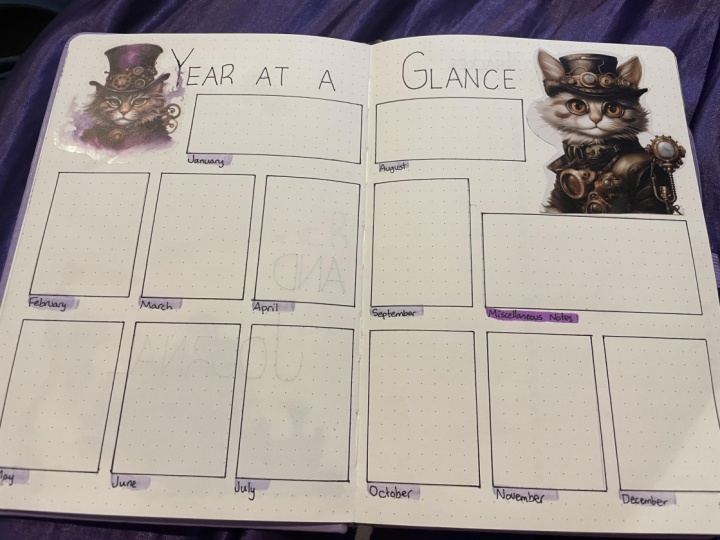
a future log, and you split a spread
into six months, and you just write stuff
that you know you're going to do or is going to happen in those months on these pages. Kind of like a six month
window into the future. And as you go on, you can move the things from these months into
your daily tasks, into your daily experiences. But it's really nice
just to be like, Okay, I remember this thing, it's happening in February. Do not forget Valentine's Day. January, what about a holiday? March, there's
nothing happening. Oh, Christmas. Mm Sint Martin's, my
daughter's birthday. Okay. Let's go to
November, Christmas gifts. Let's buy them. So it becomes a nice place to put stuff that relates to a
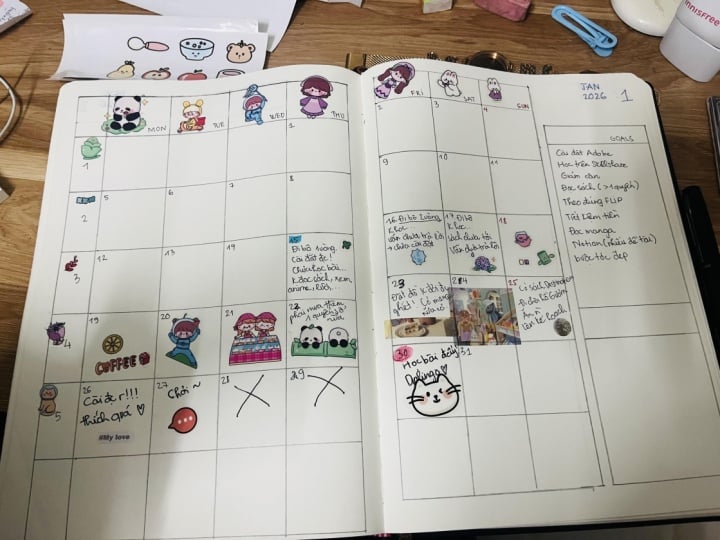
particular month. So this is called a future log. Next is a monthly log. What you do on a
spread is on the left, you have the month's calendar, and on the right, you
have the month's tasks. Stuff that you
want to do just in that month or try
do in that month. And try keep at high level. You don't have to
put details in here. And if I go and put this
on the right again, This page unfortunately
doesn't get to 30 or 31 days. But most of them do. I'll show you my
one at the moment. It's not super populated. But I've still got a couple
of days after there. And then I put the date and
the days next to each other. I also customize
it a little bit. And you begin to get a
really nice sense of how your month is going
to shape out this way. You've got your tasks,
you've got what's happening. Yeah. Then you can
also say, Okay, I'm going to work on listing my dad's bike on 18 September, or I'm going to write
my life story or continue writing that on a
weekend, something like that. That is the monthly log. These three practices are really really helpful when it comes to thinking
about the future. But this does affect
your daily pages, and I'll show you how. Here this month or in the next six months or
sometime in the future. If you don't want
to do something, you schedule it rather than
migrating it to the next day. Here, the newsletter
says date on remix drop. I don't want to do
this today and I probably don't want
to do it tomorrow. Ordinals research, I'm not
going to do today or tomorrow, so I'm going to schedule those. I either put those into my monthly log or into my future log or
into my future list. I'm saying I'm not going to worry about doing this
today or tomorrow. It needs to be scheduled
or planned somewhere else. And we signify a schedule
task with a less dan symbol. If a task is unfinished, now, you can choose to migrate it, schedule it, or strike it out. So this becomes powerful. You're choosing what to do with the stuff that you
can't do or didn't do, which means you have the opportunity to
prune it, to be like, I'm not doing this anymore, and you don't feel that pressure
to do so much in a day. And you have like objective
data or data to be like, Look, you haven't done
this in the whole week. What are you going
to do about it? This is where Bojo
becomes really powerful. Then you can migrate tasks
from future pages like your monthly log into your daily pages or
from the future to the daily or from
your six monthly log or future log into
your monthly log, you can just migrate stuff into a more current version of how you're thinking
about time and tasks. So you can also then decide what to do with unfinished tasks from one month to another and
not just from day to day. Then as this gets even more from one journal to another
or from one year to another. So at the end of September, what tasks are
undone, quite a few? So what do I do
with these tasks? Well, I migrate them
to the next month, or I schedule them for sometime in the future,
or I cross them out. Once I've done
that, I then create a new monthly log each month. This is a day to day practice and then a month
to month practice. It means we now have an
updated bunch of symbols. We've now got a task and a task that has been
done. We've got a note. We've got an event
or experience. We have a scheduled
item and we have a migrated item.
Pretty powerful.
7. Journaling The BuJo Way: Journaling. The Bogo way. So, initially, I did not want a journal. I
didn't want to journal. I wanted a productivity system, and that's what I got. But after a few months, I saw a change. There was probably
a really big bah. 'cause I was like, B.
So after a few months, I saw a change, and I was like, Oh, I get it now. So I realize I was journaling, but I was journaling
the Bojo way. And this made me so productive, Uber productive, in fact. So a journal can be a place to let your
emotions and thoughts out, but if that's all it is, you're missing out on so much. Taking action based on your
thoughts and experiences and past action is where the
magic of journaling happens. This is how you begin to
work on the right stuff, and this is how you grow. These two things are
super important. So taking action based
on what's happened. Because you have
this log of data, this log of your actions and your thoughts and things that you've finished
and not finished, you begin to change how you act. You only have roughly
4,000 weeks in your life. So work on what matters. It's a really sobering thought, especially when you work out how much you've already, like, done or completed, and how
much of these weeks you sleep. If you work out how
much or how many of these weeks you
like, you know, playing computer games
or watching series or doing stupid stuff,
it's pretty infuriating. There's this really
good book called 4,000 Weeks by Oliver Berkman. How do you recommend
reading that? It's like the best
productivity book I've read. And it's not really, how to get more stuff done. It's more like your mortal, you're human, stop
trying to do so much. Do stuff that matters. Bogo makes moving forward
by looking back easier, and with regular journal, this is far more difficult. But with Bougo, oh,
this is just amazing. With Bougo, there's
an objective log of what you've been doing,
thinking, and experiencing. It's an objective archive
of your life, basically. Well, as much as
you put into it. When you migrate and
schedule tasks to become aware of what you're
doing, what you're not doing, and what you want to do, So Bogo becomes a visual
and physical representation of what's going on in your life. Visual because you can see
it and physical because you have to move things
and rewrite things. It's like it's painful to write this stuff
and rewrite it. But you're engaging with what you're writing as
you're doing it. One day informs the next, one month informs the next, one journal informs the next. Each section of your Bojo
informs the next section. It helps me become
aware of what matters. I've learned what
keeps me engaged, I've learned about myself, and it helps me figure out
why I do certain things. I begin to ask questions like, why can't I do this one task? Why has this thing been on my list of things to do forever? Now, no one wants to be super productive with
the wrong stuff. This is so important. It's like, people can be
productive and highly efficient, but if you're not
efficient and productive with the right stuff,
like, what's the point? Budge helps with this. And that's what I
really love about it. This is why I'm now super
productive or Uber productive. I'm not just like
smashing my to do list, I'm working on the right things. And what I liken it to it's like a whittling
away process. You're discarding the bad, and you're discovering the good, much like how a sculptor
might create a statue. This process helps
prevent autopilot living. It's like you intercept
the automation. You ask why? Maybe you would consider like
active journaling, like you're being mindful. Seriously, the migration
process is the key. It is for me the hardest part. I just want to carry
on going. Let's just write, I have more ideas. But when I begin to reflect
and look back, it's good. Things begin to change. For each unfinished task, you can ask a
couple of questions like why was this left undone? Does it matter that it's undone? Is it important? Do I
really want to do it? And how would I
feel if I ditched it or just struck it out? It's really powerful set of questions to ask for
every unfinished task. At the end of the
month, schedule time to migrate to a new month. This helps a lot.
Summarize your month on a new page before
your new monthly log. This means you get
to engage and review your past month before
just creating a new month, and then re read and
review your month. Maybe re read and the summarize
should be swapped around. Then perhaps you want to highlight content
with a highlighter. Maybe that could come second. Re read and review, then
highlight and then summarize. Maybe these aren't linear. Then at the end of a notebook, schedule time to migrate to
a new notebook, re read all, re read and review all
the monthly summaries, and ask if this represents the life
that you want to live. This is pretty intense. You've just gone through
a whole bunch of months, a whole bunch of journaling,
a whole bunch of tasks. If you're like,
Well, this actually just I can't believe
I'm working on this, you get an opportunity
to change. Then you can migrate
only the content and the techniques that you like or that you
want to migrate. And then when should I
start a new notebook every new year or when you reach
the end of your notebook? Sometimes they're really
like similar time, so use your best judgment. I don't really like, you know, starting a new
notebook for a month, and then be like,
Oh, it's new year. Let me start a
whole new notebook. And it's especially
helpful to start a new notebook at the beginning
of a new season of life. I love getting things done
as do a lot of people, and Bogo helps me do
the right things. One of the core
principles of Bogo is rewriting things until
they're done or irrelevant, which is really powerful. I really like this idea as well. A new journal represents a new. It's a leveling up,
and it's not like, Oh, I'm starting again. It's not just another
journal to help you manage your
day to day tasks. It's helping you become a better person or live
a life that you're more interested or curious in living and more
creative life. The friction of rewriting forces you to slow down and
pause and consider and engage because your life
becomes visual and physical.
8. Collections: So up until now
it's been linear. It's easy to search through, but life is not
linear like this. What about non linear things? We want to keep
in one place like conference notes or a list
of our dreams or a project? Like, We does a project go? Or how do we track habits? We don't want these
things to get lost in between our daily logs, and we don't want our daily logs to be interrupted
by these things. So we create a collection. And a collection is
just a type of page, and you can design
it however you want. The future list that I showed you earlier is a collection. The future log is a collection. So is the monthly log, and so is the daily log. They're all types
of collections. It's just a way to
manage your thoughts, your ideas, your life. But a collection has a purpose. It helps you do something. So what I suggest is when
you begin a collection, start with at least
two blank pages, start on a blank spread, at least two pages. If it doesn't require two pages, you may not need to
create a collection. Here is an example of this. This is a Procreate
dreams collection. I've got a bunch of
ideas on the left. I've got a bunch of
tasks there too, some doodles of how
things could work, some mockups, stuff like that. So you could create
a collection for projects and quotes and
books and habit tracking, expense tracking,
subscription tracking, life story, learning
a new language. I've created collections
for exercise and food and sleep and skin quality
because at some stage, I had acne like I was
a horny teenager. I'm 36, and I'm like, Why? Why? I began to track that
in my bullet journal. And I tracked my
dreams and goals. I wrote all the questions for my perfect 100 day
book in my Bogo. And then I kept a collection for Bougo here's an idea for how
to make my Bougo better. Let's keep a
collection because I couldn't remember all
the good ideas I had. So I kept on writing the good ideas and looking
at them and be like, Oh, yeah, that's
what I wanted to do. Or I have this problem. How do I solve it in my Bougo? So future projects, here's another quick look
at a collection, class ideas for classes
that I want to teach. A lot of the time I
write a class idea, and after writing
it, I'm like, Mm. Yeah, it's probably
not that good. So here is what
is 100 a project? All of these things made it
into the perfect 108 book. I basically asked questions. In my bullet journal, and then
wrote about it in notion. You can also have a mini tracker on your monthly calendar
page rather than, you know, create a whole
new collection for that. So here's an example of
this, like in April. I wanted to do C W and M, and sometimes I would
forget what C W and M were. So I put a little key there. Oh, M is meditate, W is write 100 day project, and C is creative workout. And I'll just mark
each day with an X. So every day, I would refer to this page, see
what was coming, go to my daily page, write some stuff down, and then keep it by
me for the whole day. So, what I don't
want to do is give you an exhaustive list
of collections to try. I want you to ask yourself
what you need and then try, create something,
create a collection that fulfills that need. Otherwise, you're like, Whoa, Bojo is so intense. I have all of these
things that I need to do. You don't need to
create a collection. You can just do your daily logs, if that's all you need. So have a goal and
intention of a collection. It will help you
design it better. And you can design
it however you like, which means that
some people have really colorful
16-year-old journal like Bogos or scrapbooking
looking journals, or they're just super colorful because that's how they
like their journals. I don't like that
decoration kind of stuff. And this is really important. You don't need to get a
perfect the first time round. Seriously. Check this out. This is my food diary. I've got 34 days here
with a lot of writing. I then morphed that into, oh, I can make it a bit simpler. All right. That's cool. Activity, how stressed I felt, drinking stuff, how
much water I drank. How did my knee feel?
How did my body feel? How was my skin, pretty much
the same the next week. Then I was like,
Okay, let's do this. Let's make it super streamlined. Bam. I iterated week after week. This was a lot easier to digest, especially that first one. Then I made it even a
little bit clearer. So I just kept on trying
things and iterating on it. Okay. So sometimes you also have a long task list
under a master task. So you can actually move
this to its own collection. So sometimes I'm
like, Okay, like, let's do something
and I start writing. And then other stuff, you know, gets put there because I'm just logging stuff in
my day, and then I'm like, Oh, but I also need to add some more stuff to
this doodle event, but where do I put it now? Just move it to its
own collection. It becomes like a self
standing or, you know, sufficient item in
your bullet journal. But now, where do we
put these collections? The answer to that is right in the middle of your daily logs, and you might be like, What? Like we didn't want to do
that? Yeah, but hold on.
9. Indexing & Threading: So, next, let's talk about
indexing and threading. Sounds very like computer
heavy, but it's not. It may sound chaotic because
how long is a collection? Is it two pages? Is it four
pages? Is it six pages? We do my daily logs go and there are multiple
collections like, Whoa, we have an index page or a table of contents
or a contents page. And your main index
page should be, could be at the
start of your book, but it doesn't have to be. It could be halfway
through or at the back if that's what you want to do. I
tried it at the back. I didn't really like it.
I like it at the front. A lot of notebooks come with an index page or two pages at
the front of the notebook. And so the main index should or could be at the
beginning of your journal, and it could be
two to four pages. Sometimes your journal
won't have one. So just make one at the
beginning of your journal. And again, it doesn't have
to be the first two pages. You can start it once you're comfortable with
bullet journaling. So on one side of the page, write down the page number, and on the other
side of the page, write down that collection. You don't need to
write down your daily logs because
you're just going to be, you know, churning those
things out every single day. This may require you to write your din or your page numbers in your journal or buy a
journal with page numbers. You could also write down three
to four as a page number, where it starts
and where it ends, but I prefer doing it like that. Because this gets a little
bit tricky to read. I also prefer doing
an index like this, just the item on the left. I'm like, Okay, that's what I'm looking for, which page is it? I just put the page
number after it. I find stuff like this maybe
a little bit too structured. But it depends on your journal. M journal at the moment
has an index at the front, and I kind of follow that
because it already has it. But when I create a new index
in the middle of my book, this is the format that I use. So again, you could have a start and end page
for each collection. So this is what my one
looks like at the moment. Much rem, my German
notebook, Murch term, 1917. It's got the page
number on the left, and you know the theme or
the topic on the right. But this is how I started. This is what my index looks
like in my Barren fig, which I absolutely love, but there were some things
that I didn't like about it, but I love Barren fig books. They also have page
numbers in this Licht em, I think, also in Moleskin. And I think Bougo also had their own, official Boogo diary. But that one for me was
just over prescriptive. If you are going to write
your own page numbers, leave space for the numbers. Sometimes I've just written and written and written
and they'll be like, Oh, where must I put
the page number now? So sometimes, what I
would do is just like go 50 pages into the
future, or just spend, you know, like half
an hour writing every single page number for
my Barren *** Notebooks. So an index page cleans
up a lot of the chaos. If you add content
to your index, you won't lose stuff, which is just amazing. But if you are going
to use an index, use it for everything. Because if you don't have some stuff there and you
do have some stuff there, it's irritating
because you're like, Well, I put everything in my index, and now
I can't find it. So you don't want your
bullet journal to keep secrets from you. You
don't want to waste time. You want to be able
to trust your index. Which means it
doesn't have to be in order because if you
forget to add something, just add it when
you do remember. So you don't have to collect
or index collections only. You can index important notes or long form journal
entries or meetings, or whatever you want. And you can also create
dedicated index pages for collection pages. If you've got a
project, you're like, Okay, this is a
very big project. Let's put an index
for this project, and maybe you can pair it with a high level task page
for that project, especially if it has
lots of sub collections. You don't want these
sub collections filling up your index page or
your main index page. For my 100 day project book, I had so many subsections and I put them all
in my main index. And I was just like
100 day project 100 d. So many 100 day
project stuff. I was like, Oh, I should
have put this into a subcollection or a
collection page or index page. Like this. This is a really
good dedicated index page. On the left, I've got
100 day project book. I've got ideas on page
one oh seven, marketing, on page 111, questions,
front cover, PR and podcasts, all on
their separate pages. They all have their own separate
subcollection and I have a high level set of tasks
that I can do on the right. So here is like a
film rig index. I spent a lot of
time researching film rigs and stuff like that. So for the table, I had my own subcollection for the frame for
monitors, et cetera. They all had their
own subcollection. So this stage, I'd be okay
with someone describing bullet journaling
as organized chaos because it's not digital. You can't like reorganize stuff. You can't search through it
by pressing command space, but it is flexible
and adaptable, and an index is really
helpful if you need it. And so this is like a very
different way of thinking. And so I went all in, and I lent into this
way of working. And honestly, it suits my brain. It's pretty chaotic in there, but I love being able
to flip between pages. I love being able to
knock get distracted. I love the feeling of writing. It just feels so much better. But still, it may
feel a bit more still too chaotic for you. So let me introduce threading. So threading is where
we use page numbers to signal where the next and previous parts of
the collection are. So this is if
they're not actually just on the next page
or the previous page. This is what it looks like. You see there's 147, page number 147 is
part of the notebook, but there's 145, which means that's where the related part of
that collection is. There we go. So if you run out of pages in
your collection and it's followed by daily logs
or another collection, resume the collection at the next double page spread
or one in the future. And then thread it. So write the next page number in the collection alongside
the last page number, and then write the
last page number in the collection alongside
the next page number. So that if you do re read stuff, or you want to go back,
you know where to go. You're like, Oh, This is actually where the next
page in the collection is. It's not like on page 97, it's on page 107. Okay. I get it. When
you use threading, update your index to
match this as well. It just makes your
index far more useful. And you can also add multiple
start pages to your index. I just said that or each start and end page,
which I showed you before. So here an index, the Doodle
event is on page 33, 45, 67, or the AI research
collection is on page 47 and 51. Or we could be
like AI researches on 47 to 48 and 51 to 54, and the Dual event is on
45 to 46 and 67 to 70. This for me just gets
a little bit messy, but sometimes if
you've got a lot of content in a collection,
it helps a lot. If you're keeping a simpler
index, y, I really like this. But something like this
could work well too. You can even index
threads or thread of collections that span
different notebooks. You can preface the page numbers with the number of the notebook. I don't really like this too much because then
it requires that I have access to multiple books. I prefer just to have
everything in one book. If I need to, then
I'll put stuff into notion or in some digital way where I can access
that at all times.
10. Conclusion & Summary: But one thing I want to end with is make your Boojo
practice your own. Like, if you're looking at what I'm doing
here and you're like, Wow, I don't know about that. That just seems too intense. L just simplify it. Like, take the stuff
that you like about bullet journaling.
Leave out the rest. And when you
encounter a problem, then create a solution for
it in your bullet journal. So make it suit your needs, and you don't need to go full
on 16-year-old diary in it, but, you can, if you want. So make it your own. So in summary, rapid logging with tasks,
notes and events, and then migrating
daily, monthly, yearly, and per journal, index, and page numbers, and then
collections and threading. Seems really simple when
I say it like this, but I know there's a lot
of content and a lot of like theory behind
it and why it works. Okay, thank you so much
for taking this class. I hope it has helped a lot. I hope you've got a lot of, like, things going
on in your brain. This is an amazing method, amazing practice to get into. I really hope that
bullet journaling is as life changing for you
as it has been for me. And I think that initially, especially on day one, it might feel a little bit overwhelming with all
this new terminology. But if you just start
with the tasks, events, or experiences, and
notes for today, that would be a good
place to start. That's not overwhelming. Tomorrow, you can do migrating if you didn't
finish all of your tasks. When you need to
create a collection, when you need to do
the monthly log, when you need to
create an index, when you need to do threading. Just do stuff as you need to. Your brain will remember, Oh, there is a way to
solve this problem. So when you have a problem, then try to come up
with a solution, or rewatch this class
for a solution. And over time,
you'll begin to see how much of an impact
it has on your life, what you work on,
what you achieve, and just how you
process your life. Now, I would love some
feedback on this class, especially because it's a live experimental
class that I did. So while you're
reviewing the class, please, write about that,
let me know about that. It will help students.
It will help me, and I greatly appreciate
those reviews. I can't wait to hear what you think about this
bullet journal method, this life format of teaching, and also how this
bullet journal method impacts and changes
what you achieve, what you do, how you
process life in the future. And then finally, if
you want to follow me and get updates on the
classes that I'm making, follow at Tap Tap C Boom on all the different
social media platforms, and sign up to my newsletter
at taptapkaboom.com. So thank you so much for
joining me. Bye for now.
 Rich Armstrong, ADHD Artist + Designer