Transcripts
1. Class Intro: Know the feeling.
There's something important that you want to do, but you avoid and
you put it off. Maybe you wish you
made more time for creativity or you want to
work on your side hustle. But when the time
comes, you feel numb, you switch off and you go and
do something else instead. You get overwhelmed
with the task and go and scroll on your phone
or hoover the house. Procrastination costs
you your creativity. Procrastination
stops you on making progress on the things that
will move you forward. And worst of all,
procrastination makes you feel
ashamed of yourself. What about instead
of ignoring or avoiding your procrastination
that you've got to know it? Rather than it being some big, scary beast, it's just your fears appearing bigger
than they really are. In this class, we will explore the five reasons
you procrastinate, and once you know why, there are tools to
address the problem. My name is Laura Lam,
and I am a mother, a folk artist, and a teacher. I sing, write songs, sew, draw, paint, and write. I live and work here in
the garden of England. That horrible beast
of procrastination has tried to stop
me so many times, but I have learned
how to conquer. Class is for anyone who is struggling with procrastination, whether in creativity
or in business, or maybe you're someone
that falls into bad habits of procrastination
and overwhelm, and you want to take this
class as a preventative. All you need to take this
class is a pen and a notebook. I'm so excited to help
you break through your procrastination
overwhelm. Let's go.
2. Welcome I D E A S: Welcome to this cast. Thank you so much
for joining me. I promise to make
it worth your time. To memorize the five reasons
for procrastination, I've made an easy to
remember acronym, and that is ideas. And I is for indecision. D is for disorganization
and dopamine addiction. E is for exhaustion. A is for avoidance. Is for seasons and stress. And so we'll go
through each letter, learn a bit about how and
why that's impacting us, and then have a practical
tool so we can overcome that. At the end of this class, in the bonus section, there is a journaling drumbeat, a self reflection
journaling drumbeat. And that is because when
I write and reflect, I like to listen to
a rhythmic drum, it helps stimulate
my imagination. So if you'd really like to go in depth and make this stick, I recommend going and
listening to that drumbeat while you do your journaling
and reflection exercises. Okay, let's get stuck in with the first letter
I for indecision.
3. I is for Indecision: Decision. There
are so many things that I could be doing
right now in this moment. I could be cleaning my house. I could be cooking. I could
be playing my guitar. But I've chosen right
now in this moment to get all my gear out and
to film here for you. That might seem so
simple and obvious, but so often with the wayward or untrained artists, they don't plan what they're going
to do and set aside that time and do it no
matter how you feel. And so if we're going to decide, we need to have a list of options, what are we
going to decide from. And we're going to take
that moment now for our journaling exercise to
journal on these questions. Write a list of all the
things you could do or would like to do professionally,
personally, and creatively. And so you just keep going. I recommend for 5 minutes,
I could cut my hair. I could write a book. I would like to get better at guitar. Just keep going for 5 minutes. You've got a list
of everything that you would like or
that you could do. And then you can go back to your list and pick the
thing that you want to do. And now, I would like to
counter this argument. Sometimes there's this
very big message. You just need to pick one thing. And I am not someone
who's picked one thing. I'm a multidisciplinary
creative. Like I said earlier,
I sew, I write music, I paint, I draw, I write, and all of those things
are important to me. But I can't do all of those things right
now in this moment. I have to set aside time and it might be different times at different times of my life. So, for example, right now, I really enjoyed
writing my last book, and I would like to write more. So what I'm doing after
my son's bedtime, I set aside 20 minutes where I write whatever it is
that I want to do. Another example is I decided I wanted to teach a new
Skillshare class. So this morning, I
got everything ready, set up my gear, and here I am. So it really is as
simple as that. There's kind of a myth that to be an artist
or creative person, you need this wide
expanse of time, and a lot of people
actually don't realize about me that I've always had a lot of other
things going on. So for example, right now, I'm home educating my son, and I fit my creativity and
my teaching in these teeny, tiny little windows,
and before I used to work for my family business,
et cetera, et cetera. But I've managed to do
all these amazing things just by doing 20 minutes here, 20 minutes there, an hour
here, an hour there, and it can add up to an
amazing creative life. And that creative thread that you thread through
everything you're doing really inspires you and
lifts you up to summarize, write down everything
you want to do, everything you could
do or want to do. Choose which things you
want to do right now, schedule them in your diary. For example, make a promise. After my son's bedtime, I will write for 20 minutes, keep your promises with
yourself, and keep going. That's all for this lesson. Let's head into the
next lesson all about disorganization
and dopamine addiction.
4. D is for Disorganisation: Organization. Some
people mistakenly mix up chaos and creativity, and they just don't go together. Maybe the most valuable thing you could do right
now is clean and tidy your home or clean and tidy your studio space because when everything is clean and tidy, you have that fresh slate for you to be able to see
and think clearly. I spend a lot of time
cleaning and tidying, and I actually enjoy it
and find it therapeutic, and it's when I
get my best ideas. Other way we can experience this disorganization is in our mind, a lot of swirling
thoughts going on. And one of the ways that
I counteract this is by long form self
expressive writing. So I get an A four
lined journal, and I write for three pages. This takes about
15 to 20 minutes, but after I do it, I
feel so much clearer. And when I write, I just write anything
that's on my mind. I write things that annoying me, have a little wing,
a little moan, things that problems
like I have, and just writing them
all down on the page, clears them out of the
way, ready for me to get on with my
creative and teaching other way that I clear this
chaos in my mind is walking. So the regular rhythm of walking just helps me process
what's going on in my life. And same with that, the
rhythm of drumming. That's why I've
included the drumbeat at the end for your journaling. I just find that helps
get everything in order. And so when it comes to
this disorganization, the exercise for you is to
pick one area of your home. It could be a drawer,
it could be a surface. It could be a table that could do with a big clear and sort out and set aside some time this week to clear and sort out, I promise you'll
feel so much better. Summarize, tidy and clean
your home and workspace, get your mind in
order by writing, walking, or listening
to drumming. And now into the second part
of D is dopamine addiction. I have so much to say on this
that I've actually created a whole other class called
social media addiction. And if you find that you are addicted to your gadget
and constantly scrolling, I really recommend
taking that class. I've had over 500 students take my social media addiction class and lots of great feedback. To summarize the main things is to have some
level of discipline around the way that you
use social media so that you don't spend all your time
compulsively scrolling, and instead, you use
that precious time creating beautiful things that inspire you and move
your life forward. To summarize on
dopamine addiction, I really recommend you take my social media
addiction class to get that addiction cleared out
of the way so that you can spend more time creating
and less time scrolling. Okay, let's get into the
next one E for exhaustion.
5. E is for Exhaustion: Exhaustion. We all know it. We live in a very
fast paced culture. There's always something to do, somewhere to go busy, busy, busy. I used to live in London. That was just now I live in a little village
and I still feel a certain pace because
of everything that goes on with social
media, et cetera. And so I make sure
that I set aside time every week to really wind down and turn down
the volume so that I don't get constantly
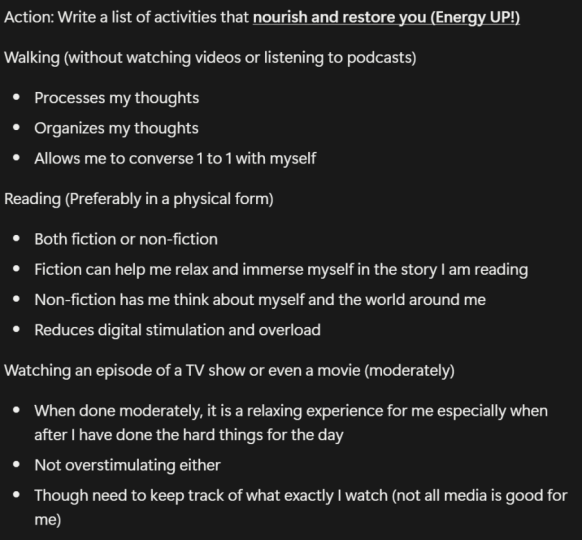
exhausted by spilling out. For this reflective exercise, write a list of activities
that nourish and restore you. For example, so for me, I love walking in nature, sitting in nature,
drinking a hot chocolate, reading a nice uplifting book. And my absolute favorite
favorite way to rejuvenate myself when I feel exhausted
is to practice Yoga Nidra. So Yoginidra is a form of yogic sleep that is
very restorative. I love it so much that I
became a yogiidra teacher. And as a little bonus at
the end of this class, there is a Yoganidra practice. So you can try it
if you're feeling burnt out and tired.
I really recommend this evening or later today trying out my Yoga
Nidra practice. Every Skillshare class
includes a project, and completing our project makes us feel a sense of completion. What I would love
to do is for you to share with me three things that you do that restore and rejuvenate yourself and pop
that in the project section. And then the project
section can be a rich and inspiring
place where we can find out what everyone else likes to do to
rejuvenate themselves. Okay, that's all for exhaustion. Let's go on to the
next one, which is all about avoidance.
6. A is for Avoidance: We're all trying to avoid hard and difficult feelings and move towards good
and joyful feelings. And sometimes, actually,
when we encounter our creativity and when we
step into the creative world, sometimes we can experience feelings that we might
not want to feel, including grief and rage. And so, although I've been very creative and done lots of
amazing things in my life, there are times I've also been a stifled and blocked artist, and there's things to grieve. And in this class,
we're going to grieve all the people who
shut us down or squashed us. We're going to write a list of the names of the people who shut us down and what they
did. So, for example, I could write down
misses Milton when she told me my story that I
wrote about money was wrong. So I have this strong
memory of four of being shut down for my story. And so I write that
down in my list, and then I just write a list of all the other people
who shut me down, who said that I couldn't do it or said that my
creativity was bad, just so that I have
that really open eyed. I can really see these
messages that I've received. And then after you've
written your list of people who have
shut you down, pick the worst offender
and write them a letter. Now, you don't have
to send that letter, but you just write it
for your own process. That's all on avoidance. Let's
get into the last lesson, which is all about
seasons and stress.
7. S is for Seasons and Stress: Seasons and stress. So
I live here in England, where we have a very, very
clear and defined season, spring, summer, autumn, winter. And those times of year
are very different. And what we can't
accept is that inside, we can sometimes
experience a winter where things are harder
when things go wrong. To share my own personal story. So last autumn winter, I decided to home
educate my son, and that meant I had
to spend a lot of time readjusting our schedule
and making a new plan. At the same time, I also got every single
virus that was going, different tummy bugs,
coughs and colds. I was completely run down. And on top of that, I
added a layer of guilt. I was supposed to be
recording an album, and I just couldn't record
it because my voice was horrible and I just didn't
have the energy for it. It can be really, really
hard as a self employed, creative person to take
that time to recharge. The ways that I
really found I could recharge myself during
that hard time is to do some very gentle and playful creative
things just for fun. So I got out my
watercolors and I was doing ten or 20 minutes
watercolor in the evening. I got out my guitar
and started playing, and that helped me
rejuvenate myself after all the knockbacks of illness and this whole
schedule reorientation. If you're going through
a winter right now, I really recommend
wintering by Catherine May. It really helped me
understand and make sense of the winter I
experienced last year. Okay, so that's seasons.
Let's move on to stress. So we all have a stress response that gets turned on by different things. And just simply having this awareness of your
stress response can be very, very helpful when it
comes to making choices. So just over the next week, really paying attention what
things make my heart race? What give me that
panic, stress feeling? Are there certain people,
certain situations. And from there, we
can make choices. You can choose to respond,
reduce, or remove. And so what I mean
by that is depending on what it is in your life
that causes you stress, you might find a different
way of responding to it. So something that causes you
stress, you might be able to act or behave or think in a different way, so it
doesn't stress you out. Two, you might be
able to reduce it, so you might be able to do a
bit less of that, or three, you might need to
actually remove that thing that
is too stressful. I'll give an example
in my own life. So I've spent many
years in entertainment, being a dancer, and a
couple of years ago, I got a job as a
children's entertainer, which seemed like my dream
job because I love children. I love dressing up. But the parties were very, very
noisy and the halls in often very bad acoustics
and you just get so much noise and sensory overwhelmed children running at you,
who grabbing you. And I noticed at the
end of the parties, I would feel very, very jittery and find it
hard to calm back down. So first of all, I tried
to respond differently. So I tried to just pause a little bit in
between activities, take some slow breaths. And I still found the end of parties. I was
still very jittery. I then tried reducing, so just doing less parties, but it just I could
not find a way to have that really stress me
out and then burn me out, so I was kind of wiped out
for the rest of the weekend. So then I decided
to totally remove that job because it was just causing me to have
such terrible crashes. And now some journaling for you, write down a list of people and places that cause
you a stress response. Over the next week,
notice what activities or people cause you a stress response and then reflect
on your choice points. How can I respond, reduce or remove that stressor? Okay, let's head into the last lesson where
we're going to say, thank you and goodbye.
8. Thank you and Goodbye: You so much for
taking this class. I really value connecting
with my students, so you can go ahead and ask me a question in the
discussions tab. Or please, if you've
enjoyed this class, do submit a review as it helps other students
to find the class. If you like to find out me and my work and other
classes I teach, head over to my
Skillshare teacher page. They will find links
to my social media, a link to my email
list where I send out inspiring emails
every so often, and also links to
listen to my music. Creativity isn't a
natural born talent, it's a muscle you train. The more you turn towards making and turn away from distraction, the more joy and beauty
you'll discover. May this short and
simple class light your creative spark
so you can go out and create beautiful and amazing
things that inspire others. Thanks so much. Bye.
9. BONUS - Journalling Track: Uh,
10. BONUS - Yoga Nidra - Quick Intro: Welcome. I'm so glad that you are going to practice
Yoganidra with me. A few quick bits of
information before we start. First of all, unlike other
meditation practices, Yoganidra is
practiced lying down. You'll see this image here on screen of the pose that
you want to be in, your arms not
touching your body, your legs not
touching, your palms facing up and your eyes closed. And anything you can do to
make yourself extra cozy, so you might like a
pillow under your head or a blanket so you can really settle down
into the practice. I'm also going to
mention your San calpa. So San translates
as highest truth, and LPA is vow. So your San calpa is an
intention or a prayer, and it's something that
is repeated every time we practice Yoga Nidra when we open the practice and when
we close the practice. And we are planting seeds in our consciousness for
who we truly are. So you might like to think
about qualities that you are looking to cultivate and plant them as seeds
in your mind. Now it's time to
get cozy and get started with your
Yoga Nidra practice.
11. BONUS - Yoga Nidra Meditaion: Welcome. Taking your time
to get extra comfortable. Have you got a nice
pillow for your head, are you all cozied up? Have you got a blanket,
the lights low, maybe a last little wriggle and just checking your arms
aren't touching your body, palms facing up, and your
legs aren't touching. And to start the practice, we will begin with a nervous
system, calming breath. So we breathe in
through the nose, and we breathe out with purse lips as if we are
breathing out through a straw. So let's try that together
in through the nose. Out through a straw. In through the nose
out through a straw. Extending the outbreath. I'll give you a moment to practice a couple more of
them in your own time. Arriving here and now, letting your body be heavy. Letting your mind center
and focus on my voice. My voice is the anchor that will carry you
through this meditation. So if you notice
your mind wandering, come back to my voice. O and now there's a moment to quietly whisper in your mind your sun
culpa three times. If you haven't brought
with you a sun culpa, you can repeat I am
rested and rejuvenated. So repeating your sun culpa
three times in your mind. O. Now, we move on to the rotation
of consciousness. So I will mention different
parts of your body. For example, I will
say your right thumb. And then in your mind, you will bring your attention
to your right thumb, and you might even mentally
repeat right thumb. My voice is your anchor. So starting with center
of your forehead, right eye, left
eye, right eyebrow. Tip of your nose, right nostril. Left nostril, upper lip, lower lip, your
chin, your throat, the right side of your neck, left side of your neck, right shoulder, right upper arm, right elbow, right, lower arm, right thumb, right second
finger, third finger. Four finger, fifth finger, palm of the right hand, back of the right
hand, the right wrist. The whole of the right arm
from right shoulder to right, fingertips, the whole right arm, right ribs, right waist, right hip, right upper
leg, right knee, right lower leg, sole
of the right foot, top of the right
foot, right big toe, second toe, third toe, fourth toe, fifth toe, the whole right foot, the whole right leg
all the way from your hip to the
tips of your toes, the whole right leg, the whole right arm, right side of the
body, right leg. The whole right
side of the body, arm, torso and leg, and the left hemisphere
of the brain, the whole right side of the body and left hemisphere
of the brain. Right side of the body, left hemisphere of the brain. Now to your left shoulder, left upper arm, left elbow, left lower arm, left wrist, palm of the left hand, back of the left hand. Left thumb, left, second finger, third finger, fourth finger, fifth finger, the
whole left hand, the whole left arm from
shoulder to fingertips. The whole left arm from
shoulder to fingertips. Left ribs, left waist, left hip, left upper
leg, left knee, left lower leg, sole
of the left foot, top of the left foot, big toe, second toe, third toe, fourth, toe, fifth toe, the left foot. The whole left leg
from hip to toes. The whole left arm, left leg, and left torso, the whole left side of the body and right
hemisphere of the brain, the whole left side of the body, and right hemisphere
of the brain. Left side of the body, right hemisphere of the brain. The whole body. Whole body. Traveling down the
back of the body, your back of your head, back of your neck, back
of your right shoulder, back of your left shoulder. Mid back, right
buttock, left buttock. The back of your right leg, the back of your left leg, right heel, left heel. The front of your body, forehead, tip of your
nose, tip of your chin, sternum, belly
button, right knee, left knee, right, big
toe, left big toe. The whole body. The whole body. Resting in here and now. And now we bring to mind
our San Calper again, quietly whispering in your mind, You San Calper three times. Giving your fingers and
your toes a little wiggle. Maybe a stretch. What do yawn. Rolling very carefully
onto your right hand side. When you're ready in your
own time softly, quietly, slowly, finding yourself up to seated and completing
your practice. You might like to
maintain this quiet space by going on to do something
quiet and reflective, maybe making yourself
a nice cup of tea, writing in your journal, doing a nourishing
creative practice. Thank you so much for joining me in this Yoga
Nidra meditation. May the qualities that
you have planted in your mind bloom and blossom and radiate
outwards in your life. And so it is.
 Laura Lamn, I light the Creative Spark