Transcripts
1. Watercolour Toucan Introduction: Hi, Welcome to this step-by-step
watercolor tutorial on how to paint this
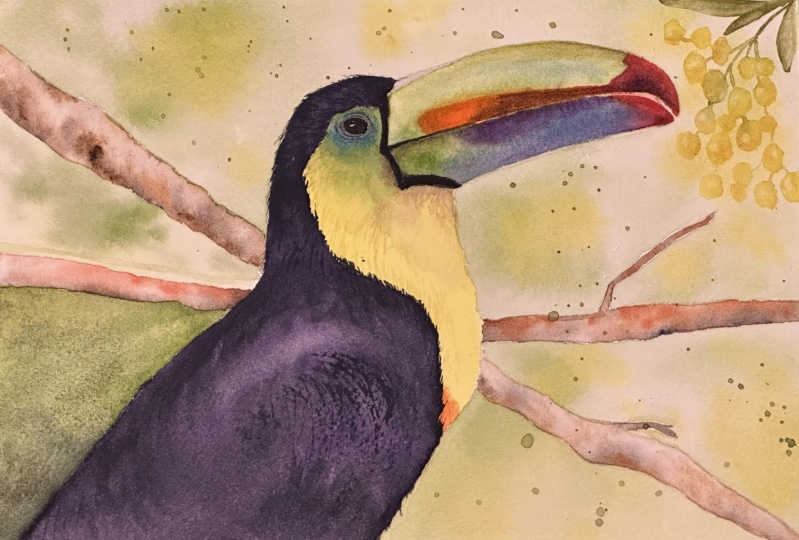
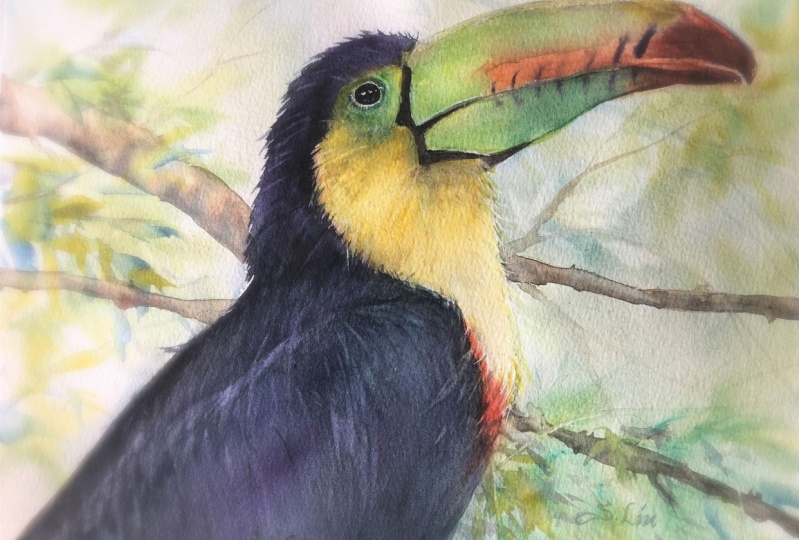
beautiful toucan. This has honestly got to be one of my favorite paintings
I've ever done. In this tutorial, I'm
gonna show you how I bought certain objects
in the foreground. For instance, I made these branches here
more crisp and low shop so that they bought forward. But then I made these
wins more fuzzy. And so they look like they're
more in the distance. I'll be showing you how
I painted the beak and really bright colors and how I dealt downstate
and colors as well. So make those bright
colors pop off the page. I'm also going to
show you how I kept the darkest areas of the 2k and fresh and vibrant and still colorful because
although it looks black, I haven't actually used
black on the toucan. So I'm going to show you a layering technique
that you can use to keep your dogs really fresh
and vibrant and still fun. We're gonna be painting this simple but realistic
looking eye as well. I'm also going to be talking
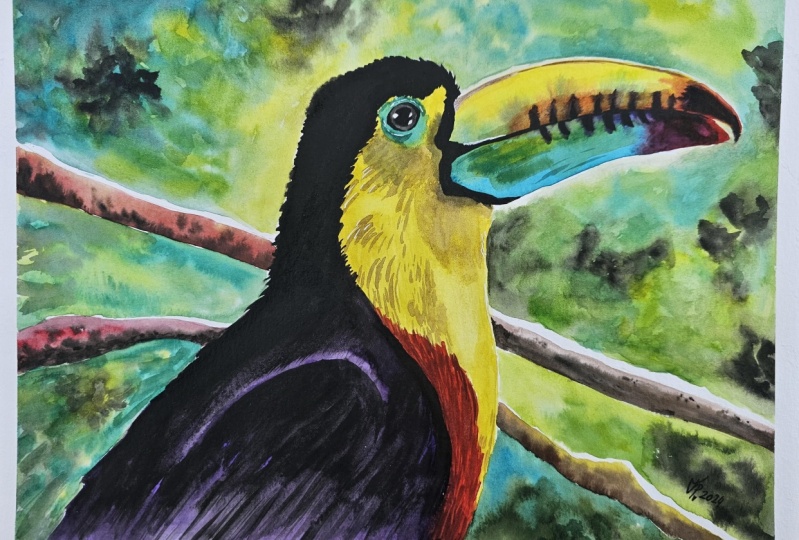
you through how I painted this fun and splashy and
blurred out background. The background is definitely my favorite parts of
painting is toucan. I do recommend that
you go through and watch my videos first and then go back and follow me step-by-step through
these videos. You can do a little
bit at a time because each video is only
a few minutes long. And the reason why
I've filmed it like this is so you can easily follow along with me with the
step-by-step instructions. So what are you waiting for? Grab a cup of tea
and we're going to move on to step number one.
2. Colours and Supplies: The colors I'll be using all the toucan or dioxazine violet, Payne's gray, lemon yellow, also cobalt turquoise and
that's a pinky color. Quinacridone red, and
that's Daniel Smith. And then I'm gonna be using a range of shades
of greens as well. I'll be using my favorite silver and black velvet brushes. I mainly use a size ten
throughout the painting. It's Olivia pointed round brush. And then for the
smaller details, I did use my size six for the
background and my size 12, which is a larger brush. I will also be using
some tube paints, so I'm using Daniel Smith
and Winsor and Newton today. I've also got some cloths for dabbing off excess water
from my paintbrush. The paper that I'm
using is A3 size and it's a Moulin do
ROI Canson paper. This is 100% cotton. It's £140 cold pressed paper
and two jars of clean water, one for rinsing and one
for picking up new paint. Then I'll be using
a mixing palette of my favorite palette is
this ceramic palette. And then also I've taped
my paper down to a board. These boards I get from an art shop called
Jackson's hours. And I'll be using a
harder lead pencil and also an eraser
for sketching.
3. The Beak: First Layer: We're going to
start off on the to convert, painting the beak. And to be honest, I was so excited to actually
paint this beak, but very unsure
what colors to use. I wanted the beak to
remain very vibrant, but I also wanted certain areas of the beak
to be a little bit more subdued or a little bit less
vibrant and in your face. So I did struggle with
the colors a little bit. But the first layer, I'm going to lay down a
light wash of lemon yellow. And I'm going to leave a
little gap in the middle, just at the front of the beak. And you'll see what
I mean in a minute. So I am going to
paint the top and the bottom of the beak
in this lemon yellow. And then I'm gonna come in
with some cobalt, turquoise. I would say that this
is a mid strength. I am touching the end of that paint to the lemon yellow while the
paint is still wet. So you've got some nice blades, Outlook or a blended effect. And then I'm going to take
some of that cobalt turquoise into the beak area right at the back of the
bottom of that beak. I'm painting on the
dry paper here. So I'm going to continue to leave that little
golf at the front. So now I'm dropping in
the quinacridone red. This red is very vibrant. So although I've added water
to this is still quite thick and quite dark pigmented
wise, it's very vibrant. Like I said, I'm just using a damp brush just to blend
out this little edge so that you've got
quite a harsh edge between the top and the
bottom of the beak there. So this is just a dump
brush and I'm using this on the paper while the
paint is still wet so you can get a nice
blended effect. I am going to leave
a little bit of the white paper showing
that the front of the B. And in the next part
we are going to paint the first layer of the
toucans chest and body.
4. The Chest and Body: First Wash: I'm going to use my
putty eraser now to pick up some of the
graphite on the paper. This is my fiber
cast El Patio visa. I did get this from Amazon
and I'm just going to break up a little bit so I can save the rest of the eraser
for another time. What I'm gonna do is
I'm just going to press that to the paper. And that's going to
help pick up some of the excess graphite to lighten
those lines a little bit. Just because I don't want those lines coming
through the paper. Especially because we're going
to be using lemon yellow, which is a very light color. With my size two brush, I'm going to paint
on a lighter wash of the lemon yellow
all over the chest. I am going to be very
careful to paint this around the area
of the eye as well. So I'm trying to not go on to the middle of the eye
because we are going to be adding some
Payne's Gray and they don't want to call it
a retaining green. So we are going to just
carefully bring that lemon yellow down the friends of
the toucans chest as well. And I'm just going to flick off a few little feather flicks just with the tip of my brush. And I think two major, just a few sorts of prominent feather flicks
just at the front there, but you will have
them on your line drawing if you're going
to use the line drawing. Now I'm going to drop
in some more pigment. He'd lemon yellow. So this has got less
water mixed into it, so it's a bit thicker. And I'm dropping that
onto the lemon yellow while that first
layer is still wet. Just so we get nice
bled out blended. Look. Now I've got the cobalt
turquoise and I'm going to also apply that
around the eye area. While that's lemon
yellow is still wet. I do want to have this nice and soft or keep
this nice and soft. So that's why I'm working
on the wet paper. And can you see when the cobalt to Greece goes over
the lemon yellow, it actually turns green. And that's the effect
that I was looking for. This is the exact
color I wanted. I'm just going to use some very concentrated
cobalt turquoise now because I wanted the top of that to be
very blue or very turquoise. So I am going to add a little
bit at the bottom as well. Here, I mixed the
quinacridone red with a little bit of the
yellow to get an orange color. I'm going to paint
that at the bottom of the toucans body
on his chest area. And the next we're
going to paint the first underlayer of
the toucans head and body. So grab your dioxazine violet
and we're going to paint this very vibrant and very
beautiful underlayer wash. You probably thinking, why am I odds in
dioxazine violet as a layer of the two can, when the toucans should be a dark color like
a black or gray. And there is method to my madness whilst I want
it to happen was when we pop the Payne's gray over the dioxazine violet a
little bit later on, I want that diet, that
dioxins are invited to come and shine
through that gray. Make it a bit more
fresh and a bit more interesting and more vibrant. That's why I'm popping this first layer of
dioxazine violet all over the back of the head
and onto the body as well. The consistency of this, I would say is like milk. So it's got lots of
pigment mixed in, but lots of water as well, so it flows nicely on the paper. Now I'm just blending
at the bottom with some clean water and also
add in some drips of water. So really sorts of attempts
that paint to come down. And then I'm angling
my board damage as well to allow the
paints to drip down. Next, we'll be
building up depth and shadow on the chest area.
5. The Chest; Adding Definition: I wanted a darker version
of the lemon yellow. So I've added a little bit of dioxazine violet to
this, and I mean, just a tiny amount of
the dioxazine violet to dial it down and make
that yellow a bit darker. And the reason why the
dioxazine violet and makes that yellow darker is because those two colors
are complements. So that means that they
are complementary colors. Horrea mean, that means that
the Dell each other down. So I'm using my water now
I'm wetting the paper around the eye very carefully
and also the chest area. Then I've got that darker yellow and I'm just
going to drop it into a few areas of
the toucans face. I'm also going to paint that dark color right
at the front of his chest to really give that chest more of
a rounded feel, to give it a little
bit more shape. Now I've got the
dioxazine violet and his very watered down. And I just painted that dark shadow shape at
the bottom of his beak. I'm painting on a
nice diluted wash of the cobalt turquoise again. And I wanted to take
a little bit of that very light color over the front of the
eye here as well. Just where it's a little
bit more green shaded, bit more green tinted. Now I've got some clean water. I'm going to paint
the top of that be. Then I'm going to drop in
some cobalt turquoise again. I'm going to take that over
the bottom of the beaker, the top of that peak there. I'm carefully following
the line of the beak. So you can see that I made the lines of beat
quite prominent. And then I'm going to
take some of that color into the middle of
the beak as well. I'm painting on the wet paper because I want to keep
this nice and soft. And then I've got this color. So it's kind of an
orangey color like so I got them from mixing the red, which was the quinacridone red, the lemon yellow, and
also a little hint of the violets to get more
of this subdued color. It's a bit less
vibrant and that's exactly what I wanted for this
shape here in the middle. So I'm just painting that onto the middle part with the
beak separates as well. And that is because I wanted the area to be a
little bit darker. So I'm going to
carefully paint that up to the edge where
I've already painted. And then I just use a damp brush then to blend that edge out. I've added the lemon yellow to the two coils now to get
more of a green color, and I'm going to drop
that onto the beak while the paint is still wet. Now for a bit more
of the turquoise. So this is the turquoise neat. I'm going to drop
that in as well. So this isn't mixed with
anything now the turquoise, and that's going to be dropped
into a few little areas of the beak as well while
that paint is still wet. This is the quinacridone red. Again. I'm going to take that
onto the edge of the beak. You can see that I'm not being so straight with the edges. So I am making the edge of
that a little bit irregular. And for the next
area of this lesson, we will be painting
some further details on the toucans chest.
6. The Chest and Body: Adding Feather Detail: I've added some dioxazine
violet to the lemon yellow now to get this
lovely sort of dull color, you can see that
it's really done, that yellow and it looks kinda
like a brown or a mustard. What I'm gonna do
is I'm going to paint this onto the dry paper. And I'm going to use the tip of my brush to create
some feather flicks. In areas I am going to use a damp brush just to
blend out some of those edges just so that we
get softer edges in areas. And then in other areas I'm
going to leave them sharp. So you can see I'm just using either the belly of
the brush to get these feather shapes
and also the tip of my brush to really get some
lovely texture and locks, but look a little
bit like feathers. Now, I did find this
a bit difficult. So hover practice on some
scrap paper for this color. Now, this was the
dioxazine violet with the lemon yellow mixed in. So first start with
the dioxazine violet, and then the little bit of the yellow too dull that color down. And then just going to paint in this little shadow shape
underneath his beak. I also took a little bit of
turquoise at the top diluted. I'm going to continue to take the dulled down yellow onto
the chest at the bottom. Just using a damp brush in areas to blend out some
of those edges. Next, we will continue
to work on the beak. This will give the
chest chance to dry. So I've got some
clean water and I'm going to re-wet the
top of the beak. The back of the
beak I'm dropping in the dulled down yellow. So this was the
lemon yellow with a little bit of the
dioxazine violet. And then on the rest of the beak you can see
me, your opinion. The dioxazine violet,
which has been dels down with a little
bit of the lemon yellow. So this is when you start with the dioxazine violet and add a little bit of the
lemon yellow to it. And I'm going to paint it
across the beaker like this, but I'm going to leave the
top of that big light. You can see that I've left
a small strip of white that is done for a reason
because we are going to add the background
a little bit later on. I'm painting this
dioxazine violet mix onto the front of the beak. So over the quinacridone red. And I am going to
leave a small strip of the red showing up the
front of the beak. So I would watch what I'm doing first before you start painting, because you might end up accidentally painting
the whole of that beak. I am going to preserve a
little bit of the red. Now I've got the dioxazine
violet and very watered down to dull down this
middle area here. And dropping in a
little bit of the lemon yellow just to
brighten it up a little bit. I'm re-wetting the bottom of that beaker with
some clean water. And then taking my lemon yellow, I'm going to start dropping that into the areas of the beak. I'm taking that
lemon yellow over the lemon yellow that
I've already put down. But I am also going to paint that over the cobalt turquoise. And you can see that that's
actually changing that into a green color because I wanted to get some
of the green in there. That's why I've done that. And you can see me painting
some dioxazine violet, which is quite watered down
Over the middle area of the beak and also onto the red lower area
of the beak as well. So we're just
basically doing the same as what we did on
the top of the beak. You can see I'm taking some
of that dioxazine violet, partly into the bottom of that beak there while
the paper is still wet. And also running it
along the middle line. And this color might
look a little bit more subdued or a little
bit less vibrant. And that's because
the dioxazine violet is going over the yellow. So that helps to dog
dioxazine violet down. I'm painting these markings on now with some dioxazine violet. And I'm painting this onto the beak while the
paint is still wet, you're going to
get softer edges. Towards the front of the beak. The paint started dragging
on me, but that's okay. I didn't really mind that
effect and I quite liked it. So you can see that
it's a bit more fuzzy at the back
where the paper is still a bit damp and then at the Friends
it's a bit sharper. You can see that it's
actually painting those markings on the streets. I am actually curving
them ever so slightly. And it's going to help give the full moon
shape of the beak.
7. The Eye and The Dark Markings on the Beak: I'm going to paint in the eye now I'm using some
Payne's gray here. This is no sin diluted
mix lots of water into this to keep it lighter
on this first layer. And you can see
that I'm carefully painting around some
little highlights. So I'm leaving a few little
areas of the paper white to give that sense of the
eye gleaming and className. And it makes the eye look a
little bit more realistic. When you leave
highlights like this, you could use masking fluid to preserve those highlights
if you prefer to do that. But I don't really use
masking fluids a lot, so I just prefer to
paint around them. And you can see that I'm fixing
the shape of the eye now. And now I've got some
very thick and creamy mix of the Payne's gray. So this has got hardly any water mixed into it to get
it nice and dark. I'm going to paint
it around that I while the paper is still wet. Now I'm going into the
middle of the pupil and I'm painting that on while the paper is still
a little bit wet. Next I'll be painting on the first layer of
the Payne's gray. So I'm going to
watch the back of the head now with
some clean water. I'm going to also wet
the top of the body. I'm not going to wet the
whole thing because I don't want the paper
to be draining on me. So I am going to
wet a little bit of that bottom area a
little bit later on. So I've got some very
concentrated Payne's gray now, it's got a little
bit of water mixed into it just to get it
flowing on the paper. We are going to paint the
back of the head here. I'm painting on this paint while the paper is still
wet and I'm using the tip of my brush to pull out a few little
feather flicks. So you want to keep
those quite short. Try not to overdo
these feather flicks. But it makes the two can look
a little bit more fuzzy. And then I'm going to
use the tip of my brush to pull up some of
that paint onto the dry paper into that
yellow area of the toucan. And then I just
use my damp brush to blend out the
edges a little bit. I'm going to bring that paint
down into the neck area, but I don't want to bring that paint down
further than water. That water has traveled. So you can get a good idea
of where that water is by having a look of the
sheen of the paper, you can clearly see
where the water stops. So if you hold your
paper on his side, then you might be able to see the sheen on the paper where
it's a little bit wetter. I'm going to continue to wet the rest of the bird's body now. And then I'm still going to drop in this really
dark mixture. This is going to lighten. It does lighten a
little bit further on, so we will add another
layer of this dark paints. And the reason why I popped down the dioxazine violet
faced was because I wanted some violet
to shine through the Payne's gray and give it a
little bit more vibrancy. I'm calling up a few
little feather flicks onto the dry paper with
the tip of my brush. Then I'm going to leave a gap of the dioxazine violet to create a little bit
of a highlight. If you have a look at the
reference photo on the toucan, that lovely curved highlight on the shoulder of the toucan. And that's going to help to
give the toucan will form. And then he's not going to look so much like a flat shape on the paper is going to help to give him a bit of
a 3D shape there. And you can see that I'm just
using my brush to lift out a little bit of a highlight
on the back as well. So I just use the damp
brush is clean and then I just lifted out a bit of paint while the
paint is still wet. Now I'm going to continue to add this dark paint all over the
rest of the bird's body. You can see that it
is quite light here and that's because my
paper is really wet. If you want to add a darker layer to start with and you want it to be very dark. Lights that water seep
into the paper a bit more. And then add your paint on top and make sure
that your paint has got lots of pigment mixed into it and not
much water at all. But we are going to
build this color up. So don't worry if it's a bit
too light to start with, we are going to
make this darker. I'm adding a thicker
mixture of the Payne's gray now just to
the shoulder of the bed. This has got not much
water mixed in at all, and it's got lots of pigment, which is paint mixed into it. So I'm going to apply
that to the shoulder of the bed while the
paint is still wet. We're going to continue
to bring this down. And what I'm gonna do
is I'm going to try and create some sort of feather
shapes at the bottom, just using the tip on
the belly of my brush. And don't worry if it
looks a bit messy, That's the look that
we're going for today. I'm just going to use
the tip of my brush just to tidy up this front area here. And just using a little bit of that dark mixture on the
back of the body as well. So really dark in the back
of thought birds, birds, I'm going to go into avoid the highlight that
we've already put down. I don't want to cover
up that highlight. I am just using a damp brush here just to blend out
some of the edges, just to soften them
up a little bit. If you're not going to
pop a background and you can add some
splatters as well. But we are going to come in with the background a
little bit later on. I'm also going to
use some clean water on the beards as well. If you do this while
the paint is still wet, you're going to get
some lovely texture.
8. The Beak and Body: Adding Darkest Markings: I'm going to start
by painting in the darkest markings
of the beak. So I'm going to
start by painting these lovely dark markings around the outside of the beak. Now, this is very
concentrated Payne's gray. So you can see I'm
quite struggling a little bit to get it
to move on the page. There isn't much water
mixed into this at all. It is lovely and thick and I rubbed my damp brush
over the sticky mixture. So I had some brand new Payne's gray squeezed out
onto my tray for my tube. And that's how I got it so dark. So I'm going to just
continue to paint this around the bottom of
the beak as well. I'm using a size
six now to paint in this middle line
of the toucans beak. And I'm not gonna
make this straight. I'm just using the
tip of my brush really to make
some jagged marks. And you can see that some of those are not even join death. I am making it very
irregularly shaped. Sorry, I can't say that word. And now I'm going to be putting these little shapes at the
bottom of the toucans beak. And I'm kind of moving them
around a little bit to make the beak look like it's
more rounded shaped. So I am going to dip my brush
into the water jar as well. So get the markings at the Friends a little
bit lighter in value. You can see those marks at
their backers slightly darker than those marks that
I'm painting on now. And all I'm doing
is starting with a triangle shape at the top and then just
bringing it into a point. And some of those
markings are going to be a little bit smaller. Now I'm going to just paint on a tiny dark area right at
the beginning of the beak. That was a bit of Payne's gray. And then just prefixing some of that middle
line where it got a little bit lost with those middle markings that I painted. I didn't want that
middle area of the B2B very miss shaped. So now I'm going to be adding some more dark
markings to the body. I really did want to
darken up certain areas of the toucans had and
also the body area. So I'm just wetting this with some clean water and be very careful that you don't
disturb the underlayer. So be very careful with
your brushstrokes. Now I've got some Payne's
gray and it's very thick. And I'm dropping that in
not all over the head. I am missing areas
because I do like the look of some of that
lighter color shining through. So I mainly taking it onto the front of his heads where
it touches the yellow. And then using the
tip of my brush, I'm just pulling off
some feather flicks with the dark mixture. And that was the Payne's gray. I've got the Payne's gray now, I'm going to continue to drop it all over the body of the toucan. You can see that I'm
actually bringing that down and bring it down in
strokes or streaks. Kind of make it look like feathers because this
mixture is so thick, you are going to be able to
get that dry brush effect, which I really liked
because you can see some of the lighter wash
shining through. And if you don't like
the look of that, you could always
use a damp brush to blend it out a little bit. So I've got some of
that dark mixture on the back of the toucan now, and I do want to try and
preserve that lovely. So to have light highlight in the middle with that lighter
purple shining through. So I did avoid that. And now continuing
with my brush strokes, so lovely dark mixture
of the Payne's gray. And you can see that I'm just using the tip and the
belly of my brush 3D with a dryer brush to create these lovely streaky feathers. You can see that
with a dry brush, I'm able to get those
real sharp feather ends. Now I've got some clean water
and splatter in that on. And now we'll be
adding a few shadows to the chest and eye area.
9. The Chest and Eye: Adding Shadows and Definition: I'm applying clean
water again to the face and the chest area
all over that area. And now I've got that dulled down dioxazine
violet that we used earlier. So that was the
dioxazine violet and mixed with a little bit
of the lemon yellow. And I'm adding a watery wash
of this around the beak to create some shadows while
the paper is still wet. And I'm also going
to add a little bit towards the back of
the face as well, and just underneath the eye
to create a bit of a shadow. So this is a nice
watery mix and I'm just blending out this edge
to keep it nice and soft. Now I've got slightly
more pigmented paints, so this has got more paint
mixed into it and less water. Now I've got some of
the cobalt turquoise mixed with a small amount of
Payne's gray to dark in it. And I'm going to paint this onto the IOA to create some shadows. This was painted on dry paper. I'm just using a
damp brush and then I'm dropping in a
little bit more of the dark pigment
to really darken up a few areas while
the paint is still wet. And I'm also going
to blend some of that color around the
front of the eye. Lastly, we're going to be painting a really
fun background.
11. Finishing Off and Your Project: Thank you so much for
taking this class today. I hope you enjoyed it and got some useful hints and tips for yourself for painting your
own toucan or your own bids. Remember to post your paintings in whatever process you're at in the projects and
resources area of this class, I get so excited to see
your creations and see that my students are
actually following along with me
step-by-step tutorials. It really does mean
the world to me. So remember that
whatever process you're at at the moment, post a picture of your painting in the projects and
resources area. And if you want feedback, I would be happy to
do that as well. If you've got any
questions about this class or your
painting process, please reach out to me,
That's what I'm here for. I will get back to
you as soon as I can. You'll projects now is to
paint your own to cone using the skills that you've
learned in this class, have a lovely rest of your day. Happy painting, and
I will see you soon. Bye.
 Lindsey Dawn Art, Watercolour Artist