Transcripts
1. Introduction: Imagine your artwork
being featured in a global brand campaign seen by millions and driving
conversations around the world. It sounds like a dream, right? So today, we're
turning this dream into a strategic plan.
Welcome, everyone. I'm thrilled to have you
here as we dive deep into an exciting world of securing high profile
brand partnerships. My name is Anna Bucharelli. I'm a professional
illustrator from Canada and a top
teacher here on skill. Over the course of my career, I've had a pleasure
of working with many international brands
and creative agencies, producing surface design,
book illustrations, and even ads for luxury cars. My longest and most
productive brand partnership has been with the
Royal Canadian Mint, where for the past ten years, I've been creating designs
for Canadian money, the gold and silver coins, featuring various decorative
motifs and royal effigies. If you're a creative
professional like me, you know that our talent
can open incredible doors. But navigating the path to those big brand collaborations requires more than just talent. It demands a blend of very compelling
professional portfolio, strategic social media presence, and the courage to
approach the brands on your own and using cold
pitches to stand out. So in this class, we
will explore how to create a portfolio that not only showcases
your best work, but also tells a story
that brands can resist. We'll talk about building and curating personal
portfolios and also discuss hybrid portfolios or so called portfolio aggregators
that in my experience, are extremely effective at connecting you to
the right clients. We will learn how to use
social media platforms to attract the attention of
creative directors and agencies. And most importantly,
I will share tips for putting
together winning pitches that will help you
communicate your value and open doors to rations. In the class resources, you can download a handout that I created for
your class project. We will use this portfolio
checklist together to guide us through the process of curating a successful portfolio, and you can use it to set up a new online presence or to
curate your existing website. As a bonus, we will discuss
how to communicate with clients effectively with a focus on working with creative briefs, and I will also share one of the best pieces of
creative advice that helped me grow my
creative practice and build relationships with
brands over the years. By the end of our session, you'll have actionable strategies
to elevate your brand, to attract high profile clients, and to secure partnerships that will take your
career to new heights. Whether you're just
starting your career or looking to pivot into a
new creative direction, the tactics and strategies we discuss will be very helpful. So I look forward
to seeing you in class and sharing my tips, case studies, and
experiences with you.
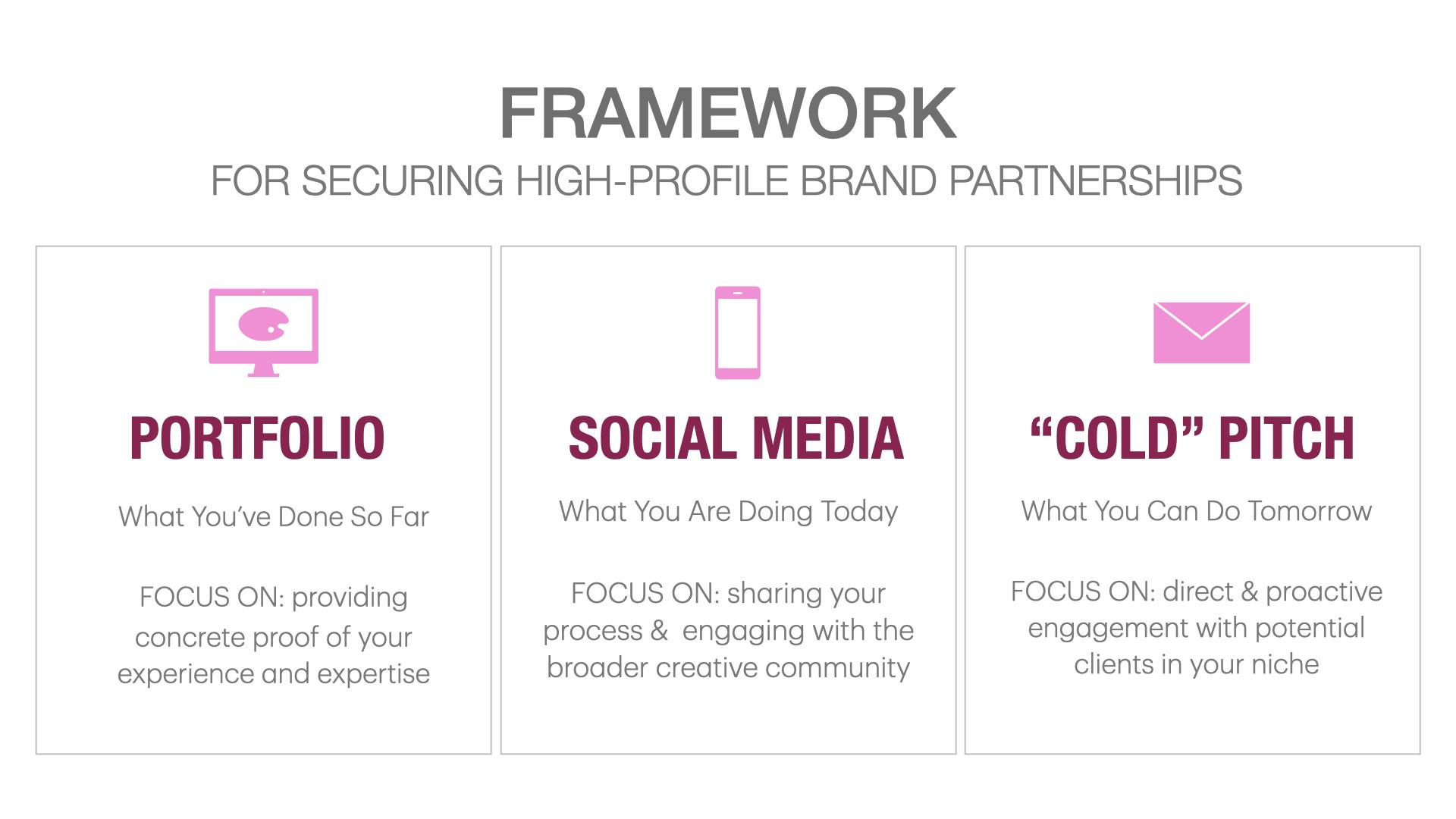
2. Framework for Securing Brand Partnerships: Let's start with a
simple framework that will help you think about
your creative practice and different strategies and tactics that you can put in place that lead to working with big brands and
exciting clients. Before I start, I
should mention that everything I'm talking about is based on my own
experience and is meant as advice and
food for thought. Want to be too prescriptive. I'm simply giving
you some ideas and a framework to help you think through some
of these challenges, and maybe put some of these things to test
in your own practice. Now, my own creative path is rather unique and maybe
somewhat non linear. I didn't pursue a
full time career in illustration until
well into my late 30s. Instead, I pursued
a business degree. I have an MBA, and up
until six years ago, I worked on the other
side, the client side. This is not a traditional path, but it gave me a lot
of really good insight into how things work holistically from a
brand perspective. Having worked for companies
like Procter and Gamble, I was able to get a
better understanding of how creative briefs
are actually developed, and how brands decide on
hiring external designers and illustrators and what actually matters
in that process. There are three main components, three pillars, if you will, that we need to
consider and tend to, if we want to work with big
and exciting brands and enjoy long term successful
brand collaborations. I'm talking about
your portfolio, your social media strategy, and your No matter where
you are in your career. These are the things that
matter above all else. And we're going to
talk about some of the additional peripheral things like hybrid portfolios that
contribute to this ecosystem. Once again, keep in mind
that this is meant as a helpful framework
for you to think on. In addition to all the tips that I'm going to share
in this class, you can always choose to explore
these components more in depth and add to this framework as your
creative practice grows. Everything starts
with your portfolio. This is the cornerstone of
everything we will discuss. This is where we start, and this is where all
the paths will lead to. I want you to think about
it as a business card, a place where you will showcase
your best creative self. Now, we often think about
it as a static thing, but it has to evolve over time, and there are lots
of nuances that we will discuss to
help you transform your portfolio from
a simple collection of static images to a very powerful business tool
that will really appeal to your potential client and help you land your
dream project. We have social media and
unlike your portfolio, which shows the work that
you've already accomplished, social media is all about
the things you do on a daily basis and
how you engage with the world and creative
community as a whole. Of course, there
are lots of things that we can do to tweak your online social media
strategy in order to make your work more appealing
to potential clients. But let's not forget
that social media has a broader reach that goes
beyond your potential clients. So we're going to talk
about some of the things that we have to do and
some of the things that we can do if we want this part of our
social presence to work effectively and to help us land the
jobs that we want. Finally, the third
pillar is pitches. In other words, actively reaching out to
potential clients, either simply with
samples of your work over e mail or doing
something more elaborate. And we will also talk about some of the
things that we can do. Now, this part is the
most intimidating, but it's also very effective. So we'll discuss that as well As we're working through
this framework, don't forget that I've prepared some handouts for this class, and you can take these
checklists and use them to help you work
through your own assets like your portfolio or
your online presence and see where there might be some opportunities for
optimizing your content, for tweaking your strategy, and maybe some of the new ideas that you hear are
very, very simple, and you can
incorporate them right away or make a plan for yourself or how you
can optimize say your portfolio over the
next couple of weeks.
3. Understanding Your Target Audience: So now that we have a framework, let's talk about each
component separately, starting with your
online portfolio, which is different from
your social media strategy. And this is actually a common
mistake I see people make. We often tend to think about our social media
as our portfolio. But these are two
different things with two different audiences. Though there might be
some slight overlap, but for the most part, the audiences are different
and our strategies therefore need to be different when we think about
these different components. At the end of the day, and
I can't stress this enough, it all comes down to understanding your
target audience and understanding how effective
these different channels that we have at our disposal, how effective they
are at actually lending us the work that
we're interested in, and the clients that we want
to And the key distinction I want you to make is that your portfolio,
for the most part, will be viewed and appreciated
by potential clients, decision makers that can
actually reach out and hire you. And your social media is oriented at a much
broader group. That is not to say that you can't lend clients through
your social media, but that happens a lot less
often than you might think. I'm going to give you a
simple example based on my own statistics just to
drive this point home. On my YouTube channel, I get anywhere 10-20
thousand views every day. It might be even more on my Instagram if I post
something exciting, like a really engaging real. Now, in my entire career, there's only been a
handful of times when a potential client discovered
me on social media. In comparison, I get 400-500 visits to my
website on a monthly basis. And yet the majority of
projects I get to work on, the majority of brands
that reach out to me, find me through my portfolio, even though the number
of visits seems rather low compared to what
I get on social media. In fact, most of my
clients often have no idea that I have a large
social media presence at all. And you may wonder how
I know this, Well, I always ask them about
how they discovered my majority of them come
through my portfolio. Oftentimes through
portfolio aggregators, these hybrid portfolios that we're going to talk about
in a minute that are incredibly effective
because they attract people who are looking to
higher potential creatives. When they come to
your portfolio, they come with a
project in mind. They're not coming
to be entertained. A that is to say is well, social media might give you very broad reach and lead to some exciting
collaborations. It's your portfolio,
and by extension, these hybrid
portfolio aggregators like Be hands that we're
going to talk about in a minute that are a crucial step in helping you lend the
work that you want. That is because people
that come to your website are not coming there
to be entertained. They're not coming to
pick up tips on painting a particular subject
like they do say on YouTube or Instagram. But they're coming
to your portfolio with a very specific
thing in mind. They're coming to look at your skills in the context
of your completed projects, and they're coming with
their own creative problems, looking for people like you who might be able to
help them solve it. Are the creative directors, the brand managers who
have big budgets and creative briefs and the vision for something they
want to build, be it a series of book covers or maybe an entire brand
identity redesign or maybe an advertising campaign that needs an illustrator. They're very much
on a lookout for someone with a very
specific set of creative skills who is also reliable and nice to work with. Keep in mind that these
are busy professionals who are going through multiple
portfolios at a time, when the timing is right, when they're on the lookout for that illustrator or designer, and it's your portfolio that is the proof they
need in order to feel confident to reach out and explore this working
relationship with you. At the end of the
day, your portfolio, not your social media, it's your portfolio
that gives you the most concise way if
you do this right to show someone at a
glance that you do have the right set of skills and invite
them to reach out. With this in mind, every
visit to your website is worth so much more than a follow on Instagram or
even a viral techo. And that is not
to say again that your social media strategy
is not important. They go hand in hand. But at the end of the
day, your portfolio is the cornerstone and that important piece
of the puzzle that actually lends us the
work that we want.
4. Portfolio Strategy #1: Quality vs Quantity: So let's talk about what makes a successful portfolio in the context of what
we just discussed. The fact that people
who are coming to see our work have very specific
creative needs in mind, and it is our responsibility, our challenge to convince them that we are the right
person for the job. And I will give you
four pieces of advice, and I encourage you to download
the portfolio checklist. It's a resource that
I've prepared for you as part of this
class and review each point to see how it might
apply to your portfolio. You might already have an
existing portfolio online. You might be in the
process of setting one up, or just starting to think
about designing one. So use this checklist as a guide to help
you on your journey. See if there are any
opportunities to change things up or maybe
try a different approach, fine tune some of the
things you already have, or maybe plan to include some of these things that
we're going to talk about in your future portfolio, regardless of where you are
in your creative career, all of these will apply. First and most important
piece of advice is to curate for
quality over quantity. You really want to showcase your best work,
not all your work. It's very likely that
potential clients will have maybe a minute to appreciate the body
of work at a glance, and they will make a
very quick decision about whether or not they
want to explore further, simply by looking
at your home page. So you can see how
it's better to have just a few striking outstanding
pieces on your home page, rather than a whole variety and a Mish Mash of different
styles and projects that you worked on that
somebody would have to scroll through to find the gems. Now, depending on where
you are in your career, you might have a whole library of projects that
you can showcase, and I recommend selecting
only those that highlight your strengths and
align with the type of work you want to
attract right now. My recommendation is to
come up with a grid. Limit yourself to maybe six
maximum nine projects at a time that you can
rotate throughout the year or maybe update
every couple of years, depending on the body of
work that you develop. I know it might
sound really harsh, but it does pay off
to be selective, and I want you to really get rid of anything
that doesn't fit into the vision of the type of work you want to attract today, and let's say in
the next two years. Example, and I'm going
to make this very, very concrete because I made
every mistake in the book. Early on in my career, when I didn't have a lot
of professional projects, there were a lot of
sketchbook work that I was very proud of and
I wanted to showcase. I've populated that
sketchbook with lots of watercolor fish and flowers.
I was very proud of it. In fact, it did really, really well on social media. But as we discussed earlier, social media has a very
different audience. And so for the longest time, I've included my sketchbook
shots on my website. But after having a couple of
portfolio reviews myself and consulting with some of the more seasoned
designers that I know, I decided to get rid of
it because it wasn't communicating anything
of extra value to my potential clients, other than just another
reason to look at endless variations
of different flowers that I really enjoyed sketching. A much better approach was to highlight the real
projects that I've done. Also, some of the
concept projects, what I call dream projects, which we will also
discuss in this class, and curate my portfolio in a way that shows my potential
clients exactly how I can fit in into their ongoing projects rather
than showing them the type of creative
explorations that I do on my own time.
5. Portfolio Strategy #2: Expertese vs Versatility: My second piece of advice is to emphasize experience
over versatility. In other words, you
need to niche down. And you may have heard
this before for a reason. It's because this advice works. Now, of course, it will
depend on where you are in your creative journey and how strong your sense of style is. If you're a seasoned artist, you might already have developed a very
cohesive body of work. For example, one of my favorite illustrators
in the whole world, known by the name of Merdinara. If you go on her website, you'll see a variety
of different projects, but there's a common theme, a common style that
runs through it, and it instantly tells your potential
clients whether or not this particular illustrator fits into their
vision and the type of work they're looking to
hire an illustrator for. But more often than
not, especially in the beginning of your career, you might still be in the process of
discovering your style, and you might be tempted to show a wide variety
of different styles, maybe hoping to reach
a broader client base. I've done this, and
this is totally normal. I found from talking
to my clients over the years and just
intuitively realizing from the type of work I
was getting is that it is much better
to niche down and show one maybe two maximum
three different styles to make it easier for
your potential clients to understand what it is that
you really specialize. Believe me, you
will be much more successful at attracting
clients that are looking for that specific set of skills rather than
trying to please everyone. For example, in the
beginning of my career, I used to show five
different types of work in my portfolio, and it was probably extremely confusing because
even though I was quite good in some
of these mediums, it didn't really show me as
an expert in any of them. I had guash, I had watercolor. I had digital folk art. I also had black
and white drawings, coloring pages, surface design, children's illustrations,
digital ads, and a few Canadian coins. To be completely honest, it was a bit of a mishmash
and a bit of a mess, and I wasn't doing
myself any favors. So as I got more
experience under my belt, I really had to take a
hard look and ask myself, what is the type of
work I want to attract? What are these two
maybe three styles that I really want to
pursue going forward. At the end of the
day, I decided to get rid of anything
that lacked color, which is my strength and
what I want to focus on. For example, I removed my projects that had to
do with coloring books, black and white advertising
work that I've done, including the really
exciting project that I did for Jaguar, because it simply didn't f
with the overall aesthetic. Another change I did is I really doubled down on
traditional mediums like watercolor and gouache
and removed everything that was done purely on the
computer, on the tablet. With proliferation v, it's becoming more and more
difficult to stand out. And distinguish your work
from that done by machines. So I really felt like
going back to my roots, where I feel most comfortable, which is watercolor
and gouache as the entire creative
industry is going through this very
turbulent time. Again, these are just
examples of my thinking. Your rationale may
be very different, and it may be very different today versus a year from now. But the key is to narrow things down and really position
yourself as an expert, showcasing a few
very strong examples in a particular niche. Rather than trying to go after multiple segments in
the creative market.
6. Portfolio Strategy #3: Telling a Story: My third piece of
advice is very simple, and it's to tell a story. If you think about it,
most big client projects involve several team members all working to solve one
creative problem. These typically include
creative directors, managers, traditional
artists, digital artists. In the case of book
covers I design, there's always a publisher, and of course, an author who's also very much involved
in the creative process. In the case of Canadian
coins that I work on, the team includes engravers. All that is to say,
a project typically involves an entire team
and you want to really show that ability to step
up and work as part of the team as you're showcasing your projects on your website. So I recommend including
the role that you played, maybe it's an illustrator
or brand strategist. And also don't forget to include a narrative for each piece
of work that you create. This might be a brief
description of creative problem that you addressed Maybe a
few words about your process, maybe even some sketches to show how you arrived at
the final solution. And of course, your specific
role on the project, which you can't overstate, so be very clear
and very honest. This will give your
potential clients a good insight into
your creative process, your teamwork, and your
problem solving abilities.
7. Portfolio Strategy #4: Professional Presentation: My last piece of advice and
something that you need to keep in mind as
you're setting up your portfolio might be
a little bit technical, but it's very, very important. As you can imagine,
professional presentation matters and it matters the most when it comes
to your portfolio. There are a couple of
components to this. I'm going to mention
the ones that I think are the most important, the ones that I keep
in mind when I set up my portfolio and
update it year. One, you want to use modern website
building platforms because you want to ensure that your portfolio is easy to
navigate and most importantly optimized to be viewed on all platforms, including phones. Keep in mind that a
significant portion of your website visitors will be viewing it on the
phone or tablet, and so you really want to
make sure that whatever you're presenting is optimized across all potential platforms. If you're not a web
design expert, I highly, highly recommend professional
website builders. There's so many of
them on the market. I'm just going to
mention my favorites. I've used Adobe portfolio, which is synced with the B Hans portfolio
aggregator platform. There's square space that
I'm using right now. Has lots of different
functionalities beyond simply showcasing your
work. There's also Wicks. There's word press. No matter which
platform you choose, look for optimization options so that your work can be
accessed on any device, and also consider a variety of templates that these
platforms offer. You want to use clean
intuitive layout with clear categories and easy
access to contact information. When you're researching
these different platforms, look at their library of
inspiration and examples. Most of these sites, showcase examples of design
and illustration portfolios, and these are
absolutely invaluable. Whether you already have a
portfolio and looking to update one or you're
starting from scratch, you will find a ton
of inspiration and things that you may not have
considered on your own. The second thing I want to mention is high quality images. Remember that you want to always use high resolution
images and even maybe consider
professional photography or mock ups to
present your work. Be poor quality images can undermine even the best designs. So for example, when
I want to showcase my watercolor
illustrations that are typically done on
very textured paper, I spend quite a bit of time scanning and cleaning
up my images so that everything
looks nice and crisp against the
white background. Now, this is optional, but you may want to ensure your portfolio reflects
your personal brand. So things like consistent
use of colors, typography, and layout will always
help you create a cohesive and
memorable impression on your potential clients. Again, professional
website building platforms will help you here. You will have access to beautifully created
templates and color schemes. And of course, if you don't want to stick to a
particular look, there's nothing wrong with going with clean and crisp
black and white look. This is typically
what I default to because I want to showcase
the colors in my work. Again, this is
something to consider. If you have a theme or a
particular set of colors, a palette that you stick to, maybe that you're already
using on your social media, and maybe a set of fonts
that you love that you're maybe already using for
your Instagram reels. This is an opportunity to
bring it in and weave it into the overall style in
your portfolio website. Finally, you have
to make sure that your contact information
is easy to find. This is such a simple thing, but it's very often overlooked. Don't want to make
potential clients search for how to get
in touch with you. They might get frustrated. So link up your e mail
and make sure it's very prominently displayed
on your website. The best way to do it is not to put your real e mail address
out there on the web, but to use a form so that
potential clients can use this form to get
in touch with you and you don't get the spam. Of course, you need to update your portfolio occasionally. How often is entirely up to you? But you really want to take
a look at least once a year, remove some of the
more outdated work or any of the work that
doesn't fit with your current aesthetic
and doesn't fit into the vision of the type of projects that you
want to attract.
8. "Hybrid" Portfolios: Before we move forward
with discussing your social media
strategy and pitching, I want to discuss something
special in this lesson, something that exists in
between your main portfolio, like your website, and
typical social media channels like Instagram,
YouTube, and TikTok. I'm talking about sites
like Be hands, art station, or dribble that aggregate thousands of portfolios
across different niches, and they serve them up in an
organized way in a way that is designed to connect you with brands and potential clients, that's more effective than anything else in my experience. Essentially, these are massive
aggregators of portfolios, like a showcase for artists that comes with features
like direct messaging, and even a database of
creative jobs in many cases, both freelance
projects and full time engagements that you can apply to directly on the platform. It's sort of like a linked in designed for people
like you and me. And creative directors and agencies who are looking
to hire someone, say in the world of
packaging design or children's illustration or gaming can instantly get access to the best portfolios
within that niche. So that's where your
target audience goes. I can tell you
from my experience that most of my early work, including the
Canadian money that I design came from being
active on these platforms. Specifically, at the
time, ten years ago, the Royal Canadian
Mint was actively searching for Canadian designer, Canadian citizen with
decorative illustration skills on a very small miniature scale. That's what they searched
for on one of these sites, and that's how they
came across my work. In my particular
illustration, Niche, I find that adobe B
hands works best. But if you're developing
game characters and you specialize in
three DD and digital art, that may be consider displaying
your on art station. You have to do a little
bit of research and get a better understanding
of which one of these sites will work
best for your needs. And the best part is
that once you have your main portfolio and select the projects that
you want to showcase, most of these hybrid portfolios won't require any extra work. You can simply re upload the images and some
of the sketches that you've chosen for
your main portfolio to those sites and maybe
add some extra information. So cases, this
transition is seamless. For example, if
you're already using Adobe portfolio platform
to build your website, then you can link up
your projects and they automatically appear on B hands. And Be hands has a
huge network that sorts projects into the
so called served sites, which display work in
specific categories. For example, fashion
illustration, industrial design, typography. And in addition, it has
a job board, of course, where you can search
for jobs on your own If you're not
using adobe portfolio, I'm not saying it's
the best platform. It's just one of the platforms. Let's say you're
using something else like WordPress or square space, then simply re post
the images from your main portfolio to
one of these hybrid sites and put your work and
your projects in front of the clients who are actively looking for
people like you.
9. The Best Creative Advice I've Ever Received: As we're discussing your portfolio and
pitching strategies, you might be thinking, Well, what if I don't have enough
relevant work under my belt, or what if the types of projects that I've
done in the past don't exactly match the type of creative work and the brands
that I want to work with? Well, there's actually
a brilliant solution, and it comes from one
of the best pieces of creative advice
that I've ever heard. It's been extremely effective at helping me grow my practice and building long
term relationships with clients in my niche. Disclosure, I've actually
learned this the first time from one of the top
teachers here on Skillshare. Shout out to Andy J Pizza, the brilliant Illustrator and the author of the
podcast I Love. The advice is to work on your
dream project before you land that dream contract and before you're approached
by real clients. If you want to be an illustrator
of children's books, for example, don't wait to be
approached by a publisher. Go ahead and pick
your favorite book, let's say Alice and Wonderland, and reimagine the
classic illustrations using your own style and
your medium of choice. Use another example.
If you want to create video game characters, go ahead and create a series of new characters for
popular game with your own unique
take on established aesthetic or maybe
something completely new. Here's the best part.
Your personal project can be used to populate
your portfolio. It can be used to expand
your social media content. And you can also include it
in cold pitches to clients. The three pillars we discussed in this class can all benefit from this approach
because it will show potential clients
within your niche, exactly how well you can fit into their vision and how you can solve their creative
problems in a very concrete way. One of my favorite
examples is when brand experts do a series
of logo redesigns, essentially reimagining
classic logos and brand identities using their
own creative aesthetic, showcasing their own unique
take on popular names. Are quite popular
on social media, and they tend to make really
wonderful portfolio pieces, especially if you include your process and some
before and afters. I've created several
personal projects, especially in the
beginning of my career, but also more recently. One particular case led to a collaboration with a big
publisher, Simon and Schuster, that asked me to
design a series of book covers based on a
passion project that I did. It all started before
had any big clients and really wanted to transition
from doing typical folk art, where I didn't see a lot of commercial application to
doing children's book tations. So I used my folk art
skills to illustrate my favorite children's
stories and some real and magical
creatures that I really liked. One of the images was quite striking this tiger on
the red background, and it ended up being re
posted on Pinterest by A Terp, eventually finding
its way to one of the agents at Simon
and Schuster, who was looking for that type of style for one of their
upcoming book covers. They did a reverse
search on my image, ended up finding my portfolio
and approached me with the first book cover that eventually led to
follow up projects, and the rest as they
say is history. All that is to say, working on your dream projects can lead to all of interesting
opportunities, and you don't need to wait to be approached by a brand
in order to start. Think about what type of
work you want to do and what you're passionate about
and share it with the world. Your dream project
doesn't need a. You are the client, creating the best
proof of concept, that final piece
of the puzzle that will lead you to
future collaborations. To help you get started,
I recommend checking out a few classes on how to create a dream project
here on Skillshare, and I will leave my favorite in the class description so you can check it out
on your own time.
10. Social Media Strategy: Now that your
portfolio is ready, you might be wondering,
how do I promote it? This is exactly where social media and pitching to
clients will come in handy. In this lesson, we're going to focus on social media first. Now, I want to
mention again that social media is not
your portfolio. It's a lot broader
than that because it allows you to reach a
wide variety of people, and you're essentially speaking to the entire
creative community, which may or may not
include potential clients. However, it is still
an opportunity to showcase your
work and attract potential clients
by highlighting your skills and your overall
approach to your craft. Now, there are lots
of amazing resources, including some great classes here on skill share that will do a deep dive into social media strategy for
your creative practice. In this class, I
want to focus only on five key things that
you need to keep in mind as you curate your social media presence in
the context of looking for these long term brand
partnerships and looking to establish new relationships
with creative clients. Umber one is to keep
your content consistent. Meaning if you're focusing on traditional illustrations in
this stage of your career, and your goal is to partner with brands, say like Hallmark, to design greeting cards, or maybe you want to do a
children's book illustration, then you need to focus
on displaying that type of work and that style
on your social media. The same time, you
might be interested in three D art or game design or maybe creating digital
portrait commissions, but I would keep
that type of work to a minimum in order to be
consistent with your portfolio. My second recommendation
is to show your process. Social media, as we know, calls for fairly frequent posts, and it could be quite stressful
to keep Keep in mind that one piece of artwork can be broken down into
many content pieces. If you record your process, you can make a wide variety of posts using the same piece, you can post static images. You can record your
sketches and process work, perhaps give some tips on
the materials you use or maybe discuss some struggles that you've encountered
along the way. And as an added bonus, which I really appreciate
and take advantage of. Showing your process will really help you stand out
against the sea of AI generated content
that unfortunately we're being flooded with
these days on social media. My third piece of advice is to avoid posting too much
personal content. This can be distracting at best, and unfortunately
professional at and you can always start another account for your personal content. But in general, I would focus on showing
more of your work, your materials, your process, and only post pictures of
your lunch if it actually inspired you to create something that fits
within your portfolio. Another important
consideration is to focus on social media that work for your style and
your creative needs. We kind of have to accept that most platforms these
days, favor video format. And depending on
how much you want to edit and how frequently
you want to post, you can go from
TikTok, for example, where you need to
post almost daily to a more long term format like YouTube or stick
with Instagram where images still play a large role. Also, don't overextend yourself. My humble opinion,
having just one channel, say Instagram or YouTube, where you showcase
your work is more than enough if you do
a good job curating your main portfolio and
actively participating in these hybrid sites that we discussed in the
previous section, like art station, B
hands, and Dribble. Lastly, you always
want to include a link to your website on your
social media channels. Don't forget this detail because
if a brand is interested in working with you because they come across say your Instagram, they're likely next step is to take a deep
dive into your work. So they will want to see your main portfolio
before getting in touch.
11. Pitching to Clients: Securing high profile brand
partnerships is really a journey that combines your unique talent with
some strategic effort. Once you have a solid portfolio and you're active
on social media, the next step to consider
is reaching out to clients directly
through cold pitches. Now, I totally get it. This method can be a
little bit stressful, but it's extremely effective for building new long
term relationships. Be prepared to manage rejection. It's all part of the process. Section, I will break
down how to create a high quality professional
pitch that tells your story, attracts the right clients, and gets you more leads. I will also share an example of a successful pitch that led
to a long term collaboration. Your pitch always
starts with research. So you need to identify a handful of brands that
you want to work with and ensure that your artwork and your skill set aligns with
their creative interests. For example, if you want to work in children's illustration, research specific publishers
that specialize in those types of books and identify agents that
you can reach out to. Note that Linked Ten, social media and
company websites are a fantastic resource
for this information. Very often, you can find
the name and the e mail of the person you're interested in and reach out to them directly. And you can use the same
method to reach out to creative agencies that work
with your dream clients. Next, craft a personal
message explaining why you're reaching out and how you work can help the brand with
their next project. This personalization
piece is key. You want to mention
specific projects or aspects of the brand
that resonate with you. You may want to address the creative team
or person by name, if possible, and if you
can find that information, a general greeting
is also acceptable. Clude a link to
your portfolio or go as far as sending
a few custom samples, tailored to the brand
you're pitching to. Keep your message professional
brief and to the point. Including relevant
work samples or even a custom piece that matches the brands aesthetic
and their creative needs, will really go a long way to
make your work stand out. I'll give you an example
in just a moment. You want to clearly
state what sets you apart from other
illustrators or designers. Whether it's your unique style, your reliability, or specific
experience within a niche. For example, I always highlight my background in Eastern
European folk art, which is quite unique and
the fact that I'm equally skilled in digital and
traditional mediums. For you, it could be
something different. For example, your
storytelling abilities, or relevant experience in
the very niche subject, for example, cars or
food illustration. Ever it is that
makes you unique, make sure that it's relevant to the brant and highlight
it in your pitch. Finally, if you don't hear back, you can send a polite follow up e mail after a week or two. Persistence does show interest, but don't be overly aggressive. And if you don't
hear back, simply move on to the next
potential contact. Here's a quick study
from my own experience. A few years ago, I was really interested in coloring books. What I did is I created
three page samples based on my own Gach folk art
compositions and reached out to a handful of publishers and
some popular coloring apps, offering to do a full project. The folks at Lake Coloring responded right away
and asked me to create an entire library of coloring pages for
their next release. Been six years and
I still work with their team earning
regular royalties. It did take some upfront work and dealing with
some rejections, but connecting with that one
brand made it all while, and I did it all over an e mail. I also want to mention some innovative formats for your code pitches that will
really help you stand out. These days, we have
so many new options for managing cold pitches. For example, dribble, the portfolio
aggregator site that I mentioned earlier allows you to record a video with your pitch. They call it a sizzle reel, which is distributed through
their dribble pitch feature. Now, these types of services
sometimes have an extra fee, but you can use the
same format for free by recording a
personalized pitch video, perhaps in a vertical format
that works on platforms like Instagram and reaching out to brands directly on social media. Come back for a moment to my earlier point about
dealing with rejection. This is a normal
part of the process, and you have to be prepared
for some of your messages, perhaps many of your
messages to be ignored. This is typically not personal. Not everyone will respond to
your pitch or even explain why your style doesn't fit with their brand at that
particular moment in time. So don't dwell on rejections or assume there's something wrong with your work. Very often, it's
simply not a good fit. So stay confident in your direction and continue
working on your craft. The more you pitch, the more
confident you will become, especially as you
lend more clients. In conclusion, just remember
that cold pitches can be a very effective
supplementary strategy to your main portfolio. By staying persistent,
handling rejection gracefully and continuously
refining your approach, you increase your chances for securing high profile
brand partnerships. One thing you can do
immediately after this class is think of three brands that you would
love to work with, and think of pieces
of your recent work that you can include
in your pitch, and do a little
bit of research on Link ten and company
websites to see if you can identify the
right contact people or teams that you can
get in touch with.
12. Working with Brands & Creative Briefs: O. Once you lend a project, the real work begins. And in my experience, successful projects
lead to more work. So Majority of my clients
are either repeat clients or referrals sometimes within the same
organization as I work with different teams or simply
referrals within the industry. And it makes sense
because once you deliver quality
work for the brand, it's a lot easier
for the agent or brand manager to trust you and want to work
with you again. So it's important to treat
every client interaction, every piece of work that
you deliver along the way. An opportunity to make
your relationship stronger and to
win that next gig. Here my ten pieces of advice on how to work with brands and creative agencies with
a particular focus on communication and
handling creative briefs. Number one, you want to understand the creative
brief thoroughly. Before starting any project, ensure that you fully understand the needs of the brand
and ask questions, if anything is unclear, see clarifications
on objectives, the target audience, style
preferences, and deadlines. And my advice to
you is that it's always better to
do that up front. So I spend quite a bit of time
going through the briefs, reading through all the details and asking questions before I actually go ahead and start
developing my concepts. Number two, you want to set
very clear expectations. From the outset, you
want to communicate about expectations
regarding deliverables, timelines, and the type of communication your
client prefers. You want to ensure that
both parties are on the same page to avoid any sort of
misunderstandings later on. For example, some of
my clients prefer a quick phone call to clarify some things
around the brief. Others prefer written
communication, and I usually ask them to
clarify their preferences upfront before going
forward with the project, so they feel comfortable and
I know what they expect. Number three, You want to maintain open and
regular communication. So keep the lines of communication open
throughout the project. Don't wait until the
final deliverable. Regular updates and check ins can help you
ensure the project is on track and allow for
any necessary adjustments. You also want to accept feedback graciously and be willing
to make revisions. Understand that feedback is part of the
collaborative process, and it aims to improve
the final product. It's never really
meant as criticism. You're discussing your ideas, do so with confidence. Explain your creative
choices and how they align with the
briefs objectives. And this goes without saying, but always maintain
professional demeanor in all your interactions
with the brand. Respect the client's vision and the input from creative
agency or the brand manager, even if you have a
different opinion. May want to keep very
detailed records of all communications, especially feedback, and of
course, formal agreements. This can be invaluable
if any disputes arise or if you need to refer back
to previous discussions. For example, I always archive all my client e mails
going back years. Prepared to adapt to changes in the project
scope and direction. Flexibility can help build a positive working relationship and ensure the success
of the project. And of course, adhere to deadlines and manage
your time efficiently. And this is important. If
you ever foresee any delays, you want to communicate
them promptly and propose solutions in
order to stay on track. Finally, you want to build a
collaborative relationship, particularly with your point
person on that brand team. Person is your greatest
ally in getting the client on board with
your vision for the project. So you want to foster a collaborative environment by being approachable and
willing to share ideas. A good working relationship will always lead to more
opportunities in the future.
13. Final Thoughts & Next Steps: So I hope you found this class helpful and that it gave you some useful and practical ideas that you can incorporate
in your own practice. Remember that building
relationships with brands and clients
is an ongoing process, and you can use this
framework of portfolio, social media strategy, and pitching as a
foundation to build on, adapt it to your practice, and try different techniques and tactics that we discussed
at different times. Remember that you
have some takeaways, the checklist that you can download from the class
resource section. So the easiest thing to
do is to start there, focus on one of the
pillars we discussed and use the checklist to review how you
present your work, maybe identify some
opportunity areas, and test a couple
of new approaches. If you need some
help in that area, I will be offering a few one on one sessions where we can review your portfolio
in depth together. So I can give you some
personalized back. You can be on the lookout for
those sessions and sign up using the link either in this class description
or on my profile. Before you go, I would greatly
appreciate if you took a moment to leave a review and some feedback on this class. Your insights are
always invaluable, and it helps me improve the teaching experience
for everyone. Thank you for watching,
and I wish you the best of luck on
your creative journey.