Transcripts
1. SECOND NATURE - Finding Your Personal Style Intro: Hi, everyone, Welcome back to second nature. My name is Megan and the owner, operator and curator of Wild Ways Vintage in Calgary, Alberta, Canada. So second nature is a course designed to help us to decrease our ecological footprint by being more conscious of what we're putting in our closets. And in the first part of the course, we discussed sustainable shopping, how to shop sustainably through secondhand shopping or thrift ing, and kind of the tips to help you be more efficient to that items that you may want to bring with you. So if you're interested in correcting or secondhand shopping and you haven't seen those videos yet, please have a look at those. It's a great course in how to make the most of a thrift trip, even if it's your first line. So in this portion of the course, we're going to discuss finding your personal style, and what I want to relate the most is that there's a lot of videos out. There are a lot, of course, is that talk about personal style, but it's mainly talking about personal style as finding your aesthetic finding clothes that really work for you, which is a part of it, but it is not the whole the whole thing. Finding your personal style is a really amazing way to become more efficient in the morning , more efficient in your day. It helps you with productivity on and helps you with confidence. When you were wearing something that you feel good in, that fits you well that you just you feel your best and it doesn't have to be something fancy your posh or anything like that. It's just about what makes you feel your best. This video is excellent for people who have yet to find their personal style. Maybe you've been trying different trends or different aesthetics, and you've been kind of all over the map, and you'd like to hone in on some particular style. This video is great for you. It's great for someone that maybe you know what your personal style is, But perhaps your closet is bursting at the seams with impulse buys or items that maybe you loved at the time of purchase. But you got at home and you're just not reaching for it as much. So we'll go through Ah, closet audit together. Eso a great video for someone who's wanting to pare down on what's in their wardrobe. I'm also a great video for someone who maybe you've been shopping sustainably for a while. Maybe you've done a couple of closet audits, but you're just kind of looking for more of a compass to guide you in purchases that you'll make or even in styling. So aside from the tools for closet audits and going over questions to ask when shopping kind of as far as what to bring home and what not to bring home, you will also get to see a video on my personal journey in personal style. How I came a boat knowing kind of what my personal style is, feeling confident in it and feeling comfortable in what I choose. So I'll go over that with you. I'm also going to film video on the guidelines that I use when I style my daily outfits. It could be anywhere from something professional to something kind of work related today and just dressed in little jacket and a cotton T shirt that I use when I'm working in the studio. I can also be something a little bit more formal, so I'll go over kind of what I use to style. The items that I own about 95% of my closet is second hand, and I take great pride in that. But it is a mission of mine to kind of highlight how you can style second hand. I think that there's still kind of a stigma in regards a secondhand that maybe you're not used to finding the items that you're looking for, items that you love. And so how could you possibly style them? But when you have a personal style sorted out or defined, it really helps you to be able to styling wardrobe appropriately. So I'm going to talk about the guidelines that I use when I style my own wardrobe. Of course, that's going to look different for everybody on, and it's important that it looks good for everybody that it's different for everybody because it would be really boring if we just all dress the same. So finding your personal style, it allows you to get creative as well. It's with the different outfit combos that, um, that's you kind of need to make because you'll have less clothing to worry about, um, at the end of the video, I'm going to provide you with a couple of PDS that you can download. One. PdF will be questions and tools you can use when doing a closet audit. So it's a great little list of things that you can check off as you're doing a closet audit on the other. Pdf is about finding your personal style, the tools that we're going to discuss in regards to finding your personal style and questions. You can ask yourself, do kind of self interview so that you know when you're looking back or when, even when you're out shopping, you kind of have a bit of a guideline, a bit of a compass in regards to what you want your closet to look like. So I'm really excited to teach you all of this course. I love teaching second nature, and if you would like to reach out, please find me an instagram at Wild Ways meant agent on my website Wild Ways vintage dot com. Thanks so much for listening, and I'll see you in the next video
2. SECOND NATURE - The Benefits of Finding your Personal Aesthetic: everyone, Welcome back to second nature. My name is Megan and the owner and operator of Wild Ways Vintage in Calgary, Alberta, and I'll be teaching you all about finding your personal style today. So second nature is a series, of course, is that I have developed, and the first videos were about thrift ing or shopping second hand. How you can learn to do it efficiently, how you could find what you're looking for and basically just making the most of it. This particular series of videos is about finding your personal style, So what we're going to discuss in this video is what finding your personal style can bring to you. So it's not just about finding an aesthetic or a personal brand. It's also about improving the quality of your life. So one of the things that I do in regards to personal style is formulated to kind of a perfect trifecta of questions to ask in relation to each garment, and that's whether I'm shopping or whether I am doing a closet audit. So finding my personal style has provided me with a compass, and these three questions are a huge part of that compass for me. So when I'm shopping, whether that's correcting or by in a sustainable clothing store or looking online, the three top things that I look for in a garment, our quality I don't want anything that is a falling apart at the seams were if it is falling apart at the seams. If I love it enough, I'll repair it. Um, I looked for quality, though, and fast fashion does not provide me with quality. I don't see anything wrong with thrift ing fast fashion pieces. However, for myself, I tend to avoid even thrift ing fast fashion for the simple reason that it just seems to fall apart. And I tend to be quite rough on my clothes. So there's no point in me just cycling through something and then having to repair it after one use. Um, so quality is one of the things that I look for. I want really good quality fabrics, good quality cotton, good quality denim wool linens. I love really good quality fabrics and they don't have to be fancy. I'm not someone who dresses fancy or upscale, but I just look for quality, something that I love it enough that I will prepare it when that time comes. But I know that because of the quality, I likely won't have to repair it for quite some time. The second thing that I look for its versatility. So if I'm going to purchase the garment, whether that strict ing or shopping online, wherever it may be, even at clothing slots, I don't want to bring anything home into my closet. That isn't a versatile piece. So this jacket, for example, I can wear this in the summer by garden, gardening in the yard or just running errands. I can wear it in the fall with sweater underneath. I can wear it kind of is a kimono shirt in the winter. I can wear it through all the seasons, and I confined Creative boys toe wear this. So I look for versatility, and the reason I look for versatility is that I tend to have fewer pieces in my closet when my garments are versatile and that's my goal. I don't want to have an over abundance of things that I'm not wearing. So the fact that I can wear this piece in all seasons and it looks adorable, I'm sold on it on The last thing that I look for is sustainability. So 95% of my wardrobe is second hand. Quite proud of that. But I do look for sustainability. So whether I'm purchasing something new, which tends to be bored, bear with me because I do love, thrifty and shopping second hand. I want to make sure that when I'm purchasing is honoring the Earth, either in the way that it is using the resources of its a new product. I want to know that the resources that it's using are being replenished. We're being respected. Andi, I want to know that the people making my garment are treated properly. They're paid properly and that they're in a safe work environment, so that's extremely important to me. The other facet of that was sustainability is that if I'm shopping second hand, which I tend to do more often than not, I know that what I'm purchasing and I love it sometimes even more usually more than if I purchased new. If I'm shopping second hand, I know that what I'm purchasing hasn't put a demand on the Earth in the first place. So it did when it was first made resources were used. Someone you know was s o ng the garment. We're cutting the cloth. What have you. But I know that when I'm purchasing it, it's giving it a second life or third like or fourth life. And I know that the garments in my closet I haven't personally wanted to purchase something new that would require just for me to purchase that new item that would require the Earth's resources to be used or potentially for a garment worker to be in an unsafe environment. Mistreated, underpaid. So it's a great trifecta kind of questions that I developed for myself. Your questions might look very different from that, But in looking at finding your personal style and using kind of your personal style as a compass, I would highly encourage you to come up with three questions that you ask yourself whenever you're going to purchase a garment or bring a garment into your wardrobe. And it really helps you narrow down what will come into your wardrobe and usually based on the three questions that you have, and it's the kind of tailor to you those questions helped direct what you purchase, and it will ensure that the items in your closet are items that you love, and they will get wear and you'll reach for them over and over. So that's kind of the first way that finding your personal style provides a compass. The second way is regarding the way that the garment looks. So a color palette is a really great thing to develop for yourself on knowing kind of your fit preferences. So color palette would be kind of a group of colors that you feel great in. You look great in, and that can kind of go together. They're not going to clash too much or if they clash the clash in a really bad way. So just finding that kind of group of colors that really works for you and that you're drawn to and again that's gonna look different for everybody. So find your color palette and finding a fit preference or finding kind of ah, the cut of a garment preferences on that for myself. I love high waisted vintage jeans. I love cropped vintage pauses with those vintage jeans on I love ah, high waisted skirt wrap skirts so there's there's different get a different kind of questions or different fit preferences that each of us will have. But having said that, it it serves as encompass again for what you're going to bring into your closet. So I'm not going to go out. And even if I like the wash of a pair of jeans or like embellishment on a pair of jeans, I know that if I was to purchase stretchy jeans or something like that, I'm not going to reach for them. So even if there's something about that garment that I do like, I'm not going to purchase it, because I know that I will not get the wear out of it. Um, and the last part of it being a compass is that it helps us to purchase fewer items but better items. So we're purchasing items that we love that we know we're going to get use out of. We know we're going to reach for, and we're really going to make use of them and, um, kind of build our wardrobe based on a commitment to less. But better, you know less of a demand on our earth and better quality and better in the sense that you love each of the items in your closet and you're going to wear those. So I guess in kind of wrapping up the compass portion of this I a long time ago made a commitment to sourcing a lot of my wardrobe and a lot of my home goods secondhand. Andi I highly encourage you to do that as well. It's very rewarding, and you can find things that that you absolutely adore. There's so there's We have such a multitude of clothing that comes into these second hand stores every single day. That is perfectly good toe where it's still in style, and I highly encourage you to look at your wardrobe and to kind of take a path for sustainability in regards to making to shop secondhand for the majority of your items. There's certain things that you know I don't chop secondhand for like unmentionables, but I think making a commitment to sustainability by shopping second hand or by shopping sustainable brands or buy clothing slops, but have you is a really beautiful commitment to make Teoh being better to our planet. So all in all, as far as a compass goes, I think a good way to look at this is whatever you're going to bring into your wardrobe, where your values and where your decisions. So if you were if you're deciding that, you know, if I if I see a dress that I absolutely love and maybe I didn't make the choice to try it on at the time. And the fit just isn't right or something, Maybe look at, um, finding someone who does alterations to see if they could fix that up for you so that you not only love the way that it looks on a hanger, but you love the way that looks on you. So where your decisions? If you made a choice to bring a garment home, um, where it and make use of it. And if you were, just find that you can't find someone who will absolutely love it or put it up for sale either on one of the online platforms, like deep opera posh mark Um, and then it's for is wearing your values where your values and that you are you know that you're not contributing to the mistreatment of the planet or the mistreatment of garment workers. So where your values and where your decisions and what else can find your personal style provide you with? So we talked a little bit in the intro video about the fact that it can improve your quality of life, and I know that that does sound a little bit outlandish and you know, it's it sounds like a big idea for something a simples fashion. However, if you think about it this way in my closet, I have developed kind of, ah, maybe five or six colors that I know that I gravitate towards. I know that I wear, and I know that they can. You know, I can interchange outfits and pick and choose, and I will find something that really looks great and I feel great in. So if I have my closet dialed with items that I know, I open that door and I love everything in there, then it's going to make getting dressed a whole lot easier, which means that your morning will be a lot more efficient and, you know, if I if I reach into my dresser drawer and I pull out any pair of jeans and I reached into my closet and I pull out any blouse, I don't even have to have the lights on in my room to know that those things are kind of interchangeable, and I'll probably wind up with a really cute open that I absolutely love. So it makes your your morning more efficient, and you know how you get ready being productive. So I talked a little bit about the fact that it can help you be more productive in your life. And I think because of the efficiency offers, if you are going to quickly grab something to put on and you feel great in it, you feel great. You look great. Um, you know, you did this efficiently you're not concerned about. Oh, it just doesn't look right on me or all this color really washes me out. There's no real concerns. Your mind didn't set on anything to do with how you feel in the garment, because how you feel is wonderful. So if you were, if your mind's not fixed on worrying about how you look in regards to the garments that you chose that morning, then it's going to allow you Teoh, focus your attention on on your day and on being productive in whatever job or whatever projects have set up to do, and lastly, it helps you with confidence. So all of us, from time to time, can feel a lack of confidence. We can feel, you know, so conscious. Um, it doesn't matter who you are. You're gonna have days like that. So confidence in regards to find your personal style. It's just that when you know, for example, when I reached into my dresser drawer and I pull out whatever pair of jeans and I pull out whatever blouse and they go together and it's great and I feel good because I love both of those things and I like the way that they look together. That just makes me feel confident. And when you feel confident, you radiate that to the world. People see it in you, and it's not, um, it's not a self indulgence kind of narcissistic confidence. It's just that you feel your best, and you, you know, you move through life with your best forward. You're looking your best and you radiate confidence. And I think those are three really beautiful things that finding your personal style can offer. So just to recap, finding your personal style improves your quality of life by offering you efficiency when you're getting ready productivity in your day because you're not focused on how a garment feels and you're tugging at it all the time. You can just put your focus on the day in front of you and what you want to accomplish, and it provides you with confidence, because if you were opening your closet and you love everything in there, you're not going to reach for something that makes you feel awful. So whatever you have on that particular day, you feel like a rock star. And as far as the compass portion, it just helps you with what to bring into your closet and assess. We've been over earlier. There's many ways that it that it does provide a compass through the questions that you ask yourself when your vote to purchase through, finding the particular group of colors and the fit of the clothing that you feel your best in, and by purchasing fewer but better quality garments. So that's some kind of wrapping up what finding your personal style has to offer. So again, it's not just about looks. It's about improving your quality of life and I will see you in the next video. You're welcome to reach out to me on Instagram at Wild Ways Vintage or on my website wild waste vintage dot com. I would love to hear from you.
3. SECOND NATURE - Personal Style Tools & Resources: Hi, everyone. Welcome back to second nature. My name's Megan. I own Wild Ways Vintage in Calgary, Alberta, Canada. And I'm teaching second Nature as a way to help us to decrease our ecological footprint by being very choosy in particular about what we bring into our closets. So this particular set of videos were talking about how to find your personal style, and I want to talk about the tools that I used to do that. So I've been kind of working on what my personal style is for a very, very long time. I've been thrift ing for a very, very long time. Um, these air come tools that I use when I'm maybe trying to change something about my personal style or trying to solidify something. But I find them to be really effective. And I think that when you're either starting from square one, maybe you have a closet that is absolutely bursting from. Seems overwhelming. You don't wear 70% of what is in your closet. This is a great way to figure out all these garments. What ones would fit with what my personal style is and what is that personal style? So these air really great tools to use the 1st 1 being Pinterest. So I have a board on Pinterest that is called favorites. And basically my rule for this board is that I can Onley put pins on this board for outfits that I absolutely love. I love it head to toe. There's not anybody bit about this outfit that I'm on the fence about or I don't really like this, though. I don't like that necklace with them like that hat. I have to absolutely love everything about the up it, and then it goes on the board. The reason that I do that is because oftentimes if I pin something with a pair of flare jeans and I have a pair of similar to that in my wardrobe already, But maybe I'm missing that cute sweater they're wearing with it. Once I find that sweater or something similar when I'm thrift ing, I have that full outfit so it can really help with. I don't have to go out and buy a new pair of flare jeans. I have some. I'm just gonna have a look for that cute sweater when I'm out drifting so it can help with kind of being a guide for what you're looking for when you're shopping, and it could be a guide in your personal style. Because if you look through the board and you're noticing a trend with the outfits that you're choosing, then it can kind of help be a compass for exactly how to define that style. So use Pinterest and be picky on the pins that you choose. I think I have about 30 pins on my favorites board on Guy suggest not choosing any pins that would be kind of in the maybe pile, um, the second tool that I would highly suggest, Um, and the next two tools. It takes work, but it's really worth it, because it really helps define for you in an honest manner where your personal style is so the 1st 1 being a self interview interview yourself. So I'll go through a list of questions here that I tend to ask myself or think about when I'm defining my personal style, and I'm sure that you can come up with more. But this is kind of a baseline for the questions that I will ask myself and I write I love to write down my answers. I find when I'm doing a self interview or going through certain garments and what I like about the what I don't it really helps pinpoint things for me and helps solidify why I choose certain pieces and why I keep certain pieces around for us, long as I do so the questions being what colors do I like? What colors look good on me? What fit do I like? What do we want my aesthetic to say to the world? What aspect or aspects of my personality do I want to show the world? Um, what am I comfortable in? What serves me well, what serves my lifestyle? Well, um, what garments do I gravitate towards? What is my favorite shop and what is the vibe of that shop? And if I could raid anyone's closet, whose closet with a raid. So all of these questions are going to be available in the pdf that I will make up for you that you can download. But they're great questions to ask yourself in defining what your style is. So the second portion of the self interview would be a style journal. It sounds intense, but it's not intense. It's just basically keep a little notebook. And if you have a particular day where you chose an outfit that you feel awesome in, take two minutes right down the pieces of that outfit top bottom accessories, jacket, shoes so that you have a record of that, so that if you're ever having a day where you feel like you know what, I just I don't know what to wear today. For whatever reason, I don't feel that what I have in my closet I can really make the most of today. Maybe it's just the mood, maybe whatever. But this little journal will help you with that, because you can go back through and realize Oh, yeah, I felt great in this. I'm gonna wear this again, so keep a record. When you have a day that you wear something and you feel amazing in it, keep a record of that. You can take a photo of the outfit. If you're into that, you can do all of this on your phone or, if you wanted, like, print the picture out, keep it with with the little record that you made, but keep a record of the pieces involved in that outfit that made you feel awesome and at the very bottom just right. Why did this make me feel awesome and maybe write down three points like, Oh, it accentuated this part of my, um my physique that I am proud of or the fabric is so comfortable or, you know, this teller brings out my eyes. Whatever your reason, maybe just keep a tab of that at the bottom. So Self interview and style journal. Um, the next exercise that I would suggest is to be very honest with yourself, open your closet door, open your dresser doors and pick the 10 pieces that you wear the most. Be really honest. You know, it's not the 10 pieces that you think are the most beautiful or, um, the most comfortable picked the 10 pieces that you wear the most, and there lay them out in your bed. It will try them on. Look for the similarities between those pieces. Is it color? Is it fit? Comfort level? Is that how it serves you in your life? But write down what the government is an underneath right, three different things that make you go back for that garment over and over again. Um, the reason that these questions are so important and writing down the reasons the three reasons that you love and outfit or choose a garment is because those questions become your compass when you're shopping. So if you're out and you're a reason for you know, picking your top 10 items seems to be comfort how it serves my lifestyle and fabric quality . Well, then, when you're out shopping, you have that list of questions. And if you have, you know 15 things in your cart. But only one of them hits all of those points. That's the item you take home the other ones you leave, so make sure when you're shopping, even when you're threatening and things are cheap, make sure that the items that you're picking tick off every single question on your list. The last exercise that would suggest and I think this one is the most fun is to ask a friend to help you invite a friend over, grab a bottle of wine and go through your closet. Maybe she's a bottle of white wine, but go through your closet and, um, have your friend help you with determining what colors look best on you. What fit looks best on you when you're in this outfit. I think that you are super confident, and I've seen you wear this outfit before and you seem kind of self conscious. So a friend can really help because they kind of have a different viewpoint. You know, they can look at it objectively. Be like, Oh, yeah, When you wear this, I think your your legs look longer. I think your eyes pop more. I think you see more confident. So enlist the help of a good friend someone that you trust and make a fun afternoon or evening of it. But the's air, the tools that I find to be really effective to guide you with finding out what your personal style is and how you want it to evolve. So I would suggest using these. If you have other tools that you use or that you've heard suggested, please feel free to leave those in the comments on this page. I would love to read them. I'm always looking for new ways to think about my style and how I might your pare down or kind of funnel exactly what that style is, so I would love to read those. You can find me on Instagram at Wild Ways Vintage and on my Web page, wild waste vintage dot com. Thank you so much for listening and we will see you in the next video.
4. SECOND NATURE - Personal Style Checklist: Hi, everyone. Welcome back to second nature. My name is Megan. I'm the owner and operator of Wild Ways Vintage in Calgary, Alberta, Canada. In this video, Siri's second nature, we're talking about how to decrease your ecological footprint by being super conscious of what you're bringing into your wardrobe and being very conscious of utilizing the items that you already have in your wardrobe. So this particular video we're talking about how to find your personal style and we'll be discussing questions that you can ask yourself when you're out shopping. And you might be kind of floundering on whether or not you should be purchasing a garment as well as questions you can ask yourself when you're doing a closet audit. So all of these questions will be included in the pdf that you can download from this page . Use those tools when you're doing a closet audit or when you're trying to find your personal style. Don't worry about writing any of this down. They will be in the pdf so questions that I ask myself on them shopping. The first thing that I asked myself if I'm picking up a blouse, I think of my three questions. Does this hit the mark for me with quality, sustainability and versatility? So I'm very particular about quality fabric. I like silk. I like linen. I like wool quality denim. I want the fabric to be high quality. It doesn't have to be perfect. There might be like a tiny stain or a small tear, something I So So I find that I'm much more apt to pick up a garment. That's not perfect, because I'm okay to repair that. Generally speaking, so quality, versatility and sustainability so quality fabric. I want versatility. I want to ideally be ableto wear this'll particular garment in all four of our Canadian seasons, Um, or in different ways, maybe I want to be able to wear this casual as well as more formal. So can I dress it up as well? Address it down. I want to find as many ways to where this item as I can. So if it checks off quality and it checks out versatility, that's great. And also me to check off sustainability. So sustainability for me more or less comes into play. If I'm considering purchasing a new product, is this locally made? Is it a small business. Is this made in a fair manner? It's fair to our environment. It's fair to the garment workers. I I want to know that the garments that I'm purchasing that are new tick off, especially the sustainability box. Um, as faras thrift ing trucking is barely sustainable simply because if I'm giving a garment a 2nd 3rd 4th Life, I know that I'm not the person that that government was initially produced for. So if I'm going to purchase something new, I want to make sure that it takes off the box where it's respectful to the environment and respectful to the garment worker. If I'm purchasing secondhand, um, it's not. You don't always know if the garment that your purchasing was made in a sustainable manner . However, you do know that because you're giving it a second life or third life or what have you. You are prolonging the life span of this garment, and you're not the individual that went and bought it new. So you know that this is one less person that is making those demands of the planet as faras, its resources air concerned and one less person that is making demands on a garment worker that maybe underpaid or working in unsafe conditions. So it's really important to think about those things when you were shopping. I love thrift ing because I find for me the thrill of the hunt is super exciting. But it's also a way for me to shop for items that I love to know that I'm doing right by the planet and to know that I'm giving something a second life. Um, so the next question that I ask is, Do I love this government enough to repair it when it needs it? So if I'm going to bring a garment home, that is a big question. That I always ask is, How much do I love this garment? Because I want my closet to be filled with garments that I love and I love wearing, and I feel great in them. Um, and that's a big part of what your personal style can help you with. So when you find it, you'll find that your closet gravitates towards having a more solid roster of items that you really love. Eso do. I love it enough to repair it. I try on a pair of jeans at the thrift store and, you know, they fit great. They're comfortable. I love the way that they look. But maybe I'm kind of like there's just something about it I'm not super happy with, um, I don't tend to bring items home unless I'm over the moon for them. And if I don't love a government, and if I'm not over the moon for a garment, I'm probably not going to spend my time preparing it. So that's why I want to be really picky and make sure that if I'm bringing home on article clothing that I love it enough that I'm going to sit down and put a button that gone or so up a tear when it needs it. If you don't have the time or you don't have the ambition to do that, um, look up a local Taylor. It's always great to find a local Taylor and support a local business. Eso either go with a local tailor, or you can learn how to do that yourself to make sure if you're bringing a garment into your wardrobe, you love it enough to either sit down and repair it yourself or take it to a tailor who will do that for you? The next question is, do I already have something similar at home? So I have, Ah, a tendency to look for silky black camisoles. And I love them. However, you can have too many chemists ALS and I've pared it down to only having to in my closet. Um, I found that because I tend to gravitate towards a certain style and towards certain items , um, I will often pick up things that I have something extremely similar to at home in my closet already. So that's something that I've been really trying to focus on when I'm out is that if I have something similar, I'm gonna use what I have a home. And maybe that particular item will just serve as a friendly reminder that I do have that I am at home and I should wear it more. Um, The next question is, is this a need or a want and, for example, a black cami. I might love it, and I might want it, But do I need it? No, I have to in my closet right now, So that's an important question to ask. Um, does this garment fit within my color palette and my fit preferences. The reason this is a really important question to ask is because when forming a sustainable wardrobe, it doesn't necessarily have to be a capsule. But it really helps if the items that you have in your wardrobe can be worn with several different pieces like you can you know interchange outfits or interchange a shirt with a skirt with a pair of pants. You know, under address like there's you want versatility, you want to be able to be creative. But the best way to do that is to make sure that your pieces are versatile because they go with every other piece in your closet. So make sure that when you're shopping, if for myself, I tend to go for no dusty Rose brown beige love earth tones. So if I'm out shopping and I see this amazing shirt, but it's like cerulean blue, I'm probably going to leave that in the shop because it's not gonna go with anything else in my wardrobe. Um, and that's not to say that you can't experiment with color or if you, if you love bright colors or, you know, if you love mixing and matching pattern and color. Go for it. You know that's that's part of what's important about personal style is that it's personal eso. You'll develop a method of paring down and figuring out what items aren't really going to go with your style, even if you do like them and you'll be able to leave that confidently in the store. The last question I ask when among shopping is regarding versatility, and they did touch on that regarding my trifecta of questions. But your trifecta of questions might look different than mine, and I think to question a garments, versatility is extremely important just because it makes the government go so much further and you'll get so much more wear out of it. So make sure, um, if you're picking up a garment, can I wear this casually can address it up professionally? Could it potentially be something I could wear formally? Um, can I wear this in several different seasons? Make sure that you can style something in many different ways, and you'll get so much more wear it of it. So those are the questions I ask when I'm out shopping. Um, my closet audit questions. There's a bit of overlap there just because I think that this group of questions in particular, is a group of questions that we should ask any time. We're questioning whether to keep a garment with us, whether to bring it into our roster, whatever that may be. These are questions that are important to ask to keep your wardrobe organized, sustainable, functional and efficient. So questions I ask myself when I do a closet audit. Closet audits are really important because our style evolves over time, and I highly suggest doing a closet audit with each season. But everyone's different. I usually do a closet audit about three times a year, and I'll find pieces that I'll donate. I'm I tend to be rough on my clothes, but I do take care of my clothes, and I will repair them when they need it. Wash out the stain if it happens. So I'm able to donate a lot of the items that might not necessarily be getting the wear that they deserve. And, of course, if I'm not really wearing a vintage item, I also have my shop that I can cycle that in two and potentially pass it on to someone else is going to love it just as much you can look it signing up for deep pop or posh mark, even etc. Passing along garments that way. Um, so you could set up a little shop in the league and bring in a little bit of extra cash for you. You can also look a taking them into a consignment shop and getting cash or store credit that way, or just donating them or, you know, taking part in a clothing swap. So having said all that, what do I ask myself when I'm doing a closet? Bought it. So I'll ask myself, How often do I reach for this garment? So I might love the way a garment looks. But if I'm not giving it aware that it deserves and someone else would, then maybe it's time that I should pass that garment along. So I always ask myself, How often do I actually wear this? The second question is a really important one when it comes to personal style, because I think we can get caught up in what colors look good on me. What if it looks good on me the most important question. You can ask yourself in regards to finding your personal style. Doing closet audits or shopping is how does this garment make me feel? Does it make me feel confident? Does it make me feel, you know, fun doesn't make me feel like I look good. Um, you should feel good in the garments you have in your closet, plain and simple, and that's gonna look different for everyone. Everyone styles different, but ask yourself that question with every single garment, whether you're sorting what you have, where your purchasing something new, how does this garment make me feel? The next question, I ask again, is in regards to How versatile is this government? Can I wear it in all poor seasons in Canada? Example of vintage blouse? Maybe I could put like a little sweater vest over it in the winter or a little button up vests in the fall. I might be able to wear it under kind of an apron dress or in the summer with a skirt or shorts, so make sure it's a versatile item again. Will I repair this garment when it needs it? If you don't really want to learn how to. So where you don't have the time? Look for a local tailor. The garments that we have in our closet. We should love them enough that will repair them and we'll prepare them over and over and over. That's how much we should love the governments in our closet, and that's how much where they should get. So ask yourself that question when you're out. If this karmic it's a little hole in it if it loses a button. Do I love this garment enough that I'm gonna fix it so that I can keep wearing it cause that's a huge indicator. Will I sit down and take the time to sew up a rip? Will I take the time to actually bring this to a tailor? Because if you truly love the garment, you'll do both of those things. Um, do I have more than one of these? So again, you don't wanna have you know 10 black camisoles in your wardrobe. Find out you know what do I actually happen? My wardrobe And make sure that you're not, you know, purchasing repeat items. Is this government comfortable? So make sure that you're comfortable in the garment and Sometimes, you know, this is different for different people. Sometimes a muumuu is like the most comfortable. Most of the time, a muumuu is the most comfortable thing. But there's different levels of comfort, and some people don't mind when an item squeezes them at the waist. Or maybe it's a little bit not tight around the neck. But if it did at the neck, I can't do turtlenecks. It drives me insane to have something super tight at my neck. But for other people, it's fine. So make sure that for you, the government is comfortable, because if it's not comfortable for you, you're not going to wear it. Um, and does it fit so for myself, I have fairly narrow hips, and I find that if I'm purchasing denim and this happens with vintage enemas, well, all the time the waste itself might fit. But then the hips, it's like there's like, two inches of extra fabric on each side, so make sure that a garment either fits you really well. Or when you're looking at the garment, maybe you see the potential toe have it altered so that it fits you really well. So if you're out shopping through, putting you find a pair of jeans for $7 you adore them. But they're just a little bit bagging in one area. Maybe it's worth it to pick those up and take them to a tailor. So again fit is a really important part of the questions that you ask yourself just because again it contributes to How do I feel in this garment? If the garment is, you know, made for you whether you found it that way, or whether it's altered to be that way, you're more apt to wear it more often. So thank you so much for joining me in this video. Um, I look forward to doing the other videos with you. Next, videos that I will do will be just a video boat, my personal style journey video about personal styling guidelines that I used to kind of have a a cohesive personal brand Until talk about the process that I kind of go through when I'm thinking about how to put outfits together and the last video will just be discussing the PDS that'll have available as tools for you to use whenever you're doing a closet audit or you're out shopping or just thinking about your personal style. So again, thanks so much for joining me in this video of Siri's. And if you'd like to leave a comment below or if you have any tips or tricks, I would love to read those. I'm always looking for more ways that I can kind of be conscious when I'm shopping. So I love to read those, and I'm sure anyone else who is watching these videos would be interested as well. Um, if you have any comments or questions, feel free to reach out as well. I'm on Instagram at Wild Ways Vintage and on my website, Wild Place vintage dot com. Thanks so much for joining me, and I'm really excited to do the next videos with you.
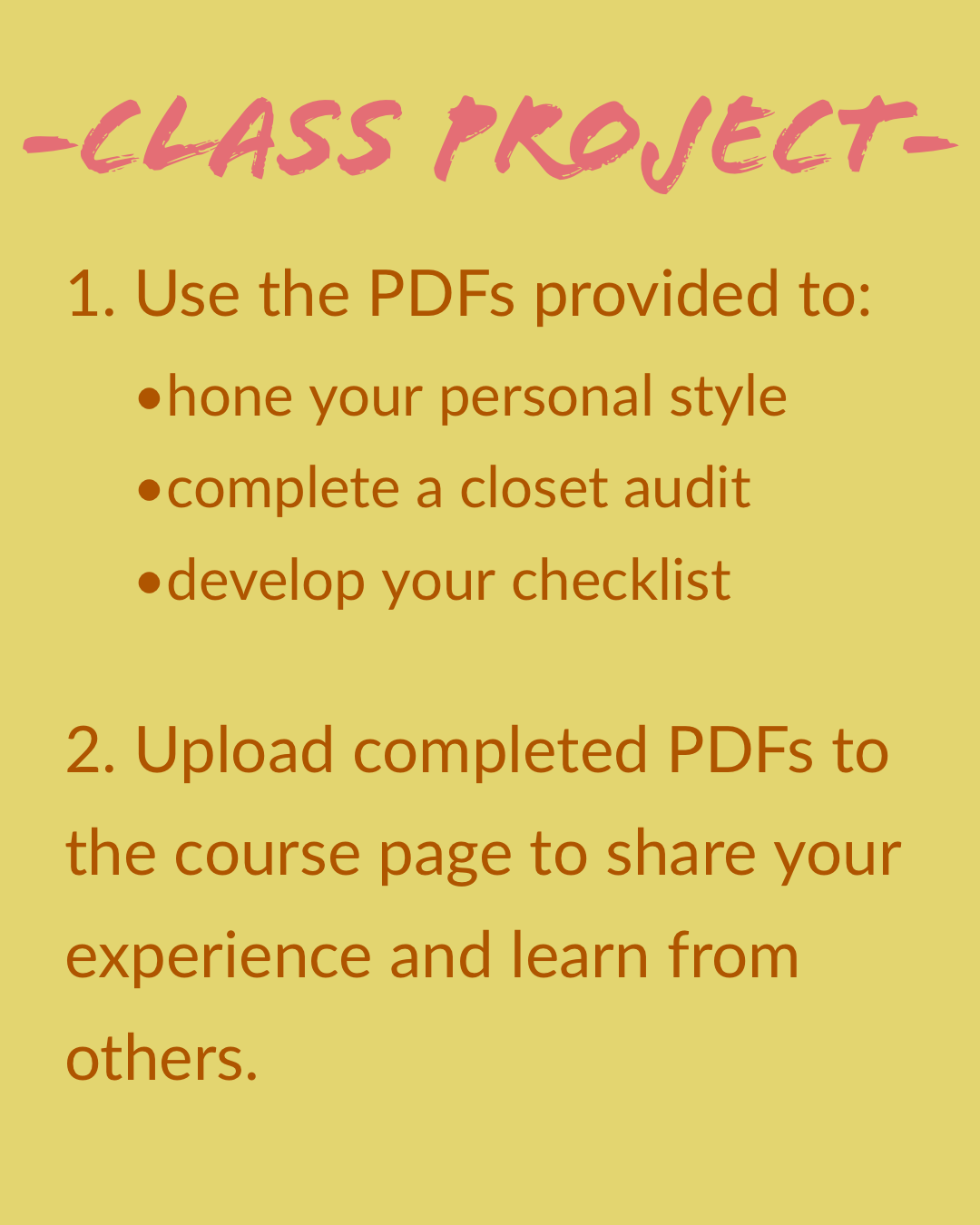
5. SECOND NATURE - My Personal Style Journey: Hi, everyone. Welcome back to second nature. My name's Megan. I'm the owner and operator of Wild Ways Vintage in Calgary, Alberta, Canada. I've designed Second Nature as a way to help others to successfully thrift shop. Thrift shopping is a very sustainable and very affordable way to source the items in your closet. Eso When this course were kind of discussing the best methods, you can use the most efficient ways you can thrift shop and how you confined what you're really looking for. We've also been discussing personal styling. So this particular video course that were in currently we've been talking about the benefits of finding your personal style because it can be challenging. It takes quite a while for some people in very short time. For others, it took me quite a long time to find mine so and kind of discussing the tips and the tricks and the tools that I've used to find my personal style, and then how that helps me in my day today and how that helps me in regards to shopping sustainably and thrift shopping. There's a lot of benefits that I wanted to share with you in this video. How I came about finding mine. Um, the journey is gonna look different for everyone. As I said, this is just kind of how I came about finding my personal style and just realizing that it works for me, that this particular style, whatever you might call it, seems to work for me. I feel comfortable and confident in it, and it's a style that I can really make my own. So without further ado, um, I grew up, uh, thrift shopping from a very young age. My mom and my grandmother would take me thrift shopping, and this is the way that my family would source most of our clothing and a lot of her home goods. And it's simply out of necessities of my parents used to have shopping as a way to clothe their family. So I grew up in thrift stores and, um, you know, from a young age I had a grandmother that taught me how to sew, and she was a seamstress herself. So having her as an example watching her alter clothes and repair clothes and then teaching me how to do that myself was a huge gift and just the act of going thrift ing with my mom and my grandmother was a huge gift as well, because it opened up so many doors for me in regards to, um, finding my style but doing it in a very earth friendly way and also being very creative with my closer. That's one thing that I find thrift ing really offers people is the ability to be creative . Um, I don't know if you guys are gonna be able to hear it, but in Calgary right now we have a police helicopter that's circling kind of intermittently so you might hear the fluttering of a helicopter. I am not a wanted woman, but you might hear that. So, um, all that aside, thrift ing in itself actually really helped me to find my personal style. And I think that this is due to the fact that when you go to a thrift store, you're going to a store that has, like, thousands upon thousands of one of a kind items. And you know, there's some of them that are vintage Richard, the ones I love. And there's some that are secondhand, more contemporary pieces. But the fact that you were going into a store and you're kind of sifting through the one of a kinds to find items that you really like and it speak to you. I think that in itself is a way for you to really figure out what it is that you like. And what you feel best in recently say that is because if you think about the way it feels to go shop in a mall, you'll go into a store. And you know, these popular stores. They have all kinds of advertisements on social media on TV, and when you go into their stores, maybe they have, like 30 different shirts that choose from and 30 different bottoms to choose from. But they're basically telling you, here's your selection and from that selection, this is kind of what's in style. This is what you should choose. So it kind of it really is a little bit more limiting, and it's much more influenced by advertisements. Now we're threatening. I'm not saying that we're not influenced by ads or by social media or by influencers. Anything like that. We were still influence. We're all influenced by that on bats, part of finding your personal style as well. But I think that when you were shopping in a thrift store because you don't have those constant ads telling you, um, thes air, the particular items that are in style right now. And if you don't have those, it kind of makes you feel like you're missing out or that you are not current. You're not on trend, and it almost kind of tells you that you should feel odd about your wardrobe or odd about your outfit or something if you're not wearing those current trends. So when you're shopping in a thrift store, though, I mean you're going through racks and racks of goods. And if you come across a shirt that you really like, maybe the shirt was from, like, 30 years ago. Maybe it was from 30 days ago, but regardless you're making the decision on your own that you really like this item. And although you might have that influence in the back of your mind, maybe something you saw on Pinterest something you saw on one of your social media feeds something that you really liked and that influenced you. It's not really the same as going into a store and being limited and being told that these air, the particular items that are on trend and these are the ones that you should stick to. So I think in that way thrift ing really helped me develop my personal style and to know what I actually like and to not depend on the stores at the mall or do not depend entirely on media influence to tell me what I should be wearing and what I should like. So that would be kind of the first thing that helped me find My personal style is threatening itself. Um, additionally, as I said before, my grandmother was a seamstress and she taught me have a so from a young age. So I watched her over the years, kind of reworked garments, alter garments, repair garments and that had a major effect on me, especially since she passed that gift on to me. She taught me how to sew with a sewing machine. Um and it really helped me when I was thrift ing to kind of see the potential in items that I you know, maybe there's a pair of pants that Oh, if it just looked this way or but just fit me this way, then I would buy it and having that gift from her, the gift to be able to so an altar clothing. It's opened up a lot more for me in the way of finding a garment in the store that I really love, but that maybe I think it needs a little bit something extra in order to, um, just make it mine or fit me properly. Your have the style that I want, and it's giving me the confidence to know that I can alter that myself on that. There's ever a garment that I purchase. That may be, I don't know if I am well equipped to alter it and the way that it needs to be altered. I would just take it to a tailor. That's the nice thing about thrift ing as well is that if you're if you're good to go to a thrift store and you're going to purchase something for a minimal for action, um, of the costs of something new, it offers you a little bit more leeway in the way of taking an item to a tailor and paying that little bit extra toe have it fit you properly or to have it repaired. So again, it's, you know, the the gift of being able to so has really helped me hone in on my personal style. And, you know, stripping itself has really helped me and figuring out what I like. Um, and as I said before seeing potential in items at thrift stores, that's huge. It's a huge part of what I do in my personal wardrobe and in my shop. There's a lot of times where I'll bring fabric home or I'll bring a garment home and maybe it's address and I'm going to turn it into a blouse or ah, blouse and a skirt set or something like that. So I've had instances like that where I'll be shopping and I'll see something and whether it is like damaged in a certain way. And I'm thinking, Oh, I think I could salvage something out of it or if it's just maybe not as current or I just want to get creative with it. It just offers me, um, kind of the the option. So the next video set that I'll be doing in the Siri's second Nature, I'll be talking about different ways that you can look at garments and housewares when you're thrift ing to help you to see maybe if you could do a DIY I why or have a garment altered or alter it yourself. So we'll kind of go over different ways that you can view items in a thrift store that might kind of help you find what you're looking for with just little adjustments. Um, so another thing that helped me find my personal style is noticing that trends tend to repeat themselves. So, you know, if you if you look at major stores that carry, you know, fairly upscale fashionable goods. Ah, lot of times if you go back in history, you know, a few decades before or just a couple decades before when you look at vintage clothing, a lot of times it's very like modern trends are very much based on vintage design. And I love I love that I love one of my favorite things to do before going thrift ing is to actually look online at certain stores. You know, modern stores in the mall and see like, what are they actually carrying, like what are they saying is on trend right now? And Then I'll go to a thrift store and I'll go to certain areas and find the items that are similar to what they're offering and, of course, paying much less. And sometimes you know, it's Ah, it's a garment that needs absolutely no updating its perfect. And then there's other times where I may want to bring it home and alter it a lot of times with vintage blouses, I'll wind up cropping them and whether that means I'll put an elastic at the bottom or just Hammett. But I'll wind up cropping them. I think that looks really, really cute. And I think that the design on a lot of vintage blouses lends well to that style of having a crop. So, um, that's an example of seeing the potential in something in a thrift store and then, you know, making it yours and whatever way you see fit. Um, yeah, I guess that's kind of my personal style journey. Just over the years, I kind of developed, um, kind of a bohemian, maybe a little bit Western festival, uh, kind of forties, elegant. I just kind of have. It's a strange mishmash, and I don't know if it's because I'm a gem and I, or if it's just me, But it's a kind of different mishmash of, uh, styled items that I have in my closet. But what I really love about the clothes in my closet is that they're all from different vintage Harris, but they're very interchangeable. I lean heavily towards the 19 seventies in what I purchase and in my styling. I just love that era. The warm colors I love, kind of the classic Jane Birkin look like the white blouse and jeans. I kind of consider jeans and a blouse, my beautiful room, if you want to call it that. That's what I would be comfortable in on a daily basis. So I think that I leaned heavily towards the seventies. But, I mean, I have items in my wardrobe from, you know, I have a pair of army pants from the 19 fifties, and then I'll have a dress from the eighties. So you know the items that I do choose, though they might be from different eras. But maybe the color scheme, you know, corresponds well, or the cut or the pattern, but they all kind of work together so that I can get the most out of the fewest pieces, like unknown. If that makes sense, I don't want toe own, Um, I don't want my closet to be bursting at the seams and want my closet to be well curated. Um, I would not call myself a minimalist, but I I once had a closet that was bursting at the seams, and I just find that it's not conducive to having kind of peace and like mental clarity and everything, I find it's very kind of overwhelming, whereas now the pieces that I have in my closet I'm extremely choosy about them. They do have to fall into kind of certain categories. As I mentioned before, I lean towards the seventies. My color scheme is kind of, I mean, Denham, um, denim. And then anything kind of neutral. So I I would go for, like, black items, white items, brown items, 10 items. Um, it's rare that will have something really vibrant. But that's me. That's, you know you can have every color of the rainbow in your closet and make it work like everyone so unique it their styling. And I think that that's really wonderful. Um, but That's kind of my color palette is a lot of neutrals, a lot of denims, kind of classic fabrics, silk wool linens. I love really good quality fabrics. So I think that in the way that we style our items and if you are able to develop a color palette and maybe a group of fabrics that you lean towards and you kind of know that they pair well together, that could be really helpful. Um, I am quite short. Five foot three, so cool lots. A lot of times can wind up looking awkward on me as much as I love them, and I think they're really elegant. It's something that I tend to be kind of careful about when I'm picking a garment, but I do crop a lot of my jeans, too. So I think it really just depends on what you truly like and what feels good for you. Um, what makes you feel the most confident? So that's kind of my personal styling journey. As I said, I've been thrift ing since I was a kid. I kind of started, um, styling on my own, I guess when I was getting into my teens, but I was a nineties kids, so I started buying kind of grunge like T shirts and dad cords and whatnot, um, and then kind of evolved from there into difference. You know, different trends if you want to call it that. But I'd always shopped thrift. And over the years, that just kind of evolved into me, finding my style. So it is a journey my style is going to keep evolving. Your style is going to keep evolving, but it is really nice to find a core kind of style that suits you and makes you feel good. Onda helps. You kind of threw your daily life as we talked about in the previous video. Um, so yeah, and I guess, um, as far as my personal styling guidelines like how I think about putting an outfit together , I have a couple of guidelines or rules that I follow, but again, that's gonna look different for everybody. I'm just going to tell you what I dio It might, you know, inspire you to try that in your own closet or kind of make you think about different ways that you could come up with your own guidelines. So the first thing that I do is a pair a statement piece. I don't have a lot of bright things in my closet. But Opare when I like to call an understated statement piece, if that makes sense with kind of more plain items. So that might look like a fairly plain white blouse, a pair of jeans. But maybe the bag is like a brown leather bag, but it has a really intricate pattern on it, or a really intricate cut to it or something. Just one piece that is, um, kind of a pop of interest in that outfit. So that's the first kind of thing that I try to always dio. And a lot of times with my opens, it will wind up being a jacket, or it might be a belt or a bag pair shoes. A lot of times, it's more accessories than the outfit itself, But occasionally I will have a piece of my wardrobe that is a little bit more, um, you know, bright or have ah, wild pattern. And I used that in the hope it to make my I hope it pop and just to add that bit of interest so that would be the first thing is kind of an understated statement piece. So I've been saying that understated statement piece to me a statement piece of something that's bold and bright and kind of grabs your attention and shakes you. And I think that that's great for people that love that look. But for me personally, the understated statement piece I love something that is like the same colors that I tend to use in my wardrobe, Um, same fabrics that I tend to use my wardrobe. But maybe there's just a little bit of a design element that's different. So it's just when you know, when you really look at the outfits like Oh, that's really interesting. Um so that would be the first thing that I do for the second thing is juxtaposition and regards the styling. This is one of my my favorite design elements to use, and I think it's just it's interesting. We always hear the phrase opposites attract, but you can use this so easily in styling, your wardrobe and a lot of times, if I'm looking on Pinterest or I am looking on Instagram and I see an outfit that I like, it's generally because there's juxtaposition in the design elements of it. So for me, a good example would be maybe parenting a leather jacket, which would have kind of more of, ah, harsh, um, kind of a hard look to it, with either feminine dress or a feminine skirts of something softer. I have a skirt from the 19 forties that I love pairing with a leather jacket, and I think it's just kind of that opposite effect. You know, this beautiful skirt from the forties that you wouldn't normally see with a leather jacket . And then when you pair it with that, it just gets your open. This, you know, it's it's different. It's interesting. It's different. It's kind of unique. Eso juxtaposition in that way kind of the tone of the outfit. So pair harsh with pretty your feminine or soft or, um, kind of any anything opposite of that. Um, another way that I would use it is to pair kind of, ah, how formal apiece is. So I might pair a really elegant silk blouse with a really casual pair of pants on a pair of sneakers or something like that. So use one particular garment that is quite dressy, and then parrot down or kind of dress it down with, You know, if it's the bottoms that are really dressy paradigm with a really casual top and a pair of sneakers where you know if it's the top, that's dressy. Just wear an old pair of jeans with it. I think it gives a really kind of unique and kind of carefree vibe. But it also allows you to wear those more formal pieces in your wardrobe that you might not always get the chance to wear. And that's important because you want to wear every piece in your wardrobe. That's part of being sustainable is making sure that if you bring something into your closet that you use it so I use understated statement pieces. I use juxtaposition, and the last one I try to incorporate is, and this is just personal preference. But I love matching my shoes, like, say, if I have brown leather shoes, I'll try to match it to a brown leather belt and maybe a bag that has brown leather accents on it. So it doesn't always like the the items in my closet. I mean, there were thrift ID their vintage. The leather doesn't always go together some, but I try to get it as close as I can. And it's again just personal preference. It's not something that you have to dio. So those are kind of the guidelines that I use when I'm styling my oap, it's and I just find it works for me. I feel good in that combination on, but just allows me to use the pieces in my wardrobe to create more combinations toe wear. So that's kind of it for this video. That was my personal style journey. So that's kind of it for this video. The next video I'm going to show you a few opens that I put together s so that you can kind of see what my thought processes. When I talk about juxtaposition and understated statement pieces and matching my shoes and my jacket in my belt, it will give you an idea kind of how I think about that style. Um, so we'll do that in the next video. I'm really excited to show you these outfits, and you can reach out to me on instagram if you like. At wild waste vintage. I am available on my website, Wild Ways vintage dot com. I'd love to hear from you, and I also wanted to mention that the project in this particular set of videos finding your personal style. It's actually a group of resources that I put together. So it's exercises you can do, and you can either print them off. If you prefer pen and paper, you can use a pdf that I've created. Just download that and use that if you like, but it will help you go through the process of doing a closet audit. There's a page that talks about kind of different resources that I've used over the years that have helped me and maybe they'd help you. There is a self interviews to kind of hone in on what your style might be. There's a couple of pages that go through the items in your closet, and it asks you to list the reasons that you like particular items and that will help you develop a checklist when you're shopping. That will keep you from impulse buying. So I put together these Pdf. So I'm excited for you to have those, and that is our project, so you don't have to do all of them. But if you are taking this course, part of it would be to choose one of those resources that have created and use it and then upload your results to the page. So again you can reach me on my website or an instagram. I'd love to hear from you and we'll see you in the next video.
6. SECOND NATURE - Outfit Examples of my Styling Guidelines: Hi, everyone. Welcome back to second nature. My name is Megan. I'm the owner and operator of Wild Ways Vintage in Calgary, over to Canada. This is the final video in our Siris on finding your personal style. In the previous video, I talked a little bit about my guidelines or rules that I use when I'm putting together outfits from my wardrobe, and I wanted to show you a few of the outfit so they would put together and kind of discuss what, maybe choose certain pieces when you come up with your own guidelines or if you already have them, everyone's are going to look a little bit different, and you'll develop that along the way on its ever changing on. So the first open that I have is something that I would wear to an interview. I mentioned in the last video that I kind of kind of thing for, like, 19 forties classic pieces. And it's not that this blouse is necessarily from the forties, but it just has a very tiny, kind of cute tailored locus gathered at the bottom. And then it has very cute cut out and embroidered sleeves. So I just love how kind of elegant and classic that pieces. And then I would pair up with a really kind of average vintage pair of black dress pants. The house. There's pleats in the fronts and comfort the bottom. And there's a brown leather belt there. So it's just kind of different eras, right? Like these air, probably from the nineties and then pairing it with a little white cropped blouse and a belt. It's just a very cute combination, and I love apparent kind of different eras like that. So that's a little bit of the juxtaposition a guy lying that I talked about previously, and the fabrics as well, like this pants are kind of a poly blend. And then this is a linen. So I love juxtaposition in my fabrics in the tone of an outfit, and it helped formal an outfit ISS. So that's what I would pair together for an interview. The next item is something that I have warned to family gatherings. It is a vintage dress from the 19 eighties and has kind of all of color with white flowers on it, Dolman sleeves. So they kind of taper in at the cuff and then It's kind of tough to see on video here, but there are little cute fabric covered buttons and then a gathered belt with a fabric buckle at the very, very bottom. There is kind of, Ah, a mock slits in the dress, but then there's a pleated fabric underneath, so it's a very unusual piece. This I would pair with a pair of ankle boots. I think booties would look really, really cute with this, and so I'll show you that the end of the video you'll see some bone isn't me in the open so that you're not just seeing it on a hanger because that's never doing clothing justice. So, yeah, that would be the piece that I would wear Teoh kind of a family function. It's dressy, but again has that vintage flair. But it could, you know, it has a modern enough look to it that it's kind of more of a current current vintage piece like us. So and again with that piece in talking about juxtaposition, you have a very elegant kind of formal or semi formal dress and then pairing it with a pair of booties kind of dresses that down and gives it more of an edgy vibe. So the next But I had This is just something I read. Where if I was running errands, um, so we just have a pair of very high waisted vintage jeans. These are probably my favorite jeans that I own. Pockets are really, really high on the, but but they're very comfortable, very soft. And then I have it paired with just a very light summer blouse. That kind of has this. I don't know what this would be called like a crow shea pattern or something, but it's gold. So it adds that little pop of interest. And it's kind of a creepy gauze like fabrics really, like, really comfortable for summer. And has that seventies feel that I mentioned that I love so much? Yeah, and again kind of juxtaposition in the fabrics that really light, kind of airy and allst striped pattern of the gauze shirt and then a classic denim, and I paired it with this brown other bag. But I absolutely adore, and it's kind of my understated statement piece because it has a really unique a tool pattern on it s I'll show you a photo of that close up towards the end of the video, so that is kind of a running errands outfit. They were put together. The next one is This is probably my favorite skirt in my closet. It's a wrap skirt from the seventies, and it has that kind of hand block print on really comfortable cotton. I love rob skirts. I think they're so flattering and so comfortable, especially at their MIDI length. I love midi length because you're still getting that. He's in the summer and then we have very playing black tank top. Scots, um, stretch to it. It's from the nineties, and it's just like an old work up Marco Tank, I think. But it's an excellent condition and it's super comfortable. So I think pairing something very, very plain with something that's quite patterned Onda again. The different eras, like the nineties, were co tank with something from the seventies, and it just adds a really cute and unique flair, and I would pair it with this little Cissel bag with the brown leather accents and a pair of brown mother sandals will show you that the end of the video as well. And this is something that I probably would wear, just like running errands or maybe going out with friends. But it's a nice, breezy summer outfit and, yeah, it's very comfortable. So this next one, I wear this out on a date night with my hubby. So this is this one you're going to see at the end of the video as well, because it's tough to see. But I have a very vintage 19 probably between the the forties, now, the forties in the sixties. But it's a beautiful kind of cocktail dress as a slit in the front and kind of ah, kind of a sweetheart neckline, I would say, And some gathers their super elegant, very, very pretty, very tailored. And then I paired it with this black leather jacket from the seventies. So it has kind of zippers at the cuff here, which kind of adds that element of, like, it's kind of harshness or come on edginess. And then at the side it has these little buckles. I don't know. You can see those, but again, just a little bit of edginess to it, and I would wear that with a cute little pair of black kitten heels, and I have a beaded black velvet handbag that would add just that like pop of interest and has gold beads on it. So the gold beads, along with the gold zippers, kind of ties in together. Well, so again, juxtaposition addressed from like the forties of the sixties that I think is quite feminine , very classic and then parentless kind of Ah, for but badass leather jacket. Give it that edginess and you last that I have here this one I would wear to a concert. So I have just a very, very plain black tank top here. And then I paired it with a suede brown leather jacket and a pair of vintage Lee Bell bottom jeans so I would pair this whole outfit with kind of a probably a wedge. I don't do really well in heels, so I would parrot with more of ah, wedge like a black wedge shoe. And then I have with that here kind of a fringe bag that I got second hand. This isn't vintage, but I think it was originally from free people. But it's just very kind of bohemian seventies, and I think just wearing a cotton tank top to a concert is. I mean, you can't really get more comfortable than a plain cotton tank tops. Oh, yeah? This one I would probably wear to a concert. From what? Music. So for a hat, with maybe, Yeah, I want to thank you guys. Kind of an idea of when I say I have styling guidelines. Kind of how my thought processes go. And, of course, we're all implements by people on our social media. You know, you're scrolling instagram to see opens that you like or on Pinterest. So I'll show you each of these outfits photographed toward the end of the video just so that you can see what it looks like with the accessories paired with it. You kind of have a better idea of what the juxtaposition guideline looks like in the open that I chose. And then you'll also get a kind of an idea of what accessories that repair with it. When I talk about really wanting things to match, they don't know dispatch, but try. So you'll see those photos at the end of this video and the PDFs that I have Lotus those on the page, you can download those you can print them off if you prefer to use pen and paper, but I do encourage you to make use of them. It will help you through closet audits. It will help you to home in on your personal style by doing a self interview, talking with friends, utilizing Pinterest just so that our closets become more and more sustainable. Doing the closet audit can be really tough, especially if you're dealing with a massive, massive amount of clothing. And people do. I want a closet with bursting at the seams, and I I went through it, and I honestly thought, I know I'll wear this Sunday, but sometimes, if you're not asking the right questions, you keep putting those items back in your closet. Closet audits are so important to do, and it also passes along really good quality items that other people might love and where, more often than you do. So I've created a Pdf to help you through that process. This ultimate Pdf that will kind of be a questionnaire self interview to ask you questions that will help you hone in on what your personal style is, and there's a pages well, that will ask you for the 10 most Warren garments in your closet. And besides that garment you were going toe list three reasons that you kind of reach for that arm in the most enjoy wearing at the most. And then there's a page that talks about that checklist and how you kind of go about formulating that checklist. So that's our project for the syriza. Finding your personal style. If you choose to just do one of those items, that's great. You can post that item to the page if you choose to do all of them, please feel free. Opposed those to the page. I would love to see them, and I would love to hear you guys. So if you want to reach out to me on Instagram at Wild Race Vintage and on my website Wild Race Minted Shop calm, I encourage you to share these. Pdf's with friends with family. I am not shy about you sharing my content. I do just ask that you would take the in it. So again, just my instagram handle at Wild Ways Vintage. Thank you so much for following along in this course and allowing me to teach you. I look forward to seeing your closet audits or yourself interviews uploaded to the page, and I definitely could learn from you as well. And in the next video, I'm going to take you through my kind of thought processes when I'm thrift ing so that you have an idea of when I talk about finding potential in items and thrift stores and garments or HomeGoods, it'll give you an idea of what things to look for and how to kind of narrow down something that you should take home and maybe do a DIY I why have altered as opposed to items that you should probably just leave there, So I look forward to doing that next course with you, and in the meantime, I think of our future shop in her past.
7. SECOND NATURE - Outfit Photos!: way, Theo.
 Megan Harris, Think of Our Future, Shop in Our Past!