Transcripts
1. Introduction: Businesses and business people tend to speak their
own language, which they have developed
around their industry, their product, and
their expertise. But buyers and customers
are approaching the world from their
view and their needs. Bridging this
communication gap has been a large part of my work
and my motivation. If you are a sales leader
with a new or growing team, if you are creating
a new sales process, if you're updating how
you pitch your customers, if you are preparing to launch a new service or operate
in a new market, then this class is for you. Welcome to my class on building sales process through
the buyer journey. I'm Rebecca heartbreaks, be
a management consultant and my main mission in life is
to make business simple. I grew up in a trilingual home, or much of my life was spent avoiding lost in
translation moments. When I came to business, I realized the same
thing is required, especially in sales and
customer experience. I spent 12 years running a small software company and
since then have been working with small and
medium-sized businesses on building their
business models so that they can offer it simply and with
maximum effectiveness. In this class, you
will learn to build your sales process all in
your customer's language. We'll begin with understanding
what pushes customers to buy and how that influences
the way that they buy. Then we will discuss how they research a solution
to their problem. How you can work with them
as they make a decision. And we'll wrap it up
with how to nurture a long-lasting relationship
with those customers. After you have completed
this class and the project, it should come naturally
to you to approach your sales work with the
customers needs in mind first, and adapt both what
you do and how you communicate to
match those needs. This should change how you approach sales conversations and needs and allow you to become an advocate
for your customer, driving your company's
internal decisions based on what will be most effective
for your target audience. Download the worksheet in the resource section and as
you go through each lesson, keep your pen and paper handy
to work on the exercises and build up the material you will need to complete
the final project. Now, let's get started.
2. Understanding the Buyer’s Journey : When people buy, it's not
about you, the seller. It's all incompletely
about them. The buyer, after all, the customer is the
one taking the action. And that action
is to buy without which there cannot be
the action to sell. As a salesperson, it
is vital that you understand that whole
action of buying, including what leads
up to it so that your sales process is adequately mapped to
the buying journey. The tactics you will
learn here will set you apart as a sales leader and
give you a competitive edge. In this lesson, I will teach you why it is important
to understand the customer and
what it means to put yourself in their shoes. Salespeople start with sales
rather than the buyer. It means that they are speaking a different language
from their customers. It becomes more difficult for
the buyer to connect with what you are selling and to understand why it
would benefit them. You end up asking
your buyer to do a lot more work and many will
not be bothered to do it. Imagine being editable,
perhaps at a conference or a networking event with
five potential customers. And for other salespeople, the customers at the
table should not be able to easily
distinguish you as a salesperson because
you are speaking their language and understanding
their problems so well. This is what it means to
develop your customer context. I'll give you an
example of this. In my life. Early in my career, I found myself in a small
bootstrapped company. I was initially tasked with codifying our customer
support practices. And once that was done, I was asked to go out
and increase sales. I have no experience of
sales at that point, but I realized that I did
have experience of buying. So that's where I started. I decided to spend time
with our customer base and joined to trade
associations in their industry. I heard what they were learning, what they spoke about around the lunch table and what
they wanted in their work. From that early experience, I have built a customer
contexts approach to sales and customer experience built entirely around
customer preferences, behaviors, and choices. There is no money in sales. Think about it. You can sell and sell and sell. But at what point do you
actually make money? It's when somebody else buys. The money is in the
action of buying, not in the action of selling. Before you build a sales plan, understand how your
customers buy. Here are three tactics that will teach you to speak your
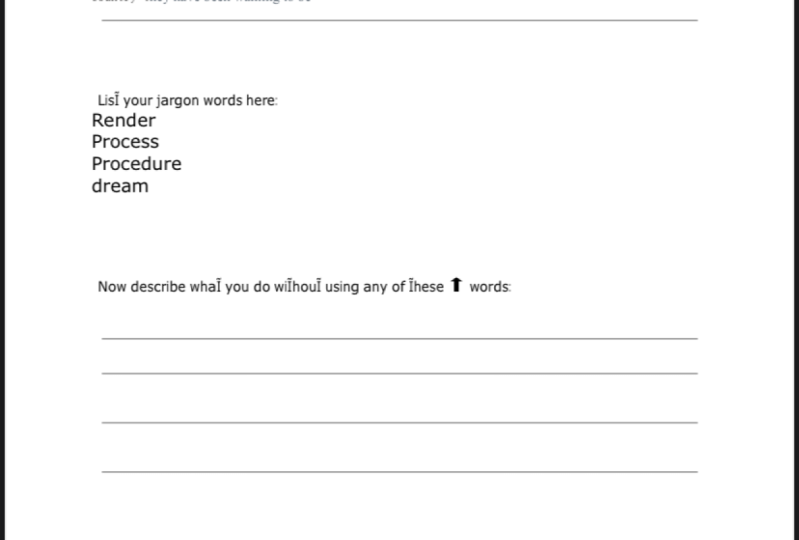
customers language. You can use the jargon
removal worksheet in the resource section
for this exercise. I'm a management consultant, so the first words I would list our management consultant, I will add managing and
business administration. These are often used
interchangeably with management consulting. So it's a good reminder that I can't just replace one piece
of jargon with another. Then I'll start to describe
what it is that I do. Right away, I realize I've
used the word management. I will highlight that in red. I have to replace that with
something more descriptive. I might say, I work with small businesses
to make sure they have a simple way to make
decisions for their business. That includes who they hire, how they give them direction, and how they build strategy. This makes me notice
that strategy in this context is
also a jargon word. So now I want to
think of another way to say building strategy. Small businesses must find ways to follow a path to
determined goals, what they want to achieve, how they will get there, and what resources
they will require. I might also highlight
resources as a jargon word. A business might want to think about the specific
resources they need. So I might replace that with the list of what I
mean by resources, people, software,
technology tools, etc. Drop the associations from your industry and join those of your customers so
you can network with people you
have to bond with, listened to what
they're learning at educational events and talking
about at the coffee table. When you talk about
what you do, use, the language you heard them use, instead of recycling
your list of features from your
website or brochure. Second, describe your product or service without
ever naming it. And get in the habit of talking about it
in layman's terms. Think about the
language your customers use at work and even
at the dinner table. Learn to use that same language
to create a connection. Don't separate yourself
from your customer by reversing to your product
as a starting point. Instead, realize you're in their playgrounds, so to speak, and always start your
conversations from their needs to work up to
your product or service. Your student action is
to write a description of your product or service
without ever naming it. You can use the jargon
removal worksheets to assist with completion. The buyer journey section of the customer journey
worksheet begin with a list of two to ten words that are specific
to your industry. These are the words
you have to avoid. Challenge yourself to
describe your product or service without
using these words. For example, if you
sell a CRM platform, describe it without
using the terms CRM, customer relationship
platform, or even sass. If you sell office supplies, explain your work without using the words supply or inventory. It may not be easy at first, but it will get you thinking about your product in a new way. Complete the exercise
for your situation. And then the next lesson, we will analyze
why customers buy.
3. Analyzing Why Customers Buy: In this lesson, we will analyze what encourages your
customers to buy something so that you
can insert yourself into the conversation
as early as possible. You want to understand what
the customers thinking and going through long before they pick up the
phone to talk to you. Something we'll have happened in their work that triggered
the need for purchase. The difficulty is that
it may be something that is not directly related to
your product or service, but can still be solved by it. It's important to understand
that the buyer's journey for customers begins long
before sales begins. It is when they are first
confronted with that problem, that change or that concern. By understanding
what the customer is going through in
those early stages, you'll be able to present a solution for the
customer that solves that early problem
and helps them understand the full benefit
of what you are offering. This stage is about
understanding what those initial binding
triggers are so that you can meet your customers
where they have a need. Your customer is struggling
to get invoices paid. More than half of
their invoices are paid late and they're never able to keep on top of what is
overdue and who is responsible. Because of their lack
of organization. Their clients have gotten
in the bad habit of neglecting invoices
and paying well, after two days, they
realized that it's because their software systems are not speaking to each other. They track their
clients in one area, invoices in another, and the two do not connect in
any meaningful way. The people chasing invoices
don't have any insight into who the clients are or
what their milestones are. Often information on
invoices is incorrect. You offer a CRM platform and you know that amongst
its many features, it also allows for payment
tracking and easy reminders. If automates the process
of creating invoices, updating details
when they get paid, and sending reminder e-mails
at regular intervals. Your customer, however,
is thinking about invoicing software rather
than a CRM platform. If they hear you say that
you sell a CRM solution, they won't automatically
connect that with their need and they won't
bother to find out more. Understanding your
customer's problem helps you to present a solution even though they
aren't using the term CRM. Here are three main
types of triggers that prompt a customer to
buy a service or product. There is the proactive trigger. This is the buyer
being proactive. This is when nothing
is broken with the person's current
product or system. In fact, things are generally
working well for them. However, this customer is somebody who likes to
be ahead of the curve. They may have heard or
learned something new, which has prompted them to
do some window shopping for new solutions in case
there's something out there that is better
than what they have now, this fire has no urgency, but can be swayed by a better return or a
more effective solution. There is the reactive trigger. This buyer is reacting
to something. They may have a suspicion that
something might be broken. Either it has been
a long time since this particular area of business or life
has been reviewed, or the buyer is not getting
the expected results. Nothing major is wrong. But there is an
understanding that things can probably be better. It might be a series of minor complaints or
small inefficiencies. This fire may be
more reluctant than a proactive buyer because it feels more like a chore
to buy something new. And finally, the
urgency trigger. This is when something damaging has occurred and the buyer needs a replacement or a new
solution to either solve the problem or ensure it does
not happen in the future. The spire is in a hurry
and willing to buy, but also stressed
and possibly angry. They will have a
higher degree of fear. Creating a connection
and showing that you understand them can
make a huge difference to their state of
mind as they by facilitating the entire
process. Now it's your turn. Create a list of three
to five triggers to buy that are not about
your product or service, but about the customers needs. What are some problems
that you solve for them, either directly or indirectly? What might prompt the need for that solution at their end. With this exercise,
you will better understand your customer's
mindset when they began to consider
a purchasing need that will allow you to speak to their specific
concerns and target your solution and your
timing to their needs. In the next lesson,
we will explore how customers research
their solutions.
4. Researching a Solution: In this lesson, we will discuss
how customers generally conduct research to find
solutions to their problems. In other words, how
are they finding the product or service
that they need to buy? At this stage of the
buyer's journey, the salesperson begins to
potentially enter the room. This is when buyers are
actively looking at specific companies and
products yours included. It's important to understand not only why the customer
is researching, but also how they
are researching. The more you understand this, the more you can
ensure you are front and center of that research, we're finding this
stage of the process allows you to be in the right
place at the right time. To make the first impression
that you want to make. Virus tend to find out about
solutions in two main ways. They ask others for suggestions. This may include members
of those associations, their colleagues, peers,
and other businesses. Or they'll post a question
on a social media platform. Ask yourself, are you well-known
amongst those people? Do other people,
your customers would talk to know that you exist. The other common method of research is to do
a Google search to make sure that
you're showing up in their results and
getting them to click. You have to know what exactly
they are searching for. What are they typing into
their search engines? It probably reflects their
problem in some way. Are you showing up
in those results? In the example I
gave previously, I told you about how
I learned to sell effectively by spending more
time with my customers. One important insight
I gained was that my customers were
using Association, listservs, and forums to
get advice on products. Their first step was
generally to login to an association bulletin board
and ask for suggestions. By joining these associations, I2 could see what
people were asking, what others were suggesting, and most importantly, what
language they all were using. When your ideal customer
is looking for advice? Who do you think they will ask? Do those people know about you? What do you think they will
say about your product? A tactic for navigating this scenario and
getting your name on those people's minds is to be deliberate about who you connect with and
most importantly, what impression you make. Know how to talk about your
product in a way that is memorable and we'll come
to mind when it matters. This will help you be the
resource people think of when their peers ask them for
ideas as your student action, get ready to put this to work by answering the following
questions for your company. You can use the first
impressions worksheet. What are three words
you want people to use when they describe
your business? What are you doing now to make those words the main way
people think about you? What if people are not using
those words right now, then what do you need to change to earn
those descriptions? When I have to select
three words I want people to say when they
describe my business. The first one that comes
to mind is integrity. The reason for this is
I know that what I sell can feel ethereal
management consulting. And I want people
to know of me as somebody who is selling
tangible results, tangible deliverables,
somebody with integrity. Another word I want people to associate with me
is reliability. Partially for the same reason. I want people to know
that I keep a promise. If I say I will call
you at three PM, I will call you at three PM. The third word I want people to associate with me
is intelligence. By intelligence I mean reasoning, thinking
something through. I want people to
know that I'm not providing cookie
cutter solutions, but that I'm sitting
with them and reasoning on their issues
and their specific business. I will take the three words
and put them in my table. As you come up with the three
words for your business, talk to your
colleagues about this. Explain out loud on in full sentences what
each word means. It's not enough to have the
adjective or the descriptor. You need to be sure that
everybody, everything is saying, uh, lines that you're all describing these in the
same way I learned. Fill in the table asking myself, are people using this
particular word now? Do people use the word integrity
when talking about me? I'm not sure they
use this exact word. Are they using
something similar? That's what I might want to find out and put a list in here of the words that they might be using that are related to this. Perhaps they're saying
that I'm honest. If they are saying this
word to describe me, how can I make sure that they
continue to use this word? Here, I might want to list some habits that
I could develop. Transparent pricing,
for example, specific timing on projects, things that I can
do in my business. And then the way I
interact with people to bring forward this
idea of integrity. And finally, I think
about what do I need to change from what
I am doing now? If I'm looking at
transparent pricing, makes sure pricing
is on my website. And I want to repeat this across all three of these words. Once you're done, focus
on that bottom row. What do you need to change? This tells you the
fixes you want to make, to make sure that
you are leading with these three descriptors.
With this work. You're taking ownership for your reputation and how
people perceive you. In the next lesson, we will discuss
what happens when customers are ready
and decide to buy.
5. Deciding to Buy: When choosing what to buy, the three things
customers really pay attention to
are the product, the price, and the
level of service. It's important to
make expectations clear in order to spend your conversations
with the customer discussing the benefits of buying your product or service, rather than the logistics, which is not where
money is made. They want to know that the
product solves their problem, that the price is lower
than their ultimate return. And that the level of service
we'll cover any warranties, support, training, and
customization that they may need. Remember that they are
looking at these factors from their perspective of
their initial problem. That is what they
most need to address. And even if they are interested
in additional features, they will keep coming
back to that concern. It's important that you know how your business
justifies its price. You have to be familiar with your product features and how they address various
customer needs. And you must be able to
explain the details of the service agreements
and how they will address any customer
expectations. You have to be able to
get this information across in a simple
and clear manner. If you can be clear
about expectations, then the process
becomes simpler. Ask yourself, are
details about product, price and service easy to understand during
sales conversations? Let's continue with the
example of a business that needs to improve accounts
receivable productivity. Can you explain how your CRM software will ensure that invoices
get paid on time. How does it make
tracking of payments and the problems
customer-facing easier? How does it improve the
receivables process beyond that one
particular knees? And with this
knowledge in place, can you appropriately
explained how the price, the product features, and the service levels all contribute to
achieving those goals. Be clear about expectations
that as the salesperson, you can help your customer
understand that your service will improve their
business functions in many different ways. Here's a helpful exercise in preparing for those
conversations. Gather all the information your customers will
need about the product, the price, and the
service levels. Be ready to get this information
into the conversation early and effectively
get it out of the way. So that you can easily
direct the conversation to the benefits and spend your time discussing
those returns. Prepare a simple pitch that
says what the product does, how it is priced, and how
you support the customer. The challenge is to do this
in one to three sentences. Then craft the rest of
your conversation with customers around the benefits and returns that they will see. Now it's your turn
to understand why people buy your
product or service. To do this, prepare simple answers to these
questions for your product. How do you price your
product, and why? What are the core features and solutions that your
product offers? What service level is
included in agreements. This information gives
you all the elements you need for the sales pitch and
that sales conversation. In the next lesson, we will discuss how
to close the sale and maintain your
customer relationships.
6. Closing the Sale: In this lesson, we
will use all of the knowledge and
tools you already have to close the sale and we
will add what is needed to create long-term, ongoing
customer relationships. You already have the sales
tools and steps you need to perform for your company
to make the sale official. But don't forget that your
customer is still part of this relationship and you're still having a
conversation with them. From this point forward, you want to make sure there are no surprises for the customer. Everything has to work the
way they expect it to. Once the sale closes. Don't forget everything
that we've done so far. It is still important to
speak to the customer using their language and
understand what they are trying to accomplish
in their business. This is important in building ongoing relationships rather
than just one time sales. The value of each cell
increases with repeat business. And you probably have some
customer retention goals. To achieve these. Customers need to see
the benefits over time well beyond the
moment of purchase. Whether your customer
retention is premised on repeat purchase or renewal, you will achieve that
retention by continuing to have a peer to peer relationship
with your customer. Remember that in our example, your customer wanted a
more reliable accounts receivable process
without realizing it, they needed a CRM to
solve that problem. By working with you. They have a better
invoicing process as well as all the benefits
of a CRM system. Now that they understand that
they can see it in action, the things that they want. We'll shift to include
additional benefits of the CRM, which are ultimately improved relationships
with their customers. Be prepared to continue to
address these desires and work with your customer to
make the most of your product. To do this, think about what is happening to the customer
after you've left the room. Here are some ways
to remain part of the conversation with
customers for the long term. Continue to network and learn in the same places
as your customers. Stay in those associations, attend the annual conferences, attend local events, and
stay on their email lists. Find ways to have regular
conversations with customers. Think of some
natural touch points and their use of your product, as well as ways to interact
with them through networking. Have a template that agenda for conversations
with customers. What are the standard questions
you always want to ask? What is the information
that you must extract from those
conversations? As your student action, you will create a template that agenda for your
customer conversations. You always want to learn what
is going on in their world with their work and with any new goals that
they have to do this, consider asking them the
following questions regularly. What are you working on?
What are your goals? What are the obstacles
to those goals? What do you think
will come next? What would be the
perfect outcome? With answers to these questions, you will continue to be part of your customers world and
function as a trusted advisor.
7. Final Thoughts: Thank you for taking
my class on crafting a sales process through understanding the
buyer's journey. I hope you're coming away
from this class with a deeper understanding of your
customers thought process, of their preferences
and of their behaviors, you should feel
more connected to your customer base almost
as if you were one of them. Your class project will be to complete your own
buyer's journey, britain as if entirely from
the buyer's point of view. The worksheet in the
resource section of this class follows
the lessons and offers face to include
the material you need to add to your
final sales process. I can't wait to see
your final projects in the project gallery. And I look forward
to questions and comments on the
discussion board. Please use these
resources to share ideas, to ask questions, and to
show us your results. Thank you for your attention, and I'll see you
in the next class.
 Rebecca Brizi, Strategy and Business Growth