Transcripts
1. Introduction: Businesses and business people tend to speak their
own language, which they've developed
around their industry, their product, and
their expertise. But buyers and customers
are approaching the world from their
view and their needs. Bridging this
communication gap has been a large part of my
work and motivation. Value, just like Bushi, exists in the eye
of the beholder. When it comes to your
value proposition, the beholder is your customer, and your value proposition
must be telling a story that they will understand
and be able to relate to. Welcome to my class on
writing a value proposition through the eyes of
the customer name. I'm Rebecca Brizi, a management consultant
whose main mission in life is to make business simple. This class will teach you to
write a value proposition that truly resonates
with your customer. This class is for any individual whose work includes
business development. That includes you if
you are a salesperson, if you are a member of
the marketing team, if you're a product manager
or product developer. If you are a business executive who's making
company-wide decisions. If you're a customer-experienced
professional and if you are somebody
who has contact with customers in any way, we will go through
three steps that you can use to define what
your customers value. Your final project
will be to complete a single sentence
value proposition, which includes your
customer description. The problem that
they need to solve, why your solution is the
right one or benefits and how you solve their
problem, the features, as well as the final outcome
that the customer receives. Don't forget to share your value proposition
in the project gallery. Once you have completed
this class and the project, you will know all
the ways in which your product can improve
your customer's life. This will change
your perspective not only on how to connect
with that customer, but how to provide
internal feedback for improved customer support and improved product
development. There is often a bit of brushes sets to start a
sales conversation or a fear of being pitched to. With the value proposition
built around the customer, that barrier will disappear. Let's get started.
2. Defining a Value Proposition: In this first lesson, we will set the
foundations for your work by addressing what value
means to the customer, how it might be different from your definition and
why that matters. Understanding the true meaning
of value means achieving wisdom about both your
product and your customer. Think of it like this. Information is
knowing what you are. Let's say you're a CPA, saying I'm a CPA demonstrates that you have
the correct information. Knowledge is about
knowing what you do. I will complete your tax return and do your monthly bookkeeping. The next level is wisdom, and that is something
else entirely. Wisdom is knowing how what you do matters to your customers. For a CPA, that might be, avoid an audit,
maximize tax credits, and build financial reports. Wisdom is where we will find
your value proposition. The thing about value is that it is not about
what you sell. It's about what
the customer buys. Nobody buys for fun
or to do you a favor. Nobody is buying a
Coke out of concern for the Coca-Cola Company's
end of your results. Nobody buys a website without
caring what goes on it. Nobody hires a plumber to not come over
and fix something. People buy an outcome. They buy the result of
your product or service. They are buying the
solution that you provide. Quenched thirst, customer
communication, a fixed leak. What you sell, what you
do, doesn't matter. The only thing that matters
is how you solve the problem. The first step in understanding your customers is to understand
what you solve for them. In other words, how they
think of your product. You may have only one product, but you have as many solutions
as you have customers. A value proposition describes what a customer receives
by working with you, not the product
that they buy but what that product
enables for them. It is a statement about how your service increases
the value of your customer's organization or life if you are a
business-to-consumer company. For example, think
of the difference between a Toyota and a Ferrari. They are not both cars. A Toyota is a commute. A Ferrari is an image. These two cars offer something
different to buyers. Crafting that message puts
each product in front of the right buyers and compels
those buyers to purchase. Here are some tactics to help distinguish between
benefits and features. Test yourself on noshing
these differences. Think of three
common products or services and try to
describe them from the point of view of what people buy rather than what
the businesses sell. For example, if you sell pens, your customers get the
ability to write a postcard. If you sell running shoes, your customers get comfort and support for meaningful exercise. If you sell family law services, your customer gets a simple and quick settlement
with minimal disruption. Now it's your turn. Start with a blanket
statement for your company. Try to describe
what your customers buy instead of what you
sell in one sentence. This will get you in
the correct mindset for the rest of the exercises. Instead of starting
the sentence with I offer, fill in the blank, start the sentence with my customer needs and
fill in the blank. In the next lesson, we
will work on understanding the business value your customer receives from your
product or service. Be prepared to start walking
in your customer's shoes.
3. Achieving Business Targets: Business value is anything
that has a positive impact on the strategic goals
of the organization. To recognize that
positive impact, you must know both
what the goals are and how your buyer's work is expected to contribute
to those goals. Here's one way to look at it. Your work as a salesperson
contributes to your company's goals
through revenue increases, customer acquisition,
market reach, and more. Business value is about revenue, product development,
services, customer retention. It includes anything that shows an improvement to
the bottom line and an advancement towards
corporate strategic goals. Another way to think of this
is that business value is the transformation
that your customers receive by hiring you. They are able to achieve
business targets after working with you that they could not
achieve before that. Let's look at an example. Think of business
value for a company that offers corporate gifts. The gifts can be purchased
directly from their website, and they also offer appointments to meet with their consultants and request customized products. The company's
strategic goals will include things like
revenue targets, customer acquisition, increased
brand reach, and more. An effective website
for that company contributes to all
of those goals. A website designer must be able to explain how a good website will increase revenue through either more sales
or higher prices, increase new customer acquisition
by reaching more people and conversing more visitors. Expand brand reach through a good customer
experience and more. Think about this in
your own context. You target a particular profile or department within a business. Describe how your customers work contributes to that
company's overall goals. This will help you
understand what pressures and expectations your
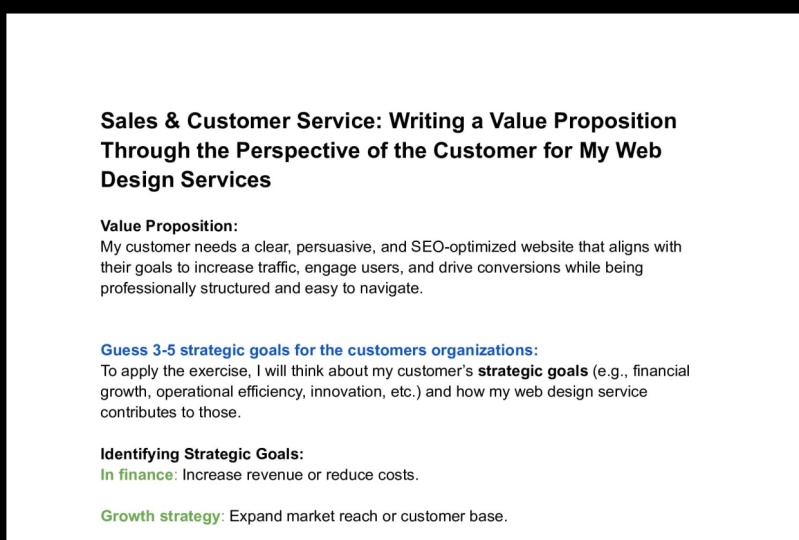
customer is working under. Now it's your turn. Guess 3-5 strategic goals for the customers organizations. Consider subjects such
as finances, growth, innovation, operations,
HR, and company culture. Now, describe how your customer
is expected to contribute to those goals through their
work and their targets. Select the goals on which
your customers work, makes a difference. How does your customers work contribute to achieving
those corporate goals? With this exercise, you
will be able to tap into the core long-term value a customer receives
from what you sell. In the next lesson, we will look at how you
can talk to customers about the technical value
of your product or service.
4. Providing a Technical Solution: The next type of value
that your customer receives from your product
is technical value. Technical value is about the technical skills or the technical product
that you're offering. It is the skill gap that you're plugging with your
product or service and it describes
how that product or service will be
used by the customer. This value has to connect nicely with the
skills your customers do have so that your solution
is easy for them to adopt. Technical value is the
base value of any offering in the sense that it is the simplest form of
value to explain. Customers will buy from you because your
product or service has a technical expertise
or ability that they lack. The technical value of a
pen is writing in ink. The technical value of running shoes is in the
design and materials. The technical value of a family law attorney is in
her degree and experience. Let's go back to our
website example. The technical value of a web developer is all
of that coding and designing and user
experience knowledge and training that they have. An effective website will offer a seamless buyer experience
with high-quality images, simple payment methods, and all in as few
clicks as possible. It will also allow
prospects to book appointments online at a
time of their choosing. It continues to work as a sales and scheduling
platform at any time of day, whenever the customer
visits the site. It is doing all this without interrupting the
company employees. These are technical features that the website
developer offers. The customers
themselves probably do not have the skills to
achieve on their own. A simple way to think
of this is that technical value
describes the things that a customer needs, which you know how to
do and they don't. It is about the means to an end. How does your product
or service allow better work overall
for the customer? It explains why your service
is better than a DIY option. Now it's your turn to describe the technical value your
product or service offers. Start by writing down three
ways your customer might try to DIY a solution
instead of buying yours. Next, explain what
they are losing or missing out on by trying
to do it on their own. Finally, explain how the technical expertise
your company offers will take them from all
of those gaps and weaknesses of their
DIY option to a great, easy-to-use,
comprehensive solution. Once you have completed
the explanation, you will have all the value points relevant to
your product offering. In the next lesson, we will address the third form
of value, personal value. There, we will look
at what the customer gets out of the deal personally.
5. Offering Personal Value: In this lesson, we get to know your customer on a
whole new level. Personal value is what
makes your buyer smile. Even when you sell
to a business, businesses are still
run by people. Personal value is about the individual involved
rather than the business. They are the ones
making the decision, doing the things, and enjoying
the business benefits. Your customer is a person with their own business
and technical needs, as well as personal
hopes and preferences. People are ultimately driven
by the width and urge. What's in it or me? As we established earlier, nobody buys a Coke to do a favor to the
Coca-Cola Corporation. They buy it to
quench their thirst, maybe also to satisfy
a sweet tooth. That's what's in it
for the customer. That's the personal value. Know what's in it
for your customers when they buy from you? What are their personal
benefits from the deal? Ask yourself how a
successful purchase and project will make your
customers' life better. When your buyer is able to
implement a solution that achieves the company's
business goals through what you sell, that means that they are
successful in their work. Tell them what they can
report internally to show that success and find out what motivates your
buyer in their work every day and what
they hope to achieve. It might be things like an
increase in salary, a bonus, a promotion, an improved working environment, improved
working hours. More interesting work,
professional development, clocking out early every
Thursday so that they can see their daughter's soccer
game, and much more. To put this understanding
into action, think beyond your
customer's day-to-day work. Try to imagine what
motivates them to do their job and what
other interests and desires they have in life. Personal goals that are supported by the
work that they do. You can get a lot
of information from things they say or
things you might see. Like, do they have a picture
of their dog on their desk? Or do they mention their
hobbies during small talk? For the rest, it's okay to make some assumptions to give
you that initial direction. Now it's your turn to identify the personal value you can
provide to your customers. The effective way to get
to the personal value is describe how your customer
is evaluated in their work, what is expected of them, and how do they get recognized
in their own company? Next, explain how your product
or service can increase their chances of
recognition and what that might do for the
individual overall. Finally, take it a
step further and add some thoughts on how
that might change your customers' working
environment for the better, how it might contribute to
a promotion or a bonus, or better hours and so on. Now you see your customer
in a deeper way. You can connect all the types of value that they receive from your product or service and you know what they are
really buying. In the next lesson, we will take this knowledge and
translate it into both the features and benefits you offer in your
product or service.
6. Honing in on Benefits: You know all the value you bring to a customer for
the business needs, the technical needs,
and the personal needs. Now, you're ready to take
all of this customer context and use it to create a new customer-centric description
of your product, a customer-centric
value proposition. This work is where we
describe your product and draw the lines
between benefits and features connecting
each to a technical, business or personal value. In describing your
product or service, features and benefits
are equally important. You could say they both
describe the same thing, but for different purposes. Features are facts about
what your product does. While benefits are the outcomes and changes that your
product enables. Use the benefits
to give value to the features by explaining
why the features matter, and use the features to prove the benefits by showing how
you achieve those outcomes. You end up with a sentence like, I can promise this benefit
because we offer this feature. One of the best examples we have of the difference
between features and benefits is the classic
description of the first iPod. Feature, one gigabyte
of music storage. Benefit, 1,000 songs
in your pocket. Nobody wanted one gigabyte
of music storage, but everybody wanted 1,000
songs in their pocket. The iPod could promise
1,000 songs in your pocket because it featured one
gigabyte of storage. Here's an example of
how I might fill in this table of features and
corresponding benefits. One feature I offer in
my work is flat fees. This is a fact. It's a thing that is
part of what I offer. The corresponding benefit
to a client is simplicity, transparency, and
ease in planning, financial planning and
looking at their projections. Is this a business, technical
or personal benefits? I would say it's a
business benefit because it impacts their
financial projections. Another feature I offer is a report after every
single meeting. The corresponding
benefit is having the background of
the work we did together and a
constant reference for them to look at
about that work. Is this a business, technical
or personal benefit? I would say that it's a
technical benefit because it is the reference point to go back and remember what we agreed upon and remember the thought
process behind it. It gives them direction. I will add to that, that each report includes at least three action items
of what they have to do next. The corresponding benefit is that they know
exactly what to do. It removes their
own decision-making or having to recall
what we talked about. It allows them to focus on
action instead of thought. Is this the business,
technical, or personal benefit? I would argue that there is a personal benefit
element to this because it is making it simpler
for them to take action, which means that it
removes stress for them. It removes the weight
of having to remember, of having to make decisions and instead it allows
them to focus on the work and anything that
relieves stress for a client is certainly
a personal benefit. Here are some examples of how you can look
at your features, at the benefits and determine
if it impacts your client in their business
in a technical way or in a personal way. To learn the difference
between features and benefits for your
product or service. Separate the facts from the outcomes using
the same examples we shared at the beginning. If you sell pens, the features are
the size and color, the materials, the ink color, the grip type, the type
of ink, the cost, etc. The benefits are beautiful
calligraphy, no leaks, multiple colors, a soft
and easy application, a thick or thin line. If you sell running shoes, the features are the materials, the weight, the added components
to the shoe, the cost. The benefits are
comfort, fewer injuries, less soreness, greater
speed, long-term wear. If you sell family law services, the features are where and
how often you meet customers, the contracts, the
communication methods, how you share files and so on. The benefits are outsourcing the mediation, getting
expert advice, not making mistakes,
maximizing opportunities, crafting long-term custodial
decisions, and so on. Benefits are the outcomes or results that customers
will experience by using your product or service. The very reason why the
prospective customer becomes an active customer. It's time to list the features and benefits for your business, creating a connection
between each one. Using the worksheet in
the resources section, fill in the features
and benefits columns of the table
at the bottom. On one side, list the key
features your product or service has
developed and offers. Next to each one under the
corresponding benefits heading write the benefit
that that feature offers. Why should the customer
care about this feature? The answer describes
your benefit, the what's in it for the
customer statements. With this list and all the
work that came before, you will do more than be able to craft a
value proposition. You will also learn
how to inform the future product
improvements and decision. If a feature does not
have a connected benefit that adds value to the customer
in either their business, technical, or personal needs, then that feature
is not necessary.
7. Final Thoughts: Thank you for taking
my class on writing a value proposition through the perspective of the customer. I hope you're coming away
from this class with a deeper understanding of
your customer's world, their wants, and how you contribute to make
their life better. Your class project
will be to write your own value proposition and include the supporting
material from the work you did
throughout this class. I can't wait to see your value proposition
in the project gallery. I look forward to questions and comments on the
discussion board. Please use these
resources to share ideas, ask questions, and
show us your results. Thank you for taking
this class and enjoy your new
value proposition.
 Rebecca Brizi, Strategy and Business Growth