Transcripts
1. Introduction: Productivity means the amount of work done in certain
time duration, the more productive you are, the more work you are producing in the
shortest time possible. However, in this day and
age full of distractions, it is almost
impossible for anyone, including myself, to be focused and productive
all the time. But I've found some simple
tricks, few important hacks, and few proven techniques
that I've implemented in my business that took my productivity to
the next level. And you know, the coolest part is now I have more time to relax and not be in front of
the laptop all the time. My name is Adi Sing. I run
a video production company. I run a full time
Youtube channel, and I make courses, and I also post on my social media accounts
almost every single day. How do I handle all this? Well, it's not about fancy
tools and applications. It's more about
few simple tricks that I'm going to teach
you in this course. To take your productivity, to organize your life, and just have a healthy
work life balance. So let's get started.
2. Organise Yourself: To be productive,
the first thing you need to do is to plan your life. To organize your life. And to organize everything. What is important for you? For example, if you're
a business owner, you should list down
all the important, all the important
jobs that you have to do to have a
successful business. What are the tasks
you have been doing throughout the week,
throughout the months? Write those tasks down. If I give you my example, then it might resonate
with you more. My first task is
editing a Youtube video a week because I run a
full time Youtube channel, which means I'm uploading
every single week, one video on the weekends. So that is the mandatory task, which I have to do without
compromising anything. That's the highest
priority of my task. The second is make
content for clients. I'm a videographer, I run a
video production company. I'm usually filming with clients maybe once
or twice a month. And then I'm editing
a lot of reels, a lot of video content for them. So that is the second priority. In some weeks, I
have to do a lot of editing for them
in some weeks, not that is why that
comes on the second list. And the third is make content for my social
media accounts. I have two social
media accounts, one for my Youtube and one
for my freelancing business. I keep making videos
for those accounts. That's also a
really top priority because in this day and age, if you're not consistent
on social media, if you're not advertising your
services on social media, then it would be
really hard for you to survive if you are in
a creative industry. The next task is I make courses. Courses like this. I make at
least one course a month. That also takes a lot of
effort, a lot of energy. But with these courses, I also get help from an editor. So I'm not doing all
the editing by myself, but just to plan, write, and film the courses. That's already another
full time job. After courses, I also
film for clients. Filming for clients is mostly
once or twice a month. Sometimes it's five
or six times a month. It really depends.
But in this month, I think I'm just filming twice. That's why the priority list of filming clients
is on number five. After that, I have few tasks, which involves few
learning things. If you're in a
creative industry, if you're a business owner, you have to constantly be
on top of what is going on. Which involves a lot of
learning about new technology, a lot of learning
advertising things, or learning about a few
things which you don't know. For example, I have to learn about how to
advertise my courses, how to run Facebook ads, Instagram ads and
all that stuff. I don't know nothing about that. Of course, I have a lot of time to learn
about that as well, but I have kept that on
priority number six. The last priority is I am also learning Dutch because I'm
based in Netherlands. And to get my citizenship
and all that stuff, I'm learning Dutch as well. That is also important
part of my daily routine, so I have to involve
that as well. All these tasks, I've listed it down in terms of priority, in terms of how much
income they're making. My main source of
income is of course, Youtube and clients that
I have put in top two. But the task which is 0.6 which is to learn to
advertise courses, in my opinion, it is
not a priority now. Because if I spend too much
time in learning about how to learn about Facebook marketing and how to learn about
Instagram marketing, then I would compromise
my time on the task, which is generating a
lot of money, not a lot, which is generating majority of my income at the same time. So that is why you list
down all the tasks, what you should be doing as a business owner or
what you already have. Just list it down priority wise. By listing it down,
you would have this whole list of things
and you would have things clear in front of you that these are really important tasks
that I should be doing. Yeah, the first thing
is to just list out your main objective,
your main tasks.
3. Why Use A To-Do List: And once we have identified all the major tasks that
we should be doing, now it's time to
make, to do a list. You might have heard
a lot of times that people make to do a list
and it helps this that, but trust me, it has been
a game changer for me. By having this to do a list, I have a lot of
clarity and focus. I exactly know in which week, what task I'm doing, on what time of the day, exactly, what am I doing. That also takes off a
lot of stress because sometimes being an entrepreneur you would be super overwhelmed. Because it's not just working, It's not just video editing, it's not just filming if
you're a videographer. It's about advertising. It's about talking to clients. It's about replying
to e mails and all that sort of
stuff. All the stuff. And it's about also
learning new things. All this stuff can make
you super overwhelmed. So that's why it's really
important to divide every second of the day and write it down in the to do list. So everything is in front of
you, everything is clear. You don't have this fear that, oh, you're missing
out something. You should be doing
something which you are not. No, everything is here. That's why it takes a lot of stress from your life as well. And the best part of
having that to do list is once you
finish some task, the best feeling is
to just take it off. That's the best feeling. The more you take off the task, the more it gives
you confidence about yourself that you are doing
something throughout the day. It's going to give you
a really good feeling. You wouldn't feel that, oh, I spent my whole day in front of the laptop and I didn't
get anything done. It would give you the totally
opposite feeling that I spent 6 hours in front of my
laptop today and I got this, this, this, all of
these things done. That's the best feeling ever. That's also a really cool
benefit of having a to do list. As I mentioned before,
a to do list would also help you to prioritize
what's important. Whatever is the most important, you put it on the top
of the to do list. What are the things which
could also be delayed for tomorrow or for next week?
You put it at the bottom. So even if you do not finish
those tasks, it's okay. As long as you finish the most important task, that's fine. Yeah. It also helps you to categorize the priority
of your tasks. And the last thing,
in my opinion, what a to do list does is to track your progress
by end of the day. By end of the week, you would
exactly see Al task you got done and Al tasks are not
done for some of the task, I thought that it's
going to take less time, but in reality it
took more time. So when I'm making a to do
list for the next week, I would be mindful that I'm allotting more
time to that task. You can really get
a good feedback of how you are doing
with this to do list. Sometimes when we start
making to do list, we get really overwhelmed. We put like ten tasks a day. In the end, we are
only done with two tasks by end of that week. You would exactly
know that, okay, I'm not capable of doing all these things in
one day for next week. I'm going to put less tasks in my to do list so you get
a really good feedback, you can really
track your progress of whatever you're doing with
the help of a to do list.
4. Make An Effective To-Do List: Now let's learn how to make
an effective to Do List. I divide my to do
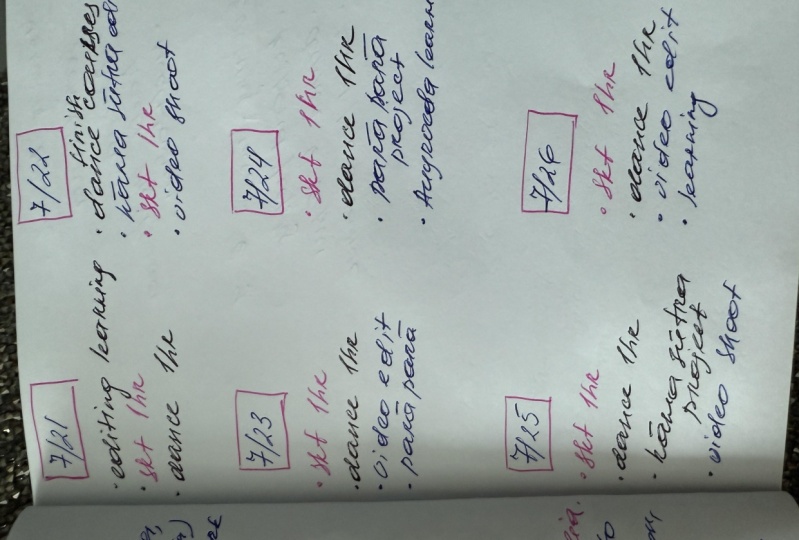
list into two types. First one is weekly overview. For the weekly overview, I write down all my tasks according to what
data I'm going to do. What in this little notebook, I don't use any fancy apps, because to use a fancy app, I have to open my phone that I'm distracted
with something. And to have an app
on the laptop, I have to go to that app, open that app, and
then read it out. This thing, it just stays right in my office
in front of my eyes. All I need turn my head there and I
know what I have to do. When. This is the
weekly to do list here. First I do, I write down the date from
Monday to Saturday. Sometimes I also write down Sunday if I have
things on Sunday. And then once I write
down just the dates, then you already know, oh, I have so many days, I have so much time to
do all these things. What I've listed
all my priorities, I first prioritize, what do we have to get
done in this week. The first and the most priority is Youtube video and
clients editing. It could be something
else for you, of course, for Youtube videos I
can allot some days, but in this week, which is next today, Saturday, I also do this Monday morning or Sunday evening
or Sunday morning. I know what I have
to do next week. That's also a good
preplanned technique that you already
plan your next week. You already know what
do you have to do next week is a little bit
different than usual next week. As I told that,
I'm also learning. I have this interview in Dutch
for my integration exam, that is on Tuesday, which is the 24th evening. I have to at 24 full
day to learn that, which is also called Oa
ON I've written it here. I have to learn for Oa on Tuesday so that the
whole day would be gone. I would be learning
in the morning and I have the test in the evening. Monday morning, I am
learning Oa in the morning because I cannot learn a
thing for the entire day. Or my brain would
just get Friday, I would do an effective 2 hours learning in early mornings. And then I have to edit
an event video for a client that I'm going
to do that evening. Once I'm done with Oa, then on the 25th, I would be editing
the event video because it's a long event
video, It's going to take time. I try not to do these
creative things in one go for five to 6 hours because I'm super creative
in the beginning. And then as the time passes, the creativity goes down. I break these down,
break these tasks down. Every time I'm allotting
2 hours to do this, I would be doing here
the event video, and then I have to
edit the Youtube video that I would be
doing on Wednesday. According to that,
I have on Thursday, I would be editing
Youtube video and I would be editing some reels. I also do is that everything with these
small small videos, I do a lot of batch filming. And batch editing
today is Saturday. Tomorrow I would be filming, I think five to six reels for my Instagram that I would
be editing on Thursday, second half after
lunch, I think. Yeah, that would literally take me 2 hours to edit
five to six reels. Then on 27th is the deadline
for my event video, 27th morning, I would
do some finisher, some finishing for
the event video. Then 27 evening or
27 second half, I would be editing the
course, what I'm filming now. I also have an editor
to help me out but be edit together,
he does some parts. I do some parts on the 28th,
which is the Saturday. Saturday, we have to upload
Youtube video Saturday, I would be doing some subtitles, some final collab rating, some final changes in the video. I'll make sure that my Youtube
video is done Saturday, early morning, and by
10:00 in the morning, I am ready to upload it. You see if you already
organize everything, what you have to do, it's not super overwhelming,
it's just there. Here I am checking out my
Dutch Learning client work, Youtube editing and
social media editing. I'm already doing four
major tasks that I should be doing to run a decent, successful business,
if that makes sense. So this is an weekly overview. In the weekly overview, what also I do is that I just put the
highlight of the day. The highlight of the day is
that what is the major task? What is the major
thing you're going to get done on that day? On Monday, this is Ona learning and event video on Wednesday, This is event video and Youtube. So this just two major tasks that I have to do on this day. I don't have to worry
about editing reels, I don't have to
worry about editing courses on this day
because I have already allotted different time for
those tasks on this day. I would just focus on this. That's why it also
takes a lot of stress from your life
because you know that, okay? All the other things
that I have to do, I have a lot of time
for that right now. I just focus on this task. That's why it's also
really important to define your highlight
of the day. The highlight of the day shouldn't be more than
max three things. I usually put it
one or two things that on that particular
time of the day, I can just focus on that task. That's why it's really important to choose your
highlight of the day. Of course, now your
question would be, I just don't have these tasks. I have a lot of
other tasks as well. I have to e mail people, I have to reply to the
comments on my social media. I have to advertise my thing, I have to have a social life. Those things I don't put in my weekly overview
for those things. I have this little sticky
note for those things. I write it down here if I have to do
my accounting work for my taxes that I would
write it down here because that shouldn't take me more
than half an hour to 1 hour. That is not the
highlight of the day. That is just a few extra
tasks that I would be doing, not in my focused hours. I'm going to also talk
about the focused hours and the non focused hours later. The things which is not that
important or the things which shouldn't take
that much time. I write it down here so that
my weekly to do list or the highlight of the day is not overwhelmed that in the
first few creative hours, I can just focus
on these things. Here I talked about my two
different to do lists. First was which just shows what major tasks I would be
doing on that particular day. Then the other which is
the daily to do list here, I just write down whatever
comes in my mind that, oh, I have to order this, Oh, I have to order a memory card. Oh, I have to return
this memory card. Oh, I have to do my taxes. Oh, I have to call
my accountant. Oh, I have to call this client. Oh, I have to get feedback
from this client. So all those litter,
other things that I put it here and I see this in the second half
of the day so that my mornings are just
focused on these things. In the next section,
I'm going to talk about how do I plan
my entire day. I hope that the to do
list is clear to you. How I make my to do list
is clear to you and you can also apply this technique
in your life as well. So let's move on to
the next section.
5. Plan Your Day: In this section, I'm
going to show you how do I plan my day earlier. I'll give you an
example of I think last month until last
month I was waking up. I wake up quite
early around like 5530 and there's no judgment. I work really good
in the morning. Some people can work
like during late nights. You have to really see
what works for you. I wake up quite early, like 5305530 in the morning. And then earlier, what I used to do is that I would have
like a little morning routine. I do journaling,
meditation, all that stuff. I'll get that out of the
way and then I'll go straight to the gym after
coming from the gym. Then I would start working from 830 or 09:00 to 12 or 12 30. That worked really good. But some days when I
wouldn't go to gym, when it was my rest
day on those days, I would get also a
lot of things done early in the morning and I would really enjoy those
working hours. I was like, oh, if
I don't go to gym, I have so many hours
in the morning, I can do so much and
there's no distraction. I'm not getting any e mails, I'm not getting any messages. Nobody's awake. It's
so nice and quiet. I just love working
during this time. Then I was asking
myself that if I really like working
during that time, why don't I work during
that time, every day? Then I changed my
routine a little bit. Now what happens is I wake
up whatever time, 5530, and then from 06:00 or 630 to 08:00 I have my first
session of the day. I break down different
working hours into sessions. This 2 hours, or 1.5 hours, is the first session of the day. In my opinion, that is the most productive
session because I can do three to 4 hours of
work in that 1.5 to 2 hours. Because first of all, my
brain is super fresh. I am not overwhelmed with
a lot of screen time. I'm not overwhelmed with a
lot of external information, which is social media, e mails, messages, all
that sort of stuff. That is a really good
productive time for me. Then I go to gym 8-10
I shower breakfast, and 10-1230 I have
my second session. That session is
creative as well. In between both the
productive sessions, I had a little gap,
really refreshing gap, 10-1230 I would have another session and then
I would have lunch, 1230-2 I would just
chill, watch television, or I don't just walk around or just do
something in my garden. From 02:00 to 04:00 I
have another session. I have divided all
these sessions, and that's how I allow the tasks to all
different sessions. All the tasks that
you saw on weekly. To do a list, I would
allot these tasks. Say for example,
the event video, which is on the Wednesday 25th. I would allow this
in the morning because this needs a
lot of creativity, This needs a lot of focus. This needs a lot of thinking. I would put that in the morning. Then I would also put this 10-1230 because I'm already
in the flow in the morning. So I just want to
do this as well. Then in the second
half after lunch, I would be editing
the Youtube video. Because Youtube videos, I've
already filmed everything. I know it's in a
chronological order. It doesn't require
a lot of focus, it doesn't require a
lot of creativity. Because everything is there. I just have to put
them together. That's why I've put this
here during these sessions. I also which tasks I'm
going to do, when, which I'm going to do when, then if I have some other task which is not that productive. For example, some days
when I'm doing on the 26th when I'm editing Youtube videos and then
I'm editing reels, then I would also allot maybe
1 hour to do some e mails. Or if I have something else to do that day, I would do that. That's how I allow different
different tasks in different different sessions
throughout the week. Then with this
small to do a list, this is if I have to do
something which doesn't require that much focus that I would do in the evening after dinner. So we have dinner quite early, around 430 or five 530-630
I still have 1 hour, so then I just
chill on my laptop. I just do reply to some e mails, post on social media, reply to people on social media, connect with my friends,
family during that time. So I know that if I have
to reply to someone on socials or on Youtube
or on my whatsapp, I can do that in the evening or I can do that
in the afternoon. I'm not going to touch my phone, I'm not going to
do anything with my phone during the first hours, which is more productive. Because I know that if I
go to reply to someone, then I'm going to get a reply
back then to reply again, and then the whole
focus just goes away. That is why sessions
are important as well. A lot of times what happens
is that if we are planning to do multitasking or
if we're planning to do 23 things in one session, then our focus gets
really distracted. For example, I would also teach you a lot about how to do
deep work in these sessions. I'll teach you in that as well, but switching
between one thing to another then coming back to the first thing that
also takes a lot of focus off from
your productivity. Really just a one thing per session so that you can
just focus on that. Anything comes in your mind, anything external, you
just write it down. Or you know that that is already
placed in my to do list. Now what I'm going to teach you, this also helps me determine
which work should I do when the first type of work is deep focused or
intense focused work. Those work that I
do in the morning, that work is not
dependent on anyone. I don't have to wait for reply for anyone to do that work. That work is dependent on me. And that work usually involves some creative editing or
some color grading or Yeah, something like that, which
is just focused work. For example, this morning I was making a structure
for this course. I've already written it down. But I was just going
through everything just to make sure that
what am I talking? How I have structured
everything? Does this make sense
for my audience? Does this make sense
for me or not? I think in 1.5 hours I just
had a full structure of this course that is
the deep focused work. Then the second category
is deep focused work, which also involves
some other people. I usually do my client work
in that time or I usually do some sort of work
which I have to show it to my wife
or which I have to show it to my client and then I can get
feedback from them. So then I can proceed to further edits to
this kind of work. I do not early in the morning, but in the second half, 10-1230 or even 2-4
Then the other task is, which doesn't need focus at all. For example, if I have to do some accounting, for example, if I have to post
on social media, if I have to make stories for
social media, those things, they don't need too much
focus so that I can do after dinner or even 2-4 because that time also my productivity is not at its peak as how
it is in the morning. I can allow those tasks there, or if I have to order something, or if I have to research for
a new camera or a new lens, I'm not going to do that
at 06:00 in the morning because that really doesn't require a lot of
creativity, a lot of focus. I push all those tasks
later during the day. And then there are some works which can be done in batches. For example, replying to emails. If I have like 67e
mails to reply, because we have a
Youtube channel, we also get a lot of
E mail from brands. If I have classes posted
on different platforms, I get questions from
students about that class. I can reply that in batches. All the replies I
just do in one batch. All the replies on my Whatsapp
I try to do in one batch. If it's not that important,
all the E mails, all the comments
on social media, I'll just sit for 20 minutes. I'll just reply.
Reply. Reply Done. Next reply you would hear
from me is next day. That also make sure that I'm not going back and
forth whole day, but that also has an exception. If my client has something
really urgent to be edited or they need
an urgent video. If something changes I would, I see the messages
so I can reply to it instantly if
it's really needed. Then one more tip to
finish all these tasks is allocate specific
time to certain tasks. How I allocated like 1.5 hour
session, two hour session, two hour sessions later, 1 hour session here, allocate
time to different sessions. Because if you see
in the to do a list, if I just write one
task, say on Wednesday, if I just had to
edit Youtube video, then in my head I
would think that, oh, I have whole day to do this. I can just chill,
be on my phone, go for a coffee, do
this in between, I have whole day to do this. I have a lot of time that doesn't put a lot of pressure
on me to do this work. That's why I allocate
time so that I know that. Okay, I just have 2 hours
to edit this Youtube video. After the 2 hours I'm
going for a walk, then I have this
time constraint. And then I work
effectively efficiently, even if you are a creator, if you're working for yourself, really treat it as a job. Treat everything as a deadline. That puts some pressure on you, and that makes you
work very efficient. That makes you
work more focused. That's how I categorize
different types of work according to
those types of work. I allocate them at
different times of the day when I'm
going to do them. Now, I have taught
you how to do, to do, list what type of
tasks to do when. Also like these deep,
intense working hours. For me, it's early
morning for some people. I've also heard that
they love editing, or they love making songs, or they love writing. In the night when the
whole world is sleeping, some people were from 11:00
to 03:00 A.M. in the morning. It works really
perfect for them. You have to choose what
time you are productive, what time you are
less productive. And this comes with a
lot of self awareness, also comes with a
lot of feedback. What happens is that whatever you have gotten it done today, then you do a review that, oh, I wrote this this morning, I wrote this this afternoon. Did I finish it? If not, why I didn't finish it? Was it really that this task would take longer
than what I thought? Or was it because I
was just distracted? Really get a feedback. Give an honest
feedback to yourself. And then according to that,
plan the next day as well. Then plan the next week. Plan the next month. Yeah. To do they help you a
lot to get feedback as well.
6. Deep Work: Here we're going to talk about what is intense focused work? What is deep work? Deep work is something
where you achieve a flow state where you don't even realize
what time it is. How long have you spent
on this particular task? And you are just so leaned into, so focused on your
task that you just don't care that you haven't touched your phone
in the last 2 hours. That scenario is deep, intense focused work
and how to achieve it. Because the amount of work, what you can get done in the deep focused work
is just a blessing. Sometimes I can finish work, which I thought that would take four to 5 hours in 2 hours. If I'm really focused and if I'm really away
from distraction. How to achieve this
deep focused work? The first thing is take care of all the distractions
That distraction could be external or internal. A lot of times it
happens with me. For example, this morning
I was writing something, not something I was
writing about this course. A lot of thoughts, they
come, they're like, oh, I have to check for this
new camera which came, oh, I have to check for
this new memory card, which is important. It's not that it's
not important. Then what I do, if I'm working, I have the sticky
note in front of me. If something comes
I'll be like, okay, let's check this and I'll just put it in my to
do list in the evening. When I'm watching
it, I'm like, oh, I had to check this,
let's check it out. Or some other creative idea comes because we are creatives, you know, we have tons of ideas
throughout the whole day. I'm not going to just
disrupt what I'm doing now and then search
for this creative idea. I'm writing here. Another creative idea came
that I can make reels, about few video editing
techniques. I wrote it down here. I'm not going to
type another chapter about what reels can I make or do research
about that real. I just wrote it here and
I'm going to allot it maybe this week or next
week, or today evening. I've just written it down
here. It's written down. Once I write it down,
it's out of my mind and then I can focus again
back on my work. That's why it's also
really handy to have this sticky note in
front of you on my desk. I literally just have this. I don't have any
other fancy stuff. I see a lot of set ups on
Youtube or a lot of tutorials, a lot of desk set up videos, and I see that a lot of people have a lot of things
on their table, and I find that has super
distracting for me. I just have my laptop keyboard, my mouse, my monitor, and just this
little sticky note, which has few little things. What I have to do
throughout the day, that was the internal
distraction. What comes in your mind? Some creative ideas, some
tasks. What do you have to do? Don't do that. Then the
external distraction is your phone to reply to
e mails to reply to that. I do not put my phone on silent because I am
away from my family. I am not with my clients 2047. If something really urgent
happens, I would be notified. If it's not really, really
important to reply, then I'll reply it later. I keep getting notifications, but I control myself
not to check it. If you cannot control yourself, put your phone on
silent and keep it. Don't not keep it in your room. Once you achieve that deep work, you would even forget
that you have a phone. Really trust me, that's how
the first step to achieve deep work is to get rid of
all the distraction possible. That's why I also love working
in the morning because I know that I'm not going to
be getting any e mails. I also know that I'm not being expected to reply to
people during this time. So I can just be in
my little cave and just keep working with
all these messagings. If you always reply
people a bit later, or if you always reply
people at specific time, then they also kind of get
used to this habit that, okay, I have messaged that
person and I cannot expect reply from him because he
or she might be working. Now, I'm sure that they
would be replying me later. It's not that
they're ignoring me. Other people, they
also get used to your pattern of
reaching out to them. And then of course, I also a few times if I have to talk to my best friends or if I
have to talk to my family, this might sound a bit weird, but usually it works
with my friends. With my best friends.
I'm not going to go chat on Whatsapp whole day. A lot of time that, hey, let's catch up on this time.
It's been a long time. We have a lot going
on in our lives, but I would love to
hear it from you. Let's call on Thursday morning or let's call
on Thursday evening. What time works for
you so that we can have also a productive
phone call. Because if you're calling with your friends or your family, 2047, then you don't really realize the
value of that call. You don't get the most
out of that call. Then I know that on Thursday
morning I just have 1 hour. I'm going to talk
this, this, this, this to my friends
and I'm going to ask this question to my friend and just to know what is going
on in their life. Then you can also
make that phone call, that relationship really
productive with your friends. And then you value that
conversation a lot more. That's why it's really
also important. I do that all the time
and all my friends, they do that as well because everybody has a lot going on. Nobody has time during just a random time
of the day to talk. Yeah, That's why allocate time to call to your
friends as well, so that when you're
deep working, if you get their message, they would know that they are not expecting
any urgent reply. So you don't have this pressure
of replying to them and you can just get back
to your work deep work. Usually it's like for example, if I'm working, I said that I'm working 1.5 hours
in the morning. That does not mean that
I would be working consistently for
those 1.5 hours. It takes 51015 or 20 minutes for someone to go
into that flow state, to go into that deep work state. Deep work, it starts with
killing all the destruction. And once you start working, there is a rule called
five minute rule and which says that if you don't
feel like doing something, just push yourself
to start doing that. And once you start doing that, then you achieve that flow. Then you really
enjoy to do that. For example, just going to gym. Going to gym is really hard. But once you are in there, then you're like, oh,
I'm so glad I'm here. Let's work out same as work. I'm so glad that I've started working during
this deep hour. And once you've spent
5 minutes, 10 minutes, 20 minutes, then you're like,
oh, I'm going in a flow. I cannot stop editing. I cannot stop filming. Now let's keep going. So that's why it's
really important to push yourself to achieve
that flow state. To achieve that deep work state, usually the deep work, it wouldn't last for more than
an hour because your brain can only hyperfocus on one thing for a certain
amount of time. Because after that, your
productivity also goes down. You have to realize that it happens a lot
with me when I'm editing or when I'm writing that the first 40 minutes
or first 60 minutes, I'm really productive.
I'm really focused. Everything just makes sense and everything is just a flow. It's like a music. I'm just
doing a lot of things. I'm getting a lot of
things done during that first 40 minutes to
60 minutes After that, I can see that the productivity is going
down slow. I realize that. And then I still work for half
an hour, and then I stop. Then I do something
completely different. Then I come back again and say, productivity is
high, high, high. Then it goes down slow. You have to be also
really mindful of how much work you are doing, how much work is getting done, and get more feedback
for yourself. For some people, the
deep work state, they can only be for 30 minutes. For some people they
can be for 2 hours. I also do this one more
technique called 40 20. I would put a 40 minutes timer. I'll work that 40 minutes. I am not going to
go for a coffee, I'll go for a toilet. I'm not going to go to
drink water because I'm going to drink water
in next 40 minutes. I'm not going to die or so. And once that 40
minutes is over, then I have a 20 minutes break. Then I do this 40 minutes again. In that 2 hours, I
got 80 minutes of working time and I got
40 minutes of rest. And then I can also repeat that. I can do that for 3 hours. In 3 hours, you can get one, 20 minutes of working time
and 60 minutes of rest. So yeah, that's how you can divide your work
schedule as well.
7. Batch Work: Now I'll talk about batch work. Batch work, as I
mentioned before, batch work is the time I allot myself to do a lot
of extra things, which doesn't require
a lot of creativity. Sometimes just my mornings are the productive working time, the early mornings, and
then the rest of the day, I have to do a lot
of other stuff because as you would know
as a business owner, you just don't have the
things which you enjoy doing. You have also a lot of
administration work. Yeah, just connecting
with people, Maybe sending cold e mails, maybe reaching out
to this e mailing, other brands for
collaboration. This stuff. You can do it in batches. You can again, set
another 22 hours of work time during this time, do the batch work as well. Batchwork, in my opinion, also shouldn't be done
along with other things. For example, you cannot reply to e mail while
listening to music. You cannot reply to e mails, or you cannot post on social
media while watching TV. It's better to just
take 5 minutes post on social media and then
enjoy the television. You can do one thing at a time and make it
more productive.
8. Rest: Now let's talk about rest. As I told that I have a
lot of time from 08:00 to 10:00 then 1230-2 o'clock just to do things
in those hours. I'm not going to exhaust myself again by talking to people, because talking to people, that also takes a lot
of energy from me. I'm not going to exhaust myself again by talking to someone for 1 hour and then
going back to work because I know that that takes
a lot of energy from me. I would do something like something in my garden
or go for a walk, or clean something in the house, which doesn't require
any creativity, which really doesn't
require any screen time. That's why it's also
really important to prioritize your rest as well. If you have 1 hour of rest rest, the best part of rest is
that you can also take naps. Naps are the best thing ever. You can either take 20 minutes, 30 minutes nap and it's just the best for your
nervous system. I don't usually do it, but when I do it I
feel really refreshed. So yeah, like the whole
point of me talking about this rest time is that maximize
your rest time as well. Really enjoy your
rest time as well. This is the time where
when you are refueling yourself for the next
deep work session.
9. How To Use Social Media: Now let's talk about
social media usage. Social media is just such
a big part of our lives. If you are a person who's working for someone or if
you're an entrepreneur, social media is just
taking over our lives. That is literally a reality. And as an entrepreneur, as creative people, we have to have a good
brand on social media. We have to be presentable. We have to be doing something on social media to show the
world what we can do. And then attract clients, attract customers, attract business partners,
things like that. How to use social
media effectively. I am that person who's
posting one reel or at least four to five
reels every single week. I've been doing that for
the last three months. There was a point where I was
also uploading twice a day. But that time I was spending a lot of time on
social media as well. But now I have reduced it, and my screen time is maybe
1.5 hours to 2 hours a day. I spend, I think, 20 to 30 minutes
on social media. In the upcoming section, I'm going to give you some
tips of how to reduce your screen time and how to be off from social media because
it takes a lot of energy. Trust me, the first thing, what I told you before
is that I do a lot of batch filming and batch
editing for my reels. If I have to post
something today, I'm not going to
edit that just now. I have already
four to five posts for every week ready
to be uploaded. Then I also have the caption, the thumbnails, the hashtags
ready to go as well. I do all the research beforehand so that
when I have to upload, I just go to Instagram,
I just go to Tiktok. I upload the video, I copy paste the caption, copy paste the hashtag tag, whoever I have to tag, Upload the thumbnail, then I upload the video,
and then I'm out. Usually what I used to do is
it I would go to Instagram, then I'll scroll for a break. That would take me 20 minutes. Then I realize, oh, why was I on Instagram? Oh, I had to upload a video. Oh, let's upload the video. Oh, what captions should I put? Oh, let's see what other
people are doing. Hashtag. Let's see what other
people are doing. And that takes 1 hour to
it to upload one post. If you have already
planned everything, it would literally
take you 10 minutes, or even 5 minutes, to upload a post. That's why get everything ready. If you have to upload a
post, get the post ready. Thumbnails, captions has
tag everything ready. Once you're Instagram, this
act really professional. Once your Instagram
upload, copy, tag whoever you want to tag
and then done uploading, put it in your stories,
then you're out. Also, this mindset also changed my life and changed my
relationship with social media. As creators, the creatives, we are the creators
on social media. We are not consumers. You are making these videos to be consumed by other people to get some value to the world. Act as a creator,
not as a consumer. Every time when you're consuming
to get some inspiration, you're consuming to
find the good music, you're consuming to find
some really cool effects. Or you're consuming to
find some trending post. If you find those,
save it every time. And then when you have
to make new real. So you go to that list of
what all things you have saved and then make something
similar or get some ideas. Really use it not as a consumer, use it as a creator. All my businesses are
because of social media because a lot of people watch my Youtube, so that's
how I get paid. A lot of people buy my courses, a lot of people see
my work on Instagram, so that's how they
want to work with me. I don't post what
I'm doing throughout the whole day because that would take so much
time for me to post. I just post what I
think is what would attract my potential clients,
if that makes sense. That's what I wanted to share with you about social media. It would take a bit of
time, if you consumer, it would take a bit of time for you to switch
to that mindset. But just be aware, of course, if you post any stories, you get a lot of replies. Just also a 15 to 20 minutes
to reply to those things. Do not just reply when
everybody replies, because then they reply again
and then you reply again, and then you go in this loop. And then your 2 hours of break
becomes 4 hours of break. And then what you
have to do would be delayed for the next day. Then by under end of the day, you're going to feel not so good that you didn't
get anything done. That's why really restrict your relationship
with social media. It just takes a lot of time. Have you ever realized
that you spend half an hour or 1 hour just scrolling? Do you
feel good about it? Oh, I'm so happy
that I spent it. No. But if you work for 2 hours, then you're like, oh, I'm so happy that I
worked for 2 hours. That makes me feel so good. Really remember that feeling. One more trump card. The trump, what
it is to restrict your social media usage is
restrict the time on that app. What? I usually restrict
15 minutes on Tiktok, 15 minutes on Instagram, because these are the two
platforms which I use a lot. What happens is that if I'm scrolling, scrolling, scrolling, and after 15 minutes, I get a notification
of 15 minutes is over. Bye bye. And then
I get two options. Either you want to extend the 15 minutes or you want to
turn off the notification. Or if you want to get rid of the timer for the entire day, I press that. Okay. Tell me again after 15
minutes. By doing that? After every 15 minutes,
I'm knowing that, oh, I use it for 15 minutes, I use it for another 15 minutes, Now it's time to turn off. It's like your
parents are telling you 15 minutes is done, better get off, 15
minutes is done. At least you're realizing that how much time
you're spending. And once that 15
minutes is over, once you turn off the app on, get rid off your phone,
then you also don't get notifications on all
these platforms. Once the screen time is up, then you don't get notification. The only time you would
see any notification or see any messages is
when you open it again. Sometimes if I don't
get any notification, I don't even remember
that I had that app. So that's why it's also
really a nice trick. These features are
in all the phones, just to have specific
time limit on any app, I would really recommend
to do that as well. One thing what I also do
with social media usage is that majority of my usage
is just on one platform. For some people it
could be Instagram. For some people it could be
Facebook, Youtube, or Tiktok. I usually use Instagram. I usually do endless scrolling, sometimes on Instagram reels because I know that if
something is really important or if
something is really funny or something
is really cool, that would get on that
platform as well. It's not that if I
don't watch Tiktok, I'm missing out a lot of
stuff that is not true. If something is
really going viral, it's going to pop up in your feed in the
specific app as well. So really don't worry that, oh, I didn't check my Facebook. I'm missing out something. No, you're not missing out. Something is really
important for you. You would watch it. That's how these apps are programmed. Really, don't worry about that. Optimize your usage
just on one app. If you're wasting time on each app half an hour every day, 2 hours is already gone. I also upload on
Tiktok every day. But the only time, like
literally trust me, the only time I'm using
Tiktok is when I'm posting the same post that
I've posted on Instagram. I just scopy everything
and then I paste it there. Upload the video and paste everything that I've
posted on Instagram. Paste it on Tiktok, Upload, and then I'm out and I
don't use Tiktok at all. For some people it
could be the other way. That's how you should
be using social media.
10. Review Your Day: Now it's time to
review your day. Everything, what you wrote
down in here or everything, what you wrote down in here, just check it out in the
evening and see that what all things you did and what
all things didn't get done. Because as creatives sometimes
we think that that would take only 2 hours and that ends up taking all the
three sessions. You really have to ask yourself, why did it take 6 hours in
total instead of 2 hours? Was I distracted with something or did it really take this long? If it really took this long, the next time I'm
making this to do list, I'll be mindful
that, oh, that task, what I did last time, it takes way longer
than I thought. Let's a lot more time to that. That's how you can be mindful by getting more feedback from the entire day To make more effective to do
list for the next week, it's really important
to get a feedback. That task would have
literally taken you 2 hours and it
took you 6 hours. But in reality, it should
have taken you just 2 hours. Then you would know that,
oh, I used my phone. Oh, I picked up that call from a friend and that took
me another 1.5 hours. And then I was so exhausted
and then I was so distracted, I used my Instagram and then I got to know about
this artist and that I checked their Youtube
and then I'm watching this 2 hours of Youtube
content from that. Yeah. You really have to be getting an honest feedback from yourself that where did your
time go in the entire day? You had so much time and
where did it go? Track that. Oh, in the morning I did this, but I think after breakfast, my whole focus was gone. Okay. I'll keep that
in mind tomorrow and I wouldn't repeat
the same mistake. And this is how by getting
an honest feedback, you can improve your
relationship with work. The coolest part is now
if you see my agenda, how I plan my day, I'm not working whole
day and I have a lot of free time after 06:00 I
usually go to bed around nine. Yeah, I'm not a grandpa, but yes, I go to
bed around nine. I still have six to
nine just to chill and do nothing and don't
think about work planning. All of this also gives
you a lot of free time. It's not that your work
work. Work work work. No. That's not how
our brain works. We are not programmed
to sit in front of the computer and do
deep work whole day. No. The maximout of
deep work we can do, a normal human can
do in the entire day is three to 4 hours of
really focused deep work. All the other hours, you can just do some
work which doesn't require a lot of creativity,
not too much focus.
11. How To Achieve Big Goals: Here in this section, I'm
going to discuss with you how to achieve big goals. I have found this technique and everything, what
I'm talking to you. It's not that I have
discovered this. I have gotten this from a
lot of social media posts. I have gotten these ideas
from a lot of friends, a lot of entrepreneurs
who I filmed for, a lot of books that
I've read keep, I take like little, little inspiration from
everywhere and then I experiment with my
life and then see that, is it making my life easier? Is it my business better? If yes, then I implemented, I also learned
something really cool. Is that how to achieve anything? I'll give you a letter example. I wanted to make online courses and I wanted to publish
them on my own platform. And then I wanted to
do Facebook marketing. I wanted to do all these
like marketing and funnels. And that's a lot of things to be learned that was
really overwhelming for me. What I did was I broke
everything down. I did reverse engineering. My main goal is
to make a course. Make a successful course. What do I need to have
a successful course? I need to have a lot
of audience that can see that I've
published a course, or I need to show my course through the world with the help of the social media marketing. I didn't even know
how to publish any course on any other platform
except from Skillshare, Utymy, and other
platforms like these. It was really overwhelming. Then I reverse engineered and
I took me back to present. And then I saw that
let's make a plan. What can I do today to even take a small step to be making a successful course
and selling it to the entire world?
What can I do today? I didn't have any audience. I had a lot of audience
from my Youtube, from my blog, and from
my blog, Instagram. But I didn't have
an audience for my videography
page on Instagram. It was almost dying. I didn't post anything for last one year. I had literally no
way to advertise. Nobody would know,
Nobody knew that. I also make courses. The first thing, what I
thought was that I didn't even have Tiktok then I just had
Instagram the first thing. What I thought was
that I have to get audience first because
before making any course, I have to get people
first to get to know me, to build trust with me. So that when I show
them that, hey, I also have this course, then they can at least
check that out. My first step was to
learn how Tiktok works, just to observe what other people are doing
what I want to do. I started seeing them and
then I thought, okay, now I think I should make some short tutorials
on social media. I started working on
that for my first week. I was not even worrying about what course do I
have to make and what platform do I have to publish the course and how
Facebook marketing work. I was not worrying
about any of that. I was just worrying
about what I can do. Now, what I can do today, once I started generating
some audience, once I found an easy
way to edit and film and upload it on Instagram and Tiktok,
then I was like, okay, once I have this
thing taken care of, once I know how to do this, I still have to do
that every week once I know at least
how to do that. Now let's research about
what course can I make, what people would be buying, what is the requirement? Then I started doing research, then I found a
course, and then I started writing
about this course. While I'm writing
about this course, I have this another
question, is that, okay, now I know what
course I would be making. I know how to film,
I know how to edit, I'll find an editor and
we'll make a course. That thing is also
taken care of. Now the social media
is taken care of and what course I have to make and how to film and all that stuff, that is also taken care of. Now my goal is that on which platform I would
be uploading the course. There's a lot of
platforms in which you can post
independent courses. Then I was like, let's
do a thorough research on which platform is easiest
for me to get started. Then I started doing research
on those things as well. The main thing, what
I wanted to point out to you is that if you
have a really big goal, start with the smallest step. What you can do
today, for example, if someone wants to start
their videography business, because I can only talk about
the things what I'm doing. Or if someone wants to
start a Youtube channel, to have a successful
Youtube channel, you need to know how
to edit a video, how to film a video,
how everything works, how to do marketing, and how to write the captions, and how to do the SEO and stuff. There's a lot of
things to learn, how to take thumbnails, how to write title, there's
a lot of things to learn. But the first step, what I would do to be becoming a
successful Uber is that first step would
be I would give myself one week to do
research every day. Just not worry about filming,
not worry about camera. Just to know what kind of
videos I would want to make, what videos I can make
in long term that is sustainable for my lifestyle
and that I also enjoy doing. And which video, this type of videos are required on Youtube, for example, travel content. There is just millions
of travel content, but to make online courses, there is not many content. Or to draw or to have a
creative drawing with pen. With this specific pen, there's not many Youtube videos. You have to find
your market first. The first step should
be doing a research about what kind of videos
you are going to make. Once you have researched that, then you have to figure out how to film what
cameras do I need. Once you have that, then you have to figure
out how to edit or do I outsource it or do I
do this really take small, small step at a time. And once you write down at
first I need to learn this, then I need to learn this,
then I need to learn this. Once you have all these lists, then you know that, okay, these are all the tasks. But right now, I'm just
going to worry about that. Because all the task
I would figure out, I trust myself that
I would figure out. But right now, let's
just worry about this, really just worrying
about small tasks then. The whole entire picture
is the key, in my opinion, to achieve anything
anybody who has started, they start doing with
small, small things. What are things you
can do today to get even half a step
closer to your goals?
12. Class Project: For the project of this class, I would be giving you a simple
task to make your to do. List the weekly and the daily. First, I want to see
your whole plan, that one of the things you
want to achieve in a month. What is your main
important task? Once you have written
down your important task, then you write down
the similar thing. You don't have to make a PDF
or just write down like how I have written
down in a piece of paper and post it in
the project section. That would be the
project of this class. That looks super easy, but once you start brainstorming about your priorities and
your tasks and this and that, then it becomes a
bit complicated. But that's also a good
feedback for you to really know what is the most important thing
you should be focusing on. Yeah, I would be really happy to see what I just mentioned
in the project section.
13. Thank You: Okay guys, so that was
it for this class. I hope you got some
value from this. And if you have any questions, let me know down in the comments and connect
with me on my social media. I post a lot of content
there every day. So thank you for watching and I'll see
you in the next one.
 Adi Singh, Videographer and Youtuber