Transcripts
1. Intro: What's happened in Skillshare? Welcome back to the eye pink creatures class on this fabulous learning and enjoying website. Today I, that I started a series in start to go back to reveal my specialty in what I do in fantastical creation of art. And I always pretty much theme a lot of my genre, which is painting from the imagination. Part of painting from the imagination is also dreaming awake. You know, going into the deep realms of the fantastical creatures that fill our spaces in our world. And I am full blooded Japanese and so on my roots, my grandmother was, she begins storytellers. She again poet storyteller and worked in the oral tradition and she specialized in what are known as yo chi and Yochai are basically Eastern folklore creatures from Japan. And so like over in the European world, we have JRR Tolkien and he created a whole universe of creatures and define them and gave him Rawls in his story, Lord of the Rings in the habit. And over in Japan. The same thing was going on. But you gotta remember Japan is more an island culture and from the East in so different philosophies. And so Yochai, roughly translated to English, means strange spirit. And basically in this tutorial, I'm going to talk to you of course, about all the tools and methods and what I'm thinking when I'm painting this and what I thought about drawing it. But I'm also going to educate you a little bit more on the art of 21st century folklore. And how you can either bring the folklore in from your cultural heritage or work in this fabulous realm of the Yochai or even you know, the Lord of the Rings realm, or even the Harry Potter around worrying these great epics. And that's pretty much what I work in. I was working epic storytelling. And basically I reinvent, redefine a lot of these creatures. And so this creature that I'm painting right here is known as a Kappa, which is basically a water Goblin. And a lot of Yochai were created to kinda explain the strange phenomenon that happened in the world, right? And so now I'm going to take you over to video 2. And in video 2, I'm going to show you the first layers and how I kinda create the background. I go about it a little different than a lot of other artists. And I'm going to show you the tips and tricks in the paint and the process and educates you all about Yochai and where they have come from, and where in the world they have inspired a lot of amazing art. So see you in video 2.
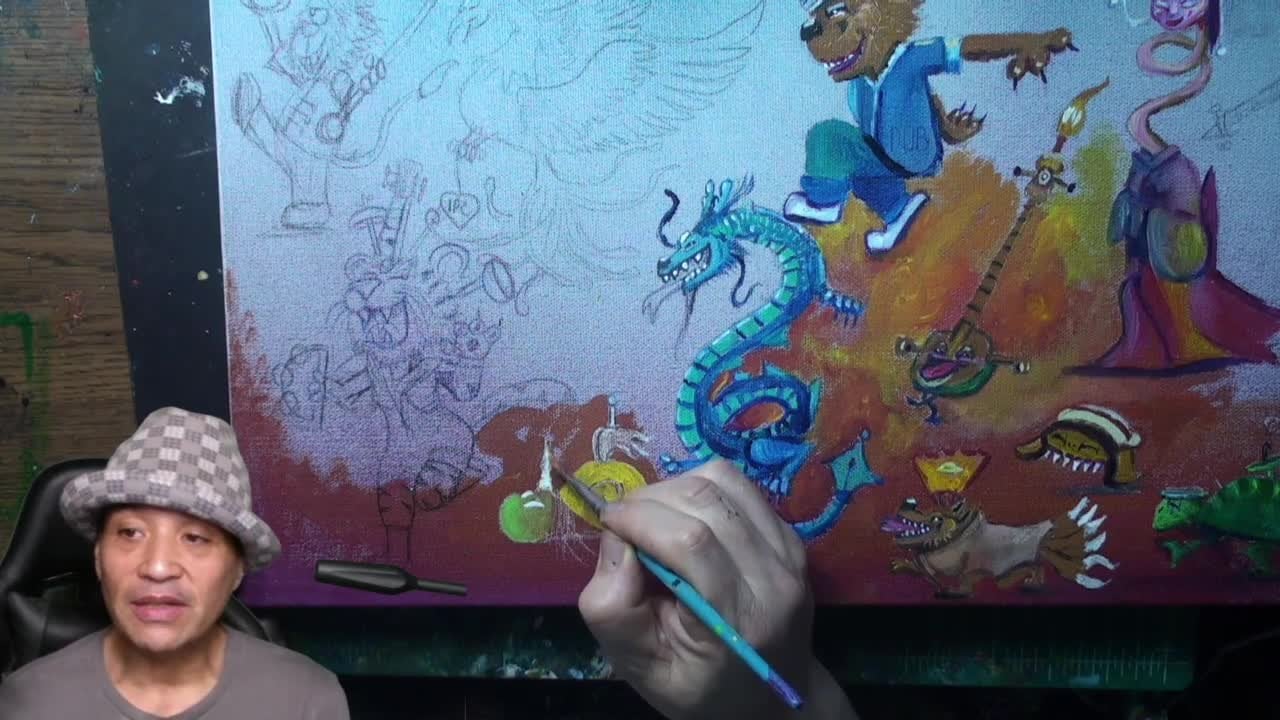
2. Painting Background: So welcome to video 2. And this one in the painting process I'm going to show you and talk a lot about love, my thinking and the process in how you can apply putting, making your own original Yochai creature. And basically what I'm doing here is called negative painting. And so I will basically paint all around the character, the creature here. And I'm definitely working in acrylics, but I'm using a lot of water, so I get it a lot. The consistency of like watercolor. And so I can do let it blend itself naturally. And also, you know, get more different tonal values like lighter greens in lighter blues. And I love doing the method I'm doing right now because I do a method call intuitive coloring were the only rules in fundamentals I'm following is the color palette and not putting colors next to each other that cancel each other out. More plane along the spectrum or the color wheel. So they're down on the bottom. I'm, I'm in the greens and blues and I know that they're right next to each other and so they all blend nice and add in little darker leaves in there. But let's talk a little bit about Yochai and how they come to me. Basically Yochai, like I said in the first video, our Japanese folklore creatures. And when it's translated in English, it roughly means strain spirit. And so that translates very much to me, what you imagine out of your imagination and you pay on your imagination. But when you're doing Yochai, it's like doing characters or creatures and it's moving in the realm of fantasy art or comic book are right. And so taking the strain spirit is a pretty incredible because you can basically, there are no rules really, but the rules are Appeal. And the rules are like basically giving you confidence and artists and letting yourself know you, you, you done original art out of your imagination and you pleasing yourself first, like one thing I love to do and you should do is draw and paint near fantastical creature if it's taken off of what I call classic Yochai. And a classic Yochai is you're going back to ones that were created before. Imaginal creatures for folklore stories back in the 16 hundreds out throughout time. And using as a reference but then evolve into either to your story arc, dry or evolving to fit them more modern times. And of course that's where it goes back to the art. Again, I, I believe the only fundamentals in doing art like this is your appeal. Or if you're a visual story telling me, it's gotta be there to tell the stories. Because especially if you look at a lot of children's books or teenager type of literature, the artists so fantastical and probably the only exception to the rule on that level is I believe the artists still fantastical, but it's kinda fallen into a genre which helps hold the story together. And I'm talking about like anime and manga art. And that's where these Yochai, very much very Japanese inspired. But they also, I'd like to deal with them is I don't really like to make a lot of art that looks like mango. Because one of the main reasons that drives me to make my art is I can't buy it anywhere, I can acquire any other place. So it motivates me and inspires we like to keep going. If I'm doing something original that I will like that I would hang on my wall or put on a T-shirt or have it bring meaning to my existence. So the copper York I'm doing right here, they're called copper. And basically from the old stories, they were kind of imaginary creature to kinda explain the weird things that happen around water, like they're drowning of children and kinda got a lot of dark stuff. And people associate goblins with dark stuff in. And that's where I worked in the ancient tradition. And I consider myself a 21st century storyteller for core storyteller. So I adjusted to the times we're in all the way to the political climate and everything else, right? So I define a goblin as basically a human creature like an animal, a turtle like this looks like or a dark or a waterfowl. It stands upon two feeds. And what makes it imaginative character is you give it features of a human does show that it has language and it has imagination, has things going up, all up in this part of yourself. And so this is a copper Yochai and the kapo was mainly created in stories. So there is no like official book that defines what Kappa is, right? And there's all these different interpretations, but how I interpret the Cut Pro from where it came from first, let me let you know where it came from. It came from, it's a water goblin, so it was created a lot to explain what happens the missing children, right. Because they just can't blame it on a dock or explain that mystery to, you know, in, in a regular turtle. They have to give it some type of personality in some type of like superpower. So the capo was definitely created in the research and the stories that I've done, you know, which is also very limited. It's not like you can go find all of these ancient complex story especially translated into your native language so you can understand it. And so I just a poet, I love getting little bits and pieces and inspired. And I bring in a lot of artistic and creative methodologies and ways of thinking I picked up when I worked at Lucasfilm. And I basically take these creatures and I reinvent them in the story and I go more elemental. I look at the metaphors that they represent more than read the Wikipedia or go back to any, anyone trying to recall like how these came into existence and live in our world. And so like once again, I define a goblin is not an evil, dirty, nasty wherever creature is a creature that took parts of an animal and then to parts of the human being is going back more to their nature. So capa Yochai was invented, like I was saying, to explain all the weird phenomenons that happened around water like Drowning Children and disappearing ships and all that kinda stuff. And, and so they kinda, in Japanese folklore they, they tend to like to joke and fill that in. It's kinda make the mysteries of life not so contin. And then if there was kind of evil element, that's where they kinda turn it into a more daemon like creature or more evil type creature. But, you know, in the times we live in, I think we have enough of that. Even this happening on the inside of ourselves in this lot of talk about healing yourself or self-developed in your mind and mindset. And so I believe, you know, redefining these copper like in my world, first of all, in the art area had to redefine how I draw them and what are their creature features. Because there's a lot of examples in them from the ancient wood blocks from Japan and they're pretty simplified and you have to also remember the woodblock. You don't have as much control the Illustrate with all the amazing through like this water brush I'm using to be able to put it together. And so they were very simplified. And of course there was known as kind of a turtle dark are those periods. But I'll see you over in video three where I'm talking about the Yochai and right there was an example of how to do negative painting and create a background have role enjoyable thing you saw, how it's just going up to the edges of things. But that's how you get your background in. If you don't do interests and traditionally acrylic ways, you would lay down your background and get the blends and the textures and all these things and then wait for it to dry and then paint on top would like white acrylics and get the shape of your creature and then go backwards and get all your detail. But I'm pretty much come from a strong illustration background and a character concept development background. So I like using ink and graphite to get the image on there first. So I'll see you in video three where we're going to paint the actual copper. And I'm going to tell you about all the art things and creative things I need to do to draw the copper in an IPC vision. So see you in video 3.
3. Painting Character: Welcome back folks to the third and final video of this class here on Skillshare. And it's a painting class and Gil chi reinventing in acrylics on a small canvas. And in this final video for video 3, just finishing up the background. And this is a real fun process of adding a lot of textures in acrylics. You waited with acrylics dry and using a water brush here you can use any type of water brush. I think this is an offshoot of water brush of my favorite water brushes, which are Pentel awkward brushes. And I like it because not necessarily use the water that much, but it's there to basically spread out. The paint is I'm using acrylics here. And if you guys are new to acrylics, you can water it down and pretty much get a lot of the watercolor effects. But you also can pull them back to the pure acrylics and get opaqueness so you can go over areas enlightenment dark in there. But yeah, I just added a whole bunch of text and you see how it's all. Just put the dots and random patterns and that now I'm starting to fill in that carpet, Yochai and this undoing a lot intuitive colorings, but this is where you just gotta imagining go for it, but also stay a little bit. That's why I love Yochai, their elemental based and this is a Water Gardens as all underwater. And so I'm bringing in the yellows and greens and the blues. And I love this. Study animals a lot. So always study animals if you've got a friend's dog and he's got interesting markings on and look at it. Not only just look at the markings, look how the markings are showing the form and shape of the animal. Because a lot of times it'll have a marker eyes I and if you notice, it's a little curve in its angle to show the contour of the face. And that's what I think a lot about it here. I also like to separate a lot of stuff's, one technique to use a lot is to give a lot of fantastical creatures mask. So it gives their form and shape a lot. And that's what you see me doing a little bit on this. And then I basically went with the green and put some blues in there, but then came down dabbing some yellow in there, so brought out more of the greens. And then I just think about all the certain parts that are his skin or his outer being, right? And so I colored his neck and maybe a lot of his head. And going back into a little bit or Yochai folklore, the kapa is basically a water goblin, but it has features of fish, has features of ducks, has features of turtles, is got a shell. It's got features of, given it pretty much like duck feet right there. But where it gets mysterious in folklorist is in really, no one really knows because we can speculate, but there was actually, I haven't discovered any stories that tell why capa creature has a dish on their hand. Like it's either it looks like a halo or an opening or a pond or a dish or, you know, I've been getting the modern technology where I call it like a satellite dish on ahead. But as a poet, I really get into the storytelling of how one has an opening on his head. Like there could be mean, a lot of things have its power to as an open mind, right? Things from getting his mind on the kind of nemesis or negative side, things you get in his mind and he's got a purifier because usually the myth of a copper, it has water up there. So when it comes to painting and drawing these creatures, that's where it gets super creative because like I was saying in the last video, you can find a lot of references on the web of people have done fan our contemporary art, but also some of the old wood blocks and, and all the wood blocks that the copper is pretty basic because a lot of it was not done with the visual. Like we have all these fancy movies today in all these 3D and 2D animated full colored creatures are coming alive. So a lot of it was in the creative writing and how you define the kapa. But since we live in this time, That's one of my funnest thing we'll do is work out my sketchbook and just use a pencil or use a ballpoint pen. I love using big sticks and I just kinda sketch in a lot of things, playing with shapes and different dimensions. You can look at other animals as reference. You can look at a lot of fish in water, water type of animals. And that's where I'll get the shapes for like fins. And I don't like to necessarily sit there and copy the FIM because then it doesn't fit the overall fantastical or fantasy imagine drawing. And so like you could spend like an hour or even a days. It's in their drawing all different types of fins from whales and dolphins to catch fish, to CTF is to all the different fish and aquatic animals. And you'll just get a sense of, I think the real trick. Um, which really to me is learning how to draw is coming back in, in a creature like this and keep drawing it over and over until you can figure out how you can represent a fin or duck's foot and put it in your own shapes so it's recognizable so people can relate to it, right? So when I approach a painting and drawing, I wanted these creatures. The first thing I think is the shapes in what you use, where I'm real original with my copper is, if you look at a lot of copper, either from the woodblock days or contemporary Fan Art. Lot of people don't put the fins on the side of the hair. That was one of my inventions. Another one of my adventures is I wanted to make room for the space because a lot of copper that I saw before I really started drawing these many years ago, is they don't leave a lot of space in the dishes kinda right on top and they get it all kinda from the woodcut drives where I kind of go into the basic nature that it's a water gobble is part dark, part turtle Park Fish part all the different parts. And I kinda go into the metaphor of it and really define the weights should look. And that's definitely in the direct proof. Professional traditional work in a working at entertainment companies, game companies, and threats that Lucas Film because George makes characters so convinced PBL in the word. And then he handed after illustrators like me, and he expects us to go way out there because it doesn't really ever preconceived notion. And that's how incredible characters like Chewbacca and Yoda and even bubbler the Fed and others, other type characters. They're definitely based off some type of architecture from ancient folklore stories. But they also take on a new genre because they're in the new evolve story of Star Wars. So I worked in that tradition too. So I sketched a lot of copper in my sketchbooks over and over again. I experiments shapes. Sometimes I get really crazy and just try things and look up, look like a platypus bill and say, Oh me back and use it more as a platypus step, build a duckbill or even some type of bird, even Eagle, and then apply it to my creature. And most of the time, each one comes out different because I'm exploring. But then when I do lock into tell my stories and everything, I create kind of a quote unquote brand and my creature, my character, and give them kind of the same shapes, so is recognizable. And, and I've gotten the point where I've been doing this aren't enough that people know me as I paint creatures on the web and they're like, Oh, that's an iPad creatures or a mug to your Kiara, That's one of the IPCC's creatures. And that's how I keep it fresh. And that also keeps you very interested in doing the drawing and painting and completing it is the anticipation and really seeing how your vision comes into fruition. And then when you either sell it or even just share it or share in a comic strip or like what I'm doing. I'm making a lot of these creatures in the puppets and get the SIM come alive by the voice actors in the pub to choose that, do their thing, including me. And you always get reminded that it's a very intuitive process that goes on in making these creatures is just a complete joy. And a lot of it is once again, experiment in trusting what you got inside yourself and finding new shapes and how you render things. And remember in a lot of story art, a fantastical are, the main thing is that you aesthetically pleasing yourself like, you know, like we find yourself complaining about your favorite cartoon or how a lot of people complain, or Disney VD Star Wars is not the same. You know, look at that in your own R and it'd be like, Well, what did you need to do to get out of the box of your normal thinking and create something so fantastic or that urine entertained by, if you enjoy it might me as a working professional artists, the more I enjoy it when I take it out to an art fair or put it online in a shop that people buy, they buy it up in. And that just brings more strength my work and, and, you know, redefining these Yochai and also taking it to the next level. When I get the confidence, I start writing poems and I start making their names just like the proposed back in the day called them Yochai make up a different name, form and then start generating their characteristics. He must fall the Creature Features and I play with them. And sometimes I'll, I'll draw like a Disney character, but then I'll look at those reference and I'll use my character skills and started exaggerated all the parts and mooning around and kinda find what works. And then at 1 like these copper, when I draw and paint them now they're like assembly kit. I mean, I always make them look the same, but I kind of know the process of where I laid down the fins and the way I put the water up in the crown or the dish, a platter on his head. In a lot of it is just, like I said, when it comes down, the paints are a lot of creative painting and using a lot of fundamentals, basically the separated, so the creature reason you can tell what it is, especially when you're introducing something that really people hadn't seen the world is recognizable because you're using creature features that are recognizable in the world and most of the time, Just lean in, in, in the best way to do that is learn your fundamentals or have a color wheel right in front of you and make sure you do contrasts opposite colors so the character really punches. So thank you for attending this course. I hope you learned a lot about your CMS me down before. If you have any questions and definitely go check out all my other social media. And I've yet to build the community where I go to my inbox and you're like IPC, make a video about this, teach us about this and look for their daycares is arriving anytime now. So you could be one of them go down, make a comment. Like you'd like to see a tattoo your chi or, or any of the other Yochai and educate arm and educate how I draw them. So go out and create some imaginative creatures if you're interested in these Yochai, create some Yochai creatures and use what's out there as a reference, but apply a lot of the stuff I'm showing you right there. Reinvent, redefined, and recreate your own fantastical creatures in acrylics on small Canvas. Thank you very much. My name is IP and creatures and our CEO Fox in it.
 Ipaintcreatures . poet painter illustrator and storyteller, drawing and painting from the poetic imagination