Transcripts
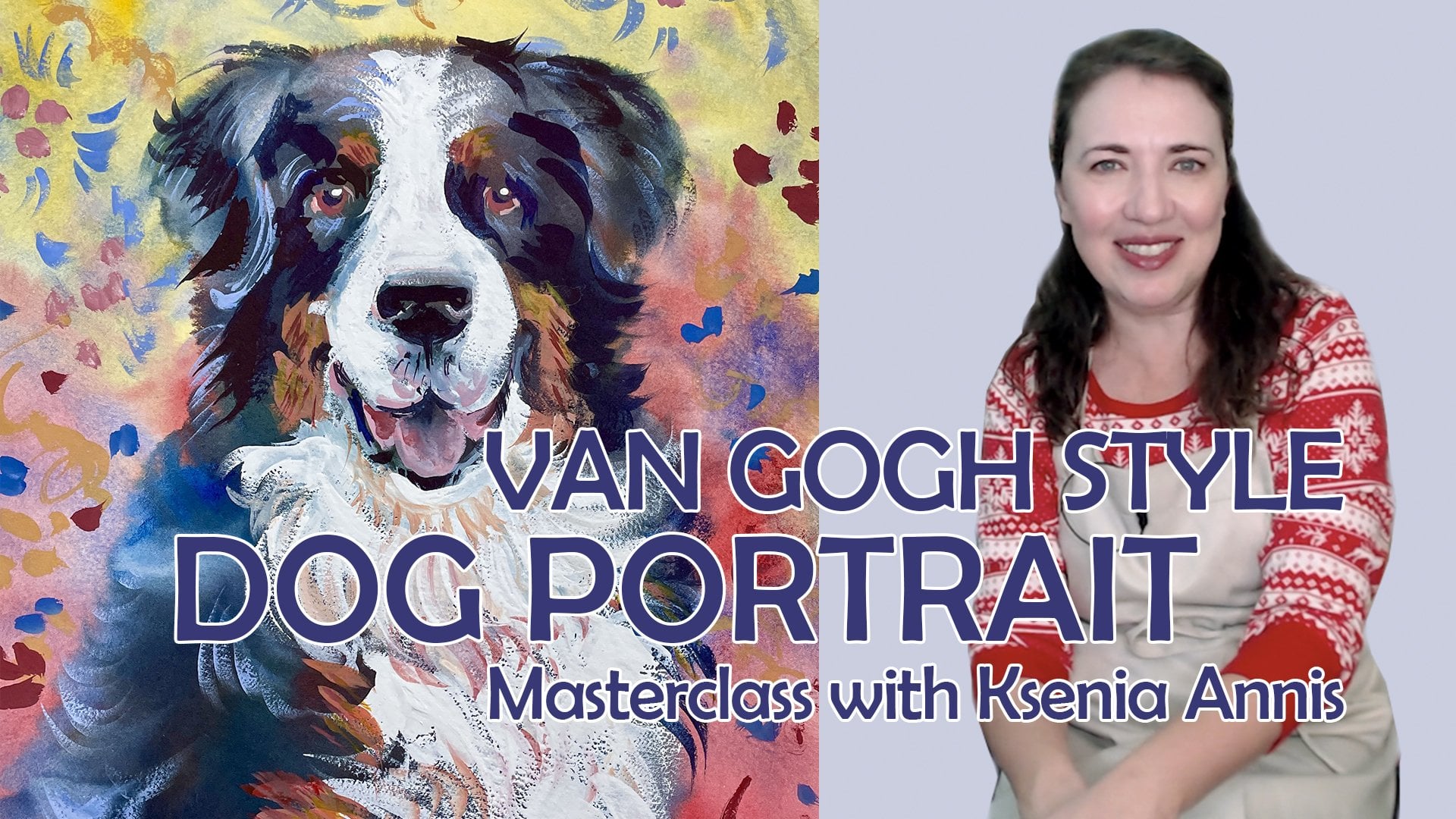
1. Painterly Pet Portraits Intro: Hello, fellow animal lover. Welcome to the glass painterly pet portrait. In this class, we will learn how to paint paths or just favorite animals in general with watercolor on paper. This class, however, will not be about rendering the realistic for and hair and painting every whisker on an animal. We will talk about that 11 but mostly we will talk about the sense of mixing colors, also known as college here. For artists, we will attempt expand our palate beyond realistic colors of nature to random. Or, as I like to call the fantasy collars. The painting techniques will be very loose and expressive. Using primary colors and shades close to them on the color wheel, I will paint wide, brown, grey and even black foreign skin. The goal will be to create vivid, luminous portrait's that reflect the joy and happiness that our four legged friends bring to. Our lives also included some exercises that will help you to achieve the same or even better results with your paintings, and I will hope that after you practice you will post one of them in the project section of this class. Let's get started
2. Expanding Your Color Palette: Hello. Welcome to Painterly Pet. Portrait's in this class will be painting with watercolors. The ability of this medium toe let the white off the page. Xiang, through its unique luminosity, makes it, in my opinion, perfect medium for conveying the softness, warmth and kidneys of animals. When we think about painting animals, the calls that come to mind are tan, brown, grey, black and white. If we disregard colorful creatures like birds and reptiles for mammals, nature prefers to use neutral or see tones, which are obviously essential. If you're trying to blend with their surroundings, this Earth stone palate can off pours be used very successfully for multitude of subjects. In here, you see a few examples of my landscapes and figurative paintings. I also initially painted the German shepherd pop him in the same, so to say, traditional style. I try to match the colors that I see in. The reference photo is exactly as I could, and so a pretty much had to use limited palette of earth tones. What if I wanted to create a realistic three dimensional painting, but with so to say, unrealistic colors can expand my palate beyond okra, burnt sienna burnt umber paint spray and that some from yellows, oranges, pinks, enemy use, blues, greens and purples For my cooler shades. Let's put our fantasy palate to the test and pain the same subject, but with brighter colors. Start. I will sketch out my subject on my piece of watercolor paper. Come using the to be regular pencil. My lines are very light. You can hardly see them on this video, but I don't want them to be heavy because they will show up under the water cooler and they're almost impossible to erase afterwards. Besides, the sketch in your subject you can use are the methods of transferring your reference photo . On paper. You can use carbon paper and just transfer the outlines. You can simply rob some graphite on the backside of the reference photo and then transferred that way. Keep your peepers not so sick. You can place your what a call sheet on top of the reference photo and hold it against the window against the light and transfer it. If you have a light box that will work to or you can even use a projector if it's larger format. So whatever works for you working on arches £300 watercolor paper picking up the excess graphite with my dry cleaning pad. It's filled with rubbish shadings that's with them off and let's start painting. I don't want to start with Hard Ages because I'm painting. First. I'm going to spray my sheet of paper from my spray bottle. So we decided to replace yellow over with some right, a yellow I'm using. Call a cold new combos. So let's apply that to all those Dan areas and just for the right here. Let's throw in some permanent orange. It's a very light orange color and a little bit of rose matter, just for interest I see inside her ears. It's great, but we can push it towards purple. So, using a bit of Kabul instead of black on her muzzle, I want to use pressure in blue, very invincible color. And because I started on the wet background and painting wet on wet colors are starting to run and mixed with each other. It's a very exciting what a color effect, which I love. I'm going to control it a certain extent by drying my brush on a piece of paper cowl and then picking up excess water. But in general I want to just let them float and do their own thing and not to control them too much. And the same goes for spluttering. If if some color flies off my brush, that's fine. It can be just incorporated into the background of the painting, and I kept going down the dog's body, applying my colors. Let's switch to mineral violet just for interest for her back, and you will notice the rule of thumb is basically to distribute your colors. So I picked several bright colors, but I'm not applying them one in one spot in another one and another spot, I'm distributing them all over my painting all over my daughter, and wildest first call application is still wet. Let's intensify some colors, couple very important points that I would like to stress to keep your colors really bright and pure. It's very important, but wash your brush after each call application. I always have to water containers. One needs to be a pretty large for washing your brush after each color, and the other one is clean water that I would use only with a clean brush. When I need to soften edges or lift some color, and that water stays clean and also after application of each layer while it dries, I go and dump by water and get some clean water. And that's how you also keep your colors luminous and clear in your avoid mud that all the water called artists dreads, and this is our first later Let's let it dry as you probably know what a color. When it dries, it becomes a least two shades lighter. So all my bright colors that I was applying when they were wet they were Saloum, Innis and shiny. But now they are a lot more muted. So what I'm going to do with the second layer, I'm going to intensify all the colors, but not everywhere, just in darker areas. And I can see those darker areas especially well if I squint when I'm looking at my reference photo. So what I'm doing here I am building my tonal relationships. I painted my light areas, and now I'm painting my mid told areas, and in the next video we'll talk a little more about the extreme importance off tonal relationships and painting, and I want to stress it one more time that I am sticking toe my bright, colorful palette. I am not adding any black. I'm not using any grace or neutral colors. I'm using the same colors I used for the first layer. I'm just picking up more pigment and applying it to Dr Areas in them on purpose, not focusing your attention on the exact pigments that I'm using because this is a fantasy palace, so it will be individual for each artist. I like this colors you might live toe different ones. What's most important here is, first of all, that you don't have to use the college that you see in the reference photos, and you don't need browns and grays to create three dimensional realistic effect in your painting. - And as you can see, my dog portrait, even though it's not painted with brown and black but with my rainbow palette starts to actually look three dimensions. So I am capturing volume. I'm capturing light and shadow, and an amenity will see that I will be adding some depth of space filled. This painting is so let's use some of this Kabul toilet to give the dog cast shadow that will help to create the illusion of space on the flood sheet of paper and maybe throw in a few sunny greens and yellows to create a feeling of sunlight in the distance. E. I started it in the background before my second late right? Some getting notice friends, but it's actually good. That helps to create the illusion of for of doll being fluffy. And it's also makes watercolor loose and expressive. Let's let this layer dry and see if we need to do anything else. When you work on the peace, especially with water color, it's good to stop and step back and evaluate what you have so far because we always want to prove things. And sometimes those improvements turned against us and ruin the painting. So I'm going to stop for a second and look at my painting, and I'm going to ask myself a question. Do I have the range from lighter slides through Midtown's darkest darks? And I can see that I can dark on some areas, so I'm going to make some intense colors. Oppression bloom, fellow green and magenta that will create an intense dark color enough I'm going to apply to those areas. These are what we call stating colors, and we will talk about them later in this class in the background to can use a little more cooler, a little more texture. So maybe some splattering with my brush on spraying with my spray bottle to soften color. And I think that's it for the darker darks. Let's let it dry. And again I'm going to stand back and ask myself a question. Do I have the tonal range? And I can see that because I didn't use masking. I didn't preserve white paper in the areas where I need highlights, but those highlights are very easy to add with a bit of white wash. So that's what I'm going to do with a small brush. And now the Benten is rooted done. Here is the final result in In the next video, we'll show you a couple more methods. You can verify your tunnel range when working from a reference photo, and we will talk about how we can practice successfully pink with these unrealistic fun colors.
3. Checking the Tonal Range: is with self from the demo in video one the illusion of light volume and space. And the painting is created by varying the tone from light to dark, and not by copying the colors of nature so we can create a realistic painting, even using unrealistic colors. The ones we don't see in our reference in the demo was just visually evaluating my tonal range by squinting and looking at the reference photo. But there are the message to do it. We can convert our reference an hour painting into grayscale and look at them side by side . This can be done by making a black and white copy of both. Or, if you have a digital picture, you can open it in photos, app on your phone and go to edit and then fine situation and turned all the way down, and it will be in great scale on your computer. Any photos APP will have edit, and there will be filters you will have left and white filter. There is some free software online, like in darkness. He can use it for some simple image processing and turned down situation. And, of course, if you have a dog before the shop. You go to image adjustments and Goto Hewitt situation and turn the situation all the way down. Another good tool is a viewfinder of U Catcher A. Some manufacturers call it. It's a little plastic frame that landscape artists used to select their composition. You can hold it over the reference and then over the same point on your painting, and that will help you toe isolate that particular spot, and you can see tunnel range without seeing the actual color so much. Or you can even make your own. Take a piece of cardboard and cut out a square hole and use that little frame to check your tunnel value at a certain point of your painting. If you would like to practice using fantasy colors in your painting and not happy in the reference, exactly the good exercise would be to paint from a grayscale funnel. Just use your favorite colors and see if you can get the tonal relationships right. And if you can get a realistic feel to the painting, take a photo off the final result with a phone and turned down the situation and compare both in grayscale and ask yourself what needs to be lighter and what needs to be darker and either finish this cage, rework the sketch or painting you want. It's a great exercise, and it will really train your eye to see those tonal relationships that are so important. And here are a few more examples of our work that I did. Here is a fig. Let that I painted with rainbow colors, and if you look at it and great scale, you will see that I could have done a little better job on his forehand. It's a little too dark, but otherwise my tonal relationships are pretty on. Flint and I just love this reference photo off the horse with its hair being blown by the wind that founded on fix a Base or painted her with my favorite things and purples. Well, I assume it's hurt, and in grayscale, the horse itself looks pretty close to the painting. I could have made the blanket a little doctor, and the background could have been darker, but background. You know, it's kind of optional. It's your decision what it's going to be. And I wanted to mention also that you don't really have to use every color on your palette to paint something for this donkey. I only used four colors to warm one's and too cool ones, not counting couple of greens and blues for the background, but don't you? Itself is only painted with permanent orange, scarlet, lake, ultramarine blue and mineral Violet and I was still able to achieve a pretty colorful result. In the next video, we will talk about fainting black with various colors which will give us reach very sharks without using any black pigment.
4. Understanding Animal Faces: In this lesson, let's talk in more detail about animal faces, in particular, about
eyes and noses. Eyes and mammals are
similar to humans in the sense that they
basically a sphere and eyeball. And they will have the
white of the eye and they will have the colored
irises, different colors, and they will have a pupil, and the shape of
the pupil will be very different depending
on the animal. Dogs have round pupils. Cats have very
characteristic pupils that are a sarco when
they're dilated. And then as they contract, they turn into those vertical
slits that we all know. The hoofed animals like
horses, sheep, goats, donkeys have elongated pupils that increases their
field of vision, keeping them safe
from predators. But I think the most
important thing to understand would be how those eyes are set in the head and also how the
light works on that form. So let's take a look at
the dog's eyes first. So if we start with a
sphere with an eyeball, there will be an iris
it and there will be a pupil in the
center of the iris and part of the eyeball
will be covered by eyelids. There will be upper
eyelid, lower eyelid, and dogs and cats actually have a third eyelid here
in the corner of the eye that allows them to moisten their eyes
without closing them. So this is the overall
general structure of the dog's eye. I'm going to use a sharpie to
highlight a little better. So you can see the
most important thing here is to carefully observe the light and shadow
on the eyeball and not to draw
continuous black lines. I know the edges of the eyelid on the dogs are usually black, but because they're moist and the light will be bouncing
off of them differently, we will not see a
continuous line. So if we think about how light usually
placed on a sphere, the light is coming
from this direction. There will be a core shadow on the side opposite
to the light source, like on any geometric object, they will be also a cast shadow. The eyelid will most likely
cast a shadow on the eyeball. So this will be all dark and
the pupil will be of course, dark because it's black. But because the eyes are moist, they will be very
pronounced highlight on the eyeball and
especially on the pupil, it will be very noticeable
and these are usually the brightest highlights
on the animal. Now let's talk about cats eyes. Again. There's fierce
set into the head, partially covered by eyelids. Cats have very
characteristic shape to the opening of the eyelids. It's a little bit slanted. The cat's eye will be
a nose here somewhere. Cats have very characteristic
pupils will be vertical. If we add some darker, darks, there will be, the pupils will be black with
highlights in them. The eyelids will be darker, but again, not a
continuous line. The light will bounce off
of them in some spots. And the third eyelid will be here in the corner somewhere. And then the central
part of the eye will be the color of the iris gets have all kinds of different
colors in their eyes. Green, yellow, blue,
and the upper lid will cast a shadow
on the eyeball. So there will be a shadow here somewhere and
we will draw it following the
principle of drawing a shadow on a spherical object. And of course there will be
some modeling on the face. We'll talk about phases in
more detail in just a second. So it's important to set those eyeballs into
the head correctly, not make them bulge because
they will be set in a little bit while some dogs
have pretty bulging eyes, but still part of the eyeball will be
covered by the eyelids. Also, when you start
working on the shadows, just observe carefully where
the light is coming from and where the shadows are
and add the highlight last, let's summarize
the ice structure with a little schematic. So we have an eyeball, will have an upper lid, will have a lower lid, will have the third
lid for cats and dogs. Here in the corner that
we can barely see. We might see a little bit
of the white of the eye, but most likely we will just see the iris that will
be certain color. And we will see that the pupil
in the center of the eye, it will be black
and it will have a characteristic shape
depending on the animal. So the upper lid cast a shadow on the eyeball
and the eyeball itself will most likely
have a little bit of a core shadow if the light
is coming from this side. So there will be a little bit
of tonal variation here in the eyeball and there will be a highlight on the most
prominent part of it. If we talk about colors. So the iris will have a
certain color in the light. It will have a cooler color or a deeper tone in
the core shadow, and this is the highlight. Now let's talk about noses. If we simplify a dog's nose. It's not flat, it will
resemble a little box, the overall shape of it. And the lips will be
down here somewhere. Course the winners
will be more rounded and the nostrils will be
here on the front surface. If you look at a photo
of a dog's nose. So maybe you have a model in front of you
that you can study. The nostrils have very
characteristic shape, the round on the front surface
and then they kind of turn the corner and there is a little like a solid go into this side. There's also a little
groove in the center. And the results of
that bottom surface then joins the
nostril on the side. That's the shiny part
of the dog's nose. So if we think about
light and shadow, if the light is coming
from up here somewhere, the front surface
will be in Midtown. There will be very
light tone there, and the side will
be in core shadow, so it will be darker. So it's not going to be
all uniformly black. There will be some tonal
variation on the nose. If you'll be able to
capture that or not, of course will depend on
the size of your painting. The nostrils will
be in cast shadow. There will be the darkest, and there's usually a highlight
where the form turns. So if the nose is black, so this top surface, it's not going to be
exactly the lightest. It will have a little
bit of tone and then the tone will intensify on the front surface
and on the side. And on the edge there
will be a highlight. So this is basically
midtone and this is the core shadow and cast
shadow is inside the nostrils. This is my light source. Of course, the diagnosis and not exactly all
shaped like this. You will have to
look at your model, look at the reference photo. Some dogs have more
elongated noses. They're kind of more pointed, so they will look
something like this. They can also be
different colors. Some have brown, a pink noses, so you'll have to figure that out depending on your model. And some dogs have flat faces. If we think about, let's say a pugs knows, we're picky knees or
something like that. They have very small
upper surface and the front of the nose
is tilted upwards. That middle tone
will be very light. It will be basically
the nose will be in the light only the site
will be in shadow, and the nostrils will
be in cast shadow. So careful observation,
as always, when we paint, is very important for
realistic representation. Gets noticed are
a little simpler. They basically triangle
and they basically flat. So it's one surface with
the nostrils on it. They do have a little
groove in the centers. So these are the nostrils. There's just a slight
curve to them. So the upper portion of the cat's nose will be a little bit lighter
than the bottom, but it's very subtle. So if you're painting small, you probably won't even
see that variation. So this is mid tone. This will just assume
this is light. There will be a little bit of a highlight right there
on the edge where the form turns and this
will be cast shadow. So the form is a
lot more simple. Ellipse are down here somewhere
and there will be the, the muzzle, the cheek. So the cat also wanted
to draw attention to the overall structure
of cats and dogs faces or the animals will
be similar of course. But since cats and dogs are
the most popular subjects, I know that sometimes
artists struggle with showing the
three dimensionality of their faces correctly. So here's what we
need to keep in mind when we draw and paint
our furry friends. If we look at a dog space
is basically two spheres. So this is, this called the main portion of it and the nose, the muscle itself is
kind of coming forward. There will be the
nose, the lips here, and the eyes are set at the intersection of that
smallest fear that's in front. And the biggest fear
that's the main shape of the head and the ears will be
here on the side somewhere. If I draw in the features, this will be my nose on the most prominent
part of that muscle. Of course, it will be longer or shorter depending on
the breed of the dog. There will be the mouth, the lips here somewhere, and then the eyes
will be on that line somewhere and they will
be set inside the head. This is the central line. Here's my second eye, and then the muscle will
connect to the cheeks and the ears will
overlap somewhere or there will be standing up
or something like that. And if we follow that
general outline, it's much easier to draw the
side of the face when we look at it at three-quarter turn or if it's a frontal view, we will see the other
cheek, of course. So all this will be
in core shadow if the light is coming from
the left side, let's say. But it's important to have
that muscle with the noses and the lips are to come forward and not give
the dog a flat face. And let's also look at the cats. It will be the same principle,
basically two circles. On the smallest circle will
have the nose and the lips. Everything is a lot smaller. The cats have a lot
more delicate faces. The eyes will be
set somewhere at the intersection of
those two shapes. There will be those
big, pointy ears. And this will be the cheeks. The other cheek
is foreshortened, but it's still will
be there somewhere. In the neck will be
attached here somewhere. Sometimes it's
hard to see behind all the fluff, the
actual structure. But if we have an understanding of how
to simplify the form, we should have no problem. So this is our
triangle of the nose. The lips are underneath. So this is the
protruding portion. That's where the
whiskers are, right? And the nose, the main
structure of the nose will be slanting backwards
towards that bigger shape. Here are the eyes, and here is the forehead
and the cheeks. So it's not all flat shape, it has a very
distinctive profile. It's two shapes intersecting
with each other. The central line. So here are the ears and here
is the cheek and the neck. This is a sloping surface. And also this is a curve rides, it goes back away from us. So if we look at the shadow, this will be in core shadow and there will
be a core shadow kind of separate core shadow
on the muscle itself because it's
not one flat shape. Mcat looks grumpy, but that's
the way cats are sometimes. So this is all in shadow. If we look at our
longer faced friends, like horses, sheep and goats, it will still be
the same principle. This simplified form
will be a couple of circles connected
with each other. Alright, I hope now you have a better understanding of the overall structure
of the animal faces. And let's move on to painting.
5. Mixing Luminous Black: their quota. Call pigments like ever black and CPS, can sometimes end up looking a little bit dull in a paper on paper, they also have a warm atone, So to pull them and make them recede into the background, they have to be mixed with something else with another cold pigment. So to stay true to my fantasy color technique, I paint my blacks by mixing three staining colors and staying in pigments are the ones that are hard or impossible to lift after you apply them to paper, as you see here in the reason I use those pigments is because they create darker, deeper colors on paper is we know from college theory. Black is the color we get by mixing three primary covers or colors that are close on the color wheel to yellow, blue and red, and also control in the amount of water is very helpful. You'll need a lot of pigment, obviously for colored to be dark, because water, the suits, the pigment and this can be achieved by using a fled Russia instead of around fresh. To find the combination I want, I test my pigments before painting. You see the names on the screen. But really, you can just use whatever you have and see which ones will give you the darkest color that your life and that will be suitable for your subject matter. The first combat going to test is actually only took pigments, but Scarlet Lake is an orangey red color, so it already has yellow and red in it, and I'm mixing it with callable. So I have my three primary colors. And for the second combo, let's try my three favorite staining mineral colors mineral violets, fellow green and magenta and see what we get here and here. You see those test combos? When the drive I'm going to go with Number one, Let's put it to the test by painting one of my all time favorite subjects. Black. There's my reference bottom. I found Olympics Obey. This whole painting will be done very quickly, wet on wet. So I'm going to start by spraying my paper with some water from my spray bottle. I'm going to start with one of those pigments I selected started Lake, and I will drop it on this areas where I see very warm areas on the reference photo from the cats, deer on. Later, on chest and on some areas, I'm going to drop some trouble. Blue and the couple purple contrast them with all those warm colors. But again, the exact figment doesn't matter that much. What matters is having like midtown dark colors. So I'm studying the light. Bring. I'm going to build the tone, as I do like to have a whole the right of colors and the painting. I just think it looks better. Some amusing, probable public purple and yellow on pace on buying Scarlet Lake, where I see those really warm colors on the cats. Coat way. Great thing about this technique. You don't have to apply the exact color. You don't need to mix the exact color on your palate. You drop in the colors, and by mixing and dragging them on your painting, you can adjust the tone. Or you can adjust color like I'm doing right now and you see that star. But Lakers get neutralized by fellow fluid, and I'm getting those dark polish that I was looking for, so I'm starting to move from light to dark. I want to have soft changes, Candace, so working with on wet with video sped up. But we still working pretty quickly if I let the paint dry, can still correct the color with further transparent layers over a different color. But that's not my team won. Colors mix on paper while they're still wet. That's why we're quick as you can see him using your flat brush for my doctor colors because it holds a lot of paint and less. It's also great for showing texture. Extra firm. 11 cats I Wife looks a little spooky, but I don't want my dark pigments to float into the eye area. I want the light to the green yellow color that the cat has. I'm avoiding that there, and I really should rinse the brush after each color application. But sometimes I get carried away and you see that I dropped Some blew into my scarlet lake Well, but it's OK. Take that up with next little clean might my segment again gradually darkening, gradually building a players more and more pigment and you see that the right inside of the cat's face our right gets darker and darker, and it doesn't liar the look of black for even though and never used given drop off and mineral violet is a great color toe. Add toe dark areas. It deepens them even more so After my mixture is in place, I like to drop a little bit of mineral violet in the darkest theories. Too deep. Look carefully at the reference photo. You see that the cats mass and chin they have a lot of reflected light, so I want to keep that. So if my color floats over there, I picked it up with a brush, and the cat is pretty much done. Let's put in some background for being back off. The cat is further away from us than the face someone to have a soft edge between the cat back on the background. So you see, I'm late in some call flow into the background to make it song That gives us the illusion of the depths of space on Fletcher. All my favorite, but sales are going on. The background talk was cobbled purple yellow. I just wanted to be very colorful, as a contrast to the blood I feel like in even the shadows is you know what color when it dries, it lightens so I can drop in more segments and make those blacks and verify my drawing at some details of the stage. It all goes pretty fast. My cat is still let you can see a little bit of shine off water, which there on the year they're important to have an accurate drawing. But this gauge rubbed some charcoal on the backside of my reference photo and transported on the water pulp paper to have very criticize drawing on this can. Okay, I can stand to work on the eyes, bliss key allies. And there's a easy just dropping Cem yellow and some blue, and when they mix, it creates that green variation off call around the pupil. Dry a little bit while I deepen the shadows of one more a mixture of scarlet lake and scalable. Oh, I just use a small brush to drug pupils of the eyes. Okay, we can leave our watercolor at that, but I like to add just a few small details with wash, which would be especially appropriate for this painting. You see in the photo the cat's whiskers, a white drug. Those give him some highlights in the eye. Some of those small white hairs who has here and there. So she I don't know. I mean and just put a few finishing touches with blush. And here's a black cat painted by mixing complementary colors. Director on paper, without using any black pigments.
6. Painting Colorful Grays: the way. In the previous video, we talked about mixing stain impediments to achieve the illusion off black paint gray as the object color or as a shadow on a white animal, and we see a lot of whites and grays and the animal kingdom. We will use our fantasy palette again, but with much larger and a lot more diluted pigments again. Of course, you can use Payne's gray or some other dark pigments, but in my opinion, mixing various colors on paper for shadows gives us a look more colorful and exciting results. Gray as black is a neutral color, so touch of grey. When you mix two complementary colors from the opposite side of the call, we will need the first faint little swatch like I'm doing now. I'm going to try lemon yellow to begin with. If you have those pigments, feel free to try the same combination, but you obviously don't have to. You can find your role in colors from what you have already. I'm using ultramarine purple to neutralize my yellow for policy, a complement of yellow and let's also test Windsor yellow deep and permanent four inch a little deeper colors, not bad, especially if I throw in some ultramarine blue as well and deep yellow with kobold. Purple gives me kind of a brown color, but that can be used somewhere as well. I'll keep that in mind. And then how about permanent orange with cobbled that creates very nice, cool gray color as well? What else can we try? I have other pink favorite. Maybe throw in some turquoise green who are cascade green will neutralize Niskala, but maybe a bit too purple now that we know which colors. When mixed, give us a neutral gray shade. We can try painting this white goat without using any black of great pigments, but using the combination of colors that we select for this technique, it is very important to start with a wet sheet of paper song going to use my spray bottle. And I also have a big round brush that holds a lot of water because I don't want the color to sink in now on the colors to stay on the surface of my paper and mixed together will be testing them on the palate to make sure they're not too dark. But I will not be mixing them on the palate. It will be changing the composition just a little bit. The reference photo is very crop, so I'll try to fit the goat. So that, both warns, is showing. So, as you see, I'm dropping in my permanent orange and I'm immediately neutralizing it with ultramarine violet. This technique allows me to vary the amount of figment that I put him so I can actually make my shadows cooler. And if I need a warmer area, let's say the nose and mouth off the goat. I can actually leave with warm of very easy limb dropping in other colors as well. Some cobbled blue, some mineral violet and turquoise in the cooler shadows. Those spots on goats forehead can be darker, so a little more pigment and when prominent oranges will most saturated when neutralized, it will give me a warm a shade when mixed with ultramarine violet, some kind of playing on that. And again, I'm using very diluted pigment with quite a bit of water, because again, when you to think about those Donald relationship so the gold needs to be like so now it's kind of blends with the background. But once I build up those tunnel relationships. The goat will really pop off the page. - I think it This is our first Later when you let a drawing. Not that my first layer is in. I want to put in the background. So, like I said, it will make it easier for me to see those tonal relationships. I will not be comparing my goto. A white page will have a medium or dark tone to compare it to. I want saturated color. So as we know, flood brush works much better than the round. One less water, more pigment. And again I will be mixing my colors all in paper, not on the palate. And there's a completely product of my imagination. I didn't want this yellow background that the photo hair, so I'm using ultramarine blue. I think it's ultramarine blue light cascade green, my mineral violet, all dark, saturated colors that will push my background to the back. And it will allow me to have high contrast between my wife goat and my background. Maybe throw in some winter yellow deep. The little green won't hurt like some vegetation in the background, and you can already see that the go to starting to come forward. Even at this stage, the goat is fuzzy, so I don't want sharp pages everywhere. I'm going to soften the age where the goats back mitts the background, and I'm going to apply a little bit of texture there to show the hairs. There's also dark spot on the back, so Oneto hinted that maybe soften some of the ages as well. With a smaller brush, the goat does not cut out of paper and paste it on the background. It's a rounded object, so some of the edges need to be soft. Okay, and let's start working on the goat's face here, my mixture of permanent orange in mineral violet that gives me a warm a brown shade is coming into play. The one I found when I was painting that was called Swatches. You can keeping some pages heart and some edges. I'm softening. Want to have a variety? OK, now it's time to start building our darks. I switch the round brush again. It's a changes brush, which I love to use. It's very pointy, and I'm going toe work on the details on the goat for darks of going to my previous combo abstaining. Pigments mineral violet tell a grim, gradually darkening certain areas. We're looking at the reference photo and school intense slightly to avoid seeing too many details. - And as the darker tones come in, some shadows start looking to light, so I'll dark on them as well. So, basically working with only three pigments orange, purple and blue, I get an infinite variety off color, and I can achieve a wide variation of tone. And even though I'm not taking color information from our reference photo, I don't follow it for tonal relationships. So it's extremely important. The constantly look at the reference and evaluate what you have on paper and what you see there in another very important thing that I need to remind you off I'm preserving somewhere is as white paper. I'm not painting everywhere. It's impossible to get a luminous watercolor without saving white paper, so all my washes are constrained to certain areas, and the lightest lights remain This white paper in a little bit. I will be adding some highlights with white wash, but they will only go on certain very small areas. I want the majority of whites to be just paper because because repainting your rights completely with my gosh will never give you the same effect as white paper will. Okay, I'll let this last layer dry. I darken the background even more. That's dry now, too. So now if I look at my goat and evaluate the result, I see that I have some light, some you tones and some darks, but I'm missing. The highlights and a missing texture have some texture, but I can add more who are going to add them with what Bush, as I mentioned, definitely need some in the eyes that looked just like two black holes. The goats code has, although separate hairs that we can see pretty distinctly in the reference photos. I'm going to paint those with my brush. I'm using an angled flat brush, which is excellent for painting for and basically in a texture. So let's pain those and evaluate the results one more time and see if when you do just anything nails there. All right, now that my highlights are in just a few final touches to darken certain spots with my point to brush, I want a lot of contrast on the goat's face, which is the focal point of this painting. And let's take a better look at the final result a white goat painted without using any black or grey pigments.
7. Creating the Illusion of Fur: in this video, let's talk in a little more detail about showing structure of the firm on animals with watercolors. We talked about it previously little bit, but I wanted to draw attention to a couple more very important boils. We can show texture without brushstrokes. I showed you how with round brush and with flat brush, if you much to beat us. But the question is where to place the texture. It needs to be placed not everywhere, because then the painting will be so much the same, you know, and it will kind of become fracture than fall apart. We need to place the texture strategically in certain points. We probably don't want toe over darkens light areas with extra breast strokes. We want toe leave them either. His wife people were just with a white wash and with the the curious with the shadows human . I can't really see a lot of details in the shadows, so those need to be probably very simple and just a flat wash, so the texture will of her where the light meets the dark, I should say the dark wasn't it tone. So as you see on the dog this light area and the mid tone they meet not in a straight line , but with some texture. And that creates the illusion offer. And also this dark area meets the Midtown area with not a bloodline but with some picture that's very easily let us show the texture of the for another trick for showing softness off texture is the outside edge off the subject that we're painting off the angle. And I mentioned in the demos that I start on with paper, so that gives me kind of blurred edge because I don't want the animal TV, you know, cut out and faced it on the background. I wanted to be your first of all fluffy, fuzzy and rounded. And that round shape is created, first of all, with soft edge all around. Did you see here? And also by placing the lights? If we look at this bunny, you will notice that the darkest area does not come up all the way to the age right way, have a little bit lighter area all around him, and then it gets darker further into the four, and that creates a round shape because the light would float over this for and the ages will be live. And on this boat, you concedes especially well. I have this dark shape here, but then I placed a little bit of texture with lighter paint. Read. They read the age and that weeks, this side as well, like here on the face. And that gives me the roundness off the four and also shows the softness off the texture and get this with white wash. Just a reminder to use artists. Wash, which is the same binder, is water color, and it can be mixed with water collar because I didn't want obviously, like stupor bride White collar right here. So I mixed whitewash with a little bit of blue water color and a softened the age with a mixture so considered all of the above, we can conclude that brushwork and in particular texture on the border of light and shadow , aiding thought out highlights not all the same everywhere but again, strategically positioned in certain places and also not painting the animal as a flag, that out figure but painted with soft ages that is using western where technique creates the illusion of her and creates the illusion off the dimensional object that is gives realism to our painting
8. Class Project and Final Words: practice would have learned in this class, start with some exercises that I mentioned throughout the videos. Painting from grayscale Reference is a great exercise for training your eye To replace the calls of nature with their fantasy colors, try experimenting with the pigments that you already have had new ones to expand your palate as well as the mix. Various options for black and gray that will given excellent understanding of the color theory. And you will confident they implemented in your everyday painting practice. Have the complete in the exercises painter, pent or just a favorite animal Post a photo of your artwork in the project section and in the description letter students. Now which fantasy colors you used to create it so they can learn from you as well. If you'd like to see how I paint even more cute animals head over to tender up studios YouTube channel. There you will see me paint these and much, much more. There is a whole playlist, how to draw and paint cute pets tutorials. I hope this videos will be educational and inspiring for you. And don't forget to subscribe to see the new ones in the class materials. I included a list of free image resources as well as the list of my art materials and my favorite watercolors. Please visit them arab dot com to see my art information about all the classes that I teach all the links, the time Europe studios, social media accounts and much more. Thank you so much for taking this class. I hope it will help you to create that art, and I'll see you in the next one.
 Ksenia Annis, Figurative artist