Transcripts
1. Hello Spring!: Spring is the season of
beautiful and bright, sunny days with flowers and
trees blooming all around. And along comes hope
and fresh beginnings. It is a season to feel
motivated, refreshed, and to rekindle the spark in
your soul. Hello, everyone. I'm Esharia, an engineer, a watercolor artist,
and an art instructor. Today I'm back with yet
another beautiful class. In this class, we
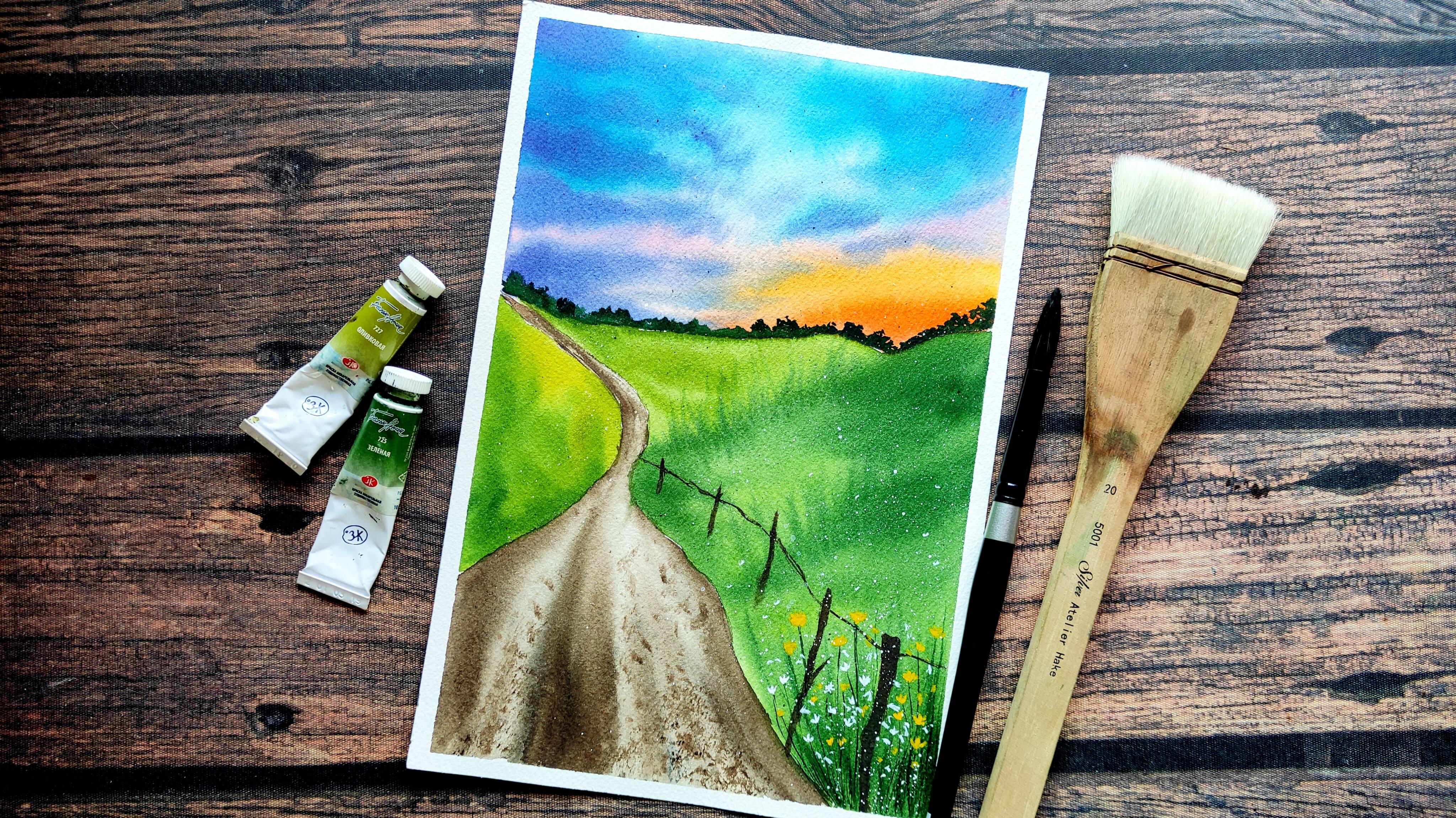
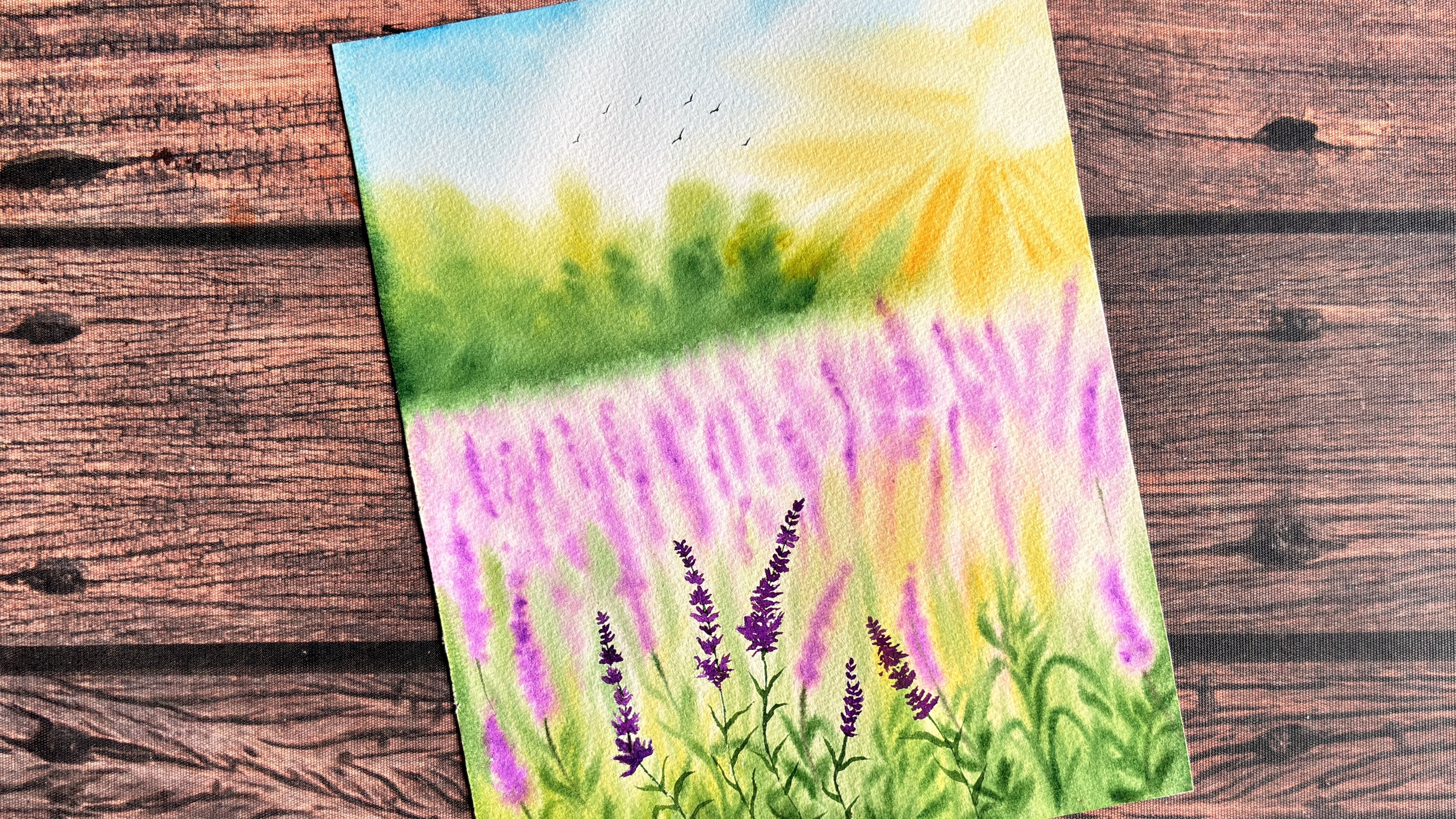
will be painting a beautiful spring
sunset landscape. You will learn how
to create soft, beautiful backgrounds, green landscapes or meadows using the wet on wet technique. You'll also learn how to
add interesting details to make your painting look more
natural and more realistic. What are you waiting for? Go grab your art supplies
and let us get started.
2. Art Supplies: All right, so let us take a look at the art supplies
that you need. First is the paper I'm using, R cheese, which is 300 GSM, 100% cotton, and it is
of 140 LB thickness. And this is a cold pressed paper and it does not have
a lot of texture. You can go with any brand
of watercolor paper, but make sure it is 300 GSM, 100% Next up, let us take
a look at the brushes. You will need a flat brush to apply an even coat of water. This brush is from silver, black velvet and it
is a hake brush. You can go with any
of your flat brush. Next up, you will
need a round brush. A larger size round brush, preferably of size ten or 12. Next up, you will need a
round brush of smaller size, preferably size
number six or eight. Lastly, you will need a detailing brush of
size number two or zero, or you can go with rigger brush. Next up, you will
need some pencil and an eraser for making
the pencil sketch. Next up, you will need colors. Obviously, if you want to look
at the details section of what colors you will require
for this particular class, I have made a detailed section. You can go to that
section and watch out for all the colors and prep your colors before
you begin painting. All right, Next up, you will need two jars of water. One has to stay clean so that you can pick
up fresh paint. And the other is to rinse off all the dirty paint
from your brush. All right, Next up, you will require a white gash. This is basically
to add the flowers. Next you will need
a masking tape, where you're going to tape down the paper onto the
backing board. And you will also
need some tissues or some cotton cloth to
wipe off the water. Lastly, you'll need
a board like this to fix the paper onto the board. Go grab your art supplies and I'll see you soon in
the next section.
3. Colors: All right, so let's
take a look at the colors that you will need
for this particular class. So the first color
that I'm going to be swatching here is
the bright blue. So it's a beautiful shade. You can choose any blue that you want for painting the sky. That's absolutely fine. So you can go with either erlian blue or
any other light blue. Okay, and the next
one is the oilet. The Wilet is from the normal
Indian brand, that is Camel. But if you have any other
volet from any other brand, that, that's completely fine. We just want a little
bit of olet for adding the clouds onto the sky. Next up we have the paints gray. And this is again from
the brand white knights, but you're a free to choose
any other paints gray. Okay, next up we
have cadmium yellow. Yes, this is again a
very beautiful shade. It's opaque yellow. It's not a transparent yellow like how we have Indian yellow, right? That's
really transparent. But this cadmium yellow is
really bold and very opaque. And we're going
to use this again for painting that sunset sky. Next up we have cadmium orange, so this is again, an
opaque kind of orange. So you can go with this or any other orange
that you have got. Next up we have, I think I'm going to be
swatching the greens now. So basically we're going
to paint the meadows. So you will need
different variety of greens like olive green, light green, leaf green. You can choose any
green that you have need not be the same that
I am swatching here. First one I swatched
was olive green. The next one is
the normal green, dark green from white nights. And if you don't have
this particular green, you can go with emerald green. Or you can just simply mix
your green with paints gray and get the different kinds of green. That's
absolutely fine. Your meadow has
to be just green. Doesn't matter which
green you're choosing. Next up I'm going
to use Dk Brown. You can go with any other brown or burn sienna or burnt umber. Okay, that's it for the colors. And get your colors ready. And I'll see you soon
in the next section.
4. Pencil Sketch: All right, so let's start by
adding the pencil sketch. So first we will add a sloping curve
towards the sky line, that is where your horizon ends. From the right hand
side you will have a sloping steeping, curvy meadow. Okay? From the left
hand side I will have another curve which is the left hand side
part of the meadow. Okay? And then from
there we will have a steep narrow pathway which is diminishing towards
the vanishing point. As it gets closer to the
viewer, it gets broadened. Okay? So you can see
this is the pathway. What I suggest is you can wait for me to complete
the entire pencil sketch, and then you can either take the screenshot of
the pencil sketch, which I have prepared, or you can pause the video and then draw a pencil
sketch for yourself. That way it will be easy
for you follow along. And you can also skip this erasing process as
I am doing currently. Okay, wait for me to complete, watch the process and then you
can add the pencil sketch. All right, so this is
the final pencil sketch. So draws, and I'll see you
soon in the next section.
5. Let's paint the sky!: All right, so we are ready
with our paper over here. Now let us start by
painting the sky. So first of all, let us go and apply an even coat of water onto
the entire sky region. So for this purpose, I will be using my flat brush, which is also known
as Hake brush, which is from silver,
black velvet. But it's absolutely
fine for you to choose any flat brush,
or for that matter, if you don't have a flat brush, you can choose a bigger
sized round brush to simply wet the April. All right? So apply an even coat and make sure you do this multiple
number of times. Because we're going to work
on the wet on wet technique. Your paper has to stay wet for
a longer duration of time. All right, so now
I have switched to my size number 12 brush. This is again from the
brand silver black velvet. Yes. So I'm just going to apply the water evenly
and make sure that there are no big puddles so that the paint does not
get collected over there. Make sure there is too much water on the
edges of the masking tape. Make sure to take a
tissue or a paper cloth and remove the excess
amount of water from here. Paper. I keep repeating these things because
these are the small, tiny little things that
make a lot of difference. What happens is if the water
gets collected at the edges, chances are the water may seep into your painting and it
may ruin your painting. You don't want that to
happen, right? Yes. I think the paper is
nicely and evenly wet and we can start painting our beautiful spring sunset sky. So first of all, I will be going with
the cadmium orange. You can see I'm mixing
that on my palette. You can go with any
orange of your choice. You can go with bright orange, orange, any opaque orange
that you have got. Okay, so to make
it more intense, I'm mixing that orange with
a little bit of cadmium red. So to make it a little bit
more dramatic and more bold. Okay, so you can see I am having very little
water on my brush. Or you can see
barely minimum water because already there is too
much of water on the paper. And if you have too much
water on your brush, then your paint
will start flowing uncontrollably and you would not be able to
control the strokes. So for that sake, you need to gauge the amount of water on your paper and the amount of water
on your brush, and this all comes
just by practice. Okay? So if you have a lot
of water on your brush, make shawl to hold a
tissue or a cloth in your hand so that you can dab
the excess amount of water. All right. Long story short, next color is the
cadmium yellow. So you can see right where I
stopped adding the orange, I have started to add
the cadmium yellow. As you can see, it is a very nice, brilliant, opaque yellow. You can choose any yellow
that you have got. Now on top of that
cadmium yellow, I will be adding a
little bit of crimson. Crimson is a very bright,
pinkish, reddish color. We don't want it to be too dark, I just want a mild, soft pink into the sky. So I'm just taking
a little bit of that crimson and adding it to the central portion and towards the left hand
side of the paper. Now all you're going
to do is blend those colors well so that
it doesn't look uneven. Blend it well and make sure your sky is looking
nice and pretty. At this moment,
just don't bother, just keep adding the colors. At the end, we will add clouds
and adjust those things. Okay, So now onto the top layer, I have started
adding bright blue. You can see I use
this bright blue from white nights for almost all
the landscape paintings, especially for painting the sky, because this blue just
stands out and it makes your sky soft,
subtle yet dramatic. So if you don't
have bright blue, you can choose
Erlian blue or you can go with any other
blue that you have got. Just make sure you apply it nicely and brightly and boldly. Okay. Yeah. Now you can see I'm applying it in the form
of strokes at an angle. And while I'm applying, I'm not just applying as a flat wash. You can see
I'm just rotating my brush, creating those small cloud like structures and holding
my brush at an angle. Make sure you don't go
with a flat wash. Just give some structure and shape
and create those clouds. Don't go with one
single tonal value. Make sure you go with
different tonal values. Like you can see
here in the middle. I have left some space and at the sides I'm having a
little bit of denser clouds. Now you can see I'm adjusting
the amount of crimson and I'm layering that
with the Erlian blue, the bright blue that
I have added earlier. All right. I'm going to keep adding these colors until
I'm completely satisfied. If you're already satisfied, then you can just wait and watch me and you can
follow the next step. Now the next step is
to add the volet. The volet is from
the brand camel. Obviously, you can choose
any volet you have got. It's up to you now. I have chosen volet
to add those deeper, denser clouds onto the sky. Right where I have stopped
adding the erlian blue, I'm focusing on majorly on the bottom region where we added the orange and the yellow. I want to add that ilet onto the sky and create
some clouds again. I'm adding it in
the form of strokes and there is very less
water onto my brush, and that is the reason
the paint is not flowing. And I'm able to
control the strokes, so this is a very
important step. If you're not confident, please practice it on a scrap piece of paper and then you can try it on
the main painting, Okay, So just create
some clouds with violet and this is how the sky
is looking at the moment. I'm extremely happy the
way it has turned out. I think we need to
add a little bit of more clouds and make it a
little bit more dramatic. To make it more dramatic, all you have to do is grab more paint and less water
and keep adding it. Also, one more thing to make sure is make sure
your paper is wet. If your paper has
started to dry, then please do not
perform this step. Wait for the paper to
dry completely and then all you have to do is
apply an even coat of water. I mean re wet the paper
and start painting again. Okay? All right. So now I'm satisfied with how
the sky is looking now let us wait for this to dry completely and I'll see you
soon in the next section.
6. Painting the bushes: Okay, so now that our sky
has dried completely, let us add some
small bushes or some far away trees in the background towards
the horizon line. For this purpose,
I'm switching to my size number six brush and I'm picking up the color dark green
from white nights. If you don't have dark green, all you can do is you
can mix your green with paints gray and create
this shade of green. So I'm just adding some irregular branches or bushes onto the
background so you can visualize right when you see a distant mountain or when you see something from
very far away, there are some tiny bushes
that appear, right? So we are going to create
exactly that one over here. Just keep adding these bushes
in a variety of sizes, like at some places these
are a little bit teeny tiny, and at some other places
you can adjust the height and make it more
organic and natural. So I'm just going to go
ahead and keep adding these bushes onto the entire
horizon line. All right. So yes. All right. So I have added the bushes onto the entire horizon line and this is how it has turned out. So you can go ahead and add these bushes and I'll see you soon in the
upcoming section.
7. Painting the meadow: All right, so now let us
begin painting the meadow. We have meadow on either
side, left and right. And first we will be
painting the left side. Take any round size brush, preferably size number
six or size number eight, anything of your choice. And start by wetting the left
hand side of the meadow. Make sure you're wetting it
nicely because we are going to be playing with different
tonal values of green. We want that area
to stay wet for a longer duration
of time in case, even though you forget to wet it for multiple
number of times, that is absolutely fine because you can go
with either wet on wet technique or
you can make use of the wet on dry technique. Okay, so anything is fine. Okay, so let us begin. The first color is olive green. I love olive green in
my green landscapes. It just pops out
and it stands out. So I just like using this color. It doesn't matter
if you don't have olive green, it's
absolutely fine. You can mix a little
bit of yellow with your green and
create this shade. Now you can see right where I stopped adding
the olive green, I am going ahead and applying
a little bit of green. This is the normal dark
green from white nights. And I'm just trying to play
with different tonal values here because I don't want to have that flat look
for my meadow. If you see a meadow, you can see different variety of greens at some
places it is darker, at some places it is lighter. We want to bring that depth, so we're going to play with
different tonal values. It's absolutely fine. You can gather like
just all the greens from your palette and you
can keep adding this. Make sure you mix
colors well into your palette and then you
drop them onto the paper. Otherwise, if you're
going to directly pick up the paint from the
palette and then add it, it may try to create
larger blooms. And once it dries out, right, you'll be able
to see dark patches. So we don't want that to happen. Mix your colors well into your palette and then
blend it onto the paper. All right, so now you
can see at the top. I want the meadow to be a little lighter because
I want to show the sun is hitting the top surface
of the meadow at the bottom, you can see like I have
added the depth. Okay. Now, similarly, we have
finished the left hand side. Now we're going to move
towards the right hand side. Since this is a larger area, I am switching to my size
number 12 brush because I can paint a little bit faster and it holds a lot of water
and a lot of pain. Okay, so choose what is comfortable for you and
then you can start. All right. So I'll quickly go
ahead and wet this region. All right. So now that we have vetted the paper completely, I mean the meadow completely. Now let us start
painting the meadow on the right hand
side starting with olive green again. Okay. Make sure you maintain this tonal value towards
the horizon line. We're going to have lighter
tonal values of green as we progress further
away towards the viewer. We're going to have
that depth and deeper tonal values once you understand display
of colors, right? It's going to be really easy. And then it's all up to you. The magic is in your hands. You can just choose
different kinds of green. Just blend it, add different tonal values need not be the same as I am doing. You can just vary the shades. You can vary the
way you're adding. Maybe in between you can add a little bit grassy
texture so there are a wide variety of things and it just comes with
a lot of practice. All right, so now I'm
picking a little bit of dark green and I will be
adding it in a sloping manner. I want my meadow to look like a sloping valley
you might have seen. I don't know if you have seen
that in the photographs. Right, We have those
sloping valleys. If someone has
visited Switzerland, probably they could
have seen that. But no worries. We can create our own
Switzerland over here in this painting and
enjoy it, isn't it? Yes. Now you can see. I have created that
separation between the top layer and the bottom
layer by adding the green. Similarly, again,
onto the sides, I'm like creating a deeper
tonal value into the between. I have that lighter
shade of olive green. Okay. And yes, not to forget, leaf green is another
important shade which makes your meadows
look more beautiful. So if you have leaf green, you could go with that, but no worries at all. If you don't have it, just
choose whatever colors you have and make your
meadow look green. It's all about green today. Okay. So now you can see I'm increasing the total value of that sloping valley and just trying to create
different shapes. So it's just u, horizontal movement of the
brush like left or right. It's just the strokes, if you are completely new
to water color painting, maybe you could
try these strokes onto a sample piece of paper. But I feel this is
a really beginner friendly and you need not really practice
before starting. You can just add the colors, just make sure your
paper is wet and yeah, you're good to go
Now you can see, I know it's looking weird
at this moment of time, but trust me and
trust the process. Once it's going to dry, it's going to look
absolutely stunning. Okay. So I'll keep
adding the colors, and meanwhile, you can watch
me and then paint it again. Okay. So now we can see I have started to add some
strokes, vertical strokes. I'm trying to create
those grassy blades, you can switch to a
smaller sized brush, preferably size number two. Or if you have a
long rigger brush, you could even use that
because rigger brush gives that nice pointed look
for your grassy blades. If you don't have rigger brush, just go with size number two. Size number one, create
those grassy patterns. You might have seen
grass blades, right? They are always sticking out and they are in different
sizes and different shapes. It's not like perfect
straight line. You're just going to
press the tip of the, as you go upwards, you're just going to
pull the off the paper. Just create those strokes. One tip is just do it very
fast so that you'll get random organic grass
blades. All right? So yeah, I'll just keep adding
this and you can watch me. All right. So now
that we have created some grass blades onto
the bottom region, now we can start creating some grassy patterns
onto those top valleys. Okay. So it's the same procedure.
There's nothing different. So the brush is in your hand and you can choose to paint
it in any way you want. All right, so this is how it is looking at the moment
and as I said, you trust the process and
you'll surely enjoy it. Okay? So I'll see you
soon in the next section.
8. Let's paint the pathway: All right, so now that we
have painted the meadow, now it's time to add
the pathway in between. We have left this
gap for painting the pathway Gently take your brush and start applying an even coat of water
onto the pathway. So make sure when you're
wetting the pathway, the water should not
seep onto the meadow. Okay. Is you're going to get hard edges and
ruin the painting. Just be very careful if you're not comfortable with
larger sized brush. I suggest you to take a smaller sized brush
and wet your paper. All right. So let me
quickly go ahead and wait it. All right. So now that we have completely
wetted the pathway, now let us start adding the
colors for the pathway. Usually the pathway is always the ground which
is brown in color. Mud. Basically, you can choose
any brown of your choice. Basically, instead of
going directly with Brown, you can use brown. Mixing it with paints, gray, create that earthy tone. Okay, It's all about
how you play with the colors I'm using
here, nd ke brown. It's a very good, nice brown
shade from white nights. It's not completely
brown in color. As you can see, it is like a little bit on the earthy side, so you feel that earthy tone. So doesn't matter if you
don't have this nk brown. As I said, choose any brown. Add a little bit
of paints gray to it and yes, you have it there. Okay, so now while painting
the pathway in the middle, we're going to have
the darkest tones and towards the sides
we're going to have the darkest tones
and we're going to leave some white
gaps in between. Okay? Yes. Be very careful and be very gentle while painting
the further pathway, which is that thin
perspective towards the horizon line because
it's a very narrow pathway. Okay. As you get further away, it's a little broadened and
that's easier to paint. Okay. So take your own
time and paint it. So now you can see I want to intensify the color for that. I have taken a
little bit of paints gray and then I added
a little bit of sepia. Just playing with the different tonal values and, you know, it gives a nice organic and
natural looking pathway. All right, so I'm just
intensifying the look. So if you have already added darker tonal value
at the first place, then you need not perform
this step always. There's a rule in painting
when you start painting, don't go with dark values
at the first place. Start with lesser tonal values. And as you progress further, if you feel like it's getting
a little bit lighter, then on top of that you can
add additional tonal values. That way, if you
make any mistake, you can actually go
back and correct. But if you directly
add darker colors, it's very difficult to lift the colors of the
paper. All right? So yes, if you feel like your paint or your brush accidentally touched the meadow, keep a tissue paper
handy and then you can just dab off that
water or the paint. All right. So there's
absolutely nothing to worry. Just guys enjoy the process and that's all I
would like to say. Okay. So I'm just adding dacatonal values onto the
either sides of the pathway. Same colors when K, brown and then mix of paints, gray and sepia. Okay. I'm adding it in the
form of strokes. I'm pulling the
strokes from, down, towards the upwards. Okay. Yes. All right, so now that we
have created our pathway, it is time to add some
splatters or some textures and dry brush patterns to make
your pathway look more realistic and more
natural naturally. When you walk on the muddy
roads, you must have seen. Right? It's not always, even. There are patches,
there are some stones, there are some textures, right? We cannot capture
everything over here. But at least we can try to
make it look a little bit natural by adding some
splatters. It's very simple. Take a little bit
amount of water, mix that with some brown paint, make sure you're not
taking too much amount of water else you'll end up
creating larger blooms. Just dab with another brush or with the help of your finger. You can dab the brush and create these dry brush
patterns or splatters, and make sure you're not splattering over the
sky or the meadow. So to avoid that, you can place a scrap piece of paper
and then gently tap. Okay, So this is how I have
created these splatters. Additionally, you can also
add few dry brush patterns, and it's all up to you how you want to create your own pathway. All right. So, yes. Okay. So I have just kept on
adding these platters and different patterns and
textures onto the pathway to make it look more realistic
and more organic. I'm really loving the look
and feel of this painting. Our painting is finally
taking its shape. So as I mentioned, just trust the process and you see the
results at the end. All right, so now our
pathway is ready. I'll see you soon in
the next section.
9. Painting the fence: All right. So now that we
have added the pathway, now there's time to add
some final details. I thought we can
add a fence onto this pathway or
the meadow to make it look more interesting
and more natural. Okay. Yeah. Let's start
by adding the fence. To add the fence,
I'm using Dak Brown. You can go with any
darker tone like sepia or wink brown mixed
with your paint scrap. It's very easy to
add these fences, but you should always remember
the rule of perspective. The fences that are
away from you, that is, the fences that are
towards the horizon line, they have to be
thinner and shorter. And the fences that
are towards you, that is towards the viewer, they have to be larger
and detailed one. Okay? It's simple. Just remember this rule of perspective and go on
adding the fences. Now you can see the
further away fence is sh, and thin and the second fence
which I'm adding currently, you can see it's a little bigger in size and a little thicker. Okay. So it's easy. You can just watch me and then you can paint for yourself. All right. So now you
can see the fence, which I'm adding right now is closer to the
viewer, correct? So it's a bit more
detailed and more thicker in size and
also larger in size. So now you can see the rule
of perspective over here. Okay? So if all the
fences would be in a straight line and of
the same shape and size, it would look really flat
and boring, correct? So this is how you can make your painting look
more realistic and more beautiful if you pay attention to those
small little details. And trust me guys, these small details
matter a lot, Okay? So yeah, So I feel like
adding few more fences and if you feel like
you want to just stop with three, that's
absolutely fine. But if you want to feel
like you want to add more, then you can paint
along with me. All right. So yes,
let's keep painting. All right. So it
kind of looks good. Now, I think I have left a lot of gap between the
first fence and the second, so I thought of adding another teeny tiny
fence over there. Okay. So yeah, this
completes the whole look. Now we're going to attach
these fences with a string. You must have seen
that string, right? I don't know what material
it is of, exactly. So I'm just calling
it as a string. Hope you guys will
understand it. So it's a very thin,
delicate line. And make sure this line is also not straight. It's crooked. And that is what makes
it look more natural. Okay? Make sure not to
draw thick, bold lines. Otherwise, you're
going to be ruining the rule of perspective. Okay. So make sure you're going with a smaller sized brush to add these details. Yeah. This is how it is looking. I'm just giving that
final touch and to make sure your fences are properly
grounded onto the meadow, Just smudge the bottom
part with your hands. Okay. With your fingers?
Yeah. That's it.
10. Painting flowers: All right, so now we are on to the final stage
of the painting, where we are going to paint
some beautiful flowers. For painting this, you will need some white gash and cadmium
yellow for adding this stem. You will need sap green or any other dark green
that you have got. So I already have some white gauche in my palette and I'm going
to be mixing that. I'm using my size
number two brush. You can go with any
smaller sized brush to add these flowers. All right? So you can see I'm adding
teeny tiny flowers. And you can just randomly go ahead and paint
these flowers. There's no particular
rule as such, and you can paint it with
different variety of colors. So basically you have
a darker background. And on top of that, if you're going
to paint flowers, make sure you're going to mix
a color with white gauche. Suppose you want to
paint red flowers. The red may not be
visible on the green. And to make it a
little bit opaque, you can mix with white
to create a pastel red. So that when you paint it on
top of a darker background, it just stands out. All right, so this is how
we'll be painting the flowers. Now you can see I'm
adding all these flowers with white gauche and I'll
be continuing to do this. All right, so now that we have added some beautiful
white flowers, now it's time to add some flowers in the same
manner using cadmium yellow. Now you can see this cadmium yellow is a very
opaque kind of yellow. You can either mix it with white or you can
directly add it. You can see I'm
directly adding it and it's looking
a little better. But if your yellow is
not as dark as mine, then what you can
do is mix it with a little bit of white go
and then you can add. So it's very easy process. You have to just keep adding random flowers of different
shapes and sizes. Don't add too many
big flowers, okay? Because this is like a
bunch of small flowers. Okay? So if you want to add some grassy blades,
you could do that. If you want to add some red
poppies, you could do that. Or if you want to add
some lavender flowers, you could also do that. So it's all about spring, guys. So it's up to you which flowers you want to add and how
many you want to add, Okay? So don't make it
crowded at one place. Make sure you're covering up the entire space and leaving
some gaps in between. All right? So yes, I'll continue to add
the flowers and you can watch me and then
paint for yourself. All right, so now that we
have added these flowers, now it's time to add the
stem for these flowers now. Again, you need to follow the
rule of perspective here, since your flowers
are very teeny tiny. The stem also should be
very delicate and thin. If you're going to be
drawing thick stems, it's going to really make
your painting look odd. So you need to keep these
things in mind and then paint, okay, so you can barely
see those stems. So you have to just take your thin brush and don't take excess amount
of water or paint. Just a little. And
maybe you can use your detailing brush or your liner brush to make
this thin, delicate stems. Okay, So now to cover
up the bottom region, I'm picking up a
slightly darker green. This is I think, sap green. And I'm just creating some
strokes, light pattern. Okay. So just keep adding this. All right. So now
that we have added those grassy patterns and stem, you can just take a
little bit of white go make it a little
thinner consistency. And then you can add
randomly splatters by simply tapping your
brush with your finger. Or you can use some
other brush to make sure you're not taking
too much amount of water or too much paint else. You'll be splattering
everywhere. And that's not what we want. So make sure you're going with the small and medium
sized splatters, and randomly you can just add a few dots or spots
as you can see here. Okay. And yes, I think that
is it for this painting. I absolutely enjoyed painting this meadow and it's literally giving me
that spring feels. So you're free to choose whatever elements you want
to add into your painting. It's absolutely yours at
the end of the day, okay? So I'm here just to help you
with the tips and tricks and everything about water
colors that you need to know before you start
painting, all right? Okay. So in the next section I'll see you where
I'll be peeling off the masking tape and
I will be ready to show you the entire final
painting. So see you there.
11. Thank you:): All right guys. We
made it to the end. I thank each one of you for making it to the
end of this class. Now it's finally time to
take off the masking tape. So you can see the painting
has completely dried. There is no water or there
is no wet paint on my paper. And now it's safe to remove
the masking tape. All right. So please wait for your paper to dry and then take off
the masking tape. I hope you enjoyed this
class as much as I did. And if you have any queries or any questions that you want to ask me regarding this class, anything about art supplies
or anything for that matter, you can start a discussion
on the discussion section of this particular class and I would be happy to
help you. All right, so there's another
section called project sections where you're free to post your
class projects. And I would be personally
reviewing it and giving you a feedback so that
you can improve your skills for your
future paintings. All right, And please consider leaving a
constructive feedback. This would help me to improve and come up with new
ideas for my new classes, and also my class would be spreading to a larger
number of audience. Please leave a
constructive feedback. All right. Yes guys.
I think that's it. And this is the
beautiful painting that we painted in the class. There you go. All right. I'll see you soon in
the next class. By.
 Aishwarya Shetty, my__paint___story | Watercolour Artist