Transcripts
1. Introduction: Dear friends, I welcome you to another one
of our lessons. Today, we're going to create this simple composition
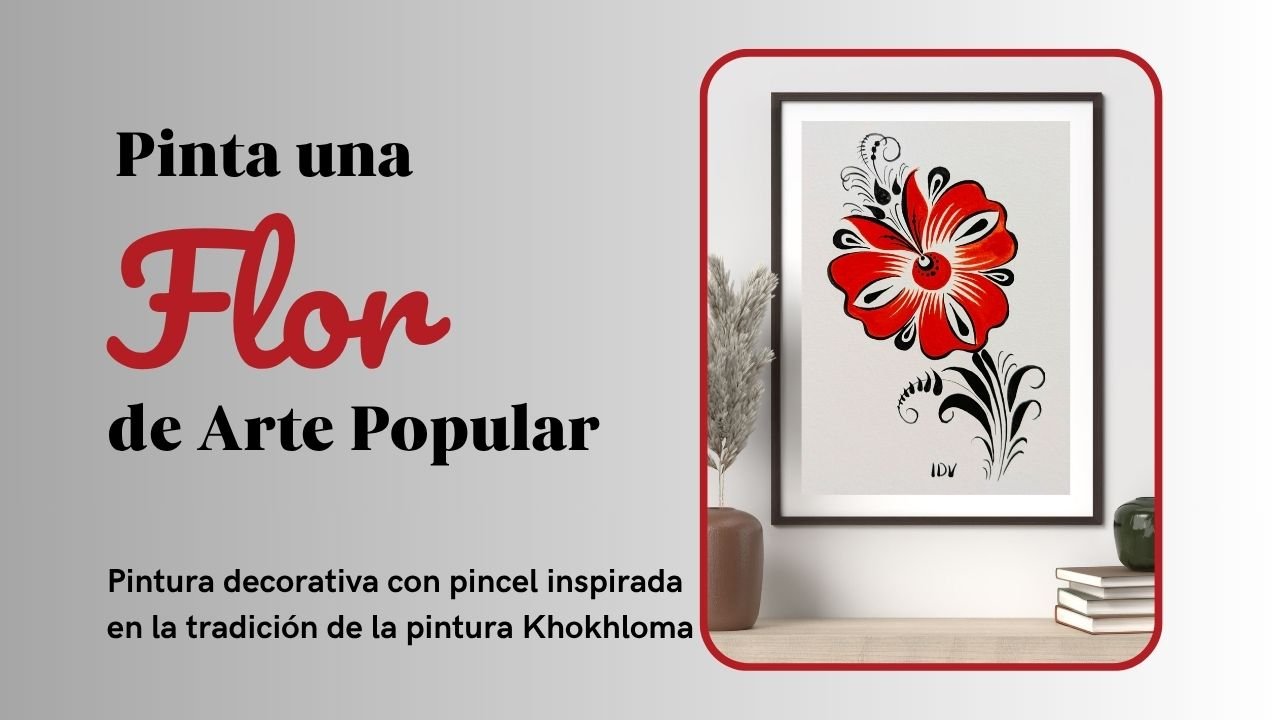
with a flower, which will look great as
part of your home decor. Take a look, for example, at how you can present
this piece and display it either on
a table or on a wall. Black and red graphics look fantastic on a
white background.
2. Materials: For any frame today,
I'll need paper. Again, I've taken half
of an A four sheet. Then we'll need a
squirrel hair brush size two with a fine tip. As usual, we'll be using paints. I'll be using tempera paint. This could be
cadmium red light or cadmium red dark
and a deep black. You can use any kind of paint, squash, acrylic, red or black. It doesn't really
matter. Just use whatever is most
convenient for you. You'll also need a palette, a cup of water, a napkin, and if you need to
do some drafting, a ruler, pencil,
eraser, and a compass. Let's get started.
3. Pencil Sketch: We have half of an A four sheet, just a regular sheet. Again, that's 15 centimeters. Now, from the top edge, we measure 9 centimeters
down so that it's not exactly in the center but a little above the
middle of the sheet. Vertically, we've measured
9 centimeters from the top. Insert the compass needle, set the diameter
to 9 centimeters, so the radius is 4.5. The circle's diameter is 9 centimeters and we set
it at a 45 degree angle. We roughly draw a guideline
so that our flour faces toward the corner following this guideline and
from the center point, we measure 1.5 centimeters. I'll mark it for
myself. And we'll draw a little circle
here like this. This will be the
center of our flower. It's a slightly
teardrop shaped circle. We'll have a little bracket
shape here, nice and round. Next, we move on to
the petals. Bye bye. We draw the first petal
with a wave like this. It spreads out a little. Then also at a 45 degree the
second petal, we open it up. As you remember in coocma, the elements almost never touch, so we draw everything
as close as possible, but they won't blend together. Or petals. At the top, we'll add some big
red blades of grass. See from the central line, there are these curved
blades of grass. Mine turned out a
little asymmetrical. Let's erase it. I'll erase it. Now let's try to make them
symmetrical like this. Of course, you could use
a ruler for everything, but let's train our eye
and try to do it freehand. I want to lower this
petal a little bit, just a bit lower so that they're all proportional, all three cos. In the center, we have the stamens where
the pollen collects. Three like this. The curved
drops will be black for us. One big, one smaller,
and even smaller. They don't have to
be symmetrical here. You can place them
at different levels.
4. Painting Petals: I our sketch is ready so we can start
painting right away, a drop of red paint, a size toothbrush, squirrel
hair with a sharp tip. I pick up the paint, dab all the bristles and
leave the tip loaded. With the tip, I start
on the first petal. We control the pressure starting thin, then
pressing down. The lower part will
be painted over, so it doesn't really matter. No need to make it perfect here. But the beginning in the center, the petal should start from a thin line and then
we lay down the drops. Look at how they follow
the shape of the petal. Now you'll see how
this series of drops will end under this oval. Toward the central elongated
part to create this oval. Now for the second part, I'll finish it and you'll
understand what I mean. This is the space
we need to leave in the middle according to
my composition plan. We lay down the drops, place the tip of the brush down
and pull it downward, pressing the brush and slightly curving it to match the
shape of the petal. Remember, cloma is a
graphic style of painting and all the effects of volume and shadow are
created with strokes. By curving the drop, we show that it arches outward. Yes, the leaf isn't flat with
perfectly straight lines. The lines are all curved
because in Jojoma there are almost no straight lines except in the
composition itself, like on a gingerbread, where we paint a
square or a diamond, sometimes in the center, we move on to the second petal
and do the same thing. You can count the
number of drops or you can just eyeball
it and not count at all. Our painting is done by hand, but even so of course, it still needs to be meat. Here, I added too much water. Now my paint isn't as intense. So I pick up more
paint and keep going. We leave this oval in
the center of the petal. This technique is very common. This is how we fill
in with clusters. In this case, with drops. This is how we stamp
these so called clusters. They can be straight or curved. You've probably come
across this before. Now, let's move on
to the third petal. We do the same thing
with the third petal. As I mentioned before, the elements don't
touch each other. But if they do touch, it's
really not a big deal. I've got a little speck here. It came from the paint. I removed it with a needle. It was just a little dried
up clump in the paint. Let's go over the edge again and start placing the drops
one after another. See, I'm already changing the direction a bit toward
the center, guiding it in. That way, I'm creating
this oval shape. You can easily practice
this separately on a scrap piece of paper
or a spare sheet. At first, it might seem tricky to lay down
the drops like this, but honestly, it's just
a matter of practice. There's nothing hard about
it. Our petals are done.
5. Painting Central Part: I'll erase a little so the
pencil doesn't show through. I'll erase the center a bit and then we'll move
on to the middle part. First, we'll draw a
circle, but look closely. At first, don't close
it all the way. We're going to make a
typical element in folk art, like a bracket, almost
closed, but not quite. Then inside, it looks a
bit like a crescent moon. You've probably seen
elements like this before. It's a really common motif. Later, we'll bring
it to life with some black paint and it'll
look really beautiful. You can do it with
dots or we move on to the red blades of grass,
chewing them with arcs. This is our last red element, which we simply
paint over inside. Just paint it over like that. And on the other side,
it's the same thing. Keep your time. I
6. Painting Stem: Meanwhile, I've already got a drop of black
paint on my palette. I'm still using the
number two brush, not changing it, and picking
up some black paint. See, we use very little paint because this is surface
painting and it doesn't require much and
we'll start with the stab. If you can't do it right
away with the brush, try sketching it
out with a pencil first so you can follow
the pencil line. But really, what
we're doing here are these long tear drop shapes. Start with a light touch, then gradually
press down harder. If you only make one tear drop, the stem will look too thin
for such a big flower. Next, we move on to
the blades of grass. At this point, it is really going to be up to your
own personal taste. If you already happen
to know all of the basic elements and have already taken the
introductory lessons, then we can just go ahead and do this in a
completely free style. Grass elements include
blades of grass, little sedges, and you can add some curls or
even a fern later on. The sedges look like
little eyelashes and the blades of grass can just be drawn
out straight or curled into these
wavy curly shapes. The main thing is
not to overdo it. Just to add a few of
these grassy elements because the main character
here is the flower itself.
7. Painting Anthers: Now I'll go ahead and paint over the anthers
with black paint, simply paint them over. That's
what we're going to do. These curved droplets,
which are also very often used in Hkloma or sometimes they're drawn in
the shape of little hearts. If you look at the works, you'll see that
these anthers for the flowers which
carry pollen are either little circles or almost heart shaped or
these curved droplets. These are the most typical
standard elements of Hokloma painting this shape is used both in the top layer and
the background painting. Let's draw the little stems
leading to the anthers, thin curved lines like this. Let's draw the outlines. Here we'll outline or rather
trace the blades of grass. We'll tie them. Next, we'll
add some detail inside them. But for now, let's also go over this area with
a few more elements. You can add some dots. Just put little dots on
it either with a brush, the handle of the
brush or a stylus. Well, right now, I'll
mark them with a brush. And do the same further along. Here, let's add a
few more stems. I'm adding some little stems because if you make the
blades of grass too thick, the anthers themselves
will get lost. This way, you can elegantly frame them with just thin lines.
8. Decoration the Flower: I here too, let's outline the central
part, this one as well. Just use curved lines like these little blades of grass pressing down
a bit in the center. Here to adjust the
pressure as you go. See if I start with a thin line, then press down, I begin thin, press on the raised part, then lift the brush for
a thin line again, and then press down once more. If you can't control the
pressure, just outline it. See, here I'm adjusting
the pressure, which is actually
really popular too. There you go. Et's start by outlining the main
central section right here. And the third petal. We
repeat the same saying. See how much more expressive the red elements become right away when contrasted with the black outlines with
the black detailing. Basically, the top painting in red and black tones already
looks complete on its own, complete, stylish, very
interesting and graphic. Of course, wonderful, truly independent compositions can
be made in black and red. Like I told you, I'll add some little strokes in the
center for more detail. You can even add two. And for the central part,
we'll do it like this. Draw a black bracket
right in the center. And with the handle or the
brush, I'll put some dots. Place one right in
the very center, and then several more all around the outer edge right
along this black bracket. As you can see, I start from the center and then without
dipping into the pane again, just keep going and they
gradually fade away. That's why they end up
being different sizes. You can make them
all the same size if you want. It's up to you. I'll add a few
dots here as well. All of this is done with the
wooden handle of the brush.
9. Balancing a Composition: I just looked at my
composition and I feel like something's
missing in terms of balance, specifically, some
mass near the storm, so I decided to add
a fern element. It's a tendril where little
blades of grass are attached. In this case, I'll make little
drops across the tendril. This element, when it tapers
off, is called a fern. Ferns can look
completely different, but for now, we'll
keep it simple. Still, you can see that with the added mass
of the flower, the stem has also shifted
a bit to the left. Basically, our flour
is already finished, but I want to take it a little further and add a
few more elements. By making the
composition even richer, I add these elongated brackets, shaped like drops,
but as you can see, they don't connect again. Here on the right side, I stretch the drop out a bit, which makes it more
decorative and I fit all of this
between the red petals. You see, these curved shapes are also a very popular
element in Kokloma. You can often find these
elongated drop shaped brackets. As you can see,
the right side of the bracket is a bit higher
and the left is lower. This way, it turns out really interesting and there's a
thickening at the bottom. There definitely needs
to be a thickening because if we just draw
a bracket like that, it won't really be
in the cocoa style. There's always this thickening. Great. All right. Let's
add a drop inside. Then let's add a few more
drops and a little flour. Ours will look completely
different now. Every little element like this, it seems small, but it adds
richness to the painting. So the viewer's eye
starts to catch every nuance of the painting traveling around and
taking it all in. And of course, that
really adds value to your work because the more interest your work
sparks in the viewer, the more they want to
look at it closely. The more valuable it
becomes, of course.
10. Signing up Your Work: My friends, our little
flower is finished. All that's left is to sign it. Don't forget to sign your work, especially if you're
going to post it online. It's also a good idea to mention my name as the author
of the composition, and together, we've created
this lovely flower. I sincerely thank you all for
taking part in this lesson, and we would be
very happy if you send us your work and show
us what you've created. Send in your pieces.
See you next time.
 Irina De Vicente, Decorative & Folk Art