Neo-Impressionism for Newbies! | Art in 15 | Whistlestop stARTs Tours | Gemma the Pen | Skillshare

Playback Speed


1.0x


  • 0.5x
  • 0.75x
  • 1x (Normal)
  • 1.25x
  • 1.5x
  • 1.75x
  • 2x

Neo-Impressionism for Newbies! | Art in 15 | Whistlestop stARTs Tours

teacher avatar Gemma the Pen, Making to Make Happy!

Watch this class and thousands more

Get unlimited access to every class
Taught by industry leaders & working professionals
Topics include illustration, design, photography, and more

Watch this class and thousands more

Get unlimited access to every class
Taught by industry leaders & working professionals
Topics include illustration, design, photography, and more

Lessons in This Class

    • 1.

      Neo-Impressionism - What is it??

      2:54

    • 2.

      You're Invited! - Meet the Artists

      2:39

    • 3.

      What to Look For - the Key Traits

      2:10

    • 4.

      Step into the Studio - Try It Yourself

      5:00

    • 5.

      Ding-ding! It's the Last Stop!

      2:19

  • --
  • Beginner level
  • Intermediate level
  • Advanced level
  • All levels

Community Generated

The level is determined by a majority opinion of students who have reviewed this class. The teacher's recommendation is shown until at least 5 student responses are collected.

10

Students

2

Projects

About This Class

15 minutes is all it takes to start learning about an art movement - and to spark some creative curiosity! Want to jump on a speedy tour with me?

Have you heard of Neo-Impressionism? If not, perhaps you’ve heard of it’s other names - Divisionism or Pointillism? It's a smaller art movement, but one that has proven to be an important (and literal) DOT in the timeline.  In today's mini-class we're going on a whistlestop wander to learn about the origins of the movement, the artists who developed it, the key themes which make it recognisable...and then we're going to try it for ourselves!

All of this in 15 minutes? You betcha!

I'm Gemma and I'll be your tour guide - let me whisk you back to 1886 where this art-meets-science experiment began! Stick with me and we can explore this dotty universe together 🎨✨

By the end of the tour:

🟡 You'll know how Neo-impressionism started

🟣 You'll have learned about key artists who used the technique

🟢 You'll be able to recognise a neo-impressionist artwork, by identifying the common themes

🔵 You'll have some simple dotty experiments in your sketchbook!

🔴 You'll know why Neo-Impressionism changed the art that followed it

Ready to hop on board?

Hurrah! I've got my scooter and there's room for you - hold on tight, and let's gooooooo! 🛴

Artwork Credits:

* Artworks may be referenced in more than one lesson. If so, for clarity, they are only listed below in the first lesson that they appear in.

Introduction:

Georges Seurat “A Sunday Afternoon on the Island of La Grande Jatte” - 1884

Claude Monet "Woman with a Parasol - Madame Monet and Her Son” - 1875

Georges Seurat “Study for “La Grande Jatte” - 1884-5

Camille Pissarro “View from my Window, Éragny-sur-Epte”  - 1886

Paul Signac “La route Pontoise (L'embranchement de Bois-Colombes)” - 1886

Georges Seurat “Seascape (Gravelines)” - 1890

Anna Boch “During the Elevation” - 1892-3

Artist Portraits:

Self Portrait - Vincent van Gogh - 1887

Paul Cezanne

Paul Gauguin

Georges Seurat

Paul Signac

Camille Pissarro

Anna Boch in Her Studio  by Theo van Rysselberghe

Théo van Rysselberghe

Meet the Artists:

Camille Pissarro “Charing Cross Bridge, London” - 1890

Georges Seurat “Chahut” - 1889-90

Paul Signac:

“Sunday in Paris” - 1887

“The Buoy (La bouee)” - 1894

“At Flushing (A Flessingue)” - 1895

“St Tropez” - 1906

“A Sunday Opus” -1888-90

Les Andelys, Côte d'Aval - 1886

“Opus 217. Against the Enamel of a Background Rhythmic with Beats and Angles, Tones, and Tints, Portrait of M. Félix Fénéon” - 1890

My own close up photo of Théo van Rysselberghe “Boulogne-sur-mer” - 1899

Théo van Rysselberghe “Denise Maréchal” - 1894

My own close up photo of Théo van Rysselberghe “Portrait de Maria Van Rysselberghe-Monnom” - 1892

Anna Boch “Falaise - Côte de Bretagne” -1900-2

Key Themes:

Jan Toorop “De prentenliefhebber (Dr. Aegidius Timmerman)” - 1898-1900

Paul Signac “A Sunday Opus” -1888-90

Vincent van Gogh The Sower -1888

Georges Seurat “The Lighthouse at Honfleur” - 1886

Georges Lemmen “Portrait of the Artist’s Sister” - 1891

Johan Thorn Prikker “Soleil à midi” - 1900

Paul Signac “Snow, Boulevard de Clichy, Paris” - 1886

Jan Toorop - Misty Sea - 1899

Henri-Edmond Cross “Calanque des Antibois” — 1891-2

Maximilien Luce “Morning, Interior“ - 1890

Camille Pissarro “Hampton Court Green” - 1891

Maximilien Luce “Les batteurs de pieux” - 1902

Maximilien Luce "Man Washing” - 1887

Georges Seurat “Port-en-Bessin” - 1888

Johan Joseph Aarts “Dünenlandschaft”  1895

Try it Yourself:

Georges Seurat "Seated Woman with a Parasol (study for La Grande Jatte)” - 1884-5

Georges Seurat "Woman with a Muff” - 1884

Georges Lemen “Bourgeois Interior” (study) - 1890-1

The Last Stop:

Henri Matisse “Luxury, Calm and Pleasure” - 1904   

Edouard Manet “Madame Michel-Lévy” - 1882

Jean-François Millet “Portrait of a Man” -1845

Jules Breton “The Cliff (La Falaise)” - 1874

------------------------------

Other Credits:

Old Clock Stock Videos by Vecteezy

Painting Stock Videos by Vecteezy

------------------------------

Meet Your Teacher

Teacher Profile Image

Gemma the Pen

Making to Make Happy!

Teacher

Hi, I'm Gemma! It's lovely to have you here. I am an artist-maker, who loves to create all manner of stuff! Outside of Skillshare, my online home is named Gemma The Pen, where I share helpful arty blogs, and on my Youtube channel, where creative goofery is the default. Come say Hi on my Instagram too!

Thanks for stopping by! I'd love to hear what you think about my classes and what you'd like to learn more about - feel free to message me through my class discussion tabs, my Instagram or website! Or you can email me at hello@gemmathepen.com

See full profile

Level: Beginner

Class Ratings

Expectations Met?
    Exceeded!
  • 0%
  • Yes
  • 0%
  • Somewhat
  • 0%
  • Not really
  • 0%

Why Join Skillshare?

Take award-winning Skillshare Original Classes

Each class has short lessons, hands-on projects

Your membership supports Skillshare teachers

Learn From Anywhere

Take classes on the go with the Skillshare app. Stream or download to watch on the plane, the subway, or wherever you learn best.

Transcripts

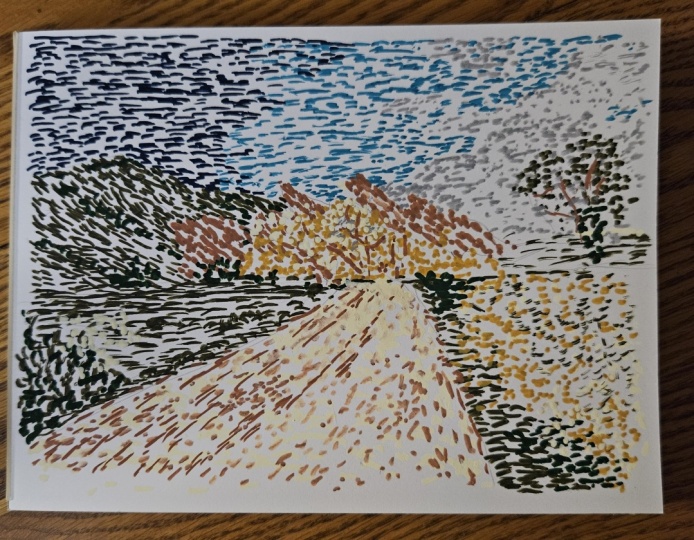
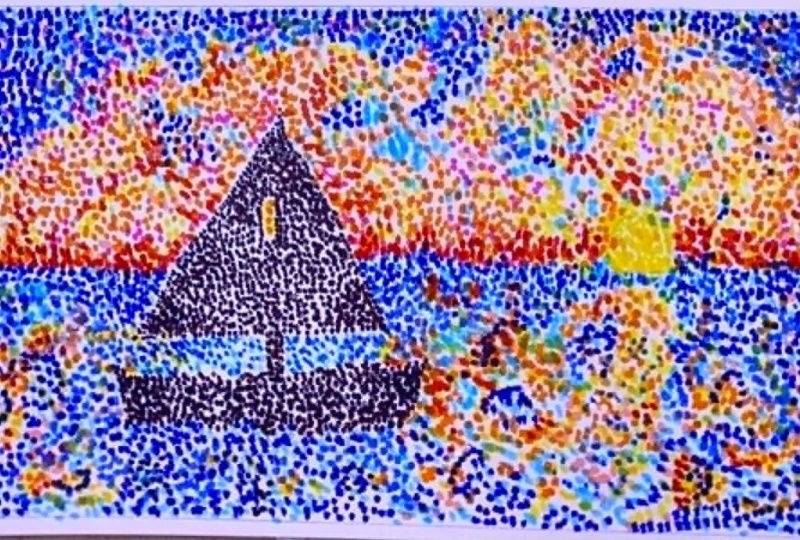
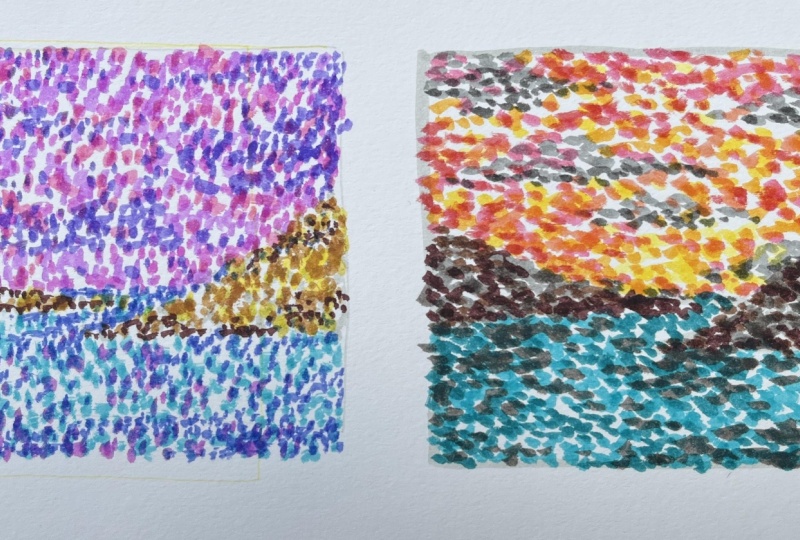
1. Neo-Impressionism - What is it??: Each generation of creative thinkers takes artistic thought in a new and intriguing direction. And in today's class, we are traveling back to look at a literal dot in the timeline, which made a big impact. Have you heard of Neo-Impressionism? If not, perhaps you've heard of its other names - Divisionism? Or, and this is a term that the artists at the time did not like using - Pointillism. it doesn't matter either way, because in 15 minutes time, you will be a Neo-Impressionist newbie no more! My name is Gemma, and I'm taking you on a Whistlestop art wander. Along the way, we'll meet a few artists stare at a few artworks, figure out the key themes of Neo-Impressionism and try out the core techniques ourselves. Alright. Sound good? Let's start by wafting away the mists of time and landing firmly in 1886. This is the time of Impressionism, an art movement characterized by its focus on light, unblended color, visible, choppy brush strokes, and capturing the in-between moments of life. But there are four artists who are about to take impressionism into its post era. The artist we are going to follow is named Georges Seurat who, at this time has just shown his ten foot wide painting "A Sunday afternoon on the island of La Grande Jatte" at the final impressionist exhibition in Paris. It's making a splash, and people are more than a bit shocked. [Gasp] You see, Seurat has developed a new painting technique whereby he's letting pure colours sit unmixed on the canvas in small separated dots. He's using color theory and placing complimentary colours side by side to make them sing and vibrate. And he is letting the viewer's eye do the job of fusing those colors together. Alongside his fellow artists and collaborators, Paul Signac and Camille Pissarro who are also showing works at the exhibition using this technique, Seurat is applying optical science to art, and people cannot contain themselves. Critics' opinions of this technique range from effusive praise [cheers] to denouncing it as "the death of painting". Regardless, as with anything so divisive, Seurat's technique soon attracted dedicated followers, especially in France, Belgium and the Netherlands. Many Neo-Impressionist artists were connected to progressive political movements, particularly anarchist and socialist ideas. They believed art could reflect ideals of harmony, equality, dignity for working people, and a balanced relationship with nature. In the next lesson, we will meet some of these artists who explored Seurat's technique and took it further. There's no time to waste. I will see you there. 2. You're Invited! - Meet the Artists: Let's imagine George Seurat has invited you, me, and a bunch of Neo-Impressionists to an arty gathering. It's may be slightly intimidating, but we've got each other. So let's go mingle and see what everyone is up to. First up, Seurat who meets us at the door. Seurat, as we found out earlier, is the one who started this wave of dot-fueled art, and at the height of the movement, he has created "Chahut", one of his most celebrated pieces. "Chahut" depicts the can-can, considered a risque dance at the time and utilizes rising geometric lines in its composition to express joy. Hey, look, over there is Paul Signac. He has become Seurat's most faithful supporter and is experimenting with various media from watercolors to lithographs to pen and ink sketches, creating artworks all composed of small dots. Signac uses a cataloging system whereby he gives his artworks opus numbers, suggesting an equivalence between his art and his musical composition. One of his most well known works is named "Opus 217 against the enamel of a background rhythmic with beats and angles, tones and tints portrait of M Félix Fénéon". Which indeed incorporates rhythmic zigzags and swirls which pinwheel around the portrait. It's hard to miss Théo van Rysselberghe who has become a prolific pointillist but in his own way. He was hugely excited by Seurat's technique and ideas and initially painted in his style faithfully as he explored its potential. As the years have gone by, though, he has found his own version by loosening the rules, using natural colours and using dabs and curls of paint rather than rigid rounded dots. Here's another artist who is using pointism in their own way. It's Anna Boch. Boch is illuminating ordinary scenes using pointillist color theory, such as in this piece called "During the Elevation", which contrasts violet blue shadows with the glow of pale morning sunshine. But the painting is only partially covered in dots. Look closely, and we can see that the people in the piece are very clearly painted in a different way. Boch doesn't confine herself to the rules of pointerism but instead uses it as a technique to enhance her vision. There are so many other artists at this gathering, it would be great to chat to, but time is ticking. Our scooter is waiting outside, and we need to get going. I don't want you to miss out, though, so check out the resources tab to download a roundup of inspiring Neo-Impressionist artists. In the next lesson, we'll figure out the key traits of Neo-Impressionism, because it's not just dots that set it apart. Hop on board and let's go. 3. What to Look For - the Key Traits: So how can we spot a Neo-Impressionist artwork? Here are the key traits we can look for - Scientific color theory. Neo-Impressionists carefully apply color theory, rather than mixing pigments directly on the palette. Paint is applied as small, separate touches of pure color so the viewer's eye can mix them at a distance. Pointillist or Divisionist brushwork. Neo-Impressionist paintings are often made of tiny dots or small strokes of color. These marks sit side by side on the artwork. The artist can decide how much of the white canvas might show through the gaps between them. Carefully structured composition. Unlike the spontaneous feeling of impressionism, Neo-Impressionist paintings are carefully planned and balanced. Artists arrange compositions to create harmony and stability. Geometry, rhythm, and balance become very important. Simplified or distilled forms. Subjects are often paired back to their essential shapes. Details are reduced, so color, light, and structure become the focus. In some Neo-Impressionist landscapes, this simplification almost approaches abstraction. Stillness and quiet atmosphere. Many Neo-Impressionist paintings feel calm, quiet, and contemplative. Figures often appear separate and introspective, even when standing close together. This creates a sense of emotional distance or silent reflection. Focus on light and landscape. Landscapes are ideal subjects for Neo-Impressionists. Within these, artists particularly explore the meeting of sky, land, and water, large areas of open space, limited color palettes and subtle light effects. Interest in everyday life. Neo-Impressionists often paint ordinary modern life, including leisure scenes, domestic interiors, workers, and city dwellers. These subjects reflect the movement's interest in social harmony and dignity for everyday people. Okay, we have now gathered some inspiration and pinpointed the key traits of Neo-Impressionism. I think it's about time we tried it ourselves. Grab your bag with the art supplies because we will start experimenting at the next stop. 4. Step into the Studio - Try It Yourself: I think it's about time we tried this process out. Let's start with a quick sketch, taking inspiration from Seurat's early Conte Crayon studies. He made them by running his crayon over textured paper, which automatically created a prickly shadow effect. Can you see when we zoom in how the sketch seems to be made of thousands of tiny dots? Grab a piece of textured paper and a soft drawing tool, something like a graphite stick, crayon or pastel. If you like, you can use the same reference I'm trying. Now, with a relaxed hand and loose movements, start to sweep the basic shapes that you can see onto the page. You don't need to press hard with your crayon or pastel. Keep it light so that you can allow those wonderful textures of the paper to shine through. As I'm sketching this, I'm trying to ignore the smaller details such as the contours of the nose and eyes and instead, letting the sketch be a simpler shadow form. Sketches like this also show how Neo-impressionism isn't fully reliant on color. Monochrome can still deliver a luminous shimmer effect and is absolutely worth exploring. Our next experiment is with complimentary colors. Let's get used to making the dots or dashes of Neo-Impressionism by creating some simple sample swatches. Whether you decide to use paints, pastels or markers, I want you to pull out three pairs of complimentary colors yellow and purple, red and green and orange and blue. Then grab one of these pairs and simply start dotting. I decided to dot a bunch of one color first and then to add in the second color afterwards inside the gaps. However, you could alternate the colors as you put them down, too. As you dot, notice the decisions that you're making. Within one sample swatch, you can try out different options to see what you are enjoying more. Try varying the size of the marks that you're making and the spacing between them. How do these changes affect the shimmering pointerism quality that you're creating? Try it with different mediums, too. Your hands will move one way with marker pens and a different way entirely with a brush and paint. So which feels more effective for this style of art? Lastly, we're going to try creating our own Neo-Impressionist landscape. Draw a small box in your sketchbook and then divide it into three bands. The top section will be the sky area. The middle section will be the water, and the bottom section will be the land. You can keep these dividing lines straight if you wish, or you can give them a little wiggle here and there to suggest a more rugged horizon. Next, choose just one of these to add into the scene a tree, a boat, a house silhouette or a pathway. Okay, that's our basic composition constructed. It's time to add color. Take one of your sky land or water sections and start filling it in with dots using at least two colors. As an easy way to begin, you could choose your favorite color combo from your sample swatches, regardless of whether it feels naturalistic. When one section is full of dots, move on to the next section and use different colors to fill. As you dot away, remember, the type of dot you're using is a choice, and it might be informed by the type of material that you're using. In this example, I'm using marker pens, which can be very precise and neat. Therefore, here I'm exploring how neater, smaller, more rounded dots can create a more structured and shimmery quality. However, in this example, I'm using acrylic paint with an old brush that has seen better days. This brush fights against neatness. So here I am using dabs of paint instead, which offer up a more organic and carefree feel. Within one type of material, there are multiple directions to try. Here I'm using marker pens again, but this time, utilizing the chisel nib to create sharper squarer dots. Then in the next section, I'm using the brush nib to create dashes, which echo the squares below, but with a slightly more haphazard then in the sky section, I use longer dashes to create denser triangles at the top, literally stretching the idea of dots and then tapering them shorter and spacing them apart nearer the horizon line. Your canvas has a part to play. You can choose to keep your dots separate to show more of the spaces between them or overlap them and let the colors push against each other. Here I'm using soft pastels in loose taps and dashes, but only using one color in those top two sections. My canvas is acting as my second color here, and as the dashes space out to show more of the white paper, it adds a sense of depth and light. These small spotty dot studies are short pockets of experimentation and play. Don't worry if you choose a color you later regret. Flow with the moment and allow yourself some slack. Enjoy creating and then pop a photo of your studies in a project to share the memories. I'd love to see them. When you're ready, we'll head to the last stop. 5. Ding-ding! It's the Last Stop!: I'm so happy that you have joined me in this Neo-Impressionist bubble. I hope you've enjoyed it. But before the bubble pops and you head off towards other arty adventures, let me tell you what happens next. Neo-Impressionism becomes a vital bridge between the impressionism which comes before it and the 20th century modernism, such as Fauvism and Cubism, which follows. It takes the spontaneous, fleeting nature of impressionism and transforms it into a structured, scientific and intentional art form. Simplifying forms and approaching colors systematically, it encourages artists to lean into abstraction. Whereas before artists held realistic representation up as an ideal to achieve, Neo-Impressionism opens the door to prioritizing emotional expression. Take a look at this artwork by Henri Matisse from 1904, which kicks off the Fauvism movement. The Neo-Impressionist style is mixed with non naturalistic colors and a conceptual meaning based in fantasy and leisure, which hasn't been explored before this. Fauvist landscapes love the simplification of form and details that Neo-Impressionism encouraged. So as you can see, Neo-Impressionism, despite being a smaller art movement, had a big impact on the art world. I'm very glad we were able to explore it together today, and I hope the downloadable resources encourage you to linger with it a little bit longer, especially when you need a little creative inspiration. Alright, it's time for us to hop off this Whistlestop art tour. Please make sure you have all of your belongings with you as you exit, and do let me know in a review if you enjoyed this trip through art history. I hope this will be the first in a series of Whistlestop wanderings. So if this class has been your cup of tea, do let me know which art movements you'd most like to explore next. If you follow me on Skillshare, you'll also be first to know when a new class launches. Don't forget to share any photos you've taken along the way, too. The project gallery is ready and waiting to showcase your Neo art noodlings. If you'd like to find me outside of Skillshare, you can pop by my website or join me on YouTube, Pinterest and Instagram. Until we meet again at our next moment in time, stay curious and keep making happy. Enjoy your day and dots away.