Transcripts
1. Welcome to class! : Hello, there friend and fellow creative artist,
creative human. My name is Elise Aabakken, I'm an artist and a performer and also a teacher and a coach. So mixing all of my
experience with how we learn, how we change our
perspective and I identity, I wanted to give you some
really specific tools because I needed to
remind myself about this. Over the past year,
more than I ever have. If a big change is
happening in your life, if something is
changing the structure, your habits, it can be hard to stick to the things we've
done for a long time. And that, that change, can kind of
shake our identity a bit. So in this class, I want to give you some really specific tools, some specific
parameters to change to change the way you feel
about your creative practice, which will have to change as you go through
your seasons of life, and also some perspective shifts so that you can be
kinder to yourself. You can give yourself
more permission. And also, it kind of opens
for more creativity in the way that you keep
a creative practice, a creative identity
in your life. In the next video, I'll talk
about our class project and a little bit about
the background for making this video
in the first place. I'm really glad you're
here. Welcome to class.
2. Class project and Background: Welcome to your class project. The class project won't look like the other class projects in my other classes where you go through the class and you'll end up with a finished painting. In this class, you will
end up with ideas, maybe a way to alter
your art practice. If you would like
to add something to the class project gallery, I would love for you to
either add a before and after photo what you before thought had to be
your art practice, what that had to look
like, what that had to be, what it had to result in,
and what it looks like now. I'll add some of mine in the class project so
you can see what I mean in the way that I
altered my materials, my supplies, my time, my size, and also my format. If you would like
to, you can put that there or if you make
some notes, some ideas, maybe you have a
posted on your wall reminding you of things
you've learned in this class, something that might be
helpful for someone else. I would love for
you to put that in the class project
gallery as well. If you're anything like me, I'm assuming that there's some kind of big shift in your life. There's something that makes the time that you
have to dedicate to a creative practice smaller
or different than before. So what happened in
my life was I moved. I moved back to Norway, which is why this space is
new. I moved back to Oslo. I left Paris, and
I left Disneyland, Paris, where I've been working
for almost seven years. I'm in a new apartment.
I'm in a new country. I'm here with my friends and
family, but it's shifted. It's different and my identity because we're informed
by the things around us. Also kind of shifted. I started painting with watercolors
during the pandemic. I had a lot of time. I had so much time to
spend on it and watch long classes and have projects that went over multiple days. And then when work came back and my social life came back
and travels came back, it shifted, and then I had to change with it and I
changed my approach. I changed how many times
a week I would paint, but I still felt
a little bit bad, and I felt like it really
didn't count, maybe, and I should be able to prioritize in the same
way that I had before. We can't. We keep
changing all the time. That's human nature. So now, with this gigantic shift and shift and changes
take a lot of energy, which meant I had to
redistribute my energy budget, which I love talking about, what do I have the energy budget for? Anything that's unknown
takes a lot of energy. Maybe you're in a new job, maybe you're in your
new relationship, new town, new place, new situations will take
a lot of your energy, so you won't have
as much to give to all of the things you usually
have time and energy for. So how do we redistribute? For me, I really didn't want the solution to be that
I had nothing, right? I wanted to have something because I like to consider
myself a creative person, someone who takes their
creativity seriously, and that my creativity and my creative practice feeds other parts of my life as well, keeps me joyful,
keeps me interested, keeps me curious about
the world around me, and I'll give you some examples throughout the next videos of how I permitted myself to
change my creative practice. I hope that can inspire
you to be kinder to yourself and to
change yours in a way that works for you in
the season of life that you're in right now. Let's go.
3. Change #1 - Physical change: Number one change
you can make to your art practice is
changing the physical size, shape, the supplies
that you're using. And I would like to
argue the price, the value, the perceived
value of your art supplies. So what I recommend is looking at the way that
you usually make art. Are there steps that
you can take out? Could you use a travel brush for watercolor so you don't have to get a separate jar of water? Could you use a smaller format? Making the format smaller means it takes less time,
it's less overwhelming. Maybe you won't
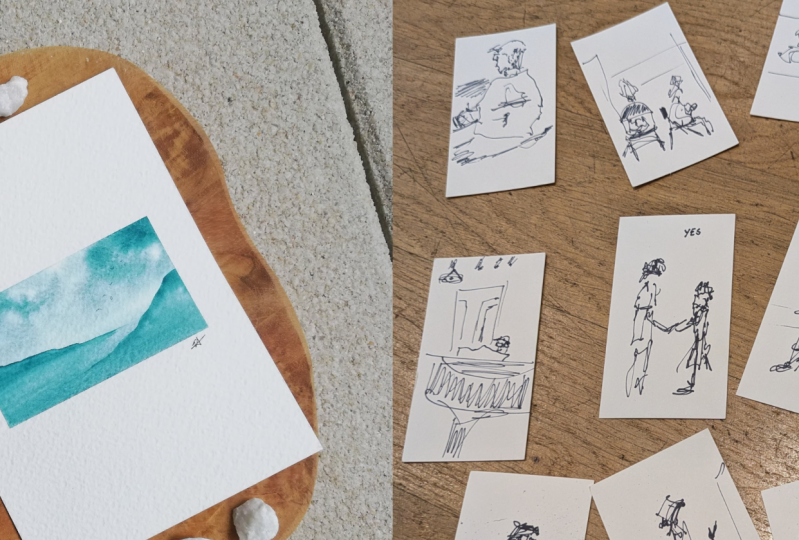
have to split it up into a multiple day project. I love making tiny
art, as you can see. Most of my art classes I recommend starting
with a smaller size. I recommend starting monochrome so you don't have
to mix your colors. Lots of different classes
you can watch on that, and if you are mixing colors, may I recommend my
rainbow watercolor class where you mix directly
onto the paper, not needing a palette, not
needing something extra. Anywhere you can pick off a step will help you make
the threshold lower. What I also recommend is
having art supplies that are not so high
threshold to use. If you have handmade
watercolor paints or handmade watercolor paper or
beautiful expensive brushes, and that makes you tense up. That might be something
to replace with like misunderstand me
correctly when I say sh*tty art supplies, horrible, cheap, inexpensive
art supplies that you don't worry as much about getting
amazing results from. Does that make sense? So
buying less expensive brushes, cutting your paper up into tiny, tiny pieces so that each piece
doesn't feel as important. And then you can
just make something. You could just do
a little doodle. In my Kiss your art supplies
good night workshop, one of my main tips is
making a time constraint. If you know you can only
paint for 5 minutes, if you know you can only
paint for 1 minute, you're not going to have the expectation of
making a fantastic, grand, beautiful artwork, right? You're going to just
create something because the point of it is just to get in touch
with your creativity. It's just to check in with your creative self and be
like, I'm a creative person. I create somethings.
I have ideas, and I use my art supplies. I'm an artist, I'm a creative, whatever identity it's tied to. You get to confirm that with
the actions that you do, which is a big part of
change in psychology of our actions inform our
identity and vice versa. If you say I'm an artist, you're more likely to paint. And if you paint, you're more likely to consider
yourself an artist. If you embrace your creativity, if you take your
creativity seriously, but in this season of life, you cannot dedicate
2 hours a day to paint or whatever your
usual creative practice is. Having check in points,
making it easier, making the threshold
lower by making the art supplies
smaller, less expensive, reducing the time frame, reducing the amount of steps, or here's another bonus one, making it with a non
permanent medium. I painted my bedroom green, and then because I have a
beautiful flower tattoo, I made a flower wall. with chalk. Not as much
pressure as paint, not as permanent as
an acrylic wall paint doesn't have to
stay there forever, but just using chalk, use chalk on the ground,
use chalk outside. It doesn't have to be permanent, which also lowers the threshold because the consequences
are not so big. The consequences of painting
that wall with paint, and not liking it or wanting to change it would
have to have okay, I need to paint over with
the other paint then. The consequences are bigger, so that's also a way
of making it easier is using supplies that don't
have a big consequence. That's my first change tip is changing your supplies to
something that is easier, faster, less steps, less
permanent or less cost. So coming over to the
next video where we start to play with a format of
your creative practice.
4. Change #2 Format and Ideas: Welcome to change number
two you can make to your creative practice that
changes the format a little. I consider myself a
painter painting and watercolor painting is my
main art medium format. What's close to that, but
not exactly the same? What could give me the same
thing? Painting is visual. Drawing, drawing on my wall, my chalk practice, drawing
little doodles in my notebook. In what other ways could
I make visual art? I've done some diamond painting, which is putting little diamonds almost like a crosstitch. I learned a little crocheting, something that has
to do with my hands, something that makes something physical. That I can look at. Looking at what might be
close to your practice, but expanding on what
that might look like, and what other ways could
you register your ideas? Could you tell someone a story? One of the easiest,
most accessible ways for me is to
write something on my phone or record a voice
note or take photos. So if I see something beautiful or interesting,
I take a photo of it. I don't have to paint
it. Don't have to. You don't have to do
anything else with it, but just registering
and being like, I'm the person who notices beautiful things that
spark my creativity, you will get the
feedback through your brain that you're
someone who notices. If you get an idea,
Elizabeth Gilbert talks about this in her book, big Magic, that ideas
are floating around. When you get an idea, it's a present. It's a gift. You don't make an idea. You get it. It just
arrives out of nowhere. I really like this image that to signalize to ideas that are
floating around in space, looking for a human
to come out through, to make sure that those
ideas feel welcome. Right. This might be on the woo Woo side,
but stay with me. Our brains are famously unreliable to keep
lots of information. We can keep about seven pieces of information at the same time. If an idea comes
into you're already very full to-do-list brain. Put it in a voice note, talking to yourself about
it and be like, I just got this idea
about this thing that I could make or paint or draw or I got this poem or I
got this phrase of a melody, recording it to
yourself on your phone, you don't have to do
anything more with it, but that way you signalize to
your brain that number one, you're a person who gets ideas, creative, and you're also someone who welcomes
ideas in so that ideas don't stop coming to you because it's still a place
where they feel welcome. You're still a person
who appreciates having creative ideas. Even if you can't
execute them right now, it's still something that keeps
confirming your identity. So to summarize,
the second change is kind of looking
at the format. Is there another
way that I could have this type of
creative practice? But without this exact format, how do I keep my
visual interest alive? How do I register wonderful
words that come to my brain, melodies that show
up out of nowhere? I don't have to sit down and compose them right
there and then, but I can record them into
a voice note on my phone. In our third and final
tip in the next video, I'll be talking about more
of the mindset shift around, what does it mean to
be a creative person? How can we keep confirming that identity even if we
can't even sit down and doodle something on a post-it
note? I'll see you then.
5. Change #3 Mindset and Perspective: The third and final, not "final", you can do
whatever you want. My third tip for changing your art practice for changing the
way you approach creativity in your life, is
to open it up even further to open it up to anything that
could count as creativity, as inspiration, as
joy in your life, because you might
have gotten into a bit of a perfectionist mode. If it's not a finished
painting, it doesn't count. If it's not a finished
song, it doesn't count. If it's not a finished
book, it doesn't count. If it's not half an hour of
writing, it doesn't count. If it's not something insert parameter that
you have to match, if not, it doesn't count. That's what trips us up, because then if we can't
do that half hour, if I know I can't
finish this painting, then what's the
point in starting? And then I keep backing
away from my practice. I keep resisting doing the
things I actually want to do because what's the
point if it doesn't count? And that's a really icky
feeling and letting go of that, letting go of the feeling that it has to look a certain way, it has to be a certain way for you to be a creative person. If Taylor Swift is sick and
doesn't sing for a week, is she not still a singer? Is she not still a songwriter? Does she not still have ideas? Of course she does. You
come back to your identity. You can always come back. And you also don't
have to stay the same. I haven't felt
inspired to paint, but I still feel like
a creative person in lots of different
ways in my life. Creativity in taking photos
of interesting things, creativity when it comes to
how I decorate my apartment, creativity in how you dress, creativity in how
you spend your days, creativity in the
food that you make, creativity, creative, creating, creating experiences,
creating memories. I have a brand new
little baby nephews. We're creating so many memories, things that feel
important and that are not resulting in
a finished product. Does that make sense?
So I want you to open up to see in
how many other ways, are you a creative person? Are you someone who creates? Are you someone who's an artist? Are you someone who has
an eye for aesthetics, are you someone who
has brilliant ideas? Are you someone who sings? Are you someone who who shares music with the
people that you love. Are you someone who takes
screenshots every time you see something beautiful
or something inspiring? All of those actions also
confirm your identity. Do you see where I'm
going with this. Making sure reminding yourself you have permission
to change it. You have permission to let
it look a different way so you don't get stuck in
the all or nothing mindset, which is also very common for perfectionists
having a feeling of, I can't do this if
it's not perfect. I'm not creative unless I
have X amount of paintings to show for or X amount of
writing or X amount of hours. You do. And yes, I get
that it's different. Caveat. If it's your
job and you have to produce a certain amount,
that's kind of different. But for us, most of us, a creative practice is supposed
to be a source of joy, it's supposed to be a
source of inspiration for inspiring us in the
rest of our lives, too. Don't make it too
hard on yourself. Don't make it too
difficult to get into and use these kind of practical
ways of shifting it, changing it, playing with it. It's supposed to be fun. It's supposed to be joyful. It's supposed to be something that gives you something back, not something that
someone is going to check like your homework. I'm not going to check
your homework, right? Don't get into the mindset of
checking your own homework. Do it for fun. Do it for play. Do it for enjoyment, right? Shifting your perspective on what counts might be the
most important part of it. Treating yourself with kindness within all of the big
changes that you're going. Join me in the next video for a little bit of final thoughts and some summary for the end.
6. Before you go! : That's the end of this class. I hope you with both the practical
tips and tricks and ideas to change your
creative habit into more of the mindset
perspective shifts that you can start seeing
the opportunities and what's available
for you so that you don't use your creative habit as a way to be mean to yourself. As your creative
practice evolves and you change and
your life changes, that holding on to
exactly the way that it was when your life was
different doesn't serve you, it doesn't serve
your creativity, it doesn't serve
your art practice. Shifting, being creative,
being flexible is also an art. And it's a way to stay kind to yourself and also
bringing more joy in. If you enjoyed this class, I would love you
to leave a review. It helps other students know what you expect, and
it also, you know, is confidence boosting for me to know that something
that I said might have landed with you and given
you some inspiration or some ideas for something
else that you could do. If you make art, if you make something with an altered mindset or
an altered format, I would love to see it at
the class project gallery, if you want to upload it or if you want to
share on Instagram, I'll put my name here
again, Elise Aabakken. Very fancy. So that you can see
that it matters, telling yourself
that it matters, telling yourself
that you matter, your creativity matters,
your habits matter, the way you live your life, the way you confirm
your identity to yourself, and who you are. What we have. So your actions and your identity,
they work together, and there's a different way of confirming that you
are a creative artist, then the only format that counts being a really
rigid, really strict one. So I hope to see you in
another class another time. If you want to make
other different art, I have lots of other classes, and you'll see
there as well that the concepts of
making things easier, making the threshold
lower finding ways to make it work for you
is a big part of the way that I teach
and the way that I encourage you to move
through your life, to move through
your practice with joy and interest
and curiosity and enthusiasm and not being hard on yourself because when your life changes and
your energy fluctuates, the way to move forward,
the way to make things better is usually
not to be hard on yourself. If being hard on
yourself worked, it would have worked
by now, if that's the way you usually handle
changes in your own capacity. I'm really glad you're here. Thank you so much for watching. I'll see you in another
class, another time.
7. What it's like working alone sometimes... : I mean, ready? No,
that's too high. Good. Apologies. I mean, that's
gonna be really nice. Did I move? This isn't right. Everything's fine. It's a little better. It's because I was
sitting on a pillow? I'm really. What? At the table. Let me alone. Did you slide? I don't know if the sound
is gonna be okay. Shall we check it together.
My name is Aisa Obachin. I'm a sir What to the
clash project. Lies. Beautiful, expensive
handmade water. Handmade water. Actually,
I made it myself. For creating. You can
making a restrict. You will I'll tell
you about What? One of the main tips. Wow. When things. For our last final, third tip change, tip for the video for the
Wow. It's very cute. And
 Elise Aabakken, Voice Coach - Teacher - Performer