Transcripts
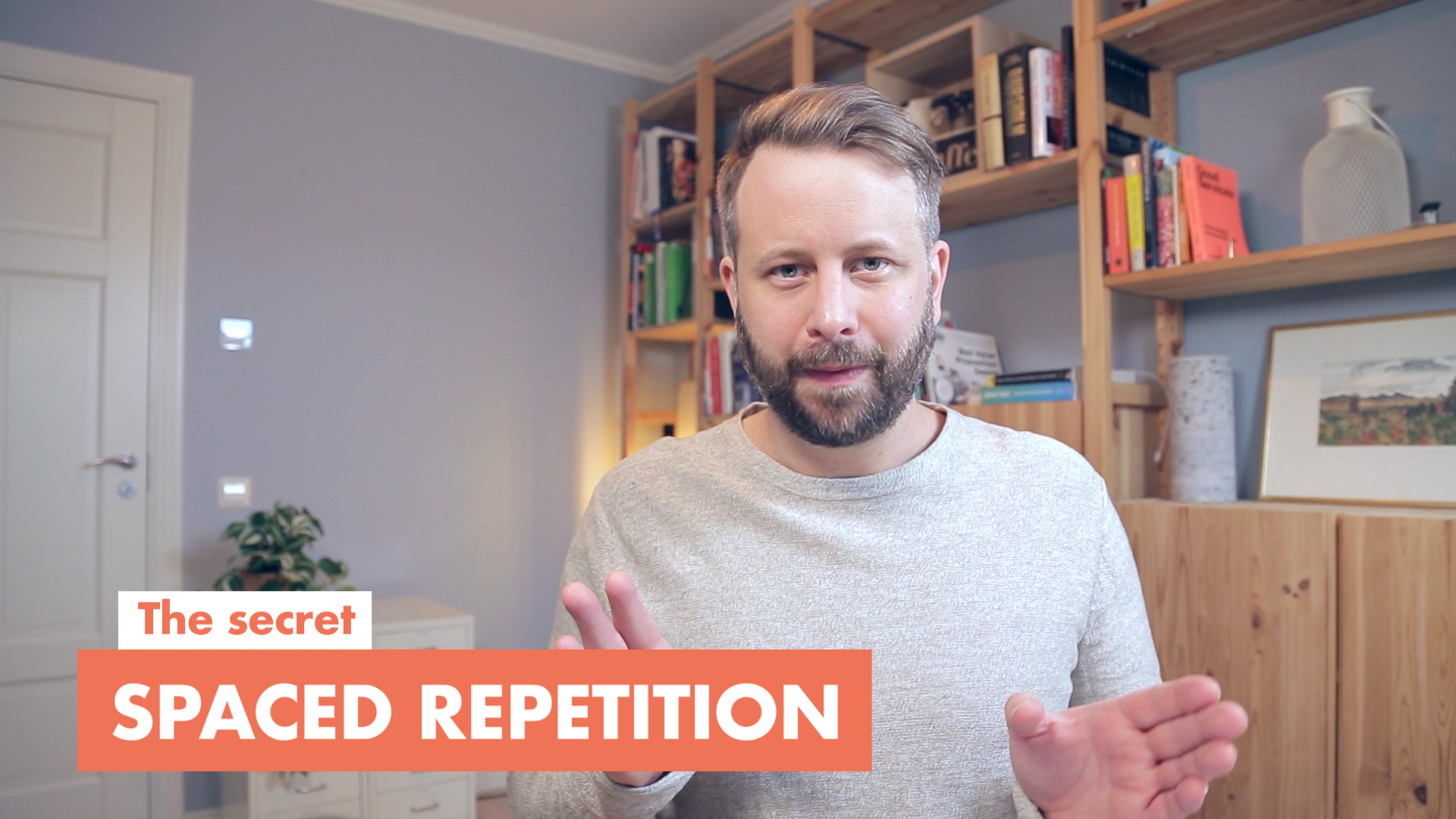
1. Learn Anything – Remember Everything: Welcome. My name is Jacob Magnll and I don't
have the best memory. I would say that I'm probably
below average when it comes to remembering any random thing that
someone tells me? But I love learning
new stuff and remembering those
so that I can add the learnings to my
life and my work? In this short course,
I will be showing you the strategies
that I have been using in order to be able to learn enough to get an
engineering degree, become a service designer, move on to becoming a product owner in a
multinational corporation. On the side of that,
I've been able to start as podcast and create a YouTube channel and not least also teach
here on Skillshare. So how do I with my poor memory, learn everything that I need to do to do all of these things. The secret is spaced repetition. And there are many
studies on this topic like this one from
University of California, which shows us that students
that use techniques like this were able to increase the results on a test by 15%. And from using
spaced repetition to learn just about
anything myself, I don't doubt that for a second.
2. Class Project: The class project for this
course is very simple. I basically want you to pick
out some piece of content, something that you
would like to learn. Again, it could be studying
for a driver's license. It could be studying
for an exam. It could be something
that you need to learn for work or something that you just want to learn
in order to make it part of your knowledge base, something that you can
bring out and have a good grasp of and
remember details around. If you can't come up with
something on the spot, you can use this
course and you can use spaced repetition to learn
about spaced repetition. And then you can remember how to implement these strategies
for a long time. So that's something
that you can do. And what we'll do
in this exercise is we will set up a space
repetition system, something that will help you remember that you should
practice and look at your information
without it becoming a big burden and without it taking a lot of time
away from your date. There are a lot of
ready made tools that you can use for this
type of learning. One of my favorites is Anke
that I have been using a lot, but For me, it's quite
good to use that, but I do like to also have a more custom made
solution for me where I can use techniques
that I find and learn about, and I can use those to
learn about things. I want to set up a
more free system, but you can also use Anki to get an app that quizzes you
on things and it uses the theory around spaced
repetition to give you questions in a way that
makes you remember them. If it notices that you're having difficulties
with the subject, it will give you questions on
that area more frequently. But I want to make my custom solution and show
that to you so that you can sort of do it the way
that I have been doing it and so that we can learn
the way that we like to. After this course, I
would be so happy if you were to upload a class
project for this course. You can just take a picture
of some of the material that you've been using
and upload that to Skillshare in the
project section, and I can feedback and
comment on your work, and we can have a
discussion with the rest of the students.
And I would love that.
3. Spaced Repetition: The idea is that when
we learn something, we tend to forget
most of what we learned within a couple of
hours from learning it. But by revisiting
what we've learned by repeating everything
that we've seen and heard, we are able to give our brains the best possible chance to retain most of what
we see and hear. And that is fantastic. So the idea is really simple. We learn something, and
the day after that, we go through everything that we learned and everything
that we want to remember, and we make sure that
we've seen it once again. Then we wait for
about three days and we look at the
material once more. Then after nine days, that will be three
times the time from the first to the
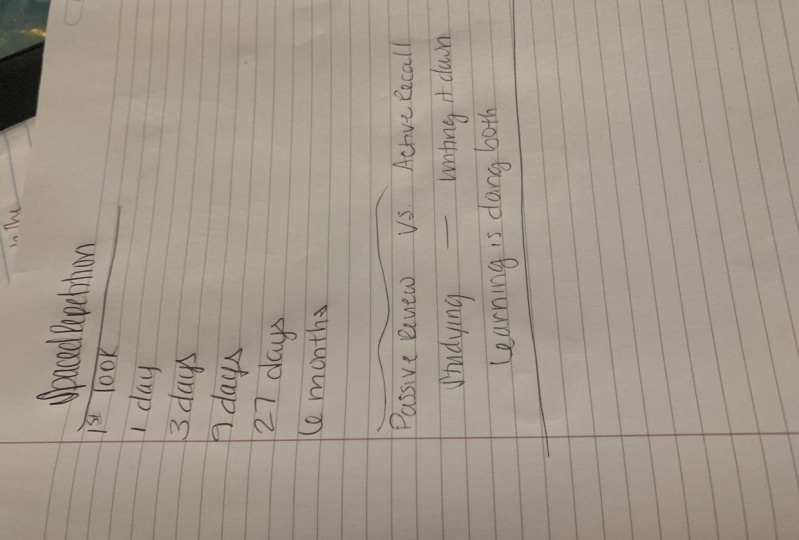
second repetition, we look at it again. One day, three day, nine day, you repeat after about
a month or 27 days, you repeat it once more. Then after six months, we go back and we look at it, and then you will remember everything
that you've learned for about 1.5 years. You
can continue this. The time scales
become very large, very quickly from
this point out. The goal of this is just simply to remember things
for a very long time, and it actually does work. So I told you that this
course would be quick. And if you want to lead
now, that's totally fine. You know all the theory that
you need to know in order to understand what space repetition is and how it
benefits the memory. Basically, just repeat things, triple the interval between the times that you go
back to the material, and you will internalize it
and you will make it become part of your knowledge base so that you can use it for
whatever it is you want to do. You can use it in conversation. You can use it at your work. You can use it to learn how to drive or study for
test. All fine. But if you want to stay,
I have a couple of more lessons where I
will show you how I use this in my day to day life to learn things and how
you can implement it to become a master of remembering the things
that you want to remember.
4. Passive Review – Active Recall: Now, there's only one
more thing that I would like to bring up
before I show you my system. And that's the
difference between active recall and
passive review. Passive review is probably
what you're doing right now. You're looking at a
piece of content, you're reading a book, you're learning something
for the first time, and this is a necessary part
of the learning process. And this provides a foundation
for your knowledge. This is where you
collect everything. Into different buckets
where you can sort things. And this is how you
get new information. This part of the
learning process allows you to be exposed to new ideas and new knowledge
in a pretty effortless way. You can just read and look and watch and you will get
some sort of information. But then we need
the next stage of the learning process
in order to really internalize this and make
this your knowledge. Active recall in contrast
is the act of remembering, bringing out what you have seen and learned and
answering questions on that or writing
down notes on that without looking at the
material from before. And this is where
you really start to internalize that knowledge base. This method challenges the brain to bring out relevant
information, and it builds those
connections in the brain necessary in order for us to remember something
quickly and efficiently. Active recall, it often
includes things like flash cards or writing
down answers to questions. But you could just resign what you've learned from memory. This requires a significant
amount of effort from us compared to just
reading or watching something, but it will allow us to keep
the knowledge for longer. I also want to say that this is best done as a
collaborative effort if you have someone in
your close vicinity that wants to learn
the same thing. Well, then that's where
you really can get some help in this and you can quiz each other and you
can talk about the subject. And this is by far my
favorite way of learning, but it's not always feasible. Using space repetition
will also allow you to learn things on
your own and have something a system
that will challenge you to know the things that you need to know
about the subject. So It works for both. I love just studying with friends and learning
things together. But if that's not
possible, that's fine too. In essence, passive
review allows you to familiarize
yourself with information, and then active recall helps you retain that knowledge
over a longer period of time. Personally, I like to throughout my entire learning process
in an area or a subject. I like to mix these up and I mix passive review
with active recall. And then after a while, I have a pretty good
grasp of the subject. It's good to bill let the passive review build on what you've learned
through the active review. For example, if you
read a book twice, you're going to understand
much more things about it than you would if you
hadn't read it twice. And if you also
have been quitting yourself on that material
before you read it again, you will get a full
new understanding. I really recommend you
do this sometimes. It is a little bit time
consuming and you can't really do this for every
topic that you study. But I really love doing this. And I do it sometimes when I have some material
that I really love, When I read it the first time, I do some space repetition
on the material, and then I go back
and I read it again, and I understand the thing
with a full new yes. It's amazing, actually.
I love doing that.
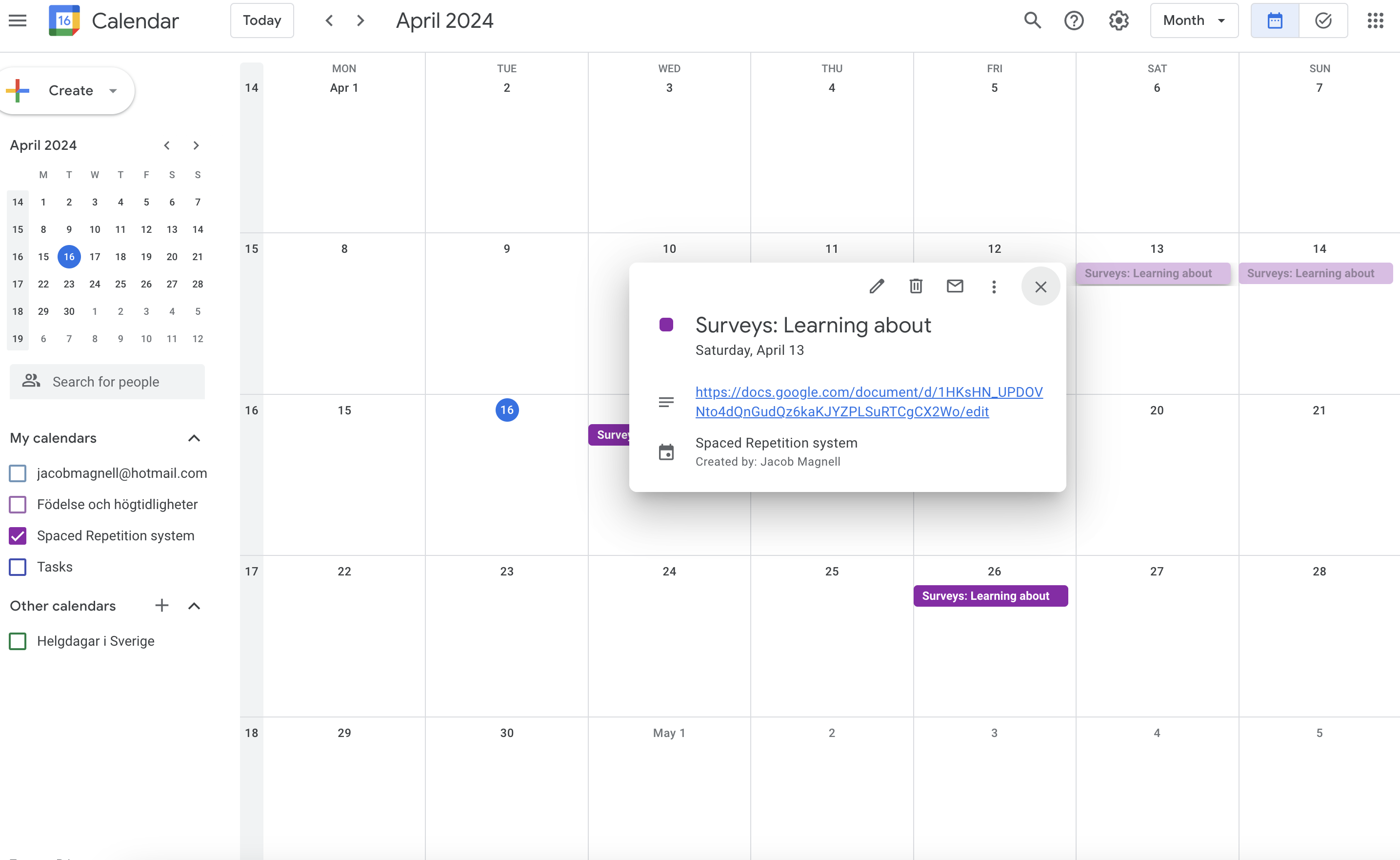
5. My Project: Now I'm going to set up my own basic spaced repetition system. I'm going to set up a Google
calendar for this course, and I'm going to call
it spaced Titan system. This is where I people to every thing
that I get to learn. And then I go into all of my calendars and I have the space repetition calendar open, and I go to today. The first thing
that I am going to do is I'm going to bring
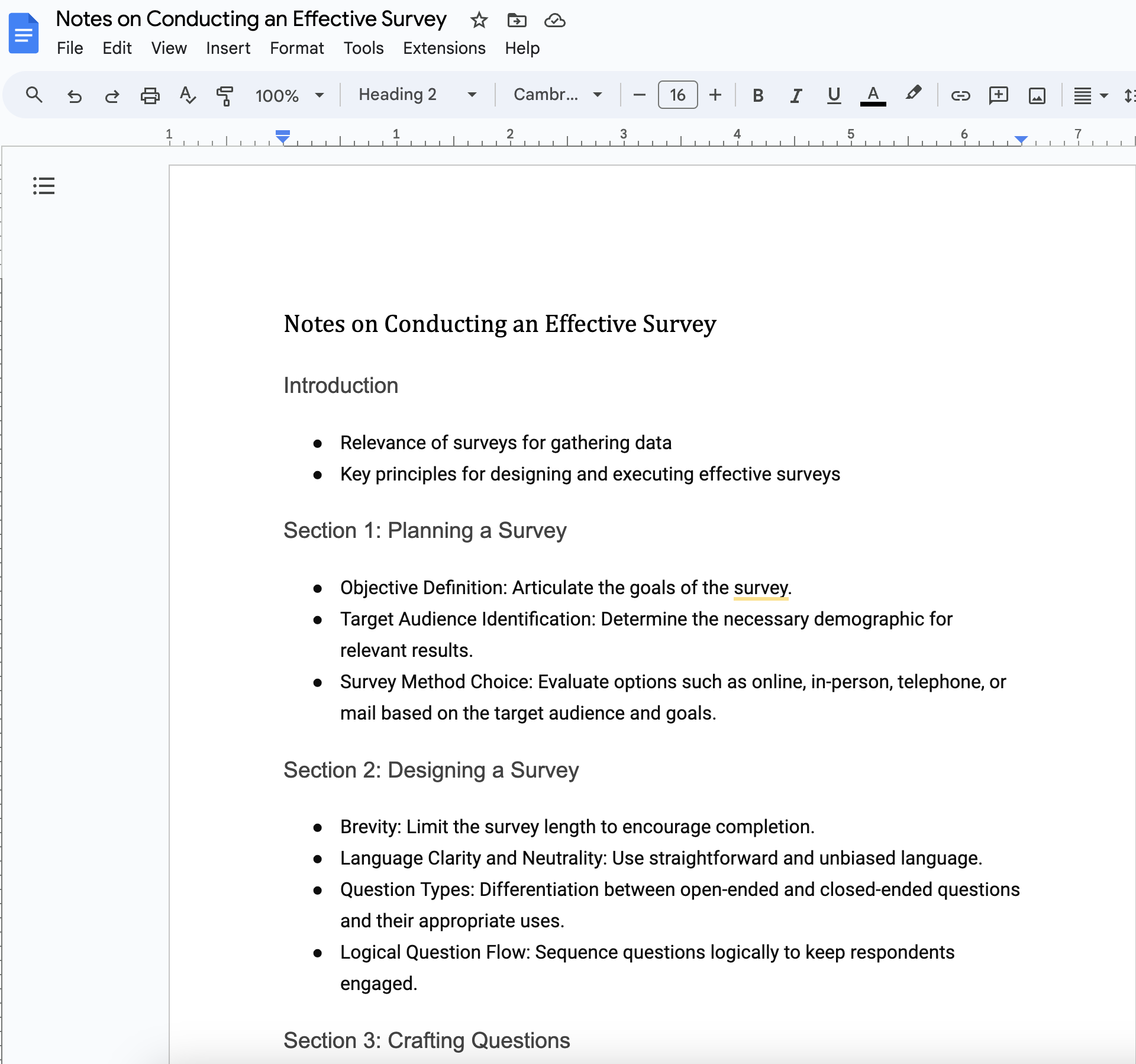
out a piece of content. So I have been studying on
conducting effective surveys. So what I want to do is I want to learn about
surveys and I want to then make a skillshare
course on that because it's something that
I have been doing a lot, but I haven't maybe in a while done any formalized
studying on the topic. And before I make a course, I like to do my research and just internalize
that knowledge, so I know that what I'm
talking about is correct. And I have created
this document. With all of this information on how to design a survey
and what to think about. And I have also put a bit
of resources at the bottom, which I can go back
to in order to get more of that passive review. So I will take this here and I will copy the
link to that document. Then I will go into my calendar, and I will start a new event. Surveys surveys
learning about Okay. Okay. Good, and
then more options. I will paste that document there so that I know that I can go back and I
can look at that, if I want to know what I
have been studying about. I can also add more documents
here during the course of this where I into that document. So that's the Hub document where I put all of
the information, and I can put
questions in there. I can make sure that I have everything that
I need in order to repeat that process of
internalizing the knowledge. Okay, and This is day zero. That means that today was
the day where I thought, Okay, I'm finished
reading the material. Now I want to go
into reviewing what I've learned so far. Cool. Then I'm going to go into that and I'm going to duplicate. This and I'm going
to put it tomorrow. That's one day after day zero, where I
learned everything. Now, I would like to save this and I have my first
piece of repetition. My first piece of repetition, I'm going to go
into my document, and I'm going to make sure
that I answer some questions. Maybe I write up some
questions that I can put in the top of the
document that I then can answer and prepare
for for the next quiz. Then I look ahead and I
see that it's one, two, three days after this is the 17th and I go in and
I duplicate this one, and I put this on
the 17th, save. Now I know that on
Wednesday the 17th, I need to go back and I need to review everything
that I've learned. And one thing that I forgot, which is good because then you know not to
forget that yourself. Before I copy more of these, I would like to go in and edit this event and I
would like to add a notification so
that I'm reminded. But I don't want it
to be one day before. I want it to be on the same day. A 9:00 seems fine. Actually, I'm going to
take do that at eight o, so that I am reminded when I have some time blocked
off for learning things. I'm going to save this. Then I'll go back
later and I'll add the notifications to
the ones that I missed. Cool then I'll
duplicate this one. And then we have Three days between this one and that one, and then we need
nine or ten days. Let's say nine just to make
the math simple two, three, four, five, six, seven,
eight, nine days. So April 26, seems like a perfect day to spend five or 10 minutes
reviewing this material. Now, now we're going
to start to see that the days becomes weeks because
nine days times three, which is the amount of time that we want
to multiply with, that is three weeks. So we go in here and now it's
easy because 18 week 1920. Let's go for Thursday Week 20. It's not so necessary to be on the day when
you get a little further ahead because in the grand scheme of things, you're not going to miss much. We save that one and
then Let's add one more. Duplicate, and so we had
three weeks or three weeks. Now, we are going to
multiply that by three. That means that we're going
to have nine weeks, one, two, three, four, five, six, seven, eight, nine weeks. I think Thursday is fine. Save. And you can tell
already now that the next one after this is going to be nine times three weeks. That's 27 weeks ahead
of this last one. That's half a year.
Actually, you know what? Let's add that one. We go here. And we duplicate and
we put this one. Okay, so we want 27 weeks
that roughly half a year. July, August, September,
October, November. Let's do it in November
on a Thursday and safe. I'm pretty sure that when I
go in and I look at this, I am going to be
met with something that I recognize because I've already gone through five or
six times before December, and I will be familiar with
what has gone on here. Next repetition will be
in 1.5 year after that. At that point, I
am pretty sure on this limited amount of
material that I have here. I'm going to be an expert.
You can also add more stuff. You're not limited to having only one repetition
set on one topic. Because of the distributed
nature of this, it's going to be
possible for you to add plenty of these
because the only time that it actually takes a
lot of time from you is those first couple of three days where you
have to do it day zero, day one, day three, and then
the spacing becomes longer and that's the most
efficient way to learn and it doesn't
take a lot of time. I love this way of
working with memory. Now, all I need to do is
I need to go in and check my notifications and
go in and review all the material that I need
to review in a single day. I tend to like to space
them out so I don't have multiple of these
coming on the same day. It's relatively simple to do unless you are
absolutely crushing it, and you're just piling on
things you need to learn, which might be the
case if you're studying for university
or something else. No matter what, this is really going to
simplify your life. If you need to learn
anything at work, school, life, you got it.
6. Outro: And again, I would love
to see what you learn. I would love to have
a discussion with you in the discussions and
see your projects. If you really like this course or you want to feedback
me on something, please leave a
review, and that will make my day really,
really happy. Thank you again for listening
to this short course on space repetition and
learning and memory. If you'd like to see more of me, you have my YouTube
channel, Jacob Magno, you have my
Skillshare page where I have a lot of
courses on design, AI, and a little bit on productivity and this
type of thing as well. A lot of interesting
stuff for me that I enjoy talking about and
getting your response from. If you're having a good day, I am to see you next time.
 Jacob Magnell, Service Designer, Innovation Strategist