Transcripts
1. Introduction: Hello and welcome to this online class about journaling your way to success. I'm Alice, but it's, I'm the founder of impulsivity biotic Sandra. I'm a storytelling and creativity expert, a writing coach and the author of the book right away to happiness. And I am just passionate about anything that has to do with journaling and writing. Because I know from experience that it's so helpful to use pen and paper when it comes to healing, as well as finding the clarity to plan for your success. So in this following course, I'm going to share with you some tips and tricks that I found useful for my journey and that I have been implementing in my life for years. And I have seen the results coming together. And I want you to have similar or even bigger results because journaling is really going to help you get that clarity to plan for your goals and to achieve success. Remember, success is what you consider to be success for yourself. It's nobody else's recipe, it's nobody else's vision. It's all about what you want to be and what you want to have in your life. And first and foremost, you want to make sure that you are going to follow your dreams according to your values. So we are going to go a little bit deeper at the beginning of this course. And I'm going to share with you both tips and exercises so that you can put them into practice and bring journaling into your everyday routine. In this online course, you will learn how to create a habit out of journalling. What are the daily practices that you can implement as part of your routine? What are some weekly exercises that you can do with pen and paper and how to write it down your vision to make sure that it comes to life in the best possible way. So let's see how you can journal your way to success and how you can impress yourself everyday. Because at the end of the day, it's really about how you feel about yourself and it's not about what other people think about you. So make sure that you go to bed by feeling proud of yourself, grateful and excited for the next day.
2. Module 1: Definition of Success: You have probably heard by now the importance of journaling for your well-being, for your health, your mental health and your physical health, for your self-awareness and for everything that has to do with your everyday well being. So when it comes to bringing success, we're going to talk about both your personal and professional success. But before we go there, it's important to know what is success for you. So let's look at your definition and I'm going to invite you now to take a piece of paper and a pen and to pause this video so that you can answer in writing, what is your definition for success? What does success mean to you? So now that you are a little bit more clear on your way of seeing success and what it means. Now you know what are your expectations for journaling towards that definition of success? In order to go a little bit deeper, I wanted to make sure that to you also create a vision for yourself. That means for both your personal and professional life, you want to think about where you see yourself in five years or ten years. And in this way, your vision for your life is going to drive that urge for success. It's really what's going to push you through the most difficult times when you feel like nothing is working. But when you have that vision in your mind, it's truly what's going to help you take the next step and the next step and the next step. Because otherwise you are so going to wants to give up or you're going to feel stuck. And I'm happy that when you have a vision that you are going towards, then this is really what's going to push you and it's going to motivate you. So let's look at this following writing exercise. What is your vision? Where do you see yourself in your personal life in five years from now? Where do you see yourself in five years in your career or your work? How does your life look like five years from now? Pause this video and take a few minutes to write down your answers. I have already mentioned that success means bringing together your personal and your professional life. So we're not going to talk about just your career and your work and the achievements that you're looking to get on this side of their life. But we're talking about how you want to have a successful life and build it every day one step at a time. So now it's time to look a little bit deeper into your areas of your life and what are the points that you wanted to improve in your life? So once again, pause this video, take a piece of paper and the pen and answered to this following question. In which areas of my life do I want to improve? And how? Okay, so these exercises are really just about creating that foundation for you to start journalling your way to success. Because let me tell you this. In journalling, it's really not about the journal itself. It's about you. The journal is just the expert or your best friend that is going to support you and hold your hand throughout the process. The journal is going to provide that safe space for you to grow and to become more self-aware so that you impress yourself every day. Think of it like a therapist or a coach that he would have with you along the way. And you would have them holding space for you and giving you directions and encouragement and supporting you throughout your success path so that you have someone there cheering for you and also holding you when you are learning lessons or feeling down. You are the only experts in your life and in your definition of success. So this is why it's important to create that vision and to be really sure what success means for you. Because how can we Journal our way to something that we don't really know what it is. And there is also the other side of the coin where very many times we create this image of success in our mind when it's not even our image of success, but it's something that we have borrowed from society, from our family, from someone that has told us their idea of success and has convinced us that that is the best way. But worry not because now you're going to pay more attention towards your definition of success and what it means to be successful according to your values, to your dreams, to your passions, and to your motivations.
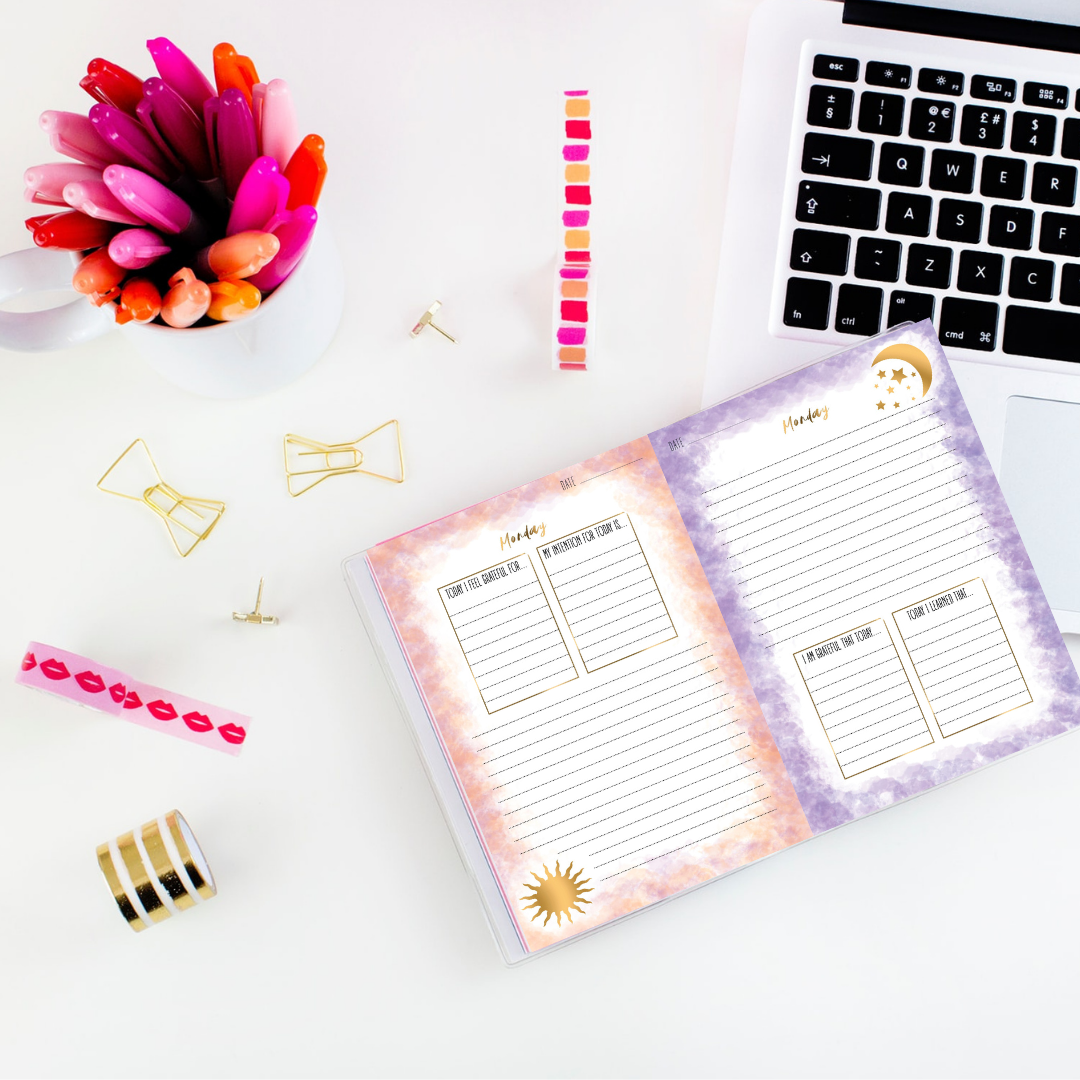
3. Module 2: Morning & Evening Routine: I talk a lot about finding your own routine in my workshops and in my online classes. But I want to make sure once again that you find your own rhythm when it comes to creating your writing habits or your routine for your well-being and for your success. It's important that you follow your own schedule, your interior world, and how you function so that you don't see journaling as a burden, but as something that is helping you and supporting you on this path. So try to figure out, according to your schedule and your lifestyle, when is the best time for you to sit down with your journal and write in it. Do you have time in the morning to sit down and create some space for setting your day and have a positive feeling. Do you have a little bit more time before you go to bed? Can you do both of them? Is it something that you prefer to do maybe at the end of the week so that you just evaluate your week and prepare yourself for the next seven days? Or is it just something that you are doing once in a while? And you have one journal that you have been keeping since high school and it's still just half written. There's absolutely nothing wrong with any of these versions. However, I do recommend that you find a little bit of a rhythm and that you journal more frequently because this isn't really going to give you that muscle practice with writing. And it's really going to help you start seeing results. And it's really going to guide you on that success journey. So let's look at how you can create routines in the morning or in the evening. The best way is to maybe give it a try in the morning and in the evening and see what works best for you. If you are going to be able to do both of them, then it's even better. In the morning. It's really important how you wake up and how you set up your day. So if you find the time for maybe a little bit of meditation, some breathing exercises, and a couple of minutes for writing down your gratitude list, then you are going to have an amazing day ahead. It might be also a good time for you to look over your plan for the day. What are your activities? What is your to-do list? So that you make sure you're in the right mindset for achieving as much as possible from your lists. At the same time, if it feels too overwhelming to do this in the morning, then you might want to check in with your list a little bit down the line during the day so that you make sure you are planning your day and you are not missing any meetings, any calls, or any important projects that you have a deadline on. You can choose to either keep your journal Andrew planners separate, or you can have them in the same notebook so that it's easier for you to just carry around only one agenda or one notebook. So make sure that you find whatever is best for you. And then. See how it works when you start planning your day and you are becoming more intentional with your day. Let's go a little bit deeper into what it means to write in the morning and journaling in the morning. When we wake up, we are still in that phase of moving from sleep to awakening. And it fills a little bit like we are perhaps still hanging on to something that we have been dreaming about and we are not yet ready to jump into the date. So that will be your perfect time to meditate, connect with yourself, and also put pen to paper. When you start writing your gratitude right after you wake up is really going to ground you and it's going to plant that seed from the beginning of the day to set you up for success for the rest of the day. You will see that at the beginning, you will write about being grateful for the major accomplishments in your life. For instance, your family, your children, the nature, the house that you have, or the place where you work. But in time, you will start being a little bit more specific. You will start to be grateful for the smallest joys of life. And that is where you're going to start seeing the results because you will become more aware and you're going to pay attention to even the slightest activities of your date. For instance, you can be grateful for the soft below that you slept on or you can be grateful for the fresh air that is coming through her open window early in the morning. It's really going to start shifting your perspective when you practice gratitude in time. And you're going to implement this over and over because it's going to give you a little bit more satisfaction to ground you in reality. So we tend to be more grateful for the things that we have as part of our everyday life. In the morning and in the evening, we are going to look at a different type of credit to practice. But don't forget that the morning is also a really great time for you to set your intention of the day and to create that one word intention that you want to guide you through your day. It can be any motion that you want to feel throughout the day. And for instance, you wanted to feel courage. So you can think about what are the activities on your to-do list that are going to give you that boost of courage. And if there's nothing on your to-do list that gives you a boost, then you might want to include something, whether is a conversation with a friend on the phone or a quick run during the lunch break, it might be useful to find some activities that boost that intention for you throughout the day. Then make sure that in the next hours when you start getting into your activities, you also find time to revisit your planner and your activities so that you don't miss something important. Sometimes we just feel that we have it altogether and that we can keep in our minds. Everything that's important, but it's so easy to forget, to get distracted or to find that sometimes something else comes into our schedule and we forget that the priority in the morning was completely different. So make sure that you check in with your planner throughout the day and maybe be grateful for having a journal and for writing down even the smallest activities that you have to do that will count as one gratitude point in the evening. If you are looking at implementing journaling at the end of the day before going to bed. You might also want to put aside a few minutes to look at your reflections of the day, maybe go through some of the most important situations throughout the day. See how you're feeling about them. See what are maybe some winds of the day, what are some lessons? And of course, you can also complete the uncredited lists in the evening because it's really going to give you some peace of mind before going to bed and creating that space in your mind so that you leave your thoughts onto paper and have a peaceful and restful sleep. I personally recommend to find a routine that works for you and perhaps use five minutes in the morning and five minutes in the evening so that you can create a healthy way of journalling your way to success. If you are new to journaling, then you might want to start with implementing these practices in the morning at first for a couple of weeks, See how it feels and then bringing the evening or switching to the evening routine and also seeing the results after a couple of more weeks and then perhaps finding time to bringing them both in the morning and in the evening. When you start implementing journaling in the evening, you have time for a little bit of reflection. So for instance, you might think about what was the conversation you had with another parent at your children's school? Or maybe discussion with the client at work or just some project that may be is not going in the direction that you were hoping for. Having this moment of reflection are going to give you a little bit of evaluation and clarity of where you are so that, you know in your measurement to success, where you are and what you can adjust. Look at these moments of reflection as some sort of understanding and know a little bit for you to change gears or to see what works best so that you can implement it more. You can also look in the evening at celebrating the small windows of the day, or maybe some big wins. But make sure that every time you find something to be proud of and to celebrate. Because so many times forget to acknowledge what we have been doing and what we have been achieving, and we only run from one goal to another. So the evening journaling routine is really going to be a reminder to celebrate and be happy that you impress yourself one more time. During the journaling practice, you are also going to look again at another gratitude exercise. But this time we tend to look at our achievements, at our professional activities, or maybe something that we have one or checked off the list during the day. So it's important to do gratitude also in the evening because it once again reinforces your gratitude and that beautiful fuzzy feeling in your heart. And it will send you to sleep with some amazing energy and you will have peaceful and restful sleep. Okay, so you might be thinking, what does gratitude has to do with planning for success? Well credited is this beautiful feeling that gives us some positive energy and it fuels us with a lot of motivation towards our dreams. Being grateful for what we already have in the present moment is really going to build that strength and is really going to give you that push towards following your passion and towards achieving more. Because you know that you already have everything in the present moment and you can only find better things and you are safe to do so because no matter what happens, you are really grateful for what you already have. So make sure that you put in place a gratitude practice, whether in the morning or in the evening, or even better, bring gratitude both at the beginning and at the end of the day because it's really going to give you some beautiful energy and it's really going to motivate you to success. It has also been proven by research that when you write it down about what has been bothering you through the day, you are activating a part of your brain that is called the amygdala. And by releasing the tension from your amygdala, you will release stress and you will also release anxiety and anything that makes you feel agitated or giving you that uncomfortable feeling in your body. And by doing that, you are reinforcing your health as well. Because when you are stressed and anxious, your immune system is busy fighting with these emotions and is not really looking after your body to protect you from anything else. So make sure that you release these two enemies, stress and anxiety, in order to boost your immune system and make it your number one protector for your health.
4. Module 3: Weekly Reflection: Okay. So you are now in the process of implementing a healthy routine on a daily basis with your journal. Let's see what you can also do on a weekly basis so that you bring success. Even closer. Studies showed that on Friday, the mood of most people goes upwards. And then on Sunday evening there is a huge drop because people start to think about the upcoming week. They start to fear and become anxious. And it really brings them down. So then on Monday, there is this huge drop in mood. There is a general low-energy and people really dread Mondays, but not you, because you are going to implement journaling as a part of releasing these low feelings and becoming really excited and enthusiastic about the next phase. So on a weekly basis, it's really important to find time baby on Sunday when you can create a little bit of space for you in a quiet place, and perhaps for yourself a glass of wine or maybe prepare some tea or hot chocolate. And take a few minutes with your journal to think about your week. Think about the previous seven days and the wind, snow lessons, everything that has been really important for you, maybe doing a little bit of an evaluation of your inner world as well as your outside world. It's important to find the balance and become aware of what is happening inside. What is really getting you excited and what is bothering you, and seeing what is the reflection of that on the outside. So this is what you're going to use your reflection time on a Sunday to look at the previous seven days when it comes to planning for the next week, then you also want to turn the page on your journal and that's your goals. Maybe find two or three important goals for that week that you want to accomplish. Don't overbook yourself because it's important to also be flexible with your schedule and make room for unpredictable things that might come up. It's important that you don't push yourself over the limit. And you also create boundaries for some self-care and perhaps some time with your family, some nature time and doing things that you love. Because when you create goals, it's about balancing your personal life and your professional life to bring them to success. Remember, it's your definition of success and nobody else's. You can also use a similar practice as in the mornings when you set an intention for your day with one word and perhaps create one of these intentions for your weak as well. You can also try to set an intention on Sunday and then repeat it every morning throughout the week to check in and see if you are following through. It's really important to have, see when your journal your way to success. And this way you will have that thread that will follow from one Sunday to the next Sunday, and that is going to be your one word intention. I also encourage you to use the end of the week for activities that inspire you and give you a boost in creativity. This is something that you can also write about in your journal because it's going to help you in designing the life that you want by being creative and boosting your self-expression, and by finding inspiration in maybe the books that you're reading or the podcasts that you're listening to, you are going to find that it's easier to make decisions. You are going to be more creative in problem-solving and maybe even more compassionate throughout the week with the people that you interact with. So inspiration and creativity are also really big players in your path to success. So make sure you include them when you write about your intention and when you reflect. Because these two are really going to change the game.
5. Module 4: Mini Vision Board: Okay, so now that you are more clear on your definition of success and your vision, I want to make sure that you have complete 100% clarity on your dreams. So this is why I also invite you to do a process that is called vision board. And that is going to give you a visual support for your dreams, for your goals, and for your definition of success. Because your vision board is really going to be a set of images or words that defined your success in five or ten years from now. Because it's really going to give you that boost. Make sure that you create a vision board, either on a big piece of paper that you can maybe put on your wall or maybe you can keep it in your office, maybe even frame it and keep it somewhere where you can revisit it. Or you can also use your journal to create your vision board and write down the key words that define your vision and your success and revisit it as often as you need, because it's important to keep your mind on the price and to see where you are going towards. This way, you will be able to make decisions that really drive you closer to your vision. And you are going to be even more motivated. And of course, you will always see the opportunities that bring you in the direction of your dreams. So journalling, your way to success is really going to be supported by having these visual aids and also by creating one word intentions that worship that vision. There is no right or wrong when you are creating your vision board, it's important that it speaks to you. I personally started using vision boards 5-years ago, And I am already on my third vision board because I always make sure to update it. And either it because I have accomplished what was on my vision board or baby, my dreams have changed or my goals have changed or slightly adjusted. And I want to make sure that my vision board is really up to date. I also like to have two different types of vision boards. I have my visual vision board where I keep my pictures, the things that I desire for my life. And I also like to have a smaller vision board in my journal where I write down the words that defines success for me. And that's really keeps me focused and in touch with my vision Every time when I open my journal and revisit my mini vision board.
6. Module 5: Creativity & Inspiration: I know I mentioned creativity on the weekly topic and how important it is to reflect on activities that bring you inspiration and creativity. But I wanted to reinforce this topic because it's really important when it comes to your success. Many people don't even think about creativity because they feel that maybe they don't have an artistic side, or that creativity is just for dreamers and not for doers. However, creativity is so important for both our personal lives, our inner fulfillment, and also for making better decisions in our work and seeing more opportunities. Creativity is something that we associate with art, but it's not just art. We can be creative by maybe mixing a few ingredients in the kitchen and creating a new recipe. Or we can be creative when we start to write a proposal for a client. And instead of giving them the solution that they were expecting, we are being creative and we find something new that nobody even thought about. Creativity is really something that can be practiced. It's like a muscle that we are putting to work every single time when we do something different. Of course, when we fall into a routine, there is no more space for creativity because we do the motions without being self-aware and without really making any adjustments. Creativity means that you bring change and transformation to things that you already know how to do. And you just maybe want to have fun. Because creativity is really, really about not taking yourself so seriously. And it's really about making a difference. You don't even know where the best ideas come from. And honestly, some really big discoveries have been made throughout time, just out of creativity and pure joy and play. So being playful is really important. Make sure that you take time for creative activities and journal about that. You can plan for those activities, whether it's hiking in the mountains or playing with your children, or doing a puzzle, dancing, painting, writing, a poem. Anything that feels like an outlet for your self-expression is an activity that is going to enhance that muscle. Creativity is something that is also going to give you ideas and inspiration. And when you list expected, you might have an amazing idea coming into your mind. So make sure that you have your journal close by to write it down. Very many times. We think that, well I had this brilliant idea and I'm just going to remember it later because right now I don't have time to put it down. But trust me, we get so many stimuli throughout the day with a lot of information coming towards us and ideas are just lost. And if we think about the approach that Liz Gilbert has in her book Big Magic, where she shares her perspective on ideas being little particles of energy that float around and they look for a host. Is the idea content visit you and you are not ready for it and you don't write it down, of course you'll forget it. But that means that the idea is just going to find someone who is ready for it and who is going to write it down and implemented. So if it feels like it's something ground-breaking or even something that you want to revisit later in the future, make sure that you write it down so that you don't lose that idea. Creativity and inspiration are really big gifts that you want to make use of. Because they're going to get you closer to your success. And they're going to be some great bodies for the journey.
7. Recap & Conclusion: Okay, so this online course on journalling, your way to success is coming to an end. And this is what you have learned in this class. What are the benefits of journalling? What is your definition of success? Because doors, and it doesn't have to be similar with anybody else's. How to create a clarity vision board. How to find your journaling routine. We talked about the benefits and differences between morning journaling and evening Journaling. We covered the ground, setting weekly intentions and reflecting at the end of the week. And we talked about creativity and how important it is to put down in your journal, your ideas when inspiration hits. I can't wait to hear more about your journaling journey to success and please do share what is your biggest takeaway from this online class? I'm excited to be part of your journey with writing, and I can't wait to hear your success stories. Please let me know. Write to me to this email address and I will see you very soon. Happy journaling.
 Alex Badita, Journaling & Storytelling Expert