Transcripts
1. Introduction to the course: Hello, everyone. I'm Janna, and I'm your Italian teacher. In this course, you will acquire essential
language skills that will empower you to communicate confidently in Italian
speaking environment. From mastering
basic greetings and conversation to delving
into grammar essentials, you will build a
solid foundation for your linguistic exploration. Get ready to enhance your
listening, speaking, reading and writing abilities through interactive lessons
and engaging activities. You will uncover the secrets of Italian pronunciation,
grammar rules, and vocabulary, all
while immersing yourself in the vibrant
tapestry of Italian culture. By the end of this course, you will not only speak
Italian with greater fluency, but also again, insights
into the rich traditions, art and lifestyle of Italy. Whether you're planning
a trip to Italy or simply fascinated
by its culture, this course will equip
you with the tools to navigate the Italian language with confidence and finance. Join me on this exciting
journey. B viajo
2. Italian Alphabet and Special sounds: Italian alphabet
Alphabet Italiano. Ah. B, D. G A, L O P S D. Set. Let's repeat one more time. A. B. G D. A. G, A. Oh. P. T. S Now, let's see the
Italian special sounds. She. She. No. Okay. Let's repeat
one more time. She. Y. Yeah. No. No. So the first Italian sound S E S. The second one S
from the letters. Sena Let's go to the next one. From the letters, and the Italian word. The next special sound. From the letters, and
the Italian word. Ca. The next special of sound. From the letters, G A
and then Italian word A Then we have from the letters, G, and then Italian word. So. Next one. From the letters, and
then Italian word span. And the last one from the letters G N and
an Italian word. Now, let's practice Ph Pash F. La La an
3. Italian Special letters: Lesson two. In this lesson, we will learn the
Italian special letters. The Italian special
letters are G G. We call them like this because we pronounce them based on the
vowel that's after. We have two ways to do that. The soft way and the strong way. When we have the letter, and then we have the
vowels, we pronounce them. But if we have the vowels and A, we pronounce them like and. Same for G. When we
have the vowels, after the letter G, we pronounce them like g. But if we have the vowels,
we pronounce them. Let's practice with
some vocabulary. Cielo. Cell Cho Cho. Limonon C. C C C. Pach Pach Gelato alto Joco Joco Form Forma Main Parma Paraczz Cento Cento Gara Cava Cavallo
4. Italian numbers: Um Italian. Let's see the numbers 1-10. Repeat after me. Un Quatro. Cueto Nove Dc Okay, perfect. Let's repeat one more time. Que. Perfect. Now, let's
see the numbers 11-20. Repeat after me. Und Dodi. Quindi vent Okay. Okay, let's repeat
one more time. Und Did Quor Quindi. Perfect. Perfect. Now, we continue with the rest of the
numbers regularly. Let's see the numbers 21-30. Repeat after me. V V Vento Trena. Let's repeat one more time. Que vent. Perfect. Let's see the numbers 40-90. Quora Cinquanta Santa Santa va. Let's repeat one more time. Cuarta Cinquanta Canaan. Perfect. Let's see the numbers 100-900. Repeat after me. Cento Decenocen Quraen Cento Soto veo Let's repeat one more time. Do Tent Quatenen Let's see the numbers
1000-4 thousand. Repeat after me. Mi Dum Tre Qum Let's repeat one more time. Mi Dum Tre Qu So after that, you just need to add the number and the word Mia. So let's see the numbers
10000-40 thousand. Repeat after me. Die Ventunmil Trent Quarantm Let's see one more time. Dicam un Trent Quanta Canta Santa Santana. Let's repeat one more time. Cinquanta Cant Santama Cento Duanenm Let's repeat one more time. Entom Denomentom we continue with this pattern. Now, let's see the rest of them. D T u. One more time Let's practice. Say those numbers out
loud. What number is that? Cin queen Cinque. What number is that? Quatro vuvu What number is that? Duvecento Dvcento What number is that? Duo Duenot What number is that? Quadraceno Stantam Quatro Cento Stantam What number is that? Cuarta miento. Cuarta mi veceno
Thanks for watching. See you on the next course Arc.
5. Italian greetings and how to introduce ourselves: Risponde Al saluto we will learn greetings
and how to answer. Let's see. We have one Jorn Jorn. And it means good morning. Then we have Bonomo Boomer and it means good afternoon. After that, we have Bona Bona it means good
evening or good night. And then we have Bonte
Bonte it means good night. Okay, perfect. We also have other
ways to say goodbye and hello. Let's start. The first word, and
it means, hello. We usually use it as informal, it's better to use it among
friends, but not necessarily. Then we have diamo and Aric Aric. It means goodbye. See you soon. Both of them have the
same meaning actually. We also have Apres Apesto I also means see you soon. Okay. Now, another
one, we have Ari. Aveda. Perfect. It also
means see you soon, but it's formal, okay? Let's repeat one more time. You can repeat after me. Bon Jo. Bonjo Bopami Bumper Buona Buonaa Be Bonati As Asto A A. Perfect. Now, let's see how we
introduce ourselves. In Italian, we have two ways
of introducing ourselves. The first one is
with the verb to B. So, we say soon and we add the name. In Italian, as you
will see later, we don't use that
much the subjects. So you don't have to
say o sono, I am. It's enough to say sono. Perfect. The second way to introduce
ourselves is with the verb Mamo Mamo, and of course, we add our names. Mamo corresponds to my
name is I call myself. Perfect. If we want to answer and ask the name of
the other person, we would say, A two. A two, LA, it actually means
and you and yourself. So we use two for
informal conversations, and we use LA for formal ones. Perfect. The question on
what's your name would be. Cam. So what is your name? How do you call yourself? Great. An easy answer
to that is Piacere Doc. Pi Nice to meet you. Perfect. Now, if you want to
continue the conversation, we would ask ova. And it actually
means how are you. Remember when we want
to ask how are you? We don't use the verb to be. But we use the verb
to stay st Perfect. So the answer would be Soboba. I am fine. To be would correspond
more to everything's fine. We can also the word vary. Soto. They both mean I'm very well. Everything is going fine. Perfect. Now, let's
do an exercise. We need to make a dialogue, I would say the first line
and you should answer. If you need more
time, don't hesitate to stop the video and
do it on your pace. Let's start Boro Come Smoltz Perfect. Don't forget to practice, and I will see you on the
next course. Thank you. Grazie Ari.
6. Italian pronouns and verbs to have and to be: Hello, everyone. Are you
ready for another lesson? Today, we will learn
the Italian pronounce. Let's start. So we have one, two, three, four, five,
six, seven pronounce. Okay? We have EO
that corresponds to. Two that corresponds to
singular Louis, like, S, voy plural for masculine
and feminine. Let's repeat one more time. O. Two Louis. Le Voi Laura Okay. Perfect. Repeat after me. Yo. To Louis Voya. Perfect. Don't forget to
practice again and again. So as we said in a
previous selection, we don't have to use the
pronounce the subjects I mean. Okay. Okay. Perfect.
Let's continue. Today, we will also
see two verbs. The first verb is the verb. T B. S is the infinite of the verb. It's very important to know
the infinites of the verbs. We will see later
why. Let's start. Sono. I am. To say you are Louise. She we are Vo, they are. Perfect. Let's repeat
again. Repeat after me. Yo To say. Voice. Okay Let's repeat
one more time, so. To say Louie. No voice. Perfect. Now, we will also learn the avere to have. Again, a vera is the
infinite. Let's start. I have to A. You have Louis. He has Lea So we have Vo they have. Okay. Okay. Let's
repeat one more time. To Leao Voya veto. Let's repeat one more time. T. La La oate. Perfect. See you in
the next course, Ave See you soon.
7. The Italian Articles: Hello, everyone, and welcome
back to another course. In today's course, we
will learn the articles, er articles in Italian are words that define nouns
as specific or non specific. Similar to English,
Italian articles come in three forms, indefinite
and partitive. However, unlike English, Italian articles also
indicate gender and number. So let's see the
definite articles. The definite articles in Italian correspond
to the in English. They indicate specific
nouns and agree gender and number with
the nouns they modify. Let's look at the
definite articles. So we have masculine and
feminine For masculine, we have in singular. That plural becomes E. Now, in masculine, we have
also another special category. This category takes the
article, which plural becomes. W words take this article. Muscular nouns that they start with and another
consonant together, ta, PNG greca x. Now, feminine. For feminine, we have a for all the feminine
nouns that they start with consonant with
plural becomes. Now, as for vowels or nouns that they start
with asylum ACA, we have lepostrophe Wits plural becomes E for masculine
and for feminine. Now, let's see some examples. Repeat after me. B b. I libri. La Casa Lea Lacz Lea Laoami L amici. Agata LaGatta D. I can. I go real I Get get Lara Labrador aria La primavera Lara in. Perfect. Now, let's see
the indefinite articles. Indefinite articles
in Italian correspond to a in English. They indicate non
specific nouns and agree with gender and number
with the nouns they modify. Let's look at the
indefinite articles. In masculine, we have for
all the muscular nouns that they start with
consonant or vowel. But we also have again the special category Muscular
nouns that they take no. Again, these nouns are muscular
nouns that start with and another consonant greca x Perfect. For feminine, we have a for feminine nouns that
they start with consonant and un apostrophe. For nouns that start with vowel. Let's practice repeat after me. Uno corso. Tanta nada nada. Un Jardin Undo nafinestra nafinstra Unatit natita Thanks for watching. See you on the next
course Ave rc.
8. Present Tense-First conjugation: Hello, everyone, and welcome
back to another course. Today, we will see the present
tense present in Italian. In present tense, we
have three conjugations, depending on the suffix. I and. To conjugate the verb, you should start from
the infinitive form and drop the ir. So as we said before, today we will see
the present tense a tens that you can
use in the present. Something that's
happening right now. Of course, there are cases that you may use it for future. For example, tomorrow, I
go to the supermarket. Instead of tomorrow, I will
go to the supermarket, which is actually
a future tense. Again, we use present
tense for now. Let's see the first conjugation. The first conjugation
has the suffix. So let's see a verb
with that suffix. We have the verb lavorare. Lavorare to work. Let's consugate it. I work. To Lav You work Louis Le Lava. He she works. No Lavoro. We work Lav You work Laura. The work. Perfect. Repeat after me. Lavoro to Lav Lava Lavoro Lavoro Lavoro Remember that in Italian, you don't have to repeat. You can say only Lava. Perfect. So now, let's see some other other verbs that they belong to
the first conjugation. Am Amar to love. Mang Mang T eat. P. To talk P Pagare to pay Ascoltare Ascoltare to listen. In contrary to meet Studiare Studiare To study. Pen Pen T thing. That was our first conjugation. Don't forget to practice. I'll meet you on the next. See you soon A
9. Present Tense-Second conjugation: Hello, everyone, and welcome
back to another course. Today, we'll see presentence present the second conjugation. As we said, in Italian, we have three conjugation, depending on the suffix. Today we will see the
second one, the suffix. As we said to conjugate, you start from the infinitive
form and drop the. Let's see the second
conjugation, second. Our verb for today is
pernde Pernde to take. Let's conjugate it. Perndo I take to Pre. You take Lou Pre here she takes Poke Von Pro let's repeat one more time,
repeat after me. Pro to Prendi. Louis Le Prende our Perfect. That was the second conjugation. Let's see some other verbs that they belong in
the same conjugation. Let's start to see Okay. Lee to read scc to write to sell to put to close read read. To love. To ask. Perfect. That was the
second conjugation. Don't forget to practice and I'll see you on
the next course. See you soon. A
10. Present Tense-Third Conjugation: Hello, everyone, and welcome
back to another course. Today, we will see the
present tense present. The third conjugation. We have already talked about the first and the second
conjugation in previous videos. Remember, we have
three conjugations in Italian depending
on the suffix, as we said before, which
we will see today. Remember when we start
to conjugate the verb, we always start from the infinitive form
and we drop there and So let's see the third conjugation, third. In the third conjugation, we have two categories
verbs like, which we will see immediately. Let's conjugate to open open. Okay. A open he she opens. No apoen Variop open. Perfect. Now, repeat after me. To prio vote apno Perfect. Now, let's see some verbs like. We conjugate them
in the same way. D Dormire to slip. Off to offer centi to hear. Perfect. Now, let's see
the second category. Verbs like fin to finish fino I finish Tish You finish. Louis finishes we finish Vo You finish they finish. What's the difference?
The difference between aprire and
fine is that in the verb fine we put the S g in the first second and
third singular third plural. That's the only difference. Let's see some verbs that
they behave in the same way. To understand to prefer sped to send to clean. That was the present tense. We saw the three conjugations
of the regular verbs. Don't forget to practice. See you on the next A Okay.
11. How to Order in Italian like a Pro+Useful Tips: Paste, the meals, a
prima Colon, breakfast, l Pranco lunch, Cena, dinner, Merenda snack. And then we have antipasto
starter, Primo, first course, secondo, main course, linsalta, salad and Dolce dessert. Now, an important
verb is the verb v v, which means I want. So let's conjugate it. I would like to Vest You
would like informal. You would like form. Louvre would like Novo we would like vvorst you would
like vor, they would like. We can use this verb
with other verbs like M to eat and B to drink. Another important verb is a verb per pen which means
I take I have. Let's conjugate it prendo. I take I have prende take
you have informal prende. You take you have
formal Lou Pernde he she takes has up we take Vp, you take prendo they take. So let's see some drinks, Devane that you can
find in an Italian bar. Caffe Espresso coffee. When you order cafe
in an Italian bar, you are supposed to receive an espresso Cappuccino
cappuccino. Chocolatacalda, hot chocolate Spermuta
darnchaFrequeze orange juice, SpramutFFruit juice,
SucifrutaFruit juice, Camilla, Camal tea, Aqua, water, Aqua frizte sparkling
water, Aqua gasta, sparkling water,
aquam mineral water, Aquasa aquatur still
water, latisana herbal t. Now, let's see the quantity, quantita glass of a a battle aca no fad Alita of Now, let's see the food Cibo that you can find
in an Italian bar. Panin sandwich, Buro
butter, Pan, bread, corto Croaan Marmata
marmalade, biscotti, cookies, formgo cheese, Java
eggs, Polo chicken, vitello beef Pache fish, may pork, Dolce sweet,
dessert, MachdonaFruit salad. Now, let's see the types of eries Panin Notca sandwich bar, Pizzeria where you
can eat mainly pizza, Osteria a moderately
priced restaurant with a short menu of simple foods
like grill meat and pasta. Trata step up from
the steraturRtaurant, tea, wine bar, sometimes
also serving small plates. Al barcodin Excuse
me. Can we order? Of course, afortf I would like one espresso
and a croissant, please. Eat here's your Espresso and your croissant Prego Astors para primos. As a starter, I would like
prostoparma for first, I take lasana as
a second course, Pre Vladur I take the beef with vegetables,
per Dolce, Abi. For dessert, we have
tiramisu, no dessert. Thank you. Dare. Would
you like a drink? Va Bota Divinc Yes, I would like a bottle of
red wine, white wine. Suzi Potremmo pagare. Excuse me. Can we pay Certo Iconic
Banco Cartreito Sure. In cash or with card. In Conte Prefavre
In cash, please. Ecoto here's your bill Grace. Thank you very much.
No don't mention it. Useful phrases. Can I make a reservation or tat? I would like a
table for tonight. Per for what time
for how many people? Do you have a reservation? No, we don't have a reservation. I'm a So I'm a vegan. Some useful tips. In Italy, it is common
to pay upfront when ordering from the bar at
the Cass register La Casa. Just be serve to
obtain a receipt, Los Conno that list what
you've ordered and paid for. Italians may visit
their local bar several times in the
morning for coffee, and again, in the
early evening for an aperitivo or
cocktail before dinner. The typical Italian
breakfast is a cappuccino or espresso and corneto
often had in a bar. At bars in larger cities, and especially once
near tourist centers, it will cost more to sit at
a table and often even if the table is outside
that it will be to stand at the bar because you
will also pay for service. Prices are posted. Al Banco meaning the
price for consuming a beverage at the
bar or Ata vola, meaning the price at the table. Smaller town bars often do
not levy table charges. A. Bars are also the focal point of a very popular Italian
ritual via petitio. After work, Italians
love to go to a favorite bar and have a light while eating
some appetizers. This has become even more
popular in recent years, and bars now have a great
selection of light foods.
12. Present Tense-Irregular verbs: Irregular verbs. Part one. In this course, we're going
to see some irregular verbs. Let's start. First one. That means to go. Let's conjugate it. Vado Louise. Andiamo Vanov Perfect. Let's repeat one more time. Vado Tua andiamo. And Lauro van. Perfect. Now, let's see the
verb venire venire to come vengo Venn Let's repeat one more time. Vengo to Venue Longo. Perfect. Now. Let's
see some other verbs. S S T B. Let's congate to voice state Lato. Perfect. Let's repeat
one more time. To tout. Not Vista Perfect. Now, the verb B to drink To Be vote. One more time. To Bev. No, vio Veve Lauro Bevo Perfect. And another verb to know. Let's conjugate it. Two Louise. No Sa Piano. Voy sapete Lauro sano. One more time. You two Louise No, S Piano vote Lauro so. Perfect. We also have
three more verbs. If you need a break, don't hesitate to stop and
continue later. Let's start. Dare to give. Let's conjugate it. To die. Lou No diamo. Void dano. Do to die da di o d Perfect. Now, we have the verb d d to say, dico. To Dice Louis Ledice No voy Lauro do. One more time. Do Touch. No diamo voi do Perfect. And the last one,
the verb to do to make two Louie Pa. No foo foo. Fc. Two Pi. Lou. No foo. That was the first part
of the irregular verbs. See you in the next
course, Averi Okay.
13. Essere stare: Hello, everyone. In this course, we are going to
learn the difference between the verb and star. In Italian, those two verbs often cause confusion
for learners. Both can be translated
into English as to be. But they are used in
different contexts and convey different meanings. In this lesson, we'll explore
the difference between A and S and provide examples
to clarify their usages. So let's start with the. We use the verb to denote
identity, characteristics, origin, profession,
essential qualities, and permanent or conditions. So let's see some examples. So I am Italian. Una Door doctor. Apenas The pen is red. To say intelligent
you are clever. Perfect. Also, the verb is used in
passive constructions. Caza costrut in Maton. The house is built with bricks. Now, let's see the verb star. The verb star
typically refers to a temporary state
condition or location. It expresses how someone
or something is at a specific moment and is
often used with emotions, health, physical states,
and ongoing actions. Let's see some examples. So I am well. Costig How are you
today? Studio. He or she is studying
for the exams. Studio. The students are
listening to the teacher. Perfect. Also, the verb star
can indicate location. Stoa, I am at home. Labors The bag is on the table. Now, let's see some exercises. In this exercise, you have
to fill in the blanks with or star in the
appropriate form. You will find the solutions
in the next page. Take your time and then check your answers
with the solutions. So in conclusion, we use S for permanent or
essential qualities, and we use for temporary states, conditions, and ongoing actions. Also, we use to describe inherent characteristics
while stare describes temporary
states or locations. So in order to use or star, you have to pay attention
to context it's time. Thank you for watching, S on the next course.
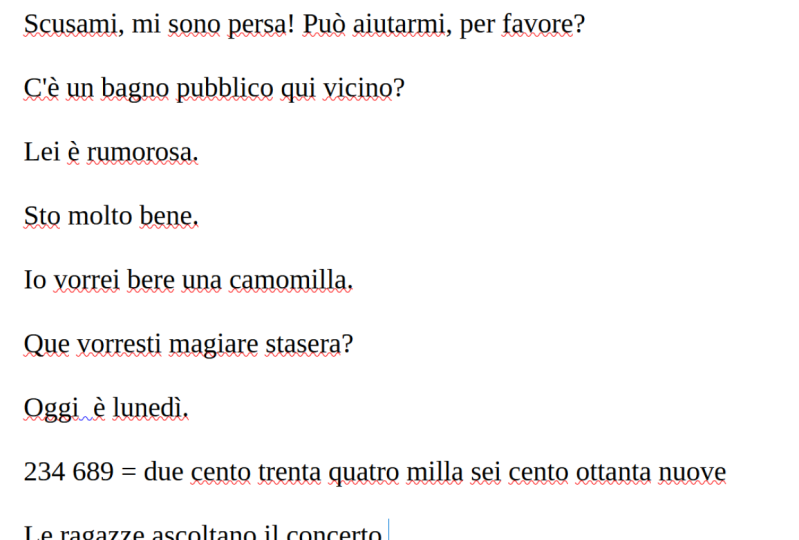
14. How to Ask for Directions in Italian: Hello, everybody. In this course, we will talk
about directions in Italian. We're going to see how to ask for directions when
we are in Italy. Let's start. First step, how to get
someone's attention. You can either say oa. I beg your pardon, or
Suzi Mu Excuse me. All of them are formal. Now, if you would like
to be more informal asking people your age or you
want to be extra friendly, you can use Schuza
or Skua Excuse me. Perfect. Now, you can also say
Mono Persa I'm lost Mono for masculine
singular and mesonoper for feminine singular and plural for masculine and
feminine plural. We are lost. Perfect. Now, if you would like
to ask information, you can say, may I ask you for some information or
can you help me? Can you help us? Perfect. Now, using the same phrase, if you would like to be
more informal, you can say. Can I ask an information
or Could you help me? Could you help us? Perfect. Now, if we want to combine those phrases to make
a question more clear? We can say Excuse me. I'm lost. May I ask you for some
information or I beg your pardon. Could you help us? Perfect. Now, informal Sufi. Excuse me. Can I ask you for
some information. We are lost. Could you help us? Now, if you would like to be, remember to use the phrase. Let's see how to ask
where something is. You can use the phrases Dove, where is Dove where are. The construction
begins with Dove where followed by the verb to be conjugated either in the third person
singular or plural, depending on the
noun that allows. That's an easy way. Now,
let's see some examples. Dove Where is the station Dove Public Where are
the public restrooms. Okay. DV Domo, where is the cathedral Dov Where
is the hotel? Perfect. Let's see some more phrases. Duvi where is located. Do We are located. These tracts and meaning are similar to the previous
expression with the verb to be located,
replacing to be This expression is
slightly more formal and typically used when
seeking recommendations. Let's see some
examples restaurante. Where can I find a
good restaurant? Where can I find a good
parking around here. Now, let's see some more phrases that would help us
ask information. Qui Is there near here Cuo Are there near here? These questions
are typically used to inquire about
specific services, businesses or
stores in the area. Now, let's see
some examples. Co. Is there a bakery near here? Civic. Are there any
restaurants nearby? Another useful phrase is
Such Cando I'm looking for. With this expression, you're
explaining what type of venue or service you're looking for hoping to get some help. For example, Studi. I'm looking for a pharmacy. Studio. I'm looking for a
bookstore. Can you help me? Now, let's see another phrase. P two, Panda to go two. These questions can
be used when you have a specific destination in mind. And you can also use these questions when
you're in a hurry. Let's see some examples. Porto to the airport Hilton
to go to the Hilton Hotel. Perfect. Now, don't forget
to add the phrase. Let's explore the names of
common points of interest. Let's start Ilbano Publico,
the public restrooms. Centro, the center I
Duomo the Cathedral, the Museum, parco the park to the port pronto Corso, the emergency, La the church, aspang the beach, LaFer the bus stop the stairs, a the main scare
the police station, Por the airport the bus station
the train station, L D Metropolitan
the metro station. Let's see some vocabulary more. Lo the hospital, Lupost
the post office. L niverita the university,
an a mechanic. A hotel. Un Centro Commerce
a shopping mall, taxi Ueno a gas
station, Un Medico, a doctor Una Lavanderia
a dry cleaner, store restaurant supermarket, nego shop, Una Banca a bank, una Pan a bakery, una Gela, an ice cream soap, Un Parqgo a parking spot. Now, let's practice Formula Fermata dela Metro Excuse me. May I ask you for
some information Where's the nearest
metro station? Merav rol I beg your. How can I get to the
archaeological Museum? And informal Excuse me. Can you help us? Where
is the train station? Pero Hilton me for
the Hotel Hilton. Perfect. Now, if you're in a hurry or you forget
all those phrases, you can simply ask
Suzi Suza Dove. Excuse me. Where is And if you don't understand what
the other person responses, you can use Can you
repeat that, please? P for informal and formal. Or you can say Do you mind repeating that T
for informal and formal. That was today's lesson. Don't forget to
practice again and again and I'll see you
on the next course. A
15. Italian adjectives and their opposites: Hello, everyone,
and welcome back. In this course, we will see 50 basic Italian adjectives
and their opposites. This course is full
of vocabulary. Take notes, and don't forget
to practice. Let's start. Grand grand Pico Pico Veo Vecio At Alto Bao Bao Magro Magro Grasso Grasso Lee Pete Bello Bell Brut BrutoFacFac Difici Difici Morbid. Do Do Vloc Valcentent Fred Fred Cardo Cardo Malo Sano por Moore Rumors Rumors Cielo Mo Mo Bianco Bianco Bravo Bravo Co. To Ordinat Ordinat Disordinat Disordinatd. So Labor Labor Pro Pro Dolce Dolce Amaro Amari Pio Sikora Sikora percs percso
16. The days of the week in Italian: In this video, we
will see together the days of the week journey, Del Stana Monday, Mart Marte Tuesday, Merc Merc, Wednesday,
Jove Jove D, Thursday, V D, Verdi, Friday, Sabato, Sabato Saturday, Dominica
Dominica Sunday. Let's repeat them
all in Italian only. Let Sabato Sabato Dominica. Dominica. Now, pay attention because the days of the
week are masculine, except for Dominica,
which is feminine. We use the article el
except for Dominica, which is a Dominica. This happens because the day or, which means day in Italian
is masculine itself. In the day. Now, let's see some phrases connected to the
days of the week. Lactam, the week, pinsetmana pinsetmana
the weaken, which is masculine and pinsetana
pinsetmana the weakens. What day is today? G means today is Friday, Doman tomorrow Dopodman
the day after tomorrow, yesterday, alter the
day before yesterday. Now, let's repeat them all in Italian only Dmmani alto Now, pay attention because we
don't use the article with the days of the week unless we talk about a
repetitive action. For example, ven Friday,
led every Friday. Unlike in English,
the days of the week in Italian are not capitalized. Unless, of course, they are at the beginning
of the sentence. Did you know that days in Italian are dedicated to the
planets of the solar system. Lund is the name of
the moon Italian. Marte is the day of Mars, Marte Merc D is the
day of Mercury, Mercurio Jove D is
dedicated to Jupiter, Jove, Verdi to venus veneer, Sabato, however, which
was once the day of Saturn, Saturn in Latin, in modern Italian,
takes its name from the tradition of the Sabbat
the Jewish Day of rest. Domenica Sunday is
the day of the Lord, as it comes from the
Latin Dominus Lord.
 Joylingua