Transcripts
1. Introduction to Chinese Calligraphy: Hi, everyone. I'm a be a compliment Chinese. I studied at history on and in particular I love Chinese art. Uh, practicing calligraphy is something that being doing for many years now, always a Chinese. Consider calligraphy as the most highest art forms. It is also a very effective way for you to connect your mind and body on gun this time were about your in a psychology. So practicing calligraphy is indeed quite simple, as it doesn't require a lot of space, but it requires just a few basic tools. So in this course, I like to give your basic introduction to Chinese calligraphy to talk about the basic tools of material that we use for Chinese calligraphy, the different kinds of scripts that I was still practiced today. Andi, also the basic strokes that we use the most common script to regular script. So by the end of the video, you'll be able to race your 1st 2 Chinese character. So don't be afraid if you don't know anything about Chinese characters because all you need is to focus your mind, let your energy flow through the movement of the brush onto the paper. All right, let's start
2. Basic Material and Tools for Chinese Calligraphy: to learn about the basic material and tools for Chinese calligraphy. Let's take a look at this picture. So you see, there are only four items in this picture, isn't it? Very simple. So indeed, practising Chinese calligraphy is very simple, so you only need to four items. So let's take a look at each item one by one. Let's take a look at brushes there just so many kinds of Russians that is hard to introduce every one of them. But it depends on like whether you want to write smaller carriages, a logic heritages. So for this one that you can see from the video that this is like a medium size off brush that you can write like from small two rather large characters, so you can see if this is so much bigger. Brush our processes for logic. Heritage's on. Ah, you may asked like Oh, I've seen some rushes, like with white. Her hair, you know. Ah, so what are the difference between the ones biz white hairs and those like this one or the one that you've seen just now that I know? It's like brown in color, So personally I like of this brown color, uh, rushes because thes brown haired brushes made off, um weasels or Woolf's the more flexible when you write. But for the white hair brushes there laid off Coach, which is like, you know, when you're right characters is less flexible. So I prefer these brown hair brushes. So now I would like to show you how to hold a brush. So first he used your middle finger and just some to hold a brush, and then you share index finger to support it and the rest of the two fingers to hold the brush like this. All right, In this way, it's actually pretty secured. You may try it yourself on to make sure that is not too low when you hold a brush. Andi not too high either, because both ways he will be out of balance. The best is to hold a brush somewhere in the middle like this, have to talk about brush. He comes Inc anxious, made off suit and animal blue andan. The old days are actually nowadays some people still grind their own ink with the use off ink stick and xto, but you can see from this picture that I want to show you that he's ready, mate. Inking bottles there actually, really great. And you can actually find them and ordinary stationary shops on its spread sheep on. And it's like Izzy to purchase, and you can start practicing very easily. So I recommend these kind off already makes in Kim bottles. So since I recommend the bottles off ink, so you just needs a simple plate to contain the ink, you can just find an ordinary plate to know from your kitchen and to start practicing quickly. Ah, this might advise for beginners that, you know the idea is to practice instead of finding very fancy tools, and you still haven't even started. So ah, that's why I recommend some simple tools for beginners. So after you open a brush with water and then you dried it up, you can start using your brush by dipping, Inc. So make sure that you used a whole body of the brush the hair part. But no, only the tech cart, so you soak up the brush was Inc totally, and then you can remove excess pink by using the edge of the plate. Make sure that, uh, the whole part of the hair. It's being used. So here comes the force material paper. We call it shun paper or rice paper. So there are actually two kinds of rice paper, one this role, and when it's right, one that's right to be at protest. Symbolism into it make it less absorbent to water. This is the kind of paper we used for calligraphy on for the role paper. We use it for painting mostly mainly for ink wash until after there is the flirt kind, which is half and half. So you see that this trend paper is quite translucent and I also use ah, pat like made of felt, to put it under the youth to paper in that practice in order to protect the desk and also to make the paper and no less heart. And it's good for practising writing.
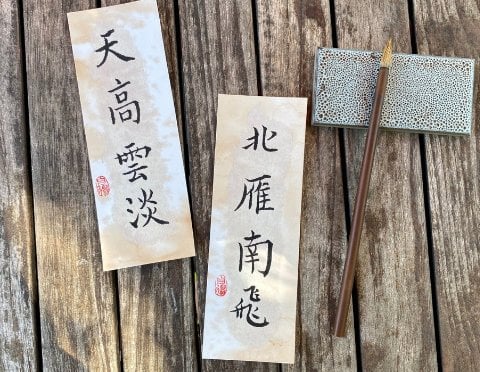
3. Different Scripts of Chinese Calligraphy: then I like to introduce two different types of Chinese scripts that was to practicing. Today was the 1st 1 is still script. It started Ah, around 1000 BC and Zhou Dynasty, and it became unified in Ching Dynasty around 200 something BC. So this was actually not the first script in China, but, uh, you know, the 1st 1 of us are Coppola's script, but this one distills Gripped was to practicing today as humane notice that you know your name itself is called seal script. We're still using the script on still engraving, so you can see from the video that's of the carriages. You know, the strokes electric. What you don't get it on. Each character is very picture risk because off this secrets of character, we still used the script on sale Engraving. Unlike the sales script, which is having round corners and elongated in shape or classical script is quite different . It was popular in the early hind dynasty, and you can see the characters. Them bulls square in shape and also sometimes is more compressed. The strokes, for example. It's characterized by having a round head, and it ends with suppressing stroke which is slightly lifted at the end. So you can see that these characters they look more stable on the most sacred. So it was actually widely used for monuments in the past. For beginners actually recommend you to stop practicing was quite full script or the regular Scripture, which I will introduce later on because both groups actually pretty easy on snow so that you can actually practice the basic techniques of Chinese calligraphy. The regular script was developed from the Clare Coast ripped, and it wished this maturity during the Tang Dynasty electing clerical script, which was exaggerated in his drugs regular script. The strokes actually tend to be not exaggerated on they look regular, so this form is most commonly used for everyday life. Andi in all printed matters and such but beginners. I highly recommend to start learning regular script. So in the later part off the video, I'm going to teach you to eight basic strokes off regular script, and after you learned all these eight basic strokes, basically, you can start writing regular script yourself. The running script is derived from the regulars gripped, and it's also apparent off the crests of scratch. That's why it's also known as the Sami Crest of script. From Patch to the regular script. It's officer less regular. It looks flowy. You can tell the person who writes to calligraphy a secretary writing pretty quickly. Andi, if you compared to cursive script is less quick on and you can see that each character stands on this. So without linking each other, that's running script. So when a script ISS used for everyday life, for example, writing letters because you don't need to write very slowly on the person who reads the letters one Einstein what you're writing, as we mentioned just now, that's the custom script just arrived from the running script and the difference between these two scripts as that repressive script. Each character's links to each other. So you can tell that you know the writer actually seldom takes away his brush from paper instead of talk about practicality. CASS. If script is more known as a not for because most strokes are omitted when writing, so even if you're Chinese doesn't mean that you know you can reach press of script. Cursive script is also the origin off Japanese hero Ghana script, and that's why you can still a lot of similarities between these two scripts
4. Learn the 8 Basic Strokes of Regular Script: The first basic stroked that I would like to introduce is to dot So I prepare on the left the direction and red line to show you how to move your brush, and I also use and so to trace, um, direction as well on your practices. You don't need to do that. Do you see the direction like a circle? Let's try another one. You go up and make a turn and you go up again. That's deduct. The second stroke has the horizontal you can see from the diagram. It actually generally is written from the left to right. But you can see the direction and red line that first you have to make a turn and the idea and you have to make another Turness. Well, let's see how this this written and you go up again to end the stroke. I hope this is clear and let's see another one. So this is the horizontal stroke, similar to the hurry Santel struck. Here comes vertical stroke. There's also written like this with both ends. You have to make sure that the bush moved inwards with up and then go down. Show your hand study when it comes to the end looking up again. So that's a vertical stroke. And let's try another one again. I hope it is clear it's a portico stroke. So now we talk about the fourth stroke, which is the hook similar to the portico. Stroup will first write a vertical line and then the hook. Let's see so it against of 40 post rope, and then you wait at the bottom to make sure that the brushes of the right angle and then you make the hook. So let's try again, can the political stroke. And then So now we talk about the rising stroke. So you see this one. It looks like a tick on. Do make sure that you know it. Your brush goes down. First interest to make a point there and then both up with some speed. All right, what is the writing stroke? Let's try again. You go down and ending both up. That's the rising stroke. Let's talk about the pending stroke. It is a stroke from the top right corner, most to the bottom left corner. I see. First you make a turn and then you make Kirsch down to the bottom left corner. So this is the band stroke. Let's try another one. Nick Turn. You moved downwards. Flicker down to the bottom left corner. I hope this clear. It's a band stroke. They can look at the throwaway stroke, so you may ask, Like Old is his first similar to the bench stroke, but it's actually quite different. You see that this this much shorter. And it was out, the kerf Let's try again, but moved down and then go straight to the bottom left corner without the Kirsch. So this is the throwaway stroke. So now let's try the very last basic stroke, which is depressed down stroke. So he actually moves from the top left corner. So the bottom right corner make sure that you actually stop as a lowest point and then moved to the right. Let's see again, you moved down and then stopped there at just to brush and then moved to direct. That's to press down stroke
5. Let's Write Our First Chinese Character: so now learned all the eight basic strokes of regular script. We can write our first trainers character, but this is a character named has your You Know, which means eternity. Nets dot You have to Dutch always sandals troop. And if Oracle stroke Nanda hook the rice stroke in the bend stroke, I just throw away stroke and lastly, the press dash look so that saved once again docked hurry song to a stroke and the vertical rice stroke, and then depend throwaway stroke, a depressed down stroke.
6. Project For You: now here's a small exercise for you with the basic strokes that you learned so far. Now it has returned to write your first Chinese character that see if you can write the character, your home or yourself. Don't hesitate to go back to any parts of the video and city again. You're most welcome to send me your work and we can discuss more.
7. Final Thoughts: I hope the judges introductory course on Chinese calligraphy. Feel free to contact me and let me know if you have any comments. Questions. I think that you would like to lie regarding Chinese art and culture. If me a message and I'll get back to use it. See you.
 Amy Chan, Art and culture lover