Transcripts
1. Intro: Hi. My name is Karla Alcazar
and I'm an art illustrator. In the last few years, I've done published work
for books and magazines, I've been plotting some
secret personal projects and I've also been a top
teacher here on Skillshare. As artists, it's really
important that we create sustainable
drawing habits that can help us
develop our own voice and also help us improve
our overall drawing skills. But what happens when inspiration
is no near to be found? How are we supposed to practice and make drawing a habit if the motivation
tab has gone empty. I'm sure, we have
all been there. When I was starting out my
journey as an illustrator, I would frequently feel stuck and would struggle to
find inspiration to draw or to find a subject
that could help me improve my drawing skills or to find my own voice. I really needed a little push that could help me practice. This is when I discovered
drawing challenges. Drawing challenges can
give us that little push that can help us feel inspired and get out of our comfort zone, while giving us the
space to practice and create better drawing
habits and skills. In this class, I would like
to share with you some tips and tricks that
drawing challenges have taught me
throughout the years. All of these, as we complete our very own
illustration challenge specifically created
for this class. As we complete our challenge, we'll practice our
drawing skills and habits and strengthen our
problem-solving abilities, amongst other great things. To complete a drawing challenge, you'll need simple
drawing materials such as pencils or markers, but if you would like
to work digitally, please feel free to do so. We will also need
some blank paper, something to write with, and lots of curiosity to
approach this challenge. You'll benefit from this
class if you have been feeling stuck in
a creative slump or not sure where to
go with your style and would like a little project
to get things moving. This class is great for beginners
but I think you'll have fun completing the challenge
even if you're experienced. I hope that by the end
of this class you feel inspired, more confident, and with a different
perspective on how to approach your
illustration practice. I'm super excited
to have you here. Hope you join the challenge, that you enjoy this class,
and that you have fun. See you in the first lesson.
2. Drawing Challenges: [MUSIC] Since this is going
to be a hands-on class and our class project will be participating in this
classroom challenge, I would like to
briefly explain what a drawing challenge is for those who are not
familiar with them. Drawing challenges invite those who want to participate in them to create drawings based on a specific theme, for example, characters or botanical
illustration, using a series of
specific prompts or materials usually to be completed in a set
amount of time. For example, we have Inktober, which I think is one of the most popular drawing
challenges out there. Every year, 31
prompts are released. The challenge consists in creating a drawing
based on the prompts. This means one drawing per day during the month of
October and using ink. There's also Mermay, which happens every year
during the month of May in which you get to draw
three one mermaids, one for each day. There's also a list of prompts
for this challenge too. There's also the hundred day
project in which you commit to do 100 drawings and you
get to choose a subject. I completely understand
that 100 days or even a month can seem really daunting and
hard to complete. But luckily, there
are other challenges that require way less time. There are challenges
like draw this in your style in which
you interpret someone else's single drawing so there's no time
constraints there. Similar to draw
this in your style, there's the draw again challenge in which you get to interpret an old drawing of yours
into a new present version. These are just to name a few, but there are so many different drawing
challenges that you can do based on your interests and your time availability and, of course, you can create your own drawing challenges, as well. For this class, we are going
to create our own challenge, which I'll explain fully
in the next lesson, but before doing that, and just in case you
are asking yourself, why would we even want to participate in a
drawing challenge? What's in for me? I would like to briefly
highlight the benefits of doing a drawing challenge and how they can be helpful to us. The first benefit is
that they can take us out of a drawing
slump really easily. Sometimes, all we need
is a little push to get the ball rolling when
we're feeling uninspired. By having a list of
inspiration sources or prompts at our fingertips is actually quite easy to
get things started. They give you an
excuse to practice. You have probably have
heard this a million times, but we need to keep practicing
in order to improve a skill and challenges can make our drawing
practice more fun. They help you with consistency. This is key when we're
trying to improve our drawing skills or any
skill for that matter. Practice is really important, but it's even more important
for our practice to be consistent in order to
turn it into a habit, then is when we actually
start seeing improvement. Our drawing muscle is
like any other muscle, it needs time and consistent
effort to develop. Drawing challenges can help
you draw a bit faster. This was a huge
thing for me when I started my journey
as an illustrator. Drawing a specific
thing could take me a really long time and I would
be such a perfectionist, I would get
frustrated and, poof, inspiration and my will to
draw work up for the day. Drawing challenges can
help us in this matter because since we're
focusing on an end goal, this is a certain
amount of drawings, we don't over-focus on one single drawing and
how good this one is. Time limit really helped
with this one too. They take you out of
your comfort zone. This is perhaps my
favorite benefit. Drawing challenges
not only prompt us to draw more
consistently or faster, which maybe out of our
comfort zone already, but these challenges might
require us to draw things that we wouldn't have not even thought of
drawing, otherwise. In other words, we get to
improve our visual language and our problem-solving
abilities and we'll talk a little bit more about
this in upcoming lessons. They give us the opportunity
to practice and work on our own illustrative
thinking abilities. I think that sometimes we see
drawing or illustration as a skill that has everything to do with how good
our technique is. Lateral problem-solving
abilities when we draw are equally as important
as our technical ones, because this ones will help
us to get more clarity on how we want to say
things and as a result, it can help us to find
our own artistic voice. They help you build
a body of work. If you're doing illustration
more seriously, drawing challenges can be a really good way
to help you build a portfolio and also create content for your social medias. Last but not least, they help create a
sense of community. Drawing challenges
are a great excuse to connect with
other illustrators, to be inspired by them, and to show support to each other and who doesn't like a little challenge
every now and then. Knowing how can a
drawing challenge can help us in our drawing practice, let's talk about our very own challenge in
the next lesson. [MUSIC]
3. Our Challenge: Our final class project
will be to complete the drawing challenge created specifically for this class. In this lesson, I will
explain what the challenge consists of and what will
we require to complete it? Let's begin with our
challenge theme. All challenges need a theme, and ours will be narratives. Narratives or little stories can be so much fun to explore, and they can also give us so
much material to work with. Let's talk about the
number of illustrations and the time we have
to deliver them. When I was planning
this class project or this drawing challenge, one of my main goals was
to make it sustainable. To keep it nice and easy, our final product will
be three illustrations. I would suggest aiming to complete one
illustration per day and doing them in
consecutive days in order for you to
practice consistency. But if doing a day
on and a day off is more sustainable for
you and your schedule, please feel free to do that. Now let's talk
about the prompts. For this class project, we will use four prompts
for each illustration. Two prompts will be
completely personal, and we will use this two consistently for all
three illustrations. The other two will
be communal prompts. This is, we will all
be using the same prompts and things will
change for each illustration. This will be related to
our challenge theme, which is narratives. In the next lesson, we
will start our challenge, and I will explain how to
obtain our personal prompts and how both communal
and personal prompts will benefit during
the practice. Another important thing
to consider, materials. In order to maintain this
project sustainable, this is to keep the challenge
nice and achievable, we're going to try and
use simple materials. I highly encourage you to use a very limited
color palette. Something from two
to three colors, and to maintain the palette consistent throughout
the challenge. In my case, I will use markers, which is a medium that
I'm very familiar and comfortable with. But I will just be using these three to keep
my palette limited. I will also use a pencil and eraser to do
the sketches and a fine felt-tip marker to
add outlines and details. You'll also need a sketchbook, but if you have been
worried to use one and depending on
the medium you use, plain printer paper
can also work. I will be using printer paper. If you prefer to
use digital media, that's completely fine, but I would suggest you to use no more than three brushes and a limited color
palette as well. You'll also need a bit of
paper to make little notes and something to write with. I will be using these. We want to keep
our illustrations relatively simple
since our main goal is to feel inspire and
to feel like we actually want to draw and
explore new subjects. I would suggest to not worry too much about the looks
of the final result. But if one of the final
illustration inspires you to create a more elaborated
version, please do it. I would also love to
see it and please upload it to the
project section too. To sum it up, we will
create three illustrations, ideally one per day. Our theme will be narratives. We will use four prompts
for each illustration. Two prompts will be personal, and we will use these two consistently for all
three illustrations. The other two will
be communal prompts, and things will change
for each illustration. We will use simple and
easy-to-use materials. Please don't forget to post your illustrations to
the project gallery, and if you have questions or would like specific
feedback on your project, please feel free to ask. I'll be happy to
read your comments. Also, as with other
drawing challenges, we're going to have
our very own hashtags, so you can find each other's
drawings on social media if you wish to post
your project over too. We're all set. Let's start our challenge with something
really fun and easy. Let's see out our
personal prompts.
4. The Prompts: Let's start with a challenge. As we have seen in
the previous lesson, our challenge has a
total of four prompts. Two personal and two communal. It's really important
that we have these two different prompts
for this challenge. Your personal prompts
are so important because if we want to get
out of her comfort zone, we need to do it from a place of excitement and a
bit of familiarity. It's difficult to
explore something if we don't feel at
least a bit confident and find the initial stages interesting and
inspiring enough. Plus, I really want to see that if you are through
your personal prompts. The communal prompts
are also important because they'll give the
challenge structures since they'll be linked to
the theme of this challenge, which is narratives. More of that in a minute. Plus, I want us all to
work with the same prompts because I find that many
different interpretations of the same prompts really inspiring. Okay, so let's see if we can figure out our personal prompts. Let's grab a plain piece of
paper and let's draw a line. Now, let's think of something that you really enjoy drawing, something that interests you, and something that you feel comfortable drawing
and write it down. For me, this is characters. I love drawing people. Characters never
fail to inspire me. This thing that you really enjoy drawing will be your
first personal prompt. This will be included in
your three illustrations. In my case, all three
final illustrations will contain a character. Now, let's think of something that you really
struggled drawing. Ideally, something that you
would like to draw that better or have more confidence
drawing and write it down. For me, it's animals. I've spend so much time
drawing people for work in practice that
animals is something that I have less practice with. This thing that you
struggle drawing will be your second
personal prompt. This will be included in
your three illustrations. In my case, all three
final illustrations will contain an animal. Now let's go over the
communal prompts. Since the theme were
challenges narratives, which is in simple
terms a story, and since we can tell a story without emotions in present, emotions will be the
first communal prompt. As we mentioned before, the communal prompts will change for each of the final
three illustrations, and to keep things fun, we will use a
generator to give us a different emotion
for each illustration. This is a generator
that we will use. I use this generator
quite frequently because it has so many different
subjects to choose from. I will leave the link
in the resources tab in case you want to explore
it on your own, a bit later. The second communal
prompt will be an object. This object will also be randomly generated by
the website mentioned. By using different objects
in our illustrations, we will get our narratives
or stories, some context. Now, all we have to do is
to think of a story that includes your two personal
prompts in my case, a character, and an animal, plus the communal prompts. Now we're ready to start
with our first drawing. If comfy, make yourself
a cup of tea or coffee, get some snacks, and
let's get ready to draw.
5. Challenge: Day 1: Hi. Welcome to Day 1. We're now going to do
our first drawing. Please feel free to draw along, or if you prefer to
do your illustrations once the class is
over, that's fine too. Let's find out today's
communal prompts. Let's go to our generator. For emotion, we
have satisfaction, interesting one, and for
object, we have umbrella. Great. These are our
first drawing prompts. For mine will be a character, an animal, an umbrella,
and satisfaction. Now, all we have to do
is to think of a story with these four elements. Don't worry, it can be
as simple as you wish. The very first
thing that comes to my mind is a boy with a
cat walking in a rainy day because they have an
umbrella with them and they feel
satisfied about it. I'm going to write it down. Now, this is not a bad idea, but at the same time
this is just one of the many ideas that
we can think of. My first step would be to
never go with your first idea. The reason for this is because usually our brains go
with what's familiar, and if we want to
improve a skill, it's very important that
we push ourselves out of our comfort zone even if
it's just a tiny little bit. It's important to explore
other possibilities so the result feels exciting and for this to be
a true challenge. I promise you that exploration
will always pay off. In a piece of paper, I
would like you to write a few different ideas so we can compare and see which
one excites us the most. For me would be maybe a
cat happy to be under a garden umbrella and seeing a kid walking by getting
soaked by the rain. Well, the cat feels pretty
satisfied about it. I immediately feel more
drawn to this idea, but let's explore another one. Another idea could
be a kid leaving his umbrella behind so
the cat can have shelter. Even if you liked
one particular idea, I would suggest you to sketch
that idea in several ways before you start with
your finished piece. We could carry on generating different ideas until it
feels right and exciting. You could also vary the
elements a little bit. My case, I could change the boy for girl or an adult even, I could try a dog or a
squirrel instead of a cat. But personally, I would
leave the boy and the cat because I would like to
get better at drawing these two specific
things at the moment. That would be my second tip. Be mindful of the
things that you might not have much
experience or practice with and try to incorporate those
things into your drawings. For example, I really
like to draw characters, but I tend to draw
lots of girls. I rarely draw boys, mainly because I feel a bit unsure on how to do their hair. Another tip would be to identify what is exactly that scares you about drawing a specific
thing and combat that fear with doing
some references. This could be online. I love Pinterest to do
this or real life as well. For example, I really
like the palette here, but I also like how
flowy his hair is, so I think I'm going to use this image as reference
for the hair. Knowledge is power. Once you know how to
tackle a problem, chances are that you'll
feel more excited and confident to
draw new things. Once you actually start drawing, it feels less scary. When I did 100-day project, I turned it into 100
days of memories because I really wanted to
work on my narrative skills and there were so many things
out of my comfort zone but I ended up having a
really good time in the end. This project helped me
to think more deeply on how to draw narratives,
backgrounds, facial expressions, just
to mention a few things, and this has helped me
enormously in my career. Now that we have our sketch, let's start to add color to it. One of the reasons why
I wanted us to use a limited color palette for
this project was because I thought it was really
important for us to figure out ways to use
our limited resources. In this case, how
are we going to distribute the colors
in the illustration? Now, these things
I've mentioned in this lesson are related to working on our
problem-solving abilities. Working on our problem-solving
abilities is quite easy. By asking ourselves
questions such as how, why, and what will help us to stop running on autopilot
when we draw. For example, how can I
draw this more clearly? What is particularly
working here? Being on autopilot
contributes to feeling stuck or having creative slumps. This is why it's super important to work
on problem-solving. Also, when we do
referencing when we are unsure on how to
draw a certain thing, we're working on our
visual language, which is part of our
problem-solving abilities. Visual language is like
any other language in which you learn new words
until you become fluent. In this case, you'll
learn new ways of drawing certain things or to think in any way until
it becomes second nature. I feel that sometimes we focus
on improving a technique or on how good a drawing are that we forget
that improving our problem-solving
abilities can actually help us to
improve a technical skill. For example, drawing hands
would really scare me but it was only when I
figure out that the reason why hand seem so difficult
to draw for me was that I saw hands as a unit and not as something
that has articulations, independent movements,
and weight twofold. Practice is important, but if we are unclear
on what's not working or working in our drawings and what really scares us the
most to draw certain things, we might really
struggle to improve. Again, knowledge is power. Also, approaching our struggles with eyes of curiosity
and seeing it as something that we can
actually solve instead of judgment can really help
with our confidence. Also, if you want to become
a professional illustrator, it's really important
to strengthen our problem-solving
abilities even more because it's really
important to be able to communicate what
the clients needs us to communicate with our art. What works, what
doesn't, and why. Now, I'm really liking how
the illustration came out, but I just noticed that this pen is actually quite thick
for the cat line. I'm not going to use it to
outline the boy's face, but I'm going to use it to
add a few other details. One last thing. If your creative slump is
really intense I would recommend to do little
changes in your routine. Maybe going home on
a different route, wearing an outfit you might
not have worn in a while, listening to new music, try a different genre or
film, this can really help. It's all in the little things. That we forget that we
only need a little moment of magic to get us out
of a creative funk. This is the final illustration. One of the things
that I really like about this illustration
is the hair. I really felt
confident to draw it like that having the reference, and I think that I managed
to capture that flowiness that I liked from the
reference picture. I also really liked
the overall textures that I created with the pencil, specifically on the boy's
face and the bushes. One of the things that I
really didn't like about this illustration are the
really thick outlines. I think that probably
I should have done it just with pencil because they just
feel a bit odd to me. I'm not quite happy with
them, especially the table. I think that I find them a
little bit distracting and also they were a bit too
thick to draw the cat spades. But I'm actually pretty happy overall on how this
illustration turned out. I definitely would like
to do a different version and perhaps using a
different color palette. Let's do a quick
recap of the things that we have talked in Day 1. The first thing is to never
go with your first idea. Trying different options can really help you to get
out of your comfort zone and that's a real challenge. Be mindful of what you might need to practice
a little bit more and try to incorporate those
things into your drawings. If drawing something scares
you, try doing references. Having a more concrete
idea on how to draw something will help
you to feel more confident. Working on our
problem-solving abilities can help us to get
out of autopilot, and this can be done
by simply asking yourself questions like
why, how, and what. Last but not least, try incorporating some changes
into your daily routine. They can be as
simple as you wish. It's all in the little things. See you in Day 2.
6. Challenge: Day 2: Hi and welcome to Day 2. Let's find out today's prompts. We have anticipation, and for object, we have toy car. My first idea is a kid opening
a box with a toy car in it, and maybe there's a
hamster in there too. The second idea, you know, those electric toy cars and you're big enough
for you to ride them. I always wanted one,
but I never got one. Maybe the sick kid really
anticipating their first drive. For this one, I would like
to call it a hamster. Last idea, maybe a kid really anticipating
buying a toy car, maybe waiting for his
toy store to open and to have their dog with them. I like this one, but I find
more exciting the second idea. For this one, I
would draw a girl just because I always
wanted one of those cars, and I want to be
carriers who lived that experience through
my illustration. Well, I do my illustration. Let's talk about
consistent drawing habits. For my sketches, I
did a complete side, the one which I really like. I also did a three-quarter one and you can actually
see the face here, which is really important. I did a third one that
he's completely frontal, but you cannot
really see the car. I think I liked the
first one better, but I'm gonna go
with the second one. I understand that
sometimes life gets hectic and it's really hard
to dedicate time to things that we love. I'm pretty sure that
you've heard many times that you need to draw
it daily to improve. While this is accurate, I think it's also really
important to consider that not everyone has the
privilege to do that. Work, mental health, other responsibilities
we might have, amongst other things, can make it difficult
to draw every day. I can appreciate that this
can be super discouraging and this can feed the
creative slump cycle. What can we do about this? Personally, one of
the things that has helped me the most
when it comes to making my art practice as
consistent as possible is working on what I call
whatever tiny projects. When I was starting
out as an illustrator, drawing something would take
me ages. I was so slow. I was so precious about any
drawing in my sketchbook, and I would get so
frustrated for not getting things right or to
even finish a drawing. I would fantasize
about maybe one day doing a comic book
or a graphic novel. But just to think the
amount of hours I would spend on projects like those
would really discourage me. The thing is, I wanted that every drawing in
my sketchbook was a finished piece instead of a small series of
tiny practices. It took me a while to
accept that sketchbooks are for sketches, not
for masterpieces. It was then when the
pressure started to go down and I could focus on a
single task for the day. Whatever the result,
maybe when Austin unique, I remember I started to do
this thing with backgrounds. Since I was busy with
school and work, I would give myself
10-20 min per day, roughly to sketch an
experiment with backgrounds. In this way, I accepted
that in 10 min I was not going to come
up with a masterpiece. That was okay. It's ironically, I started
to see that the drawings that would take me less
time were actually the ones that I liked best. This is because there were no
pressures attached to them. I could free myself and I would allow
my drawings to be what they needed to be. I started to actually
have fun instead of draining my drug
practice into a burden. I always say, you can tell if a person had fun drawing by just looking
at the drawing to a specific task and
give it a timeframe, it feels more achievable
because expectations are clear. This is why I love drawing
challenges so much because they're very
clear on what to do and how much time
we have to do it. Now, don't feel bad
if you can only carve out a few minutes per
day or per week to draw. These few minutes over time will definitely make a difference. The important thing is
that you enjoy yourself when you draw in order
to make an exciting once you pick up where
you left it off. I would recommend to maybe making a list of things
that you would like to get better at and try to make
it as specific as possible. For example, if
you would like to get better at character design, maybe think on the specifics
leg, maybe drawing, facial expressions, poses, etc. Give herself a week, month or whatever is
sustainable to you. This can really help to
get the ball rolling. Remember, the important thing
is to create consistency. It becomes a habit
not to become pros and a limited amount of time. Another thing, when I was
working on my peripheral, I accidentally created this
little routine of having some snacks and much comfort
shows when I was drawing, I started to
associate this lovely time of day with a
calming and safer as you. That definitely made
me want to draw more. Even to this day, I associate drawing with pampering myself. Remember that our daily routines heavily impact our
creative ones. A few years ago, I started to hear a lot
of people complaining about until her for
being quite demanding. I understand 30 daily
finished drawings can seem like a lot. This is why I would also
like to encourage you to adjust any drawing challenge
to your particular genes. Never feel ashamed for not completing a certain
drawing challenge. What matters is
that you actually enjoy the process and
then you feel excited. As Bob Ross one said, every drawing teaches
you something. Talking about what I have learned from this
illustration is that I have to
admit that I am not particularly fond of this one. I think everything feels a
little bit compacted in a way. I think next time I'll be
more mindful of proportions because I think that
maybe I should have drawn the girl first
and then the car. But I think it's also
worth mentioning the things that I
actually really like. The expression of the hamster I really like. That's really cool. Let's do a little recap of what we've talked
about in Day 3. Consistent drawing habits
are really important if we want to improve a skill. However, life sometimes gets
in the way, so to speak. It's really difficult to dedicate consistent
time to an activity, even if it's an activity
that we might love doing. Something that we
can try doing is giving ourselves out
whatever tiny project. We can try to do this by
making a list of things that you would
like to improve on and set a timeframe to
work on that activity, even if it's 10 minutes a
day and decide to do this for a week or a month or
whatever suits you best, but try to do it consistently. Also, it's really important to create a nice
environment or routine. Drawing feels like a
nice moment of our day. Like a burden or something that we have to do
in order to improve. Enjoying an activity
is important in order to make it consistent. See you in Day 3.
7. Challenge: Day 3: Welcome to Day 3, our last day for this challenge. But of course, if you would
like to practice some more, you can extend the challenge
as much as you wish. Let's see today's prompts. For emotion, we have smugness. Oh, that's a very good one. For object, we have
bottle of sunscreen. Maybe we have a boy who
is feeling quite proud to have brought his bottle of
sunscreen to the beach. Maybe we have a little
crab over there too. For the second idea, maybe the kid is trying to find his bottle of sunscreen
in his backpack at the beach and he can find it
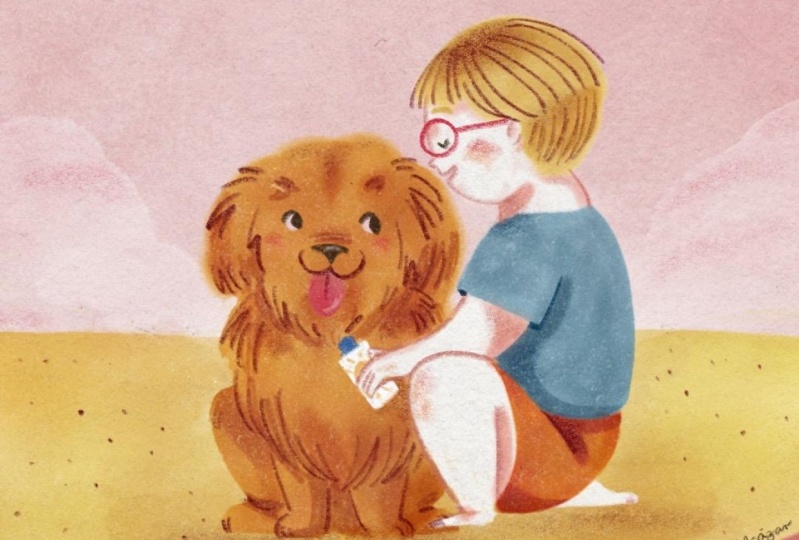
and the dog is happy because he brought it over. The third one, maybe the kid has applied sunscreen on himself and now on the dog and he's
feeling quite proud of that. I like both two and three, but I think I'm going
to go with number 3. While I do my illustration, let's talk about
our voices artist. For the final illustration, I actually decided to
sketch each individual idea instead of variations
of the same idea just to see them
all three visually, but I definitely still like
number three the best. I like this shape though. I think that one of the more
frequently asked questions I've seen being asked, not only to me but to other illustrators is
how do I find my style. I'm sure you've probably have heard more or less
the same answer, which is, you will find
your style as you practice. Although this is
actually quite accurate, I would also like to
add a little something and this is the
importance of creating or being part of
an art community. It doesn't matter how big or small this community may be, I think it's super important
to be surrounded by people who understand you and inspire you and that you can
learn from them too. I think that the most we expose ourselves to other
artists' ideas, influences, and their
personal styles, it's easier to discern which
ones resonate with us, and over time we're
going to be closer and closer to finding our own
personal voice or style. I'm going to recommend you
this book by Austin Kleon, Steal Like an Artist, in case you have not read yet. In very lovely and simple ways, he explains how everything out there is already been done. That everything new is just a reinterpretation
of something old. These interpretations
gives us big hints on our personal voice and how we see the world
or in other words, a hint of water voice
as an artist is. Considering this,
in order for you to re-interpret
something is important that you are aware of the many different
inspiration sources that other artists have and
that might interest you to. Sometimes we might meet
people with very niche and specific inspiration
sources that we might have not
discovered otherwise. This is why I'm
super excited to see your interpretations
of this art challenge. I'm sure they will be
super interesting. Now, our communities can be so inspiring and they can also encourages to complete
drawing challenges or to make our drone
practice more consistent. Think of an art community as having accountability buddies, you encourage them and
they encourage you. When I started out participating
in my first mentors, I was so surprised to see that other people have
resonated with what I made, that other illustrators and
no illustrators alike would comment on similar things like, oh, I like how you told
that story in particular or this illustration
is really good. This gave me an idea
of my strengths and made me more aware of why and how I wanted to say
things with my illustrations. We always have something to say. Sometimes all we need
is a lipid of clarity. Of course, it was
always super nice to also support other artists
in the process as well. Now think of this class and all of us here as a
little art community. Feel free to ask for
feedback to encourage other students all from a place of kindness and
respect, of course. This is my final illustration. I think this might be my favorite illustration of
them three, oddly enough, I think it's the one
that I spend less time with probably because
it's the simpler one and maybe that's something
that I need to consider for future illustrations that I'm
drawn to more simple things. That's really exciting. I can do more of referencing
on other illustrators that use that similar style
and find inspiration there. Maybe one of the things that
I'm not quite happy about this illustration is
just the dog's head. It might be too big, but it might be a puppy, so in that sense, that's okay. But probably in my head, I was thinking of an older dog, but it's not a big deal. I'm actually really, really
happy with this one. I actually do think the color is really sit this illustration. Let's do a little recap of
what we have talked in Day 3. We find our voice or
style through practice, but being part of
an art community can really help us too. This is because we are
exposing ourselves to other ideas or styles and this can help us get
clarity on what we like and feels closer to
us or in other words, we can figure out what
our artistic voice is. Sometimes feedback from
others can help us discern what our strengths are. Of course, if you ever
get back feedback, please take it with
a grain of salt. It's already difficult
to be an artist in putting your work out
for the world to see. An art community can be a very encouraging
and inspiring place. Thank you for joining
me in this challenge. Remember, it doesn't matter if you manage to do all
three illustrations or if you would like
to share works in progress instead of
a finished piece, or you would like to share a more elaborated version or one of your
illustrations too. Maybe you'd like to carry
on with this challenge and do a whole month or a week depending on your schedule. It would be super interesting to see what you come up with and I'm sure that
other students are excited to see
your work as well.
8. A Few Final Words: We have completed this
drawing challenge. Congratulations, I
hope that you had fun. In this class we talked about a lot of things
such as creating more sustainable drawing habits that are going to help us
practice more consistently, our voice as artists,
to problem solving and getting out of
our comfort zone and how drawing challenges
can help us as artists, amongst other things. I hope that you'll find the tips I've shared with you helpful and more importantly that
you feel more inspired, empowered and with a
different perspective on how to approach your
illustration practice. Please don't forget to post your illustrations to
the project section, I really would like
to see your work. Remember if you'd like
some specific feedback or comments on your project
please let me know, I'll be happy to assist. Also this is our drawing
challenge hashtag in case you would like to post
your work on social medias. This is my Instagram in
case you'd like to follow. Thank you so much
for being here. Send you all a big
hug and see you soon. Bye.
 Karla Alcazar, Illustrator and Teller of Tiny Stories