Transcripts
1. Introduction : imagine the scenario. You find the perfect picture book to read toe learners. The story line is important and the illustrations are gorgeous. But as you're reading, the book allowed you notice that not all learners air paying attention some of them might be lost in thought. Looking outside the window, this concerns you. You don't want anyone to miss out on the learning opportunity an important book has to offer. So how do you grab and hold on to the attention of everyone in the classroom? Hi, I'm worrying. Schlosser and I write lesson plans based on picture books. I am the co author of Lessons inspired by Picture Books for Primary Grades, and I also write for Library Lessons, Knowledge Quest and book pages dot com. By the end of this class, you'll know how to find a compelling picture book and sketch note. You're thinking while reading you'll use these skills to model sketch, noting in your class, I'll show you how to find a picture book that is perfect for sketch, noting for this class will focus on the book Her right foot by Dave Eggers and Sean Harris . I'll demonstrate how to draw a simple sketch of the Statue of Liberty. We'll practice drawing visual elements to show her thinking while reading the book. I structured the lessons this way, so you'll finish with a sketch note that you can share with your class. I'll give you tips so you can prepare learners to sketch note any lesson you deliver Sketched owning is important because it requires learners. Toe. Look closely and think deeply about the topic at hand. You could apply the sketch noting skills you learn in this class with any lesson. This course is aimed for educators who are new to sketch, noting, you do not need to be an artist to know how to sketch note. In fact, I'm just learning how to draw myself with the classes that I'm taking on skill share. My background is an education, not art. I am a former school librarian and classroom educator. There are so many books that inspired great learning, and I love sharing ideas with educators. Take a look at the next video to see the project that you'll be working on for this class
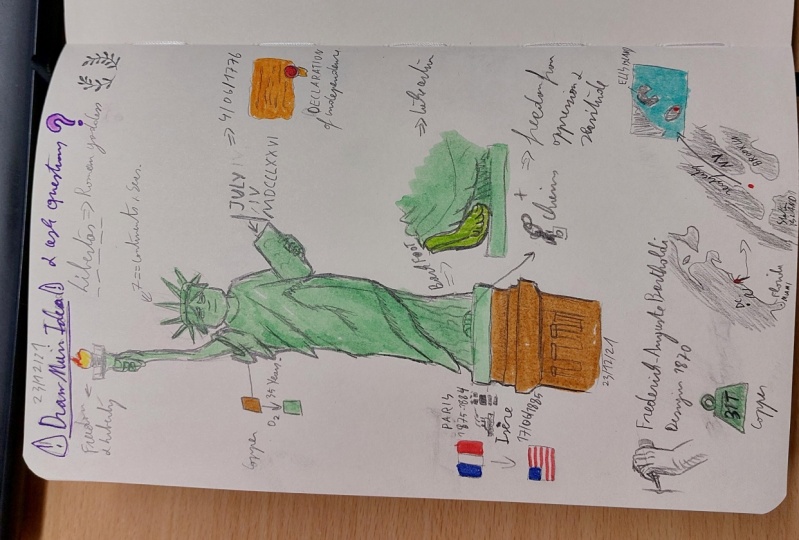
2. Project Overview: think of a picture book that compels readers take notice and wonder. Do you have that book in mind? Great. You can use that book for this class project. You'll also need a pen and paper will be creating a sketch note based on the picture book you choose. But if you can't think of the title, don't worry. I'll show you a website that has actors reading picture books allowed. You could choose one of their titles for your project. You'll start your sketch note by drawing the main idea in the middle of your paper. This can be on object, the title of the book or an essential question. Then you'll generate questions about what you notice and wonder while reading the book. You'll add visual elements to connect ideas and represent questions. The final step for this project is to take a picture of your sketch no and upload it to the project. Gallery will end up with many examples of sketch notes that you can use in your class choses projects, and you can practice sketch noting before demonstrating the process Toe learners. You'll notice a big difference in how you read picture books while working on your project , you'll find yourself noticing and wondering about details you would have overlooked before . Just imagine the impact this work will have. Unlearn er's. As a school librarian, I read lots of picture books, toe learners. I found that sketch noting was a great way to engage learners with the story. I noticed that they paid more attention to the story line and the illustrations, and they would always point out details of the artwork that would surprise me. Sketch owning comes easy to kids because they don't worry if their picture is not perfect. Once they see you modeling the sketch noting process, they will naturally start doing it themselves. I look forward to seeing the sketch notes you create. Let's get started by looking at the next video where I'll show you how to find a compelling picture book. So you there
3. Find a Compelling Picture Book: Have you heard the expression about judging a book by its cover? The idea is that we shouldn't do it, but guess what? I do it all the time. If the title and the illustrations have been wondering about the book, that's a good indication that I'll be able to work with the content in this lesson. I'll show you how to find a compelling picture book for your class project. Let's start by taking a look at the picture book will be using for this class. Her right foot by Dave Eggers and Sean Harris. The title alone intrigues May I wonder what the author wants us to know about the Statue of Liberty's right foot? Another thing I like to do when I look at picture books is take a look underneath the jacket. Sometimes there's a surprise in this book has one. I can see how learners would be curious about what this is all about. Finally, I read the text and look at the illustrations. I appreciate a storyline that grabs the attention of the reader and doesn't have too many words in this story. The author speaks directly to the reader as if he is having a casual conversation. He asks questions and points out interesting ideas. Listen to this example. So the Statue of Liberty that everyone in New York saw being constructed was actually brown . The Statue of Liberty, in fact, was brown. For about 35 years. The statue turned green around 1920 has been this color ever since. Perhaps you already knew this. Let's look at storyline online For a book you can use for your class project, this website features actors reading engaging picture books. Some of the books air just playing fun, while others provoke us to think more about the content. Right away, my eyes were drawn, Teoh as fast as words could fly. I that young learners will wonder about the typewriter. Some might not know what it ISS. They might also be curious about why the words have to be written so quickly. In the first few pages of the book, you'll notice how the author makes us wonder about so many things. With just a few sentences, we hear there is trouble and daily problems to solve. A young boy seems to be eager to fix the problems his dad brings home and I wonder why that is. The next title, I notice, is Catching the Moon, the story of a young girl's baseball dream. I wonder what baseball has to do with the moon. As I read this story, I'm curious about why the main character wears a dress when she plays baseball. I also wonder why her parents would rather see her playing with dolls. This book will lead to great conversations about stereotypes. Readers will also be fascinated to learn that this is a true story. Now that we've covered examples of compelling books, I'd like you to find a title that you can work with. You can use any of the books that we talked about in this video. Remember to look for books that make you curious. There's one book on storyline online that I'd like to caution you about. It's called Knots on Accounting Rope. There have been some reviews about this book saying that it's culturally insensitive. So before using this book with learners, make sure you do some research toe. Learn more about the controversy. If you need more ideas for titles that you can work with, check out my blawg live very lessons. Join me in the next lesson toe. Learn how to draw the main idea for your story
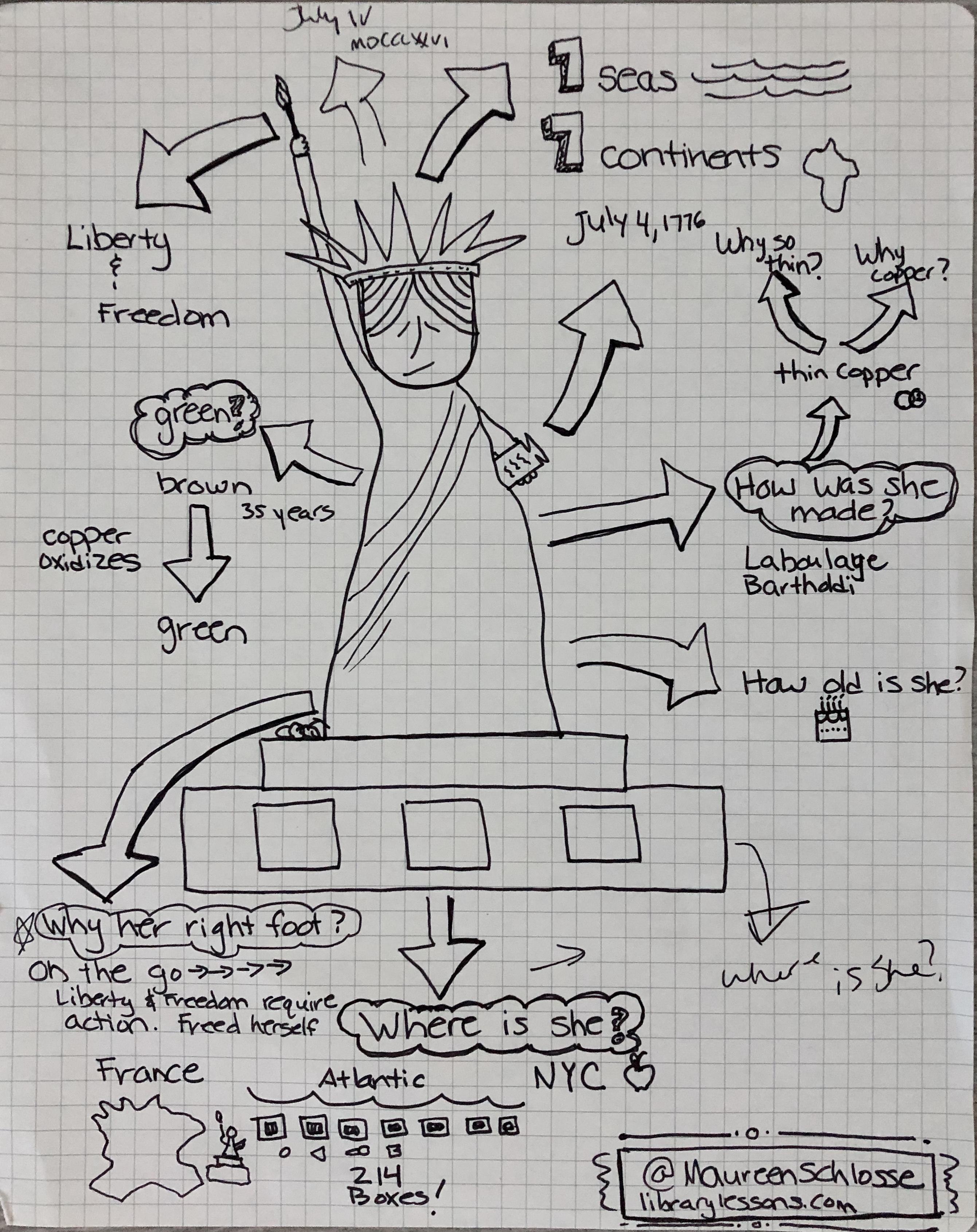
4. Before Reading: Draw the Main Idea: Can you guess the main idea of the story by just looking at the title in the illustration? You're right. It's about the Statue of Liberty. In this lesson, I'll show you how to draw a simple sketch of the Statue of Liberty by just using lines and shapes. So let's grab some paper and a pen and get started. I like to use graph paper and a felt tip pen. When I write for your project, you can use any type of paper in writing. Implement just to make sure we could see your ideas in the final sketch note for the project gallery. When drawing the main idea of a story, I always turn to the picture book first toe. Look for examples. I found a few pictures of the statue in the book that I can use for inspiration. I noticed that the picture just uses simple lines and shapes to create the statue. Next, I do a Google image search to find more ideas. I always want to use images that have no copyright restrictions, and Google has a search tool that lets me do that. Let's take a look at how that works. First, I'll Google the Statue of Liberty, Click on images and then drawing. Next, I'll click on tools and you said rights. I'll select labeled for reuse because even though I'm not tracing the image, I don't want to take any chances of violating copyright laws. As I look at the images, I pay attention to the outlines of the statue. I look for lines and shapes that I can use in my outline. Now for the drawing, I'll show you how to draw a sketch of the Statue of Liberty after we looked at the outlines of the monument. You just need to have a basic understanding off lines and shapes in order to draw this simple outline. First, I noticed the shape of her head looks like the letter You. Her band looks like a curved rectangle, and there are seven spikes for her crown, a lead, curved lines for her hair and curved lines for her eyes Nos and a slight smile. Next, they'll use a straight line up to draw her arm and come right back down with another straight line. And then we have a curve of her body. Her hand is just a little oval, straight lines for the torch and a teardrop flame. The other side of her body is just a line down. I draw the pedestal here with two rectangles, one shorter than the other. I'll put some windows down. Below that are the shapes of squares, and all she needs now is her book and a little four little bumps there for her nap knuckles and an arm. And that's it. The main idea does not have to be a drawing like the statue. It could be the title of the book or even an essential question. If you're drawing the title of the book for your main idea, here's a tip. Use a ruler to guide you as you space the letters. You don't want to squish any of the letters at the end and run out of space. Now that you know how to find inspiration for your drawing, use simple lines and shapes to draw the main idea for your story. Enjoy the process and have fun when you mess off and you probably will remember just to take a deep breath and think about what you would say to your learners if they were trying something new. You would probably tell them to Just relax and have fun. Hang on to your drawing. When you're finished, you'll see how to add to it in the next lesson. See you there.
5. Sketchnote Preliminary Questions: How do you prepare learners for a lesson? Have you ever just showed them an image of something and just have them sit and notice and wonder in this lesson, you'll see may imagining the questions learners will have while looking at the Statue of Liberty. I'll use arrows to connect the main idea to questions. You'll use the ideas in this lesson to add to your class project. First, I'll start with the torch. I imagine learners might wonder why she's holding it. Instead of writing a complete sentence about the torch, I'll just draw an arrow that leads away from it. I'm giving the arrow some depth by drawing heavier lines on the right side of the arrow. Next, I'll drawn Arrow that leads away from her crown because I bet learners were wonder why she is wearing it. They might ask about the book she is holding. Two. Someone might ask how she has made since. I can't think of an image to represent that question. I'll just draw a narrow away from the body and leave space for an answer. Some might not know where the Statue of Liberty is. So all right, that question out to. I'll add a question about how old she is, and you could draw a birthday cake if you wanted to. Finally, I'll add a question about the color of the statue. These are all the questions I anticipate. Learners will ask. But of course, they'll come up with some pretty great questions that I never even thought off. Now it's your turn. Think about the questions here. Learners will ask while looking at the main idea that you drew in the previous lesson, You can use a sentence starter. I wonder to help you generate questions. I wonder why the author chose this title, or I wonder why the illustrator drew this object. Draw arrows and right questions around your main idea. If you can think of any images to illustrate your thinking, please incorporate them in your sketch note. Now that you're drawing is ready, it's time to read the story and start sketch, noting I'm excited to share her right foot with you in the next video
6. Sketchnote While Reading: Are you ready to hear more about this great book? In this lesson, I'll show you how to sketch no important ideas of this story. Let's get started by looking at the cover. I wonder what the author wants us to know about her right foot. I'm also curious about what's underneath the jacket of the book. Let's sketch note those ideas. I'll put the date up here in the corner of the paper because of the copyright law. I can't read the whole book to you. So you're going to see me paraphrasing as I draw. But I want you to imagine me reading this book to a class and stopping along the way to sketch note my thinking. The first thing we learned in the stories that the statue came from France a leave room here because the words came from. Let me know that she isn't in France anymore. I'll add an outline of France. Next. We've learned that the statue was created by two men, Bartoletti and Level A. They made the statue out of very thin copper, only two pennies wide. That's pretty wild. I'll draw two pennies here and had two questions. I am wondering about Why is this statue so thin? And why is she made of copper? No, the next few pay. Just talk about how the statue was built in France. Taken apart, putting boxes and shipped to New York City. I'll draw a quick sketch of the statue under the word France, draw some boxes floating above the Atlantic Ocean and draw another quick sketch of the statue with the letters. And why See? I'll add an apple because N. Y. C is known as the Big Apple. The other starts writing about the parts of the statue that people tend to talk about. He starts by stating that this torch stands for liberty and freedom. He then goes on to write that the crown has seven spikes, and they each represent a continent or an ocean. So here I'll draw the number seven twice in block letters, Indra Wavy Lines for the Sea and a sketch of Africa for a Continent. Next, we learned that the Roman numeral stand for July 4 17 76 the year the Declaration of Independence was signed. I'll draw a narrow connecting the dates I'm noticing. The numerals are looking a little crowded so we'll put them in a container. This container resembles a cloud. I'm starting to notice other areas of crowding, so we'll add containers to make these ideas stand alone. The next page explains why the statue is green. She was brown for 35 years, but copper oxidizes and turns green over time. I'll add arrows here to connect ideas and show a timeline of sorts. The rest of the story is quite amazing. I wish I could read it here because my transcription is not going to do it. Any justice Dave Eggers asks us to look closely at the statues right foot. He wants us to wonder why her back heel is lifted as if she is walking. Eggers explains that the Statue of Liberty has an important job making sure everyone has liberty and freedom, and that takes action. The word action is a container because it's an important word in this story. I'll also add that the Statue of Liberty welcomes the poor, the scared and the hopeful. Now that you've learned how to sketch no important parts of a story, it's your turn to give it a try with the book you chose for your class project. Remember, it can be super simple, like my. You could always act to it later if you want. But what I'm looking for now is just the main idea and some arrows that connects the main idea to some questions. When you're done, take a picture of your sketch note and upload it to the Project gallery. I can't wait to see what you've done. Check out the next video for tips on how you can set up your learners for a sketch noting experience.
7. How To Prepare Learners for Sketchnoting: Are you ready to share your sketch? Noting skills with your class in this video, you'll learn some tips on how you can get started. Have the main idea sketched out on chart paper before the class arrives? The main idea can be an essential question. The title of the picture book or a key element from the book. Before the lesson begins. Pass out clipboards with paper and a pencil already clipped to the board. Invite learners to copy your drawing. This process will prepare learners for the lesson. If time is limited, work on a whole group. Sketch note. Draw the main idea on chart paper before the lesson. Pass out 3 to 4 sticky notes. Toe learners. The's small squares help learners Focus one idea in one contained area. Invite learners to stick their notes on the chart paper with the main idea. Read the notes, move them around and draw connections with arrows. Those are just a few ideas to prepare learners to sketch. Note. If you have some ideas that you would like to share with us, please post them in the comment box in the Project Gallery
8. Conclusion: congratulations. You are ready to share the sketch noting process with your class during our time together, you learned how to draw the main idea of the picture book using simple lines and shapes. You also learned how to find inspiration from picture books and Google image searches. I shared with you a tip on how to find images that are free to use. You also discovered how to sketch. Note. You're thinking during a lesson. My hope is that you'll take what you learned in this class and share sketch noting with your class. Once everyone understands a sketch noting process, they'll begin treat to try it themselves. Before you know it, you'll have a classroom of learners sketch. Noting any lesson you deliver, I'm looking forward to seeing the sketch notes of your picture books in the Project Gallery . It'll be fun to see your sketch notes inspired by compelling picture books. Please follow my profile. If you enjoyed this class, I look forward to seeing you in other classes on skill share
 Maureen Schlosser, Writer