Transcripts
1. Welcome to the course: Hello, and welcome to this
Illustration pricing course. If you don't know me, I'm
James Illustration agent. I've worked on and priced up an enormous range of projects
from small Indie magazines, a few hundred pounds each to enormous campaigns from
multiple territories in the mid six figures. I tried to count up
how many projects I've had a hand in pricing up, and I don't know
the exact figure, but it is thousands of projects. Not all of those prices
have been accepted, and not all the
projects were won. I've definitely made a lot of mistakes with pricing
as I've learned how to estimate what different kinds of clients want to spend on
different kinds of projects, but I've had a lot
of practice at this. Put this pricing course
together because I know how hard it can be to feel
confident in pricing work. My years of experience have led me to get a good
sense of the market, and I have a feel for
what things are worth, but it is or has largely been a sense and feeling
a lot of the time. So I've done my best
to dissect and unearth what's behind that
pricing vibe in order to be able to communicate it
clearly to you here and turn that experience into something practical so you can get
confident with pricing quicker. I've also done a
lot of reading and research on more general
pricing theory and strategy to see what
we can learn from other creative professions and apply them to illustration. Course represents the best of my knowledge of
pricing right now, but I plan to update it as I learn more and as
the industry changes. I welcome feedback
good and constructive. You'll find links to a feedback questionnaire around the course. If you find something
that was really useful, of course, I want
to hear about that. And if you'd like me to expand on any parts, I can do that. If you find something
you disagree with, I want to hear about that, too. And if you update the way
I think about pricing, I'll update the course. Can't wait to hear
what you think.
2. The problem with pricing: Here's the problem with
pricing illustration. You've got your production fee, which is a combination of
your business expenses, rent, materials,
equipment, utilities, et cetera, and what
your time is worth. Your expenses are going
to go up over time, and what your time is
worth will also change. If you're new to the industry, it'll start out fairly low. But as time goes on and you
get busier and more skilled, an hour of your time
will be worth more. This part is unique to you. What works for one illustrator won't be right for someone else. Then we get into licensing, which can be a real headache because there are
so many variables. Usage, that's what the
illustration will be used for, and often there's a
combination of different uses. Territory, that's where
it's going to be used. Again, often, it'll be used in different places
at the same time. Duration, how long
the illustration is going to be used is
somewhat more straightforward, but sometimes clients want to extend the duration or
re license the work. Some clients want to buy
the rights to your work, and you have to consider
exclusivity, too. Then you've got to
think about the client. Where they are or where
their customers are, the size and the
reach of the company, and what industry they're in. An independent craft
beer brewery in the UK that doesn't
trade internationally is going to have a
radically different budget for creative work than a Silicon Valley tech
company that has hundreds of thousands of
customers all around the world. We should also be
considering value. On the one hand, we're
trying to figure out how valuable the project
is to the client. If it's low value, they won't want to spend
much money on it. But if it's going to win them lots of new customers or sales, then it's a high value project, and they're hopefully going to want to invest more
in developing. The other hand, you've
got to consider what your value as
an illustrator is. That's the strength of your
portfolio, your experience, and your client list, and your skill level or any specialist skills
that you might have. Again, these are all
unique to each artist, and they will change over time. This is really complicated, and this illustration pricing course is going to
break down all of this and more so you can get confident with
pricing quicker. Learning to price your
work is a journey, and you don't have to get
everything perfect right away, but there's a
massive advantage to actively get into grips
with this stuff early.
3. What to expect from the course: We've already established
that pricing work can be very complicated, particularly as you get
into bigger projects. In the process of
planning this course, I gathered feedback from illustrators through
questionnaires, and the word confidence
came up again and again. I asked, what would be a good goal or outcome
for a course on pricing? Feeling more confident in
how I calculate a good price that is worth my time and is
also valuable to my client. To gain confidence in
quoting fees to clients. Feeling confident
sending quotes. To be more confident
in setting up and also discussing pricing
with the client. And I asked, What do you find challenging about
pricing your work? Confidence exclamation mark. How to confidently come up with a price and not second
guess yourself? Probably impossible.
Crying, laughing, Mogi. This didn't
surprise me at all. I've been given prices to
collapse for quite a while now, and I'm still not entirely
confident when I'm quoting a large
complicated project. The more straightforward
ones get much easier once you've
got a bit of experience. But with complex projects
and big clients, you simply don't know
what they want to spend and what
other illustrators are quoting for the project. So there will always be
some second guessing and insecurity around the things you don't know
about the project. But this course will
teach you how to reduce those unknowns
as much as possible, and it will also build
up your confidence in the things you do
know and can control. So when you give a
price to the client, you'll know it's the right price and a fair price for you. You can give that
price confidently to a client knowing you've done your research and that it's a competitive but
profitable quote. We're going to
take the guesswork out of it as much as we can. Then if the client
does pick you, you'll know you've priced fairly and you won't regret
undercharging. And if the client
can't afford you, you can be satisfied that
you didn't overcharge. There's just a mismatch
between what you need to make and what
they want to spend. So we're going to build
up that confidence in pricing as much as possible. We're also going to explore ways you can increase your
prices over time. Ideally, you'll be making a lot more money in five
years than you are now. We've got a whole
bunch of tools, tips and techniques you
can use when you're calculating your prices and
presenting them to clients. Ultimately, I'd
like you to build your own personal pricing guide filled with data that you can use to inform your
prices in the future, and we'll get into that
a little bit later on. I won't be giving
any exact prices for different kinds of projects
because for one thing, every client is different
and has different budgets. Even if on the face of
it, they look the same, sell to the same customers, and operate in the same
parts of the world, they can want to spend
radically different amounts of money on creative projects. We'll explore ways
we can try to find out how much a client
wants to spend later on. And also, every artist is different with
different expenses, cost of living and other
financial circumstances, skill and experience levels, and some styles take much
longer than others, too. If I say 100 pounds is the right price for a
particular kind of project, chances are that would be
bang on for some people. Others would be very
pleased with that amount, but for another artist, it might not even
cover their costs. For a lot of projects, there
are accepted market rates, book covers, for example, but there are still ranges
within those rates, and I'm assuming you'd rather be nearer the top end
than the low end. There are also
illustrators out there who can command much higher fees than the usual market rates because of the way they've
positioned themselves. We'll break that
down later, too.
4. Ways to price your work: It's. In this chapter, we're going to get into some
of the pricing methodologies you could use as a
freelance illustrator. Some are preferable
to others and some are appropriate
at different times. So I'll do a basic
overview and then consider when it's
appropriate to use them. Selling time for money. First, let's look at
selling time for money. Usually, that's either an
hourly rate or a day rate. This is where a
lot of freelancers start because it's
easy to work out. Add up your monthly expenses, divide them by how
many working days or hours there are in a month, and you get a rough idea of
what you need to survive. Then you add a bit on top, so you're not simply surviving. I've got a list of pros
and cons here for each, which are largely the same. Pros, it's easy to work
out for beginners. It's also straightforward
for clients. With day rates, often you'll be asked to work in
a batch of days, five days, ten days, et cetera. Some of you may have
priced your work hourly or by the
day in the past, and you might be doing that now. And it's a great way to get your freelance business
up and running quickly. Some creative
freelancers work through marketplace websites
like Upwork or FIR, which is a great way for
people in lower cost of living areas of the world to be able to work with
international clients. But selling your
time for money is not a great long
term strategy for your career because it ultimately puts a cap on
how much you can earn, and you're not being paid
for your creative skills. You're simply exchanging a unit of time for an amount of money. Your time is so valuable, and I'm not talking
about your work time. I'm talking about your
time for living and your time for family and
recreation and sleep. If you charge by the hour, sure, you can work more hours if
you want to make more money, but that time has to come
from somewhere else, and there are only so
many hours in a day. You can make the
argument that you can increase your hourly or day
rate to make more money. And while that's true, there is an upper limit on that
for most clients. You probably couldn't
charge a client 1,500 pound day rate. They'd
think you were crazy. But by using a fixed rate, you probably could charge 7.5 thousand pounds
for a project that takes you five days to complete. My mind, the cons far
outweigh the pros here. For one thing, the better
you get at your job, the quicker and more efficient you get, the less you'll earn. And you're in danger of not pushing yourself to
improve because of this. You'd be less inclined to use time saving tools and
software, for example, and you could
potentially stagnate and have very little reason to
get better at your job. There's also a point of
view that this kind of hourly work is less valuable
or less professional. There can be a bit of a lack of trust when you're
selling your time. The client might be inclined to micromanage to make sure you
don't go over your hours, and they'll want
to know what you did in each of the
hours you bill for, and you probably won't
be able to bill for the time you spend filling
in that time sheet. If you're a busy freelancer, you might be juggling
several clients at once, and you'll switch
between them as needed. But with a day rate, the client wants you to put
in a full shift, which makes it hard to work
on multiple projects at once. I'm sure most of you
have come to recognize the limitations of selling
time for money on your own. But if you're just
starting out, and this is an easy way for you to make some money and build up your portfolio,
it can be useful. But try to make it a short
term stepping stone. Do it until you can
afford not to do it. When to use it. Although
it's not optimal, there are times when it
either makes logical sense or you might just have to get on board with what the
client demands. Let's say you've been
working on a big project and it all wraps up nicely. Then a few weeks
later, the client comes back with some changes. It's just technical work to move things around and change
colors, et cetera. It'll take you a couple
of days to do it. So by all means, give
the client a day rate. All the licensing and
creative ideation has been accounted for in the
main part of the project. At this stage, the
client does simply need a little bit more time
from you, so it makes sense. Day rates are common in certain areas of the
industry, for example, storyboarding or
animation projects, you can definitely
try to make a case for giving them a fixed price. But practically speaking, if an animation studio is used
to working in a certain way, and they have plenty
of other options for illustrators who could
work on this project, you don't want to
make things more complicated for them
because if you do, you risk losing the project. It would be great if
we all got together and decided to say
no to day rates, full stop, but it's not going
to happen anytime soon. So if you want to do
the job and the client requires you to price the
work in a certain way, sometimes you've just
got to go with it. If a client doesn't have a
defined scope for the project and all the details of the
deliverables are undecided, you simply can't commit to a fixed rate because the
project might expand. Rather than giving a
day rate, in this case, I'd recommend breaking a
quote up into smaller chunks. If the client says we need 25 to 45 illustrations,
that's a big range. So you could break it
up into batches of five or ten deliverables and give a fixed price for
each chunk of the project, then you're covered, and
the client can determine the final number of
deliverables at their own pace. Asking what the
client's budget is, not sure this is a pricing
methodology necessarily, but it is the easiest way
to gather information quickly to determine whether
a project is right for you, particularly with the projects you're likely to
encounter early in your career where clients have a fairly fixed budget range, and they do a lot of similar
projects like book covers, magazine jobs, online
articles, et cetera. They know what they
have to spend, and they'll probably
tell you if you ask. This takes a lot of the headache of pricing out of your hands. If they tell you, you simply have to decide whether
that project is going to be profitable for you based on how much work
you'll have to put in. If it's not, you can
try and negotiate on the price or on the
deliverables, or you can say no. Not every client is
going to tell you, and not every client knows
what their budget is. With advertising, often there
isn't a defined budget, and they need a quote from
you that they can add to the quotes of all the other
suppliers for the project, then they'll pitch it
to the end client and the end client will decide
if they want to go for it. When to use it. Asking what the client's budget
is should always be something you consider at
the beginning of a project, no matter who the client is. But I want to make you
aware of a possible problem with this in a later
chapter called anchoring. While a client may tell
you what their budget is, there's usually an
acceptable range, what they want to pay
ideally and what they are willing to pay under
the right circumstances. They probably won't tell you what the most they're
willing to pay is, so their initial low ball number may influence how you
quote for a project. So before you ask, do a quick calculation of what you would quote
for the project. So you've got that in
your mind before you hear or read the number
they're thinking of. Plus, it's good practice
to price a project up and see if what you come up with is close to what the
client wants to pay. Fixed rate or project rate. Giving a client a fixed
rate for a job is common, and it's fair for both sides. And in fact, it works both ways. If you ask a client
what their budget is, they'll give you a number, which is not fixed necessarily because
you can negotiate it, but it's one price for
the whole project. Both sides know what
they're getting. Sometimes an
illustrator will work out this fixed rate
by going back to their hourly or day rate and estimating how much time it
will take to do the job, then adding it up and
giving that price. If you do that, you just end
up selling your time again. So we really should be thinking
about it in these terms. Production fee or creation fee plus a usage fee,
which is the license. We're going to get
into working out your production fee
in the next chapter, and we're going to go
deep into licensing and usage a little bit later
on when to use it. Fixed prices will be what you're aiming for
most of the time. This does factor in the cost of your time spent
on the project, but it is also variable depending on the license
the client needs. We'll break this all down in detail in the next few chapters. Royalties. Another
very common model is receiving royalties
on your work. You illustrate a product for a client and they share some
of the profit with you. The more they sell,
the more you make. It's common in
products like books and stationery and
toys and games. In practice, it means you accept a reduced
production fee in the hope that it will lead to a higher return overall when
the sales start rolling in. It's good for the
client because they don't have to pay
as much upfront, and it means you
can both share in the success of the product
you helped out with. That's assuming it does
lead to lots of sales, and sometimes it doesn't
the risk you take. So you have to
judge each project to see how likely you think it's going to be to be successful. Sometimes
it's hard to know. But if the client
has a track record of making great products
that sell well, then it's probably
a worthwhile risk. If it's an independent
person with no track record of
selling products, it's a bit more of a gamble. I've seen it work
very, very well, and I've seen it fizzle
out into nothing, and the illustrator
feels disappointed. You should always
receive something upfront to mitigate your risk. If you're asked to take
on 100% royalty deal, you are taking all the risk. If the product doesn't sell or the client disappears,
you get nothing. So always make sure you get
a fee for the work you do, even if it's a reduced fee from what you'd usually charge. Then you share the risks with the client and you
share the rewards. Royalties are obviously a
big part of book publishing. Some publishers pay a
flat fee for a book, but others give you an advance
against future royalties. They'll have an estimate
of how many books they think will sell and they'll give you some money upfront as you work on the book. And if the sales ever go
over that advance threshold, you'll begin to receive
royalty payments. Be aware, though, that
most illustrated books never cross that threshold and start paying out royalties. I've seen stats for fiction
and non fiction that say only around 20% to 25% of books ever earn out the advance and start paying royalties, and that talies with my
personal observations, too. The publishers have
a lot of data to put those advanced
calculations together, so they have a good idea of how many books we'll sell
before they even make it. The royalty system is there
for the odd case where something unexpectedly blows
up and gets super popular. Then the publisher
and the author and the illustrator can
all benefit from it. I hope something like
that happens for you with a book, but it
doesn't happen often, so you have to make sure the
advance is healthy enough to support you without relying
on also receiving royalties. When to use it. Royalties will likely be a part of some of the projects you work
on over your career. As I mentioned, not many books get to the point where
they're paying royalties, so it serves you well to negotiate the advance
up as much as it'll go. But the Association of
Illustrators recommends a 5% royalty rate on
Illustrated books. If you're the illustrator, if you're also the author,
you can double it. If it's lower than that, try
to negotiate it up to 5%. I've rarely seen
books above that, maybe the odd 6% or a
little bit higher for super famous illustrators with a good track record
of selling books. For products like stationary, board games or phone cases
or socks or any kind of social media startup product that might ask you to
design something for them, the royalty rates can vary
massively from 5% to 25%, which kind of depends
on how integral the illustration is to the
appeal of the product. If it's an illustrated jigsaw, then the illustration is what's going to sell that jigsaw. So you should be aiming high. If it's decoration on a
really innovative invention, then you might be looking
at the lower end because the invention itself
is the important part. Product royalties can
be great if there's a potential upside for you and the client, but
there's also a risk. If it doesn't sell,
there's no royalties. So as I've already said, get something upfront for your work, and then you share the risk
and the potential rewards. For something like art
prints or T shirt designs, a royalty deal makes
sense if they'll continue to print and sell
them on demand indefinitely. If they don't want
to or don't have the infrastructure to
do a royalty deal, you could suggest a fixed
price for a limited print run. It's X price for 250 prints. If they print 250 more, they have to pay you again. And that could work out at roughly the same amount
for whether they sell 250 with a royalty deal
or with a limited print run. For example, the
royalty deal could be 250 pounds production fee with a 10% royalty for each
print selling at 50 pounds. That's five pounds times
250, equals 1500 pounds. Or you could offer a
fixed fee of 1,500 pounds for a limited
print run of 250 prints. Then if they print another 250, you deduct the production
cost and charge 1,250. Either way, with
the royalty deal or the fixed print run price, you're making 1,500 pounds for every 250 prints they make. Retainers. Occasionally,
you might find yourself in the fortunate position
where a client approaches you and they need a lot of
illustration regularly. But the actual
quantities may vary. One month they may need three, the next they need
five, et cetera. In that situation, you might consider offering a retainer, where you suggest to the client that they pay you a fixed rate each month and you'll be on hand to help out with whatever
projects they need. And since it's longer
term regular work, that's great for you. So you'd probably offer
them a reduced rate in exchange for that security of having regular work
for a few months, which is a rare treat in
the illustration game. Are pros and cons
to this, of course, and the pro is regular work. But if it's not
planned out well, you could find yourself in
a position where a client asks you to work on 12
illustrations in a month, which is way more than
you bargained for, and the fee you
get for that month no longer seems appropriate. So you'd probably
set the boundaries early on and agree a price
based on there being, let's say, four to six
illustrations per month. Maybe one month it's only
two, but the next it's eight. If you set the rules at the
start and you make sure to keep time available for this client, then it
should balance out. You'll also need to consider
some guidelines for your availability in advance so you can plan your
other work around. The client comes to you in
this retainer period and keeps asking you to turn things around as
quick as possible, it's going to be impossible for you to plan your schedule. So you'd need to make sure that they give
you enough notice. When to use it,
you could consider a retainer if a client
wants regular ongoing work, multiple illustrations per month for longer than two
or three months. Relicensing, you'll hopefully
have the opportunity to re license your existing work to new clients over the years. And the more work you make, the more likely it is to happen. When you calculate your prices
using a fixed fee method, production cost plus usage, you can easily work out what
to charge for a re license. You deduct the
production cost and calculate a fee depending on what the client is
going to use it for. We'll be covering
that in more detail in the licensing chapter. When to use it. Hopefully,
it'll happen often. This is why it's so important to keep hold of the
rights to your work, because you can, in theory, re license your
work over and over. And I don't want to throw
around the term free money, but when it happens,
it's basically like getting free money without
doing any additional work. Value based pricing you may have come across the term
value based pricing before. This is where you charge
a different rate to every client based on how valuable the
project is to them. In theory, this is great,
and it can work very well for some kinds of
freelancers and consultants. If your work will make that
company a lot of sales or get more leads or downloads or whatever is valuable
to that client, then your fee can be
proportional to that value. If your work makes
the company an extra 500,000 pounds a year and
your fee is 50,000 pounds, that should make financial
sense to your client. It's a great return
on investment for them and a great fee for
you. Everybody wins. Practice, though, this is very difficult and unusual
for illustration, partly because the effect
of illustration on a brand or product is quite
difficult to measure. You could imagine value
based pricing working very well for someone working in
marketing or web design, where the effects of their
work are easy to measure. If they can get a baseline
measurement of how many sales the client is making or how many leads are looking
at their products, and then that freelancer
can increase those numbers and prove to the client how much extra money
they've made them, it's easier to have that
value conversation. Not so easy for illustration. In my time as an agent, I've only seen a handful of opportunities to have
that kind of arrangement. So I'm not going to
spend any more time on value based pricing, but if you do find yourself with that kind of opportunity, it can be very lucrative.
5. Market rates: When you're thinking
about giving a fixed rate to a client, you need to have a sense of what the going market rates are for different
kinds of projects. This comes naturally with
experience, but up until then, I want to share a few resources
where you can gather data about pricing that you shouldn't necessarily
copy exactly, but they can inform your
pricing and help you to know what acceptable ranges are for different
kinds of projects. Asking other illustrators
is a great first step. If you know someone who's been around a few
more years than you, they'll be able to
give you a rough idea of what a fair price might be. If you were to ask an illustrator who's
been in the industry for a significant amount of
time longer than you have, then the prices they give now are likely to be quite
a lot higher than you might be able to
ask for if you're new to the industry
because they're more experienced and they are more established and they have a
better reputation, et cetera. So keep that in mind, but
it's still useful data. I want to encourage you to share your pricing data
with others, too. If you want people to help you out, you should
help other people. If you work in a studio with a group of other illustrators, you can pool your
pricing data together, and you'll all benefit from
it and learn much quicker. In that spirit, I'd like
to point you towards a website called
lightbox dot info. This is a website where
illustrators share the prices they've got from
various clients anonymously, for the benefit of others. That's definitely
worth checking out. Are a couple of pricing
calculators online, most notably the Association of Illustrators has
one for their members. That's a really great resource, and it's really good with
straightforward projects. But with any kind of
calculator like that, when you get into the really
complicated projects, there are so many variables
that the results you get can occasionally be
unrealistic. It's just a tool. It's a good one, but a
calculator can't factor in all the nuances of each individual client
and their varying budget. Graphic Artist's Guild handbook is another great way
to get data points. It lists different
industries and projects in the US and
gives guide prices, but it should only
be used to give you a rough idea of where
the goalposts are. You'll need to do a bit of
your own maths to make sure what it's telling you is appropriate for
your circumstances. Jessica Hh has a great
pricing course on her website along with
some PDF downloads, too. And, of course, asking
the client what the budget is gives you data, even if you don't win the job. For all these resources, keep track of the data you gather. Don't let it disappear
in your email inbox. Stick it in a spreadsheet with some details
about the project. Then after a couple of years, you'll have your own
pricing guide that you can refer to when a similar
project comes along. Ultimately, any specific prices that you come
across online or in a book should only
be used as data to help you with your
pricing, not to copy. If a guide tells you 800 to $1,200 for a monthly
magazine cover, that doesn't factor in the subject matter of that magazine. Some magazines are better
funded than others. They have more advertisers, or they're aimed at audiences with different buying habits. A tech magazine will be full of ads for high ticket items. They might pay 1,200 for
a cover or maybe more, but a magazine
about skateboarding might have a much lower budget. Also, some of the magazines that use the most illustration have lower budgets
because they need to spread their budget
around the pages more. A magazine like
Wired, for example, probably has a relatively
good budget overall, but because they hire lots of interesting writers
and illustrators, that budget is
spread quite thin. Clients in different countries have different budgets, too. We'll get into that in
more detail later on, but a client
producing products in Dutch or Italian
languages, for example, has a much smaller potential customer base than one
that's in English, so their budgets will
likely be lower. You also need to have a
good sense of what prices are appropriate for your
costs and circumstances, which a book or an online
guide simply can't know. They can only ever
be a general guide.
6. Costs: This chapter is all
about your costs, and we're going to start
with a few definitions, so we're on the same page. Costs. This is a combination of all your expenses, rent, studio, materials, utilities, equipment, transport,
marketing, et cetera. It also includes your time, which I've found
that some people don't factor into their costs. Your time has a value
that you determine. As a new or junior illustrator, the cost of your time
might be fairly low. But as your skills develop
and your life expands, and the more experience you get, your time becomes more valuable. While illustrators don't work by selling their time, ideally, the value of a unit of their
time needs to be decided and reviewed regularly so it can be factored
into their costs. When you're planning
out a project that is going to
take you ten days, for example, you work out what your expenses
are going to be, which we'll dive into
in a few minutes. But let's say that's
50 pounds per day. Then you add on the cost
of your time for ten days. Let's say that's
250 pounds per day. The total you get
is 3,000 pounds. This is what you need to make
to break even on that job. Here's an example of how
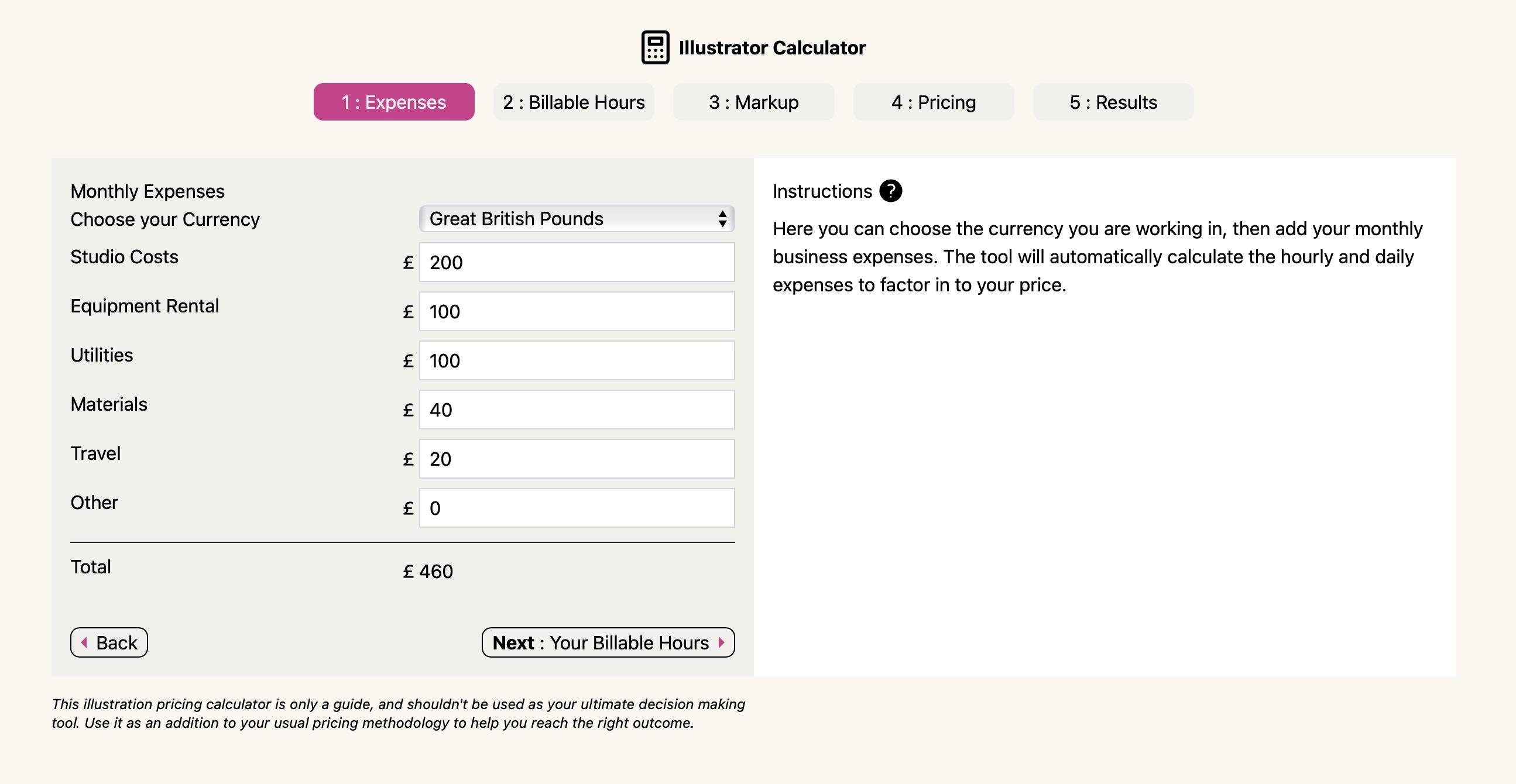
these expenses could look. So the illustrator here has added in their
monthly expenses. Their rent is 400, travel, 200, loan, or, you know, this could be anything
really that is an expense, and it's all going to
be personal to you. Mateials is 100 each month. The total of their expenses
is 1,000 pounds per month, and then they divide that to
get their daily and hourly. And the illustrator has also decided that the cost of
an hour of their time is 50 pounds based on their experience or how
complex their style is. One important note here is that not every hour of your
workday is billable, so you probably
wouldn't calculate your hourly rate based on
a full eight hour day. You still want to reserve
some time to work on non billable but important
business activities like your social
media marketing. Maybe you're learning
some new skills or you'll need to
do some contracts or invoicing or maybe even run some errands and
go pick up some materials. Much as any client might want
you to work a full 8 hours, it doesn't work
like that, and you calculate your rate
based on billable hours. You've got 50 pounds
per day expenses. That's what you're paying
out each hour plus 50 pounds per hour or 250 pounds per day as
the cost of your time. This equals 300 pounds per day, your total cost.
There's no profit here. If you charge this,
you only break even. Usage, this is what the client pays you to be
able to use your work. They pay you to make it and they pay you to use it, which
is pretty good, right? The price or the fee
is the amount of money that changes hands between the client and the illustrator. A lot of illustrators calculate
their prices like this. Costs plus usage equals the price they give
to the client, and they consider
the money they make on the usage to be their profit. There's a part of this equation that's missing, a
very important part. Let's say, for example,
a client agrees to your price based
on this equation, but then pulls the
plug on the project and decides not to use the work. So they only want to pay
you for the production. Then you're left in a position
where you've worked on a project and you've
not made a profit. You've just broken even. You might as well not
have done the job at all.
7. Profit: Being paid for your costs and your time is an
absolute minimum. If you go below that,
you are losing money. If you're not also
making a profit, your business will never grow. A very basic level, any regular business buys an item or a service
at one price, then sells it at a higher price. That's
how they make money. A shop buys from a
wholesaler at a low price, then sells it on their shelves or website for a higher price. When you're creating the item
or service from scratch, you might not think
about it in these terms. But if you want to grow as a
business and be profitable, we need to consider adding
a markup to our costs. Markup is the percentage we add onto our costs
to make a profit. Costs plus markup as a percentage, equals
production cost. Needs to be a percentage
rather than a fixed amount, so it grows relative to
the size of the project. Here's an example using
the ten day project we discussed in
the last chapter. The costs here, expenses
plus time are 3,000 pounds. The markup is 25%. So the production cost is 3,750, and your profit is 750 pounds. This is before we even get into calculating the usage fee. So if the client decides not
to use your work and only pays you for the production or creation of the
illustrations, you're still making a profit.
8. The Planning Fallacy: Before we move on to the
next chapter on usage and licensing to complete
our pricing equation, I want to go over what's
called the planning fallacy. This is a well documented
cognitive bias where humans tend to be overly
optimistic in planning things, and we underestimate how
long things will take, how much they will cost, and
how much risk is involved. We base our plans on
the best case scenarios as if everything
would go smoothly. Now, I love the
positive attitude here, but it can get us into
trouble if there's a lot of feedback or we get sick or
our computer breaks down. This is especially
true if we're in a good mood or excited
about a project. If a big time client is
considering hiring you, understandably, you'll
want to impress them and show them that you're
quick and efficient. What's not going to
impress them, though, is if you say the project
is going to take ten days, but it ends up taking 15. And if you've ever been in
a situation where you're on the eighth round of
feedback from the client, you'll know how that feels. So I wanted to add this in here because simply being aware of it can help us be a bit more accurate in our
estimates and plans. Ask yourself some
grounding questions if you feel like you might
be falling into this trap. Have I caused myself
unnecessary stress in the past by not allowing myself
enough time for projects? Am I being overly optimistic in the planning because
I really want to impress this client? Can I break the project down into smaller chunks
to plan separately? It's a lot easier to plan a small part of the project than the whole
thing all at once. Is there anything
that could delay the project that I've
experienced before? If so, how likely is it? Some setbacks are less
likely than others. Extra rounds of feedback from
the client is very common. So planning for that
possibility is wise. You don't necessarily
need to factor in your computer breaking
down for every project, but if you've owned
your MacBook for seven years and it's
noisy and it overheats, you might want to consider that more seriously in your plan. In general, I would say,
give yourself a bit of a buffer when you present
your schedule to the client. If you think it'll
take ten days, tell the client 12,
just to be safe. Then if everything does go smoothly and you
can do it in ten, they'll be pleasantly surprised. This isn't about gouging
the client for extra money. It's just sensible planning. It's usually not too bad
with small projects, but when you get into
bigger and longer projects, you can see how things could
spiral out of control, and you might find yourself in the unfortunate
position where the longer a project goes
on unexpectedly, you start eating into your profit and maybe
into your costs.
9. Usage fees and licensing: Hopefully, everything up to
this point has made sense. It's all logical and
based on simple maths. Well, here's where
it gets complicated. Let's complete our pricing
equation here first. Costs plus markup
as a percentage, plus usage fee equals the
price you give to the client. The costs and the
markup together, you can call your production
fee or creation fee, and then you add on the
usage fee to get your price. The price is the number
you send to the client. Occasionally, a client
might ask you to break down the price
or itemize it. When you do that, you send
them the production fee or creation fee and the
usage fee separately. You keep the markup to yourself. When you buy an
item from a shop, if they also listed
the price they bought it for and how much
they'd increase the price, you might think twice
about buying the item. So the costs are fixed, and the usage will vary pretty massively depending on how the client wants
to use the work. A general rule of thumb is that the more people that
are going to see the work, the higher the price should be, but it's not straightforward
to work out. Some illustrators decide on a fixed licensing fee depending on the kind of
license the client wants. So it might be a fixed fee
of 150 pounds on top of their production cost to use the illustration for a
monthly magazine cover. With time costs and
expenses and a markup, the project comes to 600 pounds. Then a fixed fee of 150 pounds
for this kind of usage and this kind of client
equals 750 pounds total. Other people might use a multiplier on the
production cost. So they've got their
production cost at 600 pounds, then they'll
multiply it by 1.25. This also equals 750. I prefer to use a
multiplier because it's scales. Here's an example. Artist A has a
production cost of 600 pounds plus their fixed
usage fee of 150 pounds. That equals 750 pounds. Artist B has the same
production cost of 600 pounds, but they use a multiplier of
0.25 to get the usage fee. Also 150 pounds, in this case, they add the production fee to the usage fee to get the
price of 750 pounds. In the second example,
let's say it's a longer project
and it's going to require more time
from the illustrator, both artists land on 1,200
pounds production cost. Artist A adds their
fixed usage fee of 150 pounds and lands on 1,350. Artist B uses the multiplier of 0.25 to get the usage fee, which is 300 pounds. They add them together, and
it comes to 1,500 pounds. So they're making 150 pounds
extra in this example. For a more extreme example, if production costs were
even higher at 2,500 pounds, Artist A still
uses the fixed fee and lands on 2,650 pounds. And Artist B, using
the 0.25 multiplier, gets a usage fee of 625 pounds, giving them a total
of 3,125 pounds. You can see you get a
better deal by using a multiplier rather
than keeping it as a fixed fee of 150 pounds. So let's move on to
the different parts of what will make up
your licensing fee. The three main parts are usage,
territory, and duration. Usage. The usage here is what the work is
going to be used for. I've made a list here of
all the different uses I've seen for illustration projects
in the last year or so, and this isn't a complete list. There are always unusual cases that you have to wrap
your head around. There's a lot here, and I've really gone around in
circles trying to think about how to teach this in a
useful way because there are so many variables and possible uses that
you might come across in your day to
day illustration work. And while some are obviously going to be more
expensive than others, a website spot illustration
versus an outdoor advert, for example, others
aren't so clear. What's worth more between some printed point of
sale items or a mural. It's not really that obvious. This is why a lot of
pricing calculators can be a bit unreliable with complex projects
because there are so many variables
to calculate. It's almost an impossible task. I really want to break
this down for you in a way that's going to
simplify this for you. And in the course
of doing that, I spoke to a photographer friend, a very experienced
photographer to ask how she priced
up her licenses. And I was surprised to discover that she only has one option. The client buys what she
calls a commercial license. None of the specifics of what the work is going to be
used for is factored in. It's simply fixed percentage
of the work she does. If the production cost, the hot and the editing, et cetera, come to 4,000 pounds, the commercial license
might be 10% of that. I don't know the
exact calculation, but she keeps it super simple. And that has worked for
her for a long time. I've since tried to
persuade her that this is maybe too simple, and
she might be losing out. If it's the same rate for a corporate magazine as
it is for an ad campaign, she's almost definitely left money on the table
with some clients. What I'm trying to get
at here is you are allowed to choose how complicated you make
this for yourself. Yes, there are
industry guidelines, and working out how much
to charge for all of these possible use cases
should be the long term goal, but you can't do
that all at once. And trying to learn
it all early in your career can leave a lot
of people feeling quite lost. I remember trying to get my head around it in the early days, and no matter how much I read about it, it was mind boggling. I have a feel for it now after nine years
pricing up projects, but it's been very
much vibe based, and I refer back to old projects sometimes to give me a steer
on what's been done before. It's very difficult
to explain and very difficult to learn when you've
got limited experience. So I'm not recommending you use one license fee percentage
for any job you work on, but I think we can
simplify a hell of a lot by grouping some of
these things together. And you can simplify
it as much as you want until you get more comfortable with it and more experienced. It's your career, they
your projects you decide and work towards a greater understanding
as you go along. You don't have to do everything
perfectly from day one. Territory. This is where the
work is going to be used. So that could mean one
location for one shop, or it could mean
an entire country or multiple countries and
everything in between. I've seen projects that
are for London only. I've seen projects that are
for the south of England. It could also be
related to where your client has
physical locations. If they've got six stores around the country
in different cities, so it's sort of nationwide,
but not really. It's just six locations. It could also relate to territories that have
a shared language. Spanish language territories
covers Spain in Europe, and also most of South America. Similarly with German
speaking countries, Germany, Austria, and Switzerland, but not the whole of Switzerland. We also have to consider that countries vary massively in how their economy is doing and also how much value they
place on creative work. That's high in the US, but maybe not so much in
India, for example. If you get bogged down
in these details, it's going to become
so complicated. The size of the
country is a factor, but in my experience,
the population of the country is
more important. Economic stability is a factor. Economic development
is a factor. The important factor
when thinking about territory is common sense. The countries that you
think would probably have the highest budgets probably
do have the highest budgets, and the countries
you think pay the least probably do pay the least. But as always, there are a few exceptions to that.
Here are a few examples. The US is big with a
relatively high population, and it has a stable, thriving economically,
generally speaking, the UK is small but stable. Canada is big with
a stable economy, but their population is low. Australia is very similar. Brazil is big with
a high population, but it's quite unstable. Switzerland's economy is great, maybe the best in the world, but it's a very small country. Similarly, the
Scandinavian countries are very economically developed, but with very small populations. India has a hell of
a lot of people, but their economy
isn't as developed as the US or UK, for example, and probably their value
of creative work isn't as high due to traditional
cultural and religious factors. If you consider three
factors, the population, economic development,
and stability, you can usually estimate what their relative budgets might be. And here's a chart based on my experience of budgets
from different countries. The USA and the UK are generally the higher
paying countries, Germany, France, South
Korea and Japan, sort of a little
bit lower there. Canada and Australia are
lower than you might imagine, but I think that's largely
due to the population. Spain, the Netherlands,
Italy, Scandinavia. These are all small countries, relatively speaking, so
they have lower budgets. And then we get
into South America, Central America,
and Eastern Europe. These are big areas
with lots of people, but they're quite
economically unstable. And then at the lowest
paying end of the spectrum, we've got places like India, Southeast Asia, and
most of Africa. So if you live in a city
in the US where it's a high cost of living
and you're asked to work for a client
in Eastern Europe, for example, it may
simply be impossible. They might not be able
to afford what you need to pay your rent
in San Francisco. If you live in a lower
cost of living area of the world and you work with
clients in the US or UK, that could work
really well for you. You can earn more money
than you could locally, and that's what
companies like Upwork and FIVA have built
their businesses around. Now people from
Indonesia, Pakistan, and the Philippines
have the opportunity to work with clients
from around the world. They get paid pretty well
relative to their country, and clients from the US can pay much less than they would
by hiring an American. It's easy to see the
downsides of those kinds of marketplace companies
if you're in the UK like me or in the US, but they present a
real opportunity for people in other
parts of the world. Duration, this is how long the work is
going to be used for, and it's more straightforward to work out than the
other two factors. Basically, the longer it's used, the higher the price should be. Some clients want the
rights to your work in perpetuity or
forever, basically. They're unlikely to actually use your work forever, though. It's more often a case that they just don't know how long
they'll use it for. There aren't many cases where
your work will be used for more than five or
six years maybe because trends change and
companies like to rebrand. So when you're asked
to give a price for a perpetual forever license, although you should
really consider that it could be used forever, thinking about it as
more like ten years is probably closer to the truth.
10. Other licensing factors: Exclusivity. This
is usually tied to the duration of the
license, but sometimes not. A company may want to use your work for
a couple of years, but they don't want you
to ever re license it, so they want it to be
exclusive to them. This cuts off your potential future earnings from
that illustration. They don't have the
right to use it after that two year term,
but neither do you. So you should be charging
more based on what you think the potential future earnings of that image could be. Can you show the work
once it's released? Usually, yes, once the client
releases it to the public, you can share the work in your portfolio or
on social media, but there are some very prominent clients who
simply don't allow illustrators to share that work ever or even say that they've
worked with that client. In that case, you're
losing out on any future promotional
opportunities that the project could
have gained for you, so they should pay you more for that request. I don't
know why they do it. It doesn't make any sense to me. But if they pay well enough, you might want to consider it. I've known
illustrators turn down exceptionally well
paid projects based on this rule because they want to have the right
to share their own work. It's really up to you
where you land on that. Buyouts or assignment of rights. This is where you sell
your rights to the work. The client then owns it and can do whatever
they want with it. You no longer have any
say in how it's used. You decide how much
that's worth to you, but you should
consider the potential future utility of an
illustration you make. If you make an illustration of some unusual medical device
or something like that, the chances you'd be
able to relicense it in the future are pretty low
because it's so specific. So if the client wants to
pay you more for the rights to that very specific image,
you could think, Yeah, I might as well, because
there's very little chance of me ever making any more money from that illustration
in the future. All the illustrations
about COVID are good examples of
that. Fingers crossed. All those illustrations of the COVID virus that many
illustrators were asked to work on in 2020 aren't going to be of any use to
other clients in the future. But if it's a general
Christmas illustration, for example, you might have the
opportunity to relicense that image year after year
to different clients. So you don't want to cut off those potential
future earnings. A buyout price for something
like that should be high, and you may actually prefer to keep hold of the
rights to that work. There are no
guarantees that any of your work will be
relicensed in the future, but based on an illustration's
potential future utility, you can make the decision
based on probability. Extending a license
after it's been agreed. If a client licenses a
piece of work from you for one year and then
returns to you when it's due to expire to relicense
it for another year, if you calculated your usage fee separately from your
production cost, then you know what the
usage for one year is, and you can simply charge
them that usage amount. Were to come back
to you and say, we want to re license it for an additional four
or five years, well, that's great for you because you don't have to do any
additional work, so you might want to
consider reducing the rate for longer terms of time on
a sliding scale like this. So if the original license
was one year for easy math, let's imagine the usage fee
was 25% of the total fee. For one additional year, you can charge 25%
of the original fee. But if they want three
additional years, maybe you knock that
percentage point down to 20% for each year. Or if it's five
additional years, you can knock it down to 15%. So here's an example.
If the original job was 4,000 pounds total, that would look like this. Plus one year equals 100 pounds, which is 25% of the total fee. Plus three years,
that'll be 2,400 at 20%. So it'll be 800 times three
for each year they want it. And if it was five years at 15%, that's 3,000 total,
600 times five. Reducing a license
after it's agreed, occasionally, a client might ask you to quote for a
one year license. You give them a quote of 4,000, with 25% of that
being the usage fee. They say, That's too expensive. What does it cost
for six months? If you've made sure
that the project is profitable at
the earlier stages, your costs plus your markup, your production fee, then
this isn't a problem for you. You could tell them it's
15% for six months, bringing the total
to about 3,530. Even if they decide
not to use it at all and pay you no usage fee, the project is still
profitable for you. You skip that markup stage and the client starts to
reduce the license, it's going to start eating
into your profitability.
11. Value: The value is the largest amount of money a client will
pay you for your work. It's what they think it's
going to be worth to them. Here are a few examples of
services clients might value. A marketing consultant solves the problem of
getting more leads, more eyes on the client's
website or product, it's measurable
and it's valuable. A web developer
solves the problem of converting those
leads into customers by improving their sales
funnel and making it easier and more appealing for people to buy whatever the
client is selling. It's also measurable
and valuable. Wedding photographer
provides happy memories, an enjoyable experience,
and peace of mind. They are trusted to do a
great job on a special day. This isn't measurable, but it is very valuable to someone
who's getting married. Is illustration valuable? It's very hard to
measure the impact of illustration, but
getting more leads, making more sales, and
being trusted to do a great job are all things
that clients value. And these are all things that
illustrators can provide. But some clients will value illustration more than others. For some, they really appreciate the creativity and really
feel the joy of illustration. For others, they simply know
that having illustrations on their website or product can help them make more sales. They don't really care
about illustration. They just know it will benefit them and they want
it done cheaply. But illustration is often the last part of the puzzle
with a big creative project, and sometimes it
can feel like we have to slot in after
the web designer, the UX designer, the copywriter, the graphic designer, and the photographer have
done their parts. It's often the last
part to be considered and the first thing to get
cut if the budget gets cut. I've certainly felt
that illustration is valued less than some of these other creative
professions. Having said that, if it is the last thing to be considered from the client's point of view, it's often the first thing that their potential customers will
notice and be drawn to UX design and graphic design and copywriting aren't things your average customer
notices all that much. When they go to that website
or pick up that product, the illustration is what
they see and connect with. Perhaps it's our job as creative professionals
to try and communicate that to our clients
and to help them understand the value in
the work we provide. If there's no return
on their investment, they won't want to spend
money on something like illustration. They
won't value it. So we have to be able to tell them how our
work is going to solve their problem and help them achieve whatever
their goal is. Often, that goal can be traced
back to making more money, more sales or new customers. Sometimes it's more
informational or decorative. But that in itself helps your client's customers figure out how to solve their problem, in turn, building up
trust with the client. Or if it's decorative, it helps to form a bond between the client
and their customers. So although it's
hard to measure, we should think about
what our illustration will do for the client's
brand or products. Even in a magazine, if they
use a lot of illustration, it becomes a nicer
looking magazine. It feels more premium. Then it makes more sales and connects with a particular
kind of reader. A wedding photographer isn't making the happy
couple any money, but when the couple are deciding which photographer
they want to hire, the photographer's job is to impress them with their
portfolio of work, of course, but also to communicate why they are the
best person for the job. They make them feel
comfortable and build up a relationship
and some trust. They communicate to that couple that if they hire
this photographer, everything will be
taken care of and they won't have to worry about
anything on the day, and they'll be happy
with the results. They have a whole sales process, and wedding photographers
charge a lot of money. I don't know many illustrators
who go to these lengths, but the ones that do have real fans who can pay
well for their work. It's hard to do through
a few email exchanges, but if you can get
on a call with a potential client and get
into this kind of conversation where you can build
that trust and put a face to the name and
really connect with someone, you will begin to be more
valuable to clients. So this brings up a couple of questions which we're
going to look at next. How valuable is the project to the client and how valuable
are you to the client?
12. How valuable is the project to the client: If the project is high
value to the client, they'll likely be willing to invest more in developing it. If it's low value, they probably want to
get it done cheap. You'll get sick of
me saying this, but there are always exceptions. For example, if you've got an independent author self
publishing their book, they're probably
going to want to get everything done as
cheap as possible. But this is a
problem that we can address when we talk
to that client. Imagine spending a year or two or more writing the
best book you can possibly write and
then going out to find the cheapest book
cover designer you can. It makes absolutely no sense. The purpose of a book cover is to get people to
pick up the book off a shelf or click on the
thumbnail image on Amazon. If the book cover doesn't get potential readers to do
one of those things, nobody is going to
read that book. When you frame it
like this, it's very difficult to argue with
because it's true. A book cover may be the most important part of a
book's marketing. Investing in a good
book cover means more people are going to
pick it up or click on it. More people are going to buy it, more people are
going to read it, and more people are
going to recommend it to others if it's good. So if you find
yourself in this kind of situation, it
could be a book, could be another
kind of product, ask the client one question.
Is the product good? And what author that spent two years on a book is going
to say no to that question. When they say yes, you can tell them that an investment
in a cover or branding or design is the first step to getting people to actually
try the product. If they get a mediocre and
cheap book cover designed, they're doing the
product a disservice. But let's concentrate
on the majority of commercial clients here where
money is a bit less tight. They already know that it's
a worthwhile investment, but we've got to try and
work out how important the project is and how much
they're willing to invest. In our early conversations
with the client, we've got to look for signs, ask questions, and try to uncover how important
this project is to them. Here are a few things
to think about, and some of these
overlap, but they come at it from slightly
different angles. We're trying to
look at the project from the client's
point of view here. Who is going to see it
and connect with it? Is it going to attract new
customers to the product, whatever the client is selling? And are those people
going to engage with it? Because if they see it and
forget it, it's not valuable. A lot of advertising money is wasted because the
ad isn't memorable. But if a potential new
customer can relate to it, connect with the
message or the style, and therefore come to like this client's brand,
that is really valuable. It an internal or
external project? If the project is like
company information, for example, posters to put
around Amazon warehouses, specifically for
their employees, there's a lot of people
going to see those posters, but the purpose of that project isn't going to get those
people to buy more products. More likely it's informational, lift with your knees,
that kind of thing. That's pretty low value. But if it's an external project, meaning it's going to be
shown to the general public, it has to present a certain
vision to the public, and more than likely it's
either directly or indirectly related to making that company more money, so it's valuable. Will it help make sales? If you're adding
illustrated elements to any kind of product packaging or marketing for that product, it's going to help
make more sales, or at least the company is hoping it will make
them more sales. If it's a book cover,
it's going to help sales. If it's a T shirt design, it's going to help
make more sales. It's high value. In which regions is the work going
to be seen and used? If I'm a company and I'm making
and selling my product in Central America to low cost supermarkets for
average customers, there's a lot of people
seeing that product, but it's not as valuable as if I was selling high ticket items to expensive department stores in Manhattan or Paris or
London, for example. What is the work
going to be used for? Is it going to appear on a big multinational
marketing campaign specifically designed to
drive sales or attract new customers to a product or an event poster for a one day folk music
event in Scotland? There's an enormous
range there to consider, but you can see the scale of how valuable illustration would be between those two examples. How long will it be used? If it's used for a short time, going by this factor alone, it's lower value than if it were to be used for
three or four years. But these three work together, usage, duration, and territory. These are your primary
licensing considerations. Is it a portfolio piece
or an award winner? Another consideration that isn't thought about that
often is if the client, the ad agency or branding
agency is going to add this project to their portfolio or maybe even enter
it into some awards. If they're really
enthusiastic and excited about working on a potentially
award winning project, they see value in it beyond whatever payment they'll receive
from their client. They're excited to work with their client because it's a
big opportunity for them. This is maybe less common, but if it comes up, you can add a point to the valuable column. How widely is it
going to be used? This is tied to a
previous point, but is the work going to
be used for one thing, a digital ad, for example, or is it going to be used on a social media
campaign, print ads, outdoor ads,
packaging, a website, point of sale printed items? If they're investing in
multiple media types, it's a higher value project. The client is, you know,
really going for it. So with everything
you learn about the project through the brief
or a call with the client, these are some of the
things you can think about to estimate how valuable
the project really is. Is the client going to make
money from this project? Usually, yes, but how
much are we talking? If your illustrations
are going to help make this company an extra 10,000
pounds in the next year, your fee can't
really be that high, but if it's going to help
make them 500,000 pounds, paying you 25,000 pounds is a pretty good deal
for them and for you. It's not easy to discover
this kind of thing. And chances are, the
person you're in contact with, like
an art director, doesn't have this kind of data, so look for the signs
and you can adjust your markup and your
usage fees accordingly.
13. How valuable are you to the client: The next thing we want to know is if the client wants
to work with you specifically or if they're just looking for any
decent illustrator. If they want to work
with you specifically, your value to them is higher, and in theory, your
price can be, too. If you're at the
start of your career, you're probably facing
a lot more competition, and clients are unlikely to be seeking you
out specifically. But once you make a name for yourself and you
have a portfolio of awesome work for great clients,
people will seek you out. Again, here, we're looking for signals of whether they
want you specifically. Probably all seen emails from clients that begin
with, Hey, there. Sadly, that's a sign
that the email has gone out to 20 or 50
different illustrators. They're not looking to work
with you specifically. They're just casting a wide net and seeing who they can catch. In that situation,
you're starting from a position of low
value to the client. So you may be competing
on price, ultimately. If you want the job,
you might have to be very competitive
with your prices. On the other hand, this is
an opportunity for you to demonstrate your value and show the client why you're the
best fit for the job. So I recommend getting
on a call with them, making your face known, asking some good questions, and beginning to form a
bond with the client. It's not ideal because you're starting from a
position of weakness. They're looking for
any illustrator, but you can still do well if you make a good
impression and go the extra mile to show
them that you're a better fit than the other
people they've email. If, however, they
ask for you by name, say positive specific
things about your work and maybe reference projects of
yours that they like, they're clearly interested in working with you specifically. That doesn't mean you won't
have some competition, but it does mean they
value you specifically. If they don't say
anything about your work, ask. Ask them how
they found you. What work they like
in your portfolio. If they give you a wishy
washy sort of generic answer, maybe they're not so interested
in you specifically. But if they tell you
they follow you on social media and they tell
you they love the project that you made for
whatever client or maybe they found
an old project on your portfolio that
they really would have had to scroll down the page
a long way to find, these are great signs. If they tell you you were
recommended by someone, immediately, your value goes up. Personal recommendation
is powerful. That means you're instantly
in a better position to negotiate because you've
got some social proof. Do you have a specialist skill that is important
for this project? If you have a skill that not many other illustrators have, your value goes up and
your price can go up. This could be linked to
having a unique style, too. If you have a style
that 100 other people can do, it's lower value. But if you're the only
one that does your thing, and that thing is
what the client wants, you are valuable to them. Do you have a lot of
experience with this kind of project or working with
this kind of client? If you've done a
lot of work with alcohol packaging, for example, and you have a portfolio of
evidence to support that, then the client can see that you're a good fit
for the project. What can you offer that
another illustrator can't is tied to whatever specialist skill
or style you might have, but this is what sets you
apart from the competition. What else do you do
that other illustrators don't after considering
these things and speaking with the client, you sense that you specifically are highly valued
for this project, you can give a high quote
and still win the job. You're not competing
on price because you know that you are a great
fit for the client. They know that, too, so
you've got less competition. If you sense that
you're not specifically valued for the
project and they're just looking for anybody, then you probably have to be more competitive
with your price, and maybe what starts
as a 25% markup has to drop down to sort of 18% just so you can
stay competitive.
14. How to increase your value: But. There are a couple of ways I'd like you
to think about how valuable you are
as an illustrator. Your baseline value
is your skills, what you can actually do and what you've done, your style, the strength of your portfolio, your experience, and what other clients you've worked for. This is a pretty standard way to measure yourself
as a creative. It will move up over
time, hopefully. Your differential value is
a lot more interesting. This is what makes you
different from the competition. Both of these added together
equals your perceived value, how valuable the client thinks
you are to their project. The higher your perceived value, the larger your fees can be. So some really famous
artist that has a load of cool clients and an
awesome portfolio of really unique and
skilled work in a large social media following has a very
high perceived value. A client looks at them and their website and their
social media and thinks, Okay, I wonder if we can
actually afford this person. They can clearly
see that they can't offer low fees to an
artist like that. That artist has positioned themselves as someone who
is skilled, popular, busy, and expensive
because they've got all these value indicators on show that the client
can clearly see. Increase your baseline value. Let's look at how you can
improve your baseline value. You can improve your
skills. This takes practice and time. There's
no getting around that. It's a long term process
that is hopefully going to continue to compound over the whole cost
of your career. If you ever get to the
point where you think, I don't need to improve anymore, then that's the beginning of
you becoming irrelevant and possibly the beginning of you getting bored
with your own work. You can add to your
skill set, too, by learning new things,
taking some online courses, and investing in your future. Then you've got to show those
skills in your portfolio, apply them to something. At the start of your career, you don't have a load of
client work coming in, so you can work on self
initiated projects. If you want to work on a big technology
advertising campaign. The only way you have a shot of getting hired to
do something like that is if you show that kind
of work in your portfolio. So if no real clients are
giving you these projects, you can make them up yourself. Self initiated
projects aren't about showing more examples of
what you can already do. They're about adding new, useful and interesting things
to your portfolio, which, in turn, makes your portfolio more valuable to more
kinds of clients. Your portfolio is full
of map illustrations, adding another map won't make the portfolio
much more valuable. It's just more of the same. Instead, learn something new. Think of a project that could be useful to a client and
make some work that shows what you've
learned and how you've improved and
how you can help them. Finally, you can
demonstrate your expertise. Your portfolio does
this to an extent, but this is where social
media is really use. Rather than simply posting
the finished image, which is what you have
in your portfolio, you can document your process and share it on social media. You can show behind the scenes, show your thought process
and how you work, and you can share your
knowledge with others. Don't worry about
sharing your secrets. Show people what you
do and how you do it, and you'll become a
valuable resource for them. They'll love you for it,
and your following will grow much faster than if you only show the
finished product. Those followers
will respect you, appreciate you, admire you, and you'll come to be a
leader and an expert and somebody who produces value aside from the
illustrations themselves. This can then potentially translate into another
income stream, eventually, if enough people
want to learn what you do.
15. Differentiate yourself: Differentiate yourself. When it comes to
differentiating yourself from the competition, there's
a lot to talk about. But basically, this
is what will make a client choose you over
another illustrator. If there's no obvious difference between you and another artist, the client can simply
pick the lowest price. Think about an art director. Part of their job
is being able to spot and hire talented, fresh, interesting, and
exciting talent, whether it's photographers or illustrators, or whatever else. If they choose uninteresting, common styles and
generic creative work, it doesn't make them look
very good at their job. They pride themselves on being able to spot
something different. And if you want
to be chosen from all the other illustrators out there, you've got to stand out. Now, being the lowest
priced illustrator is a way to
differentiate yourself, I suppose, and it's potentially a selling
point for some clients, but that is a very hard
position to sustain. There's always someone
who can undercut you, and then you're in a
race to the bottom. And how will you be perceived if you are the lowest
priced option? Well, clients might think
you're less experienced. They might think your work
will be lower quality. Basically, low price
equals low value. As a possibly interesting segue, wine lists are usually in price order from cheapest
to most expensive. The most profitable
wines in a restaurant are generally the
second on the list, because for anyone
who doesn't know anything about wine or doesn't really know
what they want, they don't pick the
cheapest option because they think it
will be low quality, so they go for the next one up. As a segue to that segue, wine is generally marked up by 200 to 300% in a restaurant from the
price they bought it at. So if you feel guilty about
marking your work up by 25%, then that might put
things into perspective. You could also
differentiate yourself by being the most
expensive illustrator. If you've got the skills
to back it up and you're willing to lose some clients
that can't afford you, you could get into
a position where only the big budget
clients will hire you. The perception, in this case, could be that you're
the best illustrator, the client who is looking at, but you can only really
get away with this if your skills are undeniably
better than anyone else. Otherwise, you'll be considered overpriced or
possibly delusional. To return to the wine
list for a moment, you look at the most expensive
bottles on the list. Maybe that's the
champagne section. You'll probably think, they
must be really good wines, but you're not drinking
champagne every day. It's maybe just for
really special occasions. So I've probably stretched that metaphor as
far as it can go. But if you're the
lowest priced option, you're unlikely to be chosen, except by the clients who
only care about price. And if you're the
highest priced option, you're unlikely to get chosen, except on rare occasions
when you find a client where money is not really an issue and they want the highest
possible quality. But you have to be
sure that you're the best person for the job. Aside from price, there are
a few other factors that can help differentiate you and help you stand out
from the crowd. Professionalism. If you're really professional
and efficient and responsive and organized and you showed that,
you stand out. A lot of creative
types are a bit disorganized and may be
slow to reply to emails. And clients accept
that to a degree. But if you're really
on the ball and you do what you say you're going to do by the deadline you agree, that is a big selling
point for a client. They'll remember
that and know that it's a positive experience
working with you. Social following, having
a large social following can also differentiate
you from the crowd, though it's not so
easy to get there. I wouldn't recommend
prioritizing this, but I wanted to add it for
the sake of completeness. Impressive client list. This is really useful,
but it takes time. If a big tech client is
considering working with you and they see you've
worked for other big tech companies in the past, they'll think, great,
this person gets it and they know what they're
doing. Special skills. If you've got a really
specialized skill set that no other
illustrators have, then you are immediately
separated from the Pack. You're the only one who
can do what you can do. And if the client
wants that, they have to hire you even if
the price is high. Specialism in a particular
kind of project. If you specialize in
working on tech project, then you are potentially
more valuable to a new tech client than another
illustrator who doesn't specialize and their
portfolio is full of all different kinds of
projects. A unique style. There are many good
reasons to have a unique illustration style, but basically, I'll return
to what I said earlier. If there's no obvious difference between hiring you and
another illustrator, then the client will
decide based on price. And if there's 100
other illustrators who can work in your style, there's no way you can
negotiate or charge the highest fees because the client can get that
style cheaper elsewhere. Great communication skills. If you ask good
questions and you're proactive in solving
problems and you send a client
regular updates and you're polite and
you're fun to work with, these things really
stand out to a client. If your specialist skill isn't obvious to a client by just
looking at the images, you need to be able
to communicate what goes into the
work in other ways. You have to be able to explain
what you do really well, and then that explanation has to be consistent
across your branding, your website, your social media, your emails, and your in
person conversations. Communication skills are really valuable in all
aspects of your work. Sharing your
personality and values. This is maybe the most you can differentiate yourself
because you are your own unique person with your own unique thoughts and opinions and values
and interests. No other illustrator is the
same as you in this respect. And if what you share publicly resonates with a
particular client, then they're immediately
going to see you as being the best
fit for the project, no matter what the price is. The flip side to that is that when you share your
views and opinions, you'll probably cut some clients out who don't agree with
your points of view. But I don't see that as
a downside necessarily. There are plenty of
clients out there, and personally, I'd prefer to work with clients
who are like me, who like the things I
like and see the world in a similar way rather
than working with a client who I have
no connection with. Testimonials. The last one
here is kind of old school, but if a client comes
to your website and sees you have some
positive comments from other clients saying
good things about your work and the process
of working with you, that is definitely going
to work in your favor. It's more social proof.
16. Price appropriately to your level: I've seen various
sources that say you should charge market rates, even as a beginner, because
that's what's fair. And if you charge under
that, it's unfair. And to a degree that's true. You don't want to be consciously
undercutting anybody. But if everybody
charged the same rate, that would be great
for beginners, but not so great for the
people who have been doing the job for
ten or 20 years. Those people should
be able to charge more for their work
because in theory, they are better at their job. That is the way it works
in all industries. The better you get at something,
the more you can charge. Costs are costs. So your
costs are your costs. You can't charge below that, or you're losing money, and those costs will
go up over time. Maybe you'll have a family
or want to buy a house, not to mention inflation and the price of
living going up. So reviewing your costs every six months or
so is important. If you're getting into
illustration in your 20s, your costs are
probably quite low. That gives you a
competitive advantage that you are allowed to use. You don't have many competitive advantages when
you're starting out. You don't have a big client list or a huge portfolio of work, but you can be cheaper and still be profitable for
your circumstances. Someone later on in their
career with three kids and a mortgage has to charge more because their life
is more expensive. Same for anyone living in
lower cost areas of the world. You can charge less than someone living in London or
Paris or Berlin, probably, and still make
a comfortable living. That is a competitive advantage
for you that you can use. However, for the reasons outlined in the
previous chapter, you don't want to go too low. You still want to be within
reasonable boundaries, so clients don't think of
you as a low quality option. Experience alone isn't
necessarily enough. Here's another thing
to think about. Just because an illustrator has been doing the
job for a long time, it doesn't necessarily mean
their value has increased. If an illustrator hasn't put
the work into increasing their baseline value and
differentiating themselves, developing a unique style, and learning new skills and pushing themselves
to be better, maybe they can't maybe they
shouldn't charge more. If you go to work in an office
and do average work for five years and then ask for a pay rise, are you
entitled to one? No, you have to earn it by being valuable to the
company you work for. Your prices will go up
as your value increases. When you work on your skills and differentiate yourself from all the other
illustrators out there, you can raise your prices. And when you are genuinely
valuable to a client, they will be happy
to pay you more.
17. Pricing High vs Pricing Low: We've already discussed
the perception of being the lowest priced
or the highest priced, but I want to outline a
few more pros and cons here of being low
priced or high priced. When you price your
work at the lower end, there are some advantages. You're more accessible
to a range of clients, so you can potentially work on a wider variety of projects. You can also potentially work on a larger volume of projects, which means it's really
good for getting experience quickly and
building up your portfolio. So when you're
just starting out, it's quite a good way
to get experience. The chances are you're going to be working on a larger volume of pretty bad projects
with low quality clients. So it's important to raise your prices as soon as you can. Once you've got a
bit of experience, raise your fees in
line with your value. Otherwise, you'll be left in
this low priced category, and you might feel quite disappointed with
your day to day work and have very
low job satisfaction. If you stay there too long, the better quality
clients are going to see you as a low
value illustrator. When you price high,
maybe not the highest, but a premium price,
there are some pros. Obviously, the biggest pro is
that you've got more money, which translates into more time, because if you only
need to work with one or two clients a month
to make what you need, you can free up a lot of the
time that would be otherwise spent working with five or
six lower paying clients. When you're juggling
less clients, you can give more
of your attention to the clients you do work with. It's good for you,
it's good for them. Time is your most
valuable resource. So if you can free up some of that to spend
with your family or friends or doing things that make you happy,
that's great. But also, more
money and more time means you can reinvest some
of that into your business, learning new things, practicing your skills, upgrading
your equipment. When you charge more, you
will cut out a lot of the lower paying and potentially
lower quality clients. You become more exclusive. And when you are more exclusive, you should be providing
a better service, which I think is a pro. It takes a little bit more work, but it means you have to
be better at your job, which is something we
should all strive for. And you'll also be perceived as higher quality if you've
got a higher price, but the work has got to
be high quality, too. Cons. You will be too
expensive for some clients, but that's not
necessarily a con. If you can get better
clients, that's good. There's potentially more
pressure if you charge more. Your clients will expect more. But as I've said, if you can cut down on the
quantity of clients, you can find a
balance more easily.
18. Raising your prices: Raising your prices
is something you should do regularly through
the course of your career. You have to raise your
prices as the cost of living goes up and as
your costs increase, so you could do it yearly. You can also raise
your prices at points where you
get really busy. That makes sense because some of the lower paying
clients may drop off, but it's okay because
you've got plenty more, and you'd likely have to
turn work away anyway, so it might as well be
the low paying clients. That's how Uber
surge pricing works. At peak times, the prices can multiply up to
four or five times. They do that because
demand is higher, and they understand
they will lose some customers in those times. But really we should
be thinking about raising our prices when
our value increases. It only really makes sense
to increase your prices yearly if you're better at your job than you
were a year ago. Let's say you learn how
to animate your work. You then are potentially
more valuable as a freelancer to a client who's looking for that
combination of skills. As we've spoken about earlier, if you're doing hourly
rates or day rates, there's only so far you
can raise your price before it seems
unreasonable to a client.
19. Estimates quotes and proposals: I've put together
a collection of handy pricing related tools and tips here that
you may find useful. First, a couple of definitions. Estimates. An
estimate is just that an estimated price or time
period for you to do a job. It's common for a
client to email you with vague details
and ask for a price. You can only really
make your best guess if the details are incomplete, but they will become attached to whatever number
you give them. It's not meant to lock you in to whatever number
you present to them. So be really clear if
you give an estimate to the client that the final price may change depending on
what other details follow. Could go up, could also go down. But an estimate is not
meant to be binding. I've been caught in this
position before where the client has submitted an estimated price
and got it approved. Then the project details are revealed and they
don't want to move away from the estimated
price that I've given them. A quote, on the other hand, is meant to be an
official, binding price. This is the final
price you give to the client and you're
committed to it. You can only really
do this once you're satisfied that you've got
all the details you need. A proposal is
something you may or may not have put together when you're working
with clients, but it is something you can do when there's a client you
really want to work with. It's not always required. You might want to reserve
it for bigger clients or clients that you
really want to impress. It's a way to really show that you are the best
person for the job. This would come after you've
had a conversation with the client and you ask your questions and you think, I really want to win this one. I'll put together a
little slide deck. Typically, it will include a summarized overview
of the project, the desired outcomes of the project from the
client's point of view. This shows that you understand their goals
for the project. If you can show
that you understand the goals of the
project better than the other illustrators
that are being considered and you put the
effort into a proposal for it, you can win the project
even with a higher price. The project scope
is what you will do in the project,
the deliverables. Proposal is also an
opportunity for you to share some initial ideas of how you'd like to
approach the project. Maybe that's a
written explanation, maybe it's some quick sketches. It's extra work you're
doing for free, but depending on how
much you want to win the client, it
might be worth it. Don't think about it
like working for free. Think about it as an investment. You're going the extra mile. Can add a timeline
into a proposal. That's when you're going
to do certain things, when you'll send the sketches, when you'll send
the second round, and when you'll send the
final illustrations. It's also an
opportunity for you to tell the client what
you need from them. If you need feedback
on a certain date in order to make a deadline,
you can put it here. You can also add a page here
that shows your value too. If you've got examples of similar projects you've
done in the past, if you've got some testimonials or maybe you want to share your client list or your special skills and why they will be useful
for this project, you can add a little bit about
you and what you can do. You can also add in your
final quote here and include your price
options, payment schedule. Maybe there's a deposit, maybe you're
offering a discount. We'll get into that a
little bit more shortly. You can prepare a
proposal template in advance if you think
you might need it. Then you can put them together
quickly as and when you need them rather than making them from scratch
when you do need it.
20. Deposits & staged payments: Deposits. I've
often been asked by illustrators when
it's appropriate to get some payment upfront. It makes sense to do it with higher paid projects or projects that are going
to run for a long time. If it's a short project or
if the fee is quite low, it just makes too much admin on the client's side to split up the payment. It's impractical. If a magazine is going
to pay you $2,000, for example, that's not really enough to
justify a deposit. It will make their job more difficult to try
and arrange that. You can decide where
the threshold is of where you think it's appropriate to get
something upfront, but I probably wouldn't charge
a deposit unless it was over 6,000 to 8,000. But deposits are also
a really good idea where you think the
client might be risky. So if you're working with
an independent client that could easily disappear, even if it's a lower
paying project, you might want to
consider asking for some payment upfront. If they don't want
to pay a deposit, that's potentially a red flag, but it could also
mean they consider paying you any amount upfront as a risk because
you could also disappear. You can explain it in a way that makes it clear that if
you get, let's say, 25% 30% deposit upfront, then you are both
sharing the risk. Staged payments.
These make sense with projects that are going
to last multiple months. This is fairly common.
Staged payments are often based on
project milestones. For example, you might
get 25% of the fee when you deliver the sketches and
the rest on final delivery. But project milestones
can get delayed. So it's probably better
for your cash flow to base staged payments
on actual dates, for example, the last
day of each month. So if the project is going
to go on for four months, you split up the total
fee into four payments. They might not even
be even payments, but you know you're going
to get something in your account each month so you can pay your rent and
plan your finances.
21. Other additional fees: Other additional
fees. If the client wants extra sketches,
you could charge more. Two to three sketches for a single illustration
is reasonable, but anything more than that should probably be charged for. Though it may depend on how quick a sketch is for you to do. For example, I work
with one artist who submits six to
eight sketches for pretty much every
project because it's quick for him and it's a good
way to get his ideas down. It's up to you where you draw
the line, no pun intended. A client wants to see
alternate versions of the final illustration, maybe they want two different color variations, for example. Again, you can decide
what's reasonable for you. If it's as easy as
clicking a few buttons, maybe it's not worth charging. But if it's a more
involved process, you'll want to charge
for your time. This kind of work where it's straightforward
technical process work is where it makes sense
to charge an hourly rate. Project requires you to
do a lot of research, maybe you have to read a
lot about the subject of the illustration in order to get the visual details correct, or you need to source
your own references. This takes time. You've already decided what your time is worth, and
it should be paid for. Rush fees, if a client
needs you to work on a project very quickly
overnight or over the weekend, for example, you might
consider adding a rush fee, which might be an additional
percentage on your price. If it needs to be done next day, maybe it's as much
as 50% or 100% more. We're not talking about
editorial projects here because they are by their
nature, very quick. But if an advertising agency
gets in touch and they say, We need this in two days, and it's a ton of work,
you need to make sure it's worth your while doing those late nights
and early mornings. There are other
additional fees you might consider, but
generally speaking, if it means you have to spend
extra time than originally agreed or you have to work on sociable hours to
meet a deadline, you might want to
consider bumping up the price a little bit.
Be reasonable about it. There's always
some give and take and urgency from clients, but decide where the line is for you and adjust accordingly if the project goes over
that line. Safety money. This is a concept
that you definitely shouldn't publicize.
Keep it to yourself. But if you know from
previous experience that a client is
particularly demanding, asking for a lot of feedback or changing the
details of a project, et cetera, you can adjust your price to account
for that risk. Then you know that
even when they are being demanding and
a pain to work with, you have charged enough for it not to bother you
so much and not to make the project
unprofitable when you're on the seventh
round of change. Don't always know
this upfront, though, and we usually find
out that a client is a pain to work with
later on in the project. But look out for signs
and red flags early on. If you suspect that
the client is quite indecisive or a bit
of a drama queen, you might want to
consider this option. Deposits, staged payments, and safety money are
about reducing risk. If there's a risk of a client disappearing without paying you, get some money upfront
and limit the risk. If there's a risk of scope creep or endless picky feedback, factor it in, then you can get on with it and not
feel too frustrated.
22. Give your client options: When a client asks us for
a price for a project, most of the time we'll
go away and work it out, then give them a number,
hoping it's what the client wants or
as close as possible. Sometimes that will lead to
a little bit of negotiation, but I'm sure you've also been in a situation where a client tells you it's out
of their budget and you don't hear
back from them again. Or they simply tell you they've gone a
different direction, and you're left wondering whether your price was too high. I've experienced
that many times. Well, there is a solution, and that is to offer options. If you only offer one price, you're only offering the client one way to engage with you, and that price is either
right or it isn't. If you say the price
is 1,000 pounds, that's more or less a take
it or leave it offer. If it's fairly close
to their budget, they might negotiate, but
if it's too far away, in their opinion, they
may simply think, Nah, there's no way we can
work with this person. But if you offer them
multiple price options and multiple packages of
what you could do for them, you're giving the
client different ways they could work with you
at different price points, and you have a better
chance of one of those prices being about
for what they want to pay. We give a client a price,
we can go back and forth, wondering if it was
the right price. If they turn us down, we
wonder if it was too high, and if they accept
it too eagerly, we wonder if it was too low. But to keep things
simple, let's say that the right price is
the one they accept. If you'd done the
earlier work on calculating your costs and
adding a profitable markup, then you don't need to worry
if your price was too low. You know it's a profitable
and fair price for you. The client may well have
more money in their budget, but we can't know
that, so there's no use in worrying
about it too much. You're thinking about offering
different price options or different tiered services, you basically want
to think of it like good, better, best. The lowest price option has still got to
be a good option, and the quality of the
work you deliver should absolutely not be a factor
that you cut back on. The work you deliver
has got to be good. But there are other
things you can negotiate on or increase or decrease for the purpose of these
different pricing options. Here's an example. Let's imagine you're
quoting on a project and you determine that
your price would be about 4,000 pounds for two final illustrations with three sketched
ideas for each one, three rounds of feedback, you've got three to four
weeks to do it, which is not too quick for you. It's manageable. Instead of
giving the client that quote, you can think about
what a stripped down basic version of
it would look like. Maybe it looks
something like this. Cut it down to two
sketched ideas for each illustration and suggest only two rounds of feedback. If you've got other
projects on the go, you could also see
if the client can wait a little longer
to receive the finals. Let's say five to six weeks. And you figure if it's easier and a bit more
relaxed in the schedule, and it's still going
to be profitable, keeping in mind your
cost and markup, you'd be happy to do it for
1,300 each illustration, which would be 2,600 total. This is your basic option. The work is still
going to be good, but it's easier for you and
cheaper for your client. You've already got your middle
better option of 4,000. So then you can think about what your premium offer
is the best option. And that might be some
extra sketched ideas. You don't want to go
crazy, but maybe it's four sketched ideas
for each illustration, which you'll compile into a
beautiful presentation deck, and you're going to
be less strict about feedback rounds to make sure the client gets
exactly what they want, and you'll prioritize
this project and deliver it quickly
in under three weeks. You have to put a limit
on feedback, ultimately, or you won't be
able to guarantee that it'll be delivered on time. You could offer a video
call halfway through the project where
you can present your ideas to the
client directly, and then maybe you can
say to the client, you'll deliver them some
additional final options, a couple of different color
ways or offer to give them some different formats so they can use
it on social too. Maybe you even throw in some light animation in there if that's in your skill set. This is your best and
highest level of service. So we're thinking about
what we can do to really blow the client's socks
off and go the extra mile. It's a lot more work, and this project becomes
your priority. So a fair price might be 3,000 pounds each,
6,000 pounds total. Then you've got
your three options. Good is 2,600, better is
4,000 and best is 6,000. Make sure you're
going to be happy with whichever option
the client chooses. If you offer as much as you
can for the best option, the client goes
for it, and you've given a price that's
still fairly low, if they choose that,
make sure you're not going to regret it
and make sure that the highest priced
tier is good enough to motivate you to
do all those extras. So when you present these
three options to the client, they'll look through
and be able to figure out what's best for them. It may be that the
cheap option is simply not suitable
for the client. Maybe they feel they need
to see three sketches or maybe their deadline doesn't
allow for any extra time. But the important thing is,
you've given them the option. They can say no to that one and then consider one of
the other options. Depending on their budget, if the better and best options are out of the range,
that's okay, too. You've given them a cost
effective solution, and they can choose
the cheapest option. Now have three
chances of winning the project, all
profitable for you. And if the client
chooses the cheapest, you spend less time
on it, it's fair. In reality, you probably don't need to do this
for small projects, but when you get into
more competitive projects and better higher
paying clients, this is a great way to increase your chances of winning the job. This also applies if the
client gives you a budget, by the if they offer
you a budget that's higher than what you would have quoted, well, that's great. You can probably just accept it. But if they give you a
budget that's a bit low, let's say, 3,000 pounds. Go check your costs
and markup so you know how flexible you can be while still
being profitable. Then you can offer some options. Option one, your usual rate, which is higher than
their offered budget, 4,000 pounds, tell them
what they'll get for that. With option two, you can
present it to them as a discounted rate to meet
their budget at 3,000. But also tell them
that to make it work, you'll have to
limit sketches and feedback rounds and maybe
you'll need an extra week, et cetera, whatever you
need to cut down on there. Might accept that discounted
rate to fit their budget, or they might be able to find a bit more money to meet
your standard rate.
23. Presenting your prices: When it comes to
presenting these prices, there are a few things to note. We've chosen three price options here for a
very good reason. You could go with a simpler
standard and premium model with just two options,
which is okay. Maybe you simply don't
have time to be able to offer the best option
in some cases, so you can only fit the good and the better option in the
schedule. That's fine. But the reasons we've
gone three options as an ideal way to
do it is because the lowest and the highest
are always going to serve as a frame of reference
for the one in the middle. Remember, the one in the middle, which we're calling
the better option, is the one you worked out first. This is what you
would usually quote. It's probably the option
most clients will choose. So you've got your lowest option here and your
highest option here. Assuming these two don't change, the position of where you put the middle option will influence how the
client thinks about it. You've got your low option at
2,600 and your high option at 6,000 if the middle option
is down here at 3,000, the high option will
seem very high in comparison and will make the middle option
seem reasonable. They'll look at the low
option and think, hmm, we can get more work for very little extra for
the middle option. It seems reasonable compared
to the highest option. The middle option seems fair,
reasonable, and achievable. This is a fairly low
risk way for you to get the client to
choose the middle option. This is known as
Goldilocks pricing. One is too low, one is too high, but the middle one
is just right. If you put the middle option
nearer the top at 5,000, it's higher risk because
you're giving the client two relatively high
priced options and only one lower
priced option. If they have 5,000
pounds to spend and they see how much more they'll get
for just 1,000 pounds more, that could encourage
more clients to choose that highest option, if that's what you want,
but it is a higher risk. This is known as might as well pricing because the client might only need
the middle option, but they might as well pay a little bit more for
a lot more value. Apple does a very good job
of this on its sales pages. If you're buying a MacBook for $2,000, something like that, and you look through
the options for the hard drives and the
RAM, and you think, well, I'm already spending $2,000, so I might as well spend a little bit more on getting
that terabyte hard drive. So this is getting
pretty advanced, and maybe it's something you play around with and maybe not. But the important thing
is that we offer options because that will give us more chances of winning the job. There's one more
thing to mention in relation to presenting
these price options, which we'll look at
in the next chapter.
24. Price anchoring: Anchoring is a
common practice in pricing all different kinds
of products and services. It plays on a psychological
tendency we have to getting attached to a statistic or a number that we
might read or hear. If I were to tell
you this course is usually priced at $500, but I'm offering it at the very special sale price of $100, and I write it like that
on the website showing the original $500 price tag with a big red line through
it and $100 next to it. That high price
acts as an anchor, something you see and
become attached to, thereby making whatever price I put after it seem
like a bargain. I could put $100
or $150 or $350 or $400 and it would
still seem like a better deal simply because there's a high
anchor price next to it. Take a look at these examples. Here's my book on Amazon. Notice the price. It shows
the recommended retail price. Then it shows what
you can get it for. It also shows the percentage
discount, bargain, right? Here's a screenshot from B&Q, a DIY store here in the UK. These products seem cheap, but only because you can see
what the original price is. Same thing here from John
Lewis, a big department store. These companies could
simply drop the price and not show the original
price, but it wouldn't work. They wouldn't sell any more
of these products because the customer doesn't have an anchor price to compare it to. It only seems like a bargain when you can see the
higher anchor price. So when you're presenting
your price options, it can be useful to present
the highest option first, as it makes whatever comes
after it seem very reasonable. So using the example
from before, we've got our best
option at 6,000, better option at 4,000
and good option at 2,600. The job of a high anchor price isn't necessarily to be chosen. It's to frame the middle one. If the middle option is
your preferred option, you want to make it seem the
most reasonable and fair. Without anything
to compare it to, the client can't see that
it's the most reasonable. If your client thinks they need a buyout and to own the
copyright to your work, this is a good opportunity to offer them a high anchor price. If the project is going to
be around 4,000 pounds, and they ask for a buyout price, and you say 10,000 or 12,000. But also offer them some more reasonable
licensed options, that's going to get
them to consider very carefully whether
they really need it. If you only offer them this high anchor price without any alternative
options to consider, you'll probably scare a
fair few of them away. Anchoring can work
against you, too. If a client comes to you with the example project we've
been discussing and tells you they want to pay around 1,500 total for those
two illustrations, you might see that number, internalize it as an anchor and adjust your whole pricing
scale based on that. What was once 2,600, 4,006 thousand pounds
for your good, better, and best
options might then become 1,000 2003
thousand pounds. That's not necessarily
a problem in itself, as long as you've
done the calculations to make sure that it's still profitable because every client has different budget
expectations, and being flexible is good. But what if the client offers
you this low ball budget, knowing that you'll probably price lower than you
would have otherwise, and it's just a tactic for
them to get a better price. It's not very likely
that people are playing mind games with
you in all honesty, but consider that it is a possibility and try not
to be swayed too much. The other way anchoring can
work against us is if we have some clients we've worked with while we're in the early
days of our career. The first couple of
years into freelancing, we probably accept
pretty low paid jobs because we need the money
and we want the experience. Some of those clients
might come back to you regularly and
love working with you. But what happens
when you get more experienced and your
skills improve and you put your prices those
old clients are unlikely to just accept that and appreciate that
you've leveled up. Those clients become anchored to the prices you used to have. Anything more than
what they're used to will seem expensive
by comparison. It's very difficult to raise your prices with existing
clients because to them, it will always seem unfair.
25. Negotiating: Et's talk about negotiating for a while. It's a big topic. If the client begins
negotiating with you after you've sent them a
quote, that is a good thing. It means your quote was
almost perfect for them, but just a little bit
on the high side. In my opinion, that's
the perfect place to be. Pretty much in the ballpark, but at the higher end
rather than the lower end. And if they weren't seriously interested in working with you, they wouldn't try to negotiate. So if you get to this stage, you can feel quite confident that with a little
bit of adjustment, the client is going to be
happy to work with you. You already know from the
work we did earlier in the course that you're making a profit on the quote you sent. Maybe that's 25%
markup on your costs, maybe it's higher,
maybe it's lower, but you know pretty much
exactly how flexible you can be in a negotiation to still
have a profitable project. So let's say your daily
costs come to 275 pounds. You're going to spend 12
days working on the project. So that's 3,300 pounds to
pay for your costs and time. You can't go under that.
You add a 25% markup. The production fee or
creation fee is 4,140. That's your costs
plus your markup. So you know that you
have 840 pounds profit. The difference between
the cost and your price. Let's say for the sake of
easy mass that the usage is 2000 pounds for
two years usage. So the total price you give to the client is 6,140 pounds. Then the client says they
have a maximum budget of 5,500 pounds to
spend on the project. You could in theory, reduce your markup
to get 5,500 pounds. But then you'd only be
at about 6.5% markup, which is raise a thin profit, definitely less than ideal. You have a few options here. You can negotiate their budget and try and find a
happy middle ground. You could reduce your costs by spending less
time on the project. Maybe instead of 12 days, you spend 11 days on it. If you're spending
less time on it, you might have to negotiate
on the deliverables. If they want three
sketched ideas, you could offer two instead. Or you could try and minimize the licensing fee by negotiating
the usage they need. If they say they need
it for two years, maybe you could get
that down to 18 months. Some combination of
these three things will bring you and your client
to an acceptable deal. If they put their budget up by 300 pounds and you reduce
your price by 300 pounds, you land somewhere
in the middle. Everybody's happy and
you're still profitable. A lot of negotiation
seems pretty vibe based, and you might be
rounding numbers up or down to make it easier
for both parties, but fundamentally, it has to be based on the
calculations you've done. If it's too vibe based and not
based enough on the maths, you can very easily get into a situation where you're
not making a profit. In this example, the
client wanted to pay 640 pounds less than your
price, which is not that much. But it took your markup
percentage down from 25% to 6.5%, a couple of hundred more, and then you'll be eating
into your costs. So negotiating on the price actually means negotiating
on the other things, how much time you
dedicate to it, how many deliverables there are, how many feedback
rounds you include, and also the licensing
requirements, too. You absolutely should be flexible and open
to negotiating, but know that there's a
limit to that flexibility. And there's one more
thing I'd like to add about negotiating
and being flexible. If you're willing to be flexible on the prices you've given, the client needs to show
some flexibility, too.
26. Offering discounts: I have a few thoughts on
offering discounts here. You'll probably be
more willing to be flexible with some clients and
less flexible with others, depending on who the client
is and what the project is. So if you're in discussion
with a project you really believe in or a charity
or something like that, you might want to offer a
discount. That's great. But if you do offer a discount, make it clear to the client what your usual rate would be. Then tell them the
discounted rate, itemize it in your quote
and in your invoice. Spoke about anchor
prices earlier, so showing what the
price would have been, along with your discounted price shows the client what a
good deal they're getting. It also doesn't diminish your
value as an illustrator. If you only show them
the discounted price, the client will categorize
you in their mind as an illustrator whose
work is worth X amount, which could bite you in the future if they
come back to you with another project and expect
to pay the same amount. If you show them
what it would cost, they can see that you have a higher value and you are
offering a generous discount, which they'll
appreciate, hopefully. Volume discounts. If
you're working with a client who needs a large
quantity of deliverables, it's perfectly
reasonable to offer a volume or bulk discount. If your price for one
illustration would be 600 pounds, but the client needs 20 of them, that's a good chunk
of work for you. So you might want
to do a deal to give you a better shot
of winning the project. Again, you decide where
the threshold is of where you begin to
offer a bulk discount, but five images is
not a big order. I would only consider offering a discount on anything over ten, and maybe it's a sliding
scale as the volume goes up. You'd have to do the
math to make sure it was profitable, of course. But, for example,
10-19 illustrations might be a 10% discount, 20-29 illustrations, might
be a 20% discount and so on, although not all the way
up to 100% discount.
27. Final thoughts: Okay, well done. You made it to the end of this illustration
pricing course. We have covered a lot.
I have talked a lot. I hope that you found
it interesting and you'll be able to apply it to
your illustration practice. If you have any feedback,
I'd love to hear it. You know, I plan on
updating this course in the future, with new things. And if you think there's
anything I've missed, please tell me I'll add it
in as soon as possible. Thanks for watching and hope it's been
helpful. See you soon.
 James Hughes, Illustration Agent and Creative Coach