Transcripts
1. Introduction: Hello, welcome to upscale shackles. Mean Joe have been in the music industry 5-6 years now. And when we first got into the music industry, it was so overwhelmed with the amount of companies under different subsections of the music industry, it's very hard to understand how everything works when you're first getting into it. So we wanted to make a course that covers everything to do with the music industry at every part of the music industry will be explained in this course. Each part of the course is a different part of the music industry. I'm going to explain to you how they work and how they interact with each other so that you've got a good understanding of how the music industry actually works. And my name is Lenny benefit. I am a Director of Bundy IY. We run a YouTube channel called Music Club. Being a singer and guitarists in many different bands over the past decade. I've also done keynotes. I'm panels and universities all across the UK about music. My name is Joe Robinson. I'm also a director of Bundy ally, aside from running our YouTube channel where we make educational videos about music industry, me and plenty of wet in the music industry at, for the past six years, we've mainly worked in independent India straight, we've worked for a record label. We've done IS development. We've done social media management for our distribution with the music publishing, we've done synchronization, we've done international showcases in places like Texas career in Gemini, and pretty much every aspects of the independent music industry we have had a part in. And all of that sounds quite overwhelming. There's a lot of stuff. We've done most of it and we want to kind of communicate that over to you about how it all works, how it all fits together. And that's what this skill shackles is all about. So hogan joy.
2. The Artist: You may think an artist is someone who writes and performs music. But in reality, I am from a business standpoint that isn't always the case. The artist is the public face and personality of the music. Not necessarily the writers know the performers of the music. For instance, Beyonce is an artist. However, she has a big team of writers and a big team of performers who helped that music come to life. Beyonce is seen as one person, but the music around Beyonce is created by many other people. Generally, these people went off public credit. They will have credit behind the scenes, but publicly it's just seen as beyond say, the only exception to this is when the writer or performer has a branded themself, someone like Mark Ronson, Dr. Dre, or performance such as now Rogers will be credited as a featured artist with Beyonce because they already have their own brand that people are aware of. This is somewhat arbitrary, but we've categorized each type of ice, so it's a bit easier for you to understand what types of ice there are and what you might want to be if you are wanting to be a musical artist, a pop, or solo artist. Now these tend to have back in performance because generally they will just be a soloist. So it will just be one person on stage, unless it's someone like edge sharing using a loop pedal, generally they will have a back-end bandwidth them or a backing track that he's playing the recorded studio session out of the speakers. And then they just singing over the top. In some instances like Britney Spears, they will also be lip-sync. And some examples of pop or solo artist are at Sharon, Frank Sinatra, One Direction or M&M now with one direction? Yes. Does multiple people. But they do fall into this category because they, they generally only saying sometimes they will have a guitarist, but generally they all sing, which puts them under the same category. Next is a band saw a band is a group of musicians, get together, they write their own music, they perform their own music. Everything is generally self-contained inside of that group of musicians. And it's just what you generally do understand as being a band. So arctic monkeys, Coldplay, slipknot, and even roots class as a typical band, that they write their own stuff, they perform their own stuff. Everything is contained within the band. That's a band with this categorization. It doesn't matter what Germany they play. It doesn't matter what instruments they play. If there are self-contained group of musicians that right and perform music, there are banned. Next you have a non original group. So it's any group of musicians who perform music together, but they don't write the music that they perform. So this could be an oasis tribute band, but it could also be the Danish Symphony Orchestra. Either way, they perform the music, but they don't usually write the music that they perform last on our list is an electronic producer. This tends to be someone who works alone, but not always. Generally, they will create music on a computer, playing all of the instruments themselves, sometimes using a keyboard to mimic other instruments, sometimes playing the instruments themselves. But either way, they will write their own music. But when it's performed, there will either use a DJ set or just play a backing track while they do the vocal over it. This varies, but the process of writing the music generally is very similar. So how do all of these iced actually make money from their music?
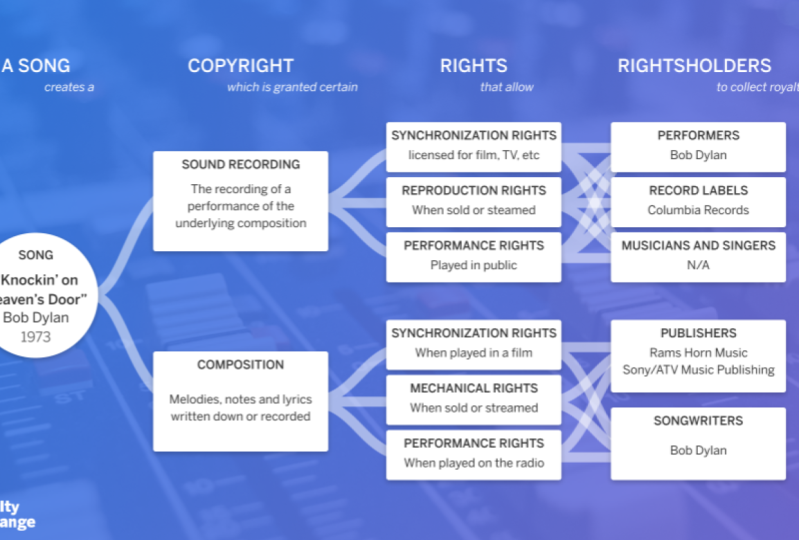
3. Artists Rights: Artists primarily earn money by their ownership of their music, rights to music or classified in two main ways. Some writing rights is the ownership of the intellectual property of the song. Now this means not the physical sung itself. This has to do with the composition. So the chords, the melody, the lyrics to be that kind of thing. This is owned by the people who contributed to the writing process of that song path of these rights are able to be licensed away to a third party for music publishing. But we'll get into that a little bit more layer. Money for songwriting rights is usually paid to our east via a performing rights society, which in the UK is the PRS. Next, we have muster rights. Now muster rights are the ownership of the physical recorded material. Each record in will have different must arise even if there are two recordings of the Samsung, each one will have different muster rights allocated to it. For instance, versions of the song My weight, one by Frank Sinatra and one by Sid Vicious For example, the muster rights for these recordings will be totally different and owned by different people. Generally, whoever funded the record, an honors muster writes, and this is usually at a record level of the artist herself. And money for muster ice is mainly paired through any medium in which the song is sold. This can be digital sales streams, synchronizations, things that actually exploit the physical recording of the song.
4. Live Music Industry: Live shows don't just happen. They are organized by two men. Part is part number one is the promoter. Promoters are the people who generally organize the live show. This means they booked the venue and the artists and any stuff that needs to be involved in running the show itself. This could be people like sound engineers or stage technicians, remote generally don't have any direct official affiliation to any particular r is the either work for themselves as freelance or for a larger promotions company, promoters nm on it from the ticket sales of the shows that they've book. Sometimes they split this money with the artist, or sometimes they pay a fee to the artist to play and therefore don't split the ticket sales with them. However, this is different for pretty much every single independent show that played in the UK. So each promoter might do it slightly differently. The second party that helps organize a live shows is the booking agent. Now booking agents work a little bit differently because they are affiliated to iced. Generally, a booking agent will sign an artist in the same way that a record level will sign an artist, then a booking agent will have a roster of artists that they will go to promotion companies with and say, okay, we want some of our artists to perform at your shows. When an artist is signed to a booking agent, Vishal will usually be an exclusive deal, which means that every show that the artist plays has to go through the booking engine in some form, agents and their money via commission. So when they book an artist until the show, when the artist has paid a lump fee, they will take their commission of that fee. When an artist isn't signed to a booking agent, does not commissioned to be paired them must have procured the show themselves. So the fee just go straight to them. For each show, 3% of the income of that show is paired to performing rights society. As part of that, then use the license to the performing rights society. This license enables that venue to have music performed at their venue. So for example, if royal blood play a show and they play ten songs, and nine of those songs are their songs on one of them is their cover of ace of spades, which was written by Motorhead. There will be paid for the nine songs that they wrote because they own the sunrise rights to those songs. However, it for ace of spades, there didn't write that song more ahead, wrote that song, which means head is going to be paired. The songwriting income for that sang. This process is a little bit long winded. Its a little bit complicated. Anita's called Music Publishing.
5. Publishing: By default, the songwriting writes for a song or allocated to the songwriters of the song. As we mentioned earlier, 50% of the songwriting rights will always remain with those original songwriters. The sunrise who may classified in two different ways. The first is a writer, the second is a composer. So a writer writes lyrics, the physical words that will be sung or spoken in the song, whoever wrote those is attributed as a writer. The other broader title is a composer. This is attributed to anyone who contributed to the composition. So melodies, B's colds or the overall structure of the song. If anyone had any contribution towards any of those, they are classed as a composer, whether those are split 50-50. So if someone did 100% of the lyrics there, 50% of the songwriting credit. If someone did 100% of the composition, they will have 50% of the overall songwriting rise. As I said, 1.5 of the songwriting rights has to stay with the original writers, always be of the 50% can be licensed away. Generally, this will be lightness to it, to a publisher who will then have a split of that 50%. So sunrise rights are already split 50-50. They are then split 50-50 again, a bug that with the original songwriter and rights under the publishers rights if they have been licensed away. Now I understand this is quite complex and it's gonna get more complex and we're gonna use an example. We're going to create a thick band with three members so that we can use real terms and real numbers rather than just being a bit arbitrary. So we're going to have Dave, MAC and Jennifer there in a band together and that splits look like this. Mock and Dave kolra, all of the music together, they composed the song. So the 50% that goes towards composition is split 50-50 with Mark and div, which means that the overall 100%, they have 25% each. Jennifer wrote all of the lyrics, which means the 50% is attributed to the writer. So the literate Krita, she will get 100% of that, which makes it 50% of the total songwriting writers. In this example, they have licensed the way 50% of their rights to a publisher, which will still have the writer and composers splits and allocated to it after the publishes split is taken into consideration, which in this case is a 28 day split, 20% publisher, 80% to the artist. So this is how the full percentage allocation looks. The first 50%, which is always owned by the artist, that will be paid to each member by the PRS. Dave has 12.5% because its 25% of the 50%, that is the composers half. Mark has the exact same because he has 25% of the composers, half of the full allocation, and Jennifer has 25% because she has half of the writer's allocation, which again is another 50%, which makes it 25% in total. Now the lift 50% has the publishes 20% split applied to it first 20% or 50% is 10%, which means the remaining 40% has the normal splits applied to it. So Dave's twenty-five percent is now 10% because 25% of 40 each 10% sand with Mark and Jennifer has double that because she normally has 50% instead of 25%, which in this case makes it 20% that super complex. I understand that the totals here are as follows. When they're added ope, Dave will have 22.5%, mark will have 22.5%. Jennifer will have 45%, and the publisher will have had 10% of the overall money that comes in from publishing. Why did this money actually come from publishing income will come from many different avenues. This could be radio play, this could be gained synchronized onto a TV show or film. But for most artists when they're first starting out, this money will come from plain live shows, as we mentioned earlier, with the 3% or problem clips license. Now this aspect of the music industry is often overlooked and rightly so because it is complex. However, if you look at the percentages that said Jennifer has compared to Mark and Dave, just in this section of the music industry, you can see the impact that it might have financial and we will look into that later. But I just want to stress the importance of music publishing within the music industry. It is important, is complex, but try and understand it because it will be worth it.
6. Recording: First, we're gonna talk about recording studios. A recording studio, which will look something like this, is designed for sound recording. In theory, the recording studio will have high-quality equipment such as speakers, are microphones for recording and will be treated in such a way that it is the best atmosphere for actually capturing sound. So the rooms will be treated with acoustic paneling and doors will be thick so that any noise at the other side of a door like outside or in other rooms, won't be able to bleed through into the microphones that are recorded. Every artist will either recorded a recording studio or by their own means, which generally is a studio in itself, but it's a home studio or the artist themselves actually owns a recording studio. A professional recording studio is generally made up of an in-house engineer under producer. Although sometimes those two roles bleed into one person and one person will do both roles when necessary. As a quick summary and engineer will be the person working the desk and plugging in the mix and turning the knobs under producer will be the person they stood behind that kind of calling the shots and helping the artist. Although we will get into produces a little bit later, if someone performs on a recording, whether they have contributed to the writing of that part or not, that will be assigned performance credits. These are very similar to master ice in that they are only affected by the recording and not the composition. This means that the performance credits and the master rights are actually paid for by the same organization in the UK, advise the PP L. Let's talk about producers. If a producer's involved, generally there will be paid in the same way that the studio itself will be paid. That being a onetime fee or paid by the hour or by the day, either way, that time will be paid for, not given any specific credits on the truck itself. However, sometimes a producer will be involved in the writing process and if this is the case, they will be assigned writing credits on top of the feed that they would normally charge. The producer has a pretty grim meaning nowadays. It can mean an electronic artists, but it can also mean this traditional definition and anything in between. And as I said earlier, it's becoming more and more common that an engineer and a producer will actually be the same person. But be aware when you're booking studio time. Are you having an engineer present or Are you having an engineer and produce a president? Because those experiences can be quite different. Because if you are working with a producer, generally they will have a vision for what they want the project to sound like. And we'll work with you and the engineer to make that happen. And engineer will just do the things that you want them to do. Remember, you have hired a producer for the musical knowledge. You have had an engineer for their technical knowledge. So to quickly summarize again, if you paying for recording studio generally is done on an hourly basis or a daily basis. By default, whoever pays for the recording owns it. This is called owning the master writes As we mentioned earlier, and generally, it is the artists that we'll pay for the recording and Jaffa on it or a record label, those already involved with the artist will pay for the studio. And therefore, and the master argues, if for whatever reason you are offered free studio time, that means that the recording studio itself will actually own the recorded. They have paid for it in time and effort spent on the recording. And therefore will earn the master eyes. This is something that we would recommend you avoid at all costs. Because if you can't own your own master writes, you should, and therefore you should pay for studio time to avoid that situation occur. And you then have the option to license those rights away to a record label, a letter dare. However, if the engineerings the rights, they can do whatever they want with them because they own them. That's a situation you definitely should avoid. Okay, let's talk about record levels. A traditional definition of a record label is accompanied that will fund, promote, and release recorded material. However, with the decline of the recording industry, with the introduction of streaming, record levels are now branched out into other aspects of the music industry, like music publishing or music synchronization. Record levels have and still do play, hand in the presentation of the music and the artist and all of the promotional material that might go along with it. This is more common in the pop industry, but it is seen in every single industry when you get to a certain level, generally this is seen as a bad thing in the music industry. That really it's just a company taking that product and then packaging it in the best possible way to then sell that product. Phase financially is good for everyone involved. Generally, the arguments against this offer creative reasons because artists want the control of how they look be held with themselves and example of a company the kind of embodies all of that is sooner they have the record label, but they also have a sister company that does music publishing and part of the big three major labels. These major labels are well-known, pop into heavy-handed in how they present their artists. Generally, a record deal will dictate the ownership of the must arise. This is not always 100% to the record label. It could be an 80-20 split. So any money that comes in through the record deal will be split in that way. There is also something called recoupment, which means any expenses the AP impaired by the record label will be paid off first before any money is split between the two parties. This means that something like The X Factor deal where you get 1 million pounds and a record deal, 1 million pounds will actually be recoupable, which means the first million pounds in revenue will underwrite those costs, meaning that you will have to earn one million and one pound before you even see any money income through muster rights can be anything from digital sales like through iTunes, streaming or physical sales. For example, a deal with HMV where they stopped guild vinyl and your CDs because they are seeing these vinyls of a physical recording, whoever owns those master rights will earn the money from those recordings. In this case, it's the record level. So we'll give you an example. Day of Mach and Jennifer have signed a record deal with a record label where it's a 5050 split. The expenses paid by the record label for the recording process are 5 thousand pounds. The A1 income from the master eyes is 8 thousand pounds, meaning that the first five thousand pounds of 8 thousand goes to recouping those expenses, meaning that the remaining 3 thousand pounds will be split in the agreed-upon way at which it's 50-50, which means they both get one hundred, ten hundred, five hundred pounds each. From that, meaning the record label gets 6,500 pounds and the artist gets 1500 pounds. The artist Duncan split that money however, they like, This is not subject to songwriting splits because it is not to do with songwriting. Generally, this money will be split equally between each member, not in the ways that the publishing income will be split. If an artist is involved with the record level, generally at the record label will take control of promoting it. Generally for this process, the artist or the record label will higher APR company BR committee will then represent the music to TV, to radio, to blogs or magazines, and to streaming services for playlist. And generally, the PR company will be paid as a onetime fee, either per release or per song. If this is paid for by the record label, it will fall under the recoupable expenses. As I mentioned earlier, the next form of promotion and generalise paid for by the artist and its merchandise. So this could be teachers, bags, badges, stickers, proper strip blankets, anything, anything that has the logo of the artist's slapped on it is merchandise and generally will be paid for by the artist, unsold, by the artist, meaning that the money is spent on from the merchandise will be self-contained within the artist. Although this isn't always true, indie record labels might help out with merchandise costs. Major record labels might help with merchandise costs. Sometimes specific deals will be made with T-Shirt companies to sell specific merchandise resemble the Rolling Stones, have a deal with prime OK, to sell merchandise. And prime OK, we'll earn probably most of the money that's coming from that. It's also possible that accompanying Prime OK, might pay a one per year fee to license the rights to that logo under than any revenue from the t-shirt sales will go directly to prime. Ok. The Rolling Stones have already been paid.
7. Sync: Synchronization is the process of placing a sung into any form of visual media. This can be a film or a TV show and advertisement or anything like that. Synchronizations are procured via async agent. So what do you think agent, a sink agent works in a similar way to a booking agent in which they will represent a certain amount of artists. So they can have a catalog that they can pick and choose from when pitching music to music supervisors, just cite the booking agent, the sink agent takes no actual ownership of the songs that they represent, instead a license in that music, so they have the right to pitch it. Again, like the booking agent disengaged and earns money via commission. Every successful sync placement that they get there, we'll take a percentage fee from which means if they don't get any placement that or earn any money, sometimes music publishing companies also branch out into seeing. And there we might have a sink department that works on synchronizing the music assigned to them via publishing deal. If that is the case, then the details of that will probably fall into the larger music publishing agreement that the ice to s2. The second way that humbled is with something called a blanket license. Now a blanket license, it gives a production company the right to use that song as they see fit throughout whatever production they're working on. Which means there might like a song and there might use it seven times throughout the course of a week on different advertisements or shows because there is no flat fee involved with this type of synchronization. Artists earn money from this via royalties. Essentially, every time that song is played similar to the radio, similar to live shows, every time that song is played on the advert, they will earn money for that. For instance, if an advert containing your song is played seven times in a day, you will repaired seven times. Royalties for this are paired generally by the second and each channel or production company will pay a different amount per second. This means that it's difficult to gauge how much money you could potentially earn from a blanket licensing deal.
8. Artist Managers: So everything that we have covered so far in this course constitutes an artist's music career. Sometimes artists might want to focus on songwriting and perfecting their craft. So they might hire someone to manage than music career for them, this person, believe it or not, it's called an artist's manager. Now the term artist's manager is a little bit vague. As long as the artist manager, managers or helps the artist in some way or another, they can be classified as an artist manager. So it doesn't have a cut and dried definition. For instance, been likes to find their own live shows and they want to keep doing that and they don't wanna have to go through a manager than the manager might focus their time on other things such as like level representation or branding or social media. Generally, some managers are hired based on how they can use their previous industry experience to help benefit and ice career. But this is not always the case. Managers can come from pretty much any walk of life. And as long as they have some music industry experience, or maybe the artist has a friend that just wants to help them out. This might eventually evolve into an ice manager, relationship, managers generally and then money based on a percentage split with an artist in a similar way to what Eric level does. And I am the manager, may have a deal in place that says any income by this artist, 20% of it goes to the manager and 80% of it goes to the artist. The general artist manager split is usually 15 or 20%. A manager will usually take their share from all money that comes to the artist's except the PRS money that goes directly to the members.
9. A Full Financial Breakdown: Okay, let's do a full financial breakdown of how the music industry actually earns money. So this is going to be an example of one year's finances. We're going to start with costs. There's only been one cost of this entire thing. And that is the record label who paid 5 thousand pounds for the recording process of the, let say EP, that's going to be released. Here's the income per source. So where it is actually coming from in terms of the music industry, entities that are given not money. First is published in revenue, that is 10 thousand pounds, 5 thousand pounds of it is coming from the PRS, and another 5 thousand pounds of it's coming from the publisher who also collected from the PRS, but the artist will see it from the publisher. Next is 5 thousand pounds worth of synchronization revenue. Next is 15 thousand pounds of master rights revenue. Now this could be sales of CDs, streaming, iTunes sales, all of that is kind of lumped into one lump-sum ready for when the artist actually gets to see it. In this example, the artist has done at all, and the tort itself won't 16 thousand pounds. Now we will do income per party. So who actually sees that money? The record level, we'll see 10 thousand pounds. That is because they see 5 thousand pounds of the recoups expenses. And then there's 10 thousand pounds left over, which is split 50-50. So they get 5 thousand pounds, extra 10 thousand pumps turtle, the publisher will see 2 thousand pounds, 100 pounds of the 5 thousand that they collected for publishing, and 1000 of the 5 thousand that they collected for synchronization. Next is the promoter that working on a 50-50 split, which means the 16 thousand pounds that was earned from the TOR, the promoters will get 8 thousand pounds of that. Generally this money won't be seen by one person and it will be many people who see it because generally, each venue will have a different promoter unless you're working on like an arena scale, in which case, one promotions company may take the entire tall, smaller level. That's less likely to be the case. So the 8 thousand pounds will be split between each venues promoter. Next is the booking agent. They will get one hundred and six hundred pounds because there are 2080 split will be applied to the 8 thousand pounds that he's left from the tours income. Next is the artist will do this kind of abstract lit as the total money that comes into the artist and then we'll break it down per member and PR manager. The total money that the artist will get him for this year is 24,400 pounds from publishing. They have 9 thousand pounds. And that's because 5 thousand from the PRS comes direct to the artist and 4 thousand pounds comes to the artist for publishing from the publisher. Because they took that 2080 split on the 5 thousand that they then collected. They'll receive 4 thousand pounds for synchronization. Again, because of the 80-20 split on the original 5 thousand that came in. For the master rights, there will get 5 thousand pounds. But because it was 15 thousand that came in, 5 thousand debit was taken for recruitment, and the other 10 thousand has the 50-50 split allocated to it, which means they get 5 thousand from mass arise from the toilet. They will receive 6,400 pounds because the promoter tick and they occur and then the booking agent of taken Thakkar leave in 6,400. Okay. Let's break that money up per member. We're gonna start with the managers. It's a little easier. And generally the manager will take that split first and then the rest of the money will be divided. So the manager is and 3,880 pounds from publishing, they've earned a 100 pounds because the money that came in through the PRS, they don't see any of that. The publisher, they see 800 pounds. For synchronization. There will receive 800 pounds for master rights, they'll receive 100 pounds. On the top there we see one hundred, two hundred and eighty pounds till invariant to 3,880 pounds for the div and Mark receive the same amount of money because everything is split equally except from the publishing and publishing that they have the same amount of songwriting credits. That means that for every single bit of income that they have, they receive the exact same months while only read this ones. But know that both Mark and did receive this money. They total at 6,156 pounds at 65 pens that I split between 250 pounds of the publishing income, 11250 from the PRS and 800 and from the publisher will notice that the money from the publisher and the Paris is different, even though the similar amount of money came in, because the publishers money has the publisher split allocated to it under the PRS minute is split just between the three members. This is also true with the manager split because they will take a cut of the publishers publish in money that came in, not the PRS money because that will go straight to the songwriters. 166 pounds at 66 pence from synchronization, 10000333 pounds, 33 pens from the master writes 1706 pounds at 66 pens from the Tor. Remember that Mark and they've both got that amount of money. Next is Jennifer. Jennifer received 8,206 pounds, 65 pence from publishing. That is 4,100 pounds. That being 2.5 thousand pounds from the PRS, 11600 pounds from the publisher. Again, because the publisher unmanaged split were applied to the publishers publishing income, not the PRS income. 166 pounds, 66 pens from synchronization, 11333 pounds, 33 pens from master ice, one hundred seven hundred and six pounds, 66 pens from the top, and that then totals to 8,206 pounds, 65 pens for Jennifer, you will notice that there is actually five pens leftover. There's a lot of recurring digits happening here, meaning that that's five P leftover, give it to charity or something. There's something to be aware of here. Notice how much more money Jennifer's earning compared to mock and div, the only money that Janissaries getting different tomorrow and Dave is the publishing income, but he does make a very large difference between her income and that income. So it is something to be aware of. The publishing is often overlooked. So just looking at how much more money Jenifer, and it's, it's evident that it's really important to take closeness of publishing and how much money songwriting can actually earlier in comparison to master eyes and taurine and synchronization that all very important incomes, but publishing on top of that will create a larger income stream.
10. Conclusion: And that's it. That's every aspect of the music industry. It's very complex. There's a lot of things happening, especially with the ammonia as you've seen. But hopefully that gives you a much greater understanding of how the music industry actually works. All of the COGS that attorney in all at the same time and where the money will flow when you start any money in the music industry, if you have any questions about what we've talked about in this course or what we do urban DIY. Please don't hesitate to contact as contact up band DRY.com. Thank you very much for watching this skill shackles. Remember we make YouTube videos of the music club, so she won't see more educational music-based content. There is the place to go. Thank you very much for watching this, and I hope you have a great day.
 The Music Lab, DIY Music Educators