Transcripts
1. Introduction: Hey guys, this is John storm and today I am super excited to work with you on this idea of drawing badly. This lesson is called Turn your bad drawings into red drives. Today, what I wanna do is I want to first of all, talking about the mindset and the philosophy of why you would want to draw badly. After that, I have a couple assignments that I want you to practice this skill of drawing badly and see what you can discover. Ok, so the great philosopher and theologian GK Chesterton said, Wow, a mouthful right there. But he has a quote that says, Anything worth doing is worth doing badly. And we're going to use that quote has a guiding principle as we explore this world of drawing and creating badly. Alright, so thanks for joining me. Can't wait to get Rolon and let's get started.
2. The Mindset: Ok, there you are. First off, I want to talk about the philosophy, the mindset of drawing badly. This is something that I've been curious in for several years, you know, often as artists and people that enjoy our drawers and people that enjoyed drawing, we get this, this idea in our head that we have to do it perfectly and we have to do it really well. You probably remember as a kid seeing somebody in class or knowing somebody that could draw a really well. And the rest of us felt like we just couldn't match or compared to that person. As we grow up, that feeling stays the same. I believe there's so many people out there that simply don't practice their creativity because they fear that they can't do it perfectly. They can't do it good. And that's a lie that keeps them from enjoying their creativity. So that quote by Chesterton that says, Anything worth doing is worth doing badly if you're going to grow in your creativity and if you're gonna grow and an artist, you have to be okay with creating things, not perfectly, with things that may be quote, unquote, bad. And I honestly believe that this whole idea of good and bad is really just as really just a mindset. I tried to go into the realm of what might be a bad drawing in hopes that I might discover something new. Okay. And so as much as you can, that little sort of evaluator inside your mind that says, well, this is good, this is bad. You try to draw something and you're as good as a bad, try to shut that off. Similar to a jazz musician that's just improvising in the moment. They can't be thinking about what is good, what is bad. They just have to get into the zone and get into that musical flow. Same is true with a visual artist as you're creating. Okay, so my challenge to you is start to turn off that little internal regulator that saying, well this is bad, you need to stop, you need to throw this way. Don't listen to that. Keep exploring and keep pushing further into what might be a bad drawing because you never know. You might discover something amazing. Ok, so that's a little bit about the mindset. There's so much more to cover and that we could dive deeper into that. But hopefully that little tip can kind of get you started as we explore drawing badly. Thanks.
3. Exercise Explanation: Or I guess next, what I wanna do is I want to explore with you three different ways that you can practice drawing it badly at the end of those three different exercise or techniques, I've got one bonus feature that can also help you take your bad drawings to the next level and help you discover some awesome stuff. Okay, so the first technique we're gonna do is going to be scribbling, okay? And I believe that as a perfect place to start as children, we scribbled all the time. We didn't really know what we were doing, but we just love the movement of making something happen. And for some reason, at some point during our artistic development, we abandoned scribbling and we get rid of it for some reason. But I believe scribbling is a great key to turning bad drawings into red drawings right? Now, why scribbling or one? Scribbling is a great way just to loosen up, you know, getting your arm and your shoulder into they're just a great way to loosen your creative muscles. Okay, the second thing why I think scribbling is important is because you can get unstuck when you start with a scribble and just kind of letting your line meander around, you will start to see something. Your mind is constantly trying to make sense of what it's, what it's looking at. And at first your mind will not like you're scribbling because it will look like nonsense. But as it keeps scribbling and those lines start to merge and intersect and criss cross, your mind will start to do amazing things of looking for an image, maybe sometimes a face, maybe sometimes an animal. And so scribbling is going to be one of our first techniques that I want you to try.
4. Exercise One: Alright, I guess so here I am just working in one of my sketchbooks. I just have a marker and I am just scribbling ok. Trying to get my arm and my shoulder into the work and just kinda scribbling China to think too much about it. Don't think good or bad. Just make marks, scribble, Scrabble. Anyway you want to, okay? And if you let yourself enjoy it, it can be a whole lot of fun. So see what you come up with. Here. I decided to do a quick little bonus scribble working on a Post-It note for you getting started, even just taking a post to know with a pen or pencil or marker and just trying to fill that, post a note with scribbles can be a great introduction into scribbling. And that leaves you with a pretty cool postsynaptic. Check that out. All right, did you guys have fun with that little scribbling exercise? Once again, scribbling is a quick, fast, easy way just to kind of get unstuck and just to get those creative muscles moving. If we ever get overwhelmed by the fear of that blank page in our sketchbook or Canvas, scribbling is a great way just to break the ice and start to look for something interesting. If you wanna take scribbling to the next step, I highly recommend missed my pinkie there. I highly recommend checking out the work of sight humbly. There's also a contemporary artists named Vince Lowe who takes his scribbling our work to the next level and mostly just have fun with scribbling. Okay, it's always a tool in your toolbox from now on, just a scribble.
5. Exercise Two: All right guys, let's move on to our technique number two, exercise number two, which is going to be blind contour drawing. Now chances are some of you guys may have heard of blind contour drive before and some of you guys may have not. This exercise is a little more challenging than scribbling, but it's a great way to discover some really interesting, what might it look like? Bad drawings, but that actually have a great purpose. Basically, blind contour drawing works like this. You choose a subject. Hands are often used as blind contour subjects. Getting started, you have a hand right then and there, all you do is you take your pencil and you have some paper or your digital drawing pad, and you simply look at your subject, for example, your hand. And you don't look at your paper, you don't look at what you're drawing. And your goal here guys, is to simply start somewhere and think of the contours as the edges of your subject or the edges of your hand. And what I like to do is I like to imagine that there's a little bug starting on my wrist and that little bug is going to crawl on the edges of my fingers. And what I'm going to try to do is I'm going to keep my eye on that little bug as it travels very slowly across the contours of my hand or whatever you're looking at as a subject, could be a coffee mug, could be a plant, could be your shoe, whatever. Okay. And so whatever your eye is doing, your drawing utensil, your drawing in is st and merge together. So you'll be amazed at the uncanny resemblance of how your hand and your eye can link together and that you can create and redraw amazing detail of your subject and try to pay attention to the wrinkles, the bumps, the little kinda nuances of your subject. Ok, so exercise number two is going to be blind contour drawing. And I know you're going to want to peek. I know you're going to want to look, but try not to. It is simply set a timer. 510 minutes is a really good challenge, but simply focused solely on your subject. And when you're done, that's when you can look at your drawing. And you typically most people let out a really good gasp of astonishment and surprise as they look at their drawing. But that only works if you don't peek. Ok, try it out. Exercise to blind contour drawing. Let's do this. Alright, so here I am getting started. I sped the video up quite a bit, but I was going a lot slower than it looks like in the video. Just because if I put it in real time, put most of you guys asleep, so sped up quite a bit. And you'll see that I'm just traveling and my eye is following along on my subject of my hand. I'm not peaking and just see what happens. Good luck.
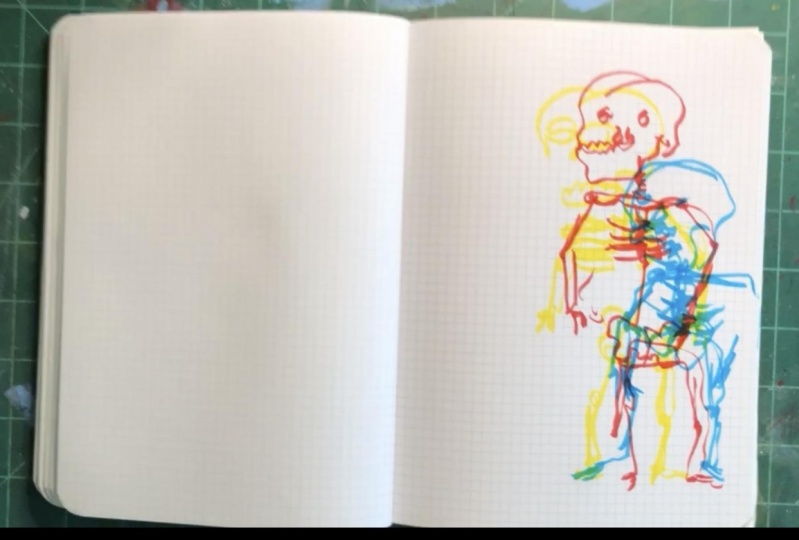
6. Exercise Three: Alright guys, we are making some great progress and making some bad drawings that in reality are probably pretty rad drawings. I hope you enjoyed blind contour dry, a little tricky to say, but now we're gonna move into exercise three, which is one of my personal favorites. This is drawing with your eyes closed. All you're simply going to do is you're going to select an object or a subject. For me. Some of my favorite things I like to do this exercise with, for some reason our faces or even skulls. But you could select flowers or an animal or something that you believe you have a pretty good visual memory of that object, okay, all you're simply going to do is you're gonna take your pencil or marker or pen. You're gonna close your eyes and you're going to redraw that object or thing strictly from memory with your eyes closed. I learned this trick from author and artist Linda Berry, and she has a really cool kinda twist to this. She takes three different colored markers or pens, and she will take one color first and she'll draw kinda the, the subject. And I think it was maybe a skeleton in the example with one color. And then show, pop the lid on, grab the next color and she'll draw the exact same subject, eyes close with the other color. And then she'll repeat with the third marker. And you'll see this really cool overlay of the same subject drawn three different times with their eyes closed. And that's what I want you guys to try to do with this exercise three, I'd like you to choose three different materials that obviously are very clear, whether in color or line quality. I want you to choose one subject, and I want you to draw it with your eyes close three different times, where it's overlaid on top of itself. I think I'm gonna go with the skeleton. Not that I can entirely remember what a skeleton looks like from memory and full detail, but I have a pretty good idea. If you can't think of anything, try the skeleton with me and we'll see what happens. Alright, so exercise three, subject, three different colors. Eyes closed. Anybody confused yet? Awesome. See what happens? I guess so here I am working on my sketchbook. My subject is the skeleton. I'm going to start by working with my yellow marker. And I turned up to speed on this trying quite a bit. And my eyes are closed or that you can't see them and hear him kinda work into their here in a second, I'm gonna switch to my second color, which will be the red. I'll do the exact same thing, eyes closed and recreate the skeleton. Lastly, I'll switch over to a blue. And I think I'm gonna start from a different spot and see how that changes the end product. So check it out. And then I was like, what what what my dad like that okay.
7. Conclusion: I hope you guys check out those videos of me doing the exercises along with you guys. And please will you upload images of your work into some of the project gallery so I can see and comment on some of the cool stuff that you've been working on. So guys, in this lesson, we've talked about the importance of drawing badly. Once again, having low expectations about your artistic output helps you just kinda keep the practice going. If we feel that everything needs to be super perfect, we tend not to do it and it really takes the fun out of it, I believe. And so drawing badly often leads to discovering new things and just having fun with it. We did. I mean, trying to think back to our first exercise was scribbling. There we did some blind contour drawing and then we also did the eyes closed, a quick feature that you could really take your drawing badly. Another step would be using your non-dominant hand. If you're right-handed, try these exercises with your left hand, okay? If you're left-handed, swap over to the right-hand, see what happens using your non-dominant hand is a great way to relinquish control of what you're creating. Guys, I did want to say a big thanks for joining me with this lesson. Hopefully you had fun, hopefully at a little practice and making some bad drawings. But realizing that they're not bad after all, they're interesting, they're strange. There may be a little weird, but chances are there read drawings. They're awesome. And I hope you've discovered something new. Alright, once again, this is John storm and I look forward to see you guys next time with what's coming up. Alright. Thanks. Bye-bye.
 John Storm, Artist & Educator