Transcripts
1. The Secret of Presenting with Confidence: Fear. It is the
silent companion that stands beside you as you
prepare to present your ideas. It grips your heart,
scatters your mind, and makes you doubt
your own brilliance, fear of being judged,
fear of rejection, fear that your
work, your effort, your creativity is not enough. But have you ever
stopped to ask yourself? What is this fear? Where
does it come from? And why do we allow it
to hold us hostage? This course is not just about learning techniques
to present your work. It's about transformation. It is about understanding fear not as an enemy,
but as a teacher. Fear arises because
you care deeply. Fear arises because
you want to be seen, understood and accepted. And in that care lies
the seed of connection. We will go on a journey
together into this space, exploring the roots of fear
and how to move beyond it. You will discover that
presenting is not about perfecting or
pleasing others. It is about authenticity. It is about sharing your vision in a way that allows
others to feel it, too. In this course, we'll focus
on what really matters, helping you move past
that fear of presenting. You'll learn simple techniques
to manage your anxiety, structure your ideas,
and connect with others by showing them the deeper
meaning behind your project. We'll talk about how to handle rejections and critiques
without taking it personally and how
to use feedback to grow instead of
letting it hold you back. You'll also discover
how to bring out the best in your project, making sure others see
its full potential. When you present with love
for what you've created, that energy is contagious. It's what inspires people
and makes them care. By the end of this journey, you will not just present. You will inspire. So if
you're ready, let's begin.
2. How to tell the story of your architecture project without fear: Hi, everyone. This is
lesson number three, how to tell the story and how to inspire with
your presentation. In this lesson, we're
going to go through the different ways or the different
principles that we can use to tell a story in an inspiring way and in a way that gives us a certain
order in our minds, to build it and also
to tell it to others. A lot of times the
fear come from our chaos in our
minds and we don't know how to tell the story
in a continuous way. So now we're going to look at some principles that help
us make some order and how to tell the story step after step or through
a certain technique. So the first thing
that I do when I create a story of my project, I take three most
important moments, the beginning the
peak and the end. Those three moments identify the whole structure of my story, and they help me build the rest. So first, I'm establishing
how did the project start? Where did it come
from? How was it born? It's moment of birth. It could be an
inspiration, a feeling, a thought, and how
it slowly developed. Then I established
the peak moment, the most important part
of my projects process, the peak moment where everything changed, where
everything turned, where everything
translated itself to a concrete design
or the moment of inspiration or design
principles where I understood what I really need to do to make
it architecture. And at the end, I'm establishing my final statement
of the project, which can be an open ending
towards new questions or it can be just a conclusion of
what the project should be, what the project
could be, what it is, actually, and how it's
showing its potentials. Another way is the
dynamic approach and the Zoom in
Zoom out approach. We will go through all of
them now and see how do we actually bring it to
a concrete presentation. So the dynamic
approach is almost as if we are creating
waves of tension. So the project is rising slowly. It goes up through sometimes a sketch or
sometimes that we write or some images that show a beginning of something of an idea, a
beginning of a plan. And the sketch already creates a tension in my mind to see, how do I translate it
into architecture? How does it look when
it becomes a plan? How does it look when
it becomes a render? So I'm creating these
moments of expectation, a peak moment that shows
me the revelation. Okay, this is how it looks. This is how the plan looks like. Then I go back down explain something that creates
curiosity and attention, and then I bring the image
that shows how it looks. Then again, I create a
curiosity, and then again, I show the image how it looks and how I translate
it into a project. I can also build a
story in a gradual way. I start chronologically how it starts and then
slowly how it developed, and then how I researched, and then how I reached
a certain understanding and from that understanding
the translation to design, and then the different details and plans and
sections and so on. So it becomes a
gradual moment of a buildup the Zoom in Zoom out technique is very interesting
and helps us also control our presentation
because in each moment, we know exactly where we are. We can't get lost. This is exactly where we're
supposed to be, and we know what
our next step is. So it has a lot of order, and the scale is the thing
that changes everything. So zoom in and zoom out and scale is when we start
with a bigger scale, we are looking at our
project from Google Earth, from the continent,
from the country, from the city perspective. Then slowly we go into
the regional perspective, then to the local perspective, then to the building site, then to the building itself,
and then to the details. So basically, we're
going scale wise, deeper and deeper and
deeper in the project. And in each way
we're going to stop, we know exactly where
we are in scale. So the next stage
is the next scale. We can also create
a Zoom out process. We start with the details
of the project or the images of the final project then we go back to the site, then we go back to the local, then we go back to the regional, then we go back to the country
or continent or or planet. So this is the Zoom out process. Again, it also creates a very clear order in our presenting and
understanding the project. While the first one
is more standard, the second one has a bigger
surprise and creates a very nice moment of
tension because we first see an amazing project
in front of our eyes. And then, Okay, how
did we get here? How did we reach this
moment of project? There is also the
zoom in and zoom out technique of content
or categories. So we zoom in based on the
elaborations that we did. We start with the
intro of the project, then we go to the
research and analysis, then to the inspiration, then the design principles, then the project
itself, and at the end, we are creating a nice
ending of the project, an open ending or
a closed circle. But these categories of understanding the projects
are actually a zoom in, not in scale, but in content. We can zoom in and
zoom out the same way. We can start with
our understanding of the final project and then go backwards from the
project itself, then the design principles, then to the inspiration,
then to the research. And at the end, how did the project actually
got its moment of birth? So how do we create
that right and in which sequence can we use
to make it much easier? So we create key points like different frames,
and in each frame, we create our emotional insights or important design insights, and then we fill
the gaps between. So don't be afraid
if you feel that it's a bit chaotic,
don't be afraid. Just put those important moments
that come into your mind as static frames that
you're now developing. And in between, now
you are actually just creating the gaps. So one moment is, how
did everything start? And then how did everything
became a strong inspiration. So between the start
and inspiration, there is a gap to fill. How did I reach from my
beginning of the project from some idea and its title
to the design principles. And from there, how
did it translate itself into space, into
architectural elements? So in that gap
between those two, there is also some
spaces to fill. Once we have those key
moments, key frames, it helps us a lot to understand how to create our sequence. So first, I would
recommend to start with the soul of the project. I personally consider a story of a project as describing
a whole organism, a whole living creature
that has a soul, it has a mind, and
it has a body. Our project has a soul, which is the part where we explain the connection
to a very high meaning, very high understanding, a very abstract and general
understanding of our project. Then we have the mind
side of the project, which is the emotional
and intellectual layer. It's the whole analysis
and the connection to the connection to data and to limitations and the things that we are developing
in our mind. So the reasonable
understanding of things and emotional
understanding of things. How did our emotion
become design principles? And at the end, we
are showing the body, which is the translation
of all of those things into a concrete design of space. These are the
architectural elements. This is the configuration
of the space. So in this case,
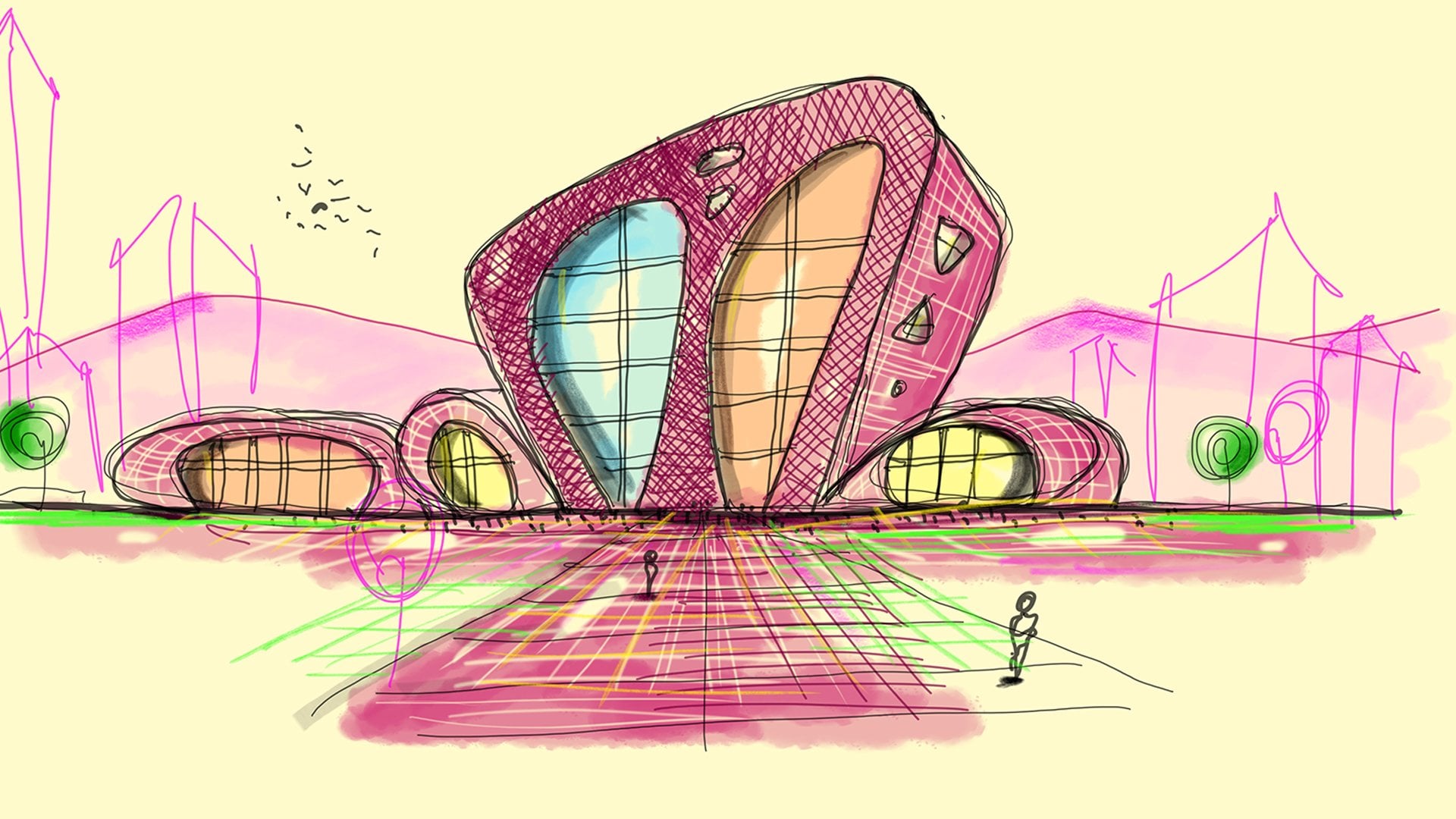
you see an example of a project that
I've developed, and it started with a
certain understanding what the human being is. So that was a museum for the
human victory on our fears, on our limitations, and this
is the museum for growth. So basically, the
first understanding was that we are as
humans are connections between a universal
or infinite power or energy towards nature
and earthly matter. So we're the connection
between those two elements, and we are constantly providing the bridges
of those gaps. So from that moment, when I
understood this motion from the sky that is
connected to the ground and we are in the middle
between the sky and the ground. So the human being for me
is the representation of this connectivity as a mediator. From that moment, I understood that this motion needs to become an architectural space that connects the sky and the ground. So it opens up towards the sky, it opens up towards the
energy that comes from above. It receives it, and
then it brings it down to earth and in scale and expands and
expands in its surrounding. And this became the project of the Museum of Human Victory.
3. How to handle feedback or critique in architecture presentations: Hi, everyone. This is
lesson number six, handling harsh feedbacks
and critiques. In this lesson, we're
going to go through one of the most important elements of presenting and especially
handling our presentations, the feedbacks, and
the critiques. And let's try to understand the difference between a
feedback and a critique. So a feedback helps us grow. It sees our potential, and then it uplifts us towards our higher self or takes the project to a higher
level to another step. So it sees all our flaws and all the mistakes so
called as potentials. So in a feedback,
when it's made right, it's not considering
the negative. It's actually seeing
the potentials and how good the project can be. What are the elements
that need to be developed to make it amazing? A critique, on the other hand, focuses on your downsides. It focuses on your faults. It doesn't inspire
you to work and change and do different things for the project, so
it becomes better. The critique is focusing
on your negative parts. It comes from a
certain belief that if a person works on his weaknesses and we're focusing on the
weakness all the time. You're weak, you're weak,
this is bad, this is bad. Eventually it will change
to something good. And in my opinion, it is very important
to change from critique to feedback because
feedback sees only the good, and people learn
from inspiration and from the motivation of a certain spark that they recognize in
themselves and say, Oh my God, I did that,
I could do this, I could reach that point, and then they work
harder and harder to change and eventually
reach an amazing outcome. So a real good feedback
is the one that sees how beautiful you can be
or the project can be and gives you a
hand to take you up, to take you towards that
place and shows you. Listen, if you take that road, if you do this thing, if
you develop that idea, look at how amazing
your project can be and then shows you a
certain vision or takes you two steps further to
make you understand that this change can bring your
project five steps higher. So as a result of that, a
good teacher, good professor, good mentor is the one who always focuses
on your potentials. It doesn't focus on your
worst parts or your faults. He sees in everything a potential to be something
more beautiful and better. And he pictures
you. He gives you a mirror and shows
you through his eyes, he shows you how amazing
or your project, how amazing they can be if you look at it
through these angles. This person is the one to
lead you to that point. He inspires you and he creates motivation
through inspiration, and this is the force
that lifts you up. If you don't feel that in a critique or in a
feedback moment, if you don't feel that pull up, then you know that something
is not quite right. And this is why I always tell my students that
critiques do not exist. It's either a feedback, a good feedback
that lifts you up, or whatever is being
said that takes you down has nothing to
do with your project, has nothing to do with you, has nothing to do with architecture. This is something
completely else, which is on a personal level, character, personality,
something that you can take aside, just ignore it. But if you don't feel the
pull up, it's not a feedback. It's not a good feedback and
it's not a good teacher. So focus on the feeling
that you have and then you will know how to recognize if it's a
pull up or a pull down.
4. How to handle a fear of rejection?: Hi, everyone. This is lesson number five, fears of rejection. In this lesson, we are
going to go through some of the most important elements
and principles that block us and prevent us
from enjoying and presenting our presentation in a beautiful flow in
an inspiring way. It's the fear of rejection. What is the fear of
rejection actually? The fear of rejection is
the fear that no one will understand our project
or our intention. It is when we are fearing of failing or not fulfilling
an expectation, and as a result of that, we are rejected by others. We think people
won't agree with us or accept the reasons
or ideas that we are presenting and dismiss
the project or even break the whole existence
of the project altogether. So we then seem very
unprofessional, and we are not appreciated. We are actually laughed at. So all of these are connected
to the sense of rejection. But what is the fear of rejection actually
underneath everything? It is actually the
ego that plays a very big role
in our existence, and we should give a very
close attention to that. It also shows that we have some distorted beliefs or
very distorted world views, and we will talk about
it in the coming slides. There is also the
lack of empathy and lack of compassion
to ourselves. This is what the fear of
rejection actually tells us. It tells us that we are
taking life too seriously. We are almost not allowed
or we don't know what are the most important things
in our lives that matter. And each small thing
that someone says becomes the end of the world or what is secondary that we
can actually laugh at. On the other hand, this fear
also shows that we care too much about the project
and we are afraid to lose it. So if someone rejects our
project or our ideas, we're afraid we're
going to lose them, or we would have to
find other ones. It is very important to remember that it's a very natural fear. Everyone has it, especially in an environment or
institution that emphasizes the need of outcomes
and emphasizes critiques. This is where the fear
of rejection actually is being multiplied and
evidenced, very strongly. But the thing is that no
one can actually reject us. This is the biggest insight. They can only say,
It's a mismatch. So the rejection cannot exist. It is just the fear of
solitude to stay alone. If someone says bad
things about our project, we are then remaining by
ourselves alone there, almost disconnected
from everyone, and we are put on a spot. So this moment of
solitude of fearing to be alone is coming to game, and we are doing everything
we can to avoid it, which is not necessary because no one can
actually reject us. In the real world, it is
so okay that a client or an authority do not accept a certain solution of the project or the whole
project altogether, and they wish to see a
different version or direction, it is not rejected. It is just a legitimate
mismatch of needs. They're basically saying
what we want and what we need is not being
represented here. So let's see a
different version, or let's see a different angle. But it doesn't mean
that we as people, we as a person are
being rejected. And again, we are more
than just our project. So nobody can
actually reject us. They can say the project
is not matching the need. So what is the
alternative of that fear? How can we handle it?
What I'm suggesting is to look on everything
from the bird view, so you leave the
chaotic events of the now if people are starting
saying certain things, and it starts multiplying and certain critiques and
feedbacks and opinions. Just imagine that
there are many, many drops of rain falling
down in the same spot. But you are now going
up and up and up and you look at everything
and you see the whole ocean. For you, the small drops
and the small chaotic, dramatic events do not
matter. You are above that. You look and focus on the unity, on the simplicity, the outer ripples of this whole
event that is happening. So how does this fear actually presents
itself as a potential? How do we transform the darkness into a work of art into light? How does this fear transform
itself into a force? It is by changing
our mindset and understanding that
each thing that can be said about our project
doesn't matter if it's good and doesn't matter if it's bad, even if it's the worst. It is actually a mirror that
puts a certain emphasis on just one part of our
project that allows us to see where we
can make it better, where we can actually
take the project and transform it into a
beautiful thing altogether. We try to envision that
critiques and opinions about our project is an opportunity that
someone gives us. We are in a receiving mode. We are not in a protective mode. We're not in a fearful mode, but we are receiving
everything that is being said. And then we're
filtering everything. We don't have to
take anything in. We're just filtering
all the information and we'll take something
from someone's opinion. And then we say, Okay,
maybe I can think of that and change an element
and see how it works. Maybe I'll reach out a new idea. Maybe some innovative
idea will come out of it. Usually, the best
projects come out of new ways of looking
at our project, sometimes if it's taking a certain weakness
of our project and I'm playing with it until
we reach a new solution. So in that sense, this
fear becomes a bridge, a moment to pass towards the biggest and most
beautiful version of our project and of ourselves. Because instead of being fearful and blocked and defensive, we are now open to receive and from that
openness can only come new insight and new ways of learning and
understanding architecture. So some techniques and
exercises to release those fears are both
mental or let's say, awareness changes, and some of them are
practical that we need to practice as we put ourselves in the situation
again and again. So the first thing
that I would do is not expect any good feedback
as a sure thing. I used to go to when
I was a student, I used to go to my revisions with a sense
of samurai, almost, like, knowing that this is going
to be the worst thing, and I'm now ready
for everything. No one will like it, no one
will understand my project. No one will know the
insights and everything. I'm coming with open arms to receive all the
critics imaginable. So I'm not coming with an
expectation for good feedback. I'm coming for an expectation to different kinds of responses. And this helps me to release the tension because
I'm not supposed to be the best or have
the best feedbacks. I'm supposed to learn and
grow as a professional. And that's very important to remember we are here to learn. We are not here just
to get a big hug of warm embrace of
safety and security. Sometimes in life,
we don't have that. We are here to learn,
we are here to grow, and sometimes it goes through maybe less
positive feedbacks. This is still not rejection. This shows that people see our project in a
different way, which is good. It's good for us to understand
how the world sees me. But don't let others have any force on you and on
your self confidence. Let your love and passion
for the project be the compass that guides you
through your whole process. It's not about
what someone says. It's about what you
feel inside of you, that's the most important
thing that matters, because if you feel that you do something with this
passion and it's truth, you know that what
you're doing is right. You feel that it's connected to all of these things
that you've developed. And so if you feel that you're really confident about
what you have done, keep that hold to
your confidence. Let that be your strength in front of others who may
not understand you. But as they are allowed to
have their opinions and say certain things,
don't be protective. Just try to understand
that it's not a rejection. They are just showing
you a different angle of your project, and maybe you could use
one of their opinions or maybe the opinion
that you need to hear. It's very important for you to hear because then it will start a certain movement of the
wheels inside your brain, and then eventually
you will see that a new innovative solution
might come out of it. So you need to see it
not as a rejection, but as an opportunity to get to a better understanding
of your project. So if the process was strong
and authentic within you, that is your
strongest confidence. The project is then
bigger than anyone else. Remember when I was
a student and I had that strong feeling
that my project was authentic and came with
a bigger mission with a bigger understanding of
how to help human beings. It was a school project, elementary school project
that started an idea of how to create a space
for children to learn. And instead of
looking at it through the perspective of
an institution, almost a prison that are being built all the time around us, to look at a place that
actually embraces children and strengthens their sense of curiosity off the world which is the most
important part in a school to create inspiration and inspire children to learn. And I really felt that
the insights that I have reached are bigger than me and are bigger than
everyone else, my professors or other people
that looked at the project. I really felt it. But
when I was in university, they rejected so
called the project. They said, The
project is not good. You should do something else.
This is not good enough. This is not strong
enough. This is not right enough,
and so on and so on. Eventually, I insisted
on the project, and it got so, so great
at the end of the course. But years later, when I had to design an elementary school, and I took these ideas and
I brought them to life, and I introduced them, the
whole world embraced it. And this project was known
in many places of the world. It was highly praised, awards, and so on. So it doesn't matter
if a professor or someone says something bad about your project.
It's not a rejection. If you feel that
you're connected to a very strong sense of
authentic mission and insight, it is then bigger
than everyone else. So give it space.
It came to you as a gift as a present,
give it space, develop it all through the end with curiosity and confidence
and especially courage. And you will see
that it will bring amazing things to
you in the future. Maybe in the moment,
it is not meant to do big things, but
eventually it will.
 Moshe Katz, Architect, Book Author & Artist